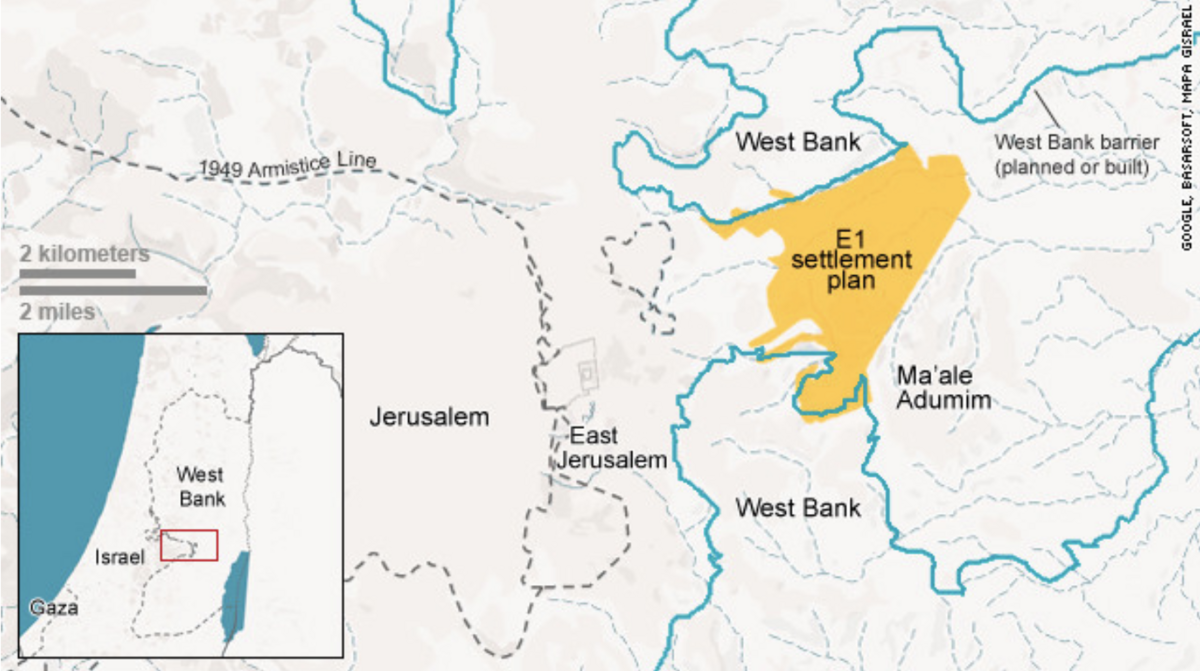







The Israeli occupation authorities have decided to resume advancing the settlement plan in the E1 area east of Jerusalem, which would separate the northern West Bank from the south, for the first time since 2021, according to a report published by Haaretz newspaper on Monday.
The report stated that the so-called Supreme Planning Council of the Civil Administration—which is subordinate to the Israeli Ministry of Defense—will review objections submitted against the project on August 6, in a session that will conclude the formal objections phase.
A number of Palestinians living in the area, along with Peace Now, Ir Amim, and the Association for Environmental Justice, have filed formal objections to the plan. These groups argue that the project's implementation will harm the only remaining area of land located in the central Palestinian urban area between Ramallah, Jerusalem, and Bethlehem, which is home to approximately one million Palestinians.
She noted that the project has "potential implications for any future settlement," as it "creates a settlement continuum from the central West Bank to Jerusalem."
The plans in the E1 area include the construction of 3,412 new settlement units, distributed across two separate programs. These projects had been slowly advanced over the years due to international pressure, particularly from the United States, over concerns that they would undermine the prospects for establishing a future Palestinian state.
The E1 area covers an area of 12 square kilometers and is part of the municipal jurisdiction of the Ma'ale Adumim settlement, located to the north and west of it. Although the plans were proposed during the Rabin government, they have been frozen since 2005 for political reasons.
Last March, the Israeli cabinet approved the paving of a road designated for Palestinians south of the E1 area, with the aim of implementing construction plans and paving the way for the future annexation of the Ma'ale Adumim settlement.
The new road will connect Palestinian villages in the northern West Bank with those in the southern West Bank, diverting Palestinian traffic away from Route 1, allowing it to be used almost exclusively by settlers and Jews between Jerusalem and Ma'ale Adumim.
For its part, Peace Now filed an official objection to the bill, stating in a statement that "the Netanyahu-Smotrich government is exploiting the war on Gaza, the fragile domestic situation in Israel, and the confused international position to impose facts on the ground that undermine the chances of achieving peace and a two-state solution."
She added, "This government is pushing us toward continued conflict and bloodshed, and is leading Israel toward the abyss. Implementing this project would be a historic catastrophe and would make the possibility of achieving a peaceful future more difficult than ever."
שתף את דעתך
The occupation resumes advancing the E1 settlement plan to separate the West Bank and expand settlements.