






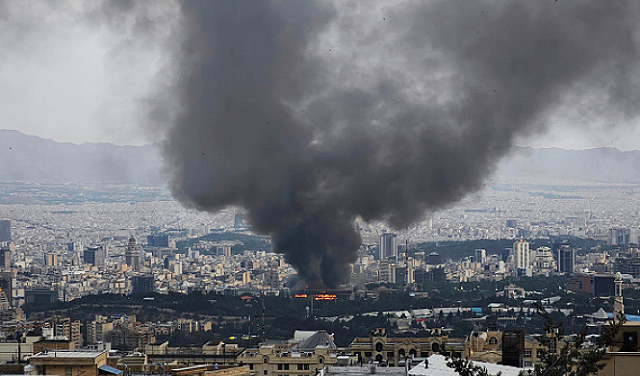
Five consecutive missile salvos were launched from Iran toward all parts of Israel on Monday, with debris and rocket fragments landing in several areas. One of the rockets struck a site near a strategic electricity company facility in the south of the country, causing power outages in several towns.
Israeli reports indicated that seven rockets were fired in the four rocket salvos, including two toward the north, a third toward the Tel Aviv and Jerusalem areas, and a fourth toward the south of the country.
Iran threatened Washington this morning, Monday, with a "decisive response to its crimes" targeting nuclear facilities in Fordow, Isfahan, and Natanz, while indicating that it would not stop uranium enrichment.
The Israeli war on Iran continues for the 11th day, with the United States directly entering the confrontation line after launching airstrikes targeting Iranian nuclear facilities in Fordow, Natanz, and Isfahan.
The Atomic Energy Organization of Iran considered these attacks a "flagrant violation of the Nuclear Non-Proliferation Treaty," but Tehran downplayed the impact of the strikes on its nuclear capabilities, asserting that its program remains active.
In contrast, Israeli Prime Minister Benjamin Netanyahu said that the military operation against Iran was "close to achieving its objectives," referring to the elimination of what he described as "the threat of the nuclear program and ballistic missiles." He added that military operations would continue until "all of the specified objectives" were achieved.
US President Donald Trump declared that the US strikes "deprived Tehran of the atomic bomb," but at the same time expressed a willingness to enter into negotiations with Iran.
For his part, Iranian President Masoud Pezeshkian stressed that "a response is inevitable" to the US attack, while a member of the Iranian parliament's National Security Committee announced that the Revolutionary Guards are prepared to close the Strait of Hormuz if necessary.
This threat prompted US Vice President J.D. Vance to warn that any disruption of shipping in the strait "would be tantamount to suicide for Iran."
Despite the damage to the nuclear facilities, American and Israeli officials confirmed that the Fordow facility was not completely destroyed, but it sustained extensive damage.
On the diplomatic front, regional and international efforts are accelerating in an attempt to contain the escalation and prevent a slide into all-out war.
Several countries in the region, including Saudi Arabia, have engaged in intensive contacts with international and regional powers to urge all parties to exercise restraint. Western powers have also been mobilized to pressure Tehran not to launch a broad response to the US strikes.
In this context, the UN Security Council held an emergency session on Sunday to discuss the latest developments, amid sharp divisions among its members. Russia, China, and Pakistan proposed adopting a resolution calling for an immediate and unconditional ceasefire in the Middle East.
With international warnings escalating of a spiral of mutual retaliation that could ignite the region, a state of cautious anticipation prevails regarding the dramatic developments that the coming hours and days may bring.
שתף את דעתך
Missiles fired from Iran towards parts of Israel, power outages reported in several towns.