






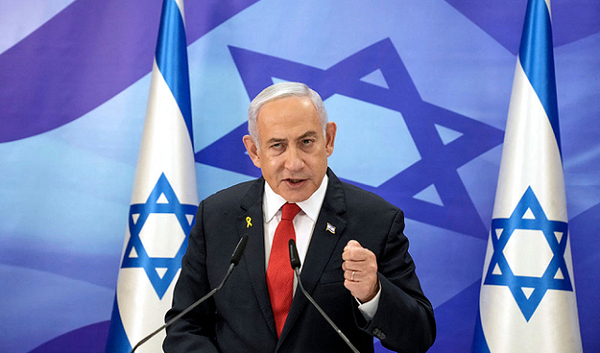
"We will see a different Middle East than we have ever seen before." This statement was perhaps the most significant in a series of statements made by Israeli Prime Minister Benjamin Netanyahu two days ago, amid Israel's aggression against Iran since June 13.
This statement came in the context of his boasting about Israel's handling of what he described as a devastating blow to Iran's military leadership and nuclear scientists, and his pledge to continue destroying Iran's missile production facilities and thwarting its nuclear program.
Threatening a country with which you are at war may be common and expected, but what's striking recently is that Netanyahu's statements have repeatedly included the term "Middle East" and talk of changing it, particularly when he discusses his multiple wars, whether against the resistance in the Palestinian Gaza Strip, against Hezbollah in Lebanon, or against Iran.
If we follow Netanyahu's statements over the past few months, we find the following:
On September 30, 2024, in parallel with a military campaign against Hezbollah, Netanyahu said:
"Israel is pursuing a systematic plan to assassinate Hezbollah leaders with the aim of changing the strategic reality in the Middle East."
"Challenging days lie ahead. We have crushed Hamas in Gaza, and we will fight anyone who threatens our interests."
On October 31, 2024, in the midst of his war on Gaza and Lebanon, Netanyahu said:
"Israel is currently changing the face of the Middle East, but we are still in the eye of the storm and face major challenges, and I do not underestimate our enemies at all."
On January 6, 2025, Netanyahu said in statements reported by Maariv newspaper:
"We are at a time of fundamental change in the Middle East."
On February 2, 2025, before leaving for Washington to meet with the US President, Netanyahu said:
"I will discuss strategic issues with him. Cooperation with the Trump administration will enable Israel to strengthen its relations with countries in the region, transform the Middle East, enhance Israel's security, and achieve prosperity through strength."
On May 7, 2025, coinciding with an Israeli bombing of Sana'a airport in Yemen, Netanyahu said:
"I do not underestimate the challenges ahead. I have full confidence in the will of our people and our fighters to achieve the mission of victory."
"This mission is not just about defeating Hamas, but about releasing the kidnapped soldiers and changing the face of the Middle East."
"This is not an easy task, but it is achievable."
While the repeated phrase "changing the Middle East" is unmistakable to observers, the more important question is: What does Netanyahu mean by this? Will it generate counter-reactions from countries in the region?
Is this serious?
Some may initially wonder whether these statements are truly serious and dangerous, or whether they are merely mere statements. The truth is that what makes the first option more likely is that it was repeated by one of Israel's most powerful leaders in its history, dating back to 1948, when the Zionist gangs declared the establishment of a state on the land of Palestine.
What makes the matter even more serious is that these are not just repeated statements, but rather talk of a future that was paved over in the past and continues at an ever-more rapid pace in the present, as evidenced by the many instances around us in Palestine, Lebanon, and other Arab and Muslim countries.
What are the axes of change?
Perhaps we can summarize the axes of change that Israel, under Netanyahu's leadership, seeks in the Middle East in the following points:
Eliminating the idea of resistance and its movements.
Ensuring Israel's military superiority in the region, particularly in the military aspect, by relying on its Western allies, led by the United States, as well as in the economic and scientific fields.
This is linked to an attempt to impose and strengthen a state of strategic deterrence on the countries of the region, preventing them from even thinking about attacking Israel or even showing hostility towards it.
To contain or eliminate the major powers in the region that are currently hostile to Israel or may consider doing so in the future.
Eliminating Iran's nuclear program, as it is the only country in the region pursuing this course in a manner that raises concerns for Israel and its Western allies, led by the United States.
Spreading the culture of normalization by focusing on normalizing Israel's relations with key countries in the region, thus opening the door wide for other Arab and Islamic countries to follow the same path that has eluded Israel for decades.
All of the above leads us to one of the greatest sources of danger: the pursuit of regional hegemony and the attempt to change its stable borders, paving the way for the dream of Greater Israel, which Israel has never abandoned.
Reactions
On the other hand, statements issued by some countries in the region in recent days have focused on condemning the Israeli attacks on Iran, noting the threat they pose to regional security.
The most prominent Arab and Islamic positions on this matter were as follows:
Gulf Cooperation Council:
He condemned the Israeli aggression, considering it a clear violation of international law, according to a statement made between Iranian Foreign Minister Abbas Araqchi and GCC Secretary-General Jassim Al-Budaiwi, who affirmed the GCC states' rejection of the use of force and emphasized the need for dialogue to resolve disputes.
Qatar: It affirmed its strong condemnation and denunciation of the Israeli attack on Iran, considering it a flagrant violation of Iran's sovereignty and security, and a clear breach of the rules and principles of international law. It emphasized that the Israeli attack, which represents a dangerous escalation and a systematic policy of aggression, poses a serious threat to the stability of the region.
Doha also stressed that regional security cannot tolerate further crises and escalation.
Prime Minister and Minister of Foreign Affairs Mohammed bin Abdulrahman Al Thani expressed his country's deep concern over this dangerous escalation during calls with the foreign ministers of Saudi Arabia, Egypt, Oman, and Jordan, stressing that Qatar will work with its regional and international partners to halt the aggression against Iran and avoid its disastrous repercussions.
Turkey: President Recep Tayyip Erdoğan asserted that Israeli Prime Minister Netanyahu has once again demonstrated that he is the greatest threat to regional security, adding that Israel possesses nuclear weapons and does not recognize any international rules. The Turkish president emphasized that Israeli attacks cannot be allowed to overshadow the humanitarian crisis and genocide in the Gaza Strip, nor can these developments be allowed to spread to Syria.
Saudi Arabia: Condemned the Israeli aggression against Iran, and Crown Prince Mohammed bin Salman—in a call with Iranian President Masoud Pezeshkian—emphasized Riyadh's rejection of the use of force to resolve disputes and the need to adopt dialogue as the basis for resolving crises.
Foreign Minister Faisal bin Farhan, in a call with his Iranian counterpart, also condemned the "blatant Israeli aggression," which could disrupt de-escalation efforts, stressing the need to reach diplomatic solutions.
Egypt: Through its Foreign Minister, Badr Abdel Aty, it emphasized its rejection and condemnation of the violation of state sovereignty, warning of the "danger of the region sliding into total chaos."
Pakistan: Prime Minister Shehbaz Sharif declared full solidarity with Iran against the unjustified Israeli aggression in a phone call with the Iranian president.
Sharif also discussed with the Turkish President the dangerous regional situation following the unjustified Israeli aggression.
For his part, Pakistani Defense Minister Khawaja Muhammad Asif called on the Islamic world to unite against Israel over its attacks on Iran.
Condemnations were not limited to the aforementioned countries, nor were they limited to official bodies. However, the most recent and perhaps most provocative reaction came in a tweet from former Egyptian Foreign Minister Amr Moussa, who called for an urgent meeting of the Egyptian National Security Council, on the grounds that "the ongoing war between Israel and Iran and the signs of direct intervention by major powers, or some of them, pose serious threats to regional security in the Middle East, affecting its countries and societies."
Moussa, who also previously served as Secretary-General of the Arab League, spoke frankly, stressing that "Egypt and the Egyptian people are not far from this."
שתף את דעתך
Netanyahu: War with Iran and an eye on the entire Middle East