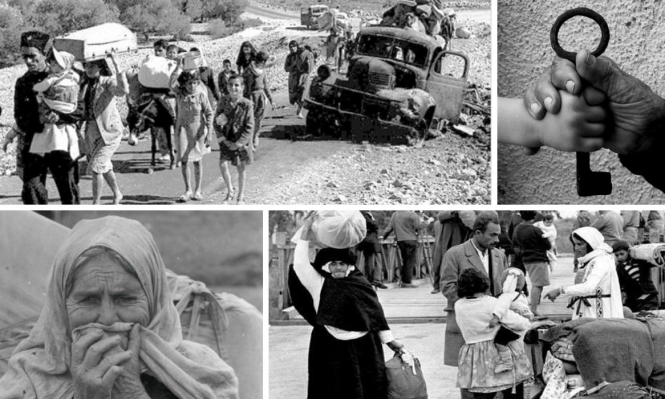







The Central Bureau of Statistics said that the number of Palestinian refugees registered with the United Nations Relief and Works Agency for Palestine Refugees (UNRWA) as of August 2023 is approximately 5.9 million.
The Central Bureau of Statistics (CBS) stated in a statement issued Wednesday on the occasion of World Refugee Day that there are approximately 2.5 million refugees in the West Bank and Gaza Strip, constituting approximately 42% of the total Palestinian refugees (15% in the West Bank compared to 27% in the Gaza Strip). At the level of Arab countries, the percentage of refugees registered with the Relief and Works Agency (UNRWA) in Jordan reached approximately 40% of the total refugees, while this percentage in Lebanon and Syria reached approximately 8% and 10%, respectively.
He pointed out that these estimates represent the minimum number of refugees, given the presence of unregistered refugees. This number does not include Palestinians who were displaced from 1949 until the eve of the June 1967 war (according to UNRWA's definition), nor does it include Palestinians who left or were deported in 1967 as a result of the war, who were not refugees to begin with.
The statistics indicated that the number of Palestinian and Arab martyrs since the Nakba in 1948 until today (inside and outside Palestine) has exceeded 156,000.
Based on population estimates prepared by the Palestinian Central Bureau of Statistics (PCBS), there are 15.2 million Palestinians worldwide by mid-2025, half of whom live outside of historic Palestine. Their number has reached approximately 7.4 million Palestinians in historic Palestine. Estimates also indicate that the number of Palestinians in the diaspora has reached approximately 7.8 million, including 6.5 million in Arab countries.
About 66% of the total population in the Gaza Strip are refugees.
The percentage of refugees in the State of Palestine amounted to approximately 42.2% of the total Palestinian resident population in 2017. 26.3% of the population in the West Bank were refugees, while the percentage of refugees in the Gaza Strip amounted to 66.1%.
Nearly two million Palestinians have been displaced from their homes within the Gaza Strip.
The statistics office continued, noting that Gaza residents have been repeatedly forced to flee their homes since the start of the aggression on October 7, 2023, under duress. They have lost their homes and become homeless in tents and schools, trapped between the walls of poverty and war. Nearly two million citizens have been displaced from their homes, out of a total of approximately 2.2 million who lived in the Strip on the eve of the occupation's aggression.
Approximately 55,000 citizens were martyred, including more than 18,000 children and more than 12,000 women, in addition to more than 219 journalists. More than 11,000 citizens are still missing, most of them women and children.
Estimates revealed that 39,384 children in the Gaza Strip lost one or both parents after 618 days of Israeli aggression, including approximately 17,000 children who were deprived of both parents, leaving them facing a harsh life without support or care.
In the West Bank, similar to the 1948 Nakba and the 1967 Naksa, thousands of citizens were forcibly displaced as a result of the aggression on the northern camps (Jenin, Tulkarm, and Tubas), in the largest displacement operations the West Bank has not witnessed in eight decades.
Since the beginning of the aggression on the Gaza Strip, at least 991 citizens have been martyred in the West Bank, amid the occupation's escalation of its aggression and ongoing violations against civilians.
According to data from the United Nations Relief and Works Agency for Palestine Refugees (UNRWA), more than 42,000 citizens have been displaced from camps in the northern West Bank, amid ongoing forced displacement and home demolitions, in light of ongoing arrest campaigns. The number of displaced persons from Jenin camp and its surroundings has risen to 21,000 people, representing 30% of the population of Jenin city and camp. Meanwhile, most of the residents of Tulkarm and Nur Shams camps, whose population, according to the agency's estimates, is approximately 19,000 refugees, have been displaced by mid-2025.
Ethnic cleansing, population replacement, and land control
The census noted that the population of historic Palestine in 1914 was approximately 690,000 people, of whom Jews constituted only 8%. In 1948, the population reached more than two million, of whom approximately 31.5% were Jews. Between 1932 and 1939, the largest number of Jewish immigrants, 225,000, flowed into Palestine. Between 1940 and 1947, more than 93,000 Jews flowed into Palestine. Thus, between 1932 and 1947, Palestine received approximately 318,000 Jews, and from 1948 until 2023, more than 3.3 million Jews flowed into Palestine.
He continued: Despite the displacement of approximately one million Palestinians in 1948 and more than 200,000 Palestinians after the June 1967 war, the estimated population of the State of Palestine reached approximately 5.5 million Palestinians in mid-2025 (3.4 million in the West Bank, 2.1 million in the Gaza Strip, a 10% decrease from the population estimates for the Gaza Strip for 2025).
שתף את דעתך
Statistics: 5.9 million Palestinian refugees registered with UNRWA