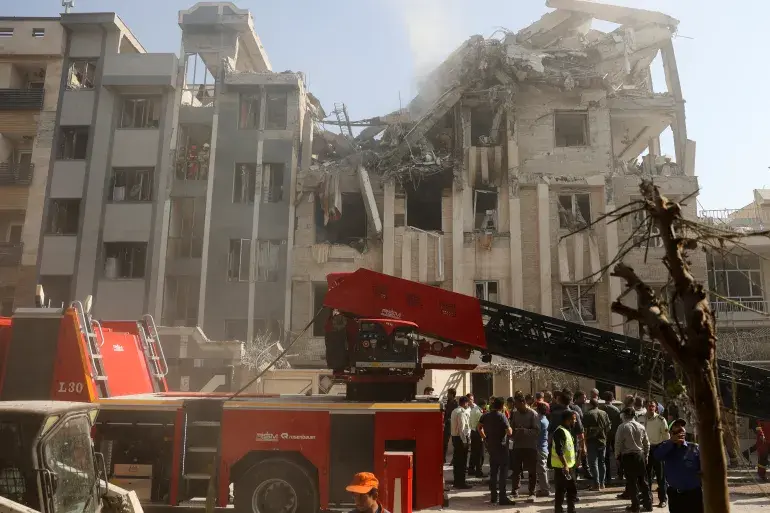







Haaretz newspaper confirmed on Friday that senior Israeli security sources revealed that the Israeli intelligence agency, Mossad, had established a military base inside Iran prior to the airstrikes carried out early Friday morning, where explosive drones smuggled into Iran long ago were stored. These drones were used in attacks on Iranian military and nuclear facilities.
The sources added that Mossad had worked for years alongside the Israeli military to gather accurate intelligence in preparation for this massive strike, which they described as "destructive." They noted that the attack was launched with the activation of internal systems already in place within Iran.
The sources said that Mossad commando teams operated in central Iran, deploying operational systems for precision-guided weapons in open areas, close to Iranian surface-to-air missile systems, with the aim of completely neutralizing them before the arrival of warplanes.
long-term planning
Haaretz quoted the sources as confirming that vehicles inside Iran were equipped with advanced offensive systems and technologies, which were used to dismantle Iran's air defense capabilities, enabling Israeli aircraft to carry out their mission without effective resistance.
The report indicated that this operation was not a spur-of-the-moment operation, but rather the result of long-term planning and years of intelligence gathering, including detailed dossiers on prominent figures in the Iranian defense establishment, nuclear scientists, and Tehran's strategic missile infrastructure.
Israeli warplanes launched extensive attacks on Iran at dawn on Friday, hitting numerous sites in the capital, Tehran, and other cities, including Natanz and Tabriz.
Israeli military spokesman Avi Dvrin announced that the military strikes hit more than 100 targets in Iran overnight, adding that 200 fighter jets participated in the attack.
Targeting leaders and headquarters
Among the most prominent targets targeted were the headquarters of the Iranian Revolutionary Guard Corps (IRGC) in Tehran, where the commander-in-chief of the IRGC, Major General Hossein Salami, was killed, and military bases around Tehran, including IRGC bases.
This is in addition to the Shahrak Shahid Mahallati complex, located in northeastern Tehran, a fortified residential complex housing senior Revolutionary Guard commanders.
The headquarters of the General Command of the Armed Forces, "Khatim al-Anbiya", was also targeted.
Iranian Supreme Leader Ali Khamenei and Iranian media announced the deaths of a number of military commanders and scholars in the attack. Khamenei confirmed that "their successors and colleagues will immediately resume their duties."
Among the most prominent of those killed in the Israeli attack were, in addition to Revolutionary Guards Commander-in-Chief Hossein Salami, the Chief of Staff of the Iranian Armed Forces, Major General Mohammad Bagheri. They also included the commander of the Khatam al-Anbia military headquarters, which is part of the General Staff, Major General Gholam Ali Rashid; Ahmad Reza Zolfaghari, a professor of nuclear engineering; and nuclear experts Fereydoun Abbasi-Davani and Mohammad Mehdi Tehranchi.
Meanwhile, Iran's Tasnim News Agency reported that the Israeli attacks killed six Iranian nuclear scientists.
Meanwhile, Iranian media reported that Abdolrahim Mousavi was appointed Chief of Staff of the Iranian Armed Forces by order of the Supreme Leader. Major General Mohammad Pakpour was also appointed Commander of the Iranian Revolutionary Guard.
Source: Haaretz + agencies
שתף את דעתך
Haaretz: Mossad activated explosive drones previously stored inside Iran