






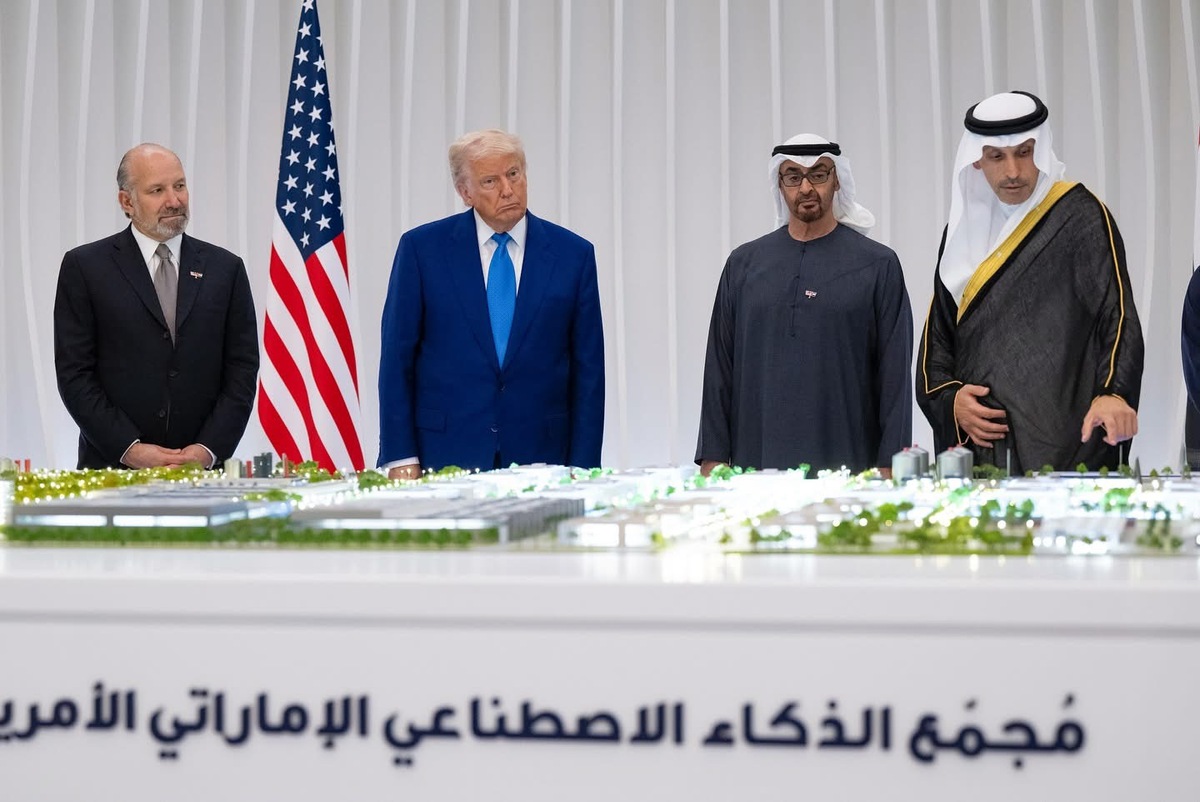
The Economist magazine published an analytical article on Thursday, May 29, 2025, indicating that the losers in the new Middle East are Egypt, Iraq, and the Palestinians. It cited that eight years ago, Egyptian President Abdel Fattah el-Sisi was “the center of attention, as US President Donald Trump warmly welcomed the Egyptian president to the White House in April 2017 (at the beginning of Trump’s first administration). A few weeks later, when Mr. Trump visited Riyadh, the Saudis invited Mr. Sisi to join them, where the former general, who seized power in a 2013 coup, took pride of place alongside the US president and the Saudi king at the opening ceremony of a counterterrorism center.”
However, according to the article, no one bothered to invite the Egyptian president when President Trump returned to Riyadh in mid-May, “as Gulf rulers were eager to talk to the American president about their vision for the Middle East, and Mr. Sisi was not among those plans. Instead, he traveled to Baghdad for an unorganized Arab League summit, where he was one of only five heads of state to attend (most of the 22 Arab leaders sent only ministers).”
The authors conclude that this is a turning point in the Middle East, with Iran weak, while the new governments in Syria and Lebanon seek to maintain this status quo. The Gulf states are keen to achieve rapprochement with both Iran and Turkey, their regional rivals, while Trump speaks with hope of a "bright new day" and a Middle East focused on trade rather than conflict.
According to the article, "The region is a difficult place for optimists: This moment may not last. Whether it does or not, it demonstrates how the Middle East has already changed. The Gulf states, wealthy and seemingly stable, are at the center of events, while some once-influential countries are mere spectators."
"Egypt tops this list, and Mr. Sisi bears responsibility for it. He has destroyed the Egyptian economy, accumulating unsustainable public debt (about 90% of GDP) to finance vanity projects, while refusing common-sense reforms that might boost the stagnant private sector."
"This has made Egypt dependent on bailouts. It has received at least $45 billion in aid from Gulf states since 2013, according to data from the International Institute for Strategic Studies, a think tank. It is also the third-largest debtor to the International Monetary Fund. But now it has competition. Lebanon will need at least $7 billion to rebuild after last year's war with Israel, and Syria will need many times that."
At least for now, both countries appear to be better investments than Egypt. Their governments are promising serious economic and political reforms. The Syrian interim government wants to privatize state-owned enterprises and attract foreign investors. Lebanese President Joseph Aoun wants to disarm Hezbollah, which is backed by Iran. Aid to those countries could help them achieve those goals; "aid to Egypt, however, merely buys time until its next financial crisis," the newspaper reported.
Iraq, too, finds itself marginalized. Iran has lost its closest ally (the Assad regime in Syria) and its most powerful proxy militia (Hezbollah). This makes it desperate to maintain its influence in Iraq, where it supports a range of armed groups. Some Gulf officials describe Iraq as a lost cause: the militias are too powerful and intertwined with the state to uproot. Ahmad al-Sharaa, the new Syrian president, was even unable to attend the Arab League summit in Baghdad due to threats from pro-Iranian militias, according to the magazine.
As for the new Syrian president, Ahmed al-Sharaa (who was known as Abu Mohammed al-Julani—the leader of the US-designated terrorist group Jabhat al-Nusra)—he traveled instead to Riyadh, where he met with President Trump and secured a promise that the US would lift its sanctions on Syria (which have now begun to be implemented). The Saudis are keen to support al-Sharaa in part because a strong Syria would serve as a bulwark against Iranian influence.
According to the article: “A Saudi official says, referring to a period when the Assad regime was a rival to Saddam Hussein’s dictatorship in Iraq: ‘Syria was helping to balance Iraq.’ Perhaps it could play that role again,” this time with Iran.
Regarding the Palestinians, the magazine says: “The stateless Palestinians have been at the center of Arab affairs since 1948. But there is reason to believe that they, too, are losing their centrality. Mahmoud Abbas, the eternal Palestinian president, has done nothing to cleanse his corrupt administration in the occupied West Bank. Hamas offers a darker example in Gaza: it allowed Israel to destroy the territory rather than cede power.”
She adds: "Arab leaders still feign loyalty to the Palestinian cause. But in reality, they are trying to reduce its influence. Lebanese President Aoun wants to disarm Palestinian militias in Lebanon's refugee camps (and some Hezbollah members have expressed their approval). The new Syrian government has pledged to do the same. There is serious talk in both countries of peace with Israel: not full normalization, but at least an end to decades of conflict."
The article notes that "all this represents a remarkable shift. A year ago, Lebanon and Syria also seemed like lost causes. Lebanon was controlled by Hezbollah and at war with Israel; its economy was still suffering from a financial crisis that had caused its GDP to contract by 40%. Syria was a narco-state still in the grip of a seemingly unified Assad regime. Now, the Gulf states and America see it as the heart of a more prosperous Middle East. To maintain this status, its governments will have to deliver tangible results."
The article concludes, "After all, many of Sisi's Arab allies had high hopes for him a decade ago as well. But those hopes were dashed. For decades, the Middle East has been divided along ideological lines. Perhaps now the division is between governments capable of fulfilling their promises and those that are incapable."
שתף את דעתך
Losers in the New Middle East: How the Table Turned on the Powerful Ones of the Past