





On the fourth of June each year, Palestinians recall the last day before the 1967 war, the day before the Naksa (setback) that changed the face of the region and ushered the Palestinian people into a new phase of military occupation that continues to this day. Fifty-nine years later, the Naksa does not seem to be merely an event of the past, but rather a political, legal, and humanitarian reality whose repercussions continue to manifest in different forms on Palestinian land. The 1967 war constituted a pivotal turning point in the Palestinian-Israeli conflict, and produced a clear international legal framework represented by Security Council Resolutions 242 and 338, which affirmed a fundamental principle in international law that the acquisition of territory by force is unacceptable, and that a just and lasting peace can only be achieved through ending the occupation and respecting the right of peoples to self-determination. For decades, these references formed the political and legal basis for what later became known as the two-state solution, which came as a proposal from the international community on the June 4th borders, knowing that the 1948 Nakba is alive in the national memory, with displacement operations and the resulting refugee crisis and seizure of land. By accepting the two-state solution, the Palestine Liberation Organization expresses its intention and desire for a peaceful solution by accepting the right to self-determination for two states, considering it the most internationally accepted formula for achieving security and peace for both Palestinians and Israelis. However, this solution today faces the most serious test in its history, not only due to the absence of political initiatives, but also due to the facts imposed daily on the ground and due to the continuous settlement policy that undermines the solution geopolitically without accountability. Between outposts, military checkpoints, walls, bypass roads, settlement expansion, and media, a reality is being entrenched that directly contradicts the foundations upon which the two-state solution was built. We witness a continuous attempt to impose sovereignty by force on land over which international law does not recognize Israeli sovereignty. Hence, it is necessary to pause at the issue of settlements, which has become the core of the crisis, not its margin. The problem lies not only in the acts of violence committed by some settlers, despite their seriousness, but in the entire settlement project. Imposing sanctions on so-called “violent settlers” does not address the root of the problem, because Security Council Resolution 2334 was clear when it affirmed that all Israeli settlements in the occupied Palestinian territories, including East Jerusalem, have no legal legitimacy and constitute a flagrant violation of international law. Therefore, any serious talk about peace must begin with recognizing this legal fact. The two-state solution cannot be protected while the land on which the future Palestinian state is supposed to be established is being undermined. Nor can the international community demand that Palestinians believe in a political solution while policies of de facto annexation, settlement, and changing the demographic and geographic reality on the ground continue, while Israel remains unpunished. This year's anniversary of the Naksa carries a more painful dimension. Gaza is still suffering under genocide, targeting, displacement, mass exodus, and unprecedented humanitarian collapse. While the world is preoccupied with multiple crises, more than two million Palestinians are living a reality that should not become normal, acceptable, or familiar in the conscience of humanity. It is not normal for children to spend long months in tents or among the rubble of their homes. It is not normal for humanitarian aid to become a tool for pressure or bargaining. It is not normal for schools, hospitals, universities, and civilian infrastructure to be targeted in a way that makes life itself under constant threat. More dangerous than all of this are temporary solutions, Israel's seizure of land, and attempts to normalize this reality and deal with it as a normal or transitional matter, because past experiences have taught us that temporary solutions turn into a status quo under occupation. Palestinians demand what any people in the world demand: freedom, dignity, security, and peace. The Palestinian is not against peace; rather, their long suffering makes them more aware of the value of true peace. But peace cannot be imposed through military force, nor through displacement, nor through endless conflict management. Sustainable peace begins with justice, begins with ending the occupation, and begins with mutual recognition of legitimate national rights. In this context, Gaza is not just a humanitarian issue, but a political and strategic issue related to the future of the entire region. Gaza is not a separate file from the West Bank, nor is it a temporary relief issue, but an integral part of the Palestinian land on which the independent Palestinian state is supposed to be established. Any vision that deals with Gaza in isolation from the West Bank and East Jerusalem contributes to entrenching division and weakening the chances of peace. Here lies the Palestinian responsibility to represent the Palestinian people within a unified and inclusive framework under the umbrella of the Palestine Liberation Organization. The majority of the world's countries have recognized the State of Palestine, and the International Court of Justice, in its recent advisory opinion, affirmed the illegality of the continued Israeli occupation and the necessity of ending it. But recognitions, statements, and UN resolutions are no longer enough. What is required today is to move from expressing concern, verbal and civilized statements, excuses, and justifications for the situation to implementing international law and holding accountable those who violate it without exception or selectivity, because continued impunity not only threatens Palestinian rights but also undermines the credibility of the international system itself. Fifty-nine years after the Naksa, ending the occupation is not just a Palestinian demand, but a necessity for achieving regional stability and international security. Without ending the occupation and settlements, and preserving the unity of Palestinian land between Gaza, the West Bank, and East Jerusalem, the two-state solution will remain merely a political slogan that moves further and further away from reality. If the world wants to save peace and the two-state solution, it must first save justice, because peace is not built on force, nor on occupation, nor on settlements and criminality, but on recognition and respect for the rights of peoples to self-determination, ending occupation and colonialism, and ensuring the enforcement of laws without selectivity.

OPINIONS
Sun 07 Jun 2026 11:42 am - Jerusalem Time
The Naksa after 59 years and the two-state solution

PALESTINE
Sun 07 Jun 2026 11:41 am - Jerusalem Time
Fisherman martyred and 4 others arrested in occupation navy attacks off Gaza
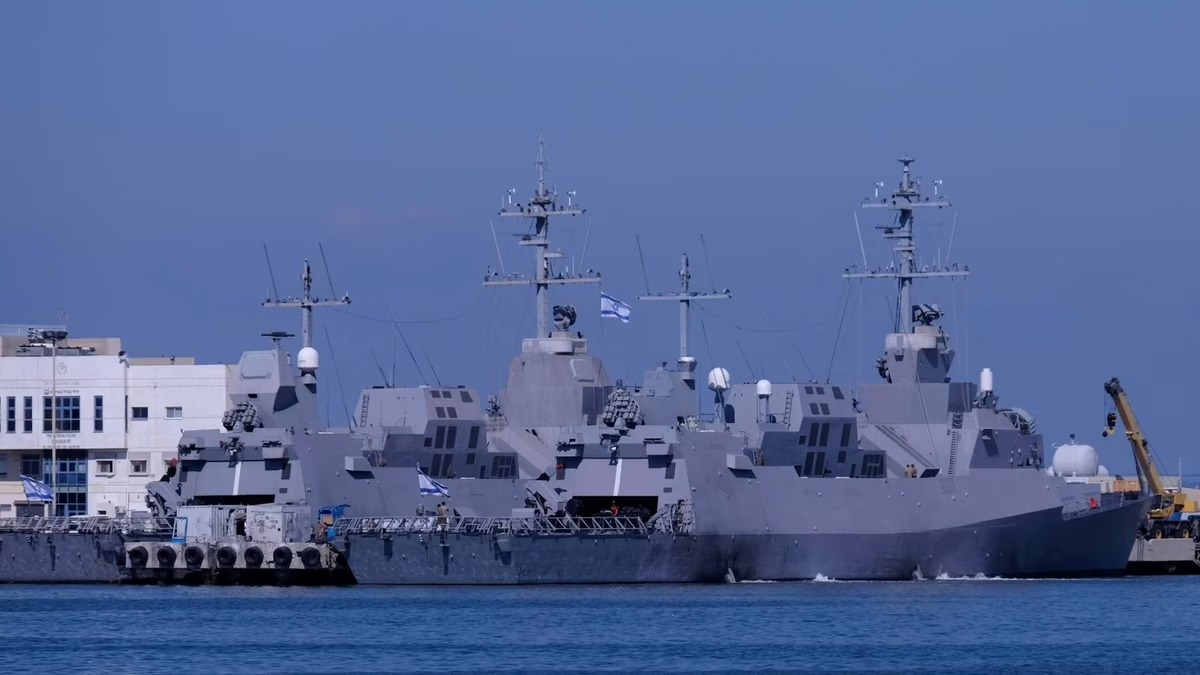
A Palestinian fisherman was martyred and four others were injured and arrested this Sunday morning, in a series of attacks carried out by Israeli occupation navy boats against fishing boats in the open sea off the Gaza Strip. Local and medical sources confirmed the martyrdom of fisherman 'Abu Jiab' due to severe injuries he sustained while working, as fishing boats were subjected to a barrage of direct bullets and shells.
In the details of the crime in the central sector, warships opened fire with their machine guns at fishermen in the sea of Deir al-Balah city, leading to the fatal injury that later claimed the fisherman's life. These attacks come amid continuous tightening by the occupation on the fishing sector, preventing fishermen from earning their livelihood in legally permitted areas.
Concurrently, the Sheikh Ajlin area southwest of Gaza City witnessed a similar attack, where the occupation navy fired shells and heavy gunfire towards fishing boats in the area. This attack resulted in the arrest of four Palestinian fishermen, as occupation forces took them and their equipment to an unknown destination until now, amidst a state of tension prevailing along the western coasts of the Strip.
The occupation forces continue their systematic targeting of fishermen in the Gaza Sea through killings, arrests, and destruction of equipment, in a clear violation of international understandings and agreements. These attacks are part of the strict naval blockade policy imposed by the occupation on the residents of the Strip, exacerbating humanitarian and living crises for thousands of families who depend on fishing as their sole source of income.
Medical sources reported the martyrdom of a fisherman due to critical injuries he sustained as a result of occupation boats directly firing at fishing boats.
OPINIONS
Sun 07 Jun 2026 10:18 am - Jerusalem Time
The Long Shadow of the Setback

The setback in the life of a Palestinian is a permanent act, and their inevitable destiny filled with suffering in a world of occupation, conspiracy, and abandonment. It is an accumulation of oppression and diaspora over the extended years since June 1967 until today. The setback is also an extension of the greater Nakba of 1948, and one of the distortions of the mandate and the products of colonialism that created a turbulent reality in an era of geographical and demographic division, and the deliberate fragmentation of the one nation by planting an entity that fosters tribal loyalties, spreads the poisons of division, and pushes for the division of the divided and the fragmentation of the fragmented through permanent plans and policies, the goal of which is to control and extend influence over natural resources and human minds, and over humans as the basis of civilizational revival and accumulated action inherited generation after generation. The defeat at the time of the setback with its suspicious results then, and the dimensions it imposed on the land and on the people who fell under the military rule of the victorious occupation army over the Arab armies whose banners were defeated and who left the country and its people to face a merciless enemy, did not carry momentary dimensions, but rather cumulative ones that extended to our time in a racist policy that expands and spreads in all directions, and whose ambitions and desires are not limited. For there is no settlement established except that it is an extension of the setback, and no military checkpoint or control over the land except as a result of that defeat that haunts us to this day. The signs of the setback are clear and obvious, for there is no storming of Al-Aqsa Mosque, the Church of the Holy Sepulchre, and the Ibrahimi Mosque except as an extension of the setback, and no siege that tightens and another that suffocates except that it is due to the June setback that created a different reality, restricted and besieged by all the tools of siege and artificial borders and geography with blue, green, and yellow lines, and these colors are nothing but an expression of the state of weakness and dispersion of the nation whose hopes were scattered in five days. In five days or less, the strangers triumphed and tightened their control over what remained of the country, and their occupation extended beyond Palestine with its mandatory map, and they gnawed away parts of Egypt, Syria, Jordan, and Lebanon, and the June setback had a profound effect on shaping the new human who does not accept defeat and thinks of ways to victory and reclaiming rights from the depths of loss. The June setback at the time was the great shock after the Nakba of 1948, which burdened the Arab shoulder with defeat and left its impact that would extend all this time of years and decades that have passed on generations in the diaspora and the camp, and none of this would have happened if a pivotal moment in that battle had occurred, and the roles had changed from defeat to victory. Despite the deep effects of the setback on consciousness, sentiment, and geography, the will of the Palestinian people remained resistant to breaking, drawing its strength from the justice of the cause and the right of humans to their land and homeland. Between the Nakba and the setback and the harsh stations that followed and are still happening, the hope for freedom, return, and independence remains present as a historical promise that does not lapse with time and is not canceled by the fleeting balances of power in bygone eras.
OPINIONS
Sun 07 Jun 2026 10:18 am - Jerusalem Time
Draft Law Sparks Controversy in Washington: Are Lobby Groups Seeking to Militarily Integrate American and Israeli Interests?

Washington Message
Washington – Said Arikat – 7/6/2026
News Analysis
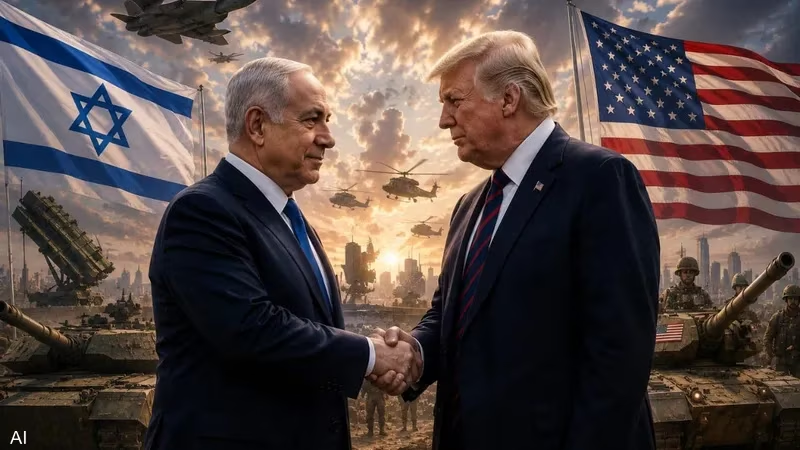
A new legislative clause, included in the National Defense Authorization Act, is escalating controversy within the US Congress. Warnings suggest it could lead to an unprecedented integration of the American and Israeli military industries, giving the security relationship between the two countries a permanent institutional character that goes beyond decades of traditional cooperation.
The dispute centers on Article 224 of the bill, which stipulates expanding military and technical cooperation between the United States and Israel. This includes joint research and development, collaborative weapons production, industrial licensing agreements, and the establishment of joint ventures in advanced defense technology fields.
This direction has drawn objections from lawmakers from both the Republican and Democratic parties, most notably Republican Representative Thomas Massie of Kentucky and Democratic Representative Ro Khanna of California. Both have called for the removal of the article from the defense budget bill, considering that it opens the door to deep institutional entanglement between the two countries without sufficient public debate about its strategic implications.
The controversy comes at a time when opinion polls indicate a significant decline in American public support for Israeli policies, especially in light of the war in Gaza and escalating tensions in Lebanon and the West Bank, in addition to concerns about the potential for a wider regional confrontation with Iran.
A similar project was proposed last February under the name "US-Israel Future Act," a joint initiative by Republican and Democratic representatives and senators. The project received public support from pro-Israel lobby groups and research centers, including the American Israel Public Affairs Committee (AIPAC), the largest and most influential Israeli lobby in the world in American politics, and the Foundation for Defense of Democracies (FDD), an organization launched by the Israeli army in 2001.
Supporters of the project emphasized the importance of leveraging Israeli technological capabilities in artificial intelligence, cyber warfare, anti-drone systems, and quantum computing, considering that this partnership would enhance American military superiority and support the national security of both countries in the face of increasing threats.
However, critics of the project believe that the issue goes beyond mere technology exchange or expanding defense cooperation, warning that the legislation could make the United States more dependent on Israeli technological and military infrastructure, which might restrict American decision-making freedom in Middle East issues in the future.
Experts, including Senator Bernie Sanders, believe it is an attempt by Israeli lobbies to circumvent Congress and receive American weapons and technology without cost.
Observers point out that the language used in Article 224 largely reflects the content of initiatives and proposals previously promoted by pro-Israel think tanks, which call for building a strategic partnership that goes beyond the concept of a traditional alliance towards long-term integration in security, technology, and defense industries.
Proponents of this vision argue that escalating global challenges, whether from Russia, China, or cross-border armed organizations, necessitate building a deeper cooperation system between Washington and Tel Aviv. However, opponents believe that such an approach could lead the United States to become more closely tied to the policies of successive Israeli governments, including controversial policies in the Palestinian territories and the region.
The ongoing battle over Article 224 reveals a significant shift in the nature of American debate regarding Israel. After decades during which support for Israel enjoyed broad consensus within the American political establishment, the relationship itself has become a subject of discussion and review. The debate is no longer limited to the size of military aid or diplomatic support but now includes the nature and limits of shared interests. This reflects the widening gap between the positions of traditional elites and American public opinion, especially among younger generations who are more inclined to evaluate Israeli policies from the perspective of human rights and international law.
This initiative raises deeper questions about the influence of Israeli lobby groups on American foreign policy. The issue is not just about supporting a strategic ally, but about how ideas produced by research centers and lobby organizations transition into official legislative texts within Congress. Critics of the project argue that including clauses of this magnitude within a massive defense bill may reduce opportunities for public debate and political accountability. Hence, the current controversy represents a test of the transparency of the decision-making process in Washington as much as it represents a discussion about Israel itself.
On a strategic level, this project cannot be separated from a long series of initiatives and legislations pushed by pro-Israel lobby groups within Washington, which have continuously innovated new mechanisms to link American interests with Israeli security and military agendas. Instead of the relationship between the two countries being based on a partnership subject to constant review and objective assessment of mutual interests, this approach seeks to transform the American commitment into a semi-automatic one, limiting the ability of decision-makers in Washington to formulate independent policies based primarily on American national interest. Critics fear that this path could increase the likelihood of the United States being drawn into confrontations and conflicts that primarily serve Israeli strategic calculations, while Washington bears their political, military, and economic costs.
From this perspective, the debate over Article 224 extends far beyond the limits of military cooperation between the United States and Israel. It re-raises a fundamental question that has haunted American foreign policy for decades: to what extent should Washington allow organized and influential lobbies to affect war and peace decisions? And to what extent can the continued provision of exceptional levels of support and political and military protection to Israel be justified, despite the repeated wars it wages in the region and the destruction and instability they cause? For opponents, the project represents a new link in a path aimed at integrating American and Israeli interests in a way that makes it difficult to distinguish between them, potentially embroiling the United States in crises and conflicts that do not serve its national security or the priorities of its citizens, while real political accountability is absent for those who constantly push for this approach.
OPINIONS
Sun 07 Jun 2026 10:18 am - Jerusalem Time
Sam Abu Heikal.. The infant born in a region punished every day

In Tel Rumeida, that small area of Hebron city, where the stones of history mingle with the pain of the present, Sam Abu Heikal knew nothing of politics, nor of occupation, nor of military checkpoints, nor of the settlements that surround the place from every direction. He was an infant, only a few months old, all he knew was the warmth of his mother's embrace, his father's voice, and the smiles of a family trying to create life amidst a reality that resembled a slow death. In Tel Rumeida, people do not live normal lives; there are iron gates that decide when residents leave and when they return. There are military checkpoints that cut off roads and close streets. There are soldiers who monitor doors, windows, and the movement of children and the elderly. And there are entire Palestinian families who have become prisoners inside their homes, waiting for hours for the gates to open so they can reach a school, a hospital, or a shop. In this place, considered one of the most targeted areas for settlement and Judaization in Hebron, the Abu Heikal family was trying to live like any other family. The mother held her child, Sam, dreaming of his future, dreaming that he would grow up, go to school, play in the streets of his city, and live his childhood in peace. But the occupation does not allow dreams time to grow; in one moment, bullets rang out, bullets fired at the family, targeting the mother and father in their car, piercing the silence of the place, and transforming the family's life into an indescribable tragedy. And Sam fell… the infant who carried nothing but his small name, the infant who knew nothing of the world but a few months. The infant who committed no sin other than being born Palestinian in an area where the occupation decided to besiege its people and make their lives a daily hell. Sam's martyrdom was not just a new number added to the lists of victims; it was a painful message that summarized the suffering of all Tel Rumeida. For when an infant is killed, the issue is not about a fleeting incident, but about an entire reality that produces fear every day. A reality where roads are closed to residents. And homes are besieged by checkpoints. And the movement of the sick, students, and elderly is restricted. And families are left under constant psychological and humanitarian pressure. Sam left before he uttered his first words. Before he took his first steps. Before he saw the world his mother dreamed of opening up to him. But his name will remain a witness to a story larger than a child. The story of a city resisting. And the story of a historic neighborhood whose residents still cling to their homes despite all forms of oppression. And the story of a people who still believe that children were created to live, not to be written in the lists of martyrs. Sam Abu Heikal is not just an infant who was martyred; he is the face of Tel Rumeida today… and the face of Palestinian childhood that still pays prices far greater than its age.
PALESTINE
Sun 07 Jun 2026 6:55 am - Jerusalem Time
Political Movement in Cairo: Resistance Factions Discuss 'Unified Vision' for Transition to Second Phase of Gaza Agreement
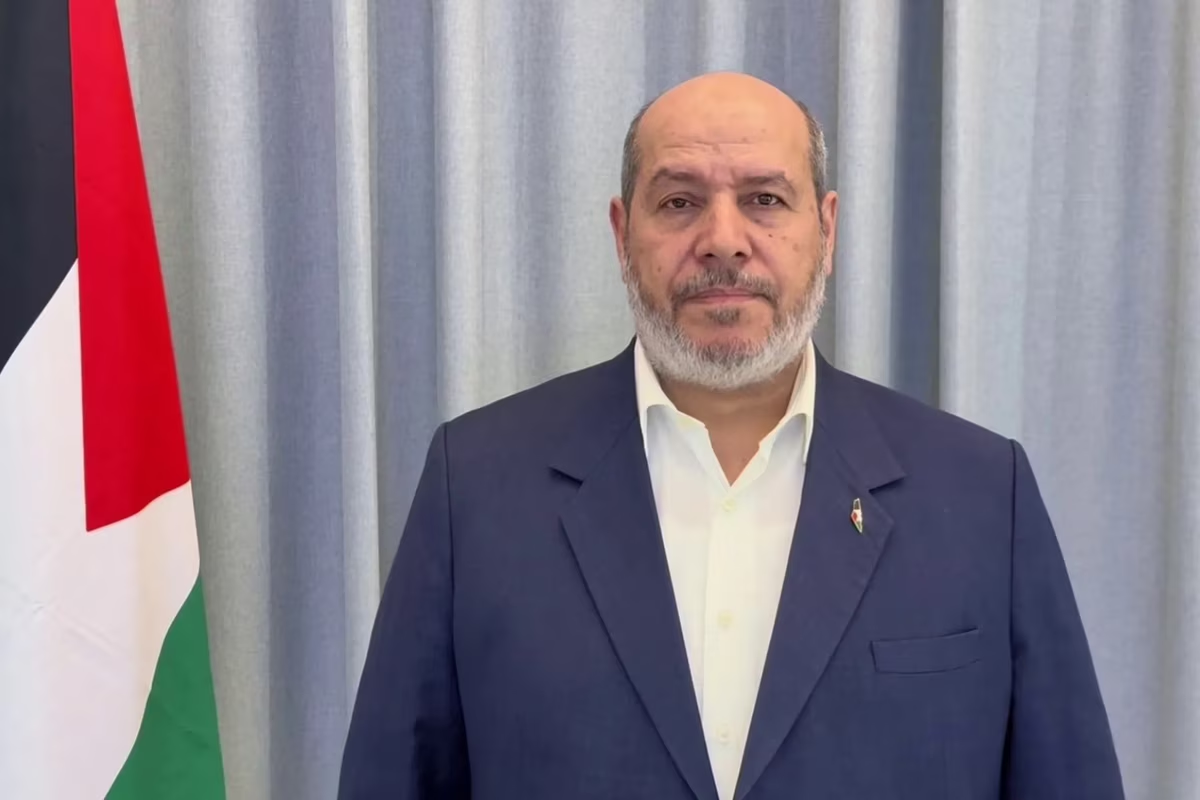
The Egyptian capital, Cairo, is hosting today, Saturday, a series of intensive meetings between Palestinian resistance factions, with the participation of high-ranking leaders from Hamas, Islamic Jihad, the Popular and Democratic Fronts, in addition to the reformist current of the Fatah movement. This political movement aims to formulate a unified national stance before the Hamas delegation engages in discussions with international and regional mediators to discuss the future of de-escalation in the Gaza Strip.
The Hamas delegation, led by Dr. Khalil Al-Hayya, arrived in Cairo on Friday evening, including political bureau members Zaher Jabarin, Ghazi Hamad, and Hussam Badran. This visit comes at a sensitive time, aiming to review the proposed amendments to the previous visions presented by the High Representative for Gaza Affairs, Nikolay Mladenov, in an effort to transition to the second phase of the proposed political plan.
In the context of the consultations, leading sources in the Hamas movement and the reformist current categorically denied reports circulated by some media outlets about granting leader Mohammed Dahlan a role in the administration of the Gaza Strip. The sources affirmed that the issue of Dahlan overseeing a 'technocrat' committee or assuming administrative tasks in the Strip is not on the table at all, neither in the faction meetings nor with international mediators.
A prominent Hamas leader clarified that the movement maintains active lines of communication and interaction with various Palestinian parties, including Dahlan's current, but this does not translate into approval for him to assume any administrative position. He pointed out that previous proposals in this regard were rejected by both the factions and the mediators, emphasizing that the utmost priority currently is to stop the ongoing aggression.
For its part, informed sources revealed that the Egyptian side remains committed to its vision based on forming a national technocrat administration to manage the affairs of the Strip in the next phase. The sources confirmed that Cairo does not welcome the expansion of Dahlan's roles due to considerations related to regional interests and the Palestinian issue, preferring to adhere to the National Committee initiative, which was a purely Egyptian proposal from the beginning.
Egyptian diplomacy is currently working on drafting a set of fundamental amendments to present during the current round of negotiations, with the aim of preventing the collapse of the framework agreement in light of the recent Israeli military escalation. These amendments include establishing binding mechanisms for the occupation to stop assassination operations targeting Palestinian cadres, which have resulted in a large number of civilian casualties and clear violations of previous agreements.
The Egyptian proposals also include a clause demanding the withdrawal of the occupation army from areas it classified as a 'red line,' through which it seized about 8% of the Gaza Strip's area in clear violation of the understandings signed last January. This step is considered an essential condition from the mediators' perspective to begin serious discussions about the second phase of the comprehensive ceasefire agreement.
These amendments aim to prepare the ground for the transition to the second phase, which stipulates the withdrawal of Israeli forces beyond the internationally agreed upon 'yellow line.' This phase also includes complex security and administrative arrangements, including initiating procedures for deploying an international stabilization force, which requires full internal Palestinian consensus that the current Cairo meetings aim to achieve.
The Palestinian factions emphasize that any progress in the political track must be coupled with real international guarantees from the 'Peace Council' and mediators to ensure the implementation of the first phase's requirements. This stance comes amid a collective Palestinian desire to stop the bloodshed and ensure that Israeli violations, which threaten to collapse the entire negotiation process, are not repeated.
The basis of the Cairo meetings is to obtain real guarantees from the guarantors for the implementation of the first phase's requirements and to stop the daily killings.
PALESTINE
Sun 07 Jun 2026 6:55 am - Jerusalem Time
Lebanese Army Commander in Pakistan Amidst Bloody Field Escalation in the South
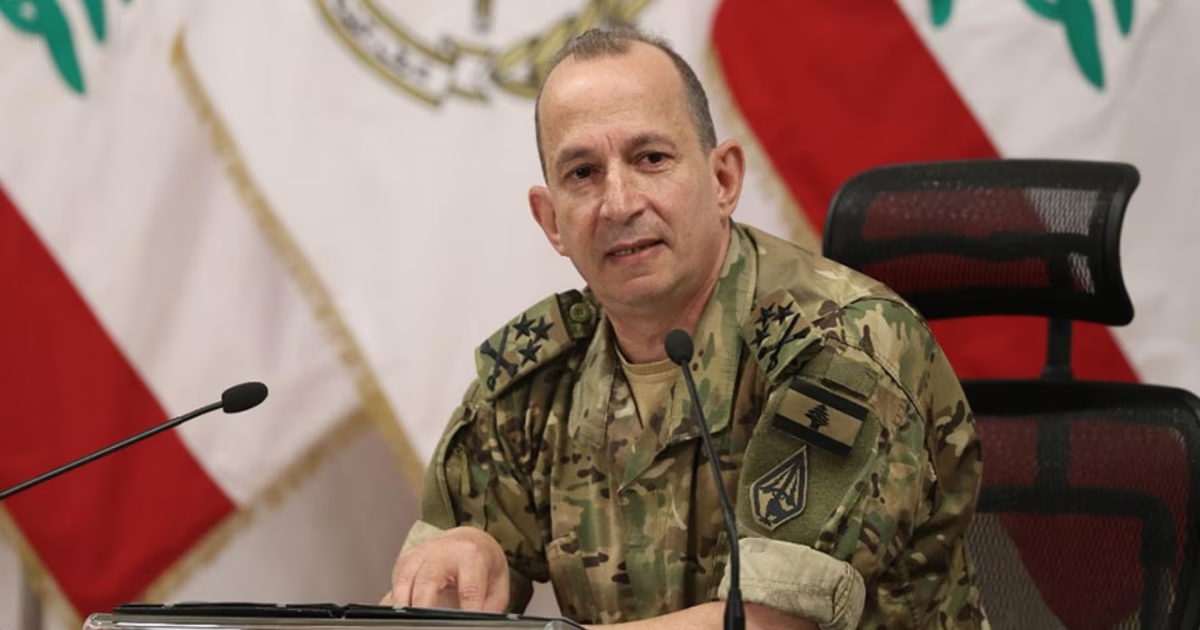
The Commander of the Lebanese Army, General Rudolph Heikal, departed from the capital Beirut today, Saturday, heading to the Islamic Republic of Pakistan on an official visit. This step comes in response to an invitation from his Pakistani counterpart, Marshal Syed Asim Munir, Chief of Army Staff and Commander of Defense Forces, at a time when the region is witnessing intense diplomatic activity to end the ongoing conflict.
The official statement issued by the Army Command did not disclose the specific duration of the visit or its detailed agenda. However, observers link this move to the mediation efforts led by Islamabad between Washington and Tehran, which aim to reinforce the de-escalation path that began in mid-April.
On the ground, sadness overshadowed the Lebanese military institution following the martyrdom of two officers, a brigadier general and a captain, in addition to a soldier, as a result of a direct Israeli attack. Occupation forces targeted a military vehicle traveling on the Kafrtibnit - Al-Khardali road in the Nabatieh region, completely destroying it and killing those on board.
These developments coincide with sharp political statements, as Lebanese Prime Minister Nawaf Salam called on the Iranian side to stop using the Lebanese arena as a bargaining chip. Salam stressed during a press conference the necessity of independent Lebanese decision-making, away from the calculations of Iranian negotiations with the United States of America.
For its part, the Israeli occupation army announced the execution of a series of extensive raids targeting about 150 sites it described as military infrastructure belonging to Hezbollah. Media reports quoted Israeli military sources confirming the continuation of offensive operations in southern Lebanon, denying receiving any orders for a ceasefire at the present time.
In the city of Tyre, the airstrikes resulted in the martyrdom of a nurse working at Hiram Hospital, following a direct targeting of a public road in the town of Abbasiyah. The attacks also affected the town of Zibdin, where local sources reported the martyrdom of a Lebanese citizen as a result of the intense shelling the town was subjected to in recent hours.
The wave of aerial escalation included the towns of Western and Eastern Zawtar, Mayfadoun, Haboush, in addition to Kafr Rumman and Nabatieh Al-Fawqa. Field sources reported that hostile warplanes carried out intensive raids between the areas of Blat and Al-Ahmadiyah, coinciding with shelling targeting the town of Haris in the Bint Jbeil district.
The aggression was not limited to aerial bombardment, but occupation forces carried out ground operations that included the demolition and explosion of residential homes in the towns of Al-Tiri and Qunain. Sources confirmed that the targeted homes were uninhabited, but the explosions caused widespread destruction in the surrounding residential areas.
On the humanitarian front, the Lebanese Ministry of Health revealed alarming statistics for the victims of the ongoing aggression since early March. According to the official report, the total death toll has risen to 3,593 martyrs, while the number of injured has exceeded 10,990, amidst a severe deterioration in the health sector.
These developments come just days after the reaching of what was described as a 'declaration of intent' between Beirut and Tel Aviv under international auspices for a ceasefire. Despite this declaration, the situation on the ground indicates an unprecedented escalation that threatens the collapse of all initial diplomatic understandings reached recently.
We continue to destroy infrastructure in southern Lebanon, and we have not received any instructions to stop doing so.
PALESTINE
Sun 07 Jun 2026 6:55 am - Jerusalem Time
Occupation army investigates report of a ramming attack south of the West Bank
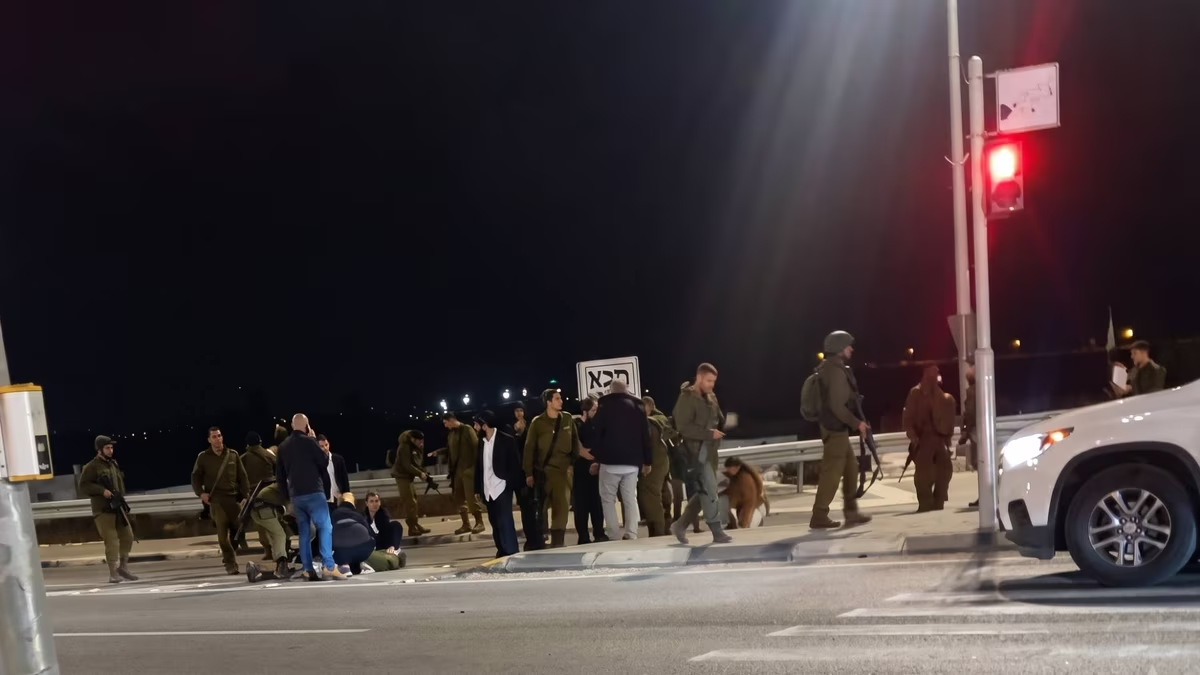
Hebrew sources reported that the occupation army received an initial report today about a ramming attack targeting a group of soldiers or settlers in an area located south of the occupied West Bank, without disclosing precise details about the exact location of the incident.
The sources stated that military reinforcements from the occupation forces immediately rushed to the reported location, where they imposed a security cordon and began extensive search operations in the surrounding area, coinciding with the initiation of field investigations to ascertain the circumstances of the incident and identify the perpetrator.
As of this moment, no official statement has been issued clarifying the extent or nature of the injuries resulting from the incident, nor has the fate of the person suspected of carrying out the operation been revealed, amid a state of security alert among the occupation forces in the area.
The army received an initial report of a ramming attack in the southern West Bank, and forces began investigating the circumstances.
PALESTINE
Sun 07 Jun 2026 6:55 am - Jerusalem Time
European move led by France to impose national sanctions on settlers involved in violence in the West Bank
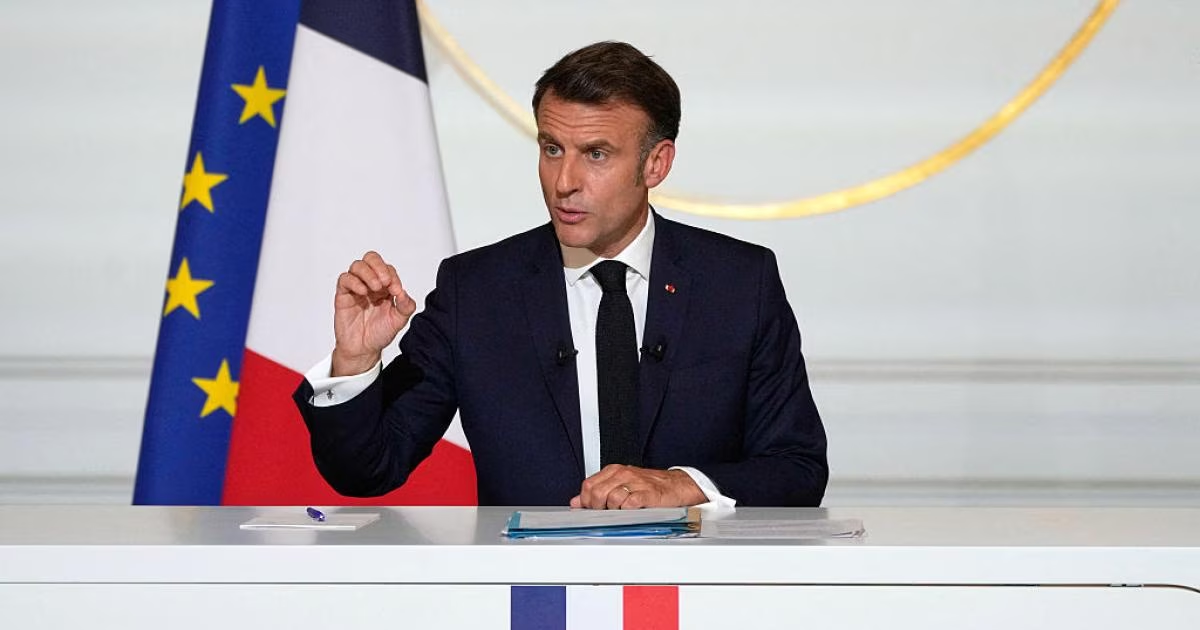
European diplomats revealed French-led efforts to increase pressure on Israel by imposing a package of sanctions targeting individuals involved in acts of violence against Palestinians in the occupied West Bank. These steps come amid an escalation in settler attacks, which pose a direct threat to security and stability in the region.
The proposed measures include freezing financial assets and imposing travel bans on individuals listed, with expectations of expanding these lists to include new names in the coming days. This move aims to send a clear message to Benjamin Netanyahu's government about the need to curb settler practices and halt policies that fuel the conflict.
Sources reported that the lack of consensus within EU institutions on taking unified punitive measures prompted countries such as France, Britain, and Norway to coordinate among themselves to impose sanctions at the national level. Observers believe that this approach reflects these countries' desire to overcome diplomatic obstruction within the European bloc.
One diplomat explained that discussions have moved to the sovereign level of each country to ensure rapid implementation and effective impact, noting that an official announcement of these sanctions may be issued soon. These discussions are characterized by secrecy to prevent targets from transferring their financial assets before the decisions come into actual effect.
European concerns primarily focus on major settlement plans, especially the 'E1' project, which aims to build a settlement east of occupied Jerusalem. Diplomats warned that this project would divide the West Bank into two separate parts, thereby definitively undermining the chances of establishing a geographically contiguous Palestinian state.
For his part, a French diplomatic source confirmed that Paris has already taken practical steps to confront settlement expansion, stressing that further measures may follow if Israeli escalation continues. France believes that protecting the two-state solution requires firm measures that go beyond mere traditional condemnation statements, which are no longer effective.
In a related context, the French capital is preparing to host an expanded meeting on June 12, bringing together foreign ministers from ten countries and Palestinian and Israeli civil society organizations. The meeting aims to keep the Palestinian issue at the top of the international agenda, especially given the major powers' preoccupation with other regional issues such as tensions in Lebanon and Iran.
This anticipated meeting coincides with the one-year anniversary of the 'New York Declaration,' which outlined a roadmap towards a Palestinian state and resulted in several European countries recognizing the state of Palestine last September. Through these moves, Paris seeks to strengthen the political and diplomatic path that guarantees legitimate Palestinian rights.
In contrast, Israeli Foreign Minister Gideon Sa'ar attacked these moves, describing the European sanctions as 'arbitrary and political' and lacking a legal basis. Sa'ar accused the European Union of targeting Israeli citizens based on their political stances, in an attempt to reject the increasing international pressure on his government.
It is worth noting that seven Western countries, including Canada and Australia, along with France and Britain, had directly accused the Israeli government of fueling tension in the West Bank. International discontent with settlement policies is growing, amid warnings that the continuation of the current situation will lead to a comprehensive security explosion that will be difficult to control.
There is no consensus at the EU level, so we moved to national-level discussions to increase pressure.
ARAB AND WORLD
Sun 07 Jun 2026 6:54 am - Jerusalem Time
Khamenei's Advisor: Iran's Rise to Power is Now a Reality and the Balance of Power is the Guarantor of Peace
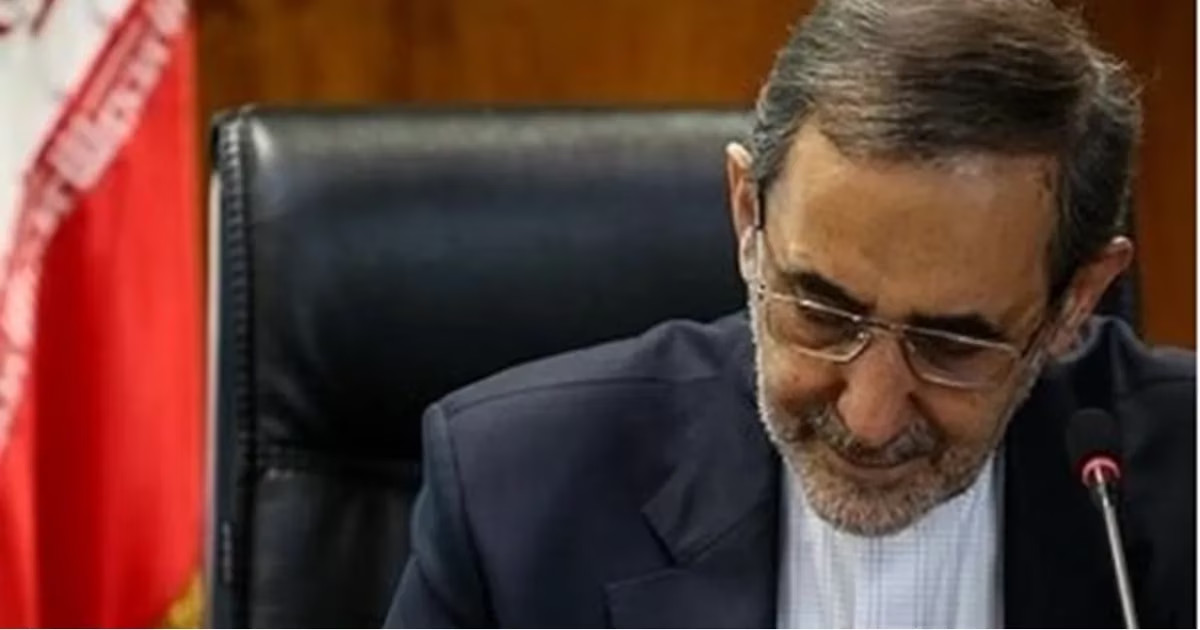
Ali Akbar Velayati, the Iranian Supreme Leader's advisor for international affairs, stressed that lasting stability in the region cannot be achieved through fragile diplomatic promises, but rather through imposing a real balance of power. He explained in press statements that relying on what he described as 'the mirage of unsupported commitments' costs parties dearly, emphasizing that recent shifts in regional power equations have redrawn the political map.
Velayati pointed out that historical Western fears of growing Iranian influence have now materialized as a tangible reality, considering that 'the new architecture of powers' in the Middle East has become an undeniable fact. He added that reports discussing the desire of the US administration led by Donald Trump to reach understandings to ensure freedom of navigation in the Strait of Hormuz are evidence of the declining effectiveness of the policy of threats directed against Tehran.
In the context of his criticism of the diplomatic moves of some regional parties, the Supreme Leader's advisor described engaging in settlement paths as a 'major strategic mistake'. He concluded his statements by emphasizing that any new security or political structure in the region will not succeed if it is based on an attempt to weaken the resistance front, stressing that power is the only guarantee against repeating past mistakes.
The old nightmare and historical fear that haunted Western theorists about Iran's rise to power has become a reality, and a new architecture of powers has been formed.
PALESTINE
Sun 07 Jun 2026 6:54 am - Jerusalem Time
Groom among the victims.. 10 martyrs in a series of occupation raids on Gaza
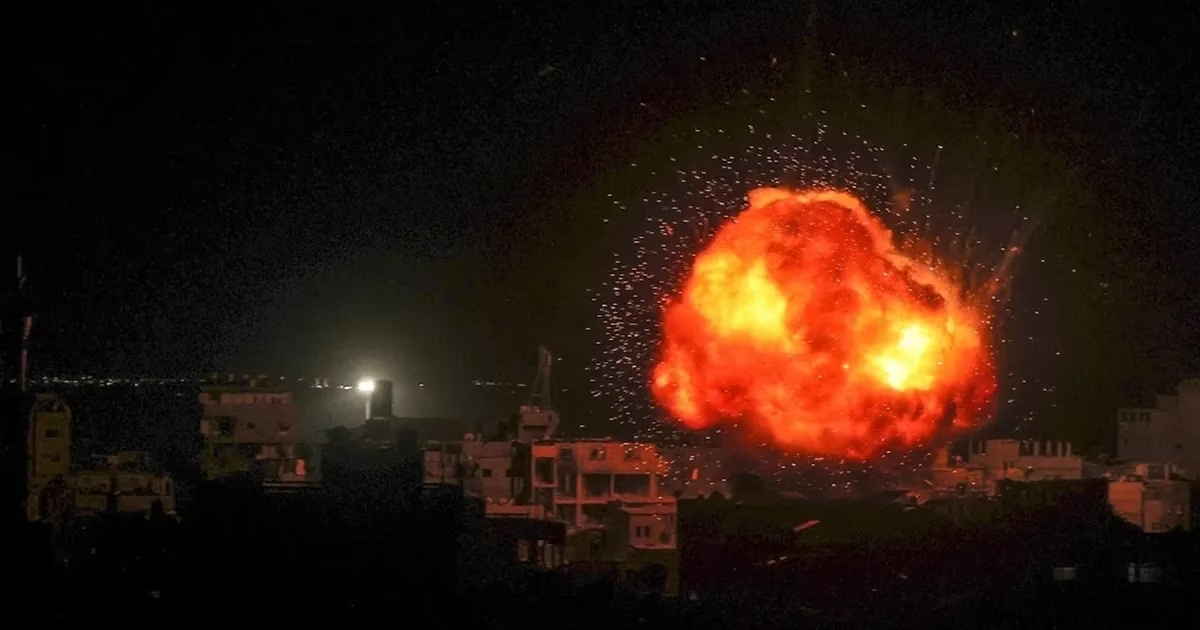
Israeli occupation aircraft continued their deadly raids on various areas in the Gaza Strip, resulting in the martyrdom of at least 10 Palestinians by Saturday evening. The attacks focused on displaced persons' gatherings and densely populated residential areas, amidst the ongoing military escalation that has plagued the besieged Strip for months.
In Gaza City, occupation forces committed a massacre in the Passports Camp, designated for sheltering displaced persons, where an airstrike led to the martyrdom of eight citizens and the injury of 15 others with varying degrees of wounds. Medical sources at Al-Shifa Hospital confirmed receiving the bodies of the eight martyrs, noting that most of the injuries received were in critical condition due to direct shrapnel.
In the southern part of the Strip, an Israeli raid targeted a tent sheltering displaced persons, leading to the martyrdom of young man Muhannad Farawneh and the injury of two others. Sources from Nasser Hospital in Khan Yunis reported that medical teams provided necessary first aid to the injured, while a state of intense sadness prevailed after the arrival of the body of the young man who was preparing to enter married life.
For its part, the Israeli occupation army officially acknowledged its responsibility for the assassination of young Muhannad Farawneh, claiming that the operation was a "precise strike" targeting a leader of a cell affiliated with the Al-Qassam Brigades. This strike occurred on the rooftop of Farawneh's home, where he was in a tent set up specifically a few hours before the start of his wedding ceremony, which turned into a funeral.
Official statistics issued by the Ministry of Health in Gaza indicate that the number of martyrs since the announcement of the last truce has exceeded 951, amidst continued intensive military operations. The United Nations confirms the reliability of these figures, which reflect the enormous human losses among Palestinian civilians due to the continuous bombing.
In contrast, the Israeli occupation army admitted the killing of five of its soldiers during confrontations and field operations in the same period. These developments come at a time when international warnings are increasing about the worsening humanitarian crisis in the Strip, with the targeting of shelters that are supposed to be safe areas for civilians fleeing the bombing.
The strike targeted Muhannad Farawneh's tent on his rooftop just hours before his wedding party.
PALESTINE
Sun 07 Jun 2026 6:54 am - Jerusalem Time
The 'Mowing the Lawn' Doctrine: How Israel Perpetuates a Policy of Preemptive Killing and Justifies Massacres?
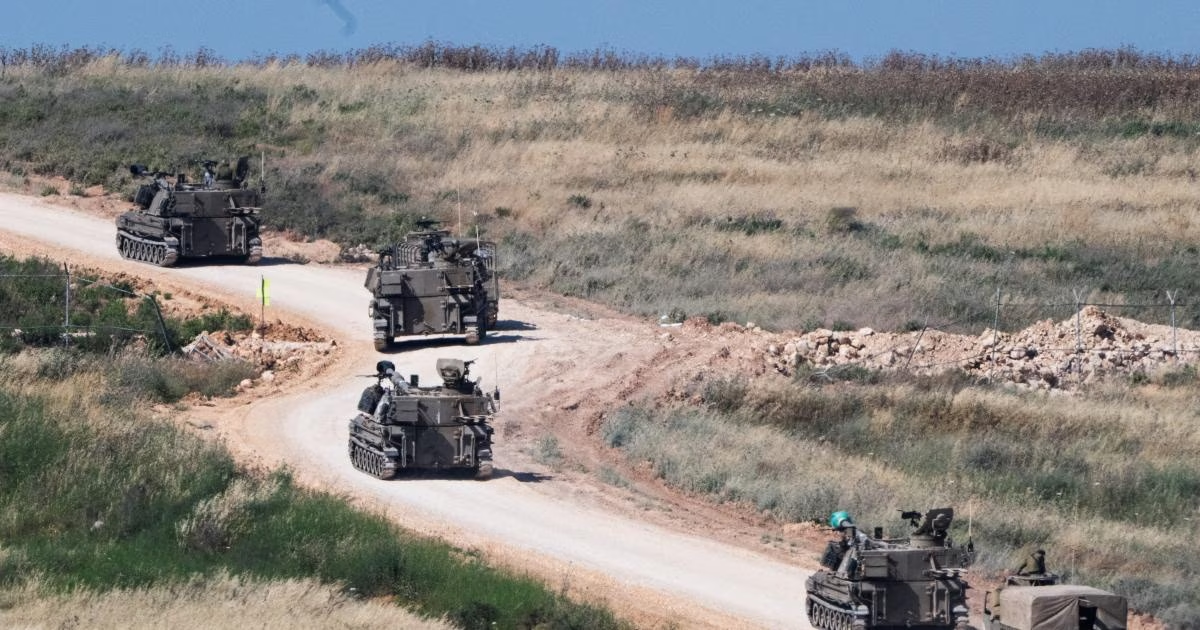
The security and military establishment in Tel Aviv adheres to an old Zionist approach known as the 'Mowing the Lawn' doctrine, a strategy fundamentally based on the principle that excessive force is the only way to deal with adversaries. This doctrine relies on preemptive and continuous military and intelligence strikes aimed at weakening the other party and preventing it from accumulating power, rather than seeking to resolve conflicts through political and diplomatic channels.
Israeli killing policies are characterized by being a systematic and institutionalized system that enjoys full support from the political establishment, where soldiers are instructed to use lethal force without hesitation. Following each crime, the official media machine resorts to using euphemisms such as 'collateral damage' or 'war casualties,' and in some cases, massacres are classified as 'individual errors' to evade legal and international responsibility.
This policy has recently become evident in the Lebanese arena, where Israeli forces targeted two officers and a soldier from the Lebanese army in a direct assault that sparked a wave of official condemnation. The commander of the Lebanese army, Joseph Aoun, described this incident as a blatant violation of national sovereignty, emphasizing that the targeting was not spontaneous but falls within the context of continuous escalation.
For his part, Lebanese Prime Minister, Najib Mikati, placed this aggression in the category of a 'described crime' that cannot be tolerated in international forums. Lebanese Parliament Speaker, Nabih Berri, also preempted the Israeli narrative, asserting that what happened was not merely a technical error or suspicion, as occupation sources try to promote to mitigate diplomatic pressure.
In contrast, the occupation army claimed that the targeting of the Lebanese vehicle came after it aroused suspicion within an active combat zone that required prior coordination for movement. Military sources claimed that the decision was made based on the 'presumed danger' the car posed to soldiers, a narrative that contradicts Israel's possession of the most advanced reconnaissance and intelligence verification systems in the world.
This Israeli behavior is not limited to the Lebanese front but extends to the occupied Palestinian territories, where incidents of cold-blooded killing of civilians under flimsy security pretexts have recurred. One of the most prominent examples is the martyrdom of the infant Sam Abu Heikal in Hebron, who was only seven months old, during raids and incursions carried out by occupation forces in the West Bank.
The occupation authorities acknowledged the killing of the infant in an official statement characterized by vague language, claiming that a vehicle was speeding towards the soldiers, prompting them to open fire 'as a precaution.' This incident reveals a consistent pattern that grants the soldier the authority to kill first, then leaves it to the military establishment to formulate justifications that strip the crime of its moral content.
Official statistics indicate a terrifying escalation in the number of casualties in the West Bank since October 8, 2023, with Israel killing more than 1,168 Palestinians. Nearly 12,000 others have been injured to varying degrees, while about 23,000 citizens have been arrested, and over 33,000 have been displaced from their homes under the policy of collective punishment.
Victims in official Israeli discourse are not treated as human lives requiring accountability or review; rather, they are seen as an inevitable collateral cost of using force. This logic transforms crimes into abstract numbers and uses a fixed lexicon of terms aimed at dehumanizing victims and justifying the failure to avoid targeting non-combatants.
Over decades and with the accumulation of these incidents, the 'kill first' logic has transformed from an exception imposed by field conditions into an integral part of Israel's entrenched security culture. This culture gives absolute priority to executing the military mission at any cost, deferring all ethical and legal questions related to victims to the post-execution phase, and often completely ignoring them.
The increasing human losses in the Israeli narrative are not isolated or accidental incidents but an inevitable result of an approach founded on prioritizing absolute military superiority. This approach views 'decisive force' as the only option, leading to repeated massacres in Gaza, the West Bank, and Lebanon without a real deterrent to stop this military machine.
Ultimately, the 'Mowing the Lawn' doctrine remains an Israeli means of escaping the requirements of peace and recognizing the rights of peoples, by continuing the cycle of violence. While Tel Aviv seeks legal justifications for every bullet it fires, the facts on the ground remain witness to a systematic policy that places killing at the forefront of its strategic priorities.
What Israel fails to take by force, it seeks to extract with more force through a military doctrine that does not recognize political solutions.
PALESTINE
Sun 07 Jun 2026 6:54 am - Jerusalem Time
Diaspora Behind the Siege: Hundreds of Wives and Children in Gaza Demand Family Reunification with Relatives Abroad
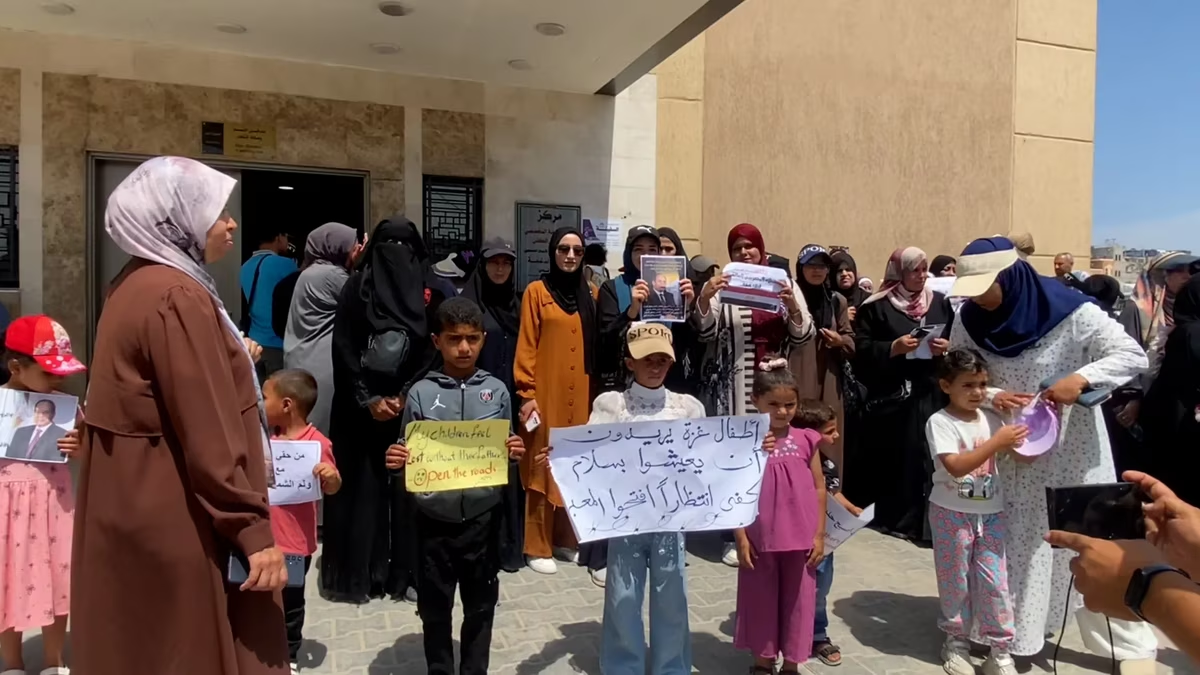
The cries of hundreds of Palestinian wives trapped in the Gaza Strip are escalating, as they find themselves and their children caught between the hammer of war and the anvil of forced separation from their husbands residing abroad. In the overcrowded displacement camps in the Al-Mawasi area west of Khan Yunis, these families endure endless chapters of daily suffering, as the siege and strict Israeli restrictions prevent the realization of their dream of family reunification.
Alaa Lafi, one of these women, bitterly recounts how she lives with her five children in a dilapidated tent that offers no protection from the summer heat or winter cold, while her husband awaits their arrival in Belgium after they obtained the right to family reunification. Alaa's suffering is compounded by her cancer diagnosis, as the collapsed hospitals in the Strip lack the necessary treatment, making her travel an urgent medical and humanitarian necessity to save her life.
For the third consecutive week, these women have been organizing protest vigils in various parts of the Strip, raising banners demanding the fundamental right to movement and to live under one roof with their husbands. These events express the state of despair that families have reached, in light of the continued closure of vital crossings, especially the Rafah crossing, which is completely controlled by the occupation forces.
Hanadi Al-Adeini, a mother of four, describes a bitter reality where her children are forced to bear responsibilities beyond their years, such as searching for water and securing simple meals amidst continuous displacement. Hanadi, who survived a previous Israeli airstrike with her children, bitterly wonders about the world's silence regarding their tragedy, while their father has been away for years in search of a livelihood.
In a poignant scene, the child Fidaa Abu Suleiman cries with longing for her father, whom she has not seen since she was a baby in her first year, as he left the Strip six years ago and has not been able to return. Her mother, Haneen, confirms that the father's absence has created a significant emotional and psychological void for the children, whose only connection to him is through his pictures and intermittent video calls.
The child Abdul Rahman Abu Teir, who lives in a tent in the Al-Mawasi area after his family was forcibly displaced from eastern Khan Yunis, represents the voice of thousands of children deprived of their fathers. Abdul Rahman raises a banner demanding his right to live with his father, who has been an expatriate for eight years, emphasizing his desire to live a normal life, play, and learn like other children in the world, away from the atmosphere of war.
Estimates reported by local sources indicate that there are approximately 830 wives and fiancées stranded in the Strip, with nearly 1,500 children, most of whom live in shelters and tents. These women have lost their homes and possessions during the ongoing military operations, and their hopes are pinned on an international or humanitarian decision that will open the closed crossings for them.
Hadeel Hussein Habib, spokesperson for the stranded wives, recounts her personal story as the fiancée of a young man residing in Jordan, where their marriage contract was signed three years ago, but she has been unable to travel to complete the wedding. Hadeel currently lives in a classroom within a school that has been converted into a shelter in Hamad City, after the occupation destroyed her family's apartment and their home in the Al-Shuja'iyya neighborhood.
Hadeel emphasizes that the lives of hundreds of girls and women are in limbo, as they fear for their future in the absence of a political horizon and the continued Israeli control over land crossings. These women appeal to Arab and European countries for urgent intervention to evacuate them humanely and facilitate their joining their families who await them across the borders.
The suffering is not limited to the physical dimension but also extends to the heavy economic burdens borne by mothers in the absence of a breadwinner, especially amidst the insane rise in prices and the scarcity of basic necessities. The mother finds herself forced to play the role of both father and mother in an environment lacking the minimum elements of safety, causing immense psychological pressure on all family members.
The restrictions imposed on the Rafah crossing since May 2024 have further complicated the situation, as the movement of travelers and humanitarian cases has almost completely stopped, leading to the accumulation of thousands of pending cases. This systematic closure is considered by human rights activists to be part of the collective punishment policy practiced against the residents of the Strip, which deliberately disperses Palestinian families.
In every corner of the displacement camps, a new story emerges of a family torn apart by the siege, where an entire generation of children grows up knowing nothing of their fathers except their voices over the phone. This state of family fragmentation creates far-reaching social consequences and increases public resentment towards the international silence regarding these blatant humanitarian issues.
The stranded wives demand a clear and transparent mechanism for travel, ensuring their safe exit with their children without being exposed to the dangers of the road or the financial extortion that travelers may sometimes face. The continuation of this situation means that hundreds of children will remain in an unhealthy and unsafe environment, away from the parental care guaranteed by all international laws and conventions.
In conclusion, the issue of stranded wives in Gaza remains a bleeding wound in the body of Palestinian society, and a cry to the global conscience to act and end this tragedy. Opening the crossings and facilitating family reunification is not just a political demand, but an inherent human right that should not be subject to military bargaining or narrow political calculations.
My children ask me every night: When will we see Dad? And I find no answer but tears that I try to hide from them.
PALESTINE
Sun 07 Jun 2026 6:54 am - Jerusalem Time
Occupation army admits targeting a Palestinian family in Hebron and the martyrdom of a child
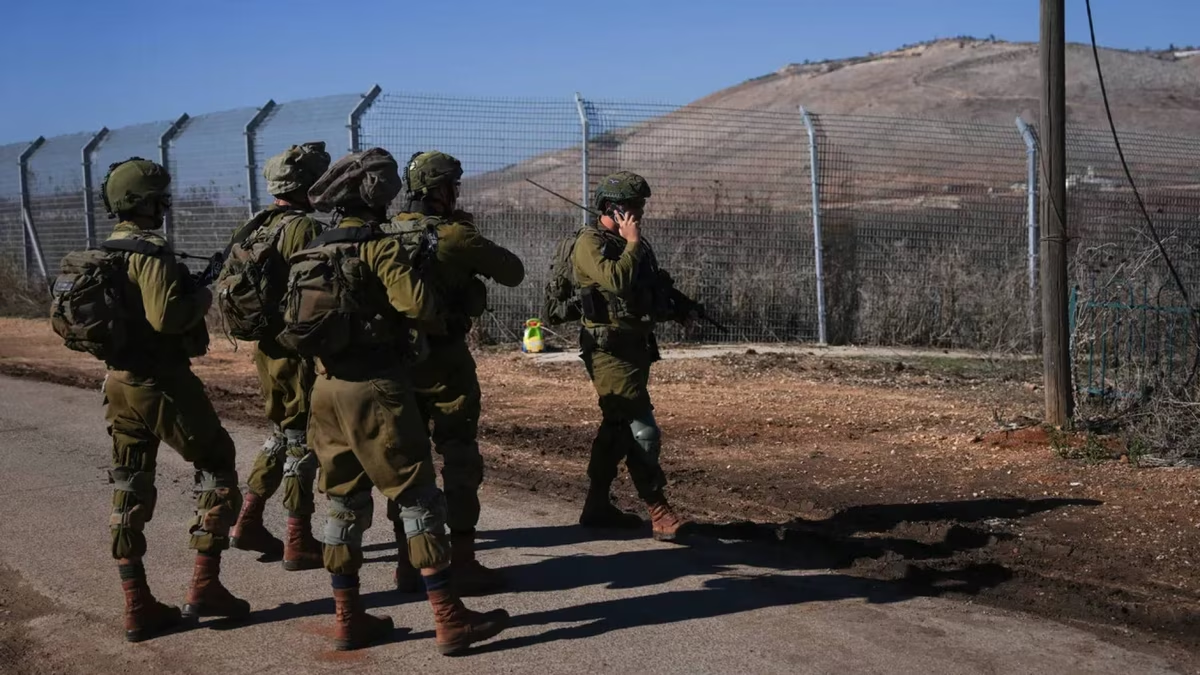
The Israeli occupation army, in an official statement issued on Friday evening, admitted responsibility for opening fire on a Palestinian vehicle in the city of Hebron in the occupied West Bank. The admission clarified that the military force targeted a Palestinian family in their vehicle, resulting in direct injuries among civilians who were later found to have no connection to any security incidents.
This crime resulted in the martyrdom of seven-year-old child Sam Abu Heikal, who succumbed to his serious injuries from live bullets. The child's parents also sustained varying injuries, necessitating their urgent transfer for medical treatment, amidst a state of shock and widespread popular condemnation in the Tel Rumeida area where the incident occurred.
Regarding the details of the incident, military sources claimed that occupation soldiers were carrying out an operational activity in the area when one of the soldiers suspected a vehicle accelerating towards them. Based on this field assessment, the soldier fired several bullets directly at the car, which led to the tragedy that claimed the child's life and injured his parents.
Preliminary investigations conducted by the occupation army indicated that the occupants were unarmed civilians and posed no actual security threat to the forces present at the scene. Despite this admission, the statement merely indicated that the incident is still under review and scrutiny by the relevant military leadership to ascertain the circumstances of the soldier's field action.
This incident comes in the context of escalating Israeli violations in West Bank cities, where incidents of shooting at civilians under suspicion pretexts are repeated. The results of the final investigation are expected to be submitted to the legal authorities affiliated with the occupation, amidst Palestinian demands for the necessity of international prosecution of the perpetrators of these crimes against children and civilians.
Preliminary investigation showed that the injured were innocent civilians not involved in any security activity at the time of their targeting.
ARAB AND WORLD
Sun 07 Jun 2026 6:54 am - Jerusalem Time
Between the American Umbrella and Iranian Threats: Is Gulf Security at Risk?
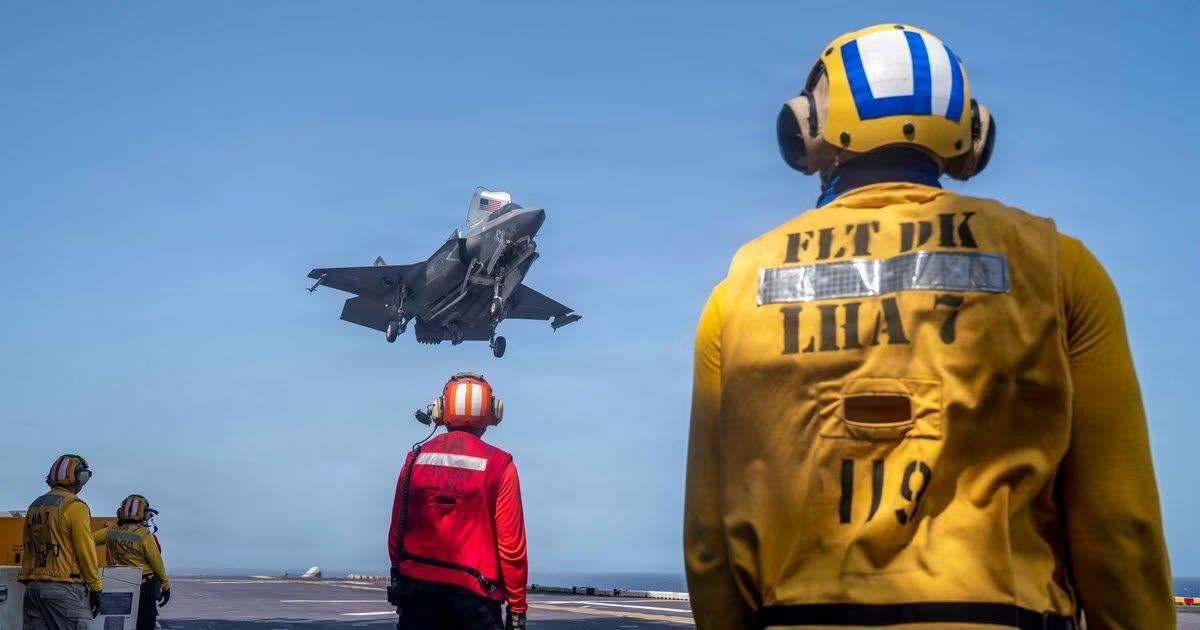
Recently, fundamental questions have been escalating regarding the seriousness of the United States in providing security protection to its allies in the Gulf region, especially in light of rapid field changes. Observers believe that recent military tests have shown a clear American focus on protecting Israeli interests, raising doubts about the priority of the region's security in Washington's defense strategy.
In contrast, Tehran adopts a discourse that holds American military bases responsible for the existing tension, considering their presence a source of discord and instability. Iranian sources claim that they do not seek to antagonize their neighbors, yet field realities indicate the continuation of military pressures targeting the territories of Gulf states despite the latter's attempts to adhere to diplomatic paths.
For his part, political researcher Hussein Jamal described Iranian proposals as part of a 'mobilization discourse' aimed at exerting political and field pressures. Jamal explained that the Gulf states, foremost among them Kuwait, have made strenuous efforts to prevent the expansion of the conflict, emphasizing the necessity of peaceful solutions as the only roadmap to overcome the current crises in the region.
Political sources stressed that Gulf states have taken firm stances by preventing the use of their territories or airspace to carry out any military operations against Iran. Despite these neutral and de-escalatory positions, the region has witnessed repeated attacks, which reinforces the hypothesis that Tehran uses these arenas as pressure messages directed directly at the American administration.
Analysts draw attention to the contradiction in Iranian behavior towards its neighbors, as reports indicate the presence of Israeli intelligence activity in Azerbaijan targeting Iranian national security. Nevertheless, it is noted that Tehran has not taken direct military action against Baku, while choosing to escalate its rhetoric and operations towards the Gulf states, which it describes as the 'soft underbelly'.
Regarding the Kuwaiti position, Jamal affirmed that the country's official policy is firm in refusing to engage in any offensive military action launched from its territory. Kuwait adheres to its vision that dialogue and diplomacy are the only way to achieve stability, away from the language of threat that some parties are trying to impose as a fait accompli in the region.
The analysis concluded that the current Iranian escalation aims primarily to raise the ceiling of demands in any future negotiations with international powers. By targeting interests linked to the American presence, Tehran seeks to turn neighboring countries into political bargaining chips to extract concessions related to its outstanding issues with the international community.
Through its actions, Iran seeks to send messages to the United States, considering some Gulf states the soft underbelly of the region.
PALESTINE
Sat 06 Jun 2026 8:58 pm - Jerusalem Time
Exclusive Testimonies for "The First Shot": How the National Resistance Against the Occupation of Beirut Began in 1982?
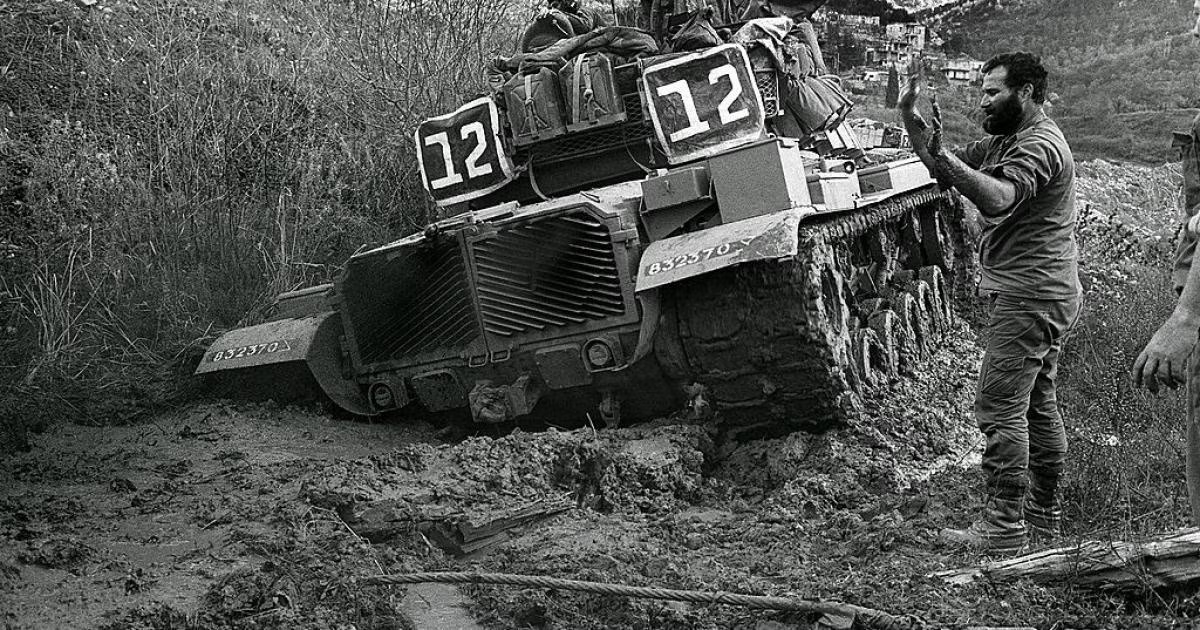
In 2026, Lebanese memory recalls pivotal moments in the history of the conflict with the Israeli occupation, specifically the 1982 invasion that began on June 6 under the name 'Peace for Galilee'. This date was not just a fleeting memory, but marked the beginning of a phase of organized resistance that emerged from the heart of besieged Beirut neighborhoods.
After a three-month siege and the departure of Palestinian Liberation Organization forces, the occupation believed that the Lebanese capital had completely succumbed to its control. However, the situation on the ground quickly changed with the formation of secret cells that began planning qualitative operations aimed at making the presence of Israeli soldiers in the streets of Beirut costly and impossible.
Former fighter 'Nidaa' recounts in his testimony that the resistance that emerged then was purely national, encompassing diverse Lebanese factions away from sectarian affiliations. These efforts culminated in the launch of the 'Lebanese National Resistance Front', known as 'Jammoul', on September 16, 1982, led by leftist and national forces.
The 'Bistros Pharmacy' operation on Hamra Street was the spark that announced the beginning of organized action, later known as 'The First Shot'. This operation was not a random reaction, but rather the result of precise monitoring and prior preparation to break the barrier of fear left by the invasion and the long siege.
The cell that carried out the Bistros operation included three young men: Fahd, Mazen, and Ammar, who moved in a city experiencing the shock of occupation. According to testimonies, the success of this operation restored hope to the Lebanese street and proved that Israeli military power could be confronted in a precise urban guerrilla war.
Women played a pivotal role in that phase, highlighted by the testimony of 'Rana', whose home in the Zarif area was a secret center for meetings. In that small house, military plans were discussed and political statements were written, which were later distributed to mobilize the masses against the Israeli presence.
'Rana' confirms that her home witnessed the first moments of preparing the materials used in the operations, where field commanders like Elias Attallah coordinated with the young executors. From this location, reconnaissance teams set out to monitor the positions of Israeli vehicles and select the most impactful targets deep within the capital.
After the success of the Bistros operation, the resistance momentum did not stop, but was followed by the 'Ayoub Station' operation in the Zarif area, which targeted a gathering of occupation forces. These successive operations created a state of constant confusion among Israeli soldiers, making them feel danger in every corner of West Beirut.
It was not long before the Israeli army was forced to withdraw from Beirut under the weight of successive blows. Testimonies recall the loudspeaker calls made by occupation soldiers as they left the city, asking residents not to shoot at them during the withdrawal, a scene that embodied the breaking of military prestige.
'Rana' then moved to clandestine work in South Lebanon and Sidon, where she participated in transporting weapons and equipment across Israeli checkpoints. She used her youth to camouflage and bypass checkpoints, enabling her to deliver logistical support to the resistance fighters who continued the confrontation in the occupied territories.
'Rana' recounts important qualitative details in Sidon in 1985, where she succeeded in delivering a weapon used in an operation in Nejmeh Square. That operation caused widespread confusion among the occupation forces due to the speed of execution and withdrawal, and confirmed that the spirit of resistance had moved from the capital to all Lebanese cities.
During that period, the resistance fighters faced dual challenges, not limited to the pursuit by the occupation but also including the complexities of the Lebanese civil war. Many of them were pursued by security agencies and local armed groups, which made clandestine work require extreme caution and a high ability to maneuver between multiple dangers.
Testimonies confirm that the 'Jammoul' experience was an honorable, cross-sectarian experience, whose compass was focused solely on liberating the land. Despite attempts to marginalize this role in subsequent political memory, the facts on the ground prove that this front was the primary pillar from which major liberation operations were launched.
Today, with the recurrence of Israeli incursions into border villages, these testimonies emerge to remind us that the will to confront is capable of changing the balance of power. The story of 'The First Shot' remains a lesson in how to transform military defeat into an organized resistance act that forces the withdrawal of the strongest armies.
The goal was clear: to expel the Israeli army from the capital, and to break the image of an occupation capable of imposing its presence without cost.
PALESTINE
Sat 06 Jun 2026 8:58 pm - Jerusalem Time
Helen Mirren.. A Cinematic Journey in Service of the Israeli Narrative from 'Kibbutz' to 'Golda'

The relationship of British actress Helen Mirren with Israel is not just a fleeting detail in her long artistic career; rather, it is a close bond that spans decades. From her experience in a 'kibbutz' after the 1967 war to her portrayal of Golda Meir, Mirren moves in a thorny area that blends art with explicit political stances. This commitment recently led her to face public criticism in the streets of London, where she was described as an 'outspoken Zionist'.
Mirren won an Academy Award in 2006 for her role in the film 'The Queen', in which she embodied the character of Elizabeth II in the aftermath of Princess Diana's death. In this work, she excelled at portraying the conflict between emotion and strict royal duty. However, it seems that in her real life, Mirren abandons this reserve when it comes to her absolute support for Israel, a stance that sparks much controversy.
Activists recently circulated a video showing Mirren and her husband, director Taylor Hackford, in a verbal altercation with someone who described her as an evil Zionist. Although the video may be from last year, its re-sharing coincided with escalating political tensions. Her husband angrily responded to these accusations, while Mirren remained silent at that moment, despite her previous statements leaving no doubt about her leanings.
In August 2023, while promoting the film 'Golda', Mirren told Israeli Channel 12 of her deep belief in Israel's survival 'forever'. She considered the Hebrew state an exceptional place, expressing her nostalgia for the period she spent there in her youth. These statements brought renewed attention to her political identity, which constantly intersects with her cinematic roles.
This connection dates back to 1967, when Mirren visited Israel with a Jewish friend and volunteered to work at 'Kibbutz Ha'on' near Lake Tiberias. Mirren describes that experience as 'magical', where she worked picking grapes and in the kitchen. Since then, Mirren began to establish an emotional and intellectual relationship with the Zionist project, which was later reflected in her professional choices.
Over the years, Mirren has played multiple roles serving the Israeli and Jewish narrative, including that of a Mossad agent in the 2010 film 'The Debt'. For this role, she studied Hebrew and the history of the 'Holocaust' for several months to ensure accuracy in her performance. She also participated in the film 'Woman in Gold', which deals with the recovery of Jewish property from the Austrian government, further solidifying her presence as a cinematic face associated with these issues.
'Golda' in 2023 is the pinnacle of Mirren's career linked to Israel, as she portrayed the prime minister who managed the 1973 war. The film, directed by Israeli Guy Nattiv, focused on the three weeks of the war from a purely Israeli perspective. Despite Mirren's strong performance, critics considered the work artistically mediocre and overtly politically biased.
'Golda' began with archival footage of the 1948 Nakba and ended with the signing of the Camp David Accords, attempting to portray Golda Meir as a lone leader struggling to save her state. The film completely omitted the Arab side of the conflict, showing Egyptians or Syrians only as enemies in the shadows. This deliberate omission reflects the one-sided vision adopted by both the work and the actress.
Some critics see a similarity between Mirren's performance in 'Golda' and her performance in 'The Queen' in terms of silence and reserve, but the comparison seems unfair. In 'The Queen', silence expressed a deep human dimension and a real internal struggle, while in 'Golda', the performance seemed stereotypical and confined by cigarette smoke. The political and promotional aspects in 'Golda' overshadowed the dramatic value of the work.
Mirren defended her acceptance of the role despite the controversy surrounding Golda Meir's policies towards Palestinians, claiming she is merely an actress playing a historical role. She stated that she does not seek to justify the character's actions, but to portray a woman of a certain age dealing with a complex situation. However, her personal history and pro-occupation statements make it difficult to believe her artistic neutrality.
Mirren considered Golda Meir's rise to power an 'amazing moment' for women around the world, ignoring the bloody legacy of that era. This fascination with Meir's character is consistent with Mirren's constant rejection of the cultural boycott of Israel. Despite her occasional timid criticism of Benjamin Netanyahu's policies, she remains committed to her fundamental support for the occupying entity.
Mirren faced criticism from within the Jewish community in Hollywood, where some objected to a non-Jewish actress playing the character of Golda. In response, Mirren spoke about the need to maintain a 'delicate balance' when portraying characters from different cultures. But this balance that Mirren seeks seems completely absent when it comes to the rights or suffering of Palestinians.
Mirren was born in London in 1945 to a father of Russian descent and a British mother, and began her theatrical career at the age of twenty. She excelled in classical roles with the Royal Shakespeare Company before moving to the big screen. Despite the diversity of her roles between queens and historical figures, her bias towards Israel remains a distinctive and controversial mark in her history.
Helen Mirren remains a model of the Western intellectual and artist who consciously adopts the Zionist narrative, using her artistic tools to reinforce it. While she continues to win awards and global recognition, she is pursued by her political stances, which many see as an unethical bias against the rights of the Palestinian people. Her career will always be a subject of debate between artistic creativity and humanistic stance.
I am a believer in Israel, and I believe it is an extraordinary country full of very extraordinary people.
ARAB AND WORLD
Sat 06 Jun 2026 8:58 pm - Jerusalem Time
US Secretary of War describes migration to Europe as an 'ideological invasion'
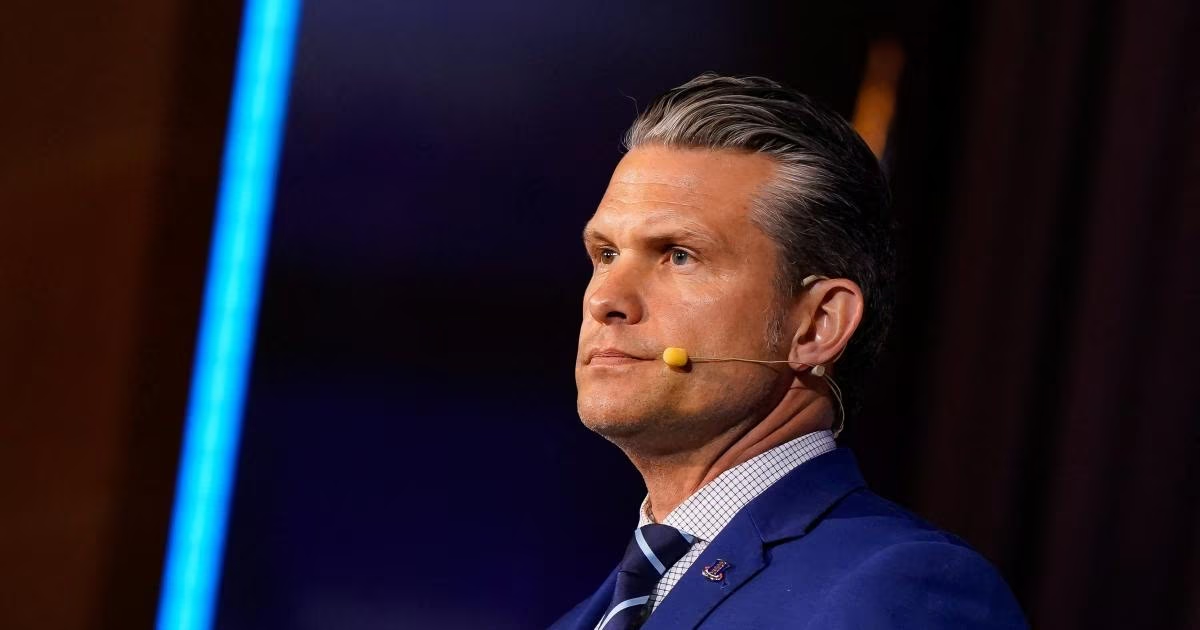
US Secretary of War, Pete Hegseth, issued strong warnings to the European continent, describing the flow of migrants across the sea as an 'invasion of dangerous ideologies'. These statements came during a speech he delivered at the American Cemetery in Normandy, coinciding with the 82nd anniversary of the historic Allied landings that liberated Europe from Nazism.
In his speech, Hegseth linked the legacy of World War II to the current reality, considering that the European shores of Italy, Spain, Greece, and Bulgaria are today witnessing 'another kind of invasion'. He pointed out that the arrival of boats and migrants represents a civilizational challenge that requires immediate action from European capitals, which he accused of hesitation in confronting this threat.
These positions reflect the general trends of President Donald Trump's administration, which has consistently criticized European allies for what it describes as defensive weakness and complex bureaucracy. Washington believes that the old continent suffers from a clear deficit in dealing with the migration issue, in addition to exercising 'censorship' over nationalist and right-wing movements seeking to come to power.
In his speech to the audience, the US Secretary questioned whether it was too late for European leaders to act to protect their borders and identity, expressing his hope that these countries would realize the magnitude of the risks before it was too late. These statements come just one day after similar criticisms were directed by JD Vance, the US Vice President, who emphasized the failure of the European system to control borders.
The US National Security Strategy document issued last year paved the way for this escalating tone, warning of the danger of 'civilizational erasure' threatening Europe. The document affirmed the necessity of correcting the European course to ensure the continent's continued status as a reliable and strategic ally of the United States amidst rapidly changing international variables.
These successive statements have caused a state of concern in diplomatic circles, as they have begun to shake established convictions about the strength of the Atlantic alliance formed after World War II. Observers believe that the Trump administration's rhetoric is increasingly pushing European countries towards seeking strategic autonomy away from the American umbrella.
In an initial reaction, several European capitals have begun to focus on plans to diversify their sources of reliance in technology and defense, in anticipation of deeper changes in US foreign policy. These moves reveal a growing gap in visions between Washington and its traditional allies on issues of migration, national security, and cultural identity.
When will European capitals act to confront this invasion, or is it too late? I hope not, and I believe it is not.
ARAB AND WORLD
Sat 06 Jun 2026 8:58 pm - Jerusalem Time
"Flamingo Revolution".. Escalating Protests in Albania Against Kushner and Ivanka Trump's Projects
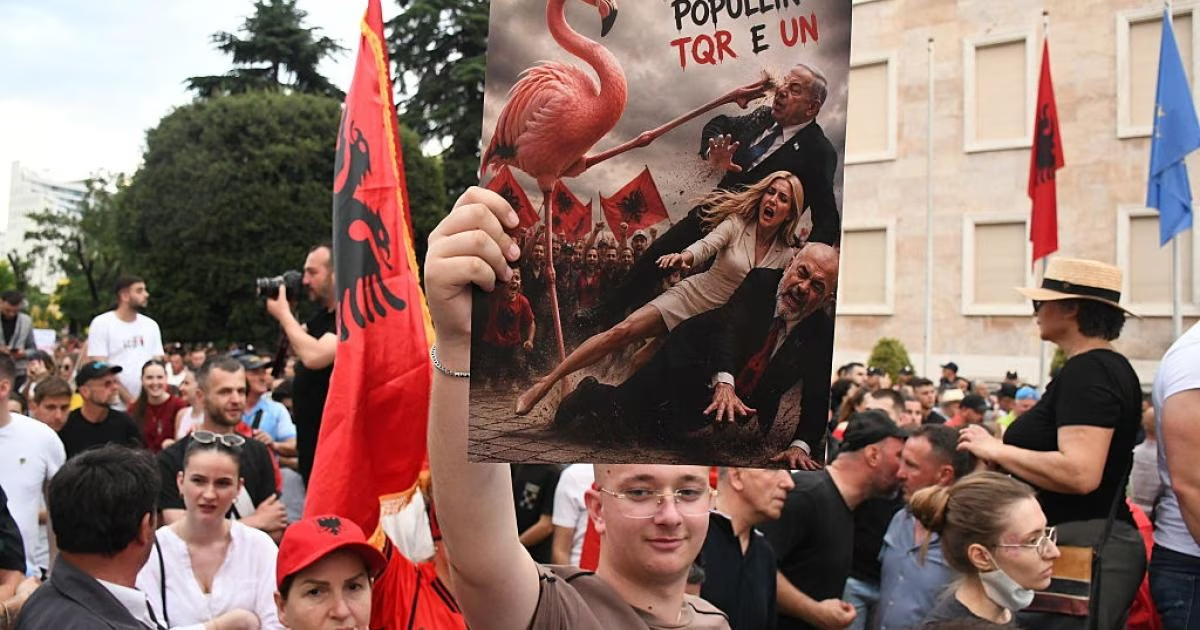
Field tensions escalated in southern Albania today, Saturday, as Zvernec Island witnessed massive demonstrations against tourism investment plans led by Jared Kushner and Ivanka Trump. Participants in the marches raised national flags and banners condemning the encroachment on the local environment, demanding a halt to any moves aimed at transforming pristine areas into massive hotel complexes.
Popular concerns focus on a proposed project to build luxury hotels and resorts on the uninhabited Sazan Island, as well as environmentally sensitive areas in Zvernec and the coastal Vjosë-Nartë. These areas are considered among the most important natural reserves in the country, forming a unique ecosystem that experts fear will be destroyed as a result of investment-driven urban sprawl.
For his part, Albanian Prime Minister Edi Rama tried to calm public concerns during statements he made from Montenegro, stressing that there is no officially approved project at this moment. Rama indicated that the government is consulting the best international experts to ensure the creation of something unique, calling on the media to exercise caution in reporting information about issues that have not yet been decided.
Rama stressed in his speech that the discussion about the project is premature, considering that something that does not exist on paper cannot be definitively discussed. Despite these assurances, the Albanian public expresses widespread skepticism, especially with the increasing field visits made by Ivanka Trump to the region accompanied by international investors in recent months.
Protests took on a striking symbolic character dubbed the "Flamingo Revolution," where demonstrators used dolls and symbols of the pink flamingo, which makes the Vjosë-Nartë reserve its home. Protesters believe that the presence of bulldozers on the beaches represents the beginning of the end for this biodiversity that characterizes the southern Albanian coast.
The targeted reserve is located about 150 kilometers southwest of the capital, Tirana, and is one of the few remaining destinations untouched by intensive real estate development. Environmental activists confirm that any construction in this area will lead to the displacement of migratory bird flocks and the irreparable destruction of coastal vegetation.
The roots of the issue date back about two years when signs of the Trump family's interest in investing in Albania began to emerge, and Kushner published imaginary pictures of the projects through his official accounts. These posts, along with Ivanka's statements in international podcasts, reinforced the public's conviction that agreements had reached advanced stages behind the scenes.
Field sources reported that recent days witnessed movements of heavy machinery and bulldozers that began preliminary work on the coast, which sparked the current wave of anger. Opponents considered that these preparatory works contradict the official narrative that denies the existence of an existing project, which increased the trust gap between the public and the government.
Legal questions are being raised in Albanian political circles about how land ownership titles in those protected areas are acquired, and the extent to which this complies with local and international environmental laws. Observers fear that exceptional facilities may be granted to American investors at the expense of Albania's national and environmental interests.
Demonstrations continue to gain increasing momentum with the joining of various segments of Albanian society, amid calls to expand the scope of protests to include the capital, Tirana. The scene remains open to all possibilities in light of the protesters' insistence on protecting the "Jewel of the Adriatic" from turning into concrete jungles that serve narrow investment interests.
There is no approved project yet, and we must first get a draft to review and discuss before worrying about it.
PALESTINE
Sat 06 Jun 2026 8:57 pm - Jerusalem Time
Massive Demonstration in Berlin on the Anniversary of the Naksa Condemning the Aggression on Gaza
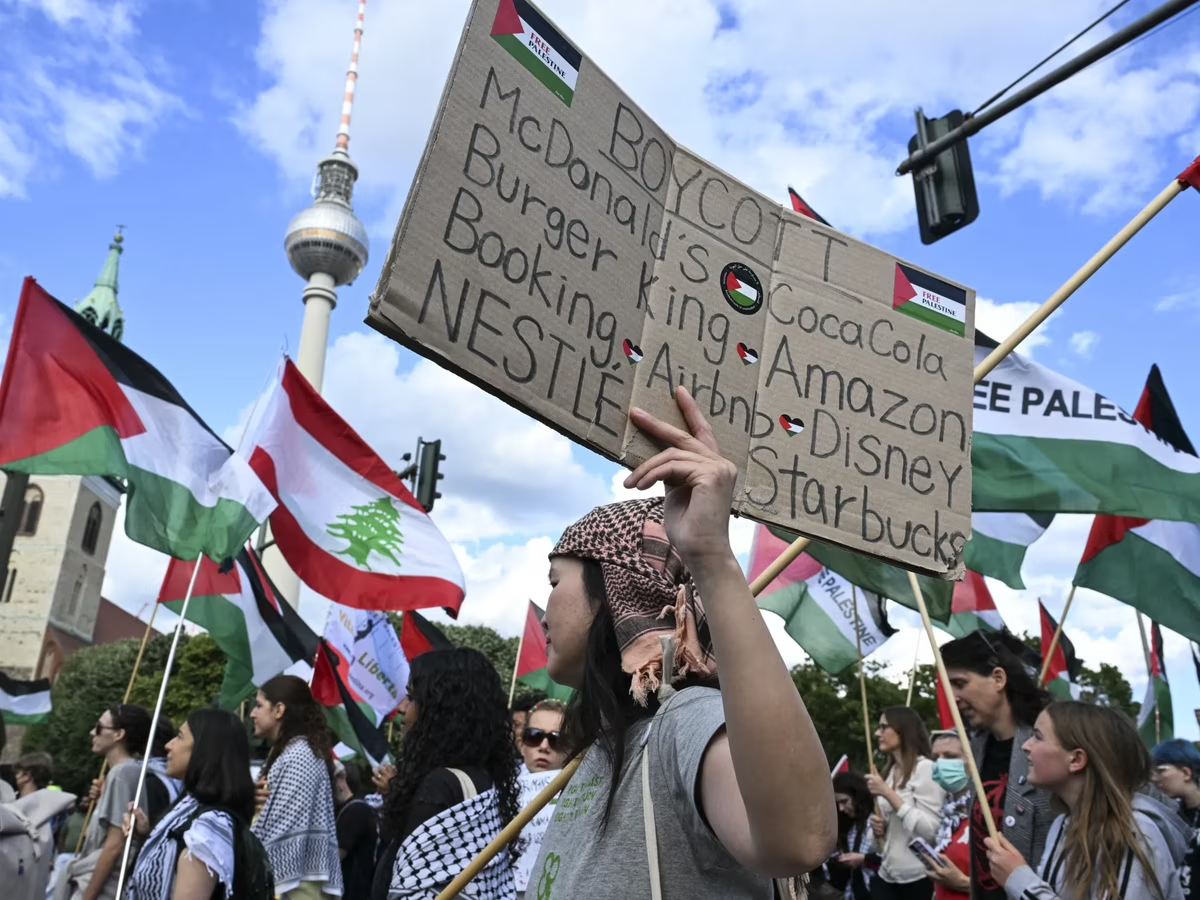
Neptunbrunnen Square in the heart of the German capital, Berlin, witnessed hundreds of demonstrators raising Palestinian flags in a large public event. This demonstration coincides with the fifty-ninth anniversary of the 1967 Naksa, linking historical memory with the painful reality currently experienced by the Gaza Strip. Participants' voices echoed with chants demanding an immediate halt to the war and an end to what they described as an ongoing genocide against civilians.
The famous square transformed into an open platform for expressing widespread popular solidarity with the Palestinian people and condemning Israeli military operations in Gaza, the West Bank, and extending to Lebanon. Field sources reported that the movement was called for by the United National Committee in Berlin, with a wide spectrum of the Palestinian community, Arab, and foreign sympathizers participating. Organizers affirmed that this movement aims to deliver a clear message of rejection of the suffocating siege and the harsh humanitarian conditions faced by the residents of the Strip.
The event included speeches delivered in both Arabic and German, during which speakers emphasized that this year's Naksa anniversary carries an exceptional and tragic character. Speakers pointed out that the scenes coming from Gaza and the West Bank bring back the most difficult moments in the Palestinian-Israeli conflict. They also considered the continuation of the aggression as an attempt to impose a new political and geographical reality that Palestinians reject entirely.
For his part, a spokesperson for the Palestinian community in Berlin affirmed that the Palestinian people, wherever they are, whether inside or in the diaspora, are committed to their inalienable national rights. In his speech, he called for the necessity of strengthening Palestinian national unity as a strategic option to confront current challenges and schemes targeting the cause. He clarified that the movement in European capitals will continue as long as the aggression on the land persists.
The issue of refugees and the right of return emerged as a main theme in the participants' speeches, with speakers emphasizing that generations of the diaspora will not relinquish their right to return to their original homes. They stressed that the ultimate goal of the Palestinian struggle is the establishment of an independent state with Jerusalem as its capital. Participants considered that the increasing awareness among Palestinian youth in Europe guarantees the continued vitality of the cause in international forums.
Participation in the demonstration was not limited to Arab communities but also saw a significant presence of German and European sympathizers from diverse political and intellectual backgrounds. European speakers at the event affirmed that opposition to forced displacement and killing policies is not linked to religion or nationality but is a universal humanitarian and moral stance. They also noted the growing Jewish voices around the world that reject the war and demand an immediate end to the suffering of Palestinian civilians.
At the conclusion of the event, demonstrators sent direct messages of solidarity to the steadfast Palestinians in the Gaza Strip, Jerusalem, and the West Bank, affirming their commitment to continuing popular pressure. This ongoing movement in German streets aims to influence decision-makers in the European continent and keep the Palestinian narrative strongly present in public opinion. With flags raised over Berlin landmarks, this year's Naksa anniversary appeared as a global cry of protest against the bloody present and an affirmation of adherence to historical rights.
This year's Naksa anniversary comes amidst exceptional circumstances experienced by Palestinians, and what is happening in Gaza and the West Bank brings back painful historical moments.
PALESTINE
Sat 06 Jun 2026 8:57 pm - Jerusalem Time
A Widening Gap: How American Media Misleads About the Reality of Democratic Division on Israel
Journalistic reports have highlighted a state of deliberate misinformation in major American media outlets, which attempt to portray the sharp decline in Israel's standing within the United States as a kind of 'transient tension' among Democratic voters. Sources indicated that headlines in newspapers like 'The New York Times' and 'The Washington Post' avoid calling things by their real names, describing widespread public rejection of Israeli policies as mere 'partisan divisions' instead of acknowledging a deep rift between the grassroots and the party leadership.
Data confirms that terms like 'tensions' and 'contentious issues' used by international agencies are not based on any recent opinion polls. The truth ignored by newsrooms in Washington is that the overwhelming majority of Democratic voters have made up their minds against Israeli practices, making the alleged 'division' confined only to the aspirations of the public versus the political elite clinging to the traditional alliance.
Looking at the shocking figures, a poll conducted in August 2025 showed that 77% of Democrats explicitly believe that Israel is committing genocide in the Gaza Strip. In contrast, the percentage of those who deny this accusation does not exceed 11%, indicating a radical shift in American political consciousness towards the conflict, and surpassing the official narrative that the political leadership tries to market.
This did not stop at the legal description of events but extended to material and military support, as a Siena College poll in May 2026 revealed that 74% of Democrats oppose providing any additional aid to Israel. This percentage reflects an overwhelming popular desire to disengage militarily from the occupation, which completely contradicts the policies of the White House and Congress that continue the flow of weapons.
Furthermore, about 67% of Democratic Party members believe that the strategic relationship with Israel now harms US national interests more than it benefits them. This shift in the assessment of 'national benefit' represents a strong blow to the foundations of the historical alliance, as Israel is no longer seen as a strategic asset but as a political and moral burden weighing on the American state.
Data indicates a sharp decline in positive views towards Israel, falling from 34% in 2023 to just 13% in mid-2026. Interestingly, this low percentage makes support for Israel a marginal opinion within the party, just like extreme right-wing views related to abortion bans or mandatory vaccinations in schools.
Despite this popular rejection, the media continues to treat support for Israel as a prevailing liberal value, while the numbers prove that it has become a distinctly right-wing stance that does not enjoy majority support. This discrepancy raises fundamental questions about the reasons for the continuation of the misleading narrative in American media, which often aims to protect the interests of the ruling elite and major donors.
In a related context, the role of political money is glaringly evident, as pro-Israel political action committees, led by 'AIPAC,' have poured tens of millions of dollars to influence primary elections. The budgets of these committees reached approximately $100 million for 2026, in a desperate attempt to sideline progressive voices that express the public's rejection of the occupation.
Party leaders, such as Hakeem Jeffries and Chuck Schumer, are among the biggest recipients of money from pro-Israel lobbies, which explains the huge gap between their statements and the will of their constituents. While these leaders participate in rallies supporting Israel, opinion polls show that their electoral bases sympathize with Palestinians four times more than with Israelis.
This shift is not limited to Democrats in general but extends to young American Jews who have steadily begun to abandon their emotional attachment to Israel. Data has shown that two-thirds of young Jews under 35 do not feel a sense of belonging to Israel, and half of them agree with the view that it is committing genocide in Gaza.
The economic interests of the military-industrial complex also play a pivotal role in the continuation of this support, as 75% of military aid granted to Israel directly returns to American arms companies. This financial recycling creates an army of lobbying groups that promote the continuation of Israeli violence to ensure the flow of profits, regardless of the human cost or popular rejection.
Regarding the aggression against Lebanon, media sources attempted to portray a bill to restrict military aid to Israel as 'controversial' and causing division within the party. But the truth is that 62% of Democrats support taking actual steps to pressure Israel to stop its bombing and withdraw from Lebanese territories, making the bill representative of the majority, not the minority.
Attempts to portray the disagreement as an 'internal conflict' among voters are an attempt to escape a democratic imperative: representing the will of the people. While 77% of voters see genocide, only 8.5% of Democrats in Congress dare to say so publicly, fearing the power of donors and organized lobbies.
In conclusion, American media will continue to vaguely refer to 'division' as long as they refuse to name the party obstructing the will of the people, which is the party leadership linked to the interests of the military complex. The Palestinian issue, for the Democratic voter, has become a morally and politically settled issue, just like climate change and civil rights, awaiting political leadership with the courage to represent this shift.
Support for Israel is now an increasingly marginal opinion among Democrats, and the real gap lies between the will of the voters and the leadership funded by lobbies.
PALESTINE
Sat 06 Jun 2026 8:57 pm - Jerusalem Time
Hamas begins crucial talks in Cairo on arrangements for the second phase of the war's cessation
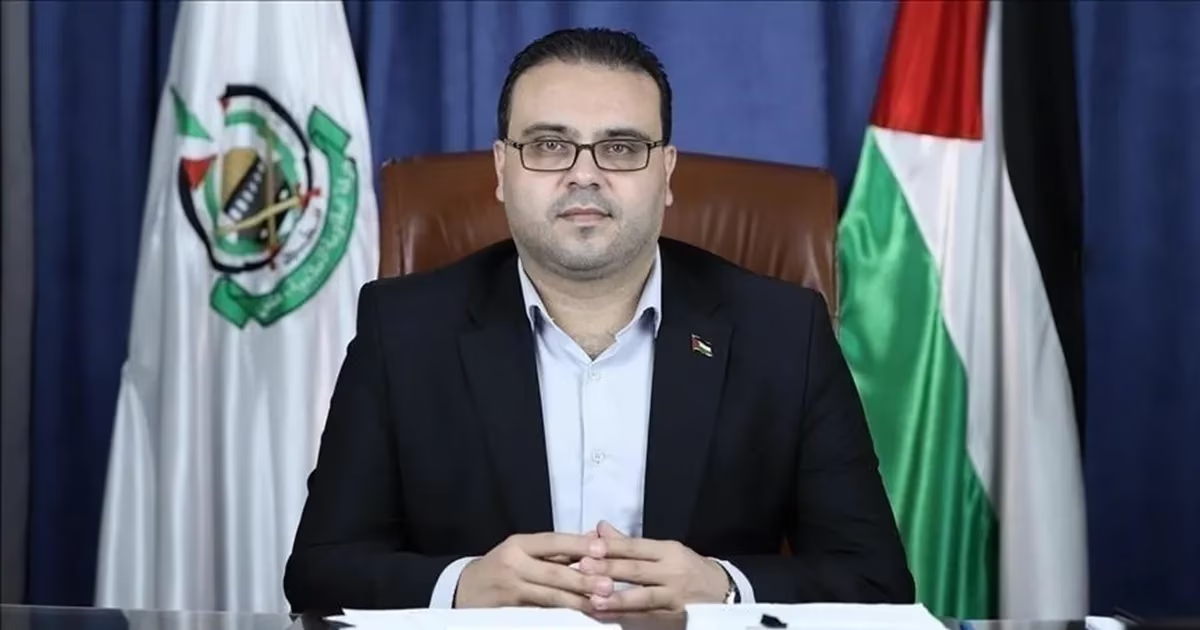
The Hamas movement officially announced the start of a series of intensive meetings in the Egyptian capital, Cairo, with the participation of mediators and representatives of Palestinian factions. These diplomatic moves come within the framework of efforts to complete the provisions of the first phase of the agreement to cease the ongoing Israeli war of extermination on the Gaza Strip, and to pave the way for transitioning to understandings of the second phase.
Spokesperson for the movement, Hazem Qassem, clarified in a video statement that the meetings aim to formulate unified national approaches that enjoy comprehensive Palestinian consensus. He stressed that the movement, along with the mediators, seeks to establish real executive mechanisms that ensure a permanent cessation of aggression and end the suffering of the besieged residents in the Strip.
The agenda of the current meetings focuses on solidifying what has been achieved in the first phase, which previously included opening crossings and the flow of humanitarian aid. The assembled parties also seek to overcome the obstacles placed by the occupation in the way of full implementation of internationally agreed-upon humanitarian commitments.
The discussions include thorny issues related to the second phase, most notably proposals for introducing international forces into the Strip or handing over tasks to a Palestinian national committee. These discussions aim to find acceptable formulas for all parties that ensure the stability of security and field conditions in the coming phase.
Qassem indicated that dealing with the issue of Palestinian weapons represents one of the axes proposed for discussion within a vision aimed at removing the occupation's pretexts. He affirmed that the utmost priority remains protecting the interests of the Palestinian people and preventing Israel from renewing its military aggression under any flimsy pretexts.
A high-level delegation from the Hamas movement, headed by Khalil al-Hayya, had arrived in Cairo on Friday in preparation for this round of negotiations. This visit reflects the movement's desire to complete the path that began with previous meetings, the last of which was in April last year with Egyptian officials.
It is worth noting that the first phase of the agreement came into effect on October 10, 2025, and included an exchange of prisoners and a partial withdrawal of occupation forces. However, Palestinian parties accuse the Israeli side of constantly reneging on its legal and humanitarian obligations stipulated in the document.
Field reports monitored widespread Israeli violations of the existing agreement, represented by continuous shelling and ground incursions in various areas of the Strip. These violations have led to the death of about 947 martyrs and thousands of injured since the start of the supposed truce, threatening the complete collapse of the political process.
Data indicates that the occupation army still controls vast areas exceeding 60% of the Gaza Strip's territory, which violates the withdrawal provisions. Palestinian factions demand real international pressure to force the occupation to retreat to pre-aggression lines and ensure freedom of movement for residents.
The second phase of the agreement includes fundamental issues that go beyond the military aspect, foremost among them the formation of a temporary technocratic committee to manage civil affairs. This phase also includes launching a comprehensive reconstruction process for what the Israeli military machine destroyed over two years of war.
In a related context, the establishment of the 'Peace Council' and the formation of the technical committee, which has begun its temporary duties from Cairo, were announced. Intensive consultations are currently underway regarding the formation of the international force that will oversee security and ensure the implementation of the agreement's provisions on the ground.
Negotiations are clashing with complex issues that are still under discussion, most notably the disarmament file and the timetable for a complete Israeli withdrawal from Gaza. The resistance adheres to a vision that ensures the occupation does not return to control the vital aspects of life in the Strip after the end of military operations.
The United Nations estimates the cost of reconstructing what the war destroyed at about 70 billion dollars, given the enormous scale of destruction that affected 90% of the infrastructure. This cost is a major challenge that requires concerted international efforts to ensure the return of normal life for millions of displaced Palestinians.
These political moves come two years after a genocidal war launched by Israel with widespread American support since October 2023. Mediators in Cairo are now seeking to transform the fragile truce into a sustainable agreement that ends the longest and most violent round of conflict the Strip has witnessed in modern times.
The meetings aim to complete what was included in the first phase, stop the aggression, open the crossings, introduce humanitarian aid, and then enter into discussions regarding the second phase.
ARAB AND WORLD
Sat 06 Jun 2026 8:57 pm - Jerusalem Time
Military escalation in the Gulf: Widespread Arab condemnations of Iranian attacks on Kuwait and Bahrain, and Tehran denounces American strikes
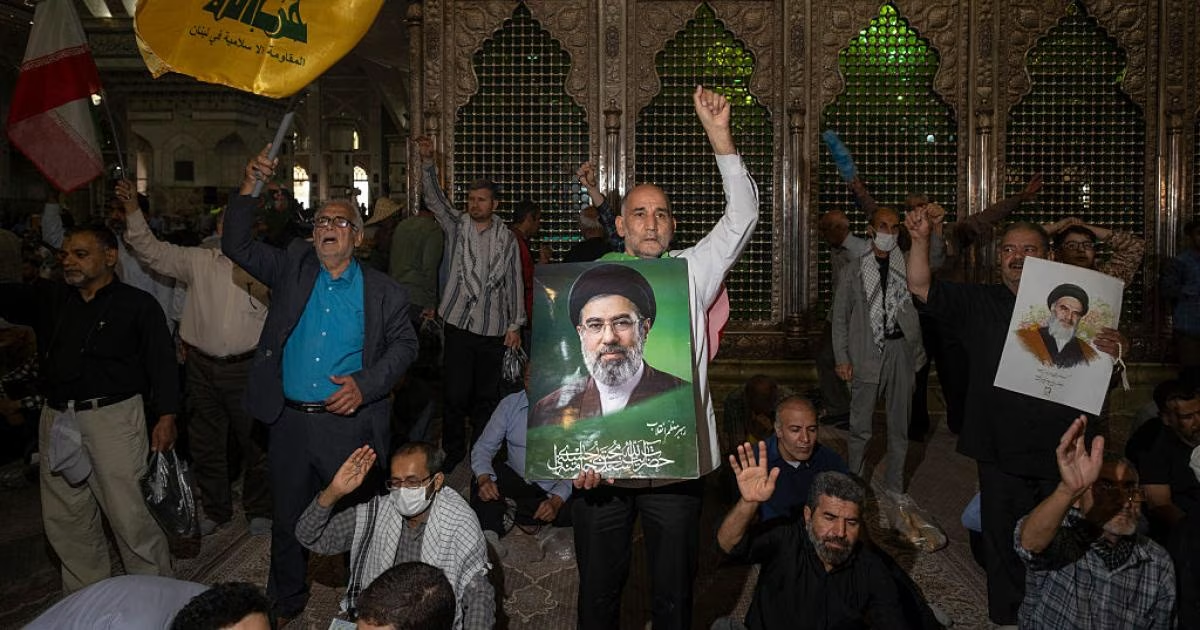
The Islamic Republic of Iran, today Saturday, condemned a new round of American military strikes that targeted radar installations and surveillance sites along the Gulf coasts during the night hours. The Iranian Ministry of Foreign Affairs described these movements in an official statement as a blatant violation of ceasefire agreements and a direct assault on Iranian national sovereignty.
Tehran considered the American behavior aggressive and provocative, noting that Washington bears full responsibility for any military escalation the region might witness as a result of these actions. The Iranian Foreign Ministry affirmed that the repetition of these attacks proves the United States' lack of seriousness in regional de-escalation efforts called for by the international community.
In contrast, the early hours of Saturday witnessed both Kuwait and Bahrain subjected to intense missile attacks, which field sources confirmed originated from Iranian territory. These attacks came after the United States announced precise strikes deep inside Iran, leading to an exacerbation of military tension in vital waterways.
Authorities in Manama described the missile attacks as a blatant aggression and a flagrant violation of state sovereignty, calling on Tehran to immediately cease these unjustified practices. Bahrain stressed the necessity of resorting to peace and avoiding policies that lead to destabilizing the region and threatening the security of its citizens and vital installations.
For its part, the State of Kuwait announced the success of its defense systems in repelling hostile attacks that included ballistic missiles and suicide drones. The Kuwaiti Foreign Ministry expressed its strong condemnation of these repeated aggressions, describing them as a dangerous escalation that disregards all international efforts aimed at sparing the region the woes of wars.
On the diplomatic front, the Kingdom of Saudi Arabia issued a strongly worded statement condemning in the strongest terms what it described as the brutal Iranian aggressions against the sovereignty of Bahrain and Kuwait. Riyadh affirmed that these violations constitute a direct threat to regional and international security, pushing the region towards further uncalculated tension and escalation.
Saudi Arabia indicated that the continuation of these attacks undermines efforts aimed at restoring stability, emphasizing its full support for its brethren in Kuwait and Bahrain. The Kingdom warned that the continued escalatory approach would lead to dire consequences for global energy security and freedom of navigation in the Arabian Gulf.
For its part, the State of Qatar expressed its strong condemnation of the repeated attacks that targeted Kuwaiti and Bahraini territories, considering them a violation of international law. Doha, in a statement from its foreign ministry, stressed the need for serious work to de-escalate and spare the peoples of the region the consequences of direct military confrontations that serve no one.
In a related context, the United Arab Emirates described the attacks as terrorist acts that violate the sovereignty of the sisterly State of Kuwait and threaten its national security. Abu Dhabi affirmed its full solidarity with Kuwait in all measures it takes to protect its territories, emphasizing that the security of the GCC countries is indivisible.
For its part, Cairo entered the crisis with a statement issued by the Egyptian Ministry of Foreign Affairs condemning the sinful Iranian attack on Kuwaiti and Bahraini installations. Egypt considered this escalation a comprehensive threat to the Arabian Gulf region, affirming its absolute support for the two sisterly states in confronting any aggression that affects the integrity of their territories.
Jordan also joined the list of condemning countries, with the Jordanian Foreign Ministry describing the Iranian aggressions as brutal and aimed at undermining regional peace efforts. The Jordanian statement warned against the danger of sliding into a wider conflict, calling for respect for state sovereignty and good neighborliness as a fundamental basis for stability in the Middle East.
These rapid field developments come amidst a state of military alert in the Gulf basin, with international fears of the collapse of fragile understandings. Major capitals are monitoring the course of events, as analysts fear that the exchange of strikes between Tehran, Washington, and its allies could lead to an open confrontation that affects the global economy.
Repeated ceasefire violations show that the United States does not intend to de-escalate, and Washington will bear responsibility for any consequences of its illegal actions.
PALESTINE
Sat 06 Jun 2026 8:57 pm - Jerusalem Time
Widespread American pressure campaign to demand the release of student Sama Safi, detained by the occupation

The pace of human rights and political movements within the United States has escalated, demanding the immediate release of Palestinian-American student Sama Safi, who was abducted by Israeli occupation forces from the town of Birzeit four days ago. These movements come amid growing concern over the fate of the 20-year-old student, who studies at Birzeit University, as her arrest coincided with a campaign that targeted other female students, namely Natalie Abu Diyeh, Golan Abu Awwad, and Laila Khalil.
The Institute for Middle East Understanding has adopted an organized campaign calling on American citizens to directly contact senators to pressure the US administration. The campaign aims to push Washington to intervene urgently to ensure Sama's safety and secure her release, warning of the consequences of continued detention of American citizens without clear legal justifications in the occupied Palestinian territories.
For his part, Senator Chris Van Hollen strongly criticized the occupation authorities' handling of the case, noting via the X platform that the Israeli side has not provided any information to the US Embassy or to the student's family about her place of detention. Van Hollen stressed that this type of arbitrary detention, which takes place without formal charges, represents a blatant violation, demanding the immediate disclosure of her legal status.
In a related context, Senator Peter Welch expressed his deep concern about Sama Safi's health, revealing that she suffers from a chronic health condition that requires continuous medical care. Welch stressed the need to enable her to communicate with her family and legal team, and to ensure she receives the necessary treatment without delay, considering that depriving her of these basic rights exacerbates the seriousness of her situation in detention.
On the official level, the US State Department confirmed that it is fully aware of the incident of the American citizen's detention in the West Bank and is closely monitoring developments. A spokesman for the department explained that the administration is fulfilling its responsibilities towards protecting American citizens abroad, but he refrained from delving into additional details related to the course of investigations or diplomatic communications, citing privacy considerations related to the case.
This escalating crisis reflects the extent of tension in the relationship between American human rights organizations and the occupation's policies towards Palestinians who hold American citizenship. Sources demand the necessity of a firm American stance that ends the policy of administrative detention and detention without charge, especially in light of the systematic targeting of student cadres in Palestinian universities recently.
Israeli authorities have not informed Sama Safi's family or the US Embassy of the location or reason for the detention, which is taking place without formal charges.
PALESTINE
Sat 06 Jun 2026 8:57 pm - Jerusalem Time
Blood on the Wedding Suit.. Israeli Raid Kills Groom in His Tent in Khan Yunis
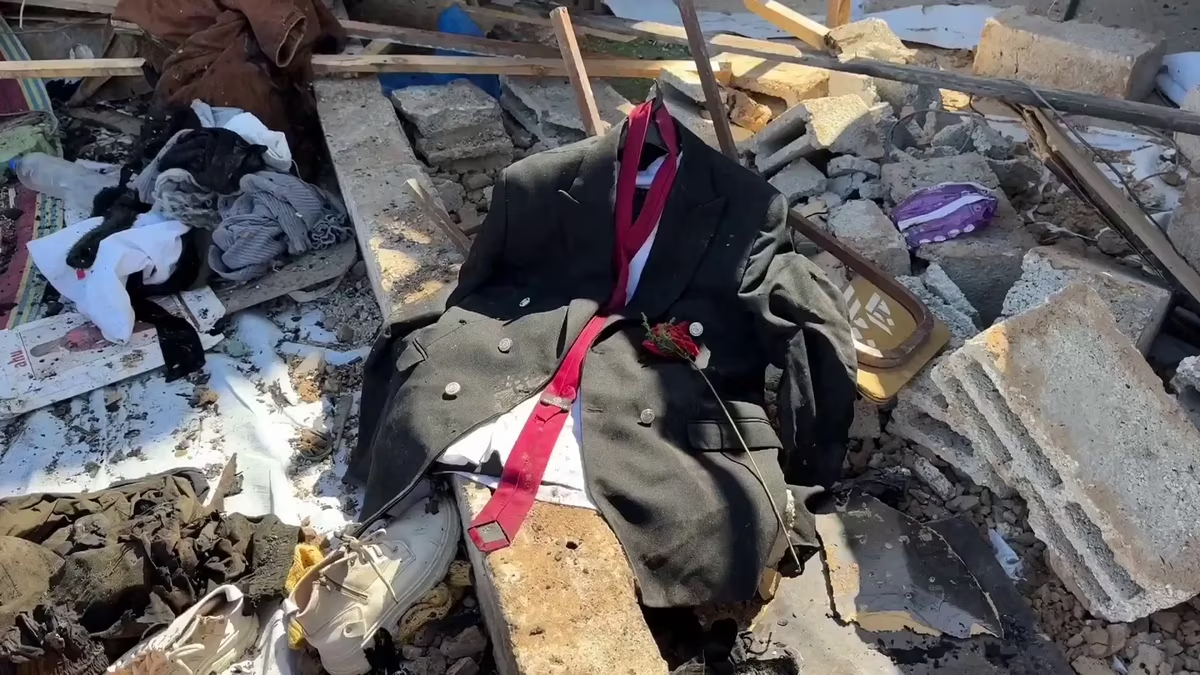
The city of Khan Yunis, south of the Gaza Strip, was shocked by a new crime committed by the Israeli occupation forces, as young Muhannad Farawana was martyred at dawn today, Saturday, following a direct airstrike. The bombing targeted the tent where the young man was sleeping on the roof of his family's house, just a few hours before his wedding, which was scheduled to take place on the same day.
Local sources reported that the explosion occurred at exactly 3 AM, completely destroying the tent and turning its contents into rubble. The scene of the targeting showed harsh images of the remains of the wedding suit and flowers that had been prepared for the occasion, covered in blood and ash, amidst a state of shock that enveloped the martyr's family and neighbors.
Mohammed Mahmoud Al-Qudra, a relative of the martyr, recounted that Muhannad had completed all the final arrangements to welcome his bride and start his new life. He explained that the family had celebrated the previous night in an atmosphere of joy, but the occupation's missiles turned that joy into a horrific human tragedy in fleeting moments.
For his part, Ahmed Othman Farawana, the martyr's brother, confirmed that the targeted site contained all the necessities for living and married life that his brother had struggled to provide under the conditions of war. He pointed out that ambulance and civil defense teams faced significant challenges in reaching the location due to continuous shelling and gunfire in the surrounding areas, despite being classified as a safe zone.
The martyr's family stressed that the targeting occurred in an area far from military engagement points, which confirms the occupation's deliberate targeting of civilians in their displacement and temporary settlement areas. The traces of the fire remained a testament to the extent of the hatred that struck a tent that held nothing but the dreams of a young Palestinian for stability and starting a family.
In conclusion of their testimonies, family members issued an urgent appeal to the international community and human rights organizations for immediate intervention to stop the continuous bloodshed in the Gaza Strip. They affirmed that stories of young people losing their lives in the prime of their youth have become a daily reality haunting the residents of the Strip, amidst international silence regarding crimes targeting unarmed civilians.
The flowers that were prepared to welcome the groom became part of his farewell ceremony, and the place was completely burned, including all its preparations.
PALESTINE
Sat 06 Jun 2026 8:57 pm - Jerusalem Time
Warnings of serious health deterioration for prisoners in 'Ganot' prison due to medical negligence
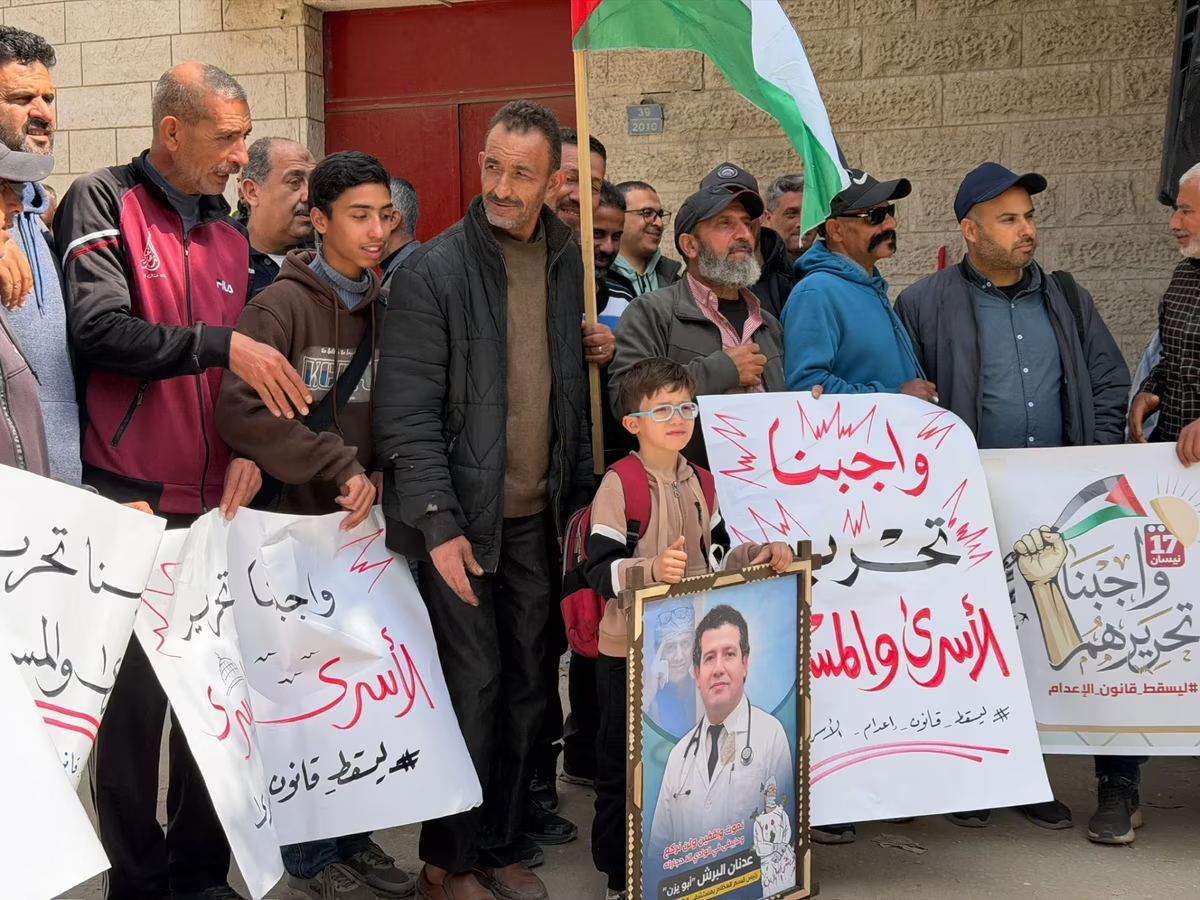
Palestinian human rights sources reported an escalation in the severity of health crises faced by prisoners inside the Israeli 'Ganot' prison located in the Negev desert. The sources confirmed that a large number of detainees suffer from severe pain in their teeth and molars, without the availability of even the most basic medical care or response to urgent treatment requests, reflecting a deliberate policy of medical negligence pursued by the prison administration.
Reports issued by the Prisoners' Information Office clarified that detainees face extreme difficulties in accessing medical clinics or receiving regular follow-up for their conditions. This continuous delay in providing treatment has led to the exacerbation of simple medical conditions, turning them into complex infections and health complications, which increases the burden of daily suffering experienced by prisoners behind bars.
This medical crisis is accompanied by harsh detention conditions imposed by the occupation authorities, where prisoners complain about the poor quality of food provided to them and a severe shortage of basic necessities and detergents. These factors combined have led to a deterioration in the general immunity of the detainees, making the environment inside the prison a breeding ground for diseases that ravage their bodies in the absence of international oversight.
In a related context, Palestinian bodies called on international institutions and human rights organizations to intervene immediately and pressure the Israeli side to stop these violations. The demands emphasized the importance of securing immediate treatment for the sick and ensuring they receive the healthcare guaranteed by international laws and conventions, warning of the consequences of continued disregard that threatens the lives of hundreds.
Official statistics indicate an unprecedented escalation in arrest campaigns since October 2023, with more than 23,000 arrests recorded in the West Bank. Currently, more than 9,400 prisoners are held in occupation prisons, including 86 female prisoners and thousands of administrative detainees who are held without clear charges, which places the international community before its responsibilities regarding this humanitarian issue.
Continued disregard for the health needs of prisoners, foremost among them dental treatment, constitutes a violation of their basic rights and exposes them to serious health complications.
OPINIONS
Sat 06 Jun 2026 3:52 pm - Jerusalem Time
The West Bank and Scenarios of Transformation: Fragile Stability on the Brink of a Deferred Explosion
Dr. Ibrahim Nairat
In the West Bank, the future does not appear as a straight path leading to a clear outcome, but rather as a situation open to multiple possibilities where politics intersects with geography, security with economics, and the daily with the strategic. There is a growing feeling that what is happening is not just a fleeting phase, but a long pattern of reshaping reality under constant pressure, without a definitive horizon to rely on or a clear moment of resolution to build upon.
In this context, the question of the future recurs: What next? And does the West Bank hold a major transformation that could redraw the entire scene and overturn the balances, or is what we see the most that current circumstances can produce in terms of continuous conflict management without resolution, with everything remaining in a state of slow motion that reaches neither an explosion nor a settlement?
One of the most prominent paths is the continuation of the status quo, where there is neither a political settlement nor a comprehensive explosion. In this framework, security control over the land continues, and settlement expansion proceeds gradually, while the Palestinian Authority remains in a position of limited powers, facing accumulated economic and administrative crises, and dealing with a reality that changes before it without full ability to control its direction. In contrast, tensions do not disappear, but appear in the form of intermittent confrontations, individual operations, and security reactions, within a state of unstable calm; it appears stable from the outside but carries within it a slow change in facts, where small transformations accumulate until they become a different reality over time without official announcement.
In addition, another path emerges, represented by the escalation of intermittent waves of confrontation that do not take the form of an organized intifada, but are distributed across cycles of escalation and de-escalation. In this pattern, individual or local operations recur, and hotspots emerge in specific areas, with more severe security responses, in a scene not led by a single center or subject to unified leadership, but formed by multi-party interactions influenced by field, economic, and social conditions. This type of escalation does not fundamentally change the general structure of the conflict, but it exhausts it, puts it under constant pressure, increases its fragility, and makes the idea of stability itself more difficult to achieve.
And in a third, deeper layer of possibilities, a slower but highly impactful path can be observed, represented by the gradual erosion of the existing political system. Here, there is no sudden collapse or clear moment of fall, but a gradual decline in the ability of institutions to perform their functions, widening gaps in administration and governance, declining public trust, and the emergence of local forces or decentralized social and security networks filling the vacuum in some areas. This path reshapes reality in an undeclared way, where the actual structure of authority on the ground changes without a major political announcement or official transition, and over time it becomes difficult to distinguish between what exists and what is forming.
At the same time, an internal dimension emerges, no less important than political and field factors, represented by the strained relationship between society in the West Bank and political leaders at various levels. With the accumulation of crises and the exacerbation of economic and social conditions, from rising unemployment rates, declining growth opportunities, and the pressure of daily life under continuous restrictions, there is a growing sense that the ability to influence the course of events has become limited for all political actors. This feeling does not mean a complete collapse of trust, but it reflects a gradual shift in the general mood, where a part of society tends to assign broader responsibilities to the leadership system with all its spectrums, amid a growing feeling that the actual impact on reality has become weak compared to the magnitude of the accumulated challenges. And as the gap between expectations and reality widens, the question of political effectiveness becomes more prominent, not only towards the authority, but towards all existing forms of political representation.
In contrast, the possibility of a widespread explosion remains present in the analysis, although it depends on the accumulation of exceptional factors that are not easily available individually. This scenario could form if a major security escalation intertwines with a severe political or economic collapse, or a shocking event that widely re-mobilizes the scene, or a moment of comprehensive loss of confidence in the possibility of the current situation continuing. Then the scene could shift from a state of daily conflict management to a widespread confrontation in which popular participation expands, the nature of political and field action changes, and the traditional boundaries between different areas and hotspots recede, but this path remains conditional on complex circumstances and cannot be considered an inevitable or necessarily imminent outcome.
Between these paths, there is a less prominent but theoretically existing possibility of a partial re-engineering of the situation through limited political, security, or economic arrangements. In this scenario, regional or international understandings or interventions may emerge that lead to improvements in some aspects of movement, economy, or local administration, without reaching a radical solution to the conflict and without changing its essence, which means a new management of balances more than a transformation in the nature of the problem itself.
But what makes the West Bank a highly complex case is that these scenarios do not compete as separate alternatives, but coexist within the same reality and operate simultaneously. The scene moves in more than one direction at the same moment: relative stability in one place, escalation in another, and slow erosion in the structure of governance, with the possibilities of explosion or partial de-escalation remaining open depending on the interaction of local, regional, and international factors, and on unexpected transformations that may suddenly appear without clear precursors.
In this sense, the “unknown” in the West Bank does not seem to be a single hidden event awaiting its moment of appearance, but rather the product of a continuous interaction between multiple forces that shape reality day by day, so that the future itself becomes the result of this interaction and not a predetermined destination. Therefore, the West Bank does not face a single answer for the future, but a wide spectrum of possibilities, one of which may advance over the other at a certain moment without prior warning.
In the end, the question remains open to more than one possibility: Will the West Bank continue to manage a long, unresolved conflict, with the continuous reproduction of the same reality in different forms, or will it enter a phase of deeper transformations that redefine the shape of the entire scene, either gradually in the long term or through sudden transformations that rearrange all that exists?
PALESTINE
Sat 06 Jun 2026 3:21 pm - Jerusalem Time
Assassination of Lebanese Army Officers in Israeli Raid in Nabatieh: Pressure Messages Under Fire
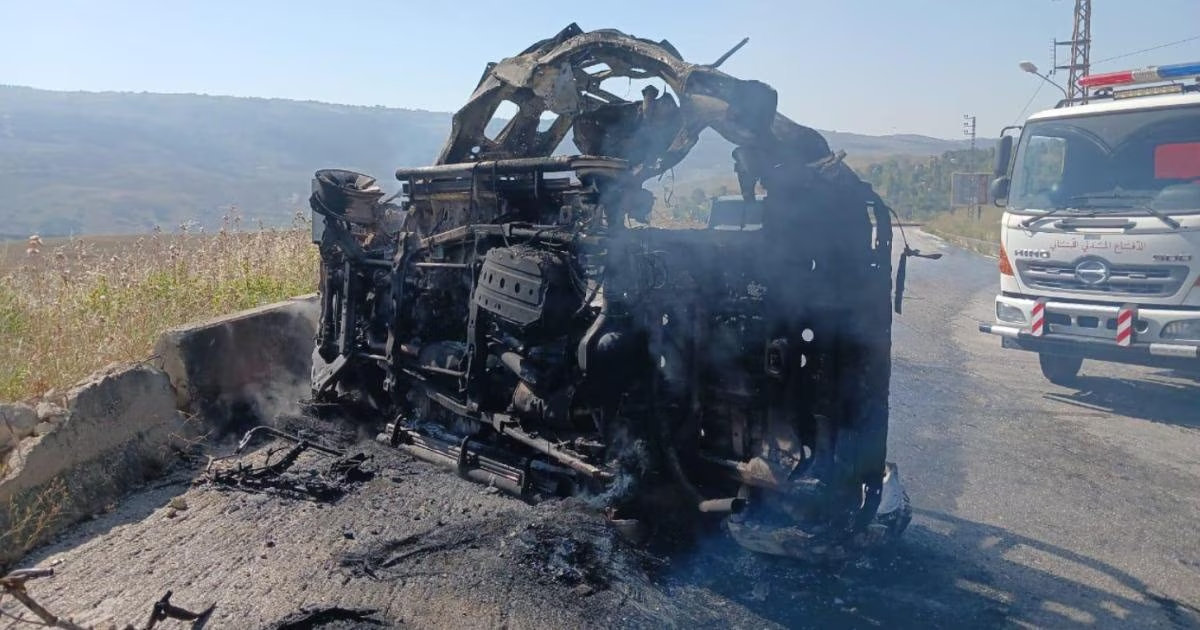
The Israeli occupation army escalated its aggression against Lebanese territories, with its aircraft carrying out a series of intense raids targeting various areas in the south. The shelling directly hit a Lebanese Army vehicle while it was moving on the Kfartibnit - Khardali road in the Nabatieh district, resulting in human casualties among the military institution.
The airstrike resulted in the martyrdom of two officers, a brigadier general and a captain, in addition to a soldier who was with them, in a field development that reflects the extent of Israeli escalation against official Lebanese forces. This incident comes amid the ongoing military operations launched by the occupation on border villages and towns for months.
For its part, the occupation army tried to justify the crime by claiming to have received intelligence indications that Hezbollah intended to open fire from the same area where the military vehicle was located. It issued a statement claiming that the targeting of the vehicle carrying the Lebanese officers is currently under investigation to ascertain its circumstances.
In an official response, the Lebanese Army Command affirmed that this repeated and deliberate aggression will only increase the military institution's determination to carry out its national duties. The statement indicated that the occupation seeks, through these targeting operations, to undermine efforts aimed at reaching a political solution that guarantees a ceasefire and withdrawal from the occupied territories.
Political observers believe that the assassination operation was not accidental, but rather a clear political and military message directed at the Lebanese leadership. The occupation aims, through pressure by fire, to force the army to evacuate its positions in the areas south of the Awali River, to ensure a buffer zone under its fire control.
Analytical sources explained that Israel rejects the diplomatic moves led by the Lebanese Army Command in international forums to establish stability. It appears that the occupation is disturbed by the role played by the military institution in maintaining the cohesion of the state and preventing comprehensive security collapse in the border areas.
In the same context, experts in Israeli affairs indicated that Tel Aviv promotes accusations claiming cooperation between the Lebanese Army and Hezbollah to justify its targeting. Israeli security circles doubt the Lebanese Army's ability or desire to disarm the resistance, which places it in the direct targeting circle according to the current combat doctrine.
On the military level, analysts considered that targeting a clearly identifiable military vehicle reflects an Israeli desire to empty the south of any sovereign or official security presence. The occupation possesses precise surveillance technologies through satellites and drones that allow it to distinguish Lebanese military targets from others with complete ease.
Field data indicates that Lebanese sovereignty is subjected to flagrant and continuous violation, as the occupation seeks to impose its security conditions under the weight of shelling and assassinations. These pressures come at a sensitive time when international demands for de-escalation and a return to the negotiating path to implement international resolutions are increasing.
Military readings concluded that the pattern of Israeli targeting reflects a consistent strategy based on maintaining the momentum of military pressure despite diplomatic efforts on the horizon. The Lebanese Army remains in the face of major challenges to maintain its national role amid the ongoing aggression that does not differentiate between military and civilian targets.
The brutal and deliberate Israeli aggression against the army continues to strengthen our resolve and determination to confront attempts aimed at thwarting stability efforts.
ARAB AND WORLD
Sat 06 Jun 2026 3:21 pm - Jerusalem Time
Trump: Iran 'strong and proud' but will eventually be forced to agree
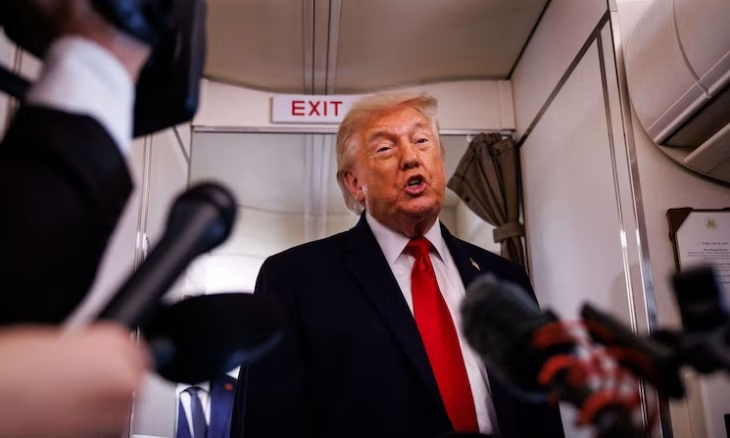
US President Donald Trump announced that the Iranian leadership has not yet reached a final agreement formula with Washington to end the ongoing military conflict, considering that Tehran is acting from a position of being 'strong and proud'. Trump indicated that the new reality imposed by events will eventually force Iran to sit at the negotiating table and make concessions it did not expect.
In a recently broadcast media interview, Trump explained that diplomatic negotiations with the Iranian side require a long time and cannot be resolved in days. He stressed that the US administration is monitoring the field developments that impose very limited options on Tehran to exit the current crisis, which has entered its fourth month.
These statements come amid intensive international efforts to end the war that erupted between the two parties, which witnessed periods of fragile calm. The two sides had reached a ceasefire agreement last April, but tensions repeatedly renewed due to the exchange of military strikes in the strategic Strait of Hormuz region.
For his part, US Secretary of State Marco Rubio affirmed before the House of Representatives that the large-scale military operation known as 'Epic Fury' has completed its primary objectives. Rubio explained that the recent military movements were purely defensive in nature, aiming to protect US interests from continuous threats.
Rubio indicated that US forces changed their strategy to directly target the elements responsible for launching drones, instead of merely shooting down the drones themselves. He stressed that Washington is ready to stop these strikes as soon as Iranian attacks targeting international navigation and ships near the strait cease.
The conflict had earlier caused the closure of the Strait of Hormuz, which led to severe disruptions in global energy markets and a record rise in oil prices. This closure placed significant economic and political pressure on the US administration, prompting it to seek a balance between military response and containing economic repercussions.
During his speech, Trump criticized repeated demands to expedite the end of the war, noting that major conflicts historically take many years to reach permanent solutions. He compared the current situation to the Vietnam War, which lasted for nearly two decades, emphasizing that his administration is moving at record speed given the scale of the challenges.
The US President said that the armed forces have inflicted severe damage on Iranian military capabilities over the past three months. He added that intelligence assessments indicate the destruction of most of the infrastructure dedicated to manufacturing and launching drones and ballistic missiles that Tehran relied on.
Despite confirming the extent of the destruction, Trump acknowledged that Iran still retains a portion of its military arsenal capable of carrying out limited attacks. Military experts estimated that Tehran still possesses approximately 22 percent of its missile inventory that was available to it before the outbreak of direct confrontation.
Trump pointed to recent attacks in the Gulf region, which targeted vital facilities such as Kuwait International Airport, as evidence of the remaining Iranian offensive capabilities. He considered these attacks to reflect desperate attempts by the Iranian side to assert its presence despite the heavy losses incurred by the regime.
The US President defended the decision to begin military operations involving regional parties, affirming that the primary strategic goal was to prevent Iran from developing a nuclear weapon. He considered military action necessary to ensure regional security and prevent Tehran from possessing unconventional threat tools.
Regarding the diplomatic path, Trump hinted at the possibility of current efforts failing if Iranian intransigence in accepting US conditions continues. He said that he might be forced to make decisive and difficult decisions if an agreement that guarantees the security interests of the United States and its allies is not reached.
Trump warned that the alternative to a political agreement would be 'another path that is not pleasant,' in a clear reference to the possibility of an unprecedented escalation of military operations. He affirmed that Washington has ready plans to deal with all possible scenarios if negotiations completely collapse.
Finally, Trump stressed that economic and military pressures will eventually lead to the Iranian leadership's submission, no matter how much it tries to show strength at present. He considered that time is on the side of the United States, which has the ability to continue the confrontation for long periods until its goals are achieved.
Either we sign a deal, or we go the other way, and the other way is not pleasant.
PALESTINE
Sat 06 Jun 2026 3:21 pm - Jerusalem Time
Summer Lee Attacks "Moral Rot" Within Democratic Party Following Targeting of Tlaib and Hamoui
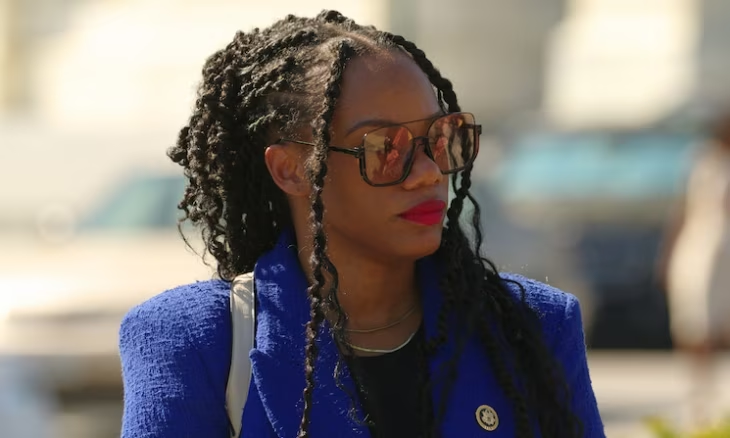
Democratic Congresswoman Summer Lee launched a scathing attack on her party's leadership, criticizing what she described as an unjustified silence regarding a wave of anti-Muslim rhetoric targeting her congressional colleagues. Lee asserted that this disregard reflects a 'moral rot' permeating the party's corridors, warning that allowing this type of hatred to grow will make it uncontrollable in the near future.
These sharp statements came via a video Lee posted on social media platforms, where she described the Democratic silence as a 'cancer' threatening the party's ability to provide moral leadership. She emphasized the necessity of not standing idly by in the face of attempts to dehumanize any marginalized group within American society or within the legislative institution.
The crisis erupted following heated debates in the House of Representatives over a resolution introduced by Palestinian-American Congresswoman Rashida Tlaib, aimed at preventing US forces from getting involved in Israeli military operations in Lebanon. During the session, Republican Congressman Max Miller directly accused Tlaib of 'defending terrorists daily,' which sparked widespread outrage.
The attacks were not limited to Miller; Republican Congressman Brian Mast joined him, describing the representatives supporting the resolution as 'agents of Hezbollah.' Despite the severity of these accusations, which impugn the patriotism of elected members, the reactions from Democratic leaders were described as weak and disappointing by the party's progressive wing.
In a move that angered advocates for Palestinian rights, Democratic Minority Leader Hakeem Jeffries and over a hundred Democratic representatives joined Republicans to vote against Tlaib's resolution. This bipartisan alliance against the peaceful initiative was seen by Summer Lee as further evidence of the moral gap the party suffers from in its handling of Arab and Islamic issues.
Lee clarified that the attack on Tlaib is not an isolated incident but part of a recurring pattern targeting her for being Palestinian and Muslim. She stated that describing a congressional colleague as a terrorist simply because of her existence and identity represents a dangerous decline in American political discourse and necessitates a firm response from all democratic forces.
The congresswoman linked what Tlaib experienced to the campaign targeting Dr. Adam Hamoui, a former US Army surgeon and the winning Democratic candidate in the New Jersey primary elections. Hamoui faced harsh criticism and attempts to tarnish his reputation based on old social connections within the Egyptian-American community.
Sources indicated that some Democrats contributed to this incitement, including Congressman Jared Moskowitz, who publicly stated that Hamoui 'does not align with our values.' Lee considered this type of statement to be the use of the worst stereotypes and clichés against Muslims from within their supposed political home.
Lee addressed the media's role in this crisis, noting that major newspapers like 'The New York Times' focused on controversial aspects of Hamoui's life before later adjusting their headlines. She believed that this implicit complicity contributes to isolating competent Muslims and excluding them from the political scene through systematic 'demonization.'
The congresswoman warned that the continuation of this approach threatens the unity of the political alliances on which the Democratic Party is built, questioning how the party can claim to defend justice and equality while failing to protect its members from racism. She affirmed that the party's message will lose credibility if it continues to apply double standards to issues of discrimination.
In a related context, the Lebanese arena has witnessed a dangerous military escalation since last March, with sources reporting the martyrdom of over 3,500 people and the displacement of approximately 1.2 million others. Tlaib's legislative attempts come within the framework of seeking to limit American involvement in this conflict, which observers describe as a worsening humanitarian catastrophe.
Summer Lee concluded her message by emphasizing the interconnectedness of issues of liberation and justice for all groups, stressing that no marginalized group should be left alone in the face of targeting. She called for dealing with 'Islamophobia' with the same seriousness with which any other form of racial or religious discrimination is dealt with to ensure the integrity of the American political fabric.
The silence of Democrats when Muslim colleagues and candidates are attacked is a cancerous rot, and we cannot lead our country if we are willing to accept the abuse of any marginalized group.