OPINIONS

Thu 18 Jun 2026 6:58 am - Jerusalem Time

The US-Iran Agreement Reshapes the Middle East and Solidifies Netanyahu's Political Defeat

Washington's Message

Washington – Said Arikat – 6/18/206

News Analysis

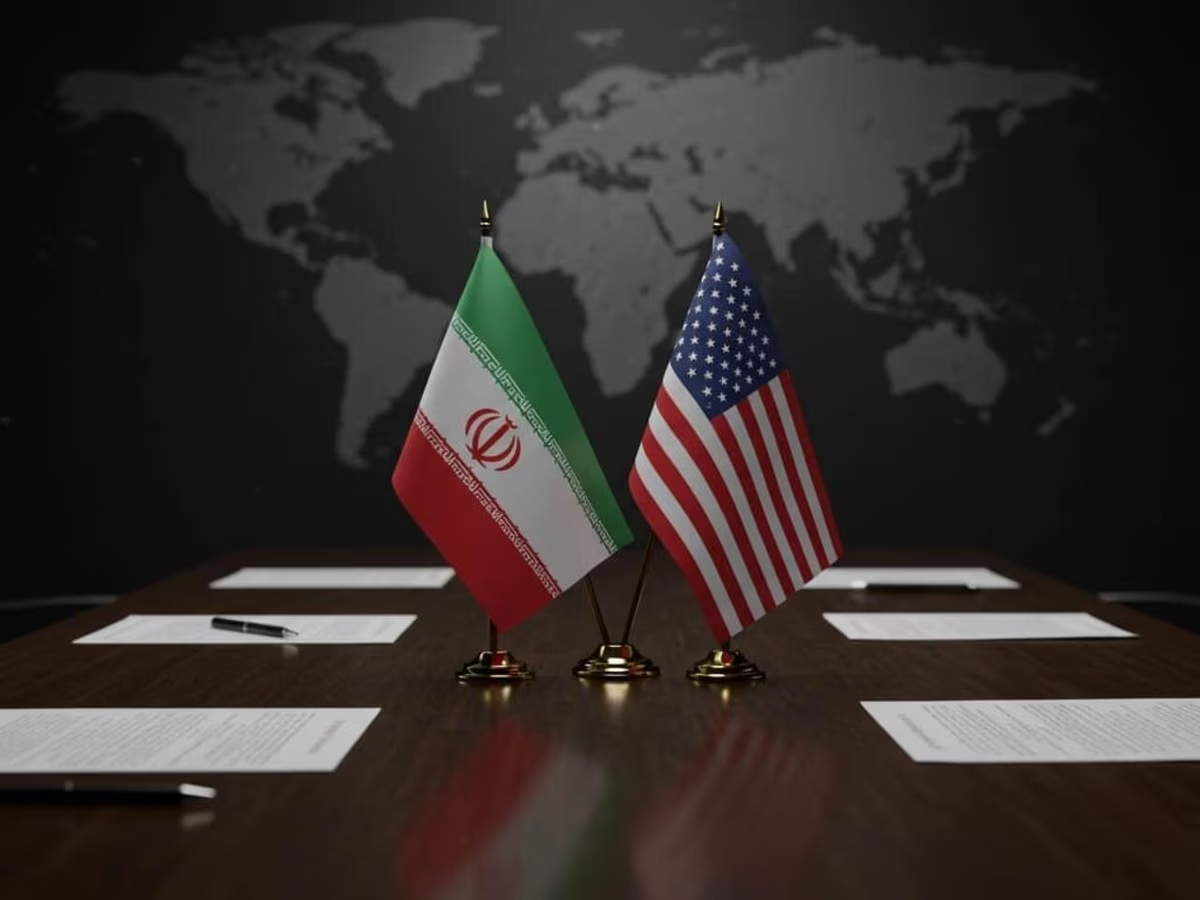
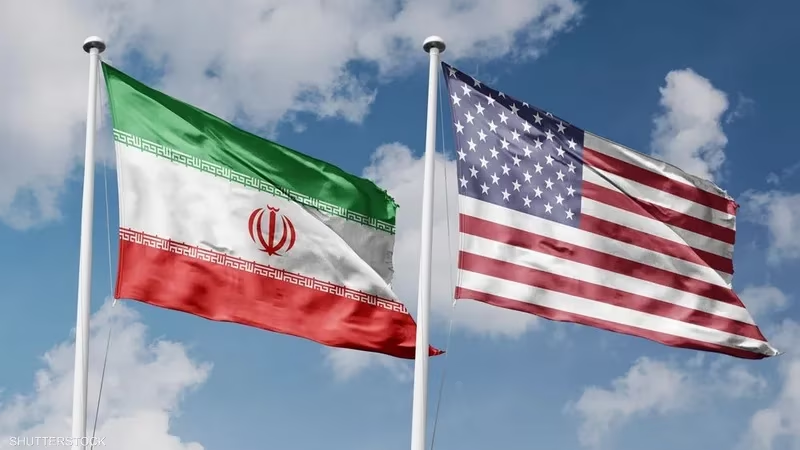
In a historic shift that may be the most significant in US-Iranian relations since the 1979 Islamic Revolution, US President Donald Trump announced on Wednesday evening the full text of a fourteen-point memorandum of understanding between the United States and Iran, after it was electronically signed by officials from both sides, to enter into force immediately. US Vice President J.D. Vance is scheduled to participate in the official signing ceremony on Friday in Geneva.

The agreement puts an end to a period of dangerous military escalation that nearly pushed the region into a widespread war, before considerations of economic and strategic cost outweighed the logic of military confrontation. It also opens the door to a sixty-day negotiation process to reach a more comprehensive final agreement addressing nuclear, economic, and security issues, and regional relations between the two countries.

According to informed sources, the final signing was scheduled to take place during a direct meeting in Switzerland, but intensive diplomatic mediations prompted both parties to accelerate the process and approve the electronic signing with the aim of expediting the implementation of urgent provisions, foremost among them the reopening of the Strait of Hormuz and the restoration of freedom of international navigation in the Gulf.

The agreement includes fourteen main points, including an immediate cessation of hostilities, respect for mutual sovereignty, reaching a final agreement within sixty days, reopening the Strait of Hormuz, resuming Iranian oil exports, freezing new US sanctions, Iran's commitment not to seek nuclear weapons, freezing its nuclear program at its current level, returning maritime trade to normal, preventing any further military escalation, establishing a joint monitoring and implementation mechanism, launching an international program to rehabilitate the Iranian economy with an estimated value of 300 billion dollars, in addition to initiating negotiations on frozen Iranian assets and sanctions, and finally presenting the final agreement to the UN Security Council.

The agreement reflects a mutual acknowledgment of the limits of power for both parties. After many years of sanctions, pressure, and indirect military operations, Washington failed to impose a radical change in Iranian behavior, just as Tehran was unable to eliminate US influence from the region or overcome the impact of the US-led global financial system. Thus, the agreement came as a practical recognition that the continuation of the conflict had become more costly than reaching a political settlement that preserves the minimum interests of both sides.

The text of the memorandum also reveals a clear shift in the American approach. Instead of insisting on addressing all contentious issues at once, including Iran's missile program and Tehran's regional alliance network, Washington focused on more realistic goals: preventing nuclear armament, ensuring the security of maritime navigation, and opening a gradual path to address sanctions and economic issues. This reflects a growing conviction within the US administration that expanding the negotiation agenda to the maximum extent would have led to the collapse of the entire process.

Despite repeated comparisons with the 2015 nuclear agreement, the new document goes far beyond that model. The previous agreement was limited to the Iranian nuclear file in exchange for sanctions relief, while the current understanding establishes a broader political, security, and economic framework that includes Gulf security, freedom of navigation, economic reconstruction, de-escalation mechanisms, and the future of the relationship between Washington and Tehran itself. Therefore, considering it merely a modified version of the 2015 agreement is a misleading simplification of its nature and scope.

However, the most striking aspect of this development lies in its repercussions for Israel, specifically for Prime Minister Benjamin Netanyahu, who spent many years warning against any American openness to Iran, and made the policy of confrontation, isolation, and maximum pressure the cornerstone of his strategy towards Tehran.

Since the beginning of the recent crisis, Netanyahu gambled that military escalation would push Washington to adopt a tougher policy towards Iran, and perhaps to impose harsh conditions on it or enter into an open confrontation with it. However, the result was completely the opposite. Instead of expanding the circle of war, the crisis ended in an agreement that relaunches the US-Iranian dialogue and gives Tehran an opportunity to gradually emerge from economic isolation, and reintegrates it into new regional and international arrangements.

For this reason, many observers view the agreement as a clear political and strategic defeat for Netanyahu, not only because he failed to prevent the understanding, but because the war he advocated for practically ended in the very outcome he had sought for years to prevent: direct negotiations between Washington and Tehran under international auspices, and mutual recognition of the necessity of managing differences through diplomacy rather than open confrontation.

The agreement also deals an additional blow to the traditional Israeli narrative, which was based on portraying the conflict with Iran as an existential struggle that could only be settled through continuous pressure, sanctions, and the threat of military force. The success of Washington and Tehran in reaching this negotiating framework proves that a diplomatic alternative is still possible even after many years of hostility and distrust.

Regionally, the agreement may open the door to a new phase of de-escalation and reordering of priorities. US-Iranian hostility was one of the main drivers of crises in Iraq, Syria, Lebanon, Yemen, and the Gulf. If both parties succeed in solidifying the current understandings, real opportunities may arise to mitigate conflicts and open new political paths in a number of complex regional issues.

Nevertheless, the real challenge lies not in signing the agreement but in its continuation. The previous experience of the 2015 nuclear agreement showed that any understanding can collapse with changes in administrations or shifts in political calculations. Moreover, opponents of the agreement in Washington, Tehran, and Tel Aviv will work to test its resilience from the very first moment.

But, even if the agreement faces significant obstacles in the future, merely reaching it after nearly forty-seven years of estrangement and hostility represents a historic event in itself. It not only reflects the end of a round of confrontation but also signals the beginning of a reshaping of regional balances on new foundations, and solidifies a political reality that is difficult to ignore: that the war Netanyahu hoped would strengthen his position ended by strengthening the diplomacy he had long sought to prevent.

PALESTINE

Thu 18 Jun 2026 6:57 am - Jerusalem Time

Amnesty: Israeli Evacuation Orders in Lebanon Amount to Forced Displacement and War Crimes

Amnesty International confirmed in a new human rights report that the Israeli army systematically adopted a policy of mass evacuation orders to forcibly displace Lebanese civilians from their homes. The organization considered these practices a blatant violation of the Fourth Geneva Convention, emphasizing that these actions may amount to war crimes due to their coercive and widespread nature.

The report revealed a significant expansion in the scope of Israeli military operations, with the area covered by evacuation orders increasing from about 5% of Lebanon's total area in late 2024 to 6% by April 2026. The analysis indicated that these orders were not merely temporary precautionary measures but had become a means to alter the demographic and geographical reality in the targeted areas.

The organization highlighted what it called the 'no-return zone' in southern Lebanon, which extended to cover an area of 600 square kilometers. This zone includes about 68 border villages, where the Israeli army prevents residents from returning despite international demands, and without providing any real guarantees for the safety of civilians who were forced to leave.

According to data analyzed by the organization's Crisis Evidence Lab, the largest burden of evacuation orders was concentrated in southern Lebanon, accounting for 75% of all issued orders. The remaining orders were distributed between the southern suburbs of Beirut (15%) and the Beqaa region (5%), reflecting a comprehensive targeting of infrastructure and population centers in these areas.

Amnesty documented widespread destruction of entire villages after their evacuation, confirming that this deliberate destruction occurred in areas where residents were definitively prevented from returning. It clarified that these operations continued even after talks of ceasefire understandings, indicating a premeditated intention to impose a new security reality at the expense of civilian rights.

In a related context, researcher Sahar Mandour from the organization called for an immediate Israeli withdrawal from all occupied Lebanese territories to ensure the safe return of displaced persons. Mandour stressed the importance of compensating those affected for the severe losses to their private property and infrastructure, considering that depriving residents of their agricultural lands represents a devastating blow to their livelihoods.

Interviews conducted by the organization with dozens of displaced persons showed that the vast majority of them are still unable to access their homes many months after their evacuation. The displaced reported that Israeli authorities issued more than 61 explicit orders prohibiting return, turning their lives into a continuous journey of displacement under extremely harsh living conditions.

The organization described the humanitarian situation in southern Lebanon as an 'actual catastrophe,' as current shelters lack the capacity to accommodate more than 10% of the total displaced persons. Hundreds of thousands live in schools and temporary buildings that lack the most basic necessities for a dignified life, amidst ongoing shelling and military warnings that exacerbate the humanitarian crisis.

For its part, the Israeli army attempted to deny imposing a permanent ban on the return of civilians, but statements by Security Minister Yisrael Katz confirmed the continued presence of forces in the evacuated areas. Katz indicated that military control would continue in some border villages, which contradicts official Israeli claims regarding the nature of military operations in those areas.

Finally, statistics from the Lebanese Ministry of Social Affairs indicate that the number of displaced persons has exceeded one million, most of whom are residents of the southern villages that were subjected to forced evacuation operations. These figures confirm the scale of the tragedy caused by the ongoing conflict, amidst international demands for respect for international humanitarian law and the protection of civilians' rights to return and compensation.

The core message of the report is the necessity of implementing a ceasefire on the ground, an immediate Israeli withdrawal from all Lebanese territories, and allowing all displaced persons to return to their homes.

PALESTINE

Thu 18 Jun 2026 6:57 am - Jerusalem Time

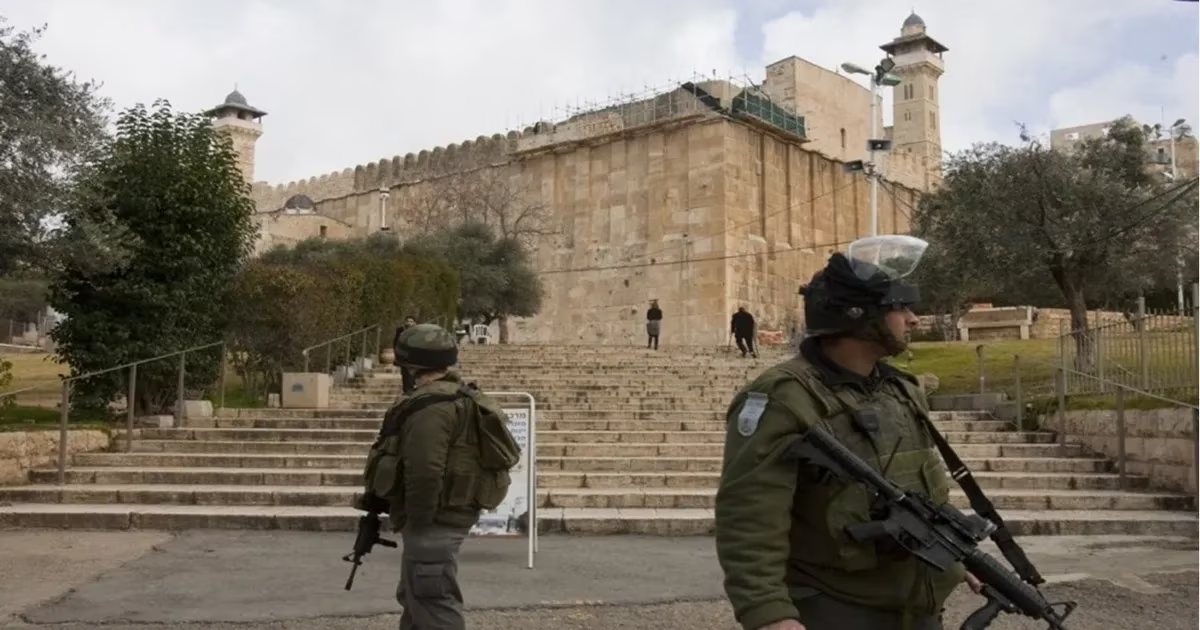
The occupation approves settlement expansion in Hebron and cancels municipal powers around the Ibrahimi Mosque

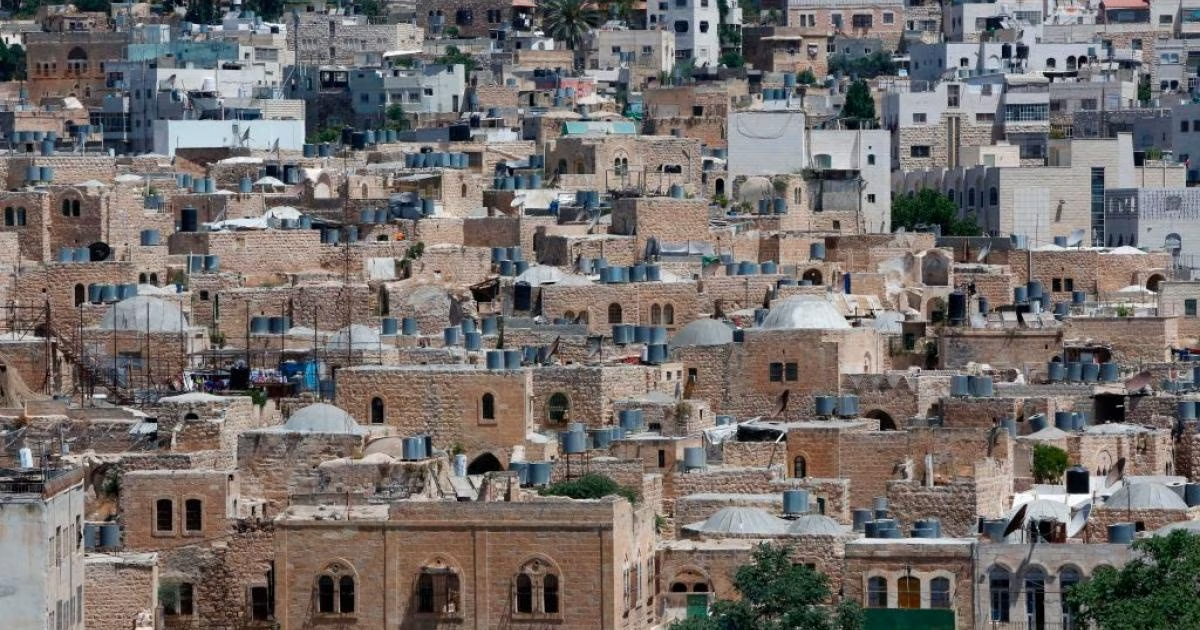
On Wednesday, the Israeli occupation authorities gave the green light to begin massive expansion work for a religious school belonging to settlers located in the heart of the occupied city of Hebron. This step comes in the context of an escalating settlement drive aimed at strengthening Israeli control over the city's historic center, amidst warnings of its repercussions on the Palestinian presence.

Israeli Finance Minister Bezalel Smotrich announced that the project includes the construction of a new building spanning approximately one thousand square meters for the religious school. Smotrich affirmed in an official statement that this decision falls within the government's policy aimed at imposing new realities on the ground and consolidating the settlement presence in the West Bank in general and in Hebron in particular.

This announcement coincided with another decision issued by Smotrich to cancel the administrative arrangements that granted the Hebron Municipality planning and construction powers in the vicinity of the Old City. This cancellation includes all areas surrounding the holy Ibrahimi Mosque, which means the complete transfer of engineering and administrative supervision to the occupation authorities, thus ending the role of Palestinian national institutions in managing the city's affairs.

Palestinian observers believe that these measures represent a blatant violation of the Hebron Agreement signed in 1997, which regulated security and civil powers in the divided city. The agreement granted the municipality a pivotal role in construction and renovation operations, but the new decisions disregard all previous international and local understandings.

Currently, more than a thousand settlers reside in fortified settlement outposts around the Ibrahimi Mosque, where they live under strict military protection amidst tens of thousands of Palestinian citizens. These new expansions lead to increased daily friction and tighten the noose on the indigenous population who face strict restrictions on their movement and urban development.

For his part, Palestinian activist Issa Amro warned of the danger of reducing the municipality's powers, stressing that the ultimate goal is to deteriorate basic services provided to Palestinians to push them towards forced displacement. Amro explained that what is happening is a silent displacement process and a systematic demographic change aimed at Judaizing the heart of Hebron completely by isolating the Ibrahimi Mosque from its Arab surroundings.

On the other hand, the decision was widely welcomed by settler leaders in Hebron, who considered that the cancellation of the Palestinian municipality's powers removes administrative obstacles that had hindered their projects. An official in the Settlers' Council stated that this step represents the inauguration of a new phase of urban settlement expansion that will witness an accelerated pace in the coming years.

These developments come in light of the current Israeli government's directives to strengthen settlement deep in the West Bank by facilitating land purchase procedures and granting extensive powers to the Civil Administration affiliated with the occupation army. These decisions reflect an insistence on undermining any possibility of future Palestinian sovereignty in the areas classified as 'H2' according to the Hebron Agreement divisions.

This step comes as part of consolidating the Israeli presence in the region and imposing facts on the ground.

ARAB AND WORLD

Thu 18 Jun 2026 6:57 am - Jerusalem Time

Washington and Tehran Agreement Enters into Force: Opening of the Strait of Hormuz and Gradual Lifting of Sanctions

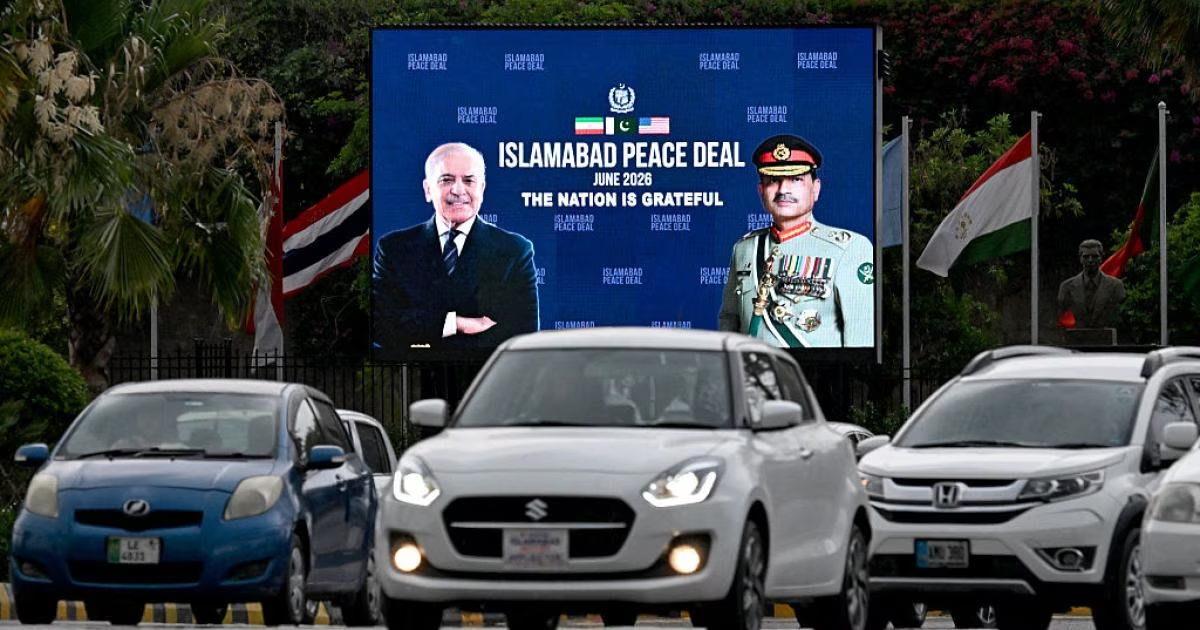
Pakistani Prime Minister, Muhammad Shahbaz Sharif, announced the immediate entry into force of the Memorandum of Understanding (MoU) concluded between Tehran and Washington, following the completion of formal signing procedures by both sides. Sharif clarified that this step represents a fundamental shift towards diplomacy to end the armed conflict that has overshadowed the region, noting that the first practical step will be the reopening of the Strait of Hormuz to international navigation.

For its part, the Iranian Foreign Ministry confirmed that the agreement was signed electronically between the two leaderships, considering this format to lend greater seriousness to mutual commitments. The ministry's spokesperson, Ismail Baghaei, stated that the text of the 'Islamabad Memorandum of Understanding' is now ready for actual implementation, emphasizing that the next phase will be a real test of the parties' commitment to what has been agreed upon.

The terms of the memorandum, revealed by informed sources, stipulate that the United States will immediately suspend sanctions imposed on Iranian oil exports once the agreement enters into force. In return, Tehran commits to ensuring full freedom of maritime navigation in the strategic Strait of Hormuz within thirty days, to end the paralysis that has affected global energy trade.

The agreement also includes a 60-day timeframe for intensive negotiations to reach a final and comprehensive settlement, at the end of which Washington will lift all economic sanctions. The negotiation track includes the controversial Iranian nuclear program, in addition to understandings on the establishment of an international fund dedicated to the reconstruction and development of Iran's war-damaged economy.

In the context of evaluating the results of the military confrontation, reports indicate that the US administration under Donald Trump is seeking to market the agreement as a political and military achievement. This view is based on the extent of losses inflicted on Iran's military infrastructure during months of fighting, which included the destruction of large parts of air defense systems and missile capabilities.

Estimates from military sources indicate that Iran lost about a third of its ballistic missile arsenal, with confirmed losses ranging between 800 and 3,000 missiles. Washington also announced its success in intercepting thousands of drones and neutralizing more than 80% of the Revolutionary Guard's radars and air defense platforms.

Despite these heavy military figures, observers believe that Tehran maintained a degree of deterrence until the last moments of the war, as it continued to threaten vital waterways. The question remains about the extent to which major political goals have been achieved, especially since Iran's nuclear capability has not been completely dismantled according to recent intelligence reports.

Sources clarify that US estimates still indicate Iran's ability to produce enough material for a nuclear weapon in less than a year, a situation that has not fundamentally changed from what it was before the confrontation. This reality places the results of the war under critical scrutiny, as some believe that the exorbitant cost did not lead to a definitive resolution of the nuclear issue.

Regionally, it appears that Iran's network of influence has been subjected to severe pressure, but the goal of 'regime change' hinted at by some parties at the beginning of the conflict remained elusive. Combat operations ended with sitting at the negotiating table with the same political leadership, reinforcing the hypothesis that diplomatic solutions were the only possible way out.

The return to diplomacy through Islamabad reflects an international desire to contain the repercussions of the conflict on the global economy, especially with the sharp rise in energy prices. The opening of the Strait of Hormuz represents the breathing room that the global market awaits to restore its stability after a period of unprecedented disruptions in supply chains.

Analysts believe that the next phase will witness a different kind of struggle at the negotiating table, where Tehran will try to trade its nuclear concessions for quick economic gains. In return, Washington will seek to ensure permanent restrictions that prevent Iran from restoring its offensive military capabilities or threatening US allies in the region.

The current agreement, despite being a framework 'Memorandum of Understanding,' puts an end to a phase of direct military escalation that threatened to ignite a comprehensive regional war. Regional mediations, especially Pakistani and Swiss, play a pivotal role in bridging views and providing the necessary guarantees to begin implementing sensitive provisions related to security and navigation.

Regarding Iran's internal situation, the lifting of oil sanctions represents a lifeline for the struggling economy, which the authorities may use to calm the domestic front after months of wartime pressures. Iranian oil is expected to gradually flow into global markets, which could contribute to lowering global fuel prices.

In conclusion, the implementation of the 'Islamabad Agreement' remains contingent on the mutual trust that is still fragile between the two parties, as the Iranian Foreign Ministry spokesperson warned that the 'test time' has effectively begun. International powers will closely monitor Washington's commitment to the sanctions lifting schedule, against Tehran's seriousness in opening waterways and halting its escalatory military activities.

The drafting of the Islamabad Memorandum of Understanding has been completed with the signing of the presidents, and it is now time to test the implementation of this agreement.

PALESTINE

Thu 18 Jun 2026 6:57 am - Jerusalem Time

Beit Iksa... A Quadruple Siege and Silent Displacement Policies Suffocate the Jerusalemite Village

The village of Beit Iksa, located northwest of occupied Jerusalem, stands as a witness to harsh chapters of systematic siege and isolation. Residents there face a bitter reality of water pipes being torn up and property vandalized by settlers, in a clear attempt to restrict basic livelihoods.

Fahd Abu Dahouk, a resident of one of the town's residential communities, recounts how their lives have turned into a series of daily harassments. He points out that the pace of these attacks has escalated significantly since a settler settled in the area, leading to severe restrictions and continuous pursuit of residents.

The attacks were not limited to vandalizing simple infrastructure but extended to preventing access to vast areas of land historically used for grazing. These hills surrounding the village are now forbidden areas for Palestinians, whether on foot or with their livestock, which is their sole source of livelihood.

Field sources reported that settlers engage in organized thuggery under the protection of occupation forces, with shepherds being severely beaten in repeated incidents. These daily provocations are directly aimed at breaking the will of the residents and pushing them to voluntarily leave the area under the weight of intimidation.

Livestock in Beit Iksa live in a state of siege similar to that of their owners, as they are confined to pens after the natural pastures were closed. This forced closure has led to a sharp increase in breeding costs due to complete reliance on purchased fodder, threatening the food security of families.

Elders in the village recall the old way of life that depended on seasonal movement between Beit Iksa and the Jordan Valley in search of warmth and pasture. However, the occupation authorities cut off this geographical and social connection about 35 years ago, forcing families to settle permanently in increasingly difficult living conditions.

Residents believe that what is happening today is not just isolated incidents but part of a larger strategic plan to isolate Jerusalem from its Palestinian surroundings. The separation wall and the settlements surrounding the village have turned it into a large prison lacking the minimum elements of communication with nearby urban centers.

During field tours in the area, armed individuals belonging to settlers were observed freely roaming and monitoring the movements of Palestinians. Israeli military vehicles immediately intervene to provide cover for these settlers, while preventing media crews from documenting these violations or filming in the area.

Despite all these pressures, the residents of Beit Iksa insist on staying on their land and reject the idea of leaving, no matter the sacrifices. Abu Dahouk confirms that steadfastness on this land is a daily existential battle, and that death on the soil is easier for them than forced displacement again.

Beit Iksa is considered one of the most isolated villages in Jerusalem Governorate, surrounded by settlements and bypass roads on all four sides. This geographical siege has completely isolated the village from its natural extension, affecting all aspects of educational, health, and economic life.

About two thousand residents, the current population of the village, are forced to pass through a single military checkpoint, which represents the village's only and narrow lifeline. Movement through this checkpoint is subject to the whims of occupation soldiers and humiliating inspection procedures that hinder students and employees from reaching their destinations.

Official data from the Beit Iksa Village Council indicates a huge gap between the historical area of the village and the area allowed for residents to use. Out of more than 14,000 dunams, Palestinians are only allowed to build or expand urban areas in a narrow space not exceeding 650 dunams.

This policy of suffocating urban expansion aims to prevent the natural growth of the population and turn the village into an overcrowded and uninhabitable residential enclave. In contrast, the surrounding settlements are witnessing continuous expansion at the expense of lands confiscated from the villagers who hold official documents of ownership.

Beit Iksa's reality remains a microcosm of what Palestinian villages in the vicinity of Jerusalem suffer, where the apartheid wall meets settler attacks. This suffering continues amid international silence, while Palestinians continue to write their story of daily steadfastness with simple tools and strong will.

We may die here, but we will not leave, and we will remain steadfast on our land no matter the difficulties.

PALESTINE

Wed 17 Jun 2026 10:22 pm - Jerusalem Time

British writer criticizes 'double standards': Belfast terrorism ignored while Palestine activists face repression

Prominent British writer George Monbiot launched a sharp attack on the British government's policies, accusing it of adopting a double standard in applying laws. In a recent article, he explained that authorities hesitate to describe the acts of violence and rioting witnessed in Belfast as terrorism, while they are quick to use their legal arsenal against activists opposing the Israeli occupation.

Monbiot considered that British ministers are unable to call things by their true names when it comes to right-wing rioters. He pointed out that what happened in Belfast, including attacks on the police and burning of property, clearly falls under the category of terrorism, yet official discourse suspiciously avoids this description.

In contrast, the writer noted that strict laws are only brandished against the 'Palestine Action' movement and those protesting crimes committed in the Gaza Strip. Monbiot believes that this disparity reflects a deep flaw in the structure of British justice, which has come to apply double standards based on the political orientations of the protesters.

The article emphasized that applying the definition of terrorism to 'Palestine Action' activities lacks sound legal logic compared to what happened in Northern Ireland. While Palestine activists face harsh legal prosecutions, instigators of racial violence escape terrorism charges that fit their destructive actions.

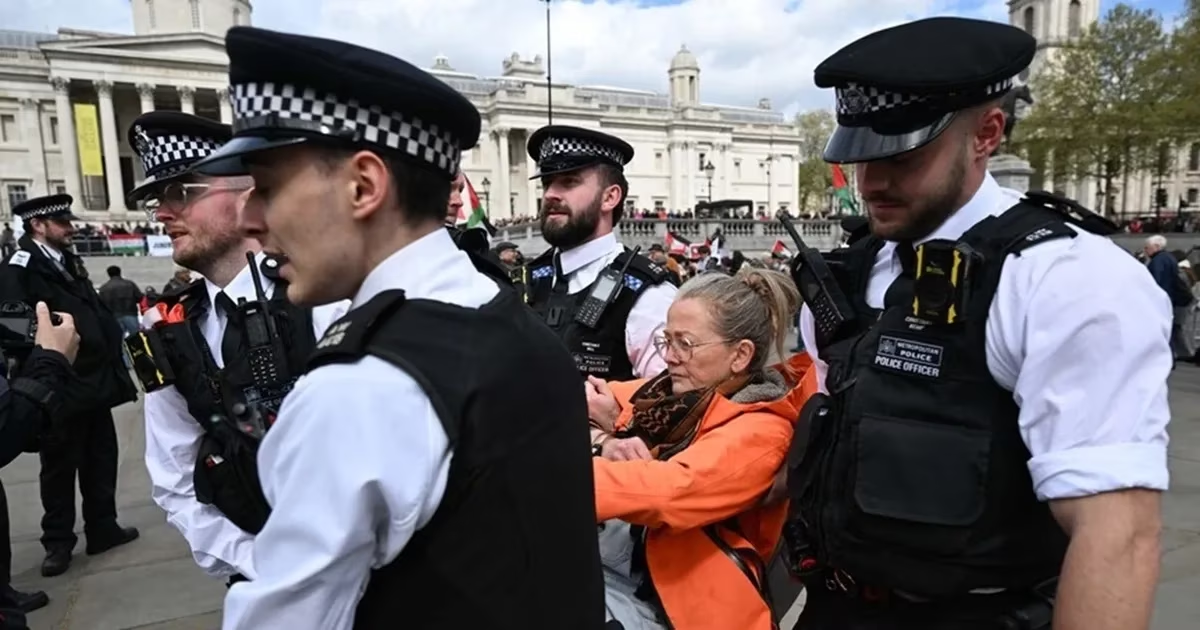
Monbiot revealed shocking figures related to arrest campaigns, where over three thousand people were detained merely for raising solidarity slogans. In contrast, no terrorism charges were brought against individuals who led the riots in Belfast or those who incited them via social media platforms.

The writer criticized the strange paradox in media and security dealings with both sides, where supporters of Palestinian rights face the risk of immediate imprisonment. Meanwhile, instigators of hatred and racism are given television platforms to express their views, reinforcing the feeling of a lack of equality before the law.

The article touched upon the ethical and legal aspects of the destruction of military equipment carried out by pressure groups, considering it a form of civil disobedience. He affirmed that preventing the use of weapons in illegal wars is an act stemming from human conscience, which some juries have previously understood.

Monbiot described the ongoing trials against 'Palestine Action' activists as political score-settling aimed at intimidating those in solidarity with the Palestinian cause. He indicated that the British judiciary is undergoing a real test of its credibility in light of these practices that target one group over another.

The writer concluded that 'two-tiered justice' has become a tangible and permanent reality in Britain, where right-wingers enjoy undeclared protection. He asserted that white men belonging to the far-right are the last who might face the dark side of arbitrary laws that are strictly applied to human rights activists.

This article comes at a time when pressure on solidarity movements in Europe is escalating, opening the door wide to discussions about the limits of freedom of expression. The question remains about the ability of British institutions to restore their legal balance away from clear political biases.

Applying the official definition of terrorism to Palestine Action protests is much more difficult than applying it to the riots in Belfast.

OPINIONS

Wed 17 Jun 2026 10:21 pm - Jerusalem Time

Hebron at the Crossroads of Transformation: Cancellation of its Agreements and the Beginning of Redesigning Control in the Heart of the West Bank

Ramallah - “Alquds ” dot com

Ramallah - “Alquds ” dot com

Opinion Writer

In a political moment that seems like an open declaration of a new phase in managing the conflict within the West Bank, the Israeli occupation government's Finance Minister, Bezalel Smotrich, announced what he called the "cancellation of the Hebron agreements." This step does not appear to be merely an administrative adjustment or a rearrangement of powers, but rather closer to a declaration of a comprehensive re-formulation of one of the most sensitive and complex cities in Palestinian geography, where politics intertwine with history, religion with control, and memory with field realities quietly written on the ground. Hebron, a city that does not stop at geographical boundaries but extends into the depths of history and conflict, returns today to the forefront as a new testing ground for equations of control and the redesign of reality, where politics intersect with religion, and history with the present, in one highly sensitive space. To understand the significance of Smotrich's announcement, one must go back to the background in which the so-called "Hebron Agreements" were formed, which came in the context of post-Oslo arrangements, specifically after the redeployment of occupation forces within the city in the mid-1990s. At that time, Hebron was divided into areas subject to limited Palestinian civil administration, and others under direct Israeli security control, especially in the "H2" area, which includes the heart of the Old City and the vicinity of the Ibrahimi Mosque. These arrangements, despite their fragility from the beginning, formed a kind of "intersection management" between two authorities: a Palestinian municipal authority with civil tasks, and an Israeli military authority holding security and field decisions. But what is being announced today, according to Israeli statements, does not seem to be merely an adjustment within this framework, but a gradual dismantling of it, by withdrawing the remaining civil powers, and re-concentrating decision-making directly in the hands of the Israeli administration.

According to the announcement, the step includes withdrawing powers from the Hebron municipality in core files, most notably urban planning, construction, and infrastructure management in large areas of the city, reorganizing powers around the vicinity of the Ibrahimi Mosque, and reducing the municipality's role to limited and semi-formal service functions; meaning that we are facing a transition from a model of "restricted Palestinian administration" to a model of "expanded direct Israeli administration," which practically means redefining the relationship between Palestinian residents and their local institutions within the city. This transformation, if actually implemented on the ground, does not only affect the administrative structure but also the essence of daily life: from construction, to planning, to urban movement, all the way to the future of the residential presence in the heart of the city. Hebron cannot be treated as an ordinary city within the geography of the West Bank. It is a city where historical and religious layers intertwine exceptionally, and it constitutes one of the most sensitive friction points in the Palestinian-Israeli conflict. At its heart lies the Ibrahimi Mosque, which bears a name and a religious narrative in Islam as a sacred mosque, and conversely is referred to in the Jewish narrative as the "Cave of Machpelah" or "Tomb of the Patriarchs." This religious overlap has not remained within the framework of spiritual symbolism but has evolved over decades into a central element in the conflict over the place, where the management of the site itself has become part of the equation of political and field control. And here specifically, any change in the powers related to the urban surroundings of the Ibrahimi Mosque becomes more than just an administrative measure, but a step that affects one of the most sensitive religious symbols in the region. What distinguishes the situation in Hebron is that religion does not stand on the margins of politics but directly intertwines with it, and sometimes is used as a tool in shaping realities. In the political discourse of some Israeli currents, biblical narratives related to the city of Hebron are invoked as the "City of the Patriarchs," a discourse that finds its extension in field policies that push for the expansion of settler presence in the heart of the Old City and its surroundings. In contrast, the Ibrahimi Mosque in Islamic consciousness forms part of a deeply rooted religious narrative, linked to the history of Prophet Abraham (peace be upon him), and what it represents as a unifying symbol in Islam. This overlap between religious text and political instrumentalization creates a state of "politicization of the sacred," where religious narratives become part of the tools of conflict on the ground, instead of remaining within their spiritual or faith framework. But the most dangerous aspect in this context is not the difference in narratives, but the use of this difference to justify field changes on the ground, gradually but profoundly reshaping the city. Withdrawing powers from the Hebron municipality does not only mean changing the authority responsible for issuing permits or regulating construction, but practically means redefining who holds the decision-making power in the urban space of the city. When planning and construction powers are transferred to the occupation authority, this opens the door for accelerating settlement expansion projects within and around the city, redrawing the demographic map by controlling urban growth, imposing additional restrictions on natural Palestinian expansion, and reshaping sensitive areas to serve new field realities. These are not just theoretical possibilities, but recurring patterns witnessed in other areas of the West Bank, where the gradual transfer of powers leads to a change in the structure of the place in the medium and long term. What is happening in Hebron cannot be read in isolation from the general context in the West Bank, where the pace of reshaping field reality is accelerating through multiple tools including rapid settlement expansion, redefining areas of control, reducing the role of Palestinian institutions, and strengthening direct administration in sensitive areas. In this context, Hebron appears as a central link in a broader project, aimed at establishing new realities on the ground, making a return to any future settlement more complicated. The city, with its population size and geographical location, represents a center of gravity in the Palestinian south, and any change in its administrative structure automatically reflects on its surroundings.

On a practical level, the repercussions of the decision can be read at several intertwined levels. At the urban level, direct control over planning will lead to a reshaping of the urban structure to serve specific expansion projects. At the population level, this may be reflected in additional restrictions on construction, creating gradual demographic pressure within the city. At the level of the Ibrahimi Mosque, any change in the management of its surroundings opens the door for a reformulation of the existing balance, which has been in place for years, and which is inherently fragile, based on precise equations between the religious and political presences in the place. From a broader political perspective, the decision does not seem isolated from trends within the current Israeli government, where more extreme visions are advancing regarding the West Bank file, based on reducing the Palestinian institutional presence, in exchange for expanding direct Israeli control. In this context, the announcement of the "cancellation of the Hebron agreements" becomes part of a political discourse that views previous agreements as a phase to be overcome, not a framework to be developed, thereby reproducing the concept of control in a more direct and less ambiguous form. At the end of this scene, Hebron does not appear to be merely a city managed by successive decisions, but a stage being rewritten anew, line by line, and power by power, until its features change very quietly, resembling the silent redrawing of maps, but leaving its deep impact on every house, alley, and stone. And between what is said in political discourse and what is implemented on the ground, the clearest truth remains that the city is being pushed towards a completely different phase, where old understandings are replaced by the logic of direct control, and the distances between decision and reality are shortened, to the extent that the place itself becomes the most eloquent and harsh statement.

Quoted from Arabi21 website

OPINIONS

Wed 17 Jun 2026 10:21 pm - Jerusalem Time

Urgent: US-Iranian Agreement of 14 Articles: A New Framework Reshaping the Relationship After Decades of Hostility

Urgent Urgent

Washington Message

Washington – Saeed Erikat – 17/6/2026

On Wednesday evening, US President Donald Trump published the full text of the fourteen-article memorandum of understanding between the United States and Iran, in a move considered an unprecedented political and security turning point in the history of relations between the two countries since 1979. The announcement comes after a period of intense tension that nearly escalated into a widespread regional confrontation, before considerations of deterrence and economic cost forced an urgent negotiation path that concluded with this interim framework.

The agreement represents a significant shift from the logic of military confrontation to the logic of conflict management through negotiation, as it lays the foundations for a cessation of hostilities, reopens navigation and trade channels in the Gulf, and paves the way for comprehensive negotiations within sixty days aimed at drafting a broader and deeper final agreement.

The agreement also reflects, in its content, an attempt to redefine the priorities of both parties, by focusing on the nuclear file, economic sanctions, and regional stability, in exchange for postponing or excluding a number of more complex contentious issues to later stages of negotiation.

Text of the Fourteen Articles of the Agreement

1. Cessation of Hostilities

Immediate and permanent cessation of all military and security operations between the United States and Iran.

2. Respect for Sovereignty

Mutual commitment to respect the sovereignty and territorial integrity of each state and non-interference in its internal affairs.

3. Final Agreement within 60 Days

Reaching a comprehensive and final agreement within a period not exceeding sixty days from the start of implementation.

4. Reopening the Strait of Hormuz

Ensuring freedom of navigation and lifting restrictions that hindered ship movement in the Strait.

5. Resumption of Iranian Oil Exports

Allowing the resumption of Iranian oil exports during the negotiation period.

6. Freezing New Sanctions

US commitment not to impose any new sanctions during the negotiation period.

7. Non-Pursuit of Nuclear Weapons

Iran's affirmation of its commitment not to produce or possess nuclear weapons and its continued adherence to the Non-Proliferation Treaty.

8. Freezing the Nuclear Program at its Current Level

Maintaining the current nuclear status without development until a final agreement is reached.

9. Return to Normal Maritime Trade

Restoring trade and shipping traffic in the Gulf to pre-crisis levels.

10. Prevention of Military Escalation

Mutual abstention from any escalatory military steps or additional military reinforcements.

11. Joint Monitoring and Implementation Mechanism

Establishing a follow-up mechanism to verify compliance with the terms of the agreement and resolve disputes.

12. Economic Reconstruction Program

Supporting a plan for the rehabilitation of the Iranian economy with an estimated value of up to 300 billion dollars through international parties.

13. Frozen Assets and Sanctions

Opening negotiations on frozen Iranian assets and gradually easing economic restrictions.

14. Final Agreement under International Auspices

Presenting the final agreement to the Security Council, to include the nuclear file, sanctions, economic cooperation, and implementation mechanisms.

Logic of Ending War Through Negotiation:

The agreement reveals that the military confrontation between Washington and Tehran was unable to impose a strategic resolution for either party, but rather reproduced the need for negotiation as the only viable option. After the escalation, it became clear that the cost of sliding into an open war exceeded the capacity of both parties to endure, whether economically, security-wise, or regionally. Therefore, the agreement came as an expression of the return of the logic of diplomacy as a tool for managing a long and complex conflict that cannot be resolved by force alone, but through gradual compromises.

Lowering the Ceiling of Demands and Redefining Priorities

The text shows that the American approach witnessed a clear shift, as the scope of issues put forward for negotiation was reduced. Instead of attempting to address Iran's missile program or its regional alliance network, Washington focused on the nuclear file, sanctions, and maritime stability. This shift reflects an understanding that expanding the negotiation agenda to the maximum extent could lead to the collapse of the entire process, while focusing on core issues provides a realistic opportunity for gradual progress, even at the cost of leaving deferred issues that could explode later.

3. An Agreement Beyond the 2015 Model

Although the nuclear file constitutes a central axis in the agreement, comparison with the 2015 agreement remains inaccurate. The current agreement is not limited to nuclear restrictions and sanctions relief, but goes beyond that to managing maritime navigation, economic reconstruction, mechanisms for de-escalation, and a potential framework for reshaping the relationship between the two countries. Thus, it transforms from a technical agreement into a comprehensive political framework, redrawing the rules of interaction between Washington and Tehran after more than four decades of estrangement and continuous conflict, making its success dependent on its ability to withstand deferred regional contradictions.

ARAB AND WORLD

Wed 17 Jun 2026 10:20 pm - Jerusalem Time

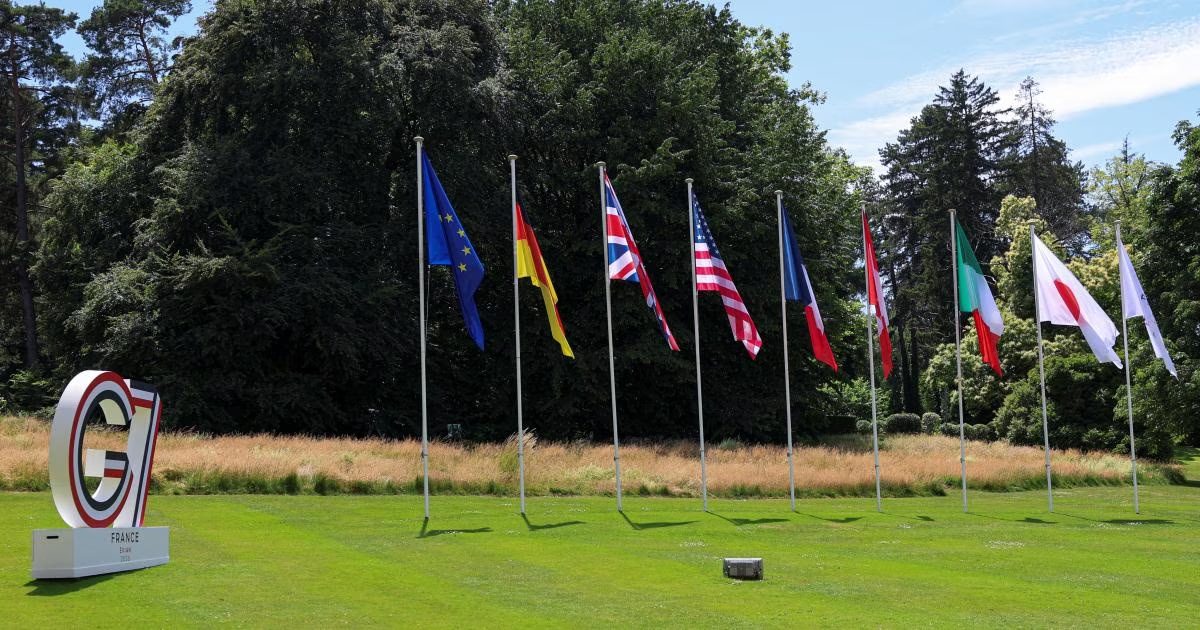
Macron from the G7 Summit: Priority for Lebanon's Sovereignty and Halting Violence in Gaza and the West Bank

French President Emmanuel Macron, at the conclusion of the G7 summit in Evian, emphasized the necessity of enabling the Lebanese state to fully extend its sovereignty over its territories. Macron clarified that the Lebanese army must be the sole authority responsible for managing security, stressing that the complexity of the situation on the ground urgently requires an end to military operations between Hezbollah and Israel.

Regarding the Palestinian issue, the French President announced that the leaders of the seven nations agreed on the need to intensify efforts to deliver humanitarian aid to the Gaza Strip without obstacles. The summit's final statement also called for an immediate end to the escalating violence in the West Bank, warning of the repercussions of continued tension on the stability of the region as a whole.

On the Iranian file, the group expressed its support for the existing understandings between Washington and Tehran, considering that the stability of this path positively reflects on navigation security and the global economy. Macron indicated that addressing the enriched uranium file is a top priority that cannot be postponed, as the summit set a two-month deadline to reach final solutions for this complex issue.

In the context of protecting international waterways, Macron revealed the involvement of about twenty countries in an international initiative aimed at securing navigation in the Strait of Hormuz. The leaders emphasized their categorical rejection of imposing any illegal fees or restrictions that hinder the flow of global trade through this vital passage, affirming their commitment to freedom of international navigation.

The French President touched upon recent American statements regarding Iran, describing former President Trump's talk of military options as falling within a deterrence strategy. He clarified that these statements should not be interpreted as imminent threats, but rather as a tool for political pressure to ensure Tehran's commitment to its international obligations in the nuclear field.

Macron described the summit as a moment of true unity among leaders, where they succeeded in overcoming the differences that prevailed in recent months. He praised the high level of close coordination that took place in Evian, considering that the discussions were fruitful and laid the foundation for genuine cooperation to face the major challenges confronting the international community at present.

In the Ukrainian file, the summit witnessed a qualitative shift with the announcement by the United States and European countries of the start of production of long-range missiles and air defense systems within Ukrainian territory. These operations will be carried out under official licenses, in a step aimed at strengthening Kyiv's defensive capabilities in a sustainable and direct manner in the face of Russian military pressure.

The French President considered that the balance of power on the Ukrainian battlefield has begun to shift in favor of Ukrainian forces, which are making tangible progress. He indicated that Russia is now experiencing a difficult situation in light of the European and international consensus on tightening sanctions and political and economic pressure to force Moscow to end the war and respect Ukraine's territorial integrity.

Beyond political issues, the summit discussed modern technology issues, with the regulation of artificial intelligence and the protection of minors in the digital space topping the agenda of the final day. Leaders sought to establish regulatory frameworks that ensure the benefits of technological innovation while minimizing the risks associated with privacy and digital security for emerging generations.

Considering the economic weight of the group after five decades of its establishment, the final report indicated a decline in the share of G7 countries in the global GDP. After the group controlled about 70% of the global economy in the 1970s, this percentage decreased to only 44% at present, reflecting the rise of new economic powers.

This relative decline is attributed to the rapid growth of emerging markets, led by the BRICS group of countries, with China at its forefront. Figures show that G7 countries represent only 10% of the world's population, while BRICS countries account for more than half of the planet's population, which changes the map of demographic and economic influence.

At the level of international trade, the G7 group has lost a large part of its historical dominance to emerging economies over the past two decades. While the group's share currently does not exceed one-third of global trade, the BRICS group continues to strengthen its position to reach a share of about 28%, narrowing the gap between traditional and emerging powers.

Despite these transformations, the G7 group still retains widespread influence in the financial services and advanced technological innovation sectors. The true power of the group remains inherent in its control over the export of high value-added goods, while the weight of the rest of the world's countries is concentrated in raw materials and traditional manufacturing sectors.

Lebanon has the right to regain control over all its territories under the administration of the Lebanese army, and the situation there is extremely complex and requires an immediate cessation of mutual strikes.

PALESTINE

Wed 17 Jun 2026 10:20 pm - Jerusalem Time

Widespread Israeli Escalation in the West Bank: Hebron Municipality Powers Stripped, Military Bulldozing in Jenin

For the second consecutive day, Israeli occupation forces continue extensive bulldozing and excavation operations in the heart of Jenin city, northern West Bank, with the aim of establishing a new military camp. Local sources reported that military bulldozers targeted a 7-dunum agricultural plot in the Al-Jabriyat neighborhood, amidst a complete closure of the area and prevention of citizens from accessing it.

This step is exceptionally serious because the targeted land is located within Area (A) classifications, which are administratively and security-wise under the Palestinian Authority according to signed agreements. Officials in Jenin Municipality confirmed that the site directly overlooks the camp and vital neighborhoods in the city, turning it into a strategic monitoring and oversight center that threatens the privacy and security of residents.

In Hebron city, occupation authorities took an unprecedented step in decades by approving the construction of a Jewish religious school in the heart of the historic city. This decision is the first actual implementation of Tel Aviv's announcement to strip the Palestinian Hebron Municipality of its powers in construction and planning, which effectively ends the Hebron Protocol signed in 1997.

Media sources reported that the Higher Planning Committee of the Civil Administration approved the establishment of the 'Shavei Hebron' religious school building, covering an area of one thousand square meters near the 'Beit Romano' settlement. This approval was granted without obtaining permission from the Hebron Municipality, in a blatant disregard for legal norms and international agreements governing work in the divided city.

In parallel, the Israeli committee approved plans to build 576 new settlement units distributed across different areas in the occupied West Bank. These decisions included the construction of 456 units in the 'Mitzpe Yericho' settlement near Jericho, in addition to 120 other units in the 'Karnei Shomron' settlement located north of the West Bank.

For his part, Israeli Finance Minister Bezalel Smotrich stated that these moves aim to implement 'effective sovereignty' on the ground by strengthening settlement. Observers considered that transferring planning authorities in settlement blocs and heritage sites directly to the Civil Administration aims to completely marginalize the official Palestinian presence.

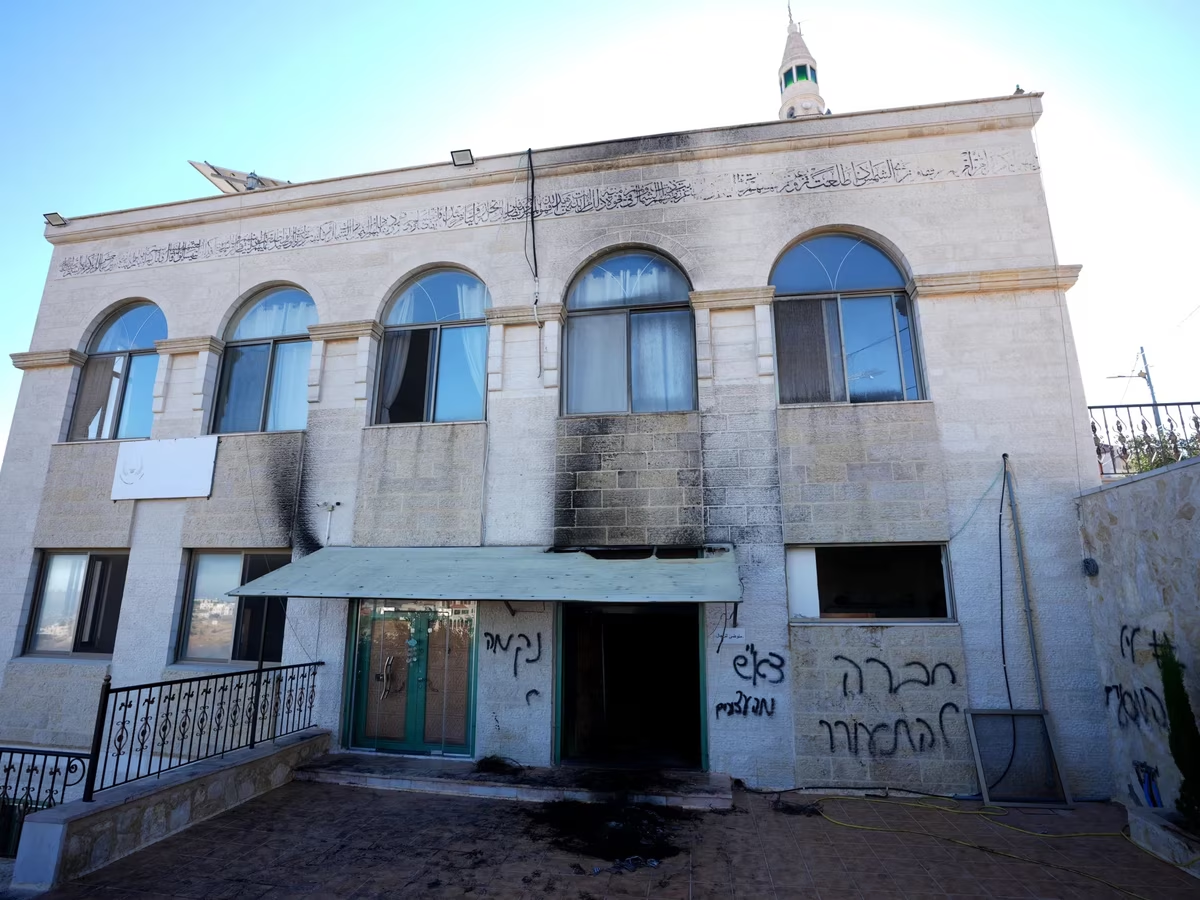
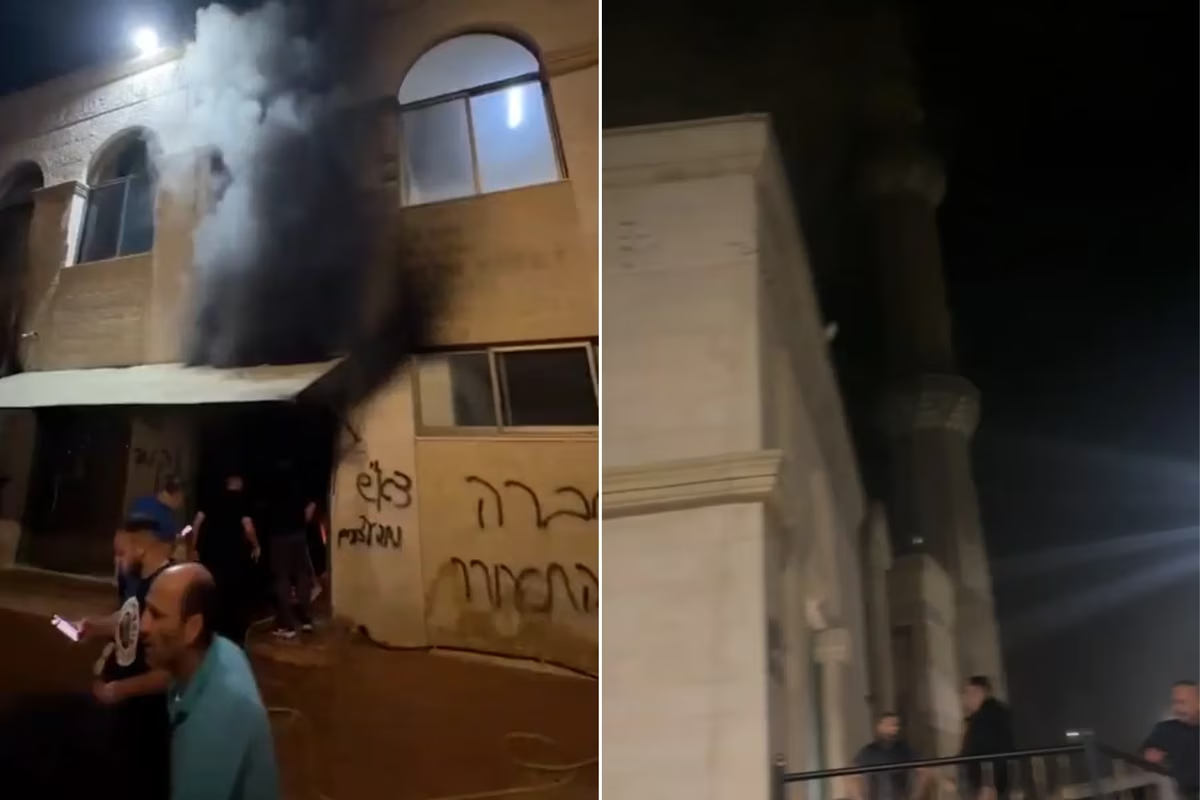
In a new racist attack, groups of settlers set fire to the Grand Mosque in Jaljulia village, north of Ramallah city, at dawn today. The assailants infiltrated the mosque and set fire to its contents, and also scrawled inciting Hebrew slogans on its outer walls before fleeing under the protection of army forces.

Field documentation showed extensive charring of the mosque's interior walls and damage to prayer areas due to the fire, which residents later managed to control. This crime comes within a escalating pattern of targeting Palestinian places of worship, as settlers had previously burned mosques in the towns of Duma and Nablus in recent months.

In the southern West Bank, occupation machinery carried out the demolition of an inhabited house in the 'Barouq' area, part of Yatta town, south of Hebron. The house, belonging to citizen Hamza Kamel Al-Adra, has an area of 180 square meters and was razed to the ground under the pretext of building without a permit in areas classified as (C) according to the Oslo Agreement.

Eyewitnesses reported that the demolition took place near a new settlement road that Israeli authorities are working to construct in the area to connect settlements. Residents of Yatta and its affiliated Masafer face increasing pressure to displace them from their lands for the benefit of settlement expansion and closed military zones.

Palestinians warn that these systematic attacks, extending from Jenin in the north to Hebron in the south, pave the way for what is known as the 'silent annexation' of the West Bank. Experts believe that intensifying settlement, demolishing homes, and confiscating civil powers aim to undermine any future opportunity for establishing a geographically contiguous Palestinian state.

Official data indicates that the West Bank has been experiencing continuous military aggression since the beginning of 2025, initially focused on the northern camps. These operations resulted in the martyrdom of dozens and widespread destruction of infrastructure and residential buildings, leading to the displacement of thousands of families from their homes.

The United Nations and the international community consider all settlement activities in the West Bank illegal and a violation of international humanitarian law. Despite international condemnations, the current Israeli government continues to accelerate the pace of settlement construction and legalize unauthorized outposts in various Palestinian governorates.

It is worth noting that the divisions of areas (A, B, C) resulting from the Oslo II Accord of 1995 are effectively fading in the face of repeated Israeli incursions into cities. Israel currently fully controls about 60% of the West Bank's area, while the areas available to Palestinians are shrinking due to the apartheid wall and settlements.

We are facing a dangerous precedent; this area is under Palestinian sovereignty according to agreements, and establishing a military point there means imposing a new reality whose repercussions no one knows.

PALESTINE

Wed 17 Jun 2026 6:30 pm - Jerusalem Time

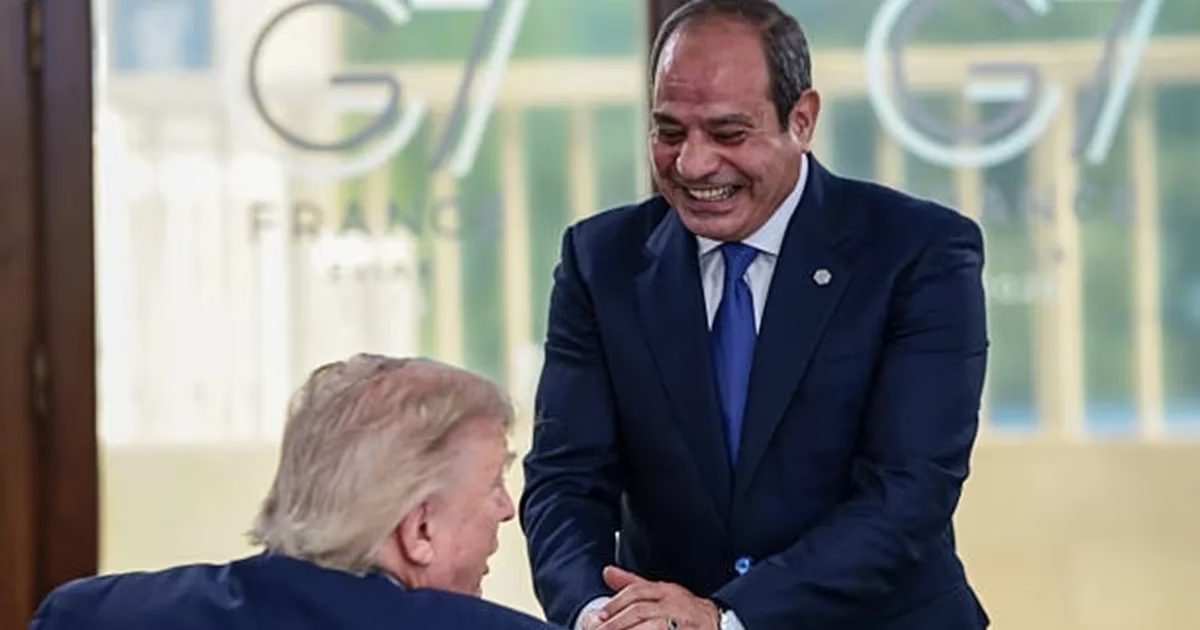
Sisi from G7 Summit: Two-State Solution is Basis for Stability, We Reject Annexation of Gaza Lands

Egyptian President Abdel Fattah El-Sisi, during his participation in the 'Exiting Crises and Ensuring Stability' session at the G7 Summit held in France, emphasized that a comprehensive settlement of regional crises is the only path to achieving global security. Sisi clarified that the stability of the Middle East is fundamentally based on reaching a just and lasting solution to the Palestinian issue, guaranteeing Palestinians the establishment of their independent state on the June 4, 1967 borders with Jerusalem as its capital.

The Egyptian President warned of the danger of recent field movements in the Gaza Strip, pointing out that preoccupation with the Iranian file allowed for the expansion of what is known as the 'Yellow Line' to consume about 70% of the Strip's area. He affirmed that this reality leaves Palestinians with only 30% of their lands, which represents a complete undermining of peace opportunities, demanding an immediate halt to this approach and preventing any attempts to annex parts of the West Bank.

Regarding diplomatic efforts, Sisi called for the necessity of accelerating the implementation of the peace plan proposed by US President Donald Trump to end the war in the Gaza Strip. He expressed his appreciation for the mediations that led to ceasefire agreements, affirming that Egypt is ready for full cooperation with all international partners to enhance this de-escalation and transform it into sustainable stability that ends the state of tension in the region.

The Egyptian intervention touched upon the situation in Lebanon, where Sisi indicated that the continued presence of Israeli occupation forces at five border points in southern Lebanon directly contributed to the exacerbation of the field situation. Participants in the session called for an immediate halt to Israeli military operations, enabling the Lebanese government to exercise its sovereignty, and moving to advanced stages of comprehensive de-escalation agreements.

On the regional security front, Sisi affirmed that the peace treaty between Egypt and Israel represents a historical model that can be built upon to expand the circle of peace in the region. He stressed that respect for state sovereignty and rejection of external interference are the two fundamental pillars for any future collective security arrangements, with the necessity of addressing outstanding issues such as energy security and international shipping lanes that have been affected by current conflicts.

At the conclusion of the session, G7 leaders discussed the repercussions of regional tensions on global trade and energy supplies, with a focus on the Iranian nuclear program file and freedom of navigation. Informed sources confirmed that the meeting concluded with the necessity of adhering to international law and ending the occupation as strategic steps to ensure the flow of global trade and protect the common economic interests of major countries and the region.

Expanding the Yellow Line to include 70% of the Gaza Strip effectively means leaving only 30% for the Palestinian people, an approach that must stop immediately.

PALESTINE

Wed 17 Jun 2026 6:30 pm - Jerusalem Time

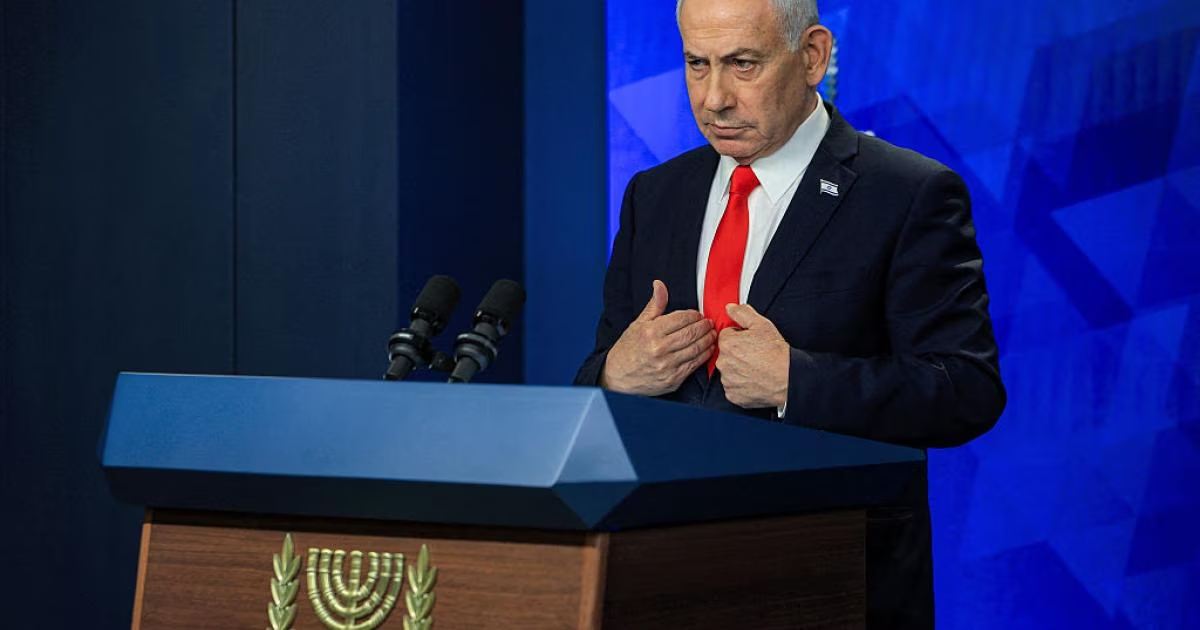
Legal disputes dog Netanyahu's joining of 'Peace Council' as Trump administration obstructs military plans in Gaza

Official media sources reported that Israeli Prime Minister Benjamin Netanyahu's joining of the so-called 'Peace Council', which is concerned with the administration of the Gaza Strip, faces serious legal obstacles within the Israeli system. Reports clarified that this step was taken without obtaining the necessary authorization from the government, which makes the signing of the Council's charter a violation of the procedures followed in making essential sovereign decisions.

The American administration had adopted new structures in mid-January for managing the transitional phase in the Gaza Strip, which included the formation of a 'Peace Council' and an 'Executive Gaza Council' in addition to an international stabilization force. Netanyahu had already participated as a member in the first meetings of this council, which were held in the capital Washington under the chairmanship of US President Donald Trump during the past February.

Sources in the office of the government's legal advisor warned of the repercussions of this unilateral move, indicating that it could create a deep gap between the commitments Israel has made on the international stage and its legal ability to actually implement them. The sources suggested the necessity of obtaining retroactive governmental approval to correct the legal course and ensure official cover for this membership.

In contrast, the Israeli Ministry of Justice tried to downplay the crisis, considering that joining the council is a purely political decision that falls within the powers of the supreme political leadership. The ministry affirmed its readiness to provide the necessary technical and legal support to assist the Prime Minister in moving forward with this step in accordance with the applicable government work systems, provided he wishes to do so.

On the ground, informed sources revealed that the Trump administration recently intervened to obstruct an Israeli military operation that was planned in the Gaza Strip, after American officials expressed their dissatisfaction with its details. Washington asked the Israeli side to freeze these plans for the time being, which reflects a divergence in tactical visions between the allies despite continuous coordination.

Instead of major military operations, data indicates that the occupation army has begun implementing a strategy of 'creeping annexation' in various areas of the Gaza Strip away from the spotlight. These moves aim to impose a new geographical and security reality through the gradual control of large areas, in an attempt to circumvent international pressures demanding a complete withdrawal.

At the same time, Washington is pushing for the immediate start of reconstruction operations in the Gaza Strip, even before a final formula for disarming resistance factions is reached. This is met with an absolute rejection by Israel, as Netanyahu's government insists on linking any reconstruction effort to the complete dismantling of Hamas's military capabilities in the targeted areas.

Estimates by observers in occupied Jerusalem indicate that Netanyahu seeks to keep the fronts of conflict open for internal political goals, especially with the upcoming Knesset elections scheduled in three months. Analysts believe that the Israeli Prime Minister prefers the continuation of escalation, and perhaps its expansion to include a direct confrontation with Iran, which raises the concern of the American administration.

The current American administration realizes that the continuation of open wars carries a heavy political, economic, and security cost that it does not wish to bear during this phase. Media sources confirm that the divergence in positions regarding the timing of resuming military operations reflects Washington's desire to contain the conflict, while Netanyahu sees escalation as a means to maintain his ruling coalition.

This political movement comes at a time when the occupation continues to impose a strict blockade on the Gaza Strip, despite previous ceasefire agreements. The humanitarian suffering of Palestinians continues amid the prevention of sufficient medical and food aid, while statistics indicate that more than 73,000 martyrs have fallen since the start of the genocide war in October 2023.

Netanyahu's joining of the Peace Council on behalf of Israel and his signing of its charter was a step taken without adhering to the legal rules that require government approval.

PALESTINE

Wed 17 Jun 2026 6:30 pm - Jerusalem Time

Over a Thousand Martyrs.. A Heavy Toll of Gaza Victims Since the Ceasefire Began

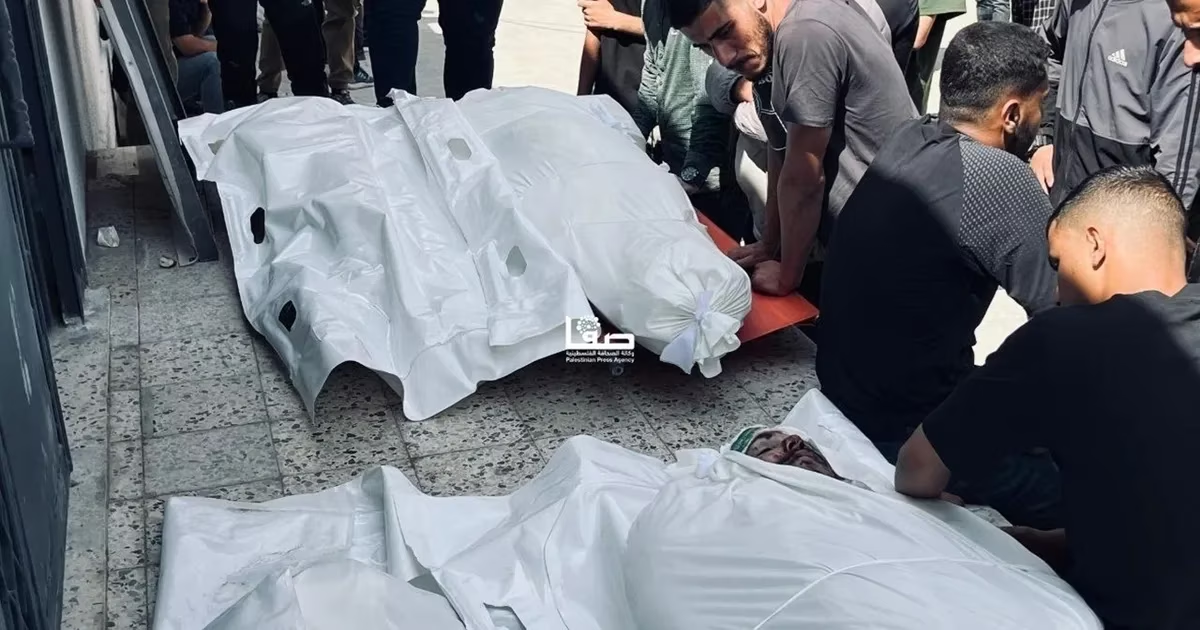
The Palestinian Ministry of Health in the Gaza Strip revealed a shocking statistic documenting the repercussions of the ongoing aggression, as the number of martyrs has risen to 1,005 since the ceasefire began on October 11th. Medical sources clarified that the number of injured during the same period reached 3,157, while specialized teams were able to recover the bodies of 784 people from various targeted areas.

Regarding the total toll since October 7, 2023, the Ministry confirmed that the number of victims has reached unprecedented levels, with 73,016 martyrs and approximately 173,265 others sustaining various injuries. Field reports indicated that hospitals received two martyrs and five injuries in the past twenty-four hours, suggesting a continued flow of victims despite official announcements of de-escalation.

Sources pointed to a worsening humanitarian crisis related to the missing, as many victims remain trapped under the rubble of destroyed homes and in inaccessible road passages. Ambulance and civil defense crews face significant challenges in rescue operations due to a lack of resources and continued direct targeting, which prevents the completion of body recovery and dignified burial.

In a related context, occupation forces continue to commit daily and systematic violations of the ceasefire agreement in various areas of the Strip, including concentrated shelling and the demolition of residential blocks. These military aggressions coincide with tightened restrictions on the movement of humanitarian and medical aid, and the prevention of injured individuals from traveling abroad for treatment, exacerbating the suffering of the besieged population.

Many victims are still under the rubble and in the streets, with ambulance and rescue teams unable to reach them at this moment.

ARAB AND WORLD

Wed 17 Jun 2026 6:30 pm - Jerusalem Time

German Report Documents Escalation of Anti-Jewish Incidents in 2025 and Controversy Over Methodology

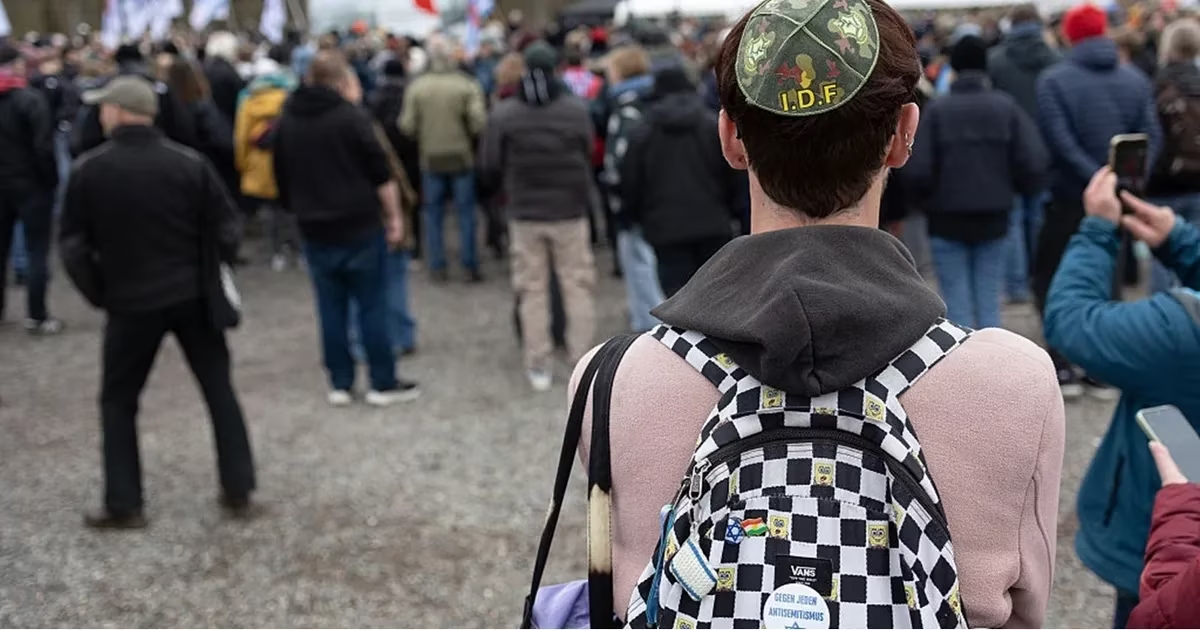
Recent data released by the Federal Association of Research and Information Centers on Antisemitism in Germany (RIAS) shows a continued escalation of recorded incidents during 2025. According to the annual report, the total number of incidents reached 8,725, a figure close to the previous year's statistics of 8,713 incidents, reflecting a stabilization at high levels of tension.

The report indicated that these rates represent a qualitative leap, exceeding by three times the levels prevalent before the outbreak of military confrontations in the Gaza Strip in October 2023. The association considered these figures to confirm the transformation of antisemitism into a daily phenomenon that directly pressures the lives of Jewish communities in various German cities.

The recorded incidents were distributed among different types of violations, with the vast majority, 7,770 cases, falling under abusive behaviors. The report also documented 178 direct physical assaults, 413 incidents targeting property with vandalism, in addition to hundreds of cases of threats and mass incitement messages.

The findings noted that four cases were classified as extremely severe violence, including a stabbing incident involving a tourist at the Holocaust Memorial in Berlin. Despite the decrease in severe violence cases compared to eight cases in 2024, the report warned of the dangerous criminal nature of some of these attacks.

Regarding motives, research sources stated that 68% of incidents were linked to attitudes towards Israel, with these manifestations increasing concurrently with developments in the Middle East. The report clarified that many of these incidents were a reaction to Israeli policies or in the context of protests related to the ongoing conflict.

The association also observed a significant increase in far-right activity, with incidents attributed to this movement rising from 562 cases in the previous year to 807 cases in 2025. This increase represents about 9% of the total incidents, indicating a growth in traditional ideological threats alongside modern political tensions.

On the other hand, the report faced sharp criticism regarding the methodology used in classifying incidents, especially concerning the link between criticism of Israel and antisemitism. Academic and media parties accused the association of using methods lacking transparency, pointing out that broadening the definition could lead to confusing political concepts with hate crimes.

German-Israeli journalist Itai Macchiavelli had previously criticized the association's exaggerated focus on 'Israel-related antisemitism'. In a report prepared for an anti-racism coalition, he considered that these criteria might not accurately reflect scientific and social reality, which RIAS rejected, deeming his criticisms biased.

In parallel with these figures, the German arena is witnessing escalating human rights tensions due to the authorities' handling of pro-Palestinian protests. Protesters in Berlin and other cities complained of excessive police violence, prompting international organizations to intervene and demand protection of the right to freedom of expression.

In this context, Amnesty International sharply criticized the German government regarding restrictions on demonstrations and harsh security treatment of protesters. These developments come amid continued German political support for Israel, despite increasing international pressure and demands for a ceasefire and protection of civilians in Gaza.

Antisemitism remained a widespread phenomenon in the daily lives of Jews in Germany during 2025, becoming a daily burden on local communities.

PALESTINE

Wed 17 Jun 2026 6:29 pm - Jerusalem Time

The Voice of Hind Rajab: Art Pursues Killers and Transforms Tragedy into a Global Icon for Accountability

The 98th Academy Awards ceremony witnessed a pivotal moment when Spanish actor Javier Bardem broke the protocol of silence, declaring his full solidarity with Palestine and demanding an end to the war. Bardem, who wore a protest badge dating back to 2003, linked past and present struggles, highlighting the film 'The Voice of Hind Rajab' by Tunisian director Kaouther Ben Hania, which was competing in the final list.

The film, which depicts the final moments in the life of the child Hind Rajab, was not just a fleeting cinematic work; it transformed into a political cry that echoed through the halls of Los Angeles. Despite not winning the award, Hind Rajab's name has become a symbol that haunts the global conscience, reminding of the crime committed by the occupation forces in the Gaza Strip against childhood and humanitarian work.

In a related context, the student movement at Columbia University had paved the way for this global presence by occupying 'Hamilton Hall' and renaming it 'Hind Hall'. This act of protest, which was met with repression by the New York police, became an inspiration for artists, as rapper Macklemore released his famous song, whose melodies were inspired by Fairuz, to immortalize the memory of the martyred child.

The American judiciary also entered the fray, with a New York judge overturning arbitrary dismissal decisions against protesting students, confirming the invalidity of the university's claims. This legal victory gave students additional momentum to transform their protest into art exhibitions that documented the tools of struggle and the messages of Hind's mother, Wissam Hamada, who blessed their efforts to preserve memory.

The art exhibition held in Brooklyn and Birzeit was not just a display of paintings, but a mobile 'war exhibition' confronting attempts at erasure and oblivion. The exhibition included images of the crime used by the prosecution as evidence against the students, but the organizers rephrased them to be a living testimony to the brutality of the occupation and the new generation's insistence on revealing the truth.

On the political front, US State Department spokesperson Matthew Miller continued to evade responsibility, referring the investigation into Hind's killing to the Israeli side. This official stance was met with pressure from journalists and activists who refused to let Hind's case dissolve among the numbers of victims, which exceeded twenty thousand children, emphasizing the necessity of individual and systematic accountability.

Kaouther Ben Hania's film chose a harsh artistic approach by having Hind Rajab play herself through her real voice recordings. This choice put the audience in direct confrontation with the child's terror as she pleaded for rescue, transforming the cinema hall into a space of dramatic tension that reflects the international community's inability to intervene in time.

Independent investigations revealed that the Israeli tank was only a few meters away from Hind's car when it fired hundreds of shots, refuting narratives of military 'error'. The film also documented the targeting of the Red Crescent ambulance and the killing of the paramedics who tried to reach it, a full-fledged war crime that occurred under the world's watchful eye.

Public reactions in New York and the Arab world varied between shock and helplessness, with many expressing their inability to bear the pain conveyed by Hind's voice. This 'helplessness', as critics describe it, could turn into political action if it is leveraged to confront the system that allows these wars to be waged, instead of merely momentary sympathy followed by a return to normal life.

Analysts link the image of Hind Rajab to historical icons such as the 'Napalm Girl' in Vietnam and the Kurdish child Aylan, considering art to be the only means to prevent the taming of memory. While political powers try to turn victims into mere numbers or abstract humanitarian issues, artists re-embed atrocities in the collective consciousness as undeniable truths.

Director Ben Hania succeeded in using 'sound' as an inescapable haunting tool, unlike images that people may get used to over time. Sitting in the dark and listening to Hind's pleas for hours forces the viewer to confront the naked truth, and prevents the tragedy from becoming just a 'meme' or fleeting content on social media.

There are serious warnings against turning Hind into an 'exception' that overshadows thousands of other children who were martyred in Gaza by deliberate sniper shots to the head and chest. Volunteer doctors confirmed that the pattern of injuries indicates a systematic targeting policy aimed at intergenerational genocide, which goes beyond the idea of individual errors by soldiers in the field.

In a significant legislative step, the 'Justice for Hind Rajab' bill was introduced in the US Congress in March 2026, demanding accountability for those responsible for her killing. The bill, which received support from prominent representatives such as Sara Jacobs and Chris Van Hollen, explicitly points to potential American complicity, representing a shift in political engagement with war crimes in Gaza.

In conclusion, the voice of Layan Hamada, Hind's cousin, remains an additional witness to the tragedy, as she was the first to report being surrounded by tanks before 64 bullets silenced her. The synergy of art, politics, and documentation ensures that these voices do not go unheard, and that the case of Hind, Layan, and all the children of Gaza remains alive until full justice is achieved.

The fact that the film forces us to sit with Hind's voice for hours in the dark is precisely the source of its strength and its moral imperative.

PALESTINE

Wed 17 Jun 2026 6:28 pm - Jerusalem Time

The occupation solidifies its occupation of Gaza with 40 military sites and surrounding trenches

The Israeli occupation army continues to deepen its military presence in the Gaza Strip through a new strategy aimed at transforming temporary control into a permanent reality on the ground. Sources reported that the occupation has begun building and equipping 40 advanced military sites distributed in strategic areas within the Strip, differing in design from the traditional bases the army knew in previous fronts.

Reports indicate that these military sites were designed to be fortified complexes capable of accommodating joint combat teams including infantry, armored, and military engineering units. The cost of establishing a single site reached about 5 million shekels, reflecting the scale of financial and logistical investment the occupation is pouring into establishing its strongholds within Palestinian territories.

The military engineering of these bases relies on prefabricated concrete buildings that provide rapid and effective protection from direct fire and projectiles, with the possibility of moving and repositioning them according to field needs. This military architectural style resembles the complexes previously established by American forces in Iraq and Afghanistan to counter guerrilla attacks and swift operations.

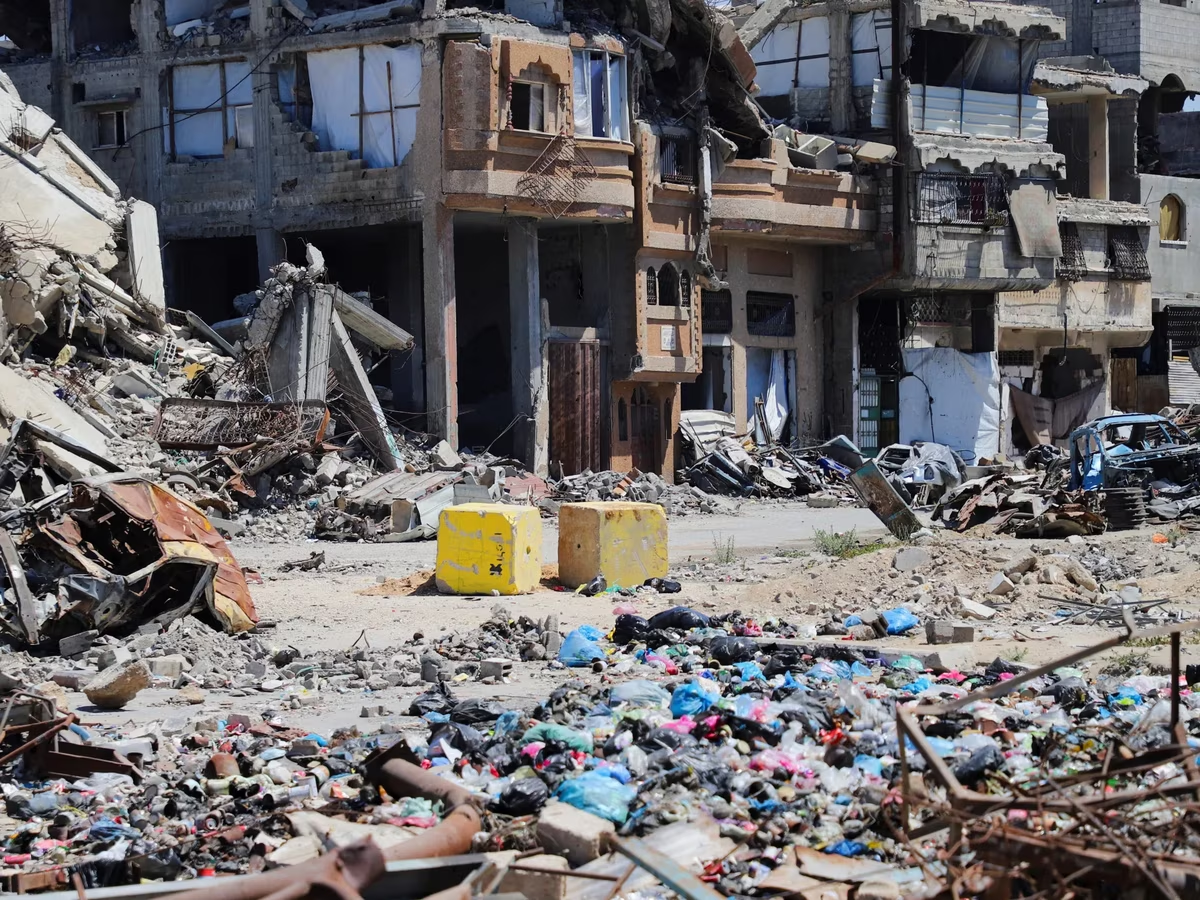
In the context of geographical control, the occupation army now dominates about 64% of the Gaza Strip's area, regions that have been emptied of their residents and turned into closed military zones. These sites are densely spread in the northern part of the Strip, while work continues to complete the remaining ones in the central and southern areas to ensure comprehensive security coverage.

The occupation's plan includes establishing 'warning zones' and protection surrounding these sites, where deep trenches are being dug for hundreds of meters to prevent any advance of Palestinian vehicles or motorcycles. These measures aim to reduce direct friction with the resistance and provide sufficient safe distances for forces stationed within the bases.

Regarding field instructions, the occupation army command issued strict orders to its soldiers to target any Palestinian attempting to cross 'yellow lines' or approach main axes such as Salah al-Din Road. This historic road, which once connected the north of the Strip to its south, has been transformed into a devastated path filled with checkpoints and military points that divide Gaza's parts.

In parallel with above-ground construction, the occupation continues extensive excavation and exploration operations to uncover tunnel networks, which represent the biggest concern for its forces. Occupation sources claim they have managed to destroy and close about 450 kilometers of tunnels since the start of the aggression, using demolition and concrete pouring techniques to permanently disable them.

Military operations also included restoring the border security barrier and developing the 'hourglass' fence that was breached on October 7. The fence has been equipped with special gates and modern remote-controlled surveillance sites, fitted with defensive systems capable of countering suicide drones targeting observation points.

In a field tour that revealed the extent of the tragedy, the humanitarian situation in Gaza was described as a 'ticking time bomb' threatening to explode at any moment due to the inhumane conditions in which the residents live. About 2.2 million Palestinians are under the weight of siege and destruction, while hundreds of thousands of them are crowded into dilapidated tents in the overcrowded Al-Mawasi area.

Field observations show that the Al-Mawasi area in the southern Strip alone contains about 400,000 displaced people living in tin and nylon rooms amidst the rubble of partially destroyed buildings. Israeli military sites overlook these gatherings from high sand hills, placing the displaced under direct surveillance and continuous occupation fire.

The occupation was not content with fixed fortifications but also paved special roads connecting military sites to facilitate vehicle movement and avoid improvised explosive devices planted in dirt roads. These roads are considered protected 'supply arteries' that allow the army rapid maneuvering and troop movement between different sectors without exposure to mine risks.

Reports indicate intense intelligence and fire coordination between the 40 sites, all linked to a joint operations room that exchanges monitoring and sensing data. This integrated system allows for precise strikes and mutual fire support in case any site is attacked, enhancing the forces' ability to withstand for long periods.

These massive military preparations reflect the occupation's intention to remain for long periods within the Strip and impose a new security reality that tears apart Gaza's geographical unity. These measures go beyond mere transient military operations to reach the level of a comprehensive 're-occupation' that includes changing the landscape and building permanent military infrastructure.

In conclusion, the scene in Gaza remains suspended between the hammer of Israeli military fortifications and the anvil of the escalating humanitarian catastrophe afflicting civilians. With the continued construction of these bases, fears are growing of turning the Strip into a large prison divided into isolated cantons subject to strict technological and military surveillance around the clock.

Beneath the surface in Gaza lies a real ticking time bomb and a long-term threat: 2.2 million Palestinians living in inhumane conditions.

PALESTINE

Wed 17 Jun 2026 6:28 pm - Jerusalem Time

Settlers set fire to a mosque in Jaljulia village north of Ramallah and spray racist slogans

Groups of extremist settlers attacked the village of Jaljulia, north of Ramallah, early this Wednesday morning, targeting the Grand Mosque in the town. Local sources reported that settlers infiltrated under the cover of darkness and set fire to the prayer hall, causing flames to engulf large parts of the mosque's interior.

Video clips documented the extent of the damage caused by the fire, showing the mosque's walls completely charred and blackened by the intense flames. Residents of the village, in cooperation with civil defense teams and relevant authorities, managed to control the fire and prevent its spread to neighboring homes, despite the difficulties they faced in reaching the site and securing the necessary firefighting supplies.

The attackers did not stop at burning the mosque; they also scrawled racist and incitement slogans in Hebrew on its exterior walls, a move that reflects the escalating hate speech against Palestinians and their holy sites. Official Palestinian bodies described this attack as a heinous crime that falls within a systematic policy of terrorizing citizens and targeting places of worship in various governorates of the occupied West Bank.

Coinciding with the attack, Israeli occupation forces intensified their military measures around Ramallah, closing the iron gate at the entrance to Rawabi city. This sudden closure restricted the movement of citizens and hindered the arrival of aid, further increasing the field tension in the region amid the recurrence of these attacks under army protection.

This incident comes as part of a series of similar attacks that have recently targeted mosques. Last March saw the burning of the 'Muhammad Fayyad' Mosque in Duma town, preceded by an attack on the 'Abu Bakr Al-Siddiq' Mosque in Nablus. Observers confirm that these attacks follow a recurring pattern aimed at imposing a new reality in the West Bank, amidst the absence of international accountability for settlers and occupation forces.

A group of settlers infiltrated the town of Jaljulia and set fire to the Grand Mosque, causing extensive material damage and charring its walls.

PALESTINE

Wed 17 Jun 2026 6:28 pm - Jerusalem Time

Israel undermines 'Hebron Protocol': Withdraws planning and construction powers from Palestinian municipality

The 'Hebron Protocol', signed in 1997, has once again returned to the forefront of political events, following unilateral Israeli decisions aimed at undermining Palestinian civil powers in the city. This agreement is the legal framework that regulated the reality of Hebron after the Oslo Accords, defining the distribution of security and civil tasks between the Palestinian and Israeli sides.

Israeli Finance Minister Bezalel Smotrich announced the initiation of actual procedures to withdraw planning and construction powers from the Hebron municipality in large parts of the city in the southern West Bank. This step directly targets areas under Israeli security control, including the Old City and the vicinity of the Ibrahimi Mosque.

Under the new decision, full responsibility for urban planning files will be transferred to the Israeli authorities, which effectively cancels the administrative link of the Hebron municipality to these areas. Media sources reported that this measure practically ends the role of Palestinian institutions in overseeing urban expansion or restoring historical buildings in the heart of the city.

The danger of this shift lies in the fact that the Hebron Protocol remained for nearly three decades the sole guarantor of the city's administrative unity despite its security division. The agreement explicitly stipulated that security arrangements do not mean a permanent division of the city, while preserving the municipality's role in providing services to all residents without exception.

The 'Hebron Protocol' dates back to January 17, 1997, and came as a completion of the Oslo Accords and a result of escalating tensions following the Ibrahimi Mosque massacre in 1994. The agreement divided the city into two famous areas, H1 and H2, to define the scope of influence of each party during that transitional phase.

Area H1, which represents about 80% of Hebron's area, is under full Palestinian control in civil and security aspects, and is inhabited by the vast majority of the population. As for Area H2, it remained under Israeli security control, with Palestinians granted broad civil powers to manage their daily affairs.

Area H2 includes the most prominent historical and religious landmarks, most notably the Ibrahimi Mosque and the Old City, in addition to settlement outposts inhabited by hundreds of settlers. Occupation forces in this area impose strict restrictions on the movement of Palestinians, and frequently close the Ibrahimi Mosque during Jewish holidays.

Despite the Israeli military dominance in the area classified as H2, the Protocol guaranteed the Hebron municipality the exercise of its duties in the fields of infrastructure, transportation, and electricity. Municipal inspectors carried out their work in monitoring construction and planning in coordination with the relevant authorities, which the latest decision seeks to completely cancel.

For his part, Hebron Mayor Yousef Al-Jabari affirmed his categorical rejection of these measures, considering them a blatant violation of international agreements. Al-Jabari indicated that this step aims to strengthen settlement in the heart of the city and marginalize the official Palestinian presence in historical areas.

The Hebron municipality appealed to the American administration and the international community to intervene immediately to stop this Israeli encroachment on civil powers. Palestinian officials stressed that Washington, as a primary sponsor of the 1997 Protocol, bears political and moral responsibility for preserving the status quo.

In an attempt to absorb international anger, the Israeli Ministry of Foreign Affairs tried to downplay the decision, claiming that it does not represent a formal cancellation of the agreement. Israeli sources claimed that the measures relate to specific powers, but the reality on the ground indicates a trend towards full administrative annexation of the area.

These developments come a few months after the occupation authorities granted legal legitimacy to a settlement committee to manage the affairs of the Old City in Hebron. This trend reflects the desire of the Israeli far-right to end any appearance of Palestinian sovereignty or administration in areas that include settlement outposts.

Hebron is considered an exceptional case in the West Bank, as it is the only city where settlers are present in the heart of crowded Arab neighborhoods. This overlap made the 'Hebron Protocol' a very sensitive document, as any infringement on it could lead to an explosion of the situation on the ground in the southern West Bank.

Observers warn that the withdrawal of planning powers will pave the way for an unprecedented wave of settlement within the Old City, where building permits will be granted to settlers easily. In contrast, Palestinians will face great difficulties in obtaining permits to renovate their homes or build new facilities, which threatens their forced displacement.

Withdrawing planning and construction powers from the municipality constitutes an infringement on agreements signed under international sponsorship and supervision, and with the participation of the American administration.

OPINIONS

Wed 17 Jun 2026 2:58 pm - Jerusalem Time

Between Politics and Development: How the Palestinian State Project Was Squandered Between Negotiation and Reality Building

Since the post-Oslo era, the Palestinian project has largely been confined within a negotiating political horizon, considered the main path towards statehood, while development and institution-building receded to a secondary status. However, practical experience in the West Bank and Gaza Strip reveals that politics without a solid economic and institutional foundation becomes a fragile path, just as development without a sovereign horizon becomes constrained and fragmented. Between these two paths, the opportunity to formulate an alternative strategy that could have been based on “building the state before declaring it” through economy, demography, and establishing facts on the ground was lost.

This article discusses how politics was separated from development, and how a different path could have transformed the Palestinian project from managing anticipation to a gradual project of building sovereignty, despite structural constraints and the complex geographical and political reality.

At an early moment in the post-Oslo trajectory, it seemed that the Palestinian project entered a phase where its tools, not just its goals, could be redefined. There was an implicit assumption among a segment of the political elite that politics was the first and last key: negotiation, international recognition, and a final status arrangement that would come later as a natural result of political accumulation. In this conception, development and institution-building appeared as “derivatives” of a political process, rather than a parallel pillar. With this understanding, the state transformed into a postponed promise rather than a project built day by day.

But the practical history of the subsequent decades revealed something more complex: politics not based on a solid economic and institutional foundation becomes extremely fragile, while development that lacks a sovereign horizon becomes constrained and fragmented. Between these two extremes, the modern Palestinian experience was shaped, especially in the West Bank.

In this context, the Palestinian Authority in the West Bank was formed as a transitional governance framework, but it gradually transformed into a vast administrative apparatus without becoming a full-fledged state project. What was built was an administrative apparatus, not a sovereignty apparatus. Bureaucracy expanded, but without a clear governance philosophy; institutions emerged, but without real independence, high standard efficiency, or a long-term productive vision. The result was an entity dependent on external funding more than on a productive internal economy, and on external political stability more than on the legitimacy of internal achievement.

The flaw was not in the scarcity of resources, but in the way they were managed. Instead of treating development as a tool to build an unbreakable reality, it was treated as a secondary, postponed file. Universities, the economy, infrastructure, the judiciary, and even local administration did not transform into a comprehensive national project to create “facts on the ground,” but remained within the limits of partial improvements that did not rise to the level of the historical challenge.

More problematically, politics itself became an alternative to building, not a complement to it. Any failure in political progress was justified by the continuation of the negotiating path, without that translating into a radical review of the internal building method. Thus, a dangerous equation emerged: high-ceilinged political discourse, against limited executive capacity, and a field reality gradually eroding due to settlement expansion and geographical reshaping.

In contrast, it is important to consider what could have been an entirely different path, not as an ideal alternative, but as an unexploited possibility. Theoretically, since the 1990s, a strategy could have been adopted that assumed the absence of sovereignty does not mean freezing action, but redefining it: “Sovereignty is built before it is declared.”

In this alternative scenario, the priority was not politics alone, but transforming the land itself into a daily expansion project. In the West Bank, it would have been possible to move from managing an authority to engineering a space: economically interconnected cities, dense industrial zones, and an infrastructure network connecting Palestinian communities into a single, semi-independent economic system. Every economic project—a factory, a university, a road, a residential neighborhood—could have been treated as a long-term geographical consolidation, so that development would become a tool for “undeclared border demarcation” through density and continuity.

In this model, development transforms from an auxiliary policy to an expansion policy. Investment, instead of being scattered or externally dependent, becomes directed towards creating internal centers of attraction, reducing geographical voids and redistributing populations and resources in a way that creates cohesive demographic blocs. And population movement here is not just the movement of individuals, but an intense presence at strategic points that makes reality more stable and less susceptible to re-dismantling.

It would also have been possible to redefine the economy as a slow sovereign tool: education, production, administration, and justice are not separate sectors, but pillars for building an undeclared functional state. A productive internal economy—in modern agriculture, light industries, services, and technology—could have reduced society's fragility to political shocks, and given the national project a daily depth that does not rely solely on negotiation or external funding.

In this framework, this path would not have abolished politics, but rearranged it. Politics would become a complementary framework, not the sole center. The goal would no longer be to await the state through a final agreement, but to gradually produce it in reality before its recognition.

In the Gaza Strip, despite severe restrictions and blockade, efforts could have been directed towards a more independent productive economy: light industries, intensive agriculture, and a service infrastructure capable of creating an internal cycle that reduces reliance on aid. In East Jerusalem, the focus could have been on strengthening civilian and institutional presence, so that separation from its surroundings would become more politically and humanly costly, making it difficult to isolate or gradually empty it.

However, this scenario also reveals the limits of the idea. The effectiveness of “expansion through economy and demography” assumes a level of control over space, movement, and resources, which was not fully available. The land was not a free space, but a fragmented area subject to multiple restrictions, making any economic expansion project vulnerable to continuous fragmentation and restriction.

And in the Gaza Strip specifically, the path of political division since 2007 was an additional, deeply impactful factor, as it led to the existence of two authorities and two different paths, which weakened the possibility of building a unified national strategy, and blocked any comprehensive development vision that treats Palestinian geography as a single unit.

Nevertheless, the core of the problem remains clear: the problem was not only in the imbalance of power with Israel, but in the absence of a strategy that integrates politics and development instead of separating them. Instead of building a single project that makes economy and institutions tools of continuous political action, politics was treated as a separate path, and development as a postponed file, which produced a reality that is neither a complete state nor a coherent building project.

Thus, between a model that made politics a center separate from the land, and an alternative model that could have made development a form of daily sovereignty consolidation, the great paradox becomes clear: the state is not just a political event, but a long accumulation in economy, institutions, demography, and space. And in the void between these two paths, the Palestinian project remained suspended between the possible and the postponed.

OPINIONS

Wed 17 Jun 2026 2:23 pm - Jerusalem Time

From Education to Unemployment: How the Structural Crisis in the Palestinian Labor Market Was Formed? ... "The Palestinian Economy Transformed from a Job-Producing Economy to a Labor-Exporting Economy"

While Palestinian universities continue to graduate tens of thousands of young people annually, the circle of unemployment widens and the economy's ability to absorb many of them declines, turning a university degree for many from a gateway to employment into a long waiting station on the lists of job seekers. In the academic year 2022/2023, Palestinian higher education institutions graduated more than 45,000 male and female graduates, at a time when the Palestinian economy is unable to provide job opportunities that absorb many of these energies and competencies, which widens the gap between education and employment year after year.

To understand this paradox, it is not enough to look only at unemployment figures and graduates; rather, one must look at the nature of the Palestinian labor market itself. Historically, the Palestinian workforce has been concentrated in three main sectors: public employment in national authority institutions and security agencies, the Palestinian private sector, and work within the Green Line. These paths were formed under exceptional political and economic conditions imposed by the occupation over decades, where a large part of employment and income became linked to factors that the Palestinian economy cannot control.

Today, it is clear that the core of the crisis lies not only in the number of graduates or the quality of specializations, but in the nature of the labor market that has been shaped over decades of economic dependency, to the extent that the Palestinian economy has become unable to absorb a large part of its human capital, despite the urgent need for it in the path of national development.

Re-engineering the Palestinian Labor Market

Since 1967, the impact of the occupation has not been limited to imposing restrictions that limited the growth of the Palestinian economy, but extended to reshaping the structure of the labor market itself. While productive sectors, especially agriculture and industry, experienced a continuous decline as a result of control over land and resources and the imposition of restrictions on investment, increasing numbers of Palestinian workers were employed in the Israeli labor market, especially in construction, agriculture, and services.

With the increasing reliance of Palestinian families on income from work within the Green Line, the importance of developing local productive paths capable of employing the growing workforce declined. Thus, the Israeli occupation contributed to redirecting work and income paths in a way that strengthened economic dependency and weakened the local market's ability to create sustainable job opportunities.

The Permits Economy and the Exposure of the Economic Model's Fragility

The impact of working within the Green Line was not limited to providing job opportunities and higher wages; over time, it led to the emergence of what can be called the "permits economy," where access to income sources became dependent on work permits subject to considerations and procedures outside the control of the Palestinian economy. Thus, a permit was no longer merely an administrative document to regulate the movement of workers, but transformed into an influential tool in shaping the labor market and distributing employment opportunities.

Before 2023, approximately 200,000 Palestinian workers were employed within the Green Line and settlements, making the income of a wide segment of Palestinian families dependent on continued access to this market. With the expansion of this pattern, the impact of the permit extended beyond the worker himself to affect families' economic decisions, consumption levels, and the financial stability of wide sectors of society.

If the West Bank has been subject to an economic model based on dependency on the Israeli labor market, the Gaza Strip represents the harshest face of this intervention, where the siege and systematic destruction of productive capacities have turned it into a hotbed of the highest unemployment rates in the world, making the challenge there go beyond the employment crisis to the erosion of the very foundations of production and life.

The events after October 7, 2023, also constituted a real test for this model; with the suspension of most work permits and the prevention of workers from accessing their workplaces, and the sanctions imposed by the seizure and looting of clearance funds, tens of thousands lost their sources of income in a short period. The repercussions extended to local markets, the private sector, and consumption movement, and the crisis was revealed by job losses, showing the extent of reliance on income sources outside the control of the Palestinian economy and its self-production and employment capacity.

The Gap Between Education and Employment: When Investment in Humans Has No Horizon

The transformations witnessed in the Palestinian labor market affected employment and income, and extended to the mechanisms that guide investment in education and skills. Under normal circumstances, the labor market sends economic signals that encourage individuals to acquire the knowledge and skills needed by the economy, by linking education and productivity to wage levels and career advancement opportunities, but the existence of job opportunities for Palestinians outside the local economy gradually weakened this relationship.

The Palestinian employment crisis does not reflect a lack of education or competencies as much as it shows the limited ability of the economy to invest in them. Therefore, phenomena such as high unemployment among graduates, the expansion of the informal economy, and the increasing reliance on individual and marginal work have become indicators of a growing gap between what the educational system produces and what the economy can actually absorb.

This gap has widened due to the prevailing societal culture towards education and work, where a university degree is still often seen as the most guaranteed path to professional success, while vocational and technical education does not receive the status commensurate with its economic importance. Families also play an influential role in guiding children's educational choices, which makes some educational decisions closer to social considerations than to the needs of the labor market and future employment opportunities.

Towards a More Sustainable Economic Model

The Palestinian experience reveals that the employment crisis is not limited to a lack of job opportunities, but rather stems from the nature of the economic model that has been shaped over the past decades. Numerous studies have shown that growth in the Palestinian economy has not been accompanied by parallel growth in productive sectors capable of generating long-term employment opportunities, but a large part of employment and income in Palestine has been concentrated in the Israeli labor market. Data from the Palestinian Economic Policy Research Institute (MAS) indicates that remittances from Palestinian workers in Israel constituted approximately 13% of the Palestinian GDP in 2017, and increased in the years leading up to the war to approach 17%, reflecting the significant reliance on labor within the Green Line to support economic activity.

Therefore, addressing the employment crisis requires more than providing alternative job opportunities or temporary employment programs; it calls for redirecting economic policies to build a national productive base capable of creating job opportunities, by directing investments towards sectors linked to local demand, promoting modern industry and agriculture, developing production chains, supporting small and medium enterprises, and linking education and training to the needs of priority sectors.

Building a resilient economy does not depend solely on government policies, but requires establishing a societal culture that recognizes the close link between consumption, production, and employment; every expenditure on a local product or service contributes to supporting a Palestinian establishment, provides income for a worker, and enhances the circulation of capital within the national economy. Therefore, supporting national products is a tool to expand the productive base and enhance employment opportunities. The transformation required today is not to replace one source of income with another, but to restore the basic function of the Palestinian economy as a producer of jobs, not a source of labor or unemployment, which necessitates a gradual transition towards an economic model based on production, skills, and added value, and relies on expanding the local productive base and enhancing the ability of economic sectors to invest in Palestinian human capital; the greater the contribution of productive sectors to GDP, and the higher the economy's ability to meet its needs independently, the greater the opportunities for job creation and achieving sustainable and more independent development.

PALESTINE

Wed 17 Jun 2026 2:23 pm - Jerusalem Time

Clearance Crisis Suffocates Palestinian Economy: Scenarios for Resilience and Challenges of Financial Collapse

The Palestinian Authority is currently grappling with one of the most complex financial crises since its establishment, due to systematic Israeli policies of withholding and deducting large portions of clearance funds. These funds, which represent the backbone of the general budget, have become a political and economic pressure tool directly affecting the Ramallah government's ability to manage citizens' affairs.

Clearance funds, which are taxes and customs collected by Israel on behalf of Palestinians under international economic agreements, are the main source of liquidity, accounting for more than half of public revenues. With the continued full or partial halt in the transfer of these amounts, official institutions have been unable to pay full salaries to public sector employees for many months.

The crisis is not limited to salaries but extends to a sharp contraction in overall economic activity in the West Bank, coinciding with a decline in external aid. This reality has forced the Palestinian government to adopt harsh austerity policies and disburse portions of financial entitlements to employees to maintain the minimum continuity of institutions.

Economic sources reported that the options available to Palestinian decision-makers have gradually dwindled after exhausting borrowing tools from local banks. The accumulation of financial arrears owed to the private sector and suppliers now threatens to halt vital services in the health, energy, and contracting sectors.

Experts believe that the fundamental question today is not about the already known causes of the crisis, but rather about the timeframe in which the Authority can withstand before reaching a stage of complete collapse. The government has exhausted its financial maneuvering capacity by postponing obligations, and the local economy is unable to generate alternative resources to compensate for the significant loss of liquidity.

In addition to the clearance crisis, the Palestinian economy is suffering another severe blow: the loss of tens of thousands of workers' jobs inside the Green Line since October 2023. This group used to inject billions of dollars annually into local markets, and their reduced income has led to weakened purchasing power and an unprecedented increase in poverty and unemployment rates.

Data indicates that annual government spending, which represents about a third of economic activity, has been severely damaged, negatively impacting internal trade. This close link between public spending and market vitality makes any disruption in clearance flows an earthquake affecting all productive and service sectors.

Amidst this bleak scene, serious concerns arise about the soundness of the Palestinian banking sector, which has become highly exposed to government and employee debts. Estimates show that about seven billion dollars in credit facilities are directly or indirectly linked to the government, making any long-term default a threat to financial stability.

On the international level, the Palestinian government is making strenuous efforts to mobilize donor support, currently relying on limited European grants and World Bank support to manage urgent matters. However, this support remains a 'painkiller' that does not address the root cause of the problem: Israeli control over Palestinian financial resources.

Palestinian calls to Arab states have been renewed, emphasizing the need to activate the financial safety net approved by previous Arab summits but not yet effectively and sustainably implemented. Observers believe that providing this network has become an urgent necessity to prevent the financial crisis from escalating into a social or security explosion that could be difficult to control in the occupied territories.

The international community, for its part, is called upon to pressure the Israeli side to release the withheld funds unconditionally, in compliance with signed agreements. Preserving Palestinian state institutions requires a regular flow of resources, not seasonal grants that do not cover the minimum operational and service expenses.

Meanwhile, the Palestinian government continues its financial and administrative reform efforts to control expenditures and reduce the deficit, despite limited results due to the lack of control over crossings and resources. These reforms aim to send reassuring messages to the international community and donors that the Authority is doing its utmost to manage available resources.

The future of the crisis remains dependent on the extent of international response and the pressure that can be exerted on the occupation government to stop the piracy of funds. Without the full restoration of clearance funds, the Palestinian Authority will remain in a vicious cycle of livelihood crises that threaten the stability of the entire region.

In conclusion, Palestinian resilience in the face of these economic pressures depends on internal cohesion and the provision of real Arab and international alternatives. The continuation of the current situation places the Palestinian economy before an existential challenge, requiring radical political solutions that end the forced economic dependency imposed by the Paris Protocol decades ago.

Continued withholding of clearance funds without providing external financial alternatives will make it difficult to talk about a real solution to the crisis, and the international community is required to bear its responsibilities.

PALESTINE

Wed 17 Jun 2026 2:23 pm - Jerusalem Time

Cancellation of Hebron Agreements: Occupation Begins Direct Control Engineering Over the City's Heart

The city of Hebron is going through a pivotal political moment that seems like an open declaration of a new phase in managing the conflict within the West Bank. This comes after statements by the Finance Minister in the occupation government, Bezalel Smotrich, regarding the cancellation of what is known as the 'Hebron Agreements,' a step that goes beyond administrative modification to a comprehensive re-formulation of the city's identity.

This step represents a gradual dismantling of the arrangements approved in the mid-nineties following the Oslo Accords, which regulated the redeployment of forces within the city. These agreements had created a fragile form of joint administration between a Palestinian municipal authority with civilian tasks and an Israeli military authority holding security decisions.

According to the new data, the occupation seeks to withdraw the remaining civilian powers from Palestinian hands and concentrate them directly in the hands of the Israeli administration. This approach includes fundamental issues such as organization, construction, and urban planning, in addition to managing infrastructure in wide and sensitive areas of the city.

Reducing the role of the Hebron municipality to merely formal service functions means moving from a restricted administration model to an expanded direct administration model. This shift affects the core of daily life for Palestinian residents and places the future of urban and residential existence in the heart of the Old City under direct and continuous threat.

Hebron cannot be read as an ordinary city; it is the most sensitive point of friction where historical and religious layers exceptionally intertwine. The Ibrahimi Mosque lies at the heart of this conflict, where the Israeli narrative attempts to impose its control over the place and transform it into a central element in the equation of political and field control.

Any change in the powers related to the urban surroundings of the Ibrahimi Mosque becomes more than just a fleeting administrative measure. It is a step that affects one of the most sacred religious symbols and reveals a desire to politicize the sacred and use it as a tool to formulate new realities on the ground that serve settlement agendas.

Extremist currents in the occupation government use biblical discourse to justify settlement expansion in the heart of the Old City. In contrast, the Ibrahimi Mosque remains in Palestinian and Islamic consciousness part of a deeply rooted religious narrative that cannot be divided, making the conflict over the place a conflict over identity and existence.

Withdrawing planning and construction powers opens the door wide to accelerating settlement projects and changing the demographic map. Controlling Palestinian urban growth and imposing strict restrictions on it is an effective means of reshaping sensitive areas to serve the long-term Israeli vision in the West Bank.

These patterns of control are not new; rather, they are a repetition of policies witnessed in other areas, where the transfer of powers leads to a profound change in the structure of the place. These measures aim to make a return to any future political settlement practically and field-wise impossible.

Hebron is considered a central link in a broader project aimed at establishing new realities and reducing the role of Palestinian national institutions. Given its population size and geographical location in the southern West Bank, any change in its administrative structure will have a significant impact on the entire surrounding area.

On a practical level, direct control over planning will lead to reshaping the urban structure to serve the settlement outposts distributed in the heart of the city. This deliberate demographic pressure aims to push Palestinian residents to migrate from old city centers and empty them in favor of settlers.

As for the Ibrahimi Mosque, the proposed changes threaten the fragile balance that has existed for many years. Reshaping the balance in this sensitive site could lead to an explosion of field conditions, given the mosque's great status in the hearts of Palestinians and Muslims around the world.

This decision is consistent with the current Israeli government's trends, which adopt extremist views calling for an end to the Palestinian institutional presence. They see previous agreements as merely a transitional phase that must be overcome to achieve full and direct control without any legal or international obligations.

Ultimately, Hebron emerges as an arena whose details are being rewritten by successive powers and decisions, sometimes away from media noise. Between political discourse and field reality, the truth remains that the city is being pushed towards a new reality that replaces old understandings with the logic of force and absolute control.

Hebron today is a new testing ground for equations of control and re-engineering reality, where politics intersects with religion and history with the present.

PALESTINE

Wed 17 Jun 2026 12:31 pm - Jerusalem Time

Israeli Supreme Court refuses to release Kamal Adwan Hospital director Hussam Abu Safiya

The Israeli Supreme Court today, Tuesday, issued a decision rejecting the request to release Palestinian doctor Hussam Abu Safiya, director of Kamal Adwan Hospital in the Gaza Strip. Abu Safiya's detention has continued since late 2024 without any formal indictment being issued against him, raising widespread human rights concerns about the fate of detained medical personnel.

Human rights sources reported that the court justified its decision by relying on what it described as 'secret materials,' a pretext that prevents the detainee or his defense team from accessing or refuting the evidence. Naji Abbas, an official in the 'Physicians for Human Rights' organization, criticized this measure, considering it to perpetuate the policy of arbitrary detention without a specific time limit.

Reports indicate that Dr. Abu Safiya is one of at least 14 medical personnel from the Gaza Strip whom the occupation continues to detain under harsh conditions for more than a year. Human rights organizations confirm that these doctors face general accusations without clear legal evidence being presented before the competent courts.

Regarding his detention conditions, 'Physicians for Human Rights' revealed that Abu Safiya has been in solitary confinement for about two weeks, and signs of severe weakness and weight loss appeared on him during a court session held via video call. Despite the denial of the Israeli Prison Service, lawyers confirm that he has been subjected to physical assaults and systematic deprivation of adequate food.

For its part, the Ministry of Health in the Gaza Strip and the Hamas movement denied the occupation army's claims that the doctor belonged to any military organizations, stressing that his work was purely humanitarian and medical. Abu Safiya had topped the humanitarian scene by refusing to evacuate the hospital in 2023, preferring to stay to care for premature and newborn babies under bombardment.

This judicial decision reinforces international concerns about targeting the health system in Gaza, as the arrest of hospital directors is seen as part of the pressures exerted on the medical sector. International bodies demand the necessity of providing protection for medical teams and the immediate release of detainees against whom no legal violations have been proven.

The message from this decision is clear: the possibility of depriving a doctor of his freedom indefinitely without charge or presentation of evidence in an open session.

PALESTINE

Wed 17 Jun 2026 12:30 pm - Jerusalem Time

Under American pressure.. Israel replaces its military operation in Gaza with 'silent annexation' and expansion of the Yellow Line

Hebrew media sources revealed direct intervention by the administration of US President Donald Trump to thwart a large-scale Israeli military plan targeting the Gaza Strip during the past period. The sources explained that the plan was discussed extensively in political and security circles in Tel Aviv, but Washington expressed strong opposition to the details presented and demanded an immediate withdrawal from implementation.\n\nFollowing the American objection, the Israeli army began to adopt an alternative strategy described by reports as 'gradual and quiet annexation' of areas of the Strip's territory. This policy relies on slow field expansion instead of a comprehensive military confrontation that would have led to uncalculated regional and international repercussions under the current circumstances.\n\nField reports monitored the occupation forces shifting what is known as the 'Yellow Line' westward by a depth of up to 300 meters in several geographical sections of the Gaza Strip. These movements were notably concentrated in the Al-Tuffah neighborhood east of Gaza City, reflecting an Israeli desire to impose a new geographical reality that goes beyond previous internationally agreed understandings.\n\nFor its part, the Islamic Resistance Movement (Hamas) expressed its categorical rejection of these movements, considering that manipulating the Yellow Line's positions constitutes a clear violation of the ceasefire agreement. The movement affirmed in a statement that these practices are primarily aimed at undermining the negotiation process and thwarting all efforts to end the ongoing conflict.\n\n"The Yellow Line" is the demarcation point to which Israeli forces retreated as part of the first phase of the American initiative launched in October 2025. Despite the agreement coming into effect, Tel Aviv continued to target Palestinians approaching this area, leading to the death and injury of dozens since the start of the truce.\n\nThese developments come in the context of previous statements by Israeli Prime Minister Benjamin Netanyahu, in which he acknowledged control over approximately 60% of the Gaza Strip's area. Netanyahu revealed in mid-May his government's ambitions to increase this percentage to 70%, which explains the recent field movements to annex more land.\n\nOn the humanitarian front, the occupation authorities continue to tighten the siege by preventing the flow of relief aid, essential medical supplies, and agreed-upon shelter materials. This intransigence exacerbates the suffering in the Strip, which has suffered massive destruction affecting about 90% of its civilian infrastructure due to the ongoing genocide war for more than two years.\n\nOfficial statistics indicate that the Israeli aggression has resulted in a heavy toll of victims, reaching approximately 73,000 martyrs and more than 173,000 injured. With the continuation of the 'silent annexation' policy and the violation of the truce, fears of a collapse of diplomatic channels and a return to comprehensive escalation are increasing in the absence of binding international guarantees.\n\nThe Israeli move constitutes a violation of the ceasefire agreement and aims to detonate the negotiation process and thwart efforts.

ARAB AND WORLD

Wed 17 Jun 2026 12:29 pm - Jerusalem Time

Trump proposes Syria disarm Hezbollah, Israel rejects

Official media reports stated that US President Donald Trump put forward a controversial proposal to entrust Syria with the task of disarming Hezbollah in Lebanon. This proposal came during official meetings Trump held with delegations from both the Israeli and Lebanese sides at the White House recently, with the aim of finding a way out of the ongoing military escalation.

Informed sources confirmed that the American proposal was not just a slip of the tongue, but a political vision that Trump repeated on several occasions in recent days. However, this proposal faced immediate opposition from the Israeli government and the Lebanese side, who expressed their categorical rejection of this type of intervention.

For its part, the Syrian side took a firm stance rejecting the American proposal, as Syrian President Ahmed Al-Shara affirmed in repeated statements that Damascus does not intend to engage militarily in Lebanese affairs. The Syrian presidency considered that the news talking about its forces entering Lebanese territory are nothing more than baseless rumors.

During his participation in the G7 summit in Evian, France, Trump renewed his praise for Syrian President Ahmed Al-Shara, describing him as a strong personality who is doing an amazing job. Trump indicated that Al-Shara has the ability to deal with Hezbollah effectively because he does not like them, in the words of the American president.

Trump justified his proposal by saying that Israel is fighting a long-term war against Hezbollah that has resulted in a large number of casualties without a decisive outcome. He added that he believes Syria would be more capable of accomplishing this task better and with fewer losses compared to current Israeli military operations.

In a related context, the American president sharply criticized Israeli Prime Minister Benjamin Netanyahu, demanding that he adopt a more responsible approach to the Lebanese file. Trump expressed his dissatisfaction with the pace at which military operations are being conducted, stressing the need to complete the mission more quickly.

Diplomatic data indicate that Washington has been exerting continuous pressure on Damascus since the renewal of military confrontations in Lebanon early last March. These pressures aim to push the Syrian state to take direct measures against Hezbollah's military structure in the border areas and inside Lebanon.

Despite Trump's praise for the Syrian leadership, diplomatic sources confirm that Damascus refuses to be drawn into a new regional conflict in Lebanon. Observers believe that the Syrian position stems from a desire to maintain internal stability and avoid involvement in a direct confrontation with the active forces on the Lebanese scene.

These developments reflect a growing gap in visions between the American administration and the Israeli government regarding how to deal with border threats. While Trump tends towards regional solutions involving neighboring powers, Israel insists on maintaining direct military initiative to achieve its security objectives.

I suggested to Israel that Syria take care of Hezbollah, because frankly, I think they will do a better job.

PALESTINE

Wed 17 Jun 2026 12:29 pm - Jerusalem Time

Widespread Escalation in the West Bank: Incursions Target Qalqilya and a Mosque Set Ablaze in Jaljulia

Large forces from the Israeli occupation army stormed the city of Qalqilya in the northern occupied West Bank early Wednesday morning, carrying out a widespread campaign of raids and arrests targeting a number of citizens. Sources reported that the invading force was reinforced by approximately 16 military vehicles, in addition to foot units that spread out in several residential neighborhoods to secure the raid operations.

Israeli forces imposed a strict siege on the Nazal neighborhood within the city, completely closing its entrances and preventing movement before beginning to raid dozens of residential homes. The operation included harsh field investigations with residents, ending with the arrest of more than five Palestinians who were taken to unknown destinations amidst intense military reinforcements.

Incursions were not limited to Qalqilya but extended to various areas of the West Bank, where occupation vehicles raided Al-Fawwar refugee camp in the south, and Nablus city and Askar refugee camp in the north. These military movements come within the framework of the continuous escalation policy pursued by the occupation authorities against Palestinian cities and camps daily.

In a new crime by settlers, an extremist group set fire to the women's prayer area in a mosque in the village of Jaljulia, located in the central occupied West Bank, early Wednesday morning. The attackers spray-painted racist slogans in Hebrew on the mosque walls, causing a state of intense anger among the villagers who rushed to extinguish the flames.

Eyewitnesses confirmed that the fire caused severe damage to the contents of the prayer area and the external facades of the mosque before it was brought under control, noting that the village is subjected to repeated attacks. Settlers had carried out a similar attack last month targeting citizens' property and stealing their livestock under the protection of occupation forces.

Regarding field injuries, Palestinian journalist Moatasem Saqf Al-Hait was shot by the occupation army while covering clashes in the village of Deir Abu Mashaal, west of Ramallah. The clashes erupted after an attack by settlers on residents' homes, where occupation forces intervened to provide protection for the attackers and fired live ammunition at press crews.

In the town of Al-Mughayyir, east of Ramallah, medical sources reported that a 15-year-old girl was shot in the shoulder by occupation soldiers during the incursion into the town. The girl was transferred to a Ramallah hospital for treatment, where her condition was described as stable despite the seriousness of the injury's location, which targeted the upper part of her body.

Occupation forces continued to impose a tight military cordon on the town of Al-Mughayyir, closing all its main and secondary entrances to citizens and vehicles. This closure coincided with an intensive deployment of military vehicles and indiscriminate firing of tear gas canisters and live ammunition, leading to cases of suffocation among residents.

Areas of friction near settlements and settlement outposts in the West Bank are witnessing a significant escalation in arson and bulldozing operations and preventing farmers from accessing their fields. These attacks often occur under the eyes of the occupation army, which provides security cover for settlers to carry out their violations against Palestinian land and people.

According to the latest official data, the toll of the Israeli escalation in the West Bank since October 8, 2023, has reached catastrophic figures, with 1169 martyrs. Medical and human rights sources also recorded more than 12666 Palestinians injured by occupation and settler fire during the same period.

Human rights reports indicate that arrest campaigns have targeted approximately 23,000 Palestinians, while repressive policies and home demolitions have displaced nearly 33,000 citizens. These figures confirm the scale of the escalating humanitarian suffering in the West Bank in the absence of effective international oversight to curb these violations.

The West Bank is witnessing an unprecedented escalation in settler and Israeli army attacks targeting Palestinian existence and holy sites.

PALESTINE

Wed 17 Jun 2026 12:29 pm - Jerusalem Time

French Foreign Minister Jean-Noël Barrot in a special interview with "Al-Quds"... New York Declaration champions the two-state solution and the "E1" project calls for a strong and immediate European response

The New York Declaration enshrines the right of the Palestinian people to their independent state. Peace and security can only be built on recognition, and the only solution to this conflict is a two-state solution. Peace is not born from diplomatic summits or governmental agreements, but grows in the hearts and souls of peoples. We are following with concern the statements and actions of Ben Gvir and Smotrich... and that is why we froze them with sanctions. Israel's security can only be built on the two-state solution, and on recognition and respect. The implementation of the "E1" settlement project will not only constitute a major violation of international law and international humanitarian law, but will also necessitate a very strong response from European countries. We explicitly warned companies; those participating in the "E1" settlement project tenders will expose themselves to international sanctions. France condemns in the strongest terms the restrictions imposed by Israel in Jerusalem on churches and mosques and the prevention of access for Palestinians, Christians and Muslims, to holy sites. We were shocked by the way French and European citizens participating in the "Fleet of Resilience" were treated, and I referred this file to the French Public Prosecutor, who opened a special investigation. We have repeatedly expressed to the Israeli authorities, at all levels, our deep concern regarding human rights violations within Israeli prisons and detention centers. There is no alternative to UNRWA, and Israel's targeting of UN buildings and the demolition of its headquarters in Jerusalem is condemned, and these actions are illegal and a violation of international law. There is an unprecedented explosion in settler violence and settlement... We asked the European Commission to restrict imports from settlements so that they do not benefit from European trade agreements with Israel. We do not merely issue statements of condemnation and denunciation; France recognized the State of Palestine, which encouraged ten other countries to follow suit. We will leave it to the French judiciary, with complete independence, to rule on the cases of soldiers holding both French and Israeli nationalities who fought in Gaza. The international community is not only required to provide humanitarian assistance, but also to create incentives and exert pressure to make the right decisions to achieve the two-state solution. Paris - Interviewed by Mohammed Abu Khdeir Jean-Noël Barrot, French Minister for Foreign Affairs and Minister for Europe and Foreign Affairs, broke the stereotypical image of the reserved European diplomat, to declare for the first time in a clear voice that "France recognized the State of Palestine in 2025, and encouraged ten other countries to follow suit." He said: "We are following what is happening in Gaza and the West Bank with concern, and we do not merely issue statements of condemnation and denunciation." In what was considered the boldest moment in the interview, the Minister revealed details of the actual sanctions imposed on Itamar Ben Gvir and Bezalel Smotrich, saying: "These are the ones who are destroying the two-state solution, and that is why we froze them with sanctions." French Foreign Minister Jean-Noël Barrot spoke in a special and exclusive interview with (Al-Quds) in his office in Paris about France's "shock" at the treatment of French and European solidarity activists in the "Fleet of Resilience" and Palestinian prisoners, and revealed the opening of a judicial investigation into the "Fleet of Resilience" file, confirming that reports of abuses in Israeli prisons prompted the French Public Prosecutor to open a special investigation. Minister Barrot also spoke about the "unprecedented explosion in settler violence and settlement," and revealed an official European demand "to restrict imports from settlements so that they do not benefit from trade agreements with Israel," describing the situation in the Palestinian territories as "horrific." In an angry response to those who accuse Paris of merely condemning, the Minister said: "I do not know any country in the world that has done more for the Palestinian cause than France has in the past two years." This special meeting, which comes at a time when the occupied Palestinian territories are subjected to one of the most violent and severe Israeli attacks, with cruelty and complexity in the political and field landscape in Gaza, the West Bank, and occupied Jerusalem, amid an unprecedented Israeli escalation on the ground, may be an announcement of the birth of a bolder European stance towards Israel, or merely diplomatic statements that will melt away when dealing with what the region is exposed to. The full text of the interview is as follows: Q: Thank you for this opportunity. First, I would like to start with the situation in Palestine, and perhaps you are following what is happening in the West Bank and Gaza, after the martyrdom of more than 72,000 Palestinians and the destruction of more than 80% of Gaza. What is your opinion? How can we stop this massacre and genocide in Gaza? Despite the announcement of a ceasefire, the killing of Palestinians in Gaza has not stopped. Netanyahu announced that he would expand the areas controlled by Israel and occupy 70% of the besieged strip. What is your position? And how do you view the situation in the West Bank? A war in another style, what is the reason for this silence? After the Israeli army used to kill 100 citizens daily, today it kills 7 to 10 citizens daily, destroys entire residential blocks in Gaza, demolishes dozens of homes in the West Bank, what is your position? Don't you think that should stop? A: Since the beginning of the war in Gaza, after October 7, France has stood by the Palestinian people. It hosted the first international humanitarian conference in Paris in November 2023, which raised one billion dollars to support the Palestinian people. France was one of the first countries to send military ships to treat wounded children, men, and women from Gaza. Then, last year, or 18 months ago, France, along with Saudi Arabia, launched a major international initiative to revive the two-state solution and reaffirm the Palestinians' right to self-determination. This initiative led to a declaration adopted by the United Nations on September 12 of last year, paving the way for a peace plan. It is a peace plan that has achieved some results, meaning that the war in Gaza has stopped, although the ceasefire is constantly violated. The last hostages were released, and we saw a slight but insufficient increase in the delivery of humanitarian aid to Gaza. The implementation of this peace plan, which includes the disarmament of Hamas, as well as the issue of Palestinian leadership in Gaza, and the prospect of a Palestinian state, is still faltering. That is why we hosted hundreds of leaders from Israeli and Palestinian civil society in Paris, who were invited to implement the peace plan and the two-state solution. This is very important, and I had to say that before mentioning what we are doing in Paris, because the peace plan has become stalled. We are witnessing an unprecedented acceleration of illegal settlement in the West Bank, and a sharp escalation of violence, which has led us to take a series of European and national sanctions against entities, individuals, and government officials responsible for this. We believe that this clearly constitutes a violation of international law and human rights, and also contradicts Israel's own interest and security. That is why we are trying today to build this bridge in Paris. Q: You are talking about an initiative, but who is your partner in Israel for making peace in the region? Netanyahu is not interested. He destroyed the two-state solution and wants to make Israel bigger. He spoke about this at the United Nations and raised a map of Greater Israel. A: That is why it was very important to rally 142 countries around the New York Declaration, which revives the two-state solution and reaffirms the right of the Palestinian people to establish their state. This large and overwhelming majority of countries that adopted this declaration sent a very strong signal to the United States and to the Israeli government, that there is no other path to peace and security. In fact, the peace plan supported by the United Nations refers to this New York Declaration. A diplomatic initiative of this kind may seem somewhat abstract and far from the suffering of people on the ground. But the situation would probably have become much more difficult if we had not affirmed these very important principles. And you say that the two-state solution is dead, and we say it is alive. The best proof of this is this gathering today of Israeli and Palestinian activists who work daily to prepare for peace and create the conditions for it. Peace does not come only through diplomatic conferences or agreements between governments, but it can also grow in the souls and hearts of people. Q: Are you engaging in dialogue with the Israeli side, or with the Israeli government, about the two-state solution? Do you have a partner? A: We are engaging in dialogue, but we have very strong disagreements with the policy being pursued, and that is why we have imposed sanctions. Q: There is no one in the current Israeli government who sees a two-state solution, but Smotrich and Ben Gvir, who are central ministers working to destroy this solution you are talking about? A: And that is why we imposed sanctions on them. On both of them. Q: Do you see anyone in this government or in the Israeli opposition who includes the two-state solution in their political program for the upcoming elections? Even if Netanyahu disappears and this government falls and a new government comes, we do not see anyone in the opposition talking about the two-state solution. They all talk about how to destroy, and how to make Israel bigger. A: That is why it is very important that today in Paris we have Israeli figures and leaders who believe that Israel's security can only be built on the two-state solution, and on recognition and respect. This is our vision. This is the vision that led France to recognize the State of Israel in 1949, and which led France to recognize the State of Palestine in 2025. Peace and security can only be built on recognition, and the only solution to this conflict is a solution based on two states living side by side in peace and security. Q: What about Jerusalem? Israel continues to Judaize the city and demolish homes in the neighborhoods of Silwan, Sheikh Jarrah, and Al-Bustan. Does France recognize East Jerusalem as the capital of Palestine? And when will you start protecting Muslims and Christians in the city? In what country do you need permission to go to a church or mosque to pray? The occupation closes the Church of the Holy Sepulchre and Al-Aqsa Mosque whenever it wants. When will you act to push Israel to respect the status quo for Jerusalem and the holy sites for 100 years? When will the French or Europeans intervene to stop these practices? A: You have heard France condemn in the strongest terms this type of restriction imposed by the Israeli authorities on access to religious sites. We, in particular, and because of its connection to our history, pay special attention to the fate of Christian communities and Christian holy sites in Jerusalem and beyond. Our Consulate General in Jerusalem does its utmost to support communities targeted by extremist violence. Q: How do you view the demolition of homes in Jerusalem and the West Bank? The occupation municipality in Jerusalem announced that more than 20,000 homes in Jerusalem are unlicensed, and it is pushing for their demolition, while in return, they are building thousands of settlement units, and every week they have a plan for more settlement with the aim of Judaizing the city, the latest of which is the "E1" project, which will divide the West Bank into two parts and isolate occupied East Jerusalem. A: We have imposed sanctions, and we have made it absolutely clear to the Israeli authorities that the acceleration of settlement in the West Bank, as well as in East Jerusalem, is unacceptable. In particular, we warned that the "E1" project, which includes 3,400 units that could accommodate up to 15,000 people, and divides the West Bank into two parts and separates the West Bank from Jerusalem, will not only constitute a major violation of international law and international humanitarian law, but will also necessitate a very strong response from European countries. We also explicitly warned companies that if they participate in such tenders, they will expose themselves to international sanctions. Q: You said that Hamas released Israeli hostages from Gaza. What about our hostages? We have 10,000 prisoners held hostage. And perhaps you are following reports from Human Rights Watch, and B'Tselem, one of the most prominent Israeli human rights organizations, and what is happening to them. They were raped... and prisoners are being raped, they are treated very badly. How are you following this matter? There are thousands of them without any charge, without any guilt. They did nothing. Every day we have 300 or 200 or 150 new prisoners arrested by the Israeli occupation army. Arrest has become a kind of daily habit for the occupation army? And ministers like Ben Gvir, he is the one who orders and follows up on that. A minister in the government! How do you view that? A: Indeed, as you said, we were shocked by the way French and European citizens were treated under the influence of Mr. Itamar Ben Gvir when the "Fleet of Resilience" protest was arrested a few weeks ago and its activists were detained. We summoned our ambassador for clarification. And based on these clarifications, we took sanctions against Itamar Ben Gvir. Then, based on the detailed report issued by our Consulate General in Turkey, where the participants who had been arrested arrived, I referred the matter to the French Public Prosecutor, who opened an investigation; given the extent of the violations committed. We have, on several occasions, expressed to the Israeli authorities at all levels, our deep concern regarding human rights violations, including within prisons. Q: UNRWA. As you know, Israelis, since 1949, have been attacking UNRWA and attacking the United Nations. A few months ago, they attacked and destroyed UNRWA schools in the Gaza Strip, and in Jerusalem they demolished its headquarters. They are, in a way, destroying the right of return for Palestinians, and trying to cut off its funding, what is your position on targeting this UN agency. Will you fund UNRWA? How do you view the demolition of its main office in Jerusalem? Do you think UNRWA is still important in this situation? A: France has supported UNRWA for a long time, and also during the past three years. Our total commitment to Gaza and Palestine has reached 100 million euros annually. We contribute directly to UNRWA's funding, as well as to supporting the Palestinian Authority. We have also helped facilitate the reform of the UN agency, through a report prepared by my predecessor, Catherine Colonna, the former French Foreign Minister, which also proved that there is no alternative to UNRWA. We have proven that there is no alternative to it. And whenever UN buildings are targeted, we condemn these actions, because they are, once again, illegal. Q: "Condemnation and concern," we hear the same thing... Most countries condemn, denounce, and deplore, and Israel continues to kill, destroy, and displace Palestinians in Jerusalem, the West Bank, and the Gaza Strip, and imposes a new fait accompli on the ground and on Palestinians. When can serious action be taken and Israel be held accountable for the crimes it commits, and when will Security Council and United Nations resolutions related to the Palestinian issue be implemented? A: No, you cannot say that, sir. I mentioned my great support for Palestine. And I mentioned major rounds of sanctions. And I mentioned the recognition of Palestine, and that France's recognition of Palestine prompted ten other countries to recognize it. Don't tell me that I only condemn. Otherwise, direct this question to another European, not to me. Q: My point of view is that this applies to the whole world. We hear the United Nations repeating "we express our concern," and 157 countries condemn in the United Nations, and the International Criminal Court accurately describes the situation, and we do not see any real movement to stop what is happening in the West Bank and the Strip. A: Well, ask them. Ask me what the purpose of today is. Today, for the first time in a very long time, Israelis and Palestinians are meeting, together, with ministers from 15 countries. Perhaps you think this is unhelpful, but I think it is very important, and many of us here think it is important; because it is the only way forward to build a common future and build a bridge. I do not spend my time condemning. When you ask me if I condemn certain things, I condemn them. We are working. And we have worked very intensively over the past two years. In fact, I will say it more clearly: I do not know any country in the world that has done more for the Palestinian cause than France has in the past two years. We may differ. This is my opinion. If you know other countries, please do. Q: We are looking at the situation. I live in Jerusalem. That's why I said they don't care about condemnations. And we don't see any effect on the ground of decisions and movements to stop the war and stop the demolition of homes, the confiscation of lands, the destruction of infrastructure, the cutting down of trees, the displacement of citizens, and the building of settlements and outposts. A: Yes, that doesn't change anything. Q: They are building more and more settlements. That's why the second question comes. How do you view the killing of Palestinians by settlers, the demolition of homes, the theft of sheep, the theft of land, and the expulsion of people from their homes? The theft of their money and farms under the cover of the Israeli army and with its protection? According to the United Nations, settlers destroyed 28 small villages between Jerusalem and the West Bank in just two or three months. How do you view the crime of the settlers? A: We see a sharp escalation of violence. And we see the unprecedented acceleration of settlement. And we see that as a major issue, of course, for the primary victims who are the Palestinians, but also for Israel, because this creates conditions for instability and insecurity, and more broadly for the region. That is why, in addition to the sanctions we have already taken, we have asked the European Commission to restrict imports coming from settlements, which should not benefit from the trade relations that link European countries with Israel. And I very much hope, and I am conducting these discussions today with European commissioners - two of whom are in Paris for this civil society conference - that we can move quickly, because this situation, as you say, is horrific. Q: When will we see these settlers, and the government, the army, and the ministers on the blacklist? When will we sanction the soldiers who hold both French and Israeli nationalities who fought in Gaza? They have two nationalities, and they go for fun to kill in Gaza and then return. When will you sanction them? When will we see a blacklist or the names of these people? A: We expressed our anger after the publication of some particularly shocking videos by Israeli soldiers. The issue of the criminal responsibility of Israeli soldiers falls within the jurisdiction of the Israeli judiciary, which we call upon to fully investigate the alleged facts. As for our citizens, several complaints have been filed before the French judiciary. We will leave it to the French judiciary to rule on these cases with complete independence. Q: In light of the developments in the region, how do you see the future? Do you think peace will come from within Israel? Do you see a horizon on the Israeli side? Perhaps there are those who dare to declare the necessity of ending the occupation? Or should the solution come from outside? A: First and foremost, from within, and from the people who are in Paris today. These do not represent the majority today in Israel and Palestine, but they are true leaders who call for an end to settlement, an end to the occupation of Gaza, as well as the disarmament of militias, and Hamas, they want the two peoples to live in peace and security. But it is clear that the international community must help. And not only work to alleviate the suffering of the Palestinian people through humanitarian assistance, but also by creating incentives and exerting pressure to make the right decisions, so that the peace plan enters its second phase, Israel withdraws from Gaza, Hamas is disarmed, and the Israeli government puts an end to violence and illegal settlement activity. And then, to put everyone on the only path to peace and security, which is the two-state solution.


PALESTINE

Wed 17 Jun 2026 12:28 pm - Jerusalem Time

Summit Outcomes.. Limited Consensus and Messages Reflecting Divergent Positions... G7 Summit Confronts Middle East Crises and International Tensions

- Participants affirm that establishing a ceasefire in Gaza and Lebanon requires a sustainable political settlement - The US-Iranian agreement receives cautious welcome amid Western differences - The ceasefire in Gaza and Lebanon is merely a fragile truce, and transforming it into lasting peace requires radical approaches - Washington assumes the group's presidency in 2027 amid questions about the future of its role Paris - Mohamed Abu Khdeir - In a year described as one of the most sensitive for the Middle East and the world, leaders of the Group of Seven (G7) major industrial nations (United States, France, Britain, Germany, Italy, Canada, and Japan) met at the French resort of Evian-les-Bains, in a summit dominated by intertwined political, security, and economic crises. French officials described the meeting as a “crisis summit,” given the trade tensions between several member states, the accelerating developments in the Iranian and Ukrainian files, and the accompanying repercussions on international security and stability. Regional Proposals to Enhance Stability in the Middle East Several analysts and experts participating in the discussions accompanying the summit concluded that the current ceasefire in the Gaza Strip and southern Lebanon represents an important step towards de-escalation, but it does not in itself guarantee lasting stability in the region. One of the visions discussed during the summit is based on what has become known as the “Peace Triangle,” which connects Palestine, Jordan, and Israel within a broader framework of economic integration and regional infrastructure, extending from Egypt to Lebanon and Syria, with the aim of enhancing common interests and reducing the chances of returning to conflict. This proposal is based on the idea of making peace a strategic option based on mutual economic and developmental interests, so that the cost of conflict becomes higher than the gains of cooperation, similar to the European experience after World War II. Palestinian Dimensions of the Proposed Initiatives Some experts believe that the reconstruction of the Gaza Strip within a broader regional framework could create new economic opportunities for Palestinians, through infrastructure development, enhanced trade movement, and the reactivation of communication between the West Bank and the Gaza Strip, in addition to benefiting from available energy resources off the Palestinian coast. They point out that the success of any future economic projects remains dependent on the availability of a stable political and security environment that allows for attracting investments and implementing long-term projects. Political and Security Challenges to Implementing the Vision Despite the ambitions of this vision, it faces a set of complex challenges. The state of security instability in the region still poses a concern for investors, especially in light of the war on Gaza, developments in southern Lebanon, attacks on navigation in the Red Sea, and tensions related to Iran. Political obstacles also arise concerning the future of the Palestinian-Israeli political process, as Saudi Arabia, which is seen as a key partner in any broad regional project, emphasizes the necessity of an independent Palestinian state. In contrast, observers believe that the chances of progress towards this goal remain limited given the continued settlement expansion and the stalled political track. At the European level, the proposed regional projects face competition between several countries over hosting the main centers and stations for the planned economic corridors, which reflects a divergence of interests within the European Union. Palestinian and Arab analysts affirm that achieving any real progress in regional integration projects remains linked to finding a just political solution to the Palestinian issue that guarantees the establishment of an independent Palestinian state with East Jerusalem as its capital. Cautious Welcome for the US-Iranian Agreement The announcement of the initial understanding between the United States and Iran was the most prominent event during the summit. US President Donald Trump and Vice President JD Vance signed a memorandum of understanding for a ceasefire with Iranian Parliament Speaker Mohammad Bagher Ghalibaf, opening a sixty-day window for negotiations on the Iranian nuclear file and the issue of economic sanctions. Trump described the agreement as a step that could lead to positive results for regional stability. Western Divergences on Implementation Mechanism Despite the initial European welcome for the agreement, the positions of Western capitals reflected differences regarding the conditions for its implementation. French President Emmanuel Macron announced his country's readiness to contribute to securing navigation in the Gulf region in coordination with Britain, Italy, and the Netherlands, confirming the readiness of the French aircraft carrier "Charles de Gaulle" to move if needed. At the same time, Macron stressed his rejection of imposing transit fees in the Strait of Hormuz, considering that this could open the door to undesirable international precedents. For her part, European Commission President Ursula von der Leyen affirmed that any easing of sanctions imposed on Iran must be linked to concrete steps on the ground and progress in files related to the nuclear program and issues related to regional security. European leaders also held consultations with a number of Arab and regional leaders to discuss the implications of the agreement on regional security and the situations in Lebanon and the Gulf. Ukraine Continues to Impose its Presence on the Summit Agenda In addition to the Iranian file, European leaders sought to keep the Russian-Ukrainian war at the forefront of international attention. Ukrainian President Volodymyr Zelensky participated in the summit sessions, calling for continued Western support for his country and increased sanctions on Moscow. European countries affirmed the necessity of continuing military and economic aid to Ukraine, while some European capitals still express reservations about some of the initiatives proposed to end the war. In parallel, European sources revealed efforts led by Germany, France, and Britain to revive a new negotiation track involving Ukraine, Russia, and the United States. The European Union also officially announced the launch of negotiations for Ukraine's accession to the Union, a step that European officials considered a significant development in the relationship between the two sides. Summit Outcomes.. Limited Consensus and Existing Differences The summit failed to issue a unified final statement for the second consecutive year, which reflected the continued differences among member states on a number of key issues. Among the most prominent outcomes of the summit were: Confirmation of the initial understanding regarding the US-Iranian agreement, and the continuation of negotiations during the next sixty days. Confirmation of the European position based on linking any easing of sanctions to practical steps from the Iranian side. Continued trade disputes between the United States and some European partners, especially regarding digital taxes and technological trade. Continued European support for Ukraine with ongoing discussions on ways to end the war. Global Economy and Artificial Intelligence In addition to political and security issues, leaders discussed challenges related to the global economy, including supply chain disruptions and the need to diversify sources of critical minerals that modern industries rely on. The summit also dedicated part of its work to discussing the regulation of the artificial intelligence sector, with the participation of representatives from major global technology companies, including "OpenAI," "Anthropic," and "Mistral AI," where discussions focused on regulatory aspects, child protection, and promoting the responsible use of modern technologies. Questions about the Future Role of the Group The Evian summit reflected the magnitude of the challenges facing the G7 in light of the rapid transformations in the international system. While the group still represents one of the most important global economic and political platforms, discussions showed clear differences among its members on the issues of Iran, Ukraine, and international trade. With the presidency of the group transferring to the United States in 2027, attention turns to Washington's ability to narrow the gaps of disagreement between Western partners and maintain the group's role in a world increasingly moving towards multipolar centers of power and influence.
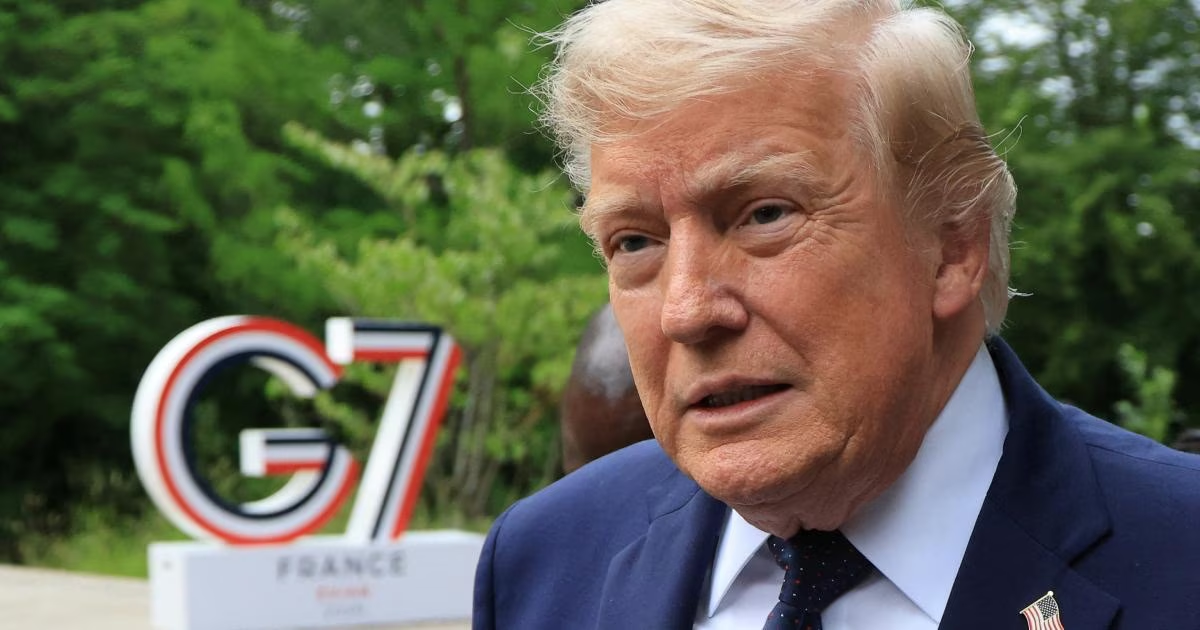
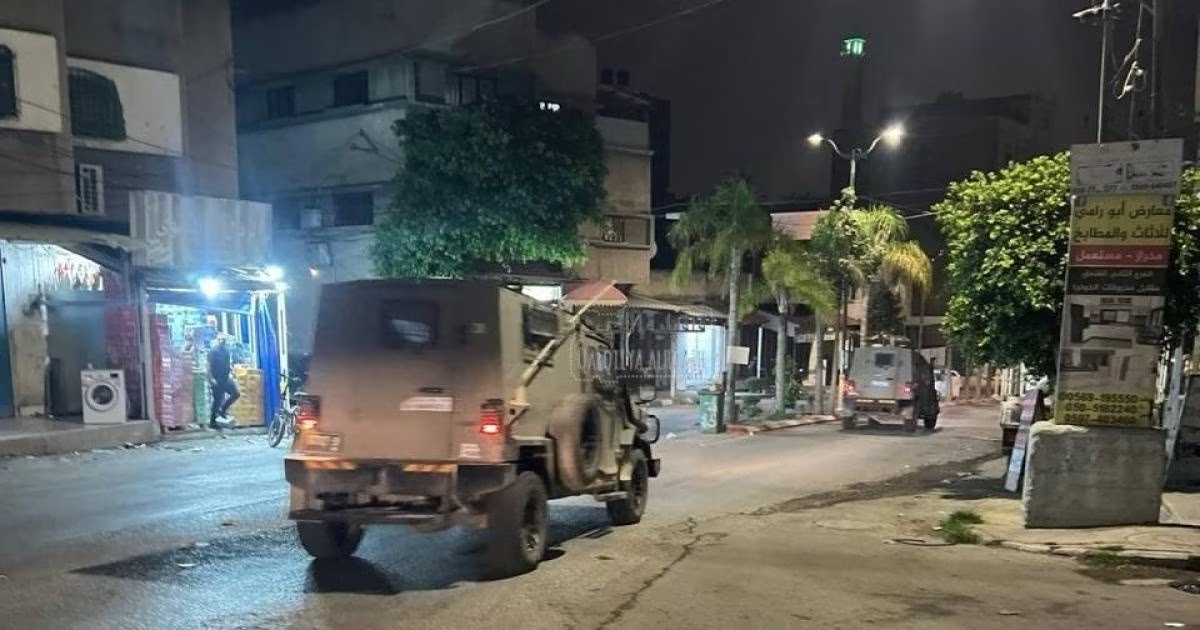
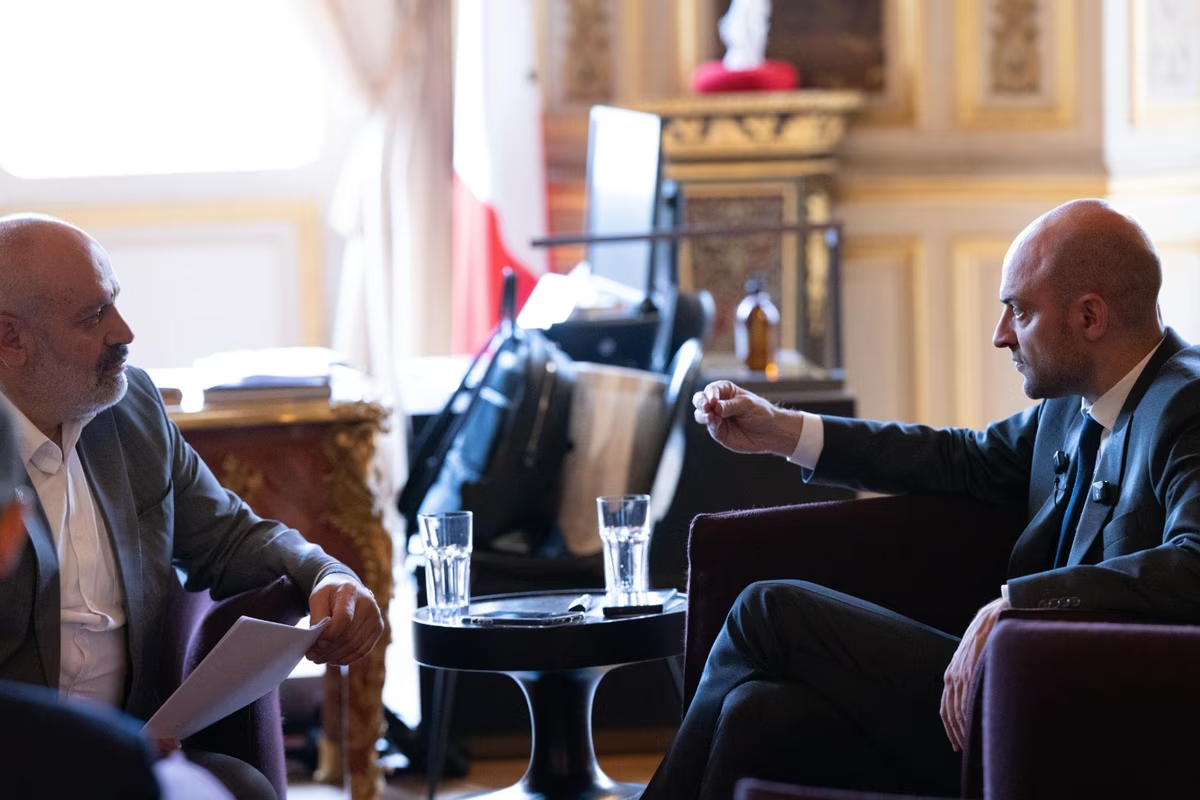
OPINIONS

Wed 17 Jun 2026 12:28 pm - Jerusalem Time

The West Bank is turning into a large prison

The town of Taybeh, a Palestinian Christian village, has witnessed in recent days a series of racist aggressions by extremist settlers who terrorize peaceful, secure citizens in their quiet village. What is happening in Taybeh is also happening around the historic Saint Barbara Church in Aboud, as well as in other places in the West Bank. Settlers roam freely in all Palestinian camps, villages, and towns in the West Bank, seeking to terrorize, intimidate, and frighten citizens, making them live in a state of tension and fear of an unknown future. The area of settlements has expanded, and the issue of confiscating Palestinian lands and building settlement outposts has become a phenomenon we see with our own eyes, especially in the Bethlehem area and its surroundings, and the Ush Ghrab and Beit Sahour areas, where lands are being confiscated and settlements are beginning to be built. Where are we going? And where are those who used to boast and lie to us, saying that the solution is two states for two peoples? Given what we see on the ground today, what is left for Palestinians? Palestinian lands are being plundered every day. And where are the guaranteeing Western parties that supported the desired and promised peace? We see that nothing of the promised and desired peace has been achieved except more targeting and abuse of Palestinians, the construction of apartheid walls, and the placement of checkpoints and iron gates that prevent Palestinians from moving from one place to another. I believe that the overwhelming majority of Palestinians now realize that what was once said about “two states for two peoples” was a big lie. Since the signing of the ill-fated Oslo Accords, apartheid walls, military checkpoints, and settlements have increased, and the political leadership in Israel boasts that it does not want a Palestinian state and does not want peace with Palestinians. It is true that Gaza suffered from the war of extermination and its catastrophic consequences, but what is happening today in the West Bank is indeed a war of extermination, albeit with different methods and patterns. Entire families have left Taybeh and gone to other places in our world, and this is happening in the Bethlehem area and other places. Emigration does not only affect Christians, but all our people who live under siege and policies of abuse, starvation, and humiliation. What is currently happening in the West Bank is a systematic policy of expulsion, for a Palestinian who does not want to be a prisoner in the occupation’s prisons also does not want to be a prisoner in his land and homeland, and the West Bank has turned into a large prison. Our children and friends in the West Bank, who communicate with us daily, tell us that their wish is to come to Jerusalem. When the issue of reaching Jerusalem becomes a wish, then the whole world must discover and realize the enormity of the injustice our afflicted and oppressed people are subjected to. The freedom to access Jerusalem and the freedom of movement from place to place is a legitimate right and not a favor from anyone, and Palestinians should not remain prisoners in their towns, villages, and camps, unable to reach their Jerusalem and their holy sites, and to their jobs and work through which they provide sustenance for their families and children. What injustice are Palestinians suffering from? And Christians suffer as all Palestinian people suffer, rather we believe that there is an unprecedented conspiracy against the Christian presence in these lands. One of the fathers told me yesterday in Bethlehem that what Palestinian Christians are subjected to comes within the framework of a systematic plan aimed at emptying Palestine of its Christians, who are an essential component of its national fabric. And those who target Palestinian Christians target all our people, for the conspiracy affects all Palestinians who are wanted to pack their bags and leave their holy land. Christian churches around the world are called upon to make their voice heard, rejecting these policies that do not target Christians alone, but target all Palestinians. International and human rights organizations are also called upon to play a role in lifting these injustices suffered by Palestinians. The apartheid walls must fall, and the iron gates of different colors must fall, and Palestinians will not accept being imprisoned in their homeland and besieged in their holy land. Peace is not achieved through apartheid walls, iron gates, and policies of abuse and humiliation suffered by Palestinians. Peace requires justice, and justice today is absent, and it seems it will remain so until the face of this world changes to be more humane and just. Those who abuse Christian clergy and spit on Christian symbols and act racially towards the Christian presence are the same conspirators against Palestinians who plan to steal Palestinian lands and eliminate any possibility of an independent Palestinian state in this holy and blessed land. May God help our people in the face of this enormous amount of injustice, and may God preserve this people to remain steadfast and firm in their land in the face of all these challenges, conspiracies, and projects aimed at liquidating the Palestinian cause.
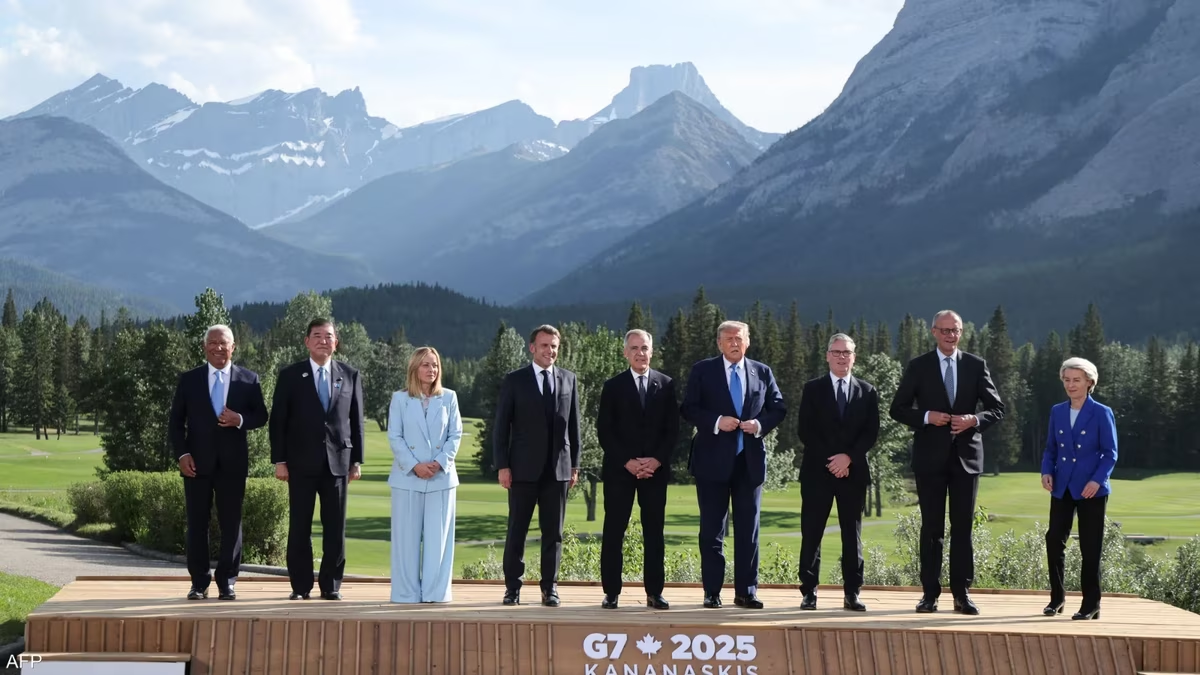
OPINIONS

Wed 17 Jun 2026 12:28 pm - Jerusalem Time

Between Diplomacy and Doubts: What Does the Anticipated Iran-US Agreement Mean?

Washington's Message

Washington – Said Arikat – 17/6/2026

News Analysis

As eyes turn to Geneva, where increasing diplomatic leaks speak of a possible new agreement between the United States and Iran on June 19, ambiguity still surrounds the final details of the anticipated understanding. So far, no official announcement has confirmed the completion of the agreement or the date of its final signing. However, accumulated indicators suggest that both parties are approaching a political moment that may be the most significant in their relations since the collapse of the previous nuclear deal.

This development comes after months of mutual military tensions and economic pressures that pushed the region to the brink of a widespread confrontation. However, recent developments have revealed that both Washington and Tehran have reached a similar conclusion: continued escalation carries greater risks than potential benefits. On the one hand, the American administration realized that any open war with Iran could impose exorbitant economic and military costs that would be difficult to justify to the American public. On the other hand, Iran found itself facing increasing economic pressures and an urgent need to alleviate the financial isolation that has burdened its economy in recent years.

According to leaks from Western diplomatic circles, the agreement focuses on Iran's nuclear program, international monitoring mechanisms, and permissible enrichment levels, in exchange for a gradual easing of some economic and financial sanctions imposed on Tehran. The International Atomic Energy Agency (IAEA) is also expected to play a pivotal role in verification and follow-up operations, ensuring a permanent monitoring mechanism that allows for measuring Iran's compliance with the terms of the agreement.

Circulating information also indicates the possibility of a gradual release of some of Iran's frozen assets abroad and allowing a limited increase in Iranian oil exports, which could give the Iranian economy a much-needed breather. There is also talk of establishing joint mechanisms to address potential disputes and prevent the collapse of the agreement at the first political or security crisis, a point that negotiators see as essential in light of previous experiences between the two countries.

Nevertheless, key issues remain shrouded in ambiguity. The extent and duration of restrictions on Iran's nuclear program are not yet clear, nor are the details of the mechanism for reimposing sanctions in the event of a breach of the agreement. Similarly, ballistic missiles and Iran's regional influence remain among the most sensitive issues, especially as they have been a focal point of deep disagreements between Washington and its regional allies in recent years.

In the United States, the anticipated agreement has begun to stir clear political division even before its official announcement. The pro-agreement camp includes a number of former diplomats, nuclear non-proliferation experts, and prominent political figures who believe that diplomacy, despite its flaws, remains the most realistic option to prevent a new war. Among the names expected to defend the agreement are Senator Bernie Sanders, Senator Chris Murphy, and former Secretary of State John Kerry, in addition to a number of experts associated with influential research institutions such as the Quincy Institute and the Carnegie Endowment.

They argue that sanctions and military pressure have not succeeded in completely stopping Iran's nuclear program, and that the absence of an agreement could leave Iran freer to develop its nuclear capabilities. They also believe that the United States needs to focus its resources on other strategic challenges, primarily competition with China and rapid international developments in Asia and Europe.

In contrast, a broad camp of conservatives and hardline Republicans rejects any new agreement with Tehran. Prominent figures in this regard include Senator Tom Cotton, Senator Ted Cruz, Senator Lindsey Graham, former Secretary of State Mike Pompeo, and former National Security Advisor John Bolton. They believe that any easing of sanctions will give Iran additional resources that can be used to strengthen its regional influence, and they argue that economic pressures were bearing fruit and should have been continued instead of returning to the negotiating table.

Economically, the importance of the agreement extends beyond the bilateral relationship between Washington and Tehran. Stability in the Gulf remains an influential factor in global energy markets, and any reduction in the likelihood of military confrontation could positively impact oil prices and international trade. Furthermore, a decrease in geopolitical tension could contribute to boosting investor confidence and reducing the volatility witnessed in markets during previous periods of escalation.

President Donald Trump's administration realizes that this economic dimension holds special political importance with the upcoming midterm elections approaching. If the agreement succeeds in achieving some stability and reducing energy-related concerns and inflation, the administration may be able to present it as evidence of the success of its foreign policy. However, if implementation falters or early disagreements emerge between the parties, the agreement could become a major subject of political attack from White House opponents.

In this context, the Trump administration's concept of "victory" seems to differ from traditional concepts associated with military decisive action. The administration does not necessarily view the overthrow of the Iranian regime or engaging in an open confrontation as a measure of success. Instead, it believes that forcing an adversary to return to negotiations and accept new restrictions can constitute a political and strategic achievement in itself. From this perspective, the administration may seek to market the agreement as evidence of the success of its maximum pressure policy in pushing Iran to make concessions it was not previously willing to make.

Conversely, the administration defines defeat as being drawn into a long and costly war without achievable goals or sufficient public support. Therefore, avoiding a widespread military confrontation is a fundamental part of the calculations that led Washington to prefer the diplomatic path over continued escalation.

One of the most sensitive questions remains related to Israel and its Prime Minister Benjamin Netanyahu. Previous experiences have shown that any US-Iranian understanding raises deep concern for the Israeli government, which fears that easing pressure could strengthen Iran's capabilities in the long run. Washington is likely to exert political and security pressure on Netanyahu to avoid any steps that could threaten the agreement. However, the White House's ability to impose its will will remain constrained by internal American balances and the extent of support Israel enjoys within Congress.

Ultimately, the importance of the anticipated agreement lies not only in its signing but also in its ability to endure after signing. The long history of distrust between Washington and Tehran, and the presence of strong opponents of the agreement in the United States, Iran, and Israel, make the implementation phase the real test of any understanding reached. If the agreement succeeds in overcoming these obstacles, it could open the door to a new phase of managing regional conflicts through diplomacy instead of military confrontations. However, if it fails, it will strengthen the voices calling for a return to the logic of force, and return the region to the cycle of tension that the current negotiations sought to escape.