OPINIONS

Sat 27 Jun 2026 2:53 pm - Jerusalem Time

Trump escalates rhetoric against the left: Progressive Democrats "most dangerous threat" to America since its founding

Washington Message

Washington – Said Arikat - 27/6/2026

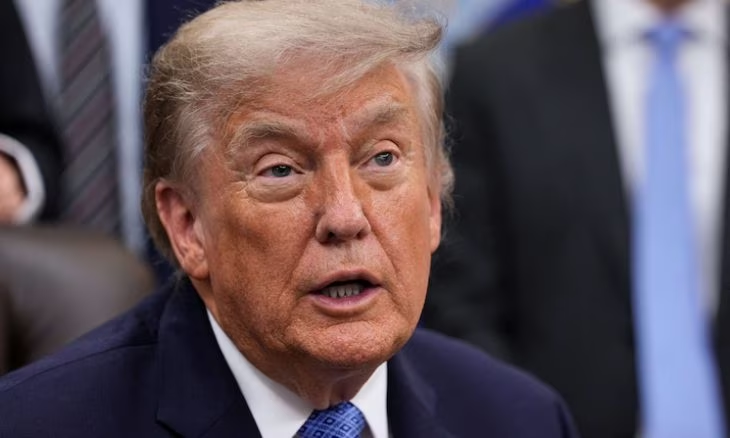
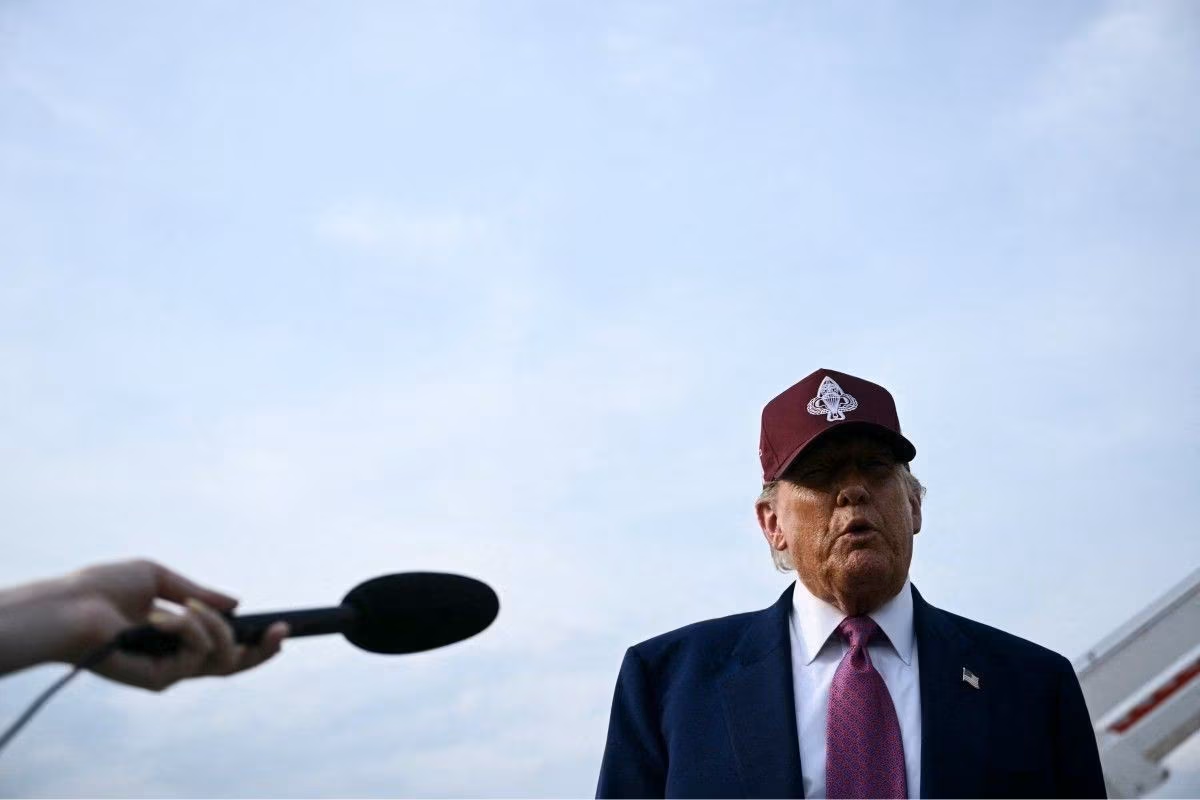
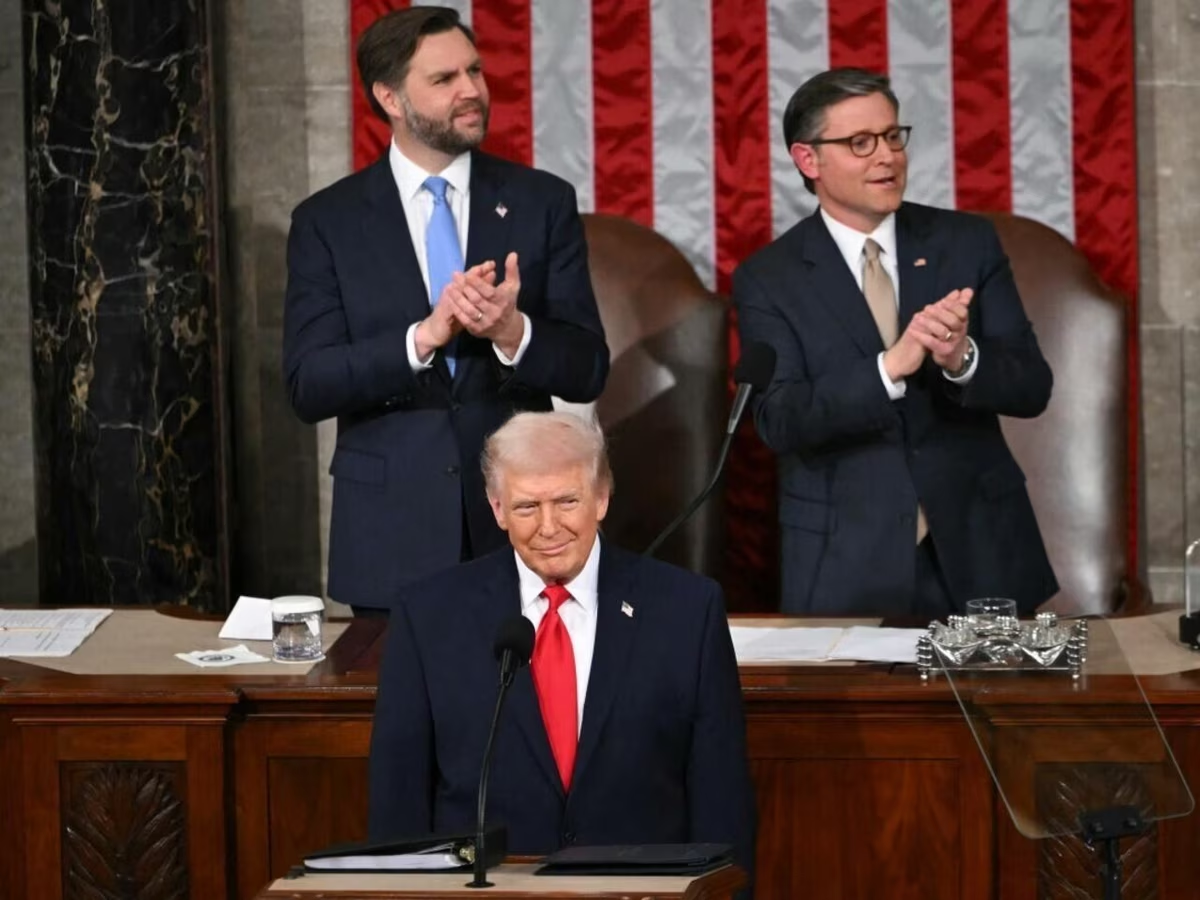
US President Donald Trump escalated his political and ideological attack on the progressive wing within the Democratic Party, describing his opponents as "atheist communists" and "animals," in a sharp speech he delivered at the Faith and Freedom Coalition conference in Washington D.C., coinciding with a lengthy post he published on the "Truth Social" platform exceeding 400 words, carrying unprecedented accusations against American progressive forces, warning of what he considered an existential threat to the United States.

The escalation came after the successes achieved by progressive and democratic socialist candidates in the New York City primaries, with the support of Mayor Zohran Mamdani, which Trump considered an indication of the expansion of the leftist current within the Democratic Party, and its transformation into a political force capable of influencing the future of national elections.

Trump said that what he described as "hardline communists" represent "the most dangerous threat facing the United States since its founding 250 years ago," considering that their ideas do not only target the economy, but also the religious and social identity of Americans. He claimed that this current "will close churches and kill people," alleging that assassinations are an essential part of its political doctrine, without providing evidence to support these accusations.

In an attempt to mock his opponents, Trump said he could become "the greatest communist in history" if he promised Americans free housing and free food, but he added that such policies would lead the country, in his words, to poverty and economic collapse and turn the United States into a state incapable of competing.

This speech comes within the framework of the election campaign in which Trump relies on mobilizing his conservative and evangelical base, by presenting the political conflict as an existential confrontation between religious and conservative values on the one hand, and radical leftist ideas on the other. His choice of the "Faith and Freedom Coalition" platform reflects his keenness to address one of the most important components of his electoral base, which played a pivotal role in his political rise in recent years.

Observers believe that Trump's language has gone beyond traditional political criticism to rhetoric based on intimidation and sharp polarization, as he portrays political opponents as an existential threat, not just electoral rivals, a style that has become a prominent feature of his discourse since entering political life.

This discourse reflects a growing trend in American politics based on transforming electoral competition into a moral and cultural battle, rather than a competition over programs and policies. When an opponent is portrayed as an enemy of the nation and religion, the space for democratic dialogue shrinks in favor of mobilization and fear rhetoric. The danger of this approach increases when it comes from a former president seeking to return to the White House, because his words not only affect his supporters, but also redraw the boundaries of public debate and push society towards more polarization and division.

Trump's statements also reveal the success of the progressive current in establishing itself as an influential player within the Democratic Party, which has led Republicans to consider it the main threat in the upcoming elections. The intense focus on New York victories reflects an understanding that shifts within the Democratic Party may extend to other states, thereby changing the nature of political competition. However, exaggerating this danger through descriptions such as "communism" and "destroying America" also reflects an electoral exploitation of historical fears associated with the Cold War more than with the current political reality.

The use of phrases such as "they will close churches" and "they will kill people" raises questions about the limits of political discourse in the United States, especially in light of the escalation of social tensions and political violence incidents in recent years. Language that relies on intimidation may achieve short-term electoral gains, but it also carries the risks of deepening societal divisions and weakening trust in democratic institutions, especially when serious claims are made without clear evidence, which opens the door to the spread of misinformation and the promotion of conspiracy theories among the public.

Trump's statements do not appear to be merely a reaction to local election results, but rather part of a broader electoral strategy based on mobilizing the conservative right-wing base by portraying the upcoming elections as a battle to save the United States from a radical transformation in its political and cultural identity. However, the continuation of this approach may make public discourse more severe, and reduce the chances of bipartisan consensus, at a time when the United States faces economic, social, and international challenges that require a greater degree of national consensus, not more political division.
PALESTINE

Sat 27 Jun 2026 2:52 pm - Jerusalem Time

Horrific Testimonies from Released Gaza Prisoners: Systematic Torture and Deaths of Detainees in Detention Centers

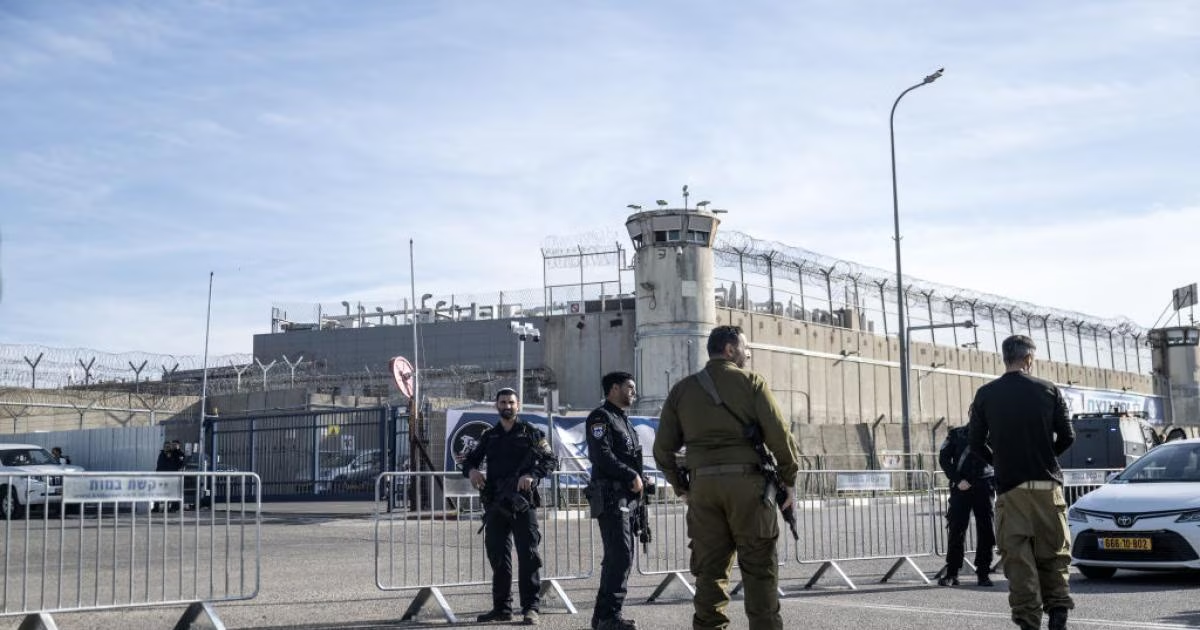
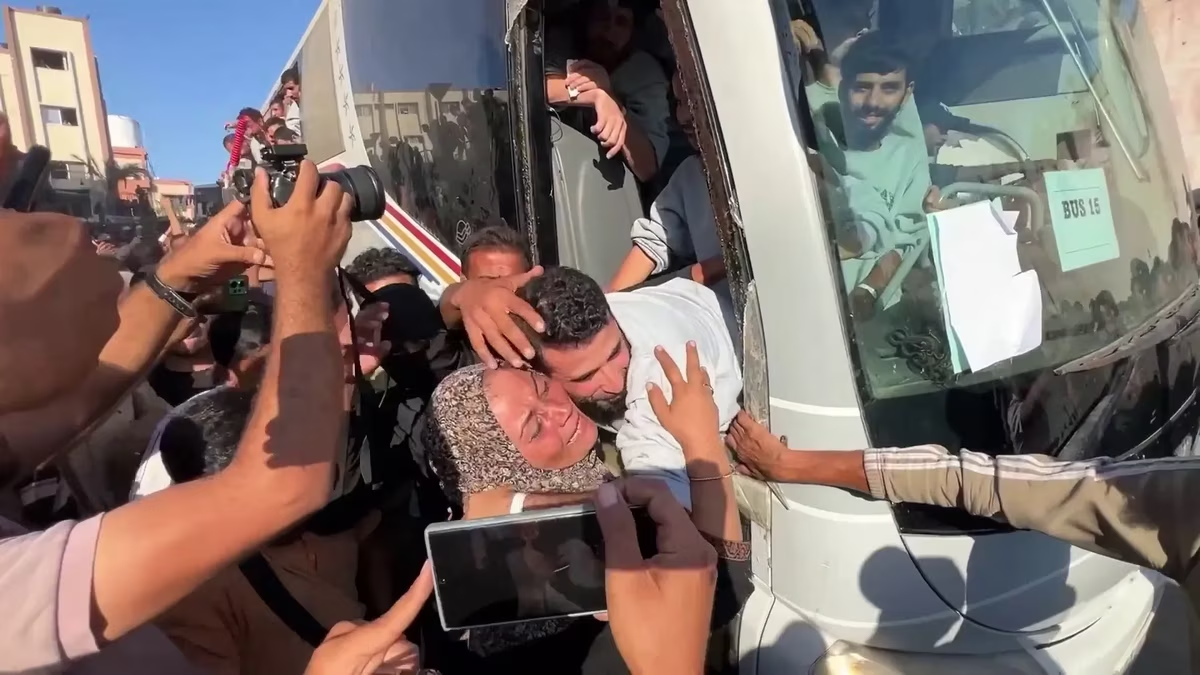
On the occasion of the International Day in Support of Victims of Torture, Palestinian prisoners released from the Gaza Strip gave shocking testimonies about the grave violations and systematic torture they were subjected to in Israeli detention centers. Sources confirmed that these practices included severe beatings, deliberate humiliation, intentional medical neglect, and deprivation of the most basic human rights from the moment of their arrest until their release.

Journalist Khader Baker Abdel Aal, who worked as a correspondent for local and international agencies, recounted details of his arrest from Al-Shifa Medical Complex on March 18, 2024. Abdel Aal explained that occupation forces tied his hands behind his back, blindfolded him, stripped him of his clothes, and subjected him to continuous beatings for long hours in extremely humiliating conditions.

Abdel Aal pointed out that the absence of international protection for Palestinian journalists made them easy prey for direct assaults from the first moments of detention. He described the transfers as taking place in large trucks packed with about 150 detainees, before they were distributed to smaller buses, shackled with iron handcuffs on their hands and feet.

The released journalist spoke about the severe physical effects left by the continuous beatings during transfers, confirming that he suffered rib fractures whose pain lasted for many months. He added that detainees were forced to wear uniform prison clothing amidst an atmosphere of continuous physical and psychological intimidation that did not stop throughout the journey.

In a horrific testimony about medical neglect, Abdel Aal mentioned that he was transferred to a medical examination point within the Gaza envelope to record data, and there he informed the specialist doctor of his chronic skin disease. The doctor's response was shocking, as he clearly told him: 'I am not here to treat you, but I came to torture you,' before he was sent back to the detention cells.

Abdel Aal revealed the crime of the death of detainee Kamal Radi inside one of the prison sections, where the latter was summoned and subjected to brutal beatings for a full hour. He explained that Radi was returned to the cell in a very critical health condition, only to die shortly thereafter, with his body placed in a black bag in front of his son, who was detained in an adjacent section.

Regarding the detention conditions in the 'Sde Teiman' camp, Abdel Aal described the 91 days he spent there as an endless series of abuse. He confirmed that the prison administration prevented detainees from speaking, praying, or sleeping normally, and restricted the use of restrooms to only a few minutes per day.

Sources reported that detainees in 'Sde Teiman' remain constantly bound and blindfolded, and are subjected to severe punishments for any slight movement or attempt to communicate with others. Repression units storm the sections weekly to carry out mass beatings without any justification, even on holidays and special occasions.

Released prisoners stressed that the violence practiced against them was not aimed at achieving intelligence purposes or obtaining information, but rather its primary purpose was humiliation and the destruction of human dignity. They described these practices as a consistent policy followed by the occupation authorities against all detainees from the Gaza Strip without exception.

In another incident, Abdel Aal recalled suffering from severe blood poisoning that required his transfer to the hospital, handcuffed and shackled, under heavy guard. There, instead of receiving care, he was subjected to a physical assault that led to bleeding in his head, and was forced under threat to conceal the truth of what happened to him to avoid a new round of torture.

Released prisoners described transfers to courts or hospitals as additional 'torture trips,' where detainees are forced to sit in painful positions for long hours. They pointed to the occupation's deliberate act of leaving them under the scorching sun and on hot asphalt surfaces to increase their physical and psychological suffering.

For his part, released prisoner Musab Amdoukh revealed the existence of special rooms known as 'the disco,' where very loud music is played continuously to prevent detainees from sleeping. He explained that this type of psychological torture aims to exhaust the mental and physical strength of prisoners and keep them in a state of constant disorientation.

Amdukh added that torture methods also included the use of electric shock and prolonged sleep deprivation as primary pressure tools. He also pointed to other humiliating practices such as forcing detainees to drink water in ways that degrade their human dignity, reflecting the sadism of the jailers in dealing with Palestinians.

Prisoners concluded their testimonies by emphasizing that what happens inside Israeli detention centers goes beyond all description and represents a blatant violation of all international conventions. They appealed to international human rights organizations to intervene immediately to save thousands of detainees who still face the risk of death and daily torture in occupation prisons.

'I am not here to treat you, I came to torture you,' the doctor replied when I told him about my chronic skin disease.

PALESTINE

Sat 27 Jun 2026 2:52 pm - Jerusalem Time

Martyrs in Khan Yunis and Israeli Incursion to Expand the 'Yellow Line' in Central Gaza Strip

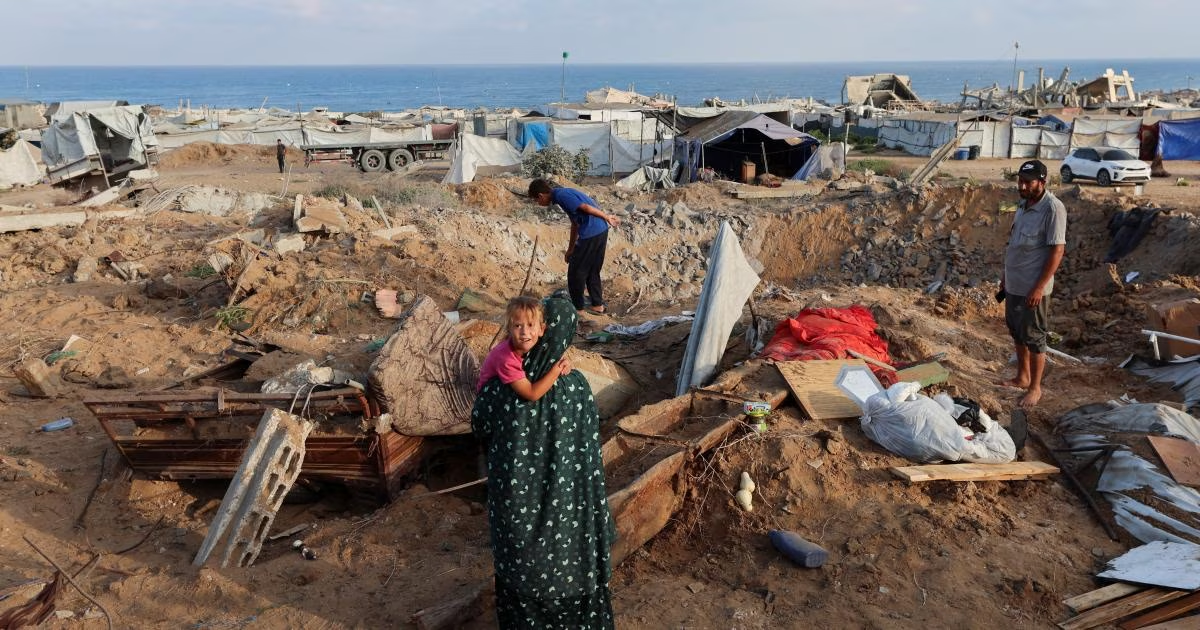
Medical and local sources reported the martyrdom of two Palestinians today, Saturday, as a result of an Israeli drone targeting a tent housing displaced people in the Al-Mawasi area, west of Khan Yunis city, southern Gaza Strip. This raid comes amidst continuous field escalation despite the ongoing ceasefire agreement, with aerial attacks targeting civilian gatherings in areas previously classified as safe.

In a related context, Nasser Medical Hospital announced the death of 10-year-old child Walid Youssef Abu Jazar, who succumbed to serious injuries sustained days earlier. The child was injured in a previous Israeli shelling that targeted the Al-Mawasi area, joining a long list of children who have fallen due to direct targeting of displacement areas.

On the ground, the central areas of the Gaza Strip witnessed suspicious military movements, as Israeli vehicles and bulldozers infiltrated a limited distance east of Al-Maghazi camp and Deir al-Balah city. Eyewitnesses stated that the invading force moved the yellow concrete blocks westward, in a step aimed at seizing new areas of citizens' lands and expanding the scope of military control.

Local sources explained that two tanks and a military bulldozer advanced about 200 meters southeast of Al-Maghazi camp, amidst heavy gunfire to intimidate residents and farmers. The vehicles removed the blocks that define what is known as the 'Yellow Line,' the demarcation line stipulated by the ceasefire agreement, indicating the occupation's intention to impose a new geographical reality.

This 'Yellow Line' forms a security buffer strip extending along the eastern and central borders of the Strip, depriving thousands of Palestinians from accessing their agricultural lands and homes. Field data confirms that the Israeli army seeks to transform this strip into a closed military zone, devouring vast areas deep within the Strip.

For his part, Israeli Prime Minister Benjamin Netanyahu had previously stated that his forces currently control about 70% of the Gaza Strip's area. These statements intersect with Palestinian reports indicating that the occupation exploited the truce period to strengthen its military presence and expand bases and security points within populated areas.

Palestinian factions condemned these ongoing violations, with Hamas spokesman Hazem Qassem considering what is happening a blatant breach of international understandings. Qassem called on international mediators to intervene immediately to pressure the occupation authorities to stop forced displacement operations, house demolitions, and the expansion of buffer zones that suffocate the population.

Statistics from the Ministry of Health in Gaza indicate that the occupation's violations of the ceasefire agreement, since its inception last October, have led to the martyrdom of 1031 citizens and the injury of more than 3300 others. These figures show the magnitude of the challenges facing the stability of the calm amidst ongoing localized military operations and intermittent aerial bombardment.

It is worth noting that the Gaza Strip has been experiencing an unprecedented humanitarian catastrophe since the outbreak of the war on October 8, 2023, with the death toll exceeding 73,000 martyrs and 173,000 injured. Continuous military operations have caused near-total destruction of infrastructure, rendering vast areas of the Strip uninhabitable amidst a severe blockade.

The occupation continues its violations of the ceasefire agreement by expanding control areas, displacement operations, and systematic house demolitions.

PALESTINE

Sat 27 Jun 2026 2:52 pm - Jerusalem Time

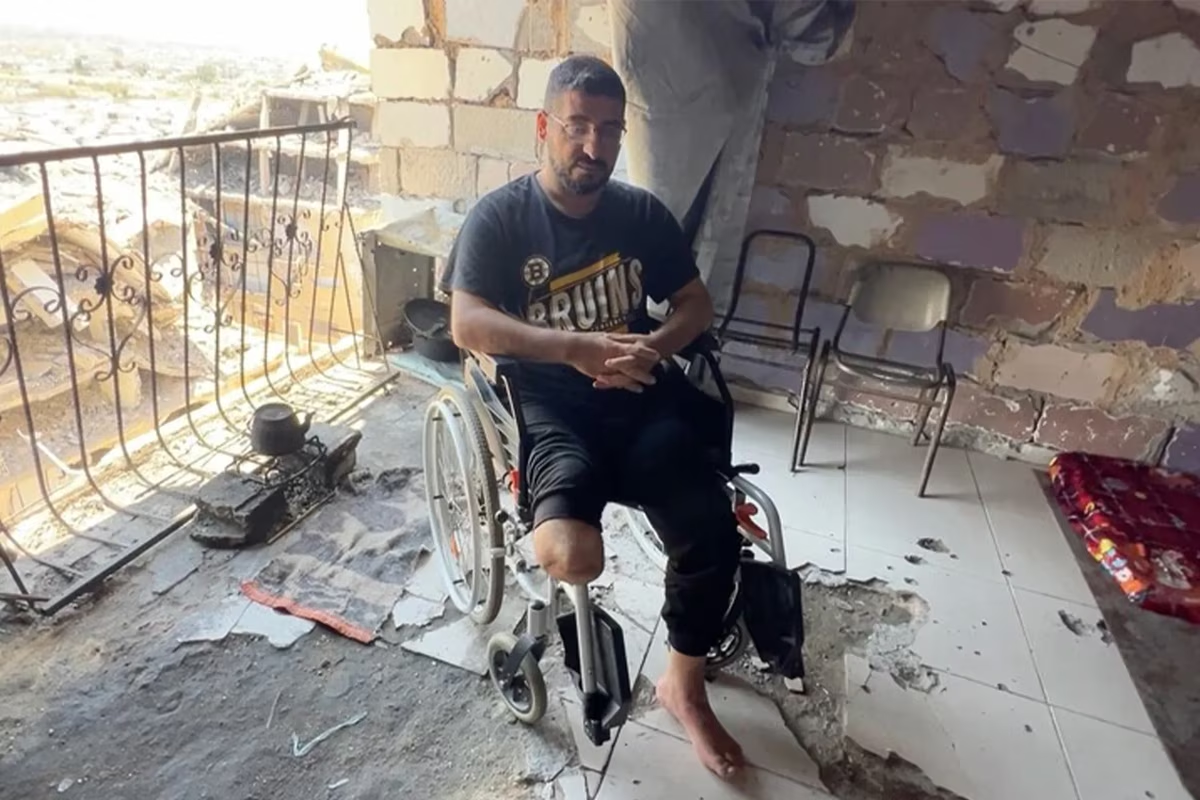
His leg was amputated and he lost his only son.. The released prisoner, Jibril Al-Safadi, recounts chapters of suffering between occupation prisons and the Gaza genocide

In a corner of his partially destroyed home in Hamad City, north of Khan Yunis, the liberated prisoner Jibril Al-Safadi (48 years old) sits in a wheelchair, bearing the scars of captivity in his body and the pain of loss in his heart. His journey to freedom from the occupation's prisons was not as he had imagined; he returned to find himself without a leg and without a son, in a story that encapsulates the chapters of double Palestinian suffering between prison walls and the machinery of war outside.

The tragedy began on March 4, 2024, when occupation forces arrested him at the Hamad City checkpoint, leading him to spend one year, eight months, and nine days in captivity. Al-Safadi entered prison with a healthy body, but he soon faced a systematic policy of medical neglect from the very first moments of his arrest, as severe pains began to afflict his right leg without his cries receiving any response from the jailers.

Al-Safadi recounts harsh details of his continuous screaming days inside the cell, confirming that he spent eight days calling on the soldiers to save him from pain and bleeding, but the response was always insults and humiliation. With his health deteriorating dangerously, he was transferred to the medical center to be faced with two bitter choices: either amputation of the leg or facing certain death, forcing him to sign documents in a language he did not master.

Al-Safadi's journey inside prison ended with the loss of his limb, but the greater shock awaited him at the gate of freedom in October 2025, when he learned of the martyrdom of his only son, 22 years old. The son was the family's primary provider in his father's absence and was killed in an Israeli raid targeting the area, turning the dream of reunion into an insurmountable tragedy.

The Palestinian liberated prisoner describes the news of his son's martyrdom as harsher than all the forms of torture he endured in interrogation centers, including 'Sde Teiman' camp and 'Ofer' prison. He affirms that his return to his dilapidated home was not a victory as much as it was a new confrontation with a bitter reality, where he became unable to move and support his wife and five daughters under extremely difficult humanitarian conditions.

Regarding the conditions inside prisons, sources quoted Al-Safadi as saying that detainees live in a deadly environment lacking the most basic human necessities, where starvation and severe beatings prevail. He pointed out that the occupation has turned prisons into centers for systematic abuse, where prisoners lose their lives or limbs due to the absence of deliberate medical care and repeated physical assaults that do not stop.

Al-Safadi's case reflects the reality of thousands of Palestinian prisoners who face a similar fate amidst widespread international silence regarding the crimes committed behind bars. Human rights calls are escalating for the necessity of opening an international investigation into cases of amputation and medical neglect suffered by detainees from the Gaza Strip, and ensuring their protection in accordance with the Geneva Conventions and international humanitarian law.

Today, Jibril tries to adapt to his new life in his wheelchair, surrounded by the city's destruction and the memories of his late son, in a scene that embodies the resilience of the Palestinian people in the face of attempts at annihilation. His story remains a living testament to the brutality of the violations practiced by the occupation authorities against prisoners, which go beyond merely depriving them of freedom to depriving them of bodies and souls.

For eight days, I screamed and called out to the male and female soldiers, but there was no response; instead, I was subjected to humiliation and insults.

ARAB AND WORLD

Sat 27 Jun 2026 2:51 pm - Jerusalem Time

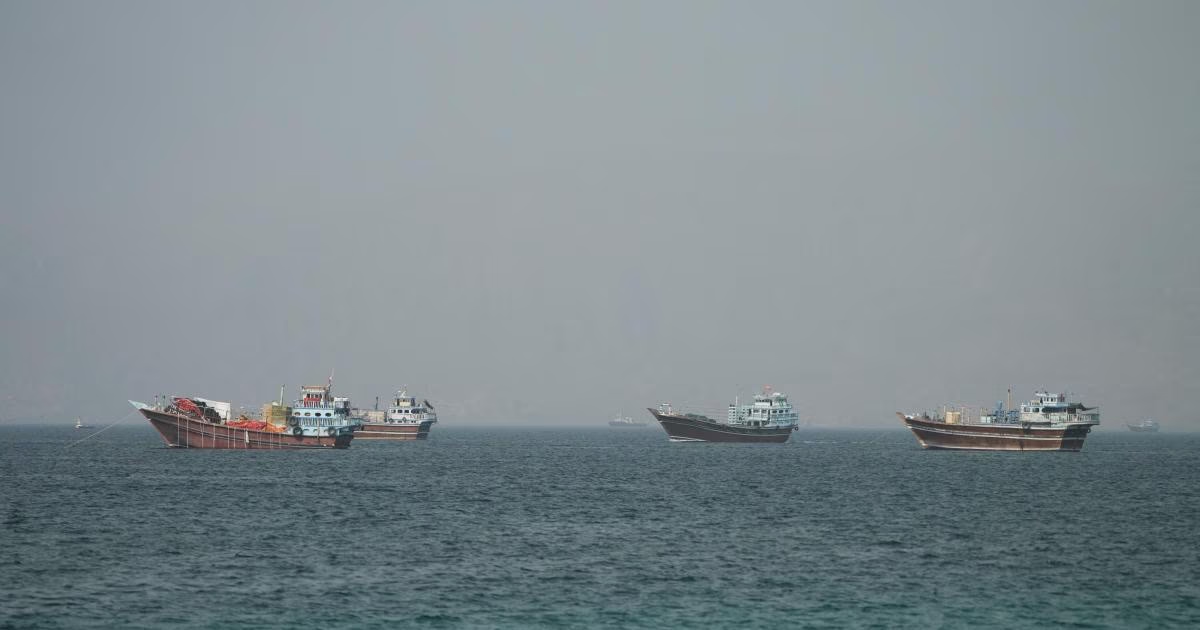
Escalation in Hormuz: Trump Accuses Tehran of Attacking Cargo Ships, Revolutionary Guard Denies Coordination with Washington

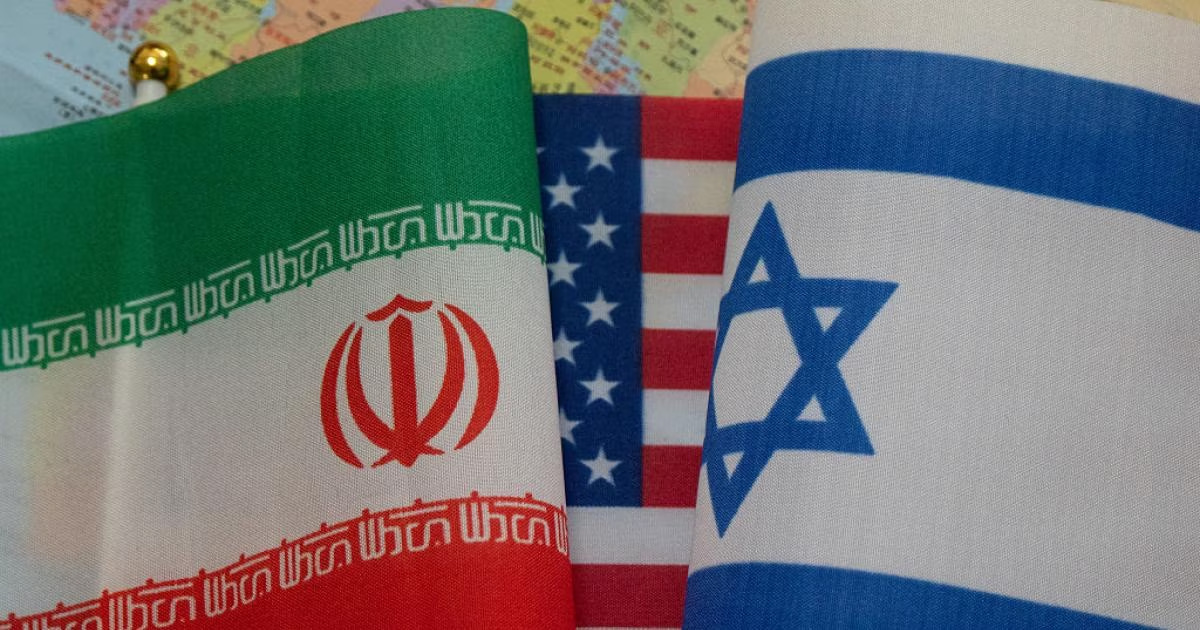
US President Donald Trump directly accused Iranian authorities of violating ceasefire understandings by launching aerial attacks targeting international navigation in the Strait of Hormuz. Trump clarified that Tehran launched at least four offensive drones towards commercial ships crossing the strategic waterway, representing a dangerous escalation in the region.

The US President revealed details of the attack, indicating that one of the drones successfully hit the deck of a large cargo ship directly, causing significant material damage. In contrast, he affirmed that US defenses and forces stationed in the region were able to intercept and shoot down three other drones before they reached their targets.

For its part, the Iranian Revolutionary Guard quickly denied reports circulating about the existence of security coordination channels with the United States. The Guard's command affirmed that there is no truth to rumors about establishing a direct communication line with Washington to regulate movement in the Strait of Hormuz, emphasizing that sovereignty in this passage is subject solely to Iranian administration.

Iranian media reports, specifically 'Press TV', had previously stated that the two parties reached understandings in Switzerland to establish a communication channel to prevent military escalation. The reports claimed that this channel aimed to avoid accidental incidents and implement provisions related to broader regional understandings, which the Iranian military establishment later denied.

In a firm statement, the naval forces of the Revolutionary Guard announced that passage through the Strait of Hormuz can only occur via the designated routes officially declared by Tehran. The statement stressed that the only law in force in the waters of the Strait is Iranian law, and under the exclusive supervision of its naval forces.

Iranian diplomacy entered the crisis through statements by Deputy Foreign Minister Kazem Gharibabadi, who affirmed that navigation security is linked to recognizing Iran's status. Gharibabadi warned that any security arrangements that ignore Iran's role as a key coastal state would not guarantee safe passage for ships, and could instead lead to disruptions in regional trade routes.

The Iranian official hinted that uncoordinated movements with his country could push Tehran to take strict measures that might affect supply chains in the region. These warnings come amid Iranian insistence on managing the maritime security file away from international interventions, which Tehran describes as illegal.

On the ground, informed sources reported that foreign oil tankers attempted yesterday to cross the Strait via routes not authorized by Iranian authorities. The sources clarified that these ships were forced to retreat and turn back after receiving strict warnings from Revolutionary Guard warships patrolling the area.

Regionally, UAE Foreign Minister Sheikh Abdullah bin Zayed held a phone call with his Iranian counterpart Abbas Araghchi to discuss the implications of the situation. During the call, the Emirati minister stressed the need to adhere to signed international agreements and ensure the protection of vital waterways that represent the lifeline of the global economy.

The Emirati Foreign Minister concluded his remarks by emphasizing that responsible dialogue and serious diplomacy are the only way to overcome current crises. He called for respecting national sovereignty and adhering to international laws that guarantee freedom of navigation, stressing the importance of stopping all hostile actions that threaten regional stability.

Safe passage through the Strait of Hormuz cannot be guaranteed under unclear arrangements or parallel routes that ignore Iran's role as a coastal state.

OPINIONS

Sat 27 Jun 2026 2:51 pm - Jerusalem Time

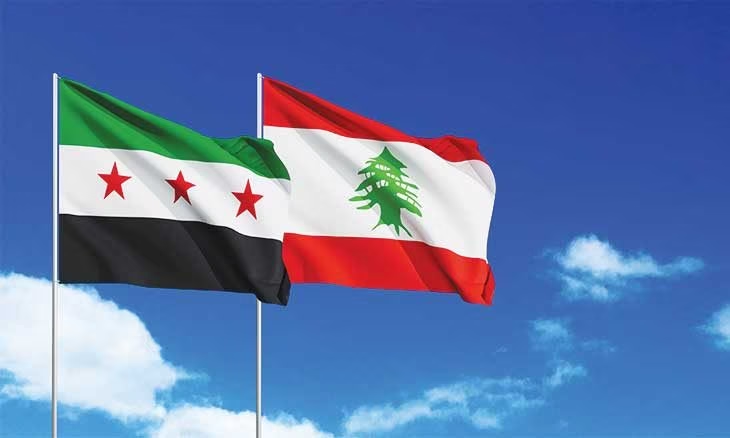
Mutual Interests Between Damascus and Beirut: Is Syria Looking for a Political Way Out in Lebanon?

Amidst the political clamor and conflicting interpretations that have recently accompanied the Lebanese file, a fundamental truth emerges, indicating that Syria does not wish to engage in a new war, nor does the United States seek Syrian military intervention there. It seems that the general trend is towards finding a political solution to the Lebanese crisis, especially after years of escalation have proven that destruction cannot create sustainable solutions for warring states.

The Syrian state, which emerged from a devastating war that lasted nearly a decade and a half and lost a large part of its infrastructure, today places reconstruction and development at the top of its national priorities. It is illogical for Damascus to seek to open external fronts or engage in military adventures that contradict its urgent need to restore economic growth and attract foreign investments to repair what the war left behind.

Geopolitics imposes an inevitable integration between the two countries, as Beirut is considered the maritime lung for Damascus, while Tripoli represents a natural extension of central Syrian regions. Syria's true interest lies in transforming borders into corridors for trade and tourism, where any financial or security stability in Lebanon positively reflects on the Syrian interior, and vice versa, given the deep geographical overlap.

Regarding international positions, it appears that US President Donald Trump's approach moves away from the idea of direct military escalation in favor of containing crises through political influence tools. Washington sees Damascus as a party with historical influence capable of contributing to producing a viable political settlement, especially since past experiences have proven that costly military solutions do not guarantee long-term stability in the region.

Recent messages from Damascus indicate a trend that adopts dialogue instead of revenge, and accommodates complex Lebanese realities, including the relationship with Hezbollah. This openness reflects a desire to close past files and open a new page based on strategic partnership, away from the traditional concepts of hegemony that prevailed in previous decades and burdened both states.

Lebanon is currently going through one of its most complex economic and political crises, which makes regional cooperation an urgent necessity, not just a political option. Utilizing the current international climate and Syrian openness may represent a rare opportunity to save Lebanon from total collapse, provided that relations are built on common interests and away from narrow ideological calculations that have drained the resources of both peoples.

Beirut represents the natural maritime lung for Damascus, and what the two countries need today is not new lines of contact, but rather trade and investment routes and economic integration.

ARAB AND WORLD

Sat 27 Jun 2026 2:51 pm - Jerusalem Time

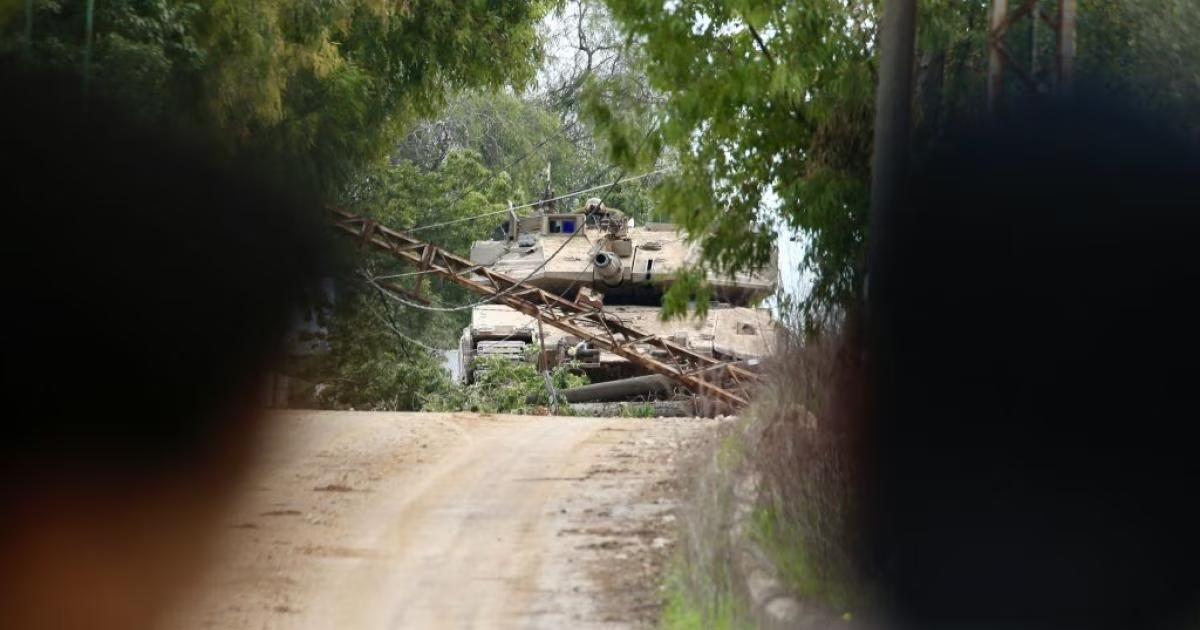
Map of Israeli Expansion in Southern Lebanon: How Does the Occupation Impose the 'Buffer Zone' as a Fait Accompli?

Southern Lebanon is witnessing rapid field transformations amidst the announcement of a framework agreement, as Israeli occupation forces continue to violate ceasefire understandings. These movements aim to impose a new geographical reality that expands the buffer zone, which the occupation seeks to establish as a fait accompli before entering any final negotiations.

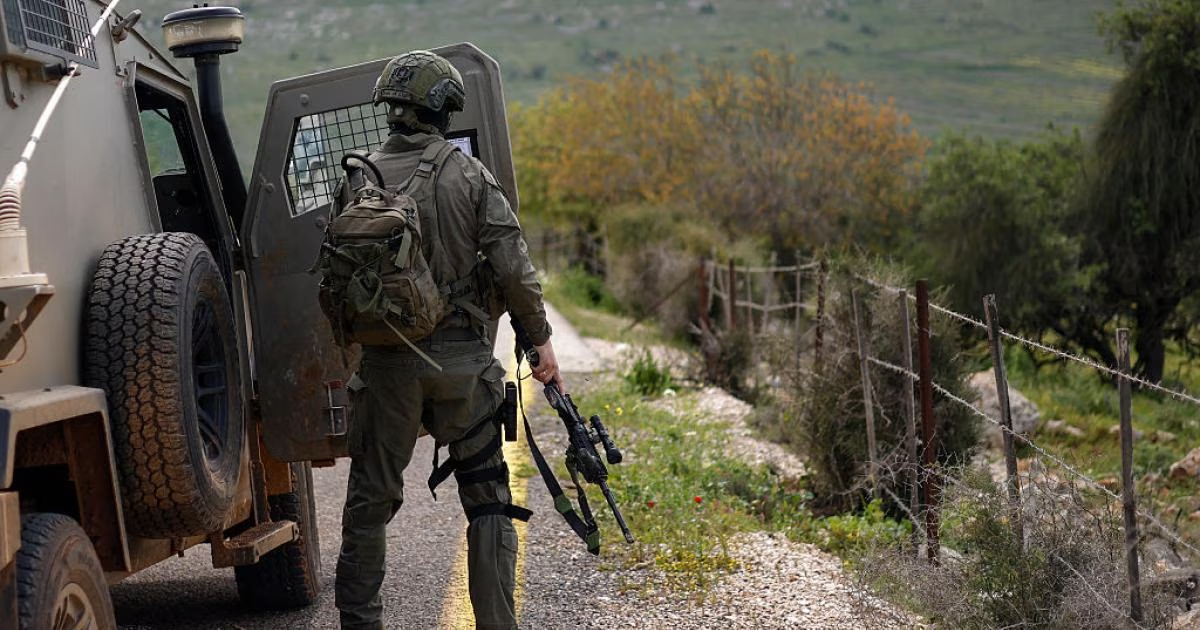
'The Yellow Line,' which defines the southern edge of Lebanon, is no longer fixed as it was when the ceasefire was first announced, as field sources have observed repeated expansions in its area. These expansions have included villages and towns that were not within the initial scope, indicating an Israeli desire to seize more Lebanese territory and secure greater strategic depth.

In the western sector, changes are clearly evident after the buffer zone's borders previously ended at the towns of Al-Bayada and Shama. However, the recent expansion has pushed these borders northward, engulfing the towns of Zibqin, Majdal Zoun, and Bayt al-Sayyad, amidst intensive ground incursions carried out by occupation vehicles in recent days.

Reports indicate that Israeli forces have already reached the outskirts of the coastal town of Al-Mansouri, which gives them partial control over the southern coastal strip. This advance aims to completely isolate the border villages from the Lebanese interior, turning them into a closed military zone from which civilians are prohibited.

In the central sector, the area of forbidden zones for Lebanese citizens has expanded to include additional areas towards the town of Hadatha, reaching the outskirts of Tibnin. Local sources recorded an incursion by Israeli vehicles last Friday, starting from Hadatha towards the outskirts of the town of Haris, an area located outside the declared demarcations of the Yellow Line.

Occupation forces stormed a house in the town of Haris and converted it into a military outpost, coinciding with extensive sweeping operations in the vicinity. These ground movements were accompanied by intensive flights of drones and reconnaissance aircraft that did not leave the region's skies, reflecting a state of constant alert.

Moving to the eastern sector, the largest and most dangerous transformations have appeared since the start of the ceasefire, with movements concentrated around strategic points north of the Litani River. Although Beaufort Castle was previously included within the Yellow Line, actual field deployment there did not begin intensively until recently.

Through its control over Beaufort Castle and the surrounding heights, Israeli forces seek to secure direct oversight of the city of Nabatieh and its villages. These heights, especially Kfartibnit and Ali al-Taher, provide significant intelligence and military advantage to the occupation, which explains the insistence on remaining there despite international pressure.

In a related context, media reports revealed a proposal to establish 'experimental zones' from which the Israeli army might withdraw and hand over to the Lebanese army under international supervision. These locations are concentrated in the eastern sector, specifically in the Wadi al-Salouqi area and the town of Zawtar, located at the western border of the Yellow Line.

Press sources quoted 'Axios' as saying that American officers might participate in the field supervision of limited withdrawal operations in coordination with the Lebanese army. This step is an attempt to reduce tension, but it remains contingent on the occupation's commitment to the proposed withdrawal timeline.

For his part, Israeli Prime Minister Benjamin Netanyahu continues to emphasize the necessity of continued military presence within the Yellow Line for an indefinite period. Netanyahu categorically refuses to allow displaced Lebanese citizens to return to their villages within this range, considering them essential security zones to protect northern settlements.

In contrast, Hezbollah announced its categorical rejection of the framework agreement in its current form, stressing that it would not accept any arrangements that do not guarantee a complete Israeli withdrawal. The party views the current Israeli movements as an attempt to impose a disguised occupation under the name of buffer zones, which will be met with field resistance.

These developments indicate that the ceasefire agreement is going through a very critical phase due to the absence of effective monitoring mechanisms on the ground. While diplomats talk about de-escalation, Israeli bulldozers are drawing new borders with blood and fire, threatening the collapse of fragile understandings and a return to comprehensive confrontation.

The situation in southern Lebanon remains suspended between the occupation's desire to seize Lebanese geography and the Lebanese people's insistence on restoring their full sovereignty. With daily violations continuing, the buffer zone remains an Israeli project facing widespread popular and official rejection, amidst anticipation of what future diplomatic moves will bring.

The occupation continues its violations of the ceasefire agreement in an attempt to gain more field leverage before any negotiation.

PALESTINE

Sat 27 Jun 2026 2:51 pm - Jerusalem Time

Protests in Beirut Reject Framework Agreement with Israel, Netanyahu Conditions Withdrawal on Disarming Hezbollah

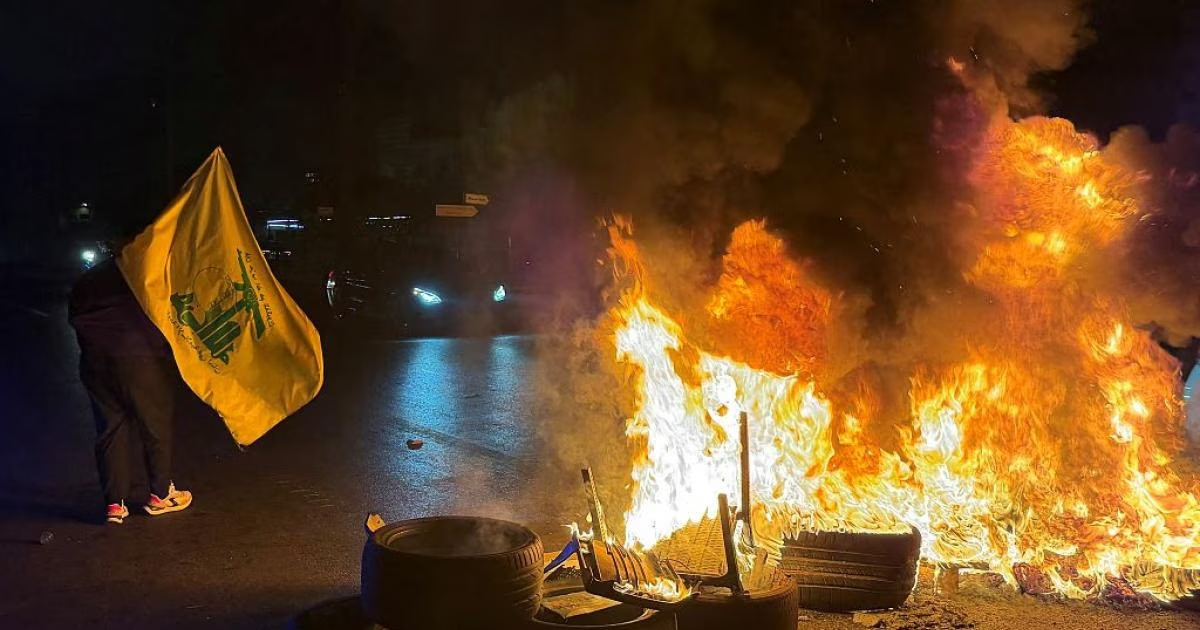
The streets of the Lebanese capital, Beirut, witnessed a state of popular unrest and field protests on Friday evening, carried out by Hezbollah supporters, expressing their categorical rejection of the recently announced framework agreement with Israel. Local sources reported that protesters blocked vital roads with burning tires, leading to traffic disruption in strategic areas of the capital.

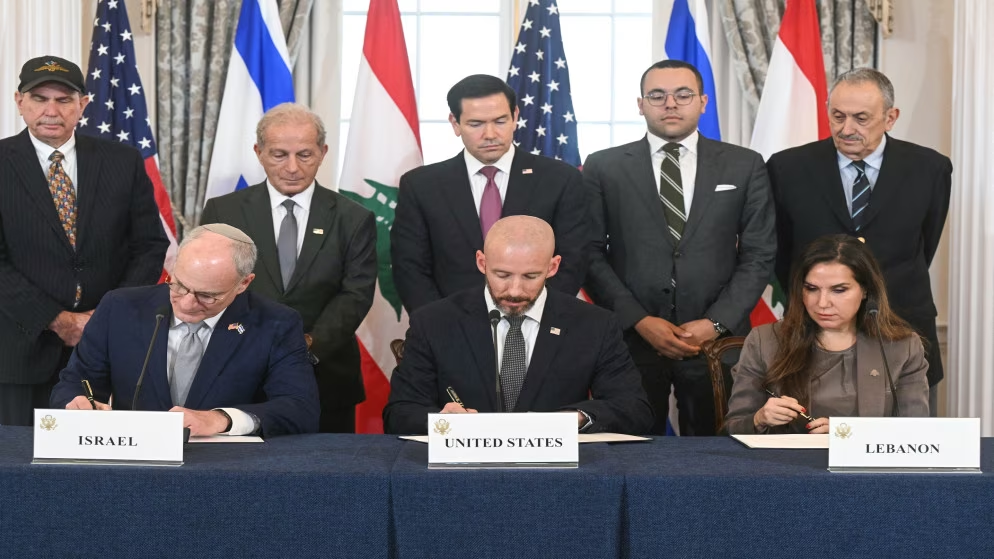
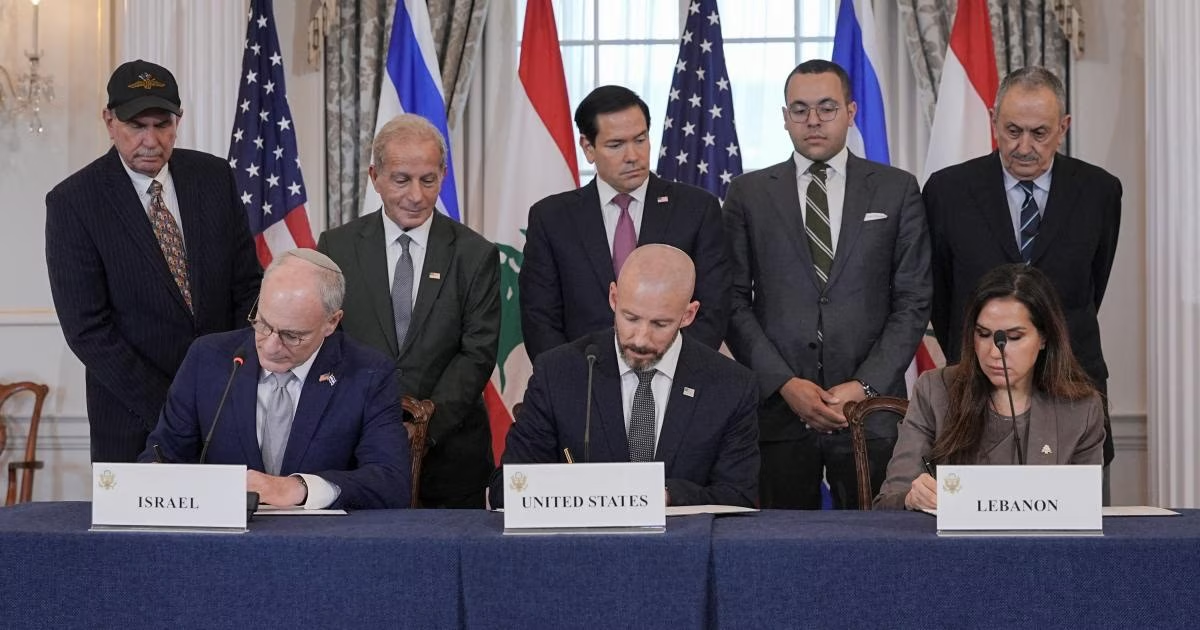
These field movements came after the US Secretary of State, Marco Rubio, announced that the Lebanese and Israeli sides had reached a framework agreement under Washington's patronage. Rubio explained that this development was the result of five intensive rounds of indirect talks hosted by the US capital during the past period to reach security and border understandings.

Regarding the details of the protests, media sources stated that dozens of young men roamed the streets of Beirut on motorcycles, raising slogans condemning the agreement and considering it a concession of national rights. These marches focused on the areas of Bechara El Khoury, Riad Al Solh, and the airport road, in addition to blocking the main Salim Salam road, which is a vital artery in the heart of the capital.

For his part, Lebanese President Joseph Aoun defended the agreement in an official statement, considering it a political achievement that paves the way for the restoration of Lebanese sovereignty. Aoun affirmed that this step represents the first stage in a long process aimed at ensuring the recovery of all occupied Lebanese territories without any derogation from national sovereignty.

In contrast, Hezbollah's reaction was sharp, voiced by MP Hassan Fadlallah, who described the agreement as a 'free gift to the Israeli enemy'. Fadlallah stressed in press statements that the party's opposition to this path is serious and final, emphasizing the resistance's adherence to the option of arms as the sole guarantee to protect Lebanon in the face of Israeli ambitions.

According to leaked information, the framework agreement includes a gradual roadmap that may lead to a future peace agreement between the two parties. The agreement includes immediate field steps, most notably the establishment of two pilot areas to begin implementing new security arrangements under direct international and American supervision.

The agreement also stipulates the withdrawal of Israeli forces from specific areas, to be replaced by the Lebanese army, which will assume security tasks in those areas. This process will be under the direct supervision of American military officers who will be present on the ground to verify compliance with the agreed security provisions and prevent any violations.

On the other hand, Israeli Prime Minister Benjamin Netanyahu set harsh conditions for implementing the withdrawal, affirming in a video message that Israel would not leave the security zone for now. Netanyahu linked any future withdrawal to the complete disarmament of Hezbollah and the elimination of what he described as security threats facing northern settlements.

Netanyahu clarified that the current agreement only allows for the limited deployment of the Lebanese army in certain points, based on security recommendations and assessments from the Israeli army. He indicated that implementation would begin exclusively in the two pilot areas to assess the Lebanese state's ability to control the security situation there.

In the context of Israeli opposition, Avigdor Lieberman, leader of the 'Yisrael Beiteinu' party, questioned the effectiveness of the agreement and its ability to achieve long-term stability. Lieberman considered that the continued growth of Hezbollah's military power makes a comprehensive confrontation a matter of time, regardless of any paper agreements signed.

These rapid political developments come at a time when Lebanon is still suffering from the effects of the ongoing Israeli aggression since March 2026. According to the latest statistics from the Lebanese Ministry of Health, the aggression has resulted in the martyrdom of more than 4,200 people and the injury of thousands, in addition to massive destruction of infrastructure and residential areas.

The ongoing military operations have also led to the displacement of more than a million Lebanese from their villages and cities, creating a major humanitarian and social crisis that puts pressure on state institutions. Observers fear that the current protests and political division over the framework agreement will lead to further internal instability under the current circumstances.

International circles are cautiously monitoring the Lebanese government's ability to market this agreement domestically in light of fierce opposition from influential political forces. Washington considers the success of this agreement a cornerstone of its strategy to de-escalate tensions in the Middle East and secure Israel's northern borders.

The question remains about the fate of the pilot areas stipulated in the agreement, and the Lebanese army's ability to deploy there without clashing with local forces. Given Hezbollah's adherence to its weapons and Israel's condition for their disarmament, the path to implementing the framework agreement appears to be fraught with complex field and political obstacles.

The agreement is a first step towards Lebanon regaining full and undiminished sovereignty over its territories.

PALESTINE

Sat 27 Jun 2026 2:50 pm - Jerusalem Time

Norwegian Report Warns: One Million Displaced in Gaza Face Risk of Death from Heat in Dilapidated Tents

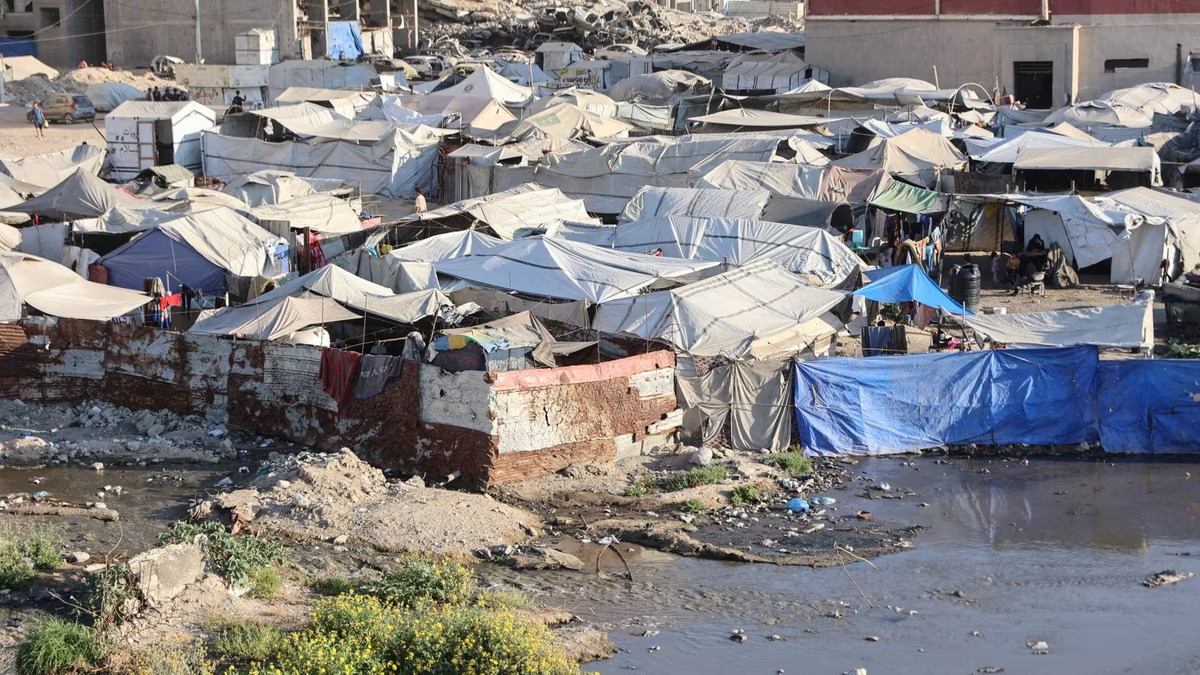
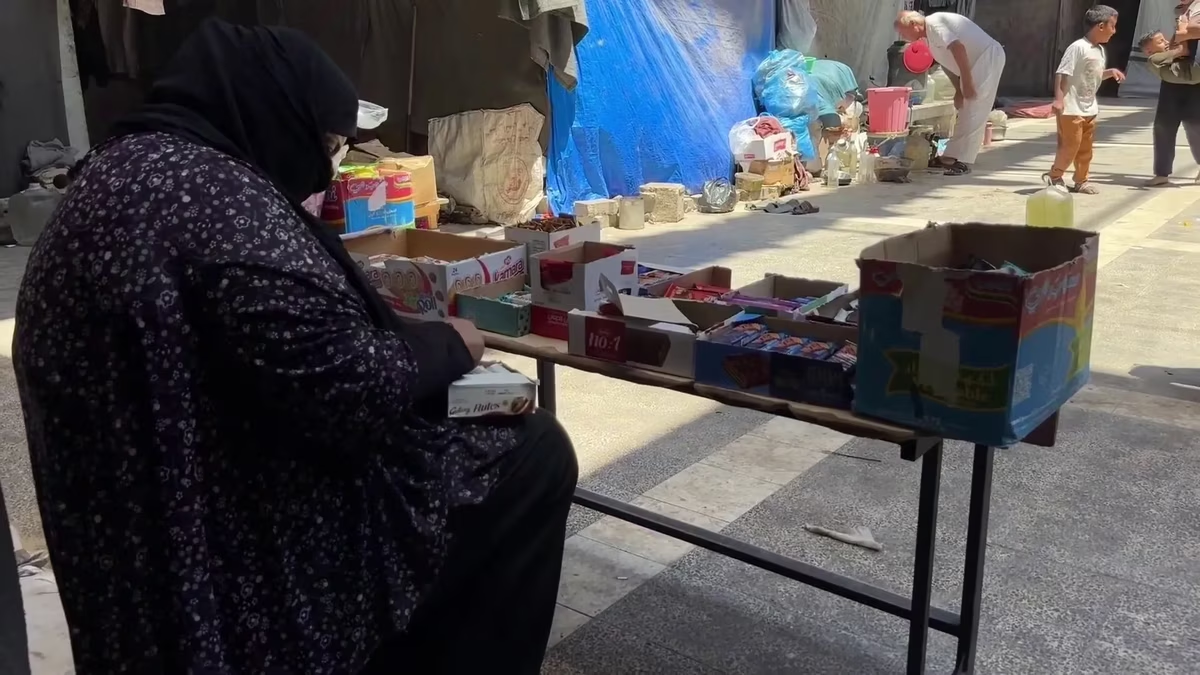
The Norwegian Refugee Council (NRC) has issued strong warnings regarding the deteriorating humanitarian conditions in the Gaza Strip, confirming that approximately one million displaced people face the scorching summer heat of 2026 inside dilapidated tents and temporary shelters. The report clarified that nearly 170,000 Palestinian families have found themselves forced to live in conditions lacking the most basic protection from weather fluctuations, due to the continued strict restrictions imposed by the occupation on the entry of essential shelter materials.

Jan Egeland, Secretary General of the Norwegian Refugee Council, described the current situation in the Strip as an 'international scandal' that requires immediate action from the international community. Egeland pointed out that the systematic destruction of homes by the occupation authorities, coupled with the prevention of the entry of wood and plastic sheeting, has made displaced families easy prey to heat stress, dehydration, and diseases associated with rising temperatures.

Climate forecasts indicate that temperatures in Gaza will reach 34.5 degrees Celsius during the day, with a significant increase in days exceeding 35 degrees. This record rise threatens the lives of thousands of children and the elderly, especially in the absence of adequate cooling or ventilation within overcrowded shelters that lack privacy and basic services.

In details of the shelter crisis, relief sources revealed that about 5,000 Palestinian families are forced to sleep completely in the open without any roof to protect them, while another 52,000 displaced people are crowded into shelter centers suffering from suffocating overcrowding. The report estimates that 850,000 people completely lack the necessary materials to repair their tents, such as ropes and thin wooden panels that the occupation authorities prevent from entering.

This suffering stems from the massive destruction of infrastructure and the housing sector, with UN data indicating that over 76% of housing units in the Strip have been damaged or destroyed. According to statistics, about 371,888 homes out of 485,361 have become uninhabitable, making a return home impossible for the majority of the Strip's population who live in continuous displacement.

International humanitarian organizations affirmed that the severe suffering experienced by Palestinian families could have been avoided through simple measures including improving ventilation and providing shading materials. However, the occupation forces' insistence on preventing the entry of these relief materials exacerbates health risks and leads to the spread of epidemics among displaced people who already suffer from malnutrition and a lack of safe drinking water.

The Norwegian Refugee Council called on the international community to exert real and effective pressure on the occupation authorities to open crossings and allow the unrestricted flow of shelter materials. The report stressed that saving one million displaced people from the summer heat requires an urgent response that goes beyond mere condemnation, to ensure the provision of a living environment that preserves human dignity and protects them from increasing environmental threats in Gaza.

What is happening in the Gaza Strip is an international scandal, where displaced families are trapped in harsh living conditions unsuitable for coping with high temperatures.

PALESTINE

Sat 27 Jun 2026 2:50 pm - Jerusalem Time

Settler Terrorism in the West Bank: Record Numbers Targeting Agricultural and Demographic Presence

The occupied West Bank is witnessing an unprecedented surge in settler violence, with field data indicating a significant increase in the pace of organized attacks. These assaults occur under the direct cover and protection of the Israeli occupation army, exacerbating the suffering of Palestinians in villages and areas classified as 'C'.

Data released by security sources showed that so-called 'nationalist crimes' committed by settlers jumped by 27% during 2025. Sources recorded approximately 867 documented assault incidents, a number far exceeding what was recorded in the previous year, which saw 682 incidents.

The danger lies in the shift in the nature of attacks towards direct and deadly violence, with incidents classified as 'serious' sharply increasing. These assaults included live-fire shootings, and the burning of inhabited homes and private property, directly threatening the lives of Palestinian citizens daily.

According to statistics, 2025 recorded approximately 128 serious incidents, compared to 83 incidents in 2024 and only 54 in 2023. This gradual escalation reflects the absence of legal accountability for settlers and the complicity of occupation authorities in curbing this growing phenomenon.

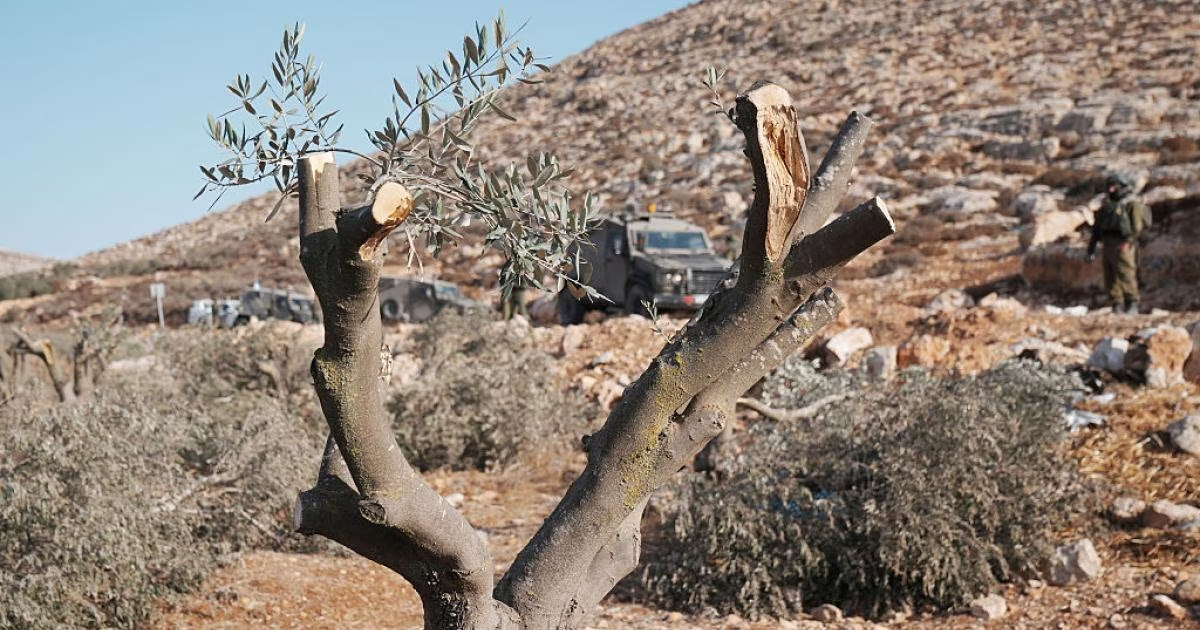
The olive harvest season, a key economic and social pillar for Palestinians, has not been spared from these systematic attacks. Field reports documented 126 attacks targeting 70 Palestinian towns and villages, involving the destruction and uprooting of more than 4,000 olive trees and newly planted saplings.

In the Tubas plains and Jordan Valley, farmers face suffocating restrictions that prevent them from accessing their fields and livestock pastures. Farmers reported losing access to two-thirds of their land, leading to agricultural machinery breakdowns and a sharp decline in production due to continuous threats.

'Pastoral settlement' emerges as a new and effective tool for controlling vast areas of Palestinian land. Settlers bring their livestock into Palestinian-owned wheat fields and olive groves, aiming to impose new facts on the ground and prevent original landowners from utilizing them.

Agricultural researchers confirmed that this pattern of settlement targets the Palestinian presence in open and sprawling areas. This policy seeks to isolate Palestinian population centers and transform agricultural lands into settlement influence zones under security or pastoral pretexts.

Economically, estimates indicate that about a quarter of the olive-cultivated areas in the West Bank have become inaccessible. This reality has led to severe losses in national agricultural income and directly impacted food security for thousands of families dependent on this tree.

The Wall and Settlement Resistance Commission revealed shocking figures for recent years, with approximately half a million dunams of land closed off. More than 52,000 trees were directly attacked, in addition to the theft of over 5,000 head of livestock since the beginning of this year.

In a dangerous field development, occupation forces and settlers deliberately dug military trenches separating villages from their natural extensions. In eastern Tubas, thousands of dunams were isolated in just one week by creating a new trench that permanently prevented farmers from accessing their crops.

Scenes of fires recur in areas south of Nablus, where settlers target wheat crops and ancient olive trees. Civil defense crews and residents are forced to risk their lives to extinguish these fires under threat of arms, in an attempt to save what remains of their daily sustenance.

This systematic targeting of the agricultural sector primarily aims to undermine the steadfastness of Palestinian citizens on their land. Observers believe that the international community's silence encourages settlers to proceed with their plans to empty rural areas of their original inhabitants in favor of settlement expansion.

In conclusion, the field reality in the West Bank remains prone to further deterioration in the absence of any legal or international deterrent. Losses continue to accumulate daily, encompassing land, crops, and natural resources, in an existential battle fought by the Palestinian farmer alone against the machinery of settlement oppression.

Settlers do not let us work or harvest, and the goal is to empty us from our land, but we remain in it like olive trees.

PALESTINE

Sat 27 Jun 2026 2:50 pm - Jerusalem Time

An incitement campaign led by pro-Israel accounts against the Egyptian national team over 'Al-Fatiha'

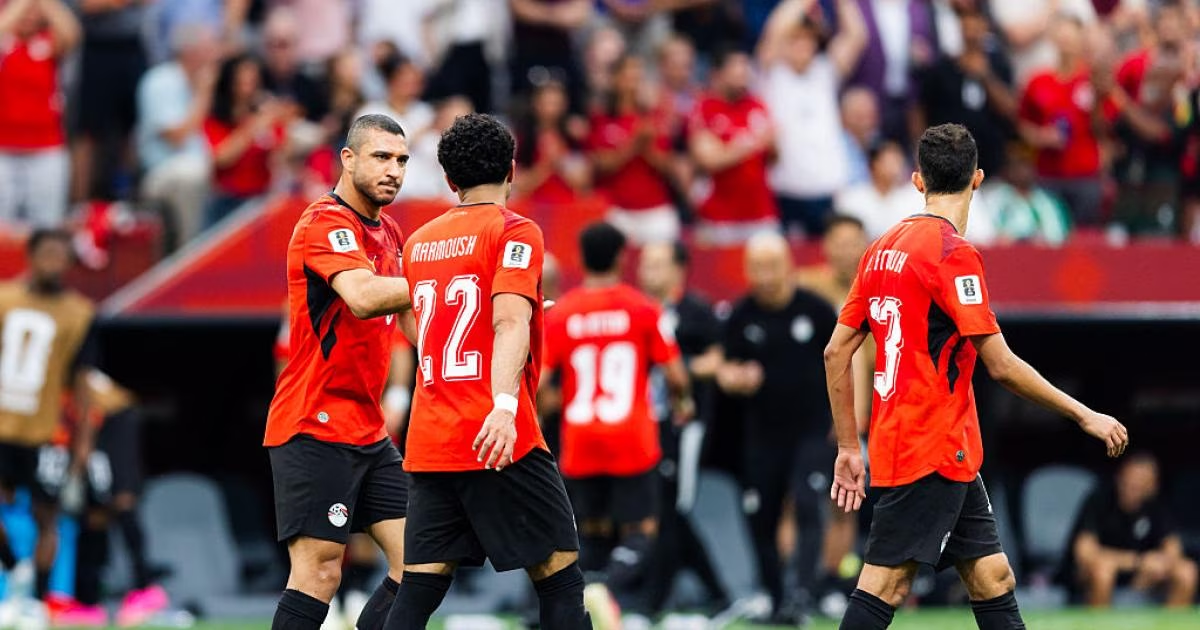
Social media platforms witnessed a wave of widespread controversy after the Egyptian Football Association published a video documenting special moments from inside the national team's locker room. The video showed the 'Pharaohs' players reciting Surahs Al-Fatiha and Al-Ikhlas in collective solidarity before the start of their crucial match against the New Zealand national team in the World Cup qualifiers.

The Egyptian Federation attached the clip with the phrase 'The Secret to Victory,' referring to the morale and faith from which the players draw their strength on the green field. This publication came after a valuable victory achieved by the Egyptian national team with a score of three goals to one, which enabled them to top their group in the global tournament.

These spontaneous moments did not pass peacefully, as media sources observed the launch of an organized attack campaign led by far-right accounts and others known for their absolute support for Israel on the 'X' platform. These accounts accused the Egyptian national team of practicing 'religious incitement' and spreading hate speech, despite the video being devoid of any political references.

The criticisms directed at the national team focused on erroneous interpretations of verses from Surah Al-Fatiha, as these accounts attempted to take the Quranic text out of its purely devotional context. The campaign's posts claimed that reciting these verses in a sports context represents a 'prayer of hatred' targeting followers of other religions, describing the behavior as exclusionary.

Pro-Israel media figures, including journalist Dalia Kurtz and an account named 'Michael,' played a pivotal role in amplifying this inflammatory narrative and spreading it globally. These parties worked to translate the content of the attack into several languages, including English, French, and Dutch, to ensure its reach to a wide international audience.

Observers considered that this campaign aims to turn a common religious practice among Muslim players into material for sterile political and religious debate. The instigators tried to link the incident to thorny issues related to minority rights and national representation, in an attempt to brand the Egyptian national team with religious extremism before the international sports community.

On the sporting front, Egypt's victory over New Zealand came after an exciting scenario, where the 'Pharaohs' fell behind by an early goal before turning the tables with a historic hat-trick. This victory placed Egypt in first place in Group G with four points, boosting fans' hopes in the current World Cup journey.

The match was held at 'BC Place' stadium and witnessed great rivalry between the two sides from the first minutes. The New Zealand national team opened the scoring through their player Finn Surman in the fifteenth minute, putting great pressure on Mohamed Salah's teammates to come back in the result.

The Egyptian national team regained its balance in the second half, as Mostafa 'Zico' managed to score the equalizer in the fifty-ninth minute. The second goal was not long in coming, as star Mohamed Salah added the second goal in the sixty-seventh minute, amidst immense joy in the Egyptian stands.

Mahmoud Hassan 'Trezeguet' concluded the Egyptian national team's hat-trick in the eighty-second minute, confirming the 'Pharaohs'' complete superiority in the second half of the match. The celebrations after the match reflected a state of solidarity between the players and the technical staff, which the Egyptian Federation tried to highlight through the 'Secret to Victory' video.

Monitoring sources indicated that the digital attack was not limited to individual accounts, but also involved newly established electronic committees that appear to have been created specifically for this purpose. This systematic move aims to tarnish the image of Arab and Muslim athletes in major international forums such as the World Cup.

Analysts believe that using religion as a pretext to attack sports teams reflects a state of bankruptcy in the face of Arab successes on the global stage. They stressed that reciting the Quran or praying are personal rituals and a guaranteed freedom for all athletes of different religions, and should not be used as a tool for incitement.

Despite the ferocity of the campaign, a wide segment of Arab and international fans expressed solidarity with the Egyptian national team, considering the attack to lack objectivity. Supporters emphasized that sportsmanship requires respect for the religious beliefs of players as long as they do not directly offend any other party.

The Egyptian national team remains focused on its sporting journey in the World Cup, overcoming these side pressures that attempt to affect its stability. Egyptian fans await the continuation of this strong performance in the upcoming rounds to ensure qualification for the knockout stages and achieve a new historical accomplishment for Arab football.

The secret to victory... This is how the Egyptian Federation described the players' recitation of the Quran before turning the tables on New Zealand.

ARAB AND WORLD

Sat 27 Jun 2026 2:50 pm - Jerusalem Time

Trump launches scathing attack on progressives, calling them 'godless communists'

Former US President Donald Trump launched a violent and unprecedented attack on the progressive movement within the United States, using language described as inflammatory. In a recent speech, Trump stated that this movement includes 'radical godless communists,' warning that their political agenda represents the most dangerous threat the country has faced in two and a half centuries.

These statements came during Trump's participation in a political conference organized by the 'Faith and Freedom' coalition, where he used the platform to direct scathing criticism at his political opponents. Trump linked the rise of progressive candidates in the primaries to what he described as the collapse of traditional values in American society, calling on his electoral base to be vigilant.

Trump described individuals belonging to the progressive movement as 'animals in many cases,' an expression reflecting the intensity of the current political polarization. He added sarcastically that these opponents often lack intelligence, but they pose an imminent danger due to their insistence on changing the economic and social identity of the state.

The former president warned that implementing progressive policies related to providing free housing and food would turn the United States into a collapsed communist state within a few years. He claimed via his 'Truth Social' platform that these trends would inevitably lead to the bankruptcy of the public treasury and the destruction of the economic incentives upon which American capitalism is based.

In a religious context, Trump accused the progressive movement of systematically seeking to close churches and kill people, noting that Christianity is particularly targeted by this political wing. Trump did not provide any concrete evidence to support these claims, but they resonated widely with his audience of religious conservatives participating in the conference.

Trump also touched on international issues in his speech, claiming that his administration carried out military strikes in Nigeria that helped protect Christians there from targeting. Despite the absence of independent reports confirming this narrative, Trump used it to reinforce his image as the primary defender of religious and Christian values in the face of what he describes as global and local threats.

These attacks come at a time when the Democratic Party is witnessing a remarkable rise of progressive figures such as Zohran Mamdani and Senator Bernie Sanders. These leaders believe that the results of the recent elections reflect a genuine popular desire to move away from traditional policies and reduce the influence of political money in Washington.

The progressive wings are pushing for an agenda focused on expanding affordable housing and promoting comprehensive healthcare, in addition to strongly supporting labor unions. These figures also adopt sharp critical stances towards continued US military support for Israel, especially in light of the ongoing war on the Gaza Strip.

In New York City, progressives achieved a social victory with the decision to freeze rents for about one million apartments for two years, which they considered an achievement to protect the poor. In contrast, conservatives view this step as blatant government interference that hinders the free market and harms the real estate and investment sectors.

Local decisions to allocate huge sums of money, amounting to $15 million, to support healthcare services related to gender transition also sparked widespread controversy. While progressives defend these steps as part of human rights, Trump and his allies see them as evidence of the moral deviation that the leftist movement seeks to impose.

Informed sources reported that the centrist wing within the Democratic Party has begun to feel concerned about the growing influence of progressives and plans to take tougher stances. According to media reports, centrists intend to issue political documents affirming commitment to capitalism and fiscal discipline to counter the proposals of the leftist wing.

Political analysts believe that Trump's latest speech represents the starting whistle for a fierce electoral battle that will primarily rely on deepening cultural and political divisions. With continued polarization over issues of immigration and social justice, the American arena appears to be heading for legal and political confrontations that will define the features of the next phase.

Progressives are the most dangerous threat our country has faced in 250 years, and they seek to close churches and directly target Christianity.

PALESTINE

Sat 27 Jun 2026 2:50 pm - Jerusalem Time

Gaza's Rescuers Face Waves Bare-Chested: Staff Shortages and Lack of Equipment

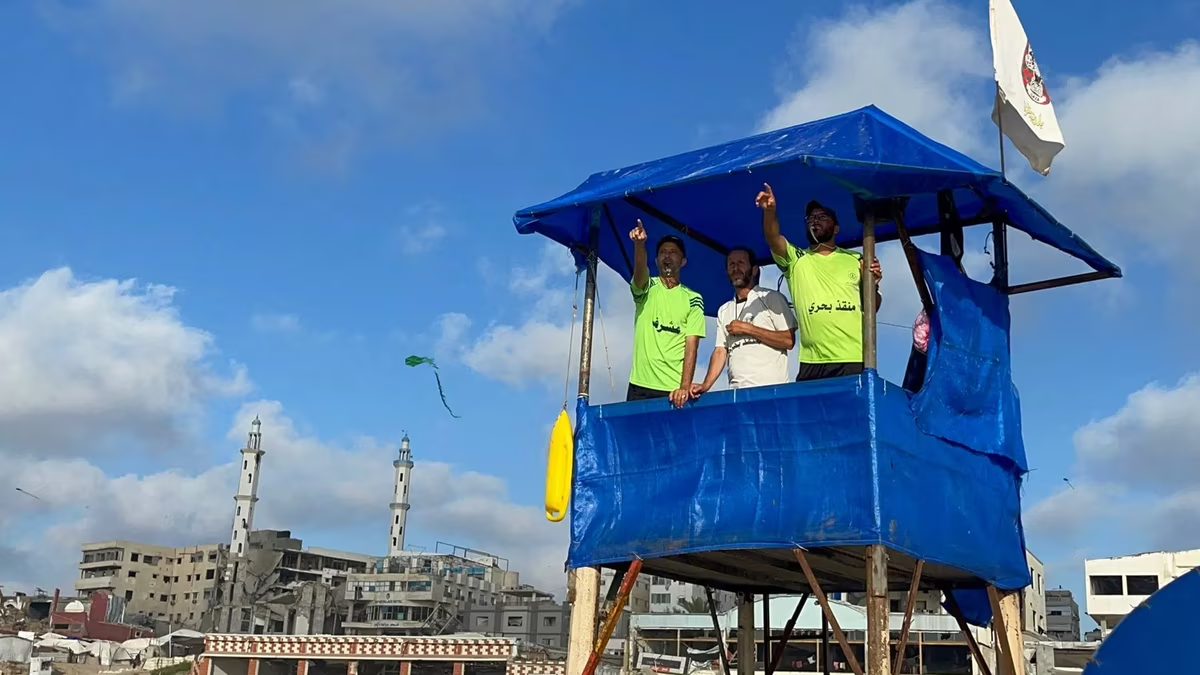
Sea rescuers on the beaches of the Gaza Strip face harsh conditions that exceed their human capabilities, as they are forced to deal with increasing drowning incidents without the slightest safety requirements or necessary equipment. Rescuer Ibrahim Kabaja recounts the details of his rescue of three girls in the Gaza port basin, where he ran hundreds of meters and battled the waves with only his body to bring them to safety.

Kabaja and other rescuers spend about 12 hours daily monitoring the beach, from sunrise to sunset, a mission he describes as the most difficult in his career spanning over two decades. The difficulty lies in the teams' lack of essential rescue tools, which were destroyed by the war machine, making the work entirely dependent on physical effort and personal risk.

Along the coast, primitive and dilapidated watchtowers are scattered, built by rescuers from remnants of furniture and wood left behind by the war, in an attempt to create observation points that enable them to monitor beachgoers. Rescuers use simple whistles and hand signals to guide young people and keep them away from dangerous sea currents, which have increased recently.

Local sources reported that sea rescue teams are currently experiencing their worst historical phase, as most equipment, communication devices, and rapid rescue means have been lost due to ongoing military operations. This severe shortage has made dealing with emergencies extremely complex, placing the lives of both rescuers and beachgoers in constant danger.

Crisis is not limited to equipment but extends to a severe shortage of qualified human resources to cover the entire coastal area, especially in light of the lack of salaries and the suffocating financial crisis. The majority of rescuers suffer from unemployment, as there are no official or international bodies capable of securing permanent employment contracts that ensure their livelihood stability.

The nature of work on the beach has changed dramatically; after the summer season was limited to only four months, the coast has become a permanent shelter for displaced people living in tents. This new reality has necessitated the presence of rescuers year-round, which exceeds the capacity of volunteer teams who work without financial compensation after their short seasonal contracts end.

Workers in this sector warn that the lack of oversight over large areas of the beach will inevitably lead to an increase in drowning incidents, especially with the significant overcrowding on the beaches. Rescuers demand the provision of fixed salaries and essential work supplies to ensure their continued performance of this humanitarian mission that saves citizens' lives.

For his part, rescuer Riyad Al-Habil complains about the absence of loudspeakers, which are a vital tool for guiding those in the sea and warning them of strong currents before disaster strikes. He emphasizes that current capabilities are almost non-existent, at a time when the sea is witnessing unprecedented demand from residents fleeing the heat of tents and the bitter conditions of displacement.

Al-Habil points out that the enormous human pressure on the beach is completely disproportionate to the number of available rescuers, creating a large security gap in maritime safety procedures. Despite the long periods without salaries, these men continue their duties out of humanitarian motivation, calling on international organizations to intervene urgently to enhance the capabilities of rescue teams.

Rescuers' suffering is compounded by some citizens' non-compliance with instructions and guidelines, due to the difficult psychological and living pressures that push them to risk entering the sea in unsafe conditions. Residents seek moments of comfort and psychological release in the sea waters, away from the harsh daily burdens imposed by the war.

In a related context, rescuer Allam Zughra recounts painful stories of complex drowning incidents among rocks, where teams are forced to intervene with very primitive means such as simple plastic floats. Zughra receives a meager amount not exceeding $10 per day for arduous work that lasts half a day, as part of temporary employment projects that do not meet his family's basic needs.

Information obtained by our sources from the Ministry of Local Government in Gaza revealed that only 445 rescuers are currently deployed along 33 kilometers of coastline. The data indicates that this number covers a vast area extending from Beit Lahia in the north to Rafah in the south, which represents an enormous burden on the currently available staff.

Official statistics indicate that the current summer season requires at least 800 rescuers to fully secure the beaches, meaning there is a deficit of nearly 50%. This numerical shortage, coupled with the absence of technical and logistical equipment, makes the task of protecting beachgoers almost impossible under current conditions.

The Gaza sea remains the only outlet for two million people facing siege and war, but this outlet has become fraught with dangers due to the collapse of the rescue system. Appeals continue to international bodies and relief organizations to provide this vital sector with the tools and personnel it needs to ensure that recreational trips do not turn into new tragedies.

We work long hours under difficult conditions and with almost no resources, relying on what remains of primitive watchtowers that do not provide the minimum requirements for work.

OPINIONS

Sat 27 Jun 2026 2:47 pm - Jerusalem Time

The $88 Billion Price of Failure: How Washington Returned to the Deal It Once Rejected


By: Said Arikat


June 27, 2026


News analysis


Washington, D.C-The Trump administration’s request for $88 billion to finance its war against Iran may ultimately become the clearest acknowledgment that military force failed to accomplish what diplomacy had already achieved years earlier. As Congress debates the administration’s supplemental funding request, Americans are left asking whether the United States has paid an extraordinary price—in lives, treasure, and strategic credibility—to arrive at nearly the same destination it abandoned when President Donald Trump withdrew from the 2015 Iran nuclear agreement.


The political origins of the conflict are now receiving renewed scrutiny following the publication of Regime Change, the new book by The New York Times’ Maggie Haberman and Jonathan Swan, which went on sale on Tuesday, June 23, 2026. The authors report that during a February 11 meeting in the White House Situation Room, Israeli Prime Minister Benjamin Netanyahu persuaded President Trump to embrace military action against Iran despite deep reservations from America’s own national security establishment. According to the book, officials from the Pentagon, the State Department, and the Central Intelligence Agency regarded Netanyahu’s proposed strategy as “farcical,” warning that its assumptions were unrealistic and unlikely to produce the promised political outcome. Nevertheless, Trump sided with Netanyahu’s assessment, placing the United States on a path toward a war that many critics now argue was unnecessary from the beginning.


If Haberman and Swan’s reporting is accurate, history may judge the episode as one of the most consequential examples of an American president being persuaded by a foreign leader to undertake a major military intervention despite substantial opposition from his own senior advisers.


Now the administration is asking Congress for $88 billion to pay for that decision.


Among the most vocal critics is Senator Brian Schatz of Hawaii, who argues that the conflict was reckless, unnecessary, illegal, and strategically counterproductive. In his view, the war produced enormous costs while delivering remarkably little to advance American interests.


The human and financial toll is substantial. Thirteen American service members were killed, while thousands of Iranians lost their lives. Tens of billions of taxpayer dollars have already been spent, with another $88 billion now being requested. Meanwhile, Americans have experienced higher gasoline and grocery prices, U.S. weapons stockpiles have been depleted, and relations with key allies have been strained by Washington’s decision to go to war.


Perhaps the greatest irony is that after months of military operations, the United States possesses not a comprehensive nuclear agreement but merely a memorandum of understanding to negotiate one. Before President Trump withdrew from the Joint Comprehensive Plan of Action (JCPOA), the United States and its international partners already had extensive International Atomic Energy Agency inspections, robust verification mechanisms, restrictions on Iran’s nuclear activities, and a functioning diplomatic framework. Should current negotiations ultimately succeed, Washington may simply recreate many of the same arrangements that already existed more than a decade ago.


Nor did the war accomplish its broader political objective. Advocates argued that sustained military pressure would weaken the Iranian regime and perhaps trigger regime change. Instead, the government in Tehran remains firmly in power. Schatz contends that the regime has emerged younger, more ideologically committed, and politically resilient, while the opposition failed to generate the transformation that intervention advocates confidently predicted.


From this perspective, the administration’s greatest mistake was not ending the war but beginning it. Diplomacy, critics argue, was always available and should have been exhausted before military force was employed.


The emerging memorandum of understanding also appears to require significantly greater American concessions than the original nuclear agreement. Iranian assets would reportedly be unfrozen, Tehran would regain broad access to global oil markets, and sanctions that had constrained Iran’s economy for decades would be substantially eased. These concessions, critics argue, exceed those contained in the original JCPOA while securing essentially the same Iranian commitment not to develop nuclear weapons.


Even more controversial are reported provisions affecting the Strait of Hormuz. Before the conflict, international shipping moved freely through one of the world’s most important maritime chokepoints. Under the current arrangement, Iran reportedly agrees not to disrupt commercial shipping for only sixty days while reserving the right afterward to impose transit fees on vessels passing through the strait. Such an arrangement would establish an unprecedented precedent in modern maritime commerce and could undermine the long-standing international principle of freedom of navigation that successive American administrations have defended.


Critics argue that Washington is making these sweeping concessions not as part of a final, enforceable nuclear settlement but simply to persuade Iran not to interfere with global shipping. If so, the United States would have sacrificed military resources, economic leverage, and diplomatic credibility only to secure a temporary reprieve from a crisis created by the war itself.


The broader implications extend far beyond Iran. Lifting oil sanctions would represent one of the most dramatic reversals of bipartisan American policy toward Tehran in decades. It also revives an uncomfortable historical pattern. Military interventions designed to reshape governments in the Middle East—from Iraq and Libya to now Iran—have repeatedly promised rapid political transformation while producing instability, enormous financial burdens, and unintended strategic consequences.


The administration’s $88 billion request therefore represents far more than another wartime appropriation. It is a test of whether Congress believes this conflict advanced American national interests or merely delayed an inevitable return to diplomacy at vastly greater human and financial cost.


Schatz has called for a more rational American foreign policy—one that recognizes Iran as an adversary while rejecting military interventions undertaken without a coherent political strategy. He has also criticized the familiar coalition of foreign policy advocates, think tanks, media commentators, advocacy organizations, and members of Congress that has repeatedly promoted regime-change wars despite decades of disappointing results.


Ending the war may indeed be the least bad option available today. But peace achieved after months of destruction cannot erase the strategic error that made such a costly peace necessary. If the United States ultimately spends tens of billions of dollars, requests another $88 billion from taxpayers, sacrifices American lives, and returns to negotiations resembling the agreement it abandoned years earlier, this conflict may be remembered not as a demonstration of American strength but as another cautionary tale about the limits of military power and the enduring value of diplomacy.

PALESTINE

Fri 26 Jun 2026 11:56 pm - Jerusalem Time

From the Heart of the Rubble.. Two Sisters Establish 'Cinema Haws' to Restore Joy to Gaza's Children

In a step reflecting the will to live amidst destruction, two Palestinian sisters in the Gaza Strip launched a unique entertainment project named 'Cinema Haws'. This project focuses on screening animated films for children, in a serious attempt to provide psychological and recreational support to families and orphans directly affected by the ongoing war in the Strip.

This initiative was established through self-effort and personal endeavor on the rooftop of a house that was not spared from targeting, where the two founders worked on the project for several continuous months. The operations included rehabilitating a passage damaged by bombing and renovating the dilapidated building's staircase, to ensure safe access for visitors and children to the new cinema space emerging from the rubble.

Safaa Dabban, co-founder of the project, explained that the idea of the cinema had been on their minds before the outbreak of the war but was forcibly halted due to military escalation. She affirmed in statements to media sources that the primary goal is to create a real outlet for the residents, with exceptional care dedicated to orphans by organizing free and regular cinema screenings for them inside the center.

The features of creativity were evident in recycling the debris and transforming the effects of destruction into aesthetic touches, as the two sisters utilized the gaps from rocket shells in the walls to turn them into artistic frames for movie posters. Holes in concrete columns were also covered with innovative cotton decorations, transforming the former military operations theater into a comfortable and attractive visual environment for children.

'Cinema Haws' faces significant operational challenges, foremost among them the constant power outages and the sharp rise in fuel prices needed to operate backup generators. These logistical crises impose additional financial burdens on the project management, which is striving to maintain the continuity of screenings despite the suffocating economic conditions in the besieged Strip.

In addition to the energy crisis, the project suffered from high establishment costs due to the insane jumps in prices of building materials and tarpaulins used to cover the roof, as well as the cost of seats. The two founders of the initiative are currently seeking ways to reduce operational costs, ensuring a reduction in ticket prices and making the cinema accessible to all social classes without exception.

This initiative comes at a very sensitive time, as statistics indicate that more than 73,000 Palestinians have been killed and over 173,000 others injured since October 2023. With about 90% of civilian infrastructure destroyed, 'Cinema Haws' stands out as a model of cultural and humanitarian resistance in the face of attempts to erase the features of life in Gaza.

We strive to provide an outlet for residents and special care for orphans through free screenings that restore a part of their lost childhood.

LATEST NEWS

Fri 26 Jun 2026 11:56 pm - Jerusalem Time

Mutual Escalation: Tehran Threatens Retaliation for 'Dangerous Moves' and Katz Warns of 'Historic Mistake'

The Iranian capital, Tehran, issued strong warnings, affirming that it will not stand idly by in the face of any threats to its national security, especially given the continued Israeli military movements. Iranian sources linked their stance to the United States' ability to contain Israeli actions and control its movements in the region, emphasizing that Iranian patience has limits in the face of what it described as 'continuous provocations'.

In a statement issued by the Khatam al-Anbiya headquarters, the movements of Israeli warplanes in the airspace of some neighboring countries towards the Iranian borders were described as a 'dangerous act' that directly threatens the country's stability. The statement clarified that Tehran is closely monitoring these movements, affirming its full right to retaliate at the appropriate time and place if international efforts and American restraint fail to stop these aerial violations.

On the other hand, the Israeli response came swiftly from Minister of Defense Israel Katz, who issued a direct threat to the Iranian leadership against committing what he described as 'the biggest mistake in Iran's history'. Katz considered the threats made by the commander of the Quds Force, Esmail Qaani, to lack seriousness and to be part of the recurring rhetoric, emphasizing that Tel Aviv is prepared for all scenarios and will not back down from its military objectives.

The Israeli minister stressed that Iranian threats to close the Strait of Hormuz or target civilians will not deter Israel from continuing its operations, noting that the Israeli army is fully prepared to successfully complete the mission. These statements come in response to Qaani's assertions that Israeli forces will be forced to withdraw from southern Lebanon defeated if they do not choose to voluntarily leave soon.

This wave of mutual threats coincides with ongoing technical negotiations between Washington and Tehran to reach a permanent and comprehensive peace agreement in the region. Despite the existence of a memorandum of understanding stipulating a cessation of hostilities on all fronts, including the Lebanese arena, the field continues to witness escalating tension amid mutual accusations of non-compliance with the proposed truce terms.

Tehran's targeting of Israel would be the biggest mistake in its history, and nothing will stop us from completing the mission.

PALESTINE

Fri 26 Jun 2026 11:56 pm - Jerusalem Time

Human Rights Organizations: Occupation Prisons Have Become 'Genocide' Arenas Against Palestinian Prisoners

Palestinian organizations concerned with prisoner affairs affirmed that Israeli detention centers have become a stage for systematic genocide, where thousands of Palestinians are subjected to various forms of physical and psychological abuse. The Commission of Detainees' Affairs, the Palestinian Prisoner's Society, and Al-Dameer Association, in a joint statement on the occasion of the International Day in Support of Victims of Torture, clarified that these practices have escalated at an unprecedented rate since the start of the widespread aggression in October 2023.

Human rights sources indicated that the policy of torture is no longer individual cases but has become a fixed approach that begins from the first moment of arrest and continues during interrogation and detention. These violations include severe beatings, deliberate humiliation, and deprivation of basic needs such as water, food, and sleep, which has led to a serious deterioration in the health of thousands of detainees.

The statement revealed the deliberate spread of skin and infectious diseases inside cells, foremost among them scabies, which is used as an additional torture tool by depriving those infected of treatment or personal hygiene. The organizations added that these harsh conditions have caused long-term suffering for prisoners, especially children, women, and the elderly, whom the occupation has not exempted from its repressive measures.

The Palestinian organizations stressed that the occupation deliberately conceals evidence of crimes committed inside detention centers by preventing the International Committee of the Red Cross and independent human rights missions from visiting prisoners. They considered that this blackout aims to isolate detainees away from international oversight, which constitutes a blatant violation of the Geneva Conventions and international humanitarian law.

In a related context, the report noted that UN bodies issued serious warnings during 2025 and 2026 regarding systematic ill-treatment in Israeli prisons. These bodies demanded the necessity of opening independent and transparent international investigations to hold those responsible for these crimes accountable and ensure that perpetrators do not escape punishment under the guise of political and military immunity.

Regarding numbers, human rights organizations documented the arrest of approximately 23,000 Palestinians from various governorates of the West Bank by occupation forces since October 7, 2023. These widespread campaigns included night raids and incursions into cities and villages, affecting released prisoners, activists, and entire families, in an attempt to intimidate Palestinian society and break its will.

In conclusion of their statement, the organizations called on the international community to activate universal jurisdiction to prosecute Israeli leaders involved in torture crimes. They also demanded the imposition of deterrent sanctions on the occupation authorities to compel them to respect prisoners' rights, provide urgent international protection for them, and ensure access to medical and humanitarian aid inside prisons without restriction or condition.

Israeli prisons have become one of the central arenas for manifestations of genocide against the Palestinian people.

ARAB AND WORLD

Fri 26 Jun 2026 11:56 pm - Jerusalem Time

Pope Leo XIV: Wars are unworthy of humanity, and solutions lie in reason and dialogue

Pope Leo XIV issued an urgent appeal to the international community to end armed conflicts and resort to the logic of dialogue and reason. This came during his presiding over a mass at St. Peter's Basilica in Rome, marking the start of the two-day meeting of the College of Cardinals to discuss current challenges.

The American-born Pontiff stressed that wars cannot be an acceptable means of resolving disputes between nations and peoples. In his homily, he expressed his deep regret over the escalating international tensions that are tearing apart the fabric of the human family and leaving deep wounds in the conscience of humanity.

The Pope affirmed in his address to the College of Cardinals that the use of military force contradicts human dignity, which the Creator distinguished with reason. He clarified that technological development in weapons manufacturing does not justify resorting to them; rather, human will must be the primary driver for establishing lasting peace.

This meeting, known as the 'Consistory,' is the second of its kind since Leo XIV's election in May 2025. Approximately 241 cardinals representing various continents are participating in this session, including cardinals eligible to vote in future papal elections.

The meeting aims to strengthen the collective approach to managing the affairs of the Catholic Church and expand the scope of consultation among spiritual leaders. The agenda includes four intensive sessions highlighting the political, economic, and social crises currently afflicting different regions of the world.

For his part, the Archbishop of Algiers, Cardinal Jean-Paul Vesco, stated that this gathering represents a real opportunity for sharing and unity among members of the ecclesiastical body. He noted that the Pope's vision focuses on unifying efforts and strengthening communication channels to confront the increasing challenges, whose nature varies from one region to another.

Vatican observers believe that the intensification of these meetings reflects the new leadership's desire to bring about a transformation in the style of ecclesiastical administration. Pope Leo XIV seeks to make the College of Cardinals an effective platform for exchanging views and formulating unified positions on major global issues.

War is never worthy of humanity, and it is never blessed by God, for the Creator endowed us with reason and will to resolve conflicts as humans, not as beasts.

PALESTINE

Fri 26 Jun 2026 11:56 pm - Jerusalem Time

Displaced Women's Stalls in Gaza: A Daily Struggle Between High Prices and the Specter of Inability to Provide

The humanitarian crisis in the Gaza Strip is escalating, casting its heavy shadow over the most vulnerable groups, where displaced women have found themselves with only one option for survival: launching micro-businesses. These modest 'stalls' have become the last line of defense to secure the minimum requirements for daily life, amid a complete loss of traditional income sources and the halt of the local economy.

One of the displaced women, a breadwinner, recounts harsh details of her daily life, where she relies entirely on a small stall to support herself and her only child after years of separation. Sources confirm that the absence of regular aid from relief organizations has made this stall the sole source of livelihood, although it barely provides enough to survive amidst unprecedented price inflation.

In her conversation with media sources, the woman indicates that the perception of divorced and widowed women receiving continuous financial or in-kind support is inaccurate and does not reflect her bitter reality. She finds herself forced to face the burdens of living alone, as the prices of basic necessities have skyrocketed, making it almost impossible to provide even the simplest school supplies for her son.

In a shocking comparison that reflects the extent of inflation, the displaced woman explained that the price of a single school notebook has reached 6 shekels, whereas it was previously bought as part of a complete package for a very small amount. This increase was not limited to stationery but also included food and clothing, which were damaged due to repeated displacement and living in tents lacking the most basic protection.

She describes her daily struggle as an attempt to hold onto life, even though the profit margin on her goods is very small, often not exceeding one shekel per carton. This meager profit quickly evaporates due to high transportation costs and the difficulty of moving between markets in search of goods at prices that displaced consumers can afford.

Cash liquidity emerges as an additional obstacle, as displaced women are forced to use banking payment applications for transportation due to the lack of cash, which further complicates simple commercial operations. Moreover, the phenomenon of buying on credit by other displaced people weakens the ability of stall owners to replenish their goods, as their money remains tied up with tent neighbors who suffer from the same poverty.

These women spend long hours under the sun or in harsh weather conditions behind their stalls, trying to collect a few pennies that may not be enough to buy a single meal. One of the displaced women expresses her helplessness when her child asks for simple needs, emphasizing that giving him from her small capital means the collapse of her only project and the cessation of her livelihood.

Suffering does not stop at selling; it extends to the journey of searching for goods, where women are forced to move between traders and large stalls in search of small price differences that save them one or two shekels. This arduous journey consumes their physical and psychological energy, increasing their feeling of exhaustion amidst the ongoing war and the absence of any horizon for a quick solution.

These individual stories come as part of a tragic overall scene in the Gaza Strip, where the Israeli war machine continues to target civilians and infrastructure since October 2023. This war has left widespread destruction affecting about 90% of vital facilities, making self-reliance through small projects an inevitable necessity to escape hunger.

According to the latest statistics, the death toll has risen to over 73,000 martyrs and more than 173,000 injured, in an unprecedented humanitarian catastrophe. In light of this reality, the 'displaced women's stalls' remain a testament to the Palestinian will to persevere, and a desperate attempt to confront the hell of high prices and limited resources in a geographical area besieged by fire and hunger.

I struggle as much as I can, but I am tired; the suffering includes buying, selling, and standing all day behind the stall to secure my son's most basic needs.

OPINIONS

Fri 26 Jun 2026 11:55 pm - Jerusalem Time

United States Announces Framework Agreement, Hezbollah Rejects It

Urgent: Washington's Message

Washington – Said Arikat – 26/6/2026

US Secretary of State Marco Rubio announced a "framework agreement" between Lebanon and Israel under the patronage of the United States, considering the agreement to be "the beginning of the beginning" towards lasting peace and stable security between the two countries, in a step he described as the first on a long and complex path to ending decades of conflict and tension on Lebanon's southern border.

The announcement came after talks hosted by Washington with the participation of Lebanese and Israeli delegations, where Rubio affirmed that the agreement lays the necessary foundations for a permanent cessation of hostilities, and aims to enable Lebanese and Israelis to live in security and stability, noting that the success of this phase requires arduous diplomatic and political work in the coming period.

In his speech, Rubio presented the traditional American narrative of the conflict, holding what he described as "external parties" responsible for turning Lebanese territory into a platform for attacking Israel, considering that the Lebanese people have paid a heavy price as a result of these interventions, and that the time has come for Lebanon to restore its prosperity, sovereignty, and stability.

The US Secretary also stressed that the residents of northern Israel deserve to live away from rockets and attacks, affirming that the agreement represents only the first step, and that the path towards lasting peace is still full of challenges.

From the Lebanese side, the Lebanese Ambassador in Washington described the agreement as "a first step" to restore Lebanese sovereignty and territorial integrity, achieve a final cessation of hostilities, and create conditions for the return of residents to their areas, expressing the Lebanese leadership's gratitude to the US administration for sponsoring the negotiations.

However, the American announcement was quickly met with outright rejection from Hezbollah, which affirmed in an official statement that any understanding or agreement with Israel "will not pass without resistance," considering that any arrangements affecting the future of the South, the resistance's weapons, or the rules of engagement cannot be imposed by political decision or external pressures, and that the resistance will deal with any attempt to change facts on the ground as it deems appropriate.

This early rejection reveals the extent of the complexities facing the agreement, as any political understanding between the Lebanese and Israeli governments will remain hostage to internal Lebanese balances, foremost among them Hezbollah's position, which possesses military and political weight that makes the implementation of any security commitments extremely difficult if it is not part of a comprehensive internal consensus.

The American statement also reflects the continuation of the American vision that exclusively links Lebanese stability to ending Hezbollah's military role, while avoiding mention of the continued Israeli occupation of Lebanese border points, daily aerial violations, issues of land border demarcation, prisoners, and reconstruction, which are issues Lebanon considers an essential part of any sustainable settlement.

It is also noted that Washington presents the agreement as a diplomatic achievement for the US administration, as part of its efforts to redraw the regional landscape after years of wars, and links it to a broader project based on expanding regional security arrangements, in line with the American and Israeli vision for a more stable region from the perspective of Western interests.

However, Lebanese experience over the past decades indicates that security agreements do not automatically translate into lasting peace, especially when the fundamental causes of the conflict remain unaddressed, foremost among them the continued occupation, border disputes, the absence of a comprehensive solution to the Arab-Israeli conflict, as well as the internal Lebanese division over the role of the resistance and the future of its weapons.

Thus, the "framework agreement" may represent the beginning of a new negotiation path, but it does not guarantee its success, because the success of any settlement will not depend only on the understandings signed in Washington, but on the ability of all parties to address the fundamental issues that have been the cause of repeated wars throughout the past decades.

The American announcement reveals a clear attempt to launch a political process that goes beyond a mere ceasefire, aiming to reshape the security environment in southern Lebanon in line with the American and Israeli vision. However, ignoring internal power balances, foremost among them Hezbollah's position, makes the agreement closer to a theoretical framework than to an implementable settlement. Previous experiences have proven that any security arrangements that do not enjoy broad Lebanese consensus, and do not address the roots of the conflict with Israel, remain vulnerable to faltering or collapse at the first field or political test.

The American discourse attempts to portray the agreement as a victory for diplomacy, but it adopts a unilateral narrative that focuses on Israel's security, while downplaying the importance of issues that Lebanese consider essential, such as daily Israeli violations, the remaining occupation, the prisoner file, and reconstruction. Without a balanced approach to these issues, it will be difficult to convince Lebanese public opinion that the agreement serves national sovereignty, rather than being merely a mechanism to control borders according to Israeli security priorities, which gives forces opposing the agreement ample space to mobilize the street against it.

Hezbollah's early rejection of the agreement confirms that the Lebanese crisis cannot be reduced to an understanding between two governments, because security decisions in Lebanon are also linked to complex internal and regional balances. Therefore, any peace project or lasting calm requires a more comprehensive approach that addresses the future of the resistance, defense strategy, Israeli occupation, and international guarantees, and not just technical understandings about ceasing hostilities. Otherwise, the agreement may turn into a new political document added to the series of agreements that later clashed with facts on the ground and internal division.

LATEST NEWS

Fri 26 Jun 2026 11:55 pm - Jerusalem Time

Hezbollah announces rejection of framework agreement with Israel and insists on full withdrawal

Sources close to Hezbollah announced the party's absolute rejection of the framework agreement recently signed between the Lebanese authority and the Israeli occupation in the American capital, Washington. The sources affirmed that this agreement does not represent the resistance and entails no obligations towards it, stressing that the only acceptable demand is a comprehensive and unconditional Israeli withdrawal from all occupied Lebanese territories.

The party accused the Lebanese authority of granting a free mandate to the occupation to remain on Lebanese lands through this negotiation path. The sources indicated that wide sectors of the Lebanese people would confront this framework and reject its outcomes, considering what happened to be a derogation of national sovereignty and a retreat in the face of external pressures that do not serve Lebanon's supreme interests.

For his part, MP Hassan Fadlallah, a member of the Loyalty to the Resistance bloc, denied all news that promoted the party's participation in drafting the official negotiating position. In an official statement, Fadlallah described that information as baseless claims aimed at misleading public opinion, affirming that the party had clearly informed those concerned of its categorical rejection of direct negotiations with the Israeli enemy under any pretext.

Fadlallah warned of the political and security repercussions of this path, describing it as a downward path that undermines state sovereignty and leads to dangerous internal divisions. He called on the Lebanese authority to immediately retract the decisions it had taken, considering that these steps serve the interests of the occupation and contribute to undermining internal stability instead of protecting it.

In contrast, Israeli Prime Minister Benjamin Netanyahu expressed great celebration of the agreement, describing it in a video statement as a 'major achievement' for the Hebrew state. Netanyahu explained that the terms of the agreement ensure the continued presence of Israeli forces in the security zone in southern Lebanon, and linked any change in this situation to achieving the goal of completely disarming Hezbollah of its military arsenal.

Netanyahu revealed details related to field control, indicating that the agreement allows the Lebanese army to begin deployment in two experimental areas in the south. He explained that these two areas are outside the scope of the security zone and the expanded areas that the Israeli army deems unnecessary for its current operations, giving Tel Aviv a strategic advantage in managing the border region.

US Secretary of State Marco Rubio had announced the achievement of this agreement after rounds of intensive talks in Washington. In a related context, Lebanon's ambassador to the United States, Nada Moawad, considered this framework to be the first and essential step towards restoring full Lebanese sovereignty, despite the strong opposition shown by Hezbollah and its allies within Lebanon.

The framework agreement signed in Washington is rejected and not binding on the resistance, and we will only accept a full Israeli withdrawal from Lebanese territories.

PALESTINE

Fri 26 Jun 2026 11:55 pm - Jerusalem Time

3 police officers martyred in Gaza due to Israeli drone targeting their vehicle in the central Strip

Israeli occupation forces escalated their field attacks in the Gaza Strip, as a drone targeted a civilian vehicle traveling in the Al-Maghazi camp in the central Strip. Medical sources at Al-Aqsa Martyrs Hospital reported the arrival of the bodies of three martyrs and a number of injured as a result of this attack, which led to the complete burning of the vehicle and the destruction of parts of the surrounding area.

The Ministry of Interior in Gaza confirmed that the three martyrs who died in this raid were officers and members of the police force, noting that the targeting occurred while they were performing their field duties. Local sources stated that the Israeli drone directly fired two missiles at the car, preventing citizens from rescuing those inside in the first moments of the fire.

In a related context, the town of Beit Lahia, north of the Gaza Strip, witnessed another crime, where an Israeli drone fired at a Palestinian citizen who was collecting firewood to secure his family's needs. The attack occurred in an area close to the positions of the occupation vehicles, leading to his immediate martyrdom before medical teams could reach him and transport him to the hospital.

The death toll recorded since Friday morning has risen to five martyrs, after the announcement of the death of young Walid Majdi Haniyeh due to his serious injuries. Haniyeh had been injured earlier as a result of shelling carried out by a drone in the Al-Nasr neighborhood west of Gaza City, and passed away after failed attempts to save him in intensive care units.

In the southern Strip, Israeli military vehicles continued sniping operations and indiscriminate firing towards residential neighborhoods in Khan Yunis city. Medical sources reported that a young man was moderately injured as a result of direct gunfire in the Austrian neighborhood, coinciding with intermittent artillery shelling targeting the western outskirts of the city.

Field reports indicate that the occupation army continues to impose its control over large areas of the Strip, reaching approximately 70%, with tightened restrictions on the movement of citizens across the so-called 'Yellow Line'. This security strip imposed by the occupation prevents farmers and residents from accessing their lands, and makes anyone approaching it a direct target for sniper fire and drones.

Regarding official statistics, the Ministry of Health revealed the extent of the heavy human losses due to the continuous Israeli violations of the ceasefire agreement signed last October. The ministry documented the martyrdom of more than a thousand Palestinians and the injury of thousands since then, reflecting the occupation's non-compliance with the truce and its continued targeting of civilians and vital facilities.

Since the start of the genocide war on October 7, 2023, Gaza has recorded catastrophic figures, with the number of martyrs exceeding 73,000 and the injured 173,000. This human bleeding was accompanied by massive destruction affecting about 90% of the infrastructure and civilian facilities, making the Strip experience an unprecedented humanitarian crisis amid the continued siege and bombing.

The three martyrs who died in Al-Maghazi camp were officers and members of the Palestinian police force who were performing their duties in serving the citizens.

PALESTINE

Fri 26 Jun 2026 11:55 pm - Jerusalem Time

Young man martyred due to his wounds and injuries from occupation bullets in Gaza and Khan Yunis

Medical and local sources in the Gaza Strip announced today, Friday, the martyrdom of young Walid Majdi Haniyeh, due to the severe injury he sustained earlier. The martyr had suffered serious injuries as a result of a missile strike carried out by Israeli occupation aircraft targeting the vicinity of the Italian Complex in Al-Nasr neighborhood, west of Gaza City, where his health deteriorated rapidly in recent hours.

In another field development south of the Strip, field sources reported that a young Palestinian man was injured by Israeli occupation forces' bullets in the Al-Nemssawi cemeteries area, west of Khan Yunis city. This injury occurred amidst the ongoing direct Israeli aggressions against civilians, where the injured person was transferred to the hospital for necessary treatment amid a state of security tension engulfing the area.

The eastern areas of Khan Yunis city witnessed a remarkable escalation, as Israeli military vehicles heavily and indiscriminately opened fire with their machine guns towards citizens' homes. This machine-gun fire coincided with intense artillery shelling targeting populated residential neighborhoods and surrounding agricultural lands, leading to material damage and a state of panic among local residents who face continuous truce violations.

These developments come in the context of a series of violations committed by the occupation army in various areas of the Gaza Strip, where aircraft and artillery continue to target infrastructure and civilian areas. Reports from the field confirm that the pace of shelling and gunfire has not stopped, increasing the number of casualties and exacerbating the suffering of citizens amidst the difficult humanitarian conditions experienced by the Strip.

Young Walid Majdi Haniyeh was martyred after his health deteriorated due to injuries he sustained in a previous targeting of the vicinity of the Italian Complex.

OPINIONS

Fri 26 Jun 2026 7:00 pm - Jerusalem Time

Palestine: Thirty Years Trapped Between Revolution and State

Dr. Ibrahim Nairat

Opinion Writer

Dr. Ibrahim Nairat

The decision of the Palestinian leadership to enter into the Oslo Accords and establish the Palestinian National Authority was not a fleeting decision in the history of the Palestinian national movement. Rather, it represented a strategic shift that moved the national project from the logic of revolution to the logic of seeking a state through political settlement. This was a transition fraught with risks, because the Authority was not established on liberated land, but rather emerged under the occupation itself, with all the direct political, security, and economic restrictions that this entails.

Nevertheless, the option of establishing an authority under occupation, despite its difficulty and complexities, was not necessarily the most dangerous of the options available. The alternative option, i.e., the continuation of armed resistance in parallel with the settlement project, also carried equally grave risks, as it would have given the Israeli forces rejecting the Oslo Accords the pretext they needed from the beginning to assert that the Palestinians were not seeking peace, and that any Israeli withdrawal would lead to more violence. Thus, the opponents of the peace process within Israel found in every escalation an additional opportunity to weaken the project on which the agreement was based, which is now approaching its actual end.

However, this does not mean that the Palestinian leadership was required to trust the occupation or rely on its good intentions. The facts that accompanied the first years of the Oslo Accords, from the continued settlement expansion to the procrastination in implementing commitments, were sufficient to entrench a deep doubt about the possibility of the political process reaching its natural conclusion. From this, it was understandable that the leadership sought to retain alternative options, and not allow the spirit of national initiative to be extinguished, or to permanently close the door to the option of resistance in the event of the collapse of the settlement path.

However, the question posed by experience, after more than three decades, is no longer: Was this doubt justified? Rather: Was the way this doubt was managed wise and effective?

Politics is not built on intentions alone, but on the harmony between strategy and tools. If the historical choice was to adopt the peaceful path, then the logic of this choice required the Palestinian leadership to continue on it until its logical conclusion, while re-formulating the political system in accordance with it. This meant building an authority that monopolizes national decision-making, enforces the rule of law, monopolizes the use of force, and becomes the sole reference in managing the relationship with the occupation, whether in negotiation or in any future shift in national strategy.

However, what actually happened, according to this reading, is that the leadership chose an integrated model that combined the logic of authority and the logic of revolution, and between the state project and the liberation movement. It retained the legitimacy of the settlement path, but it did not completely end the multiplicity of decision-making centers and initiatives in managing the conflict. Thus, the Authority remained responsible to the international community for political and security commitments, while it was not the exclusive decision-maker in everything related to managing the confrontation with the occupation.

This hybrid model came as an attempt to combine the advantages of both options at once: maintaining the negotiating path on the one hand, and not squandering national power cards on the other. However, experience, it seems, has proven that combining two projects, each based on a different logic, may ultimately lead to weakening both. The Authority did not succeed in establishing itself as a state that monopolizes decision and sovereignty, nor did the revolution succeed in remaining united under a single political leadership that possesses a comprehensive strategic vision.

The result was that each party found in reality what reinforced its own narrative. Israelis opposed to the Oslo Accords used armed operations to confirm that the agreement had failed, while Palestinians saw the continued occupation and settlement expansion as evidence that Israel was not serious in implementing the requirements of peace in the first place. Between these two opposing narratives, trust gradually eroded, until the political foundation on which the peace process was based collapsed.

Today, the paradox seems clearer than ever. What the Palestinian Authority should have initiated since its establishment—from institutional reform, renewing legitimacy, enshrining the rule of law, and unifying national decision-making—is now being imposed on it from outside, under the pressure of regional and international transformations. Thus, what could have been a sovereign decision that strengthens the independence of the national project has turned into a requirement linked to donor conditions and the calculations of international powers.

And here lies the most important lesson. The problem was not the lack of trust in the occupation; doubt was legitimate, and perhaps necessary. But the problem was in managing the state project and the logic of revolution at the same time, without a clear resolution for either. A state can only exist by monopolizing decision and power, while a revolution does not succeed if its strategies are multiple and its references contradictory. As for combining the two logics for a long transitional period, it produced an authority in which the components of a state were not complete, a revolution that lost its unity of decision, and a peace process whose foundations gradually eroded.

Perhaps the mistake was not in choosing the path of peace, nor in maintaining doubt towards it, but in believing in the possibility of remaining for a long time in that gray area between revolution and state. History often proves that transitional moments cannot last indefinitely, and that a project that does not resolve its identity often ends up losing the advantages of all the options it tried to combine.

PALESTINE

Fri 26 Jun 2026 6:59 pm - Jerusalem Time

Israeli escalation in Gaza claims martyrs, Hamas delegation to visit Cairo soon

The Gaza Strip witnessed a new field escalation, resulting in the martyrdom of three Palestinians and the injury of others, following a series of raids carried out by Israeli occupation drones on various areas including Beit Lahia, Al-Maghazi refugee camp, and Al-Tuffah neighborhood. Medical sources confirmed that an Israeli drone directly targeted a civilian vehicle in Al-Maghazi camp in the central Strip, leading to casualties and injuries of varying severity, who were transferred to nearby hospitals.

In the northern Strip, a young Palestinian man was martyred after being targeted by a missile from a drone in the town of Beit Lahia, while he was trying to collect firewood for cooking. This incident highlights the escalating humanitarian suffering, as residents are forced to rely on primitive alternatives amidst the tight siege and the prevention of cooking gas and fuel entry by the occupation authorities.

Medical sources also announced the martyrdom of Walid Majdi Haniyeh, 32, who succumbed to his wounds sustained last Thursday. Haniyeh had suffered critical injuries as a result of a bombing carried out by an Israeli drone in the Al-Nasr neighborhood west of Gaza City, raising the number of victims of recent aerial targeting that pursues civilians in residential areas.

In Khan Yunis city, south of the Strip, field sources reported that a young man was moderately injured by direct gunfire from Israeli army forces stationed around the Austrian neighborhood. Occupation forces continue to target Palestinian movements in the western areas of the city, which constitutes a clear violation of existing field understandings and continuous risks to the lives of citizens.

For his part, Hamas spokesman Hazem Qassem stated that the Israeli occupation is committing widespread and organized violations of the ceasefire agreement in effect since October 10, 2025. Qassem pointed out that these violations did not stop at direct killing, but also included restricting humanitarian aid and obstructing international relief efforts urgently needed by the residents of the Strip.

The movement's spokesman revealed a shocking statistic, confirming the martyrdom of more than a thousand people since the ceasefire agreement came into actual effect. He considered that the continuation of Israeli military operations aims to impose a new field reality, especially with the expansion of the so-called 'Yellow Line' which devours new areas of the Strip's land and leads to the displacement of families and the destruction of their homes.

Qassem stressed the need for a firm international stance, calling on mediators to exert effective pressure on the occupation government to stop these transgressions. He also called for the necessity of allowing the national committee to enter the Gaza Strip without obstacles, to begin its tasks of overseeing real relief operations and starting the reconstruction file awaited by thousands of displaced people due to the war.

On the political front, sources in the movement confirmed that consultations with mediators in Egypt, Qatar, and Turkey have not stopped, with the aim of reaching a formula that ensures the full and fair implementation of the ceasefire agreement. The movement clarified that the current goal is to complete the provisions of the first phase and establish clear executive mechanisms for transitioning to the second phase of the agreement, ensuring the rights of the Palestinian people.

In this context, Qassem announced an upcoming visit by a high-level delegation from the Hamas movement and resistance factions to the Egyptian capital, Cairo, in the coming days. This visit aims to deliver the official response of the factions regarding the new approaches recently proposed by mediators to overcome the obstacles Israel is placing before the implementation of the agreement.

These diplomatic moves come at a sensitive time, as Cairo, with international support, seeks to complete the implementation of US President Donald Trump's plan for the Gaza Strip. The plan essentially aims to establish permanent calm and transition from emergency aid to a stage of economic and political stability, which is currently clashing with continuous field violations.

The sources concluded by emphasizing that Palestinian factions are dealing with the proposed suggestions with high responsibility, but they stipulate international guarantees for a complete cessation of Israeli aggression. The upcoming round of talks in Cairo remains the bet for shaping the next phase, amidst popular anticipation for an end to humanitarian suffering and the permanent opening of crossings.

More than a thousand martyrs have fallen since the ceasefire came into effect as a result of continuous Israeli violations.

ARAB AND WORLD

Fri 26 Jun 2026 6:59 pm - Jerusalem Time

4 Israeli Soldiers Injured in Grenade Attack Inside 'Yellow Line' in Southern Lebanon

The Israeli occupation army admitted today, Friday, that four of its soldiers were injured, including an officer whose injuries were described as moderate, after a military force was subjected to a grenade attack deep in southern Lebanon. The incident occurred during an operational activity of the force inside what is known as the 'Yellow Line,' where a fighter directly targeted the Israeli patrol before clashes erupted in the area.

Hebrew sources clarified that the attack targeted a force belonging to the 769th Combat Brigade in the town of Beit Yahoun, where one of the fighters approached the soldiers and threw a hand grenade at them from a close distance. While Israeli press reports claimed that the perpetrator was killed by the targeted force's bullets, the official army statement remained silent regarding the attacker's fate, only detailing the health status of the injured.

Field data indicates that the operation took place late on Thursday evening, reflecting the fragility of Israeli security control in the border areas that the army recently penetrated. This incident confirms the continued ability of fighters to carry out surprise attacks despite intensive military measures and continuous sweeping operations for weeks.

In the analytical context, informed sources reported that Israeli intelligence estimates suggest the presence of dozens of fighters who are still stationed in pockets within the occupied territories of southern Lebanon. This invisible military presence turns any routine movement of Israeli patrols into a perilous adventure, making the establishment of military positions extremely difficult.

On the political front, this field escalation comes at a time when indirect negotiations between Lebanon and Israel are experiencing a tangible setback under American sponsorship. The main points of contention revolve around the occupation's insistence on remaining in strategic positions it controlled after the ceasefire agreement came into effect, which the Lebanese side completely rejects.

Israel insists on remaining in vital points such as Beaufort Castle, Ali al-Taher Hill, and specific areas in the Nabatieh district, claiming their security necessity to prevent the repositioning of armed forces. In contrast, the Lebanese negotiating delegation demands a complete and comprehensive withdrawal from all towns, including Majdal Zoun and Al-Tiri, considering the Israeli presence a violation of sovereignty and international agreements.

The continued clashes in the 'Yellow Line' reflect the complexities of the field situation, which casts a shadow over the negotiating table, as Israel seeks to impose a new military reality on the ground. With the increasing human losses among the occupation army, internal pressures are mounting to demand clarity in political and military vision in dealing with the Lebanese file.

Israeli security estimates indicate that dozens of fighters are still deployed in the areas occupied by the Israeli army in southern Lebanon.

OPINIONS

Fri 26 Jun 2026 6:59 pm - Jerusalem Time

Strategic Failure and its Repercussions on the Future of Governance in Israel

The escalating anger within Israeli society towards Benjamin Netanyahu can be seen as a direct result of the accumulation of failures suffered by the project he has led for years under the slogan of "decisiveness" and "restoring deterrence." After the war on Iran, which did not achieve its declared goals, and after the confrontation with Hezbollah, which ended without eliminating its capabilities or imposing a new political reality in Lebanon, and then after the long war on Gaza, which failed to eliminate the resistance, free prisoners by force, or impose the mass displacement that was seen as one of the undeclared goals of the war, Netanyahu found himself facing a public that feels the enormous sacrifices made have not translated into a clear victory.

However, this anger should not be interpreted as a moral shift or a review of aggressive policies. A large part of the criticism directed at Netanyahu within the Israeli street does not stem from a rejection of wars or an objection to the massacres committed against Palestinians, Lebanese, and Iranians, but rather from a belief that these wars were not sufficient to achieve complete victory. Therefore, many of his opponents do not demand an end to the wars as much as they demand a leadership more capable of managing them and achieving harsher and more decisive results.

In a sensitive election year, this frustration could turn into political punishment that threatens Netanyahu's future and leads to his downfall from the scene he has dominated for decades. But the paradox is that his potential downfall does not necessarily mean the rise of a peace or moderation current; rather, it may open the door to more extremist forces seeking to restore what they consider "Israel's prestige" through further escalation and wars. The Israeli society, which has rapidly shifted towards the national and religious right in recent decades, still harbors widespread vengeful and fascist tendencies fueled by the doctrine of power and justifying the use of excessive violence against civilians.

Hence, the real crisis does not lie in Netanyahu alone, but in the political and intellectual environment that produced him and kept him in power all these years. The man may leave under the pressure of failure, but the mindset that sees war as a permanent solution and force as the only means to impose will is still deeply rooted in the structure of society and politics in Israel. Therefore, the post-Netanyahu era may be more dangerous than Netanyahu himself, if the alternative comes with a greater desire for revenge and a greater willingness to ignite the region in search of a victory that previous wars failed to achieve.

It does not seem that the question being asked today in Israel is why these wars failed, but rather why they were not more brutal. While illusions of victory fall one after another, large segments of society are not moving towards self-reflection, but rather towards searching for a new leader who promises them more blood and greater fires. Therefore, Netanyahu's crisis is not the crisis of a man who lost his political gamble, but the crisis of an entire project that collided with the limits of power after long believing it capable of breaking the will of peoples and redrawing maps. And if Netanyahu has become a symbol of failure in the eyes of many Israelis, what truly worries the region is that the alternative they await may not be less extreme, but more thirsty for revenge and more willing to push the region towards new rounds of destruction, in a society that has learned nothing from wars except the desire to fight another war.

When wars fail to achieve their goals, living nations review their options. But when defeat turns into an impetus to demand more violence, that is an indicator of a crisis deeper than a crisis of leadership or government. In Israel today, Netanyahu's luster is fading, but the idea that brought him to power is still alive; an idea that believes power creates right and that much blood paves the way to the future. Therefore, Netanyahu may leave the scene, but the most dangerous question will remain: What happens when a society punishes failure not because it ignited wars, but because it did not achieve enough destruction and more blood from them?

PALESTINE

Fri 26 Jun 2026 6:58 pm - Jerusalem Time

Assassination of Truth.. 11 Palestinian Journalists Martyred by Occupation Fire Since Truce Announcement

The Israeli occupation continues its policy of eliminating witnesses in the Gaza Strip, disregarding all international conventions that guarantee the protection of media crews. Since the announcement of the ceasefire in October 2025, systematic targeting has not ceased, affecting 11 new journalists, bringing the total number of martyrs of truth to 265 male and female journalists.

These assassinations come in the context of the occupation's continuous attempts to stifle the Palestinian narrative and prevent the details of the genocide war from reaching global public opinion. Field facts have proven that Israel deliberately targets local journalists, coinciding with the continued prevention of foreign press delegations from entering the besieged Strip.

On June 20, photographer Ahmed Washah joined the list of martyrs after being targeted by an Israeli drone inside a house in Al-Bureij refugee camp. Washah had appeared two months earlier, weeping and mourning his brother, journalist Mohammed, calling on the world to act to protect his colleagues, but the hand of treachery reached him in the same camp to which he had been displaced.

On April 13, young journalist Islam Hisham Quneita, 28, was martyred as a result of shelling that targeted him in the center of Gaza City. Quneita worked as an editor for a local agency, becoming a new witness to the occupation's brutality that does not differentiate between the field of work and displacement areas.

As for journalist Mohammed Washah, he was assassinated on April 8 when a reconnaissance plane directly targeted his car on Al-Rashid coastal street. Mohammed was known for his high professional courage and his ability to convey the suffering of citizens from the heart of the field, before he was targeted on his way back to his home in Al-Bureij camp.

Palestinian female journalists were not immune from this targeting, as journalist Amal Mohammed Shamali was martyred on March 9. An Israeli raid targeted displaced people's tents in the Al-Sawarah area in the central Strip, leading to her martyrdom while performing her professional and humanitarian duty towards the displaced.

Last January witnessed a massacre against media crews, where three journalists were martyred at once: Anas Ghneim, Abdul Raouf Shaath, and Salah Qashta. The targeting occurred while they were on an official work mission to document the opening of a new camp to shelter displaced people supervised by relief agencies, which confirms the occupation's deliberate targeting of any media effort.

In Khan Yunis, journalist Mahmoud Wadi was martyred on December 2, 2025, as a result of shelling from an Israeli drone during his field work. The incident occurred in an area that was classified as far from military operations, proving that there is no safe place for journalistic work in the entire Strip.

Targeting also affected journalist Mohammed Al-Munirawi in late October 2025, when the occupation shelled his tent in Al-Nuseirat camp. In the same month, broadcast engineer Ahmed Abu Mutair was martyred after an airstrike destroyed the headquarters of Palestine Media Production Company in the center of Gaza City, in an attempt to disrupt satellite broadcasting.

Activist and journalist Saleh Al-Jaafrawi was the first to be martyred after the truce announcement, as he was martyred by armed men in Al-Sabra neighborhood in Gaza City. Al-Jaafrawi had been subjected to widespread Israeli smear and incitement campaigns due to his active and influential coverage of the war events through social media platforms.

International reports issued by the Committee to Protect Journalists indicate that Israel is responsible for two-thirds of journalist casualties worldwide. The committee confirmed that the occupation army committed targeting operations exceeding what any other military force has committed in modern history, which puts the international community to a real test.

For their part, human rights organizations considered that preventing the entry of foreign journalists represents a double blow aimed at imposing complete control over the narrative. While local journalists are being assassinated, the world is deprived of independent international observers who can convey the facts away from strict Israeli military censorship.

In a legal development, the occupation's Supreme Court decided in June to continue the ban on international press entry to Gaza. This decision came after a series of delays and procrastinations, despite repeated appeals submitted by foreign press associations demanding the right to free access to information.

International media circles warn that the 'normalization' of killing journalists in Gaza represents a dangerous precedent that threatens press freedom worldwide. The continued impunity encourages the occupation to continue its crimes, making truth the first victim amid widespread international silence regarding these blatant violations.

Stop the occupation from targeting journalists.. A desperate message left by martyr Ahmed Washah before his soul joined his brother.

OPINIONS

Fri 26 Jun 2026 6:58 pm - Jerusalem Time

The continued dispute between Netanyahu and Trump may lead Israel into a strategic predicament...!

Israel is sinking day by day into a dispute with the American administration, possibly due to policies pursued by Netanyahu to remain on the prime minister's throne, regardless of the strategic damage that may befall Israel due to Netanyahu's constant policy of rejection to end wars in the region, contrary to what the Trump administration wants in line with its strategic interests in the region. It seems that Netanyahu has some personal and specific criteria for ending these wars, the most important of which are the war on Iran and Hezbollah in Lebanon, and the war on Gaza, which are among the most important points of disagreement between him and US President Trump at the current stage, even though Netanyahu considers Trump to be the American president most protective of Israel's interests, but not in the path of peacemaking and achieving stability in the region. We all observed the extent of American support for Israel during the wars it has fought and is still fighting in the region, whether the war on Palestinians in Gaza, or the war on Iran, Syria, or Hezbollah in Lebanon. The truth, as observers, is that without the military support of the Trump administration, Israel would not have been able to continue its wars until now, and this is what made Trump go too far in his statements towards Israel when he said, "If it weren't for America, Israel would not exist," but I believe this statement is somewhat exaggerated because Great Britain played the biggest role in Israel's existence and supplying it with weapons to this day. The truth is that all American presidents have contributed to providing all forms of military, intelligence, security, and political support to Israel, but the current president, Trump, is the most prominent among them.

The dispute between the two men erupted for reasons related to these wars, as Netanyahu wants the United States to continue waging war on Iran indefinitely and without Israel setting a final line, even if the Iranian regime falls. This is what Israel was betting on at the beginning of the war, but it became a bet of smoke after Iran recovered from the shock, gathered its remnants, renewed its lost leadership, cleaned its internal front from infiltration, and eliminated battalions of agents recruited by Israel to help it provide intelligence information about the leaders of the Iranian revolution, the army, and the Revolutionary Guard to eliminate the Iranian regime. Israel does not want any agreement to be signed between America and Iran before Israel achieves its strategic goals of overthrowing the Iranian regime, which Netanyahu would consider the greatest victory through which he would return to the premiership in the next Knesset elections, but not everything the winds bring is desired by the ships. In contrast, Trump believes that he has managed to eliminate the Iranian threat of obtaining nuclear weapons, and the matter ends here. He sees that the current agreement achieves significant interests for him in the region and makes America's relationship with Arab countries stronger than it was during wartime because it fulfilled the desire of many leaders of the region's countries to stop the war, which many leaders of the Arab Gulf states believe will cost their countries huge losses and stop the export of all types of energy, which is the backbone of the Gulf economy, which would hinder the prosperity and development of those countries.

What most annoyed Netanyahu regarding the framework agreement between America and Iran was the issue of Lebanon and the inclusion of a ceasefire in Lebanon and Israel's withdrawal from all Lebanese territories as a main clause in the agreement. Netanyahu fears that the negotiations that began between America and Iran, mediated by Pakistan and Qatar, will lead to a final agreement in which America ignores Israeli interests in two main issues: Iranian nuclear weapons and Iranian ballistic missiles, and thus the agreement will be at Israel's expense. This is considered by Israeli strategic circles a victory for Iran that will lead to a decline in the Israeli deterrence system in the region. Netanyahu's annoyance reached the point where the decision in Israel regarding the fronts became in Trump's hands, and this became clear after the incident of Israeli soldiers being killed by a Hezbollah Kornet missile and Trump preventing Israel from bombing the southern suburbs and obliging Israel to agree to a real ceasefire that includes southern Lebanon. Haaretz newspaper said, "Netanyahu is now facing a dilemma: either stay in southern Lebanon and risk his soldiers and his relationship with Trump, or withdraw and suffer a defeat in his political life project." This means that Israel is now in a strategic predicament that does not allow it to continue the war, nor can it stop it and withdraw from any territories it recently occupied in Lebanon, even to the extent that it cannot maintain buffer zones, in my estimation.

A strategic predicament by all measures is now taking Israel to its depths due to the dispute between the two men over the strategy of ending wars in the region, unless Netanyahu complies with the Trump administration's directives and engages in the current US-Iran agreement and accepts the American point of view to end the war with Iran and Hezbollah. In this context, US Vice President (J.D. Vance) said, "It is not necessary for American interests to always align with Israeli interests, and Trump has disagreements with Netanyahu regarding how to end the war with Iran, and criticisms of Netanyahu's decisions and policies do not mean anti-Semitism." Also, former Israeli ambassador to the United States, Mike Herzog, said, "Israel must have an interest in not cutting ties with America, and this will not turn back the US-Iranian agreement, but will only set Israel back." He added, "We are in a low strategic position when matters are decided behind our backs, dictating fateful issues to us." This gives us indications that the disputes Netanyahu has dragged Israel into with the Trump administration have become strategic, meaning that the continued deepening of this dispute may lead Israel into a strategic predicament that will not enable it to resolve the protracted wars in the region, and thus the resolution becomes in Trump's hands alone. Knesset member and Minister (Miri Regev) said, "There is a difference between the American partners, and the whole world understands the danger posed by Iran. We do not know the details of the agreement," and she suggested waiting to see the details of the agreement, but she stressed that the important thing for Israel now is that Iran not be nuclear, which, in my view, downplays the level of disagreement between Israel and the American administration. As for Minister (Ze'ev Elkin), he said, "We will do whatever is required in Lebanon, even if the price is a confrontation with Trump and the American administration." This means that Netanyahu is now in a dilemma regarding the issue of ending wars in the region, which represents a lifeline for Netanyahu from accountability. Should he end them and lose his political future, or continue them and lose American political support...!

The truth is that Netanyahu may have dragged Israel into a strategic predicament from which he does not know how to exit. The price of exiting it may be the loss of his political future and the disruption of American-Israeli relations. This predicament is manifested in the Trump administration's decision to maintain the ceasefire in Lebanon without Israel's participation, at a time when Netanyahu continues to pledge to the Israeli public to continue military action on all fronts...! President Trump made an important statement yesterday in which he said, "He knows how to resolve issues with Netanyahu," and I believe he means the Iran and Lebanon files. It seems that a common direction has emerged in Israel and the Trump administration in recent days to avoid any predicament for Israel as a result of the disagreement over how to end the wars in Lebanon, specifically by Israel withdrawing from southern Lebanon and the Lebanese army replacing the occupation forces under American supervision, provided that this achieves security and stability in the region, especially for the residents of northern Israel, through a peace agreement between Lebanon and Israel. If that happens and Netanyahu agrees to American solutions for southern Lebanon, then Netanyahu will face electoral difficulties that may not allow him to continue to sit on Israel's political throne in the next stage.

PALESTINE

Fri 26 Jun 2026 6:57 pm - Jerusalem Time

Naim Qassem insists on unconditional withdrawal of occupation and rejects infringement on Lebanon's sovereignty

Hezbollah's Secretary-General, Sheikh Naim Qassem, reiterated his firm stance rejecting any agreements or commitments that might infringe upon Lebanese national sovereignty. In a televised speech, he clarified that the Israeli occupation is obligated to withdraw from all Lebanese territories without any conditions, emphasizing that the resistance will not accept any formulas that grant the occupation political or field gains.

These statements come at a sensitive time, coinciding with the US State Department's announcement of extending the fifth round of indirect talks between Beirut and Tel Aviv for an additional day. This extension aims to overcome the deep disagreements that have emerged regarding the Israeli withdrawal from areas where the Israeli army recently advanced in southern Lebanon.

Qassem stressed that reaching any technical understandings does not, in any way, mean normalizing relations with the occupation or ending the existing state of hostility. He indicated that Hezbollah rejects any partial presence of the occupation on Lebanese soil, considering that protecting national interests requires political steadfastness commensurate with the field steadfastness demonstrated by the resistance.

Regarding international pressures, the Secretary-General called on official Lebanese authorities to confront attempts to drag the country into internal strife or forced normalization. He demanded enhanced cooperation with countries supporting Lebanon's sovereignty and reconstruction, warning that international calls for disarmament in exchange for financial aid are agendas that exclusively serve Israeli interests.

On the ground, Hebrew media sources revealed a 'pilot plan' proposed by Washington that includes a gradual withdrawal of the Israeli army from specific locations. The plan stipulates the deployment of the Lebanese army in those areas and the dismantling of any Hezbollah military infrastructure, but disagreement still persists regarding the starting point of this implementation.

Tel Aviv insists in the ongoing negotiations on testing the Lebanese army's capabilities in areas where the occupation is not currently present, to ensure the prevention of resistance activity before withdrawing from forward positions. In contrast, Beirut, supported by Washington's vision, insists on the necessity of starting the withdrawal from areas currently occupied by the Israeli army as a gesture of goodwill and a guarantee of sovereignty.

Naim Qassem described the recent memorandum of understanding between Tehran and Washington as an official declaration of the failure of the American-Israeli project in the region. He considered that the steadfastness of the resistance fronts in Lebanon, Yemen, and Iraq imposed a new reality that forced international powers to acknowledge the changing balance of power, despite continued Israeli violations of ceasefire agreements.

Qassem extended a special greeting to the supporting forces in Yemen and Iraq, appreciating their role in supporting the Palestinian cause and protecting Lebanon from comprehensive aggression. He affirmed that the current confrontation is a 'major war' that aimed to eliminate the existence and identity of the resistance, but the field results proved Lebanon's ability to break ambitious Israeli objectives.

Field data indicates that the occupation army advanced more than 10 kilometers into some sectors in southern Lebanon during the ongoing aggression. Israel still controls strategic points it occupied in previous periods, making the issue of complete withdrawal the most prominent obstacle in any anticipated political settlement under international auspices.

According to official data issued by Lebanese authorities, the aggression that began in March 2026 resulted in devastating human losses, reaching over 4230 martyrs. The continuous shelling and military operations also caused injuries to more than 12,000 people, in addition to a major displacement crisis affecting over one million Lebanese citizens from their villages and cities.

In conclusion, observers believe that Qassem's statements set a high bar for the Lebanese negotiator, reflecting the resistance's distrust of Israeli intentions or American mediation. The field remains the judge amidst continued diplomatic stalemate and each party's insistence on its conditions related to final security and border arrangements.

Israel must withdraw unconditionally, and any commitment against Lebanon's sovereignty will not pass, and no one has the right to sign anything that harms the country's interests.