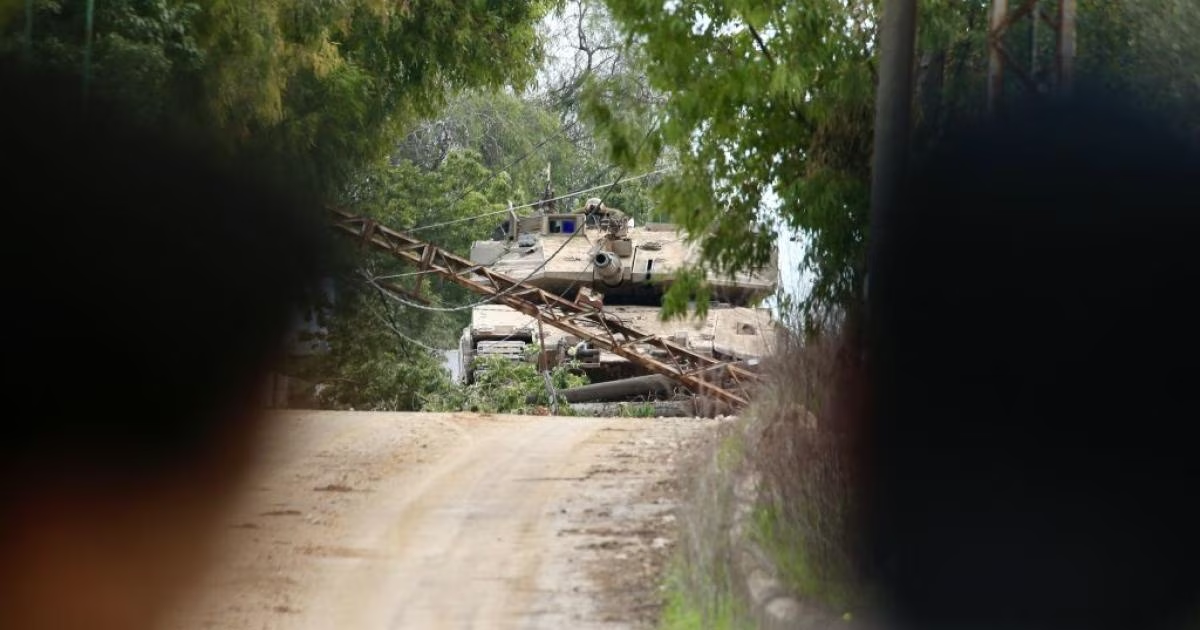







Southern Lebanon is witnessing rapid field transformations amidst the announcement of a framework agreement, as Israeli occupation forces continue to violate ceasefire understandings. These movements aim to impose a new geographical reality that expands the buffer zone, which the occupation seeks to establish as a fait accompli before entering any final negotiations.
'The Yellow Line,' which defines the southern edge of Lebanon, is no longer fixed as it was when the ceasefire was first announced, as field sources have observed repeated expansions in its area. These expansions have included villages and towns that were not within the initial scope, indicating an Israeli desire to seize more Lebanese territory and secure greater strategic depth.
In the western sector, changes are clearly evident after the buffer zone's borders previously ended at the towns of Al-Bayada and Shama. However, the recent expansion has pushed these borders northward, engulfing the towns of Zibqin, Majdal Zoun, and Bayt al-Sayyad, amidst intensive ground incursions carried out by occupation vehicles in recent days.
Reports indicate that Israeli forces have already reached the outskirts of the coastal town of Al-Mansouri, which gives them partial control over the southern coastal strip. This advance aims to completely isolate the border villages from the Lebanese interior, turning them into a closed military zone from which civilians are prohibited.
In the central sector, the area of forbidden zones for Lebanese citizens has expanded to include additional areas towards the town of Hadatha, reaching the outskirts of Tibnin. Local sources recorded an incursion by Israeli vehicles last Friday, starting from Hadatha towards the outskirts of the town of Haris, an area located outside the declared demarcations of the Yellow Line.
Occupation forces stormed a house in the town of Haris and converted it into a military outpost, coinciding with extensive sweeping operations in the vicinity. These ground movements were accompanied by intensive flights of drones and reconnaissance aircraft that did not leave the region's skies, reflecting a state of constant alert.
Moving to the eastern sector, the largest and most dangerous transformations have appeared since the start of the ceasefire, with movements concentrated around strategic points north of the Litani River. Although Beaufort Castle was previously included within the Yellow Line, actual field deployment there did not begin intensively until recently.
Through its control over Beaufort Castle and the surrounding heights, Israeli forces seek to secure direct oversight of the city of Nabatieh and its villages. These heights, especially Kfartibnit and Ali al-Taher, provide significant intelligence and military advantage to the occupation, which explains the insistence on remaining there despite international pressure.
In a related context, media reports revealed a proposal to establish 'experimental zones' from which the Israeli army might withdraw and hand over to the Lebanese army under international supervision. These locations are concentrated in the eastern sector, specifically in the Wadi al-Salouqi area and the town of Zawtar, located at the western border of the Yellow Line.
Press sources quoted 'Axios' as saying that American officers might participate in the field supervision of limited withdrawal operations in coordination with the Lebanese army. This step is an attempt to reduce tension, but it remains contingent on the occupation's commitment to the proposed withdrawal timeline.
For his part, Israeli Prime Minister Benjamin Netanyahu continues to emphasize the necessity of continued military presence within the Yellow Line for an indefinite period. Netanyahu categorically refuses to allow displaced Lebanese citizens to return to their villages within this range, considering them essential security zones to protect northern settlements.
In contrast, Hezbollah announced its categorical rejection of the framework agreement in its current form, stressing that it would not accept any arrangements that do not guarantee a complete Israeli withdrawal. The party views the current Israeli movements as an attempt to impose a disguised occupation under the name of buffer zones, which will be met with field resistance.
These developments indicate that the ceasefire agreement is going through a very critical phase due to the absence of effective monitoring mechanisms on the ground. While diplomats talk about de-escalation, Israeli bulldozers are drawing new borders with blood and fire, threatening the collapse of fragile understandings and a return to comprehensive confrontation.
The situation in southern Lebanon remains suspended between the occupation's desire to seize Lebanese geography and the Lebanese people's insistence on restoring their full sovereignty. With daily violations continuing, the buffer zone remains an Israeli project facing widespread popular and official rejection, amidst anticipation of what future diplomatic moves will bring.
The occupation continues its violations of the ceasefire agreement in an attempt to gain more field leverage before any negotiation.




Share your opinion
Map of Israeli Expansion in Southern Lebanon: How Does the Occupation Impose the 'Buffer Zone' as a Fait Accompli?