PALESTINE

Sun 31 May 2026 11:13 am - Jerusalem Time

Testimonies from Occupation Soldiers Reveal the Falsity of Calm: Orders for Direct Killing and Land Grabbing in Gaza

International press reports have conveyed shocking testimonies from soldiers who served in the ranks of the occupation army within the Gaza Strip, revealing that killings and targeting of Palestinians never ceased. These testimonies confirmed that official announcements about political agreements coming into effect were merely a cover for the continued military operations on the ground at the same pace.

In their statements, the soldiers described what is rumored about a ceasefire as 'just a joke' that finds no resonance on the ground, as the war continues under different names and with violent combat tactics. The report indicated that the situation on the ground reflects a determination by the fighting units to continue military escalation, far from the political statements issued by the leadership.

Testimonies focused on the military's mechanism for dealing with Palestinians near what is known as the 'Yellow Line,' which is the dividing line between areas under occupation control and populated Palestinian areas. Soldiers explained that strict instructions mandated automatic and direct firing at anyone crossing this line or even approaching it, regardless of their identity or gender.

The report revealed behaviors described as brutal by some elements within the combat units, where some soldiers would celebrate hysterically after successful sniping operations. These targets included civilian vehicles or individuals passing near military areas, reflecting a lack of ethical and legal oversight within the field barracks.

Sources indicated a blatant state of ambiguity and contradiction regarding the rules of engagement on the ground, where soldiers live in a state of disconnect between what they hear in the media and what they are ordered to do. While some military commanders publicly express support for political agreements, in their private conversations with soldiers, they reflect an intense desire to prolong the war and expand its scope.

Soldiers participating in the testimonies admitted that identifying targets was often impossible due to long distances and the speed of the decision to kill by field commanders. This admission reinforces international concerns about the deliberate targeting of unarmed civilians who pose no direct military threat to the stationed forces.

In an attempt to defend its position, the occupation army claimed that the area adjacent to the Yellow Line is a 'sensitive operational zone' requiring strict security measures to protect forces. Army spokespersons claimed that rules require prior warnings, but the testimonies of field soldiers refuted these claims entirely and confirmed the absence of warnings.

Field data and reports showed a sharp increase in the number of Palestinian martyrs near this line in recent months, indicating a systematic policy of physical liquidation. This rise in casualties coincided with the expansion of the occupation's field control and the grabbing of more areas and lands deep within the Gaza Strip to create buffer zones.

Testimonies concluded that the political terms used in international forums do not apply to the tragic reality experienced by the residents of the Strip under continuous fire. One soldier concluded his statement by emphasizing the need to stop misleading public opinion with terms like 'truce' or 'ceasefire' as long as the killing machine continues to operate without stopping.

We must completely stop using the term 'ceasefire' because it never reflects what is actually happening on the ground.

ARAB AND WORLD

Sun 31 May 2026 11:13 am - Jerusalem Time

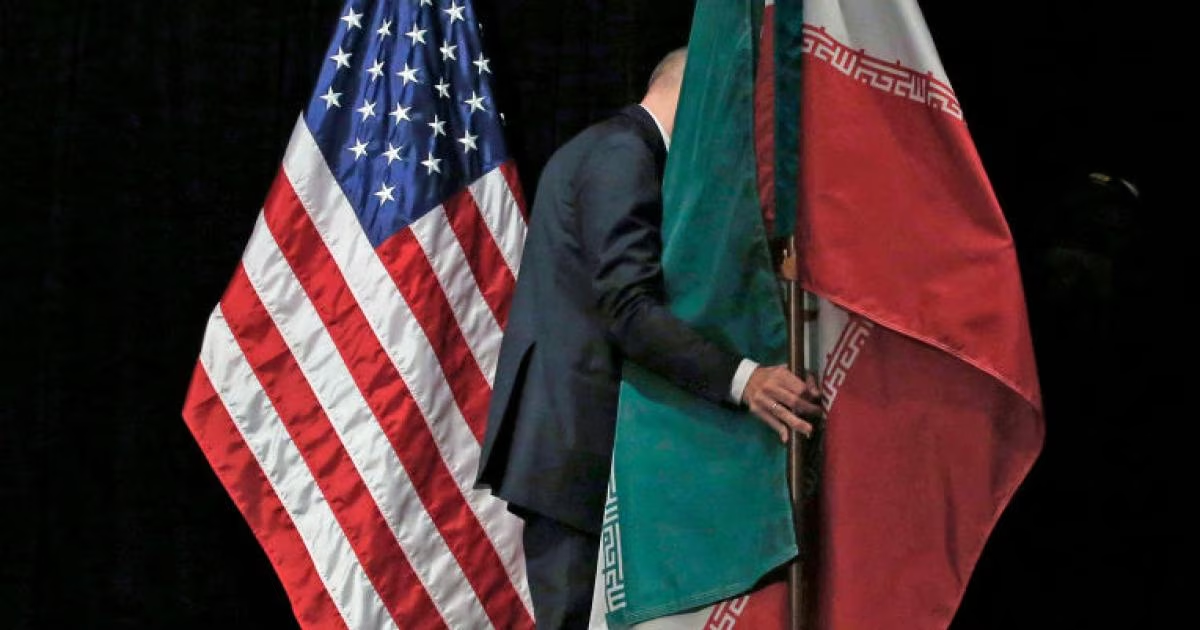
Washington threatens to resume war against Tehran, Trump sets strict conditions for agreement

The American administration officially announced that it possesses all the necessary military means and capabilities to resume war with Iran if diplomatic efforts fail. The White House clarified that President Donald Trump will not sign any agreement with Tehran unless it meets all American conditions and red lines set by Washington, amidst unprecedented regional tensions that have shaken the global economy.

These stances came after a lengthy meeting held by Trump with his senior aides in the White House Situation Room, which lasted for two hours to discuss a draft of a potential agreement mediated by Pakistan and Qatar. A senior American official affirmed that the administration will not accept any concessions that allow Iran to possess nuclear weapons, emphasizing that the interest of the United States is the first and last criterion in any ongoing negotiations.

For his part, US Secretary of Defense Pete Hegseth stated, during his participation in the Shangri-La Dialogue in Singapore, that the US armed forces are on high alert. Hegseth indicated that his country is fully capable of returning to direct combat operations if necessary, which was reinforced by the US Central Command (CENTCOM) by confirming its presence and vigilance in the region.

In a related context, President Trump, via his 'Truth Social' platform, outlined clear demands including an absolute Iranian commitment not to possess nuclear weapons, and the immediate opening of the Strait of Hormuz to international navigation without imposing any fees. Trump also indicated that the United States would work to extract and destroy enriched materials in coordination with the International Atomic Energy Agency, confirming the freezing of any financial exchange for the time being.

On the Iranian side, informed sources described Trump's statements as a mixture of facts and lies, noting that Tehran will not relinquish its sovereign rights. The spokesman for the Iranian Foreign Ministry, Ismail Baqaei, clarified that the exchange of messages is still ongoing through mediators, but he stressed that no final agreement has been reached yet, especially regarding the status of the Strait of Hormuz.

Tehran adheres to its legal position regarding the Strait of Hormuz, where members of the Iranian Shura Council affirmed that the management of the strait is an exclusive right of Iran and the Sultanate of Oman only. Iranian parliamentarians indicated that there are legislative moves to ratify a text that establishes full Iranian sovereignty over the strategic waterway, which could further complicate the international scene.

In a notable field development, the US Army announced the targeting of a cargo ship flying the flag of Gambia that was on its way to an Iranian port, where it was disabled by a missile that targeted the engine room. This incident comes at a time when Iranian sources accuse the US Navy of continuing to intercept Iranian commercial vessels and preventing them from sailing freely, despite talk of de-escalation understandings.

Tehran stipulates, for any progress in negotiations, the immediate release of $12 billion of its frozen assets held by the United States and its allies. According to official media reports in Tehran, any delay in paying these amounts will mean the suspension of negotiations, emphasizing that the issue of destroying nuclear materials or canceling transit fees in Hormuz was not included in the unofficial drafts.

Turkish Foreign Minister Hakan Fidan entered the crisis, warning that closing the Strait of Hormuz represents immense pressure that is more dangerous than the nuclear file itself. Fidan indicated that the repercussions of closing the waterway would be catastrophic for global energy security and food security, leading to sharp price increases affecting all countries of the world without exception.

Coinciding with the tension with Iran, the Lebanese front is witnessing a dangerous military escalation despite an earlier ceasefire announcement. Sources reported that Israeli forces continued their ground and air operations, issuing warnings to evacuate Lebanese towns located up to 40 kilometers north of the border, indicating an expansion of the field confrontation.

Israeli Prime Minister Benjamin Netanyahu explicitly announced that his army had crossed the Litani River, which represents a major violation of previous international understandings. This announcement coincided with military talks held at the Pentagon between American and Israeli delegations, which Washington described as constructive, despite the continued raids targeting Lebanese villages and towns.

For his part, Lebanese Prime Minister Najib Mikati accused the Israeli authorities of implementing a 'scorched earth' policy in southern Lebanon and its Bekaa Valley. Mikati affirmed that the Lebanese state is facing an unprecedented escalation that threatens infrastructure and civilian lives, calling on the international community to intervene to stop the ongoing Israeli violations of Lebanese sovereignty and international laws.

Statistics issued by the Lebanese Ministry of Health indicate that more than 3355 martyrs have fallen since the start of the widespread aggression, amidst massive destruction of property. This wave of escalation began after the assassination of the Iranian Supreme Leader, which prompted Hezbollah to respond with intensive missiles targeting objectives within the Hebrew state, plunging the region into a spiral of mutual violence.

Amidst these complexities, the scene in the Middle East remains suspended between the options of comprehensive war or reaching a major deal that resolves outstanding issues. With the continued military build-ups and mutual threats, international capitals await the outcomes of the coming days from secret and public negotiations led by regional and international parties to defuse the explosion.

The United States is fully capable of resuming operations if necessary against Iran, and we will not accept an agreement that does not serve our interests.

ARAB AND WORLD

Sun 31 May 2026 11:13 am - Jerusalem Time

Bloody escalation in southern Lebanon: Martyrs and wounded in intense raids, and the occupation halts education on the border

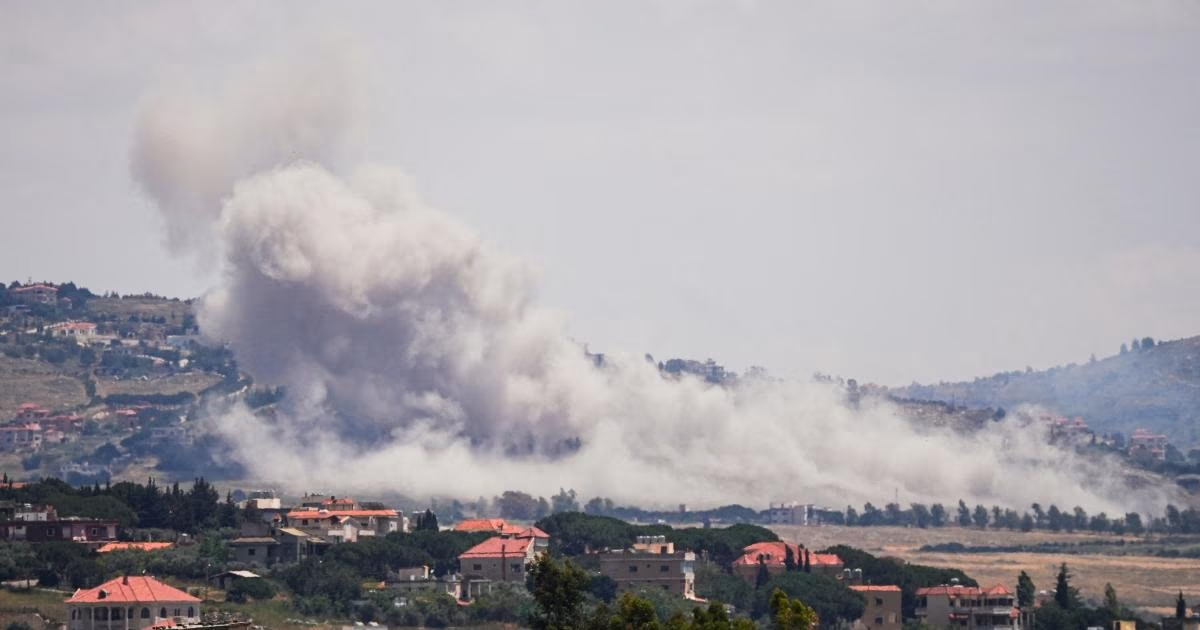
Southern Lebanon witnessed a dangerous military escalation on Saturday, as Israeli occupation aircraft and a series of drones launched intense airstrikes targeting populated towns and villages. These attacks, accompanied by heavy artillery shelling, resulted in the martyrdom of eight people and the injury of eighteen others with varying degrees of severity, in an initial toll of the ongoing aggression.

Field sources reported that an Israeli drone targeted the town of Jibshit, affiliated with the Nabatieh district, leading to the immediate martyrdom of a young man, while another raid targeted a water fountain in the town of Ansar. The latter attack resulted in the martyrdom of a paramedic belonging to the Islamic Message Scouts Association, in addition to the injury of four citizens who were in the vicinity of the targeted site.

In a related context, medical reports confirmed the retrieval of two martyrs from under the rubble of a residential building in the Burj Al-Shamali area of the Tyre district, after it was subjected to direct shelling by warplanes. The town of Loubieh in the Sidon district also recorded one martyr and one injured person due to a similar airstrike, as part of the systematic targeting policy of residential areas and infrastructure.

The occupation forces committed a massacre in the town of Ansar in the Nabatieh governorate, where a drone targeted a house in the Al-Marj neighborhood, leading to the martyrdom of a citizen and his son and the injury of seven members of his family. This coincided with the complete destruction of the 'Al-Khalil' commercial center in the middle of the town, following a violent raid carried out by warplanes that turned the building into rubble.

The attacks were not limited to homes and commercial centers but also targeted vital roads, as a drone targeted a vehicle on the Sharifah-Haboush road, leading to the martyrdom of one person and the critical injury of another. The road leading to the Nabih Berri Governmental Hospital in Nabatieh was also subjected to an airstrike, resulting in three injuries among passersby.

In a remarkable field development, the occupation army carried out extensive demolition operations in the Arid Marjayoun area, followed by a series of airstrikes and heavy artillery shelling that targeted the vicinity of the main power station. These operations, according to observers, aim to create a buffer zone and destroy the elements of life in the Lebanese border villages.

The Lebanese Ministry of Health revealed horrific details of a massacre that occurred in the town of Adloun, where it confirmed the martyrdom of nine people, including six children, in an Israeli raid that targeted the town last night. These numbers show the extent of the deliberate targeting of civilians and children amid international silence regarding the continuous violations of ceasefire agreements.

On the opposite front, the Israeli occupation army announced exceptional security measures, including halting all educational activities and closing beaches in areas near the Lebanese border. This decision came after a security assessment indicated an escalation in confrontations with Hezbollah and the possibility of intense missile strikes on Israeli territory.

The occupation army called on residents of the Upper Galilee and the occupied Syrian Golan to remain near shelters and fortified areas during the upcoming Sunday and Monday. The military statement clarified that educational activities in those areas should be limited to buildings with protected spaces that can be quickly accessed when sirens sound.

These Israeli measures coincide with Hebrew media reports talking about the army's intention to expand its ground incursion into Lebanese territory. Sources indicated that the occupation has already begun installing military bridges over the Litani River, which portends a new phase of military escalation that may exceed the established rules of engagement.

For its part, Hezbollah continued to carry out qualitative military operations targeting gatherings and positions of the occupation forces with missiles and attack drones. The party affirmed in its statements that this escalation is a natural response to daily Israeli violations of the ceasefire agreement and a rejection of the occupation's attempts to impose a new field reality on the border.

Israeli raids also included the towns of Kfardounin, Frun, and Gandourieh in the Bint Jbeil district, where warplanes carried out more than six consecutive raids. The towns of Jmaijmeh, Kharbet Selem, Haris, and Yater were also subjected to concentrated aerial and artillery shelling, causing severe material damage to private property and public facilities.

In the Nabatieh district, the town of Zibdin and the vicinity of the historic Beaufort Castle were subjected to intense shelling and successive airstrikes, while the town of Abba recorded two injuries due to a drone raid. These widespread attacks reflect the occupation's desire to paralyze movement in all districts of southern Lebanon and empty them of their residents through brutal military force.

The field situation in southern Lebanon remains open to all possibilities, amid continued Israeli raids and missile responses from the resistance. Fears are growing of a complete collapse of the ceasefire agreement, which was supposed to last until early July, amid international calls for restraint and avoiding a slide into an all-out war.

The Israeli army conducted a security assessment and decided to halt educational activities and close beaches in areas adjacent to the border with Lebanon.

PALESTINE

Sat 30 May 2026 6:51 pm - Jerusalem Time

Widespread Israeli escalation in Lebanon: Warnings to evacuate entire cities and Hezbollah ambushes invading forces

The Israeli occupation army escalated its aggression on Lebanese territories today, Saturday, issuing immediate warnings to evacuate 13 towns and villages in the southern and western Bekaa regions. Military orders demanded residents immediately move north of the Zahrani River, in a preparatory step to carry out widespread bombing operations in those areas.

Field sources reported that evacuation orders are no longer limited to specific buildings or small villages but have expanded to include entire cities, as happened in Nabatieh and Tyre. This shift indicates the occupation's desire to empty population centers in southern Lebanon, reflecting an unprecedented escalation in the level of ground and air military operations.

Since talks began about ceasefire paths, the occupation authorities have issued evacuation orders covering more than a hundred Lebanese towns so far. Observers believe that this policy aims to exert maximum pressure on the popular base and the Lebanese negotiating side by turning major cities into uninhabitable areas.

On the ground, Israeli warplanes launched a series of intense raids and formed fierce fire belts targeting the town of Kafr Tibnit, part of the Nabatieh district. These attacks come as part of the occupation army's attempts to encircle and gain fire control over the town of Yahmar al-Shaqif after previous attempts to advance in its strategic vicinity failed.

The scope of aerial bombardment expanded to include the towns of Ansar, Jumayjimah, and Mayfadoun, while an Israeli drone targeted the vicinity of the government hospital in Nabatieh city. Violent raids also hit the town of Mashghara in the western Bekaa, and the towns of Toulain and Qabrikha in the Marjayoun district, amidst a state of panic among the remaining civilians.

In an initial count of today's casualties, 5 people were martyred and others injured as a result of continuous raids on various Lebanese regions. Official sources stated that 3 martyrs fell in the town of Ansar and Nabatieh villages, while rescue teams managed to recover two martyrs from under the rubble of a destroyed building in the Burj al-Shamali area of Tyre district.

Even the Lebanese army was not spared from Israeli attacks, as the army command announced that two soldiers were injured to varying degrees after an Israeli drone targeted their vehicle. The attack occurred on the public road of Abba in the Nabatieh district while the soldiers were performing their field duties, raising the intensity of direct targeting of the Lebanese military institution.

Returning to yesterday's statistics, the Lebanese Ministry of Health revealed the martyrdom of 11 people, including a paramedic who was performing his humanitarian duty, and the injury of 8 others in Tyre city. These figures confirm the occupation's deliberate targeting of medical and relief teams to obstruct rescue operations for the wounded and the recovery of missing persons from under the rubble.

On the front of the field confrontation, Hezbollah announced the execution of a well-planned ambush at dawn today targeting an Israeli force that attempted to advance towards the town of Ghunduriya. Hezbollah clarified in a military statement that it detonated explosive devices on the invading force and showered it with a barrage of rockets and machine guns, resulting in confirmed casualties among the occupation soldiers.

The statement indicated that the occupation forces were forced to withdraw the injured under heavy smoke cover, coinciding with intense aerial and artillery bombardment of the area to secure the withdrawal operation. This operation is a new blow to the attempts of ground incursions through which the Israeli army seeks to establish strongholds within the border villages.

In the context of air defense, Hezbollah confirmed its confrontation with an Israeli drone of the 'Hermes 450' type in the airspace of the eastern Zawtar town, forcing it to leave Lebanese airspace. The party's missile force also continued to pound northern settlements, targeting Kiryat Shmona and the strategic Meron base with intense rocket barrages.

For its part, the Israeli army radio acknowledged detecting the launch of about 15 rockets from Lebanese territory towards towns in the Upper Galilee since last night. Sirens sounded in several border settlements, prompting settlers to take refuge in shelters, coinciding with the continued rocket volleys launched from the south.

Field data indicate that Israel is adopting a 'negotiation under fire' strategy, increasing the pace of infrastructure and city destruction in parallel with political activity. This military behavior aims to extract political concessions in indirect negotiations conducted through international mediation, by increasing the human and material cost for Lebanon.

The scene in southern Lebanon and the Bekaa remains open to all possibilities, given the occupation's insistence on expanding the geographical scope of targeting to include the depths of cities. With the resistance continuing to carry out qualitative operations and border ambushes, the complexities of the field situation increase, casting a shadow over any potential political understandings in the near future.

The current escalation reflects the negotiation under fire policy adopted by Israel through intensifying airstrikes and military pressure in parallel with ongoing discussions.

PALESTINE

Sat 30 May 2026 6:51 pm - Jerusalem Time

7 Martyrs in Gaza in Two Days, Netanyahu Reveals Plan to Expand Occupation to 70% of the Strip

A Palestinian citizen was martyred and three others, including a child, were injured as a result of an Israeli drone targeting a gathering of civilians near Al-Aqsa Martyrs Hospital in Deir al-Balah. Medical sources confirmed the arrival of the body of the martyr Jamal Abu Aoun to the hospital, noting that the raid occurred in a vital area with movement of citizens and displaced persons.

In a simultaneous escalation on the ground, Israeli occupation artillery launched a series of attacks targeting the eastern and southern areas of Khan Yunis city in the southern Gaza Strip. The artillery shelling also targeted the northeastern outskirts of Al-Bureij refugee camp in the central Strip, causing panic among residents and material damage to properties.

The Ministry of Health in the Gaza Strip announced the martyrdom of 7 Palestinians and the injury of 25 others during the past forty-eight hours as a result of continuous aggressions. The ministry clarified that this statistic raises the total death toll of the genocide war since October 2023 to more than 72,000 martyrs.

Medical reports indicated that ambulance and civil defense crews are still facing extreme difficulties in reaching a number of victims trapped under the rubble and on the roads. Repeated targeting and complex field conditions prevent the recovery of missing persons in several hot areas of the Strip.

Regarding the ceasefire agreement announced since October 2025, the ministry revealed an increase in the number of victims of Israeli violations of this agreement. Documented figures reached 929 martyrs and 2811 injured, in addition to hundreds of cases recovered from under the rubble during the supposed truce period.

On the political front, Israeli Prime Minister Benjamin Netanyahu sparked a wave of international condemnation after his recent statements about the future of military control in Gaza. Netanyahu acknowledged that his army currently occupies 60% of the Strip's area, announcing his government's intention to expand this area to 70%.

The United Nations responded firmly to these statements, with the spokesperson for the Secretary-General, Stéphane Dujarric, affirming that Gaza must remain entirely for Palestinians. Dujarric stressed in his press briefing the necessity of the withdrawal of Israeli forces from all areas they have controlled, including what is known as the Yellow Line.

The UN spokesperson clarified that the international position is based on Gaza belonging 100% to the Palestinian people, a goal that the international organization seeks to achieve. He called for an end to any moves aimed at seizing more land or changing the demographic and geographical reality of the Strip.

These developments come after the Israeli army announced last October its control over 53% of Gaza's area before retreating to the Yellow Line. This retreat was part of the implementation of the first phase of the US administration's plan to end the war, which assumed additional withdrawals.

The 'Yellow Line' is known as a hypothetical strip within the Gaza Strip to which the occupation army temporarily withdrew under recent ceasefire agreements. This line separates areas of Israeli military control from areas where Palestinians are allowed to be present and move, pending subsequent withdrawal phases that have not been realized.

Cumulative statistics indicate the scale of the humanitarian catastrophe, with the number of injured since the beginning of the aggression in October 2023 reaching approximately 172,919. The health system is suffering from severe deterioration and a shortage of basic resources due to the long siege and direct targeting of medical facilities.

It is worth noting that the genocide war waged by Israel with American support has entered its second year, leaving massive destruction affecting about 90% of the infrastructure. Human suffering continues in the absence of a comprehensive political solution that guarantees full withdrawal and an end to the bloodshed in the Palestinian territories.

Gaza must be 100% owned by the Palestinian people, and this is what we want to see, and Israel must withdraw its forces from the Yellow Line.

PALESTINE

Sat 30 May 2026 6:50 pm - Jerusalem Time

Injuries in a widespread settler attack south of Nablus, and the occupation forces compel a Jerusalemite family to demolish 7 homes

The village of Madama, located south of Nablus city, witnessed a violent attack by dozens of extremist settlers, resulting in seven injuries among Palestinian citizens. Medical sources confirmed that the injuries varied between live ammunition and direct severe beating, with the attacks affecting elderly individuals, men, and shrapnel hitting the faces of others.

Local sources explained that the attack began when groups of settlers launched from a newly established outpost on the northern lands of the village, targeting unarmed shepherds with live fire. Occupation forces intervened to provide protection for the attackers, closing the main entrances to the earth mounds and iron gates to prevent the arrival of medical supplies.

In a related context, the Palestinian Red Crescent reported that occupation soldiers deliberately obstructed the access of ambulances to the injured in Madama, exacerbating the suffering of the wounded. The list of injured included a 72-year-old man who was shot in the foot, another 53-year-old man who was shot in the thigh, in addition to two women who were severely beaten.

Settler attacks were not limited to Madama but extended to the town of Beita, south of Nablus, where citizens' homes were pelted with stones in the early hours of dawn. The attack resulted in the smashing of windows of several vehicles parked in front of homes, before the town's residents confronted the settlers and forced them to retreat amidst the occupation forces firing flare bombs.

In the southern West Bank, settlers targeted agricultural lands in Khirbet al-Markaz in Masafer Yatta, Hebron Governorate, where they damaged and uprooted a number of fruit trees. These attacks come within the framework of a systematic policy aimed at restricting Palestinian farmers and preventing them from accessing their historical lands.

In occupied Jerusalem, the occupation authorities committed a new demolition crime after forcing a Palestinian family to self-demolish seven of their homes in the eastern area of Qalandia village. The forced demolition operation came under the pretext of building without a license, leading to the displacement of family members who had been living in these inhabited homes for years.

Regarding arrests, occupation forces launched a wide-ranging raid campaign targeting Qalandia refugee camp, Qalqilya city, and Mithalun town south of Jenin. This campaign resulted in the arrest of a number of citizens, including leaders of the Fatah movement in Qalqilya city, in addition to two young men from Shweika suburb north of Tulkarm after raiding and searching their relatives' homes.

Human rights reports indicate an unprecedented escalation in the pace of settler attacks since October 2023, with attacks becoming more organized and deadly. According to official data from the Wall and Settlement Resistance Commission, more than 540 attacks were recorded in April alone, including physical assaults, burning of crops, and seizure of property.

These field developments come amid the continued policy of closure and siege imposed by the occupation forces on cities and villages in the West Bank. Observers warn that giving settlers free rein in areas classified as 'C' aims to accelerate de facto annexation operations and displace Palestinian residents from their lands for the sake of settlement expansion.

Israeli occupation forces obstructed the access of ambulance crews to the injured in Madama village, preventing them from providing necessary treatment to those targeted by settler bullets.

OPINIONS

Sat 30 May 2026 2:50 pm - Jerusalem Time

When Israel Loses the Street and Wins the Institutions

For many decades, the relationship between the United States and Israel seemed to be one of the rare constants in international politics. American support for Israel was not merely a fleeting government policy; it became part of the prevailing political culture in Washington and an issue enjoying broad bipartisan consensus between the Republican and Democratic parties. But the question that is now forcefully asserting itself is: Can the current course of events lead to an outcome Israel never imagined, namely the erosion of American sympathy for it, and perhaps even the escalation of manifestations of antisemitism within American society itself?

This question may seem shocking, but it is no longer a political taboo as it once was. The American scene is witnessing profound changes that extend beyond foreign policy to the very structure of society. Millions of young Americans who did not experience the Cold War or the memory of the European Holocaust view the conflict in the Middle East from a completely different perspective than previous generations. For them, Israel is no longer always seen as the "small besieged state"; rather, it is often presented in many discussions as a military and regional power with overwhelming superiority.

With the expansion of social media and the flow of images and information outside traditional channels, Israel has begun to face an increasing challenge in the arena of global public opinion. The narrative that enjoyed a strong presence in Western media for decades no longer receives the same acceptance among broad segments of the public, especially among younger generations. It has become clear that the battle is no longer just about facts on the ground, but about the ability to convince public opinion of the legitimacy of positions and policies.

Some observers believe that this relative decline in the power of the Israeli narrative has contributed to pushing Israel and its supporting organizations to focus more on official and institutional levels. The more difficult the battle for public opinion becomes, the greater the reliance on political, legal, and diplomatic tools of influence to maintain traditional support within Western countries.

In this context, intensive efforts have emerged in recent years to expand the adoption of official definitions, legislation, and policies related to antisemitism within parliaments, universities, and government institutions in a number of influential countries. Supporters of these efforts consider them a necessary response to the increasing incidents of anti-Jewish sentiment and the emergence of new forms of hatred that sometimes hide behind political discourse.

However, critics of this approach believe that the problem begins when the line between antisemitism and criticism of Israel becomes less clear. The more the scope of official definitions is expanded to include certain forms of criticism directed at Israel, the more segments of public opinion feel that political debate is subject to exceptional restrictions not imposed on other international issues.

A striking paradox emerges here; while these policies aim to protect Jews from hatred, some researchers fear that linking Israel to legal and political systems that regulate freedom of expression could lead to counterproductive results. This is because some circles might get the impression that Israel, having lost part of the battle for popular persuasion, is increasingly relying on institutional and legal power to compensate for the decline of its influence in public opinion.

This debate cannot be separated from the internal American dimension. For decades, pro-Israel lobbying groups have played an influential role in American political life, foremost among them AIPAC, which has succeeded in building a wide network of relationships within Congress and decision-making centers. While its supporters see it as playing a legitimate role within the American democratic system, its critics consider it an example of the influence of lobbying groups capable of affecting public policies.

The issue becomes more sensitive when the discussion extends to American Jews themselves. Jews have achieved remarkable successes in the fields of economics, finance, technology, science, and culture, and have made a significant contribution to building the economic and intellectual power of the United States. However, periods of political polarization often push some populist voices to turn this success into material for generalizations and collective accusations, a path that many societies have known throughout history and whose results have always been dangerous.

Here lies the greatest paradox. The more intense the debate about Israel, the influence of lobbying groups, and legislation related to antisemitism, the greater the likelihood that the discussion will shift from criticizing a state and its policies to targeting Jews as a religious or cultural group. At this point, the danger is directed not only at Israel but at the very social fabric of American society.

But the question that arises today is not whether Israel can still maintain the support of Western governments, but whether it can maintain the support of Western societies themselves. There is a fundamental difference between influence within institutions and acceptance within public opinion, and between winning in the corridors of politics and winning hearts and minds.

For decades, Israel succeeded in combining both: official support and popular sympathy. Today, however, the equation seems to be changing. The more its ability to convince broad segments of public opinion declines, the more it relies on political allies, lobbying groups, legislation, and official institutions to maintain its traditional position in the West.

However, political history teaches us that sustainable legitimacy is not built by laws alone, nor is it preserved by government decisions only. When the gap begins to widen between what institutions support and what people believe, any political power becomes susceptible to a gradual loss of its moral capital, no matter how great its official influence.

Hence the paradox that Israel may face in the coming years. While efforts to expand definitions of antisemitism and surround Israel with more political and legal protection aim to fortify its position in the West, they may be viewed by some segments of public opinion as evidence that the Israeli narrative is no longer able to assert itself with the power of persuasion it once possessed.

And the greatest danger may be that this path, over time, leads to results completely contrary to its stated goal. The more a part of public opinion feels that a particular political issue enjoys exceptional protection or different treatment, the greater the likelihood of angry reactions arising that go beyond criticizing policies to turn into hostile attitudes towards the groups associated with them. At this point, the danger is no longer limited to Israel's image but extends to Jews in the West and to social cohesion within democratic societies themselves.

Therefore, the real question is not whether Israel is losing the battle for public opinion today, but whether it realizes that increasing reliance on institutional influence to compensate for popular decline may carry within it the seeds of a greater crisis in the future. History has often shown that winning over governments is easier than winning over people, but losing the people is the loss that is difficult to compensate for.


ARAB AND WORLD

Sat 30 May 2026 2:23 pm - Jerusalem Time

Trump Conditions Agreement with Iran on 'Red Lines' and Postpones Final Decision After Situation Room Meeting

Sources from within the White House reported that US President Donald Trump is adopting a firm stance on ongoing negotiations with Tehran, emphasizing that he will not sign any agreement that does not directly serve the strategic interests of the United States. The sources clarified that any final document must meet the 'red lines' set by Trump to ensure regional stability and the security of allies.

The White House 'Situation Room' hosted a high-level meeting that lasted for about two hours, including the President and the national security team, to discuss the final draft of the potential agreement. Despite expectations of a decisive decision, deliberations concluded without a final position being announced, indicating that there are technical or political details that still require further scrutiny before official adoption.

In statements preceding the meeting, Trump set clear parameters for the Iranian side, affirming that the complete and permanent abandonment of nuclear ambitions is a non-negotiable condition. The US President indicated that Washington will not allow Tehran to possess an atomic bomb under any circumstances, considering this a fundamental pillar for any future understanding.

American demands were not limited to the nuclear file alone but also included freedom of international navigation in the Strait of Hormuz, which is considered the world's energy lifeline. Trump demanded the immediate opening of the strait to ships in both directions, with the cancellation of all transit fees that Iran had attempted to impose during the past period, and ensuring the smooth flow of commercial traffic without obstacles.

On his 'Truth Social' platform, Trump stressed the need for immediate commencement of naval mine clearance operations that were planted in the strait during months of past tension. He considered securing waterways an integral part of Iran's commitments to demonstrate its good intentions, warning that the persistence of navigational threats would impede any progress in the diplomatic track.

The leaked draft agreement indicates a major trade-off that includes lifting the US naval blockade imposed on Iranian ports in exchange for tangible nuclear concessions. Among the most prominent of these provisions is Tehran's delivery of what Trump described as 'nuclear dust' and sensitive materials to the United States, to ensure they are not used in future weapons programs.

Despite the intense atmosphere in Washington, press sources quoted high-ranking officials as saying that the President is still carefully considering the available options. It appears that Trump prefers to wait to ensure the best possible terms, especially given the complex field realities left by recent military confrontations in the region.

These developments come after a series of military escalations that began in late February, when the United States and Israel engaged in a direct confrontation with Iran. Tehran responded at the time by targeting American interests in several Arab countries, which exacerbated the security crisis in the Middle East before reaching a temporary truce in April.

Iran had taken an escalatory step last March by closing the Strait of Hormuz and conditioning prior coordination for the passage of ships, which Washington considered a direct threat to national security. In response, the US administration imposed a comprehensive blockade on Iranian ports since mid-April, which led to the near-complete strangulation of Iranian oil exports.

In a related context, Trump indicated that negotiators have already succeeded in reaching common understandings on most of the outstanding issues between the two parties. However, there are still final arrangements that require coordination with regional countries in the Middle East to ensure the comprehensiveness and durability of the agreement, especially regarding border security arrangements.

Anticipation remains the order of the day in international circles, as Trump's anticipated decision represents a pivotal turning point in the course of the conflict with Iran. Either diplomacy succeeds in defusing the explosion through a 'red lines' agreement, or the region returns to military escalation and a tightened naval blockade if negotiations fail.

Iran must accept that it will never possess a nuclear weapon or a nuclear bomb, and the Strait of Hormuz should be immediately opened to global navigation.

PALESTINE

Sat 30 May 2026 2:23 pm - Jerusalem Time

Netanyahu claims crossing the Litani, Israeli massacres leave martyrs in southern Lebanon

Israeli warplanes committed a series of bloody massacres in various areas of southern Lebanon, resulting in a large number of martyrs and wounded, and widespread destruction of property. Local sources reported the martyrdom of eight Syrian nationals due to a raid targeting the Al-Hartiya area on the outskirts of Adloun town, while rescue teams continue search operations under the rubble.

Also in Adloun town, civil defense teams managed to retrieve the bodies of four martyrs, including children, from under the rubble of a house targeted by direct aerial bombardment. These attacks coincide with ongoing intense raids that targeted the towns of Burj Al-Shamali, Al-Baysariyeh, Al-Zarariyeh, and Arid Debbin, in addition to the vicinity of Al-Sreireh and Zifta towns in an unprecedented escalation.

Regarding field operations, Hezbollah announced the execution of eight qualitative military operations against gatherings and vehicles of the occupation army in the border areas. In its statements, the party confirmed targeting six Merkava tanks, achieving direct hits that led to some of them catching fire and being completely or partially destroyed.

Hezbollah clarified that its fighters detonated an explosive device on an Israeli military vehicle in the town of Yahmar Al-Shaqif, where flames were seen erupting from the vehicle after the explosion. The party also used 'Ababil' kamikaze drones to strike three Merkava tanks in the same town, reflecting a development in the offensive tactics used against the invading forces.

For his part, Israeli Prime Minister Benjamin Netanyahu claimed that his forces had achieved strategic progress by reaching positions north of the Litani River deep in southern Lebanon. Netanyahu claimed during an inspection visit to the northern border that the army had already 'crossed the river' and now controls advanced points that were considered red lines in previous confrontations.

Netanyahu indicated in a video clip published by his office that the current military operations are not limited to the border edge but extend to include strikes in Beirut, the Beqaa, and all Lebanese fronts. He considered that these moves aim to deliver direct and painful blows to Hezbollah's military infrastructure to force it to retreat.

Military reports indicate that the occupation army has expanded the scope of its ground operations outside the security zone it tried to establish since last April. This expansion comes amid intensified artillery and aerial bombardment that paves the way for ground forces, amidst fierce resistance from fighters in border villages and towns.

In a related context, the occupation authorities imposed forced evacuation orders on thousands of residents in southern Lebanese villages, leading to new waves of displacement towards northern areas. Israel is using a scorched-earth policy by completely destroying residential blocks in areas it attempts to advance into, exacerbating the suffering of civilians.

On the political track, the US Department of Defense (Pentagon) hosted a meeting including officials from the Lebanese Ministry of Defense and the Israeli Ministry of Security to discuss proposals for de-escalation. This American mediation aims to try to defuse a full-scale explosion and reach a security formula that ensures border stability and the disarmament of disputed areas.

A US official stated that the ongoing talks in Washington are proceeding according to their scheduled timeline, considering direct negotiation as the only way to achieve lasting peace. Both parties agreed to divide the discussions into two separate tracks, one technical security and the other diplomatic political, which will begin next week.

New rounds of diplomatic meetings are expected at the US State Department to discuss the details of the proposed agreement, at a time when observers believe the gap remains wide. Israel insists on strict security conditions, while Lebanon adheres to its full sovereignty and an end to continuous aggressions against its territories and people.

The Israeli army crossed the Litani River and controlled advanced positions, and operations extend to Beirut, the Beqaa, and the entire Lebanese front.

ARAB AND WORLD

Sat 30 May 2026 2:23 pm - Jerusalem Time

Economist warns Trump against military intervention in Cuba and calls for a gradual deal

The British magazine The Economist published an analytical editorial warning US President Donald Trump against sliding into a military confrontation with the communist regime in Cuba. The magazine indicated that any decision to use military force would be a grave mistake, expressing hope that Trump had learned lessons from previous experiences, particularly in Iran and Venezuela.

These warnings come after statements made by Trump in early January, in which he hinted that Cuba is the next stop after the overthrow of Nicolas Maduro in Venezuela. The current US strategy relies on drying up the island's energy sources by pressuring the new leadership in Caracas to cut off cheap fuel supplies, which has put the Cuban regime in a severe economic predicament.

Journalistic sources explained that the oil embargo imposed by Washington has made the lives of Cuban citizens more miserable, as residents suffer from continuous power outages and a severe shortage of basic goods. Although the magazine described the island's rulers as 'evil' due to their record of suppressing dissidents, it questioned the effectiveness of violent military solutions.

Cuba constitutes what is described as a 'mild threat' to US national security, given its allowance for both China and Russia to operate intelligence listening stations close to the US coast. This foreign military presence increases the anger of the Trump administration, which seeks to definitively end communist influence in the Western Hemisphere.

In an indication of military escalation, the aircraft carrier 'USS Nimitz' arrived in the Caribbean on March 20, carrying nuclear warheads and advanced aircraft. This military movement coincided with intensive flights of American reconnaissance drones over Cuban airspace, suggesting that the military option is now seriously on the White House's table.

For his part, Secretary of State Marco Rubio affirmed that the prospects for reaching a peaceful settlement with the current regime are not high, stressing that Cuba cannot be reformed under its current political structure. Rubio added in press statements that President Trump is prepared to do 'whatever it takes' to ensure change, which observers see as a prelude to a broader operation.

On the legal front, the US Department of Justice took an escalatory step by formally indicting Raul Castro, who is still considered the de facto and influential ruler on the island. This step aims to tighten the noose on the historical leadership of the Communist Party and remove its legitimate cover before the international community and regional powers.

The Economist believes that the threat of force may give Washington leverage at the negotiating table, but a full-scale invasion remains an unattractive option given America's poor record in nation-building. Cuba has a deeply rooted ideology and an army that could wage a long-term guerrilla war, making the imposition of democracy by force a slow process fraught with risks of abject failure.

In the absence of an organized political opposition within Cuba, due to youth emigration and the transformation of society into one of the oldest in the region, alternative options to invasion emerge. The magazine suggests focusing on a 'gradual transition' by offering economic incentives in exchange for tangible political concessions from the regime in Havana.

The potential agreement proposed by the analyses includes allowing oil to flow again in exchange for the regime releasing political prisoners and easing security repression. The proposal also includes providing humanitarian aid worth $100 million to be distributed through the church and non-governmental organizations to ensure it reaches the people away from military institutions.

Among the ideas also proposed is providing free and comprehensive internet service to Cubans via satellites, a step that could contribute to breaking media blackout and creating an environment for the emergence of civil opposition. Analysts believe that digital openness could be the most effective weapon in undermining the pillars of the communist regime in the long run without the need for a single shot.

Despite the Cuban regime's announcement of economic reforms, such as allowing expatriates to own businesses, Washington still doubts the seriousness of these steps. Cuban-American investors condition their return on the departure of the regime that seized their families' properties decades ago, and demand the rule of law as a fundamental condition.

The magazine concludes its analysis by pointing out that Cuba's tourism and agriculture sectors have enormous potential for rapid growth if US restrictions are lifted and a real opening is achieved. However, this recovery requires negotiating shrewdness from the Trump administration, far from military recklessness that could exacerbate the humanitarian crisis and turn the island into a permanent hotbed of conflict.

Lessons learned from previous confrontations with Iran are that maximum pressure may not always lead to the collapse of regimes, but may push them to further extremism. Therefore, the ball is now in the White House's court to choose whether to pursue a path of tough diplomacy or risk a war with uncertain outcomes in the United States' backyard.

An actual military operation in Cuba would be fraught with risks, and it is unlikely to improve conditions, as Cuba is not Venezuela and its dictatorship is more entrenched.

PALESTINE

Sat 30 May 2026 2:23 pm - Jerusalem Time

For the first time.. UN lists Israeli forces among perpetrators of sexual violence

In an unprecedented international move, the UN Secretary-General has included Israeli armed forces and security agencies on the blacklist of parties involved in conflict-related sexual violence. This announcement came during the seventeenth annual report presented by Pramila Patten, the Special Representative of the Secretary-General, confirming the existence of credible patterns of systematic violations.

The official listing included several Israeli security arms, primarily the Israeli army and the prison service, in addition to elite units such as the special 'Keter' unit and the 'Yamam' unit of the police. The decision was based on intelligence and human rights information indicating continued patterns of rape and other forms of sexual violence as a tool for torture and humiliation against Palestinians.

UN sources clarified that these entities were under monitoring in the previous report, but the continuation of violations and the prevention of access for international monitoring teams accelerated the decision for official inclusion this year. Patten affirmed that the absence of Israeli cooperation did not prevent the organization from reaching shocking facts about what is happening behind the walls of detention centers and military checkpoints.

During 2025, UN teams were able to verify 31 direct cases of sexual violence attributed to Israeli forces, targeting diverse groups including 14 men, 7 women, and 10 children from the Gaza Strip and the West Bank. These figures reveal the broad scope of targeting, including minors and men, as part of a policy aimed at breaking popular will.

Documented violations included brutal crimes such as gang rape, the use of sharp objects in physical assaults, as well as direct shooting targeting the genitals of detainees. The report also recorded cases of forced naked searches and illegal touching without any security justifications, classifying them as war crimes under international law.

The UN representative indicated that most of these crimes occurred inside secret and declared detention centers, where detainees are isolated from the outside world and prevented from communicating with lawyers or international organizations. She added that these practices are not isolated incidents but fall within a broader pattern of sexual violence used as a form of physical and psychological torture.

Regarding the Israeli position, the report confirmed that authorities in Tel Aviv continue to deny the existence of any organized pattern of sexual violence, claiming that these reports stem from 'institutional bias' against them. However, the Israeli government has not provided any evidence of transparent investigations or prosecutions against soldiers involved in these documented crimes.

The report touched upon the famous 'Sde Teiman' detention center case, noting that the Israeli military prosecutor dropped sexual violence charges from the final indictment despite the seriousness of the evidence. The United Nations considered that the political protests in which Knesset members participated to support the accused soldiers reflect the culture of impunity prevalent in the Israeli establishment.

On another note, Pramila Patten justified her not visiting the Gaza Strip so far by the strict security assessments issued by the United Nations Department of Safety and Security, despite receiving official invitations from the Palestinian side. She affirmed that access to Gaza was a fundamental condition in her negotiations, but field conditions prevented the completion of the mission at present.

In response to questions about the delay in documenting Palestinian cases compared to others, Patten explained that her office adheres to the mandates set by the UN Security Council, and that field restrictions hinder immediate documentation. She indicated that many victims are unable to give their testimonies until after their release and their exit from the grip of the occupation.

The report was not limited to Israel but also included the Russian armed forces and their security agencies, where 310 cases of sexual violence committed against prisoners of war and Ukrainian civilians were documented. Russian violations included electric shocks and sexual mutilation, reflecting the increasing use of these crimes in major international conflicts.

The report revealed alarming figures at the global level, with 2025 recording more than 9,000 cases of conflict-related sexual violence in 21 different countries. This figure represents a 100% increase from the previous year, raising alarm bells about the collapse of humanitarian standards in conflict zones around the world.

At the conclusion of the conference, Patten stressed that the inclusion of any party on this list aims to exert international pressure for corrective actions and an immediate halt to violations. She affirmed that the United Nations will continue to monitor the situation in the occupied Palestinian territories despite attempts at intimidation or prevention practiced by the occupation authorities against its staff.

Israel currently faces increasing legal and diplomatic pressure, as this report places it among the countries and organizations most violating human rights in the world. This inclusion opens the door for new international legal prosecutions that may affect military and political leaders responsible for providing cover for these practices.

Restrictions on the access of UN staff and human rights observers still significantly impede the process of documenting and verifying violations.

OPINIONS

Sat 30 May 2026 2:23 pm - Jerusalem Time

The Legacy of Edward Bernays: How Modern Algorithms Manipulate the Human Mind?

Ramallah - “Alquds ” dot com

Ramallah - “Alquds ” dot com

Opinion Writer

Social media users often believe they are in control of their decisions, whether in choosing content or adopting political stances. However, reality indicates the existence of a complex system for understanding and directing human behavior, rooted in Edward Bernays, the founding father of modern public relations. In his 1928 book 'Propaganda,' Bernays laid terrifying foundations for mind manipulation, foundations that today's digital algorithms have drawn upon to enhance their influence on the masses.

Bernays based his theories on crowd psychology, influenced by his uncle Sigmund Freud's ideas about unconscious human drives. Bernays believed that persuading people was not achieved through facts and logic, but by linking products and ideas to deep emotions such as belonging, power, and freedom. This principle is the actual driver of platforms like TikTok and Facebook today, where content that provokes anger or fear is prioritized to ensure the user stays on screen for as long as possible.

The 'Torches of Freedom' campaign is a striking example of Bernays' success, where he managed to transform cigarette smoking into a symbol of American women's independence at the time. Today, companies and influencers replicate this approach by selling 'lifestyles' instead of mere goods, creating a constant state of comparison and a feeling of inadequacy among users. The only difference is that modern technology possesses accurate data that enables it to treat each individual as an independent psychological case susceptible to penetration.

In the political sphere, the concept of 'engineering consent' coined by Bernays has evolved to become more complex and dangerous in the digital age. Propaganda no longer relies on traditional posters but has shifted to analyzing big data to target voters with personalized messages that touch upon their personal fears. Previous international scandals, such as the Cambridge Analytica case, revealed how this data can be used to direct political behavior and falsify public awareness without the targeted individuals feeling any external guidance.

The abundance of information in the current era does not necessarily mean increased awareness or freedom of thought; rather, it can lead to trapping the user within an intellectual bubble. Algorithms design a filtered world that shows humans only what confirms their beliefs, making them more susceptible to being led by directed agendas. The fundamental question remains whether we are the ones controlling these digital tools, or if they have begun to reshape our consciousness and identity according to Bernays' philosophy, which did not die with him.

Humans do not act logically as they believe, but rather by unconscious desires, emotions, and social symbols.

ARAB AND WORLD

Sat 30 May 2026 2:22 pm - Jerusalem Time

Tension in Washington Negotiations: Israel Refuses Withdrawal from Southern Lebanon and US Conditions for Disarmament

An atmosphere of severe tension overshadowed the military meeting hosted by the American capital, Washington, which included delegations from the Lebanese and Israeli armies. This escalation came amid the Lebanese side's insistence on the necessity of a complete Israeli withdrawal from the southern regions, which was met with an outright rejection from the Israeli side.

Informed sources reported that the Israeli delegation justified its refusal to withdraw by the continued existence of what it described as ongoing field threats on the border. The sources indicated that Tel Aviv links any military retreat to security guarantees related to Hezbollah's military capabilities in the border region.

This round of negotiations comes at a sensitive time, as the Israeli army continues to carry out sporadic attacks within Lebanese territory. These attacks are considered violations of the ceasefire agreement in effect since mid-April, which is supposed to expire next July.

In the context of diplomatic moves, media sources revealed that the United States is currently working on formulating a new proposal aimed at stabilizing the calm. This proposal includes a controversial clause related to the disarmament of Hezbollah, as part of broader security arrangements in the region.

Sources clarified that Washington is not proposing disarmament as part of a political normalization agreement, but rather as an implicit condition to ensure the sustainability of the ceasefire. This American approach aims to reduce the military influence of the party in areas that pose a direct threat to the security of Israel's northern border.

For his part, US Secretary of State Marco Rubio held a phone call with Lebanese President Joseph Aoun to discuss the repercussions of these talks. During the call, Rubio affirmed the US administration's commitment to supporting Lebanon's sovereignty and independence over all its national territories.

The US Secretary emphasized the need to consolidate the outcomes reached in previous Washington meetings. He considered that reaching a final agreement represents a historic opportunity for Lebanon to achieve stability and begin necessary reconstruction operations.

In contrast, Lebanese President Joseph Aoun affirmed that the highest priority must be given to reaching a comprehensive and lasting ceasefire. Aoun considered that calm is the mandatory path that will later allow for addressing all thorny issues and outstanding matters between the two parties.

The US State Department, through a statement from its embassy in Beirut, held Hezbollah fully responsible for the continued state of fighting and field tension. The statement accused the party of attempting to obstruct the negotiation process led by the Lebanese government to achieve peace, considering that this harms the interests of the Lebanese people.

Rubio praised what he described as the courage of the Lebanese President in moving forward with direct negotiations aimed at ending the conflict. The US Secretary called for the necessity of stopping what he called the provocations carried out by the party to enable de-escalation efforts to succeed.

On the media front, Israeli reports indicated that the talks have not achieved any tangible breakthrough so far. Uncertainty prevails regarding the possibility of holding additional rounds of talks before the deadline for the ceasefire expires at the beginning of next month.

Observers believe that the general atmosphere does not inspire optimism given the wide divergence in positions between Beirut and Tel Aviv. However, the possibility of extending the ceasefire agreement remains, even if the agreement remains fragile and subject to daily field violations.

The American mediation seeks to bridge viewpoints through legal and security formulations that guarantee the minimum demands of both parties. However, Israel's insistence on remaining in certain geographical points represents the biggest obstacle to achieving any real progress in the military file.

The field situation in southern Lebanon remains dependent on what the coming days will bring in terms of international pressure on the warring parties. While Lebanon demands full sovereignty, Israel insists on imposing a new security reality that changes the rules of engagement that prevailed before the outbreak of the recent confrontations.

A ceasefire is the essential entry point for moving to any other step, and the necessary passage to create the conditions for addressing the various files and issues at hand.

PALESTINE

Sat 30 May 2026 2:21 pm - Jerusalem Time

Hebrew Reports Claim Hamas Possesses Advanced 'Fiber Optic' Drones in Gaza

Hebrew military sources have revealed intelligence assessments claiming that the Hamas movement in the Gaza Strip possesses advanced drones operating with 'fiber optic' technology. Reports indicated that these drones are very similar to those used by Hezbollah on the northern front, which have caused significant losses to occupation forces and their defense systems in recent months.

The Hebrew newspaper 'Walla' quoted a senior officer in the Southern Command of the occupation army warning of the need to prepare for complex combat scenarios involving the use of kamikaze drones in conjunction with intense rocket barrages. Despite these warnings, the officer tried to downplay the possibility of immediate escalation, considering that current assessments do not necessarily indicate an imminent intention to activate these weapons at present.

Military investigations by the occupation suggest that the Palestinian resistance may have already used this type of drone during the first wave of the October 7, 2023 attack. These investigations claim that the primary goal was to 'blind' the advanced electronic surveillance systems surrounding the Gaza Strip, and to accurately target border observation towers to disrupt the army's response.

The occupation's security establishment admitted a significant operational and technological gap in confronting this weapon, as the army still lacks a comprehensive technical solution to intercept wire-guided drones. The difficulty lies in the fact that these aircraft trail a thin fiber optic cable that transmits data directly to the operator, making them completely immune to traditional electronic warfare measures.

Fiber optic drones possess superior field capabilities, including the ability to transmit high-definition video feeds without any signal delay, giving the operator extreme precision in directing strikes. They also feature a very low radar signature, making them difficult to detect, and allowing them to penetrate buildings and target objectives hidden behind geographical or urban obstacles.

On the northern front, the occupation faces a growing dilemma due to Hezbollah's reliance on this technology, which has disrupted air defense systems and imposed an unequal attrition equation. Security sources believe that the low cost of these drones compared to expensive interceptor missiles makes it difficult to continue the current defense strategy without developing radical solutions.

Hebrew intelligence documents claimed that this technology reached the Gaza Strip through complex smuggling operations and with direct support from Iran and Hezbollah, benefiting from previous field experiences in Syria and Ukraine. Reports acknowledged that the precision demonstrated by these drones constituted a shocking 'surprise' for the security establishment, which now relies on the vigilance of field soldiers as the first and last line of defense in the absence of technological solutions.

The occupation's security establishment is under the weight of a significant operational gap; there is still no complete technological solution to intercept this type of drone.

PALESTINE

Sat 30 May 2026 2:21 pm - Jerusalem Time

Occupation claims assassination of Qassam leader, Netanyahu plans to occupy 70% of Gaza

A Palestinian citizen was martyred and at least nine others were injured with varying degrees of severity since dawn on Friday, following a series of Israeli attacks targeting various areas in the Gaza Strip. These aggressions come within the framework of ongoing daily violations of the ceasefire agreement in effect since October 10, 2025. Medical and local sources reported that the escalation included intensive airstrikes and artillery shelling.

In Gaza City, occupation aircraft targeted a gathering of civilians in Al-Shawa Square, east of the city, resulting in one martyr and several injuries. Hospitals also received seven wounded individuals whose conditions were described as moderate to serious due to an airstrike that targeted a densely populated residential area at dawn, amidst a state of panic among residents who face repeated targeting.

In the city center, a qualitative aggression occurred when an Israeli helicopter shelled commercial warehouses located beneath the 'Harz' building near Al-Yarmouk Stadium, causing a massive fire to break out at the site. Civil defense crews made strenuous efforts to control and extinguish the fire, amid continuous intensive overflights by warplanes and drones in the skies of the Strip.

On the ground in the central Strip, a Palestinian woman was shot by occupation forces near the entrance to Al-Bureij refugee camp and was transferred to the hospital in critical condition. Infiltrating military vehicles in the Salah al-Din Street area also fired their machine guns at citizens near the Gaza Valley bridge, resulting in a young Palestinian man being injured with various wounds, according to eyewitnesses.

In a related context, Israeli artillery targeted the courtyard of a house in 'Block 9' within Al-Bureij camp, coinciding with artillery shelling that hit the Al-Tuffah neighborhood east of Gaza City. The aggressions were not limited to land but also included the sea, where warships fired their shells and machine guns at fishing boats and the city's coast, in an attempt to impose a suffocating naval blockade.

On another note, the Israeli occupation army claimed to have carried out an assassination operation targeting a leader in the Al-Qassam Brigades, Imad Hassan Hussein Esleem, who holds the position of deputy commander of the Gaza City Brigade and commander of the Al-Zaytoun Battalion. A statement by the occupation army claimed that the operation was carried out last Wednesday in cooperation with the 'Shin Bet' agency, accusing Esleem of responsibility for major military operations.

The Israeli statement added that the operation also targeted another prominent leader in the Hamas movement, noting that the results are still under examination and scrutiny. While no immediate official comment was issued by the Hamas movement or its military wing regarding these claims, local sources confirmed the funeral of the martyr Esleem in Gaza City after he was targeted.

Politically, Israeli Prime Minister Benjamin Netanyahu sparked a wave of anger and international warnings after announcing his government's intention to expand the area occupied by the army in the Gaza Strip to 70%. Netanyahu had previously acknowledged that his forces controlled about 60% of the Strip's area, affirming his determination to proceed with seizing more Palestinian lands.

Hamas responded to these statements by describing them as an 'ethnic cleansing plan' aimed at forcibly displacing Palestinians and imposing a new occupation reality. Ismail Al-Thawabta, director of the government media office, affirmed that any attempts to change the geography of the Strip or impose permanent military control are null and illegitimate measures that the Palestinian people will not accept.

At the international level, the European Union Commissioner for Crisis Management, Janez Lenarčič, warned of the catastrophic humanitarian repercussions of expanding the occupation in Gaza. Lenarčič said that this policy suffocates already besieged Palestinian families and directly obstructs the delivery of essential relief aid, emphasizing the need for Israel to adhere to international law.

The European official indicated that families in Gaza are now living between 'moving borders' that change without warning, making it impossible for relief teams to perform their duties safely. She reiterated her call to the international community to pressure the occupation authorities to ensure the protection of civilians and the permanent and unconditional opening of humanitarian corridors.

Official statistics indicate that the toll of ceasefire violations since last October has reached 922 martyrs and more than 2,700 injured, putting the agreement in a state of de facto collapse. These violations continue at a time when the Strip suffers from massive destruction of infrastructure and the health system as a result of the ongoing aggression.

In a terrifying overall toll, the number of victims of the genocide war waged by the occupation since October 2023 has exceeded 72,000 martyrs and 172,000 injured and missing. These figures reflect the scale of the humanitarian tragedy experienced by the residents of the Strip amid the continuation of military operations and the expansionist plans announced by the Israeli government.

The situation in the Gaza Strip remains prone to further escalation given the Netanyahu government's insistence on expanding ground operations and imposing long-term military control. Concerns are growing that these steps will undermine any future opportunities for calm or stability, amidst popular steadfastness and resistance that refuses to succumb to displacement and occupation plans.

Any attempt to impose a new reality in Gaza will be null and illegitimate, and Netanyahu's statements represent a dangerous escalation.

PALESTINE

Sat 30 May 2026 2:20 pm - Jerusalem Time

International Warnings: Netanyahu's Orders to Control 70% of Gaza Undermine Trump's Plans and Worsen the Catastrophe

International press reports indicate that Israeli Prime Minister Benjamin Netanyahu's recent announcement regarding issuing orders to the army to control 70% of the Gaza Strip's area represents a dangerous escalation that threatens to collapse any chances for calm. Sources clarified that this extensive military move places obstacles in the way of fragile ceasefire efforts, returning the conflict to more complex and violent squares.

Experts and observers warned that this new Israeli policy could lead to a complete undermining of the plans laid out by US President Donald Trump regarding the future of the Gaza Strip and related regional arrangements. They pointed out that Israel's unilateral imposition of a new reality on the ground contradicts the American vision that seeks political solutions to the crisis that has been ongoing for months.

On the humanitarian front, reports warned that tightening military control over this vast area of the devastated Strip portends an unprecedented catastrophe that could be described as a 'death sentence' for hundreds of thousands of residents. These measures will tighten the noose on civilians and prevent the arrival of necessary aid, exacerbating famine and diseases in overcrowded areas.

On the other hand, media sources quoted Israeli analysts as saying that Netanyahu seeks, through this military escalation, to divert attention from the political and legal crises he faces domestically. They believe that escaping towards expanding military operations serves Netanyahu's electoral agenda, at a time when popular and opposition pressures against him and his right-wing government's policies are increasing.

In a related context, the Israeli army faces increasing field challenges on the northern front with Lebanon, where Hezbollah's drone attacks have disrupted defense systems. These challenges coincide with deep concerns within the Israeli security establishment about the possibility of Washington and Tehran reaching a new nuclear agreement that does not meet Tel Aviv's security aspirations.

Regarding the Iranian file, former US officials doubted Tehran's seriousness in reaching a final settlement that would significantly reduce its nuclear program. Sources confirmed that the absence of mutual trust and complex decision-making mechanisms within Iran make the option of international sanctions likely amidst the confusion prevailing in Western capitals regarding the rapid development of Iranian nuclear capabilities.

In the African continent, another type of crisis emerged in the Democratic Republic of Congo, where health workers face a wave of distrust while combating the Ebola epidemic. Conspiracy theories are spreading, claiming that the disease is merely a hoax to achieve financial gains or to control mineral wealth, which has led to an escalation of violence against aid teams and complicated efforts to control the virus.

Netanyahu's announcement of controlling 70% of the Gaza Strip poses a direct threat to any fragile ceasefire and portends catastrophic humanitarian conditions.

PALESTINE

Sat 30 May 2026 2:20 pm - Jerusalem Time

Gaza's Orphans in the Grip of Loss.. An Eid Burdened by Displacement and Memories of Absent Fathers

The tragedy of childhood in the Gaza Strip is embodied in its cruelest forms within displacement camps, where Eid al-Adha passes for thousands of orphans, laden with the pain of loss and memories of scattered families. These children, who have faced a reality beyond their endurance, find themselves today without fathers to share the joy of Eid or buy them new clothes, after the war destroyed all signs of the stable life they once knew.

In the 'Dar Al-Rajaa' camp in the central Strip, eleven-year-old Yumna Abu Rahma recounts how her life changed after her father's martyrdom, as the joy of the sacrifice, which her family used to offer and distribute to the poor, disappeared. Yumna, who keeps a small video clip of her father to hear his voice whenever her longing intensifies, confirms that life has lost its taste, and amusement parks or games no longer mean anything to her in the shadow of this desolate absence.

As for the child Sana Al-Jahjouh, her story reflects the magnitude of the catastrophe that has befallen Palestinian families, as she lost not only her father but also her uncles and maternal uncles who were her support on occasions. Sana describes the vast difference between her room, which she used to decorate before the war, and the reality of crowded and chaotic tents that lack the slightest elements of privacy, in addition to the constant threat of shelling that pursues them even in their displacement areas.

In a related context, 13-year-old Muhammad Badwan faces responsibilities far beyond his age, as he has transformed from a child dreaming of becoming a professional football player to a young man tasked with securing food for his family. Muhammad spends his day in 'Tekkiyeh' queues to get food and transport water from long distances, while his mother prevents him from going out to play for fear of being targeted, leaving him confined to the camp, wondering about his guilt in being deprived like the rest of the world's children.

Statistical data issued by the Palestinian Central Bureau of Statistics indicate that the number of orphans in the Gaza Strip reached about 58,000 orphans who lost one or both parents by last April. These shocking figures come in the context of a two-year war of extermination, which left more than 72,000 martyrs, including 21,000 children, and destruction that affected about 90% of the infrastructure and civilian facilities in the besieged Strip.

Despite this rubble, some local initiatives are trying to extract joy from the heart of suffering, as an entertainment event was held in Al-Shati camp under the title 'Our Eid is Steadfastness.. And Our Victory is a Promise'. The event, organized in a school sheltering displaced people, came just hours after intense shelling targeted the surrounding residential block, in an attempt to alleviate the psychological pressure and terror experienced by children due to the continuous raids.

These activities included clown shows and simple popular games, in which the child Sally Al-Adham participated, singing for the homeland and for life despite her assertion of the absence of true happiness for many long months. The event also witnessed the recitation of poems by talented children, through which they sent messages to the Islamic world about steadfastness in the face of hunger, siege, and blood, affirming that the will to live still beats in their veins.

The continued targeting of shelters and tents places these orphans in a constant circle of danger, as there is no safe place in Gaza to protect them from the war machine. While children around the world are busy with Eid celebrations, Gaza's children remain searching for lost safety and for answers to the questions of pain left by the war, wishing every moment that the shelling would stop so they could return to what remains of their buried dreams under the rubble.

Life is very difficult without a father, we no longer have clothes for Eid or sacrifices, and all I wish is that time would go back so I could hear my father's voice again.

PALESTINE

Sat 30 May 2026 2:20 pm - Jerusalem Time

International Recognition for Gaza Journalists with "Golden Pen" Award in Appreciation of Their Courage in Documenting the War

The World Association of Newspapers and News Publishers intends to present the prestigious "Golden Pen" Award for Press Freedom next Monday, dedicating this honor to photographers and video journalists working in the Gaza Strip. This decision comes in recognition of their exceptional efforts in documenting the ongoing war, where they risked their lives to convey the truth from the heart of the field amidst extremely harsh humanitarian conditions.

The Association affirmed in its statement that journalistic teams in the Strip have experienced unprecedented levels of death, destruction, and human suffering for over two and a half years. It stressed that these professionals have not only acted as historians of the war but have themselves become victims of this bloody conflict that continues to cast its shadow over the region since its outbreak.

The Association addressed the obstacles imposed by Israeli authorities, noting the continued prevention of foreign journalists from entering the Gaza Strip since the beginning of military operations. It clarified that entry was limited to only a few dozen reporters who were allowed brief and restricted visits under military escort from the Israeli army, which placed the greater burden of coverage on local journalists.

The award ceremony is scheduled to take place in the coastal city of Marseille in southern France, where representatives of major international news agencies such as Agence France-Presse, Associated Press, and Reuters will be honored. Among those honored will be photographer Mohammed Abd, in recognition of his role and that of his colleagues in maintaining the flow of information and images from within the besieged areas.

The recognition is not limited to the living but extends to colleagues who have been injured or martyred while performing their professional duties since October 2023. This step coincides with the launch of the 77th World News Media Congress, organized by the Association in cooperation with major international media arms to discuss the challenges of journalism in conflict zones.

Statistics issued by international organizations, including Reporters Without Borders, indicate that more than 220 journalists have been killed by Israeli army fire in Gaza, including at least 70 journalists who were directly targeted while carrying out their fieldwork. These figures highlight the grave risks faced by media personnel in their endeavor to convey the Palestinian narrative to the world.

On the general humanitarian front, medical sources in the Gaza Strip reported that the death toll has exceeded 72,800 Palestinians since the start of the aggression, with more than 900 martyrs recorded since the announcement of the last ceasefire in October 2025. These data confirm the continued bloodshed in the Strip despite international attempts at de-escalation, which multiplies the importance of the role played by journalists in documenting these violations.

Journalists in Gaza are victims of the conflict as much as they are historians of a war that erupted and continues around them.

PALESTINE

Sat 30 May 2026 2:20 pm - Jerusalem Time

Hashemite Guardianship over Jerusalem's Holy Sites: A Historical Legacy in the Face of Political Undermining Attempts

Warnings have recently escalated regarding the repercussions of any attempt to change the arrangements of the Hashemite Guardianship over Al-Aqsa Mosque and the Islamic and Christian holy sites in occupied Jerusalem. This issue is considered one of the most sensitive in the Palestinian-Israeli conflict, as the Jordanian role is based on a long historical and religious legacy enshrined by international political and legal agreements.

Political circles affirm that the Hashemite Guardianship represents a fundamental stabilizing factor that enjoys broad Palestinian, Arab, and Islamic acceptance, and it is the guarantee to prevent the region from sliding into wider religious conflicts. Observers believe that any infringement on this status will open the door to unprecedented tensions affecting the future of the Holy City and its position amidst volatile regional circumstances.

Reports indicate that Washington, despite its traditional recognition of Jordanian guardianship, is witnessing moves by pro-Israel factions aimed at undermining this historical arrangement. These moves coincide with approaching elections in the United States and Israel, where political leaders seek to gain advantages by playing the holy sites card.

Within Israel, Prime Minister Benjamin Netanyahu allows extremist ministers in his government, such as Itamar Ben-Gvir, to carry out repeated incursions into Al-Aqsa Mosque in an attempt to impose a new reality. This policy is reminiscent of Ariel Sharon's provocative visit in 2000, which then led to the outbreak of the Second Palestinian Intifada and completely changed the political landscape.

The history of Hashemite patronage of the holy sites dates back to the family's roots, which undertook the protection of pilgrims in Mecca and Medina for a thousand years, before this responsibility shifted to Jerusalem in the early twentieth century. This guardianship began with a religious pledge of allegiance to Sharif Hussein bin Ali in 1917, then a political pledge in 1924, linking the family's identity to the patronage of Al-Aqsa Mosque.

King Hussein bin Talal maintained this close connection even when the administrative and legal disengagement from the West Bank was announced in 1988, explicitly excluding the holy sites and endowments. This exception was made in full coordination with the Palestinian leadership at the time, to ensure that no sovereign vacuum would be exploited by the Israeli occupation authorities.

This status was legally reinforced in the 1994 peace treaty, and then through a historic agreement signed by King Abdullah II with Palestinian President Mahmoud Abbas in 2013. This agreement granted the Jordanian monarch the right to exert all legal efforts to protect Al-Aqsa Mosque and its courtyards, considering it an indivisible and unshareable place.

On the ground, the Islamic Endowments Department, affiliated with the Jordanian Ministry of Endowments, is the primary driver for managing religious affairs in East Jerusalem. The department is the largest employer of Palestinians in the city, contributing to supporting the steadfastness of Jerusalemites and strengthening the local economic sector in the face of restrictive policies.

King Abdullah II directly funds major restoration projects in Al-Aqsa Mosque and the Dome of the Rock, in addition to the Church of the Holy Sepulchre, reflecting the comprehensiveness of the guardianship for both Islamic and Christian holy sites. This role is widely appreciated by church leaders who describe the Hashemite Guardianship as a 'safety valve' for the Christian presence in Jerusalem.

Concerns have recently emerged about plans led by Christian Zionists in the United States aimed at stripping Jordanian powers and granting them to other parties or subjecting them to full Israeli sovereignty. These extremist views ignore international laws that consider East Jerusalem occupied territory, and push towards a religious confrontation that may not be contained.

Analysts believe that attempts to link the holy sites issue to regional normalization paths, such as the Abraham Accords, clash with a firm Saudi and Arab stance that links peace to the establishment of a Palestinian state. The 2002 Arab Peace Initiative still constitutes the basic reference that rejects bypassing legitimate Palestinian rights in the Holy City.

For Jordanians, the Hashemite Guardianship is a red line and a fundamental pillar of national identity, as the people and leadership reject any compromise on this role. Palestinians also categorically reject the idea of involving other countries in the administration of the holy sites, adhering to the current arrangement as a bulwark against expansionist ambitions.

Islamic history, starting from the Pact of Umar signed by Caliph Umar ibn al-Khattab, established the values of tolerance and the protection of places of worship for all religions in Jerusalem. Today, Jordan follows this approach by promoting coexistence and protecting the existing 'status quo' that guarantees freedom of worship and prevents the Judaization of historical landmarks.

In conclusion, the Arab and Islamic world remains united behind the Jordanian role in Jerusalem, warning that any 'political fire' targeting Al-Aqsa could change the region's history forever. Guardianship is not just an honorary title, but a legal, religious, and historical responsibility that stands against attempts to liquidate the Palestinian issue.

Tampering with the Hashemite status quo in the holy sites of Jerusalem is likely to put the region and the world on a collision course instead of ushering in an era of peace and coexistence.

PALESTINE

Sat 30 May 2026 2:20 pm - Jerusalem Time

3 Martyrs in a Raid Targeting a Police Checkpoint in Khan Yunis and Escalation Affecting Displaced Persons' Tents

Three Palestinian citizens were martyred and others were injured at dawn today as a result of an airstrike carried out by occupation drones targeting a security checkpoint belonging to the Palestinian police in the city of Khan Yunis, southern Gaza Strip. Field sources reported that a drone fired two missiles directly at a police point located in the Al-Maslakh area west of the city, leading to the martyrdom of Muhammad Al-Dadda, Hussam Sharab, and a third martyr, all of whom were transferred to the medical complex in the city.

In a related context, the occupation's shelling targeted a food warehouse in the northwestern area of Khan Yunis, resulting in injuries and a massive fire that spread to nearby displaced persons' tents, leaving a state of panic and destruction among the families who were forcibly displaced to that area.

Other areas of the Strip witnessed similar escalation, as warplanes destroyed three homes in Al-Shati Camp in Gaza City, shortly after the occupation army sent forced evacuation orders for a residential block in the Al-Muntazah area. The destruction also affected a house in Deir al-Balah city located near Al-Aqsa Martyrs Hospital, causing severe damage to a nearby mosque and to public and private property in the area.

An occupation drone fired at least two missiles directly at the police point in the Al-Maslakh area.

PALESTINE

Sat 30 May 2026 2:20 pm - Jerusalem Time

Trump's efforts to link Iran negotiations to expanding 'Abraham Accords' falter

US President Donald Trump's efforts to expand the 'Abraham Accords' and link them to the path of negotiations with Iran have collided with a complex political reality, revealing the limits of the project Washington promoted for years. Sources reported that these attempts aimed to make normalization a fundamental entry point for reshaping balances in the Middle East and solidifying Israel's integration into the region.

Today, the American initiative faces unprecedented challenges amid the ongoing devastating Israeli war on the Gaza Strip, which has generated widespread popular anger in the Arab street. Observers believe that talk of new waves of normalization is far from the current political reality, especially with increasing pressure on Arab and Islamic governments regarding the Palestinian issue.

During diplomatic contacts Trump held with leaders of Arab and Islamic countries, he tried to push for new members to join the accords as part of a comprehensive regional deal linked to the Iranian file. However, these moves did not receive the hoped-for response; rather, they were mostly met with diplomatic silence or explicit rejection of the proposed quid pro quo.

Pakistan's stance was the most firm and clear in this context, as Defense Minister Khawaja Asif cut off speculation by affirming that normalization contradicts his country's constants. Asif stressed that Islamabad would not engage in any path leading to the recognition of Israel, denying any official orientation in this regard.

Analyses indicate that Trump's attempt to use negotiations with Tehran to impose a normalization agenda reflects the extent of pressure exerted by the pro-Israel lobby within the American administration. These actors seek to extract strategic gains that go beyond restricting Iran's nuclear program to include building a regional alliance led by Tel Aviv.

Despite attempts to portray the expansion of the accords as a means to form a united front against Iranian influence, the reality on the ground proves that Arab countries do not prioritize normalization. The absence of a political horizon for establishing an independent Palestinian state remains the biggest obstacle to any progress in this path promoted by Washington.

In this regard, the Saudi position stands out as a cornerstone in thwarting American ambitions that overstep Palestinian rights, as Crown Prince Mohammed bin Salman insists on linking any relationship with Israel to a credible path for a Palestinian state. This condition represents a real dilemma for Israeli governments that refuse to make any fundamental concessions on this file.

International experts believe that the 'Abraham Accords' have not succeeded in achieving their major goals of ending regional conflicts or addressing the core of the Palestinian issue. The accords were limited to official relations with a small number of countries, without touching the roots of tension in the region or achieving sustainable stability.

The war on Gaza since October 2023 has dealt a devastating blow to the normalization process, as the humanitarian tragedies and crimes committed there have brought the Palestinian issue back to the forefront of global attention. This shift has led many governments to freeze their contacts with the Israeli side or slow down the pace of existing cooperation.

As a result of this regional steadfastness, the US President later had to lower his public expectations, acknowledging the difficulty of some pivotal countries joining the normalization bandwagon at present. This retreat reflects a belated realization that diplomatic power cannot easily override the historical rights of peoples.

Informed sources confirm that the current draft for negotiations with Iran focuses exclusively on extending the ceasefire and returning to the nuclear dialogue table, away from any normalization provisions. This confirms that the 'New Middle East' project led by Washington faces a difficult test against the insistence of peoples and states on the justice of the Palestinian cause.

Joining the Abraham Accords contradicts the fundamental principles of our country's policy, and there is no official orientation towards normalization.

PALESTINE

Sat 30 May 2026 2:19 pm - Jerusalem Time

Shifts in 'Shin Bet' and US-Israeli Plans to End Jordanian Guardianship over Al-Aqsa

Media sources have revealed significant shifts within the Israeli internal security agency, the "Shin Bet," as its new head, David Zini, seeks to align with the far-right current. These moves come under direct pressure from the coalition government led by Benjamin Netanyahu, aiming to harmonize the security agency's policies with the ideological orientations of the religious right.

In a move that sparked widespread controversy, the agency, after Zini took office, changed computer screen backgrounds to display an image of Al-Aqsa Mosque under the name "Temple Mount." Although the agency retracted the move, describing it as an "accidental incident" due to angry internal reactions, it was seen as an indicator of attempts to politicize the sensitive security apparatus.

In parallel with these developments, international warnings are emerging about existential choices facing Jordan as the historical guardian of Islamic holy sites in occupied Jerusalem. Reports indicate that Israel is systematically seeking to reduce Jordanian influence within the Noble Sanctuary (Haram al-Sharif), which threatens the internationally recognized status quo.

Sources spoke of a conspiracy led by parties in the United States in cooperation with the occupation government to strip the Jordanian royal family of its historical guardianship. This plan, promoted by Jared Kushner and Ambassador Mike Huckabee, includes granting Israel the authority to appoint imams and control the content of Friday sermons inside Al-Aqsa Mosque.

These proposals are based on a precedent described as "dark," which is the division of the Ibrahimi Mosque in Hebron after the massacre committed by the extremist Baruch Goldstein in 1994. Observers fear a repeat of this model in Al-Aqsa, especially with the rise of figures like Itamar Ben-Gvir, who considers Goldstein one of his personal heroes.

On the Jordanian side, official documents and the white paper approved by King Abdullah II affirm that defending Al-Aqsa represents a sacred duty that cannot be compromised. These documents emphasize that the responsibility for protecting the 144-dunam holy compound is a "personal obligation" for every Muslim, which grants the guardian the right to take all means to defend it.

Sources indicate that Jordan possesses strategic leverage, including its long border with Israel, extending 400 kilometers and characterized by rugged terrain. In the event of a religious confrontation, the security stability currently guaranteed by Amman could vanish, placing Israel before unprecedented and difficult-to-secure border threats.

Security experts believe that tampering with the status quo in Jerusalem could drag the region into a religious war that extends beyond the borders of historical Palestine to encompass the entire Islamic world. Former Shin Bet leaders had warned that any attack on Al-Aqsa could ignite a "third world war" given the deep spiritual significance of the site for two billion Muslims.

Islamic endowments in Jerusalem are currently suffering from severe Israeli restrictions, where employees are prevented from carrying out the simplest renovation or infrastructure repair operations without prior permission. Israeli police forces are heavily deployed within the compound, in flagrant violation of international law and historical arrangements agreed upon decades ago.

King Abdullah II, who faced previous pressures from the Trump administration and Netanyahu, sent clear messages that Jordan is prepared to go to any lengths to protect its national security and holy sites. This includes threatening to reconsider security agreements if attempts to displace Palestinians or change the identity of Al-Aqsa Mosque continue.

The state of popular anger in Jordan is escalating as a result of ongoing Israeli crimes in Gaza and the West Bank, increasing pressure on the Jordanian leadership to take more decisive stances. The Jordanian street considers any aggression against Al-Aqsa a direct attack on national sovereignty and dignity, making resistance a popular and official option.

The plan led by the far-right in Israel aims to demolish the Dome of the Rock and build the "Third Temple" in its place, a step that religious Jews see as a prelude to the appearance of the Messiah. These ideological delusions clash with a complex political and military reality, as the traditional Israeli security establishment understands the catastrophic risks of such orientations.

Ultimately, King Abdullah finds himself facing a historic choice between surrendering to American-Israeli pressures or leading a defensive front for the holy sites. With the changing international balance of power, Jordan may find broader regional and international support than its adversaries expect if it decides to militarily or politically confront the liquidation plans.

Al-Aqsa Mosque remains the primary driver of conflict in the region, as the director of the Islamic Waqf, Sheikh Azzam Al-Khatib, affirmed that the Hashemite guardianship is the only guarantee to prevent full Israeli control. Al-Khatib warned that any change in the status quo would lead to a religious explosion whose cross-border and cross-continental repercussions cannot be controlled.

The guardian of these sites is the only one with the right to actually request their defense, and only he can determine the optimal way to do so.

PALESTINE

Sat 30 May 2026 2:19 pm - Jerusalem Time

Continuous Violations of the Ceasefire Agreement: Israeli Shelling Targets Displaced Persons' Tents in Khan Yunis and Rafah

Israeli forces renewed their series of violations of the ceasefire agreement in the Gaza Strip today, Saturday, launching artillery shelling and intense gunfire targeting several vital areas. This field escalation coincided with the fourth day of the blessed Eid al-Adha, exacerbating the suffering of displaced families who were trying to find peace on this occasion.

Field sources reported that Israeli artillery focused its shelling on the eastern areas of Khan Yunis city in the southern Strip, amidst active movements of military vehicles. The southern and eastern outskirts of the city also witnessed intermittent heavy machine gun fire, causing panic among local residents.

In the skies of the Strip, Israeli drones continued to fly intensely and at low altitudes, indicating ongoing aerial surveillance and tracking operations. This intense aerial activity was accompanied by artillery targeting of the northwestern areas of Rafah city, which is crowded with thousands of displaced persons fleeing previous military operations.

Gaza City was not spared from this escalation, as the southeastern neighborhoods of the city were subjected to artillery shells that fell in open areas and near residential gatherings. These developments come after a bloody day that saw two martyrs and several citizens injured as a result of scattered attacks carried out by the occupation army on Friday.

Media sources monitored the massive destruction left by an airstrike that targeted an area north of Khan Yunis, where the shelling focused on a gathering of displaced persons' tents and warehouses designated for food supplies. Field observations showed that the agricultural area that housed hundreds of families had been turned into rubble, leading to the destruction of large quantities of relief aid.

Eyewitnesses recounted that the occupation army gave residents a very short deadline, not exceeding five minutes, to evacuate the place before carrying out the airstrike. This sudden warning forced families to flee with only their clothes, leaving behind their simple belongings and what remained of their food supplies under the imminent shelling.

Displaced person Abu Tu'ma spoke of his repeated tragedy, noting that he and his family had previously been displaced from the vicinity of the European Hospital in search of safety in this agricultural area. He confirmed that the raid left nothing of the tents that sheltered his family, describing the situation as tragic as they now lack the basic necessities of life and shelter for the second time in a row.

Local reports indicated that targeting displaced persons' tents has become a recurring pattern aimed at tightening the noose on civilians and pushing them towards continuous, unending displacement. This military behavior further complicates the humanitarian situation, especially given the lack of available options for residents who have lost their sense of security in all areas of the Strip.

Statistically, data issued by medical and human rights sources indicate that the number of martyrs since the start of the ceasefire agreement last October has reached 922. These high figures reflect the fragility of the existing agreement in light of the daily targeting of civilians and infrastructure directly.

Amidst this escalation, ambiguity remains regarding the prospects for the next phase, as military operations and the expansion of Israeli field control continue. Residents of the Strip appeal to international bodies to intervene immediately to stop these violations and provide real protection for civilians who face death and displacement on a daily basis.

We were informed of the need for immediate evacuation and left the site before the raid completely destroyed the tents we were sheltering in.

ARAB AND WORLD

Sat 30 May 2026 2:19 pm - Jerusalem Time

'Impending Deal' Dilemma: Trump Faces Tehran's Intransigence and Internal Division Over Nuclear Deal

Press sources revealed a state of frustration prevailing in the White House after President Donald Trump failed to achieve a diplomatic breakthrough with Iran, despite the optimistic expectations promoted by his administration's key figures in recent days. Trump admitted during a cabinet meeting that he had no tangible results to announce, indicating that the Iranians had not yet reached the necessary point of agreement to conclude the deal.\n\nThe current discussions revolve around a brief 'memorandum of understanding' aimed at giving negotiators a 60-day grace period to find technical solutions to the issue of uranium enrichment, or what Trump describes as 'nuclear dust.' This temporary path aims to cool the conflict and avoid a comprehensive military escalation, the repercussions of which Trump fears for the global economy.\n\nDespite repeated statements by Secretary of State Marco Rubio about the imminent conclusion of the agreement, the on-the-ground and political reality has proven the complexity of the file. Rubio has retracted his time estimates several times, reflecting deep gaps in negotiations that escalating American pressure has so far failed to bridge.\n\nObservers believe that Trump's hesitation to return to the military option stems from his awareness of the extent of depletion in American ammunition stockpiles. His aides also express grave concern about Iran's ability to target energy facilities in neighboring Gulf countries, which could lead to an explosion in global fuel prices, which are already suffering from high levels.\n\nIn the context of internal pressures, Trump faced scathing criticism from his hawkish allies in the Senate, where Senator Lindsey Graham considered that any agreement granting Iran permanent influence in the Strait of Hormuz would represent a security nightmare for Israel. Graham warned that the balance of power in the region is undergoing a dangerous shift in favor of Tehran due to its ability to threaten international navigation.\n\nFor his part, Senator Roger Wicker, chairman of the Armed Services Committee, described rumors of a 60-day ceasefire as a "disaster." Wicker stressed that betting on the good intentions of the Iranian regime at this stage is a strategic mistake, which prompted Trump to change his public tone and emphasize that he would only accept a "clear victory."\n\nReports indicate that Trump tried to link the nuclear deal to the expansion of the 'Abraham Accords' in an attempt to market the deal as an unprecedented historical achievement. However, this idea seems far-fetched in light of widespread international condemnations of recent Israeli military operations and the severe damage inflicted on the region's countries due to the ongoing conflict.\n\nThe US administration is facing extreme difficulties in pushing Tehran to sit at the negotiating table directly on the nuclear program. Analysts recall the warnings of former Secretary of State John Kerry, who stressed that involving multiple issues in one file would leave the parties stuck in an endless 'deception game,' which is the dilemma Trump seems to have fallen into.\n\nThe proposed draft, circulated through Qatari mediators, includes provisions to gradually increase navigation in the Strait of Hormuz to pre-war levels. However, the sovereignty knot emerges as a major obstacle, as Tehran insists on keeping the strait under its direct supervision, which Washington rejects outright.\n\nRegarding the financial aspect, Iran demands the release of its frozen assets as a form of 'compensation' for the losses it incurred during the war. Despite Trump's public denial of discussing sanctions relief, informed sources confirm that this file represents a fundamental pillar in any potential understanding to end the current stalemate.\n\nOn the Lebanese front, the fate of military operations against Hezbollah remains ambiguous within the ceasefire proposals. While Israeli Prime Minister Benjamin Netanyahu intensifies his ground and air strikes, it is not yet clear whether the US-Iranian agreement will include a comprehensive de-escalation covering Israel's northern front.\n\nThe Trump administration faces criticism for the lack of transparency in managing this sensitive file, with information often limited to brief presidential posts on social media platforms. Negotiations are currently being led by an unconventional team comprising Steve Witkoff and Jared Kushner, who operate outside the usual diplomatic frameworks of the State Department.\n\nThe Iranian side views recent American moves, especially the missile strikes that recently targeted southern Iran, as evidence of 'bad faith.' Tehran believes that threats simultaneous with peace offers undermine the credibility of the American negotiator and make reaching a lasting solution almost impossible at present.\n\nIn conclusion, Trump finds himself facing a difficult test of his credibility before his voters who are suffering from a deteriorating economic situation and rising gasoline prices. While he seeks to declare a quick 'diplomatic victory,' the facts on the ground show that Iran has become more aware of its geopolitical influence and its ability to use the energy weapon to extract greater concessions from Washington.\n\nThey desperately want a deal, but they haven't gotten there yet.

PALESTINE

Sat 30 May 2026 2:19 pm - Jerusalem Time

Fears of new displacement... Occupation threats to expand military control pursue Gaza displaced

A state of apprehension and anticipation hangs over hundreds of thousands of displaced people in the Gaza Strip, amid continued intensive airstrikes and repeated Israeli statements threatening to expand military control. Reports indicate the occupation army's intention to increase its field control from 60% to 70% of the total area of the Strip, which puts the displaced before difficult choices and an unknown future.

In the Unknown Soldier Camp, located west of Gaza City, local sources confirmed that the recent wave of targeting affected areas previously classified as safer, such as the Rimal neighborhood. This field shift has prompted many families to seriously consider the possibilities of new displacement, despite the lack of safe alternatives and the harsh living conditions they endure.

Abu Maher, the camp director, explained that psychological pressures have significantly increased among the displaced for fear of renewed widespread ground operations. He pointed out that most families have exhausted their ability to move, and do not have the logistical or financial capabilities to leave what remains of their simple belongings and search for new shelter amid the continuous shelling.

Abu Maher expressed deep disappointment among the displaced who had hoped for a swift return to their homes in the eastern areas of Gaza City. He affirmed that talk of expanding Israeli control has made the idea of return almost impossible at present, and has even placed current displacement areas under direct threat.

In a related context, the suffering of children stands out as one of the harshest chapters of this war, as the child Yazan Talal Al-Basyouni recounts terrifying details of a raid that occurred just before Eid al-Adha. Yazan, who was preparing his Eid clothes, found himself hiding his new clothes and hugging them for fear of damage or loss amidst the roar of explosions that shook the area.

Child Yazan described the moments of shelling as resembling 'Doomsday' due to the intensity of the panic and destruction left by the rockets in his residential area. The child expressed his great fears of the continuation of the war and the recurrence of scenes of hunger and displacement, wishing for the killing to stop so he could return to his home, which he dreams of rebuilding and living in peace.

For their part, eyewitnesses from among the displaced reported that conditions inside the camps have become unbearable due to shrapnel and stones falling on the dilapidated tents with every nearby targeting. This suffering is exacerbated by the severe economic deterioration and the inability to provide the most basic necessities of life for children and women.

Field sources indicate that merely hearing the sounds of planes or explosions causes a state of collective panic, as residents rush to check on their children. This comes amid a severe shortage of medical supplies and medicines, due to the continued closure of crossings and the prevention of entry of essential relief and medical convoys for treating the wounded and sick.

Security fears have imposed strict restrictions on the movement of residents within the Strip, as fathers fear sending their children even to nearby stores for their needs. This psychological and field siege reinforces the state of isolation experienced by displaced families, and increases the complexities of their daily lives burdened with hardships.

On the humanitarian front, the crisis has worsened after the cessation of some relief programs that provided meals to the displaced, leading to a wider spread of hunger. Families face extreme difficulties in obtaining clean drinking water, at a time when the camps lack the most basic sanitation and healthy environmental conditions.

Human rights organizations warn of the spread of diseases and epidemics within displaced communities due to waste accumulation and the spread of rodents and harmful insects. These deteriorating environmental conditions increase the suffering of patients and the elderly who do not find the necessary medical care amid the collapse of the health system and most hospitals going out of service.

Media sources reported that the raids that targeted the vicinity of the Unknown Soldier Camp in the past few days were very close to the displaced people's tents. These attacks reinforced the conviction among residents that the war might return to its most violent pace, dispelling any hopes for temporary stability or a truce on the near horizon.

In conclusion, the displaced in Gaza remain cautiously watching for any political or field developments that might end their ongoing tragedy for months. While Israeli threats increase, residents cling to the dream of returning to the neighborhoods of Shuja'iyya, Beit Hanoun, and other areas from which they were forcibly displaced, despite the massive destruction that has affected all aspects of life.

We had hoped to return to the eastern areas, but now that hope is completely gone with the talk of increasing Israeli control.

ARAB AND WORLD

Sat 30 May 2026 2:19 pm - Jerusalem Time

Washington hints at military option against Tehran amid stalled 'Grand Bargain' negotiations

The United States of America has once again hinted at the military option against the Islamic Republic of Iran, as US Secretary of Defense Pete Hegseth announced his country's readiness to resume military attacks if the diplomatic path falters. These escalatory statements came during the Secretary's participation in the 'Shangri-La Dialogue' in Singapore, where he affirmed that Washington would not hesitate to use force if an agreement ensuring American interests was not reached.

Hegseth stressed that US forces possess full readiness and sufficient stockpiles of advanced weapons and high-tech ammunition to carry out large-scale operations. He explained that the balance in the distribution of military capabilities between the homeland and bases deployed around the world gives Washington high flexibility for rapid military action if necessary, noting that his country is closely monitoring developments in the situation.

In the context of diplomatic efforts, the Secretary of Defense indicated that President Donald Trump is showing strategic patience with the aim of reaching what he described as the 'Grand Bargain'. This proposed deal, from the American perspective, aims to ensure that Iran never possesses nuclear weapons, a file that tops the current administration's priorities in its ongoing negotiations with the Iranian side.

Regarding movements within the White House, media reports revealed that President Trump held a lengthy meeting in the Situation Room last Friday, lasting two hours, to discuss the draft agreement. Despite the length of the consultations, the meeting did not yield tangible results, amid reports of deep gaps between the two parties regarding implementation mechanisms and the guarantees required from each side.

For its part, informed sources in Tehran confirmed that diplomatic communication channels are still open, with messages continuing to be exchanged between the negotiating delegations until the last moments. The sources indicated that there has been slight progress in drafting some provisions of the draft understanding, but the divergence in official narratives between Washington and Tehran still hinders the announcement of any real breakthrough in the wall of the crisis.

Iran adheres to a package of fundamental demands that it considers non-negotiable, foremost among them the immediate release of frozen financial assets estimated at approximately 12 billion dollars. Tehran also stipulates a comprehensive cessation of hostilities as a mandatory prerequisite for any agreement, considering that lifting economic and military pressures is the real test of the American side's seriousness in the negotiations.

In addition to the financial file, Tehran seeks to include sensitive regional files in the final understandings, including the situation in Lebanon and the security of navigation in the Strait of Hormuz. These demands clash with a different American vision that seeks to separate the nuclear file from regional influence, which keeps the negotiations in a state of constant tug-of-war, awaiting what the coming days will bring.

We are fully capable of resuming operations if necessary, and our stockpiles are adequate for that, both domestically and elsewhere in the world.

ARAB AND WORLD

Sat 30 May 2026 2:19 pm - Jerusalem Time

Field escalation in southern Lebanon: Intense raids, targeting of a car, and rockets hitting Kiryat Shmona

The Israeli army announced this Saturday morning that it had detected a series of rocket launches from within Lebanese territory towards areas in the north, with military sources confirming that one of these rockets directly hit the settlement of Kiryat Shmona. The military statement clarified that air defense systems managed to intercept most of the projectiles, but the rocket that evaded interception caused significant material damage at the impact site without causing any human casualties.

In a related context, Hebrew media reports stated that Hezbollah carried out a large-scale rocket attack during the night hours, including launching more than ten rockets towards the Upper Galilee. Field documentation circulated on social media platforms showed the damage caused by the explosion in Kiryat Shmona, reflecting the continued field tension along the northern border.

On the Lebanese side, Israeli warplanes intensified their aerial raids targeting several towns and villages in the south, where a drone carried out an attack targeting a civilian car on the Haboush-Zahrani highway. The shelling also targeted the vicinity of the Nabatieh Governmental Hospital, injuring three civilians with varying degrees of injuries, a step that increases pressure on vital facilities in the region.

Lebanon's Ministry of Health announced a heavy toll as a result of the recent Israeli aggressions, with 11 people martyred, including a paramedic, and eight others injured. These deadly raids focused on the towns of Abbasiyah, Maaroub, and Tyre-Daba, amidst ongoing search and rescue operations under the rubble in the targeted areas.

Jezzine witnessed continuous raids from midnight until the early hours of dawn, intensely targeting the towns of Rihan, Sijid, and Qatrani. Local sources reported that occupation forces carried out a large-scale demolition operation in the Arayd Marjayoun area at 6 AM, followed by a series of violent raids targeting the towns of Debbine, Blat, Jamayjma, Kfartabnit, and Mayfadoun.

Politically, media sources revealed a tense atmosphere that prevailed in the military meetings held in the American capital, Washington, between delegations from the Lebanese and Israeli armies. Reports indicated that the negotiations faced significant obstacles after the Israeli side categorically rejected demands for withdrawal from the positions it had advanced into in southern Lebanon.

Israel maintains its refusal to withdraw, justifying it by the continued field threats and Hezbollah's military capabilities that pose a danger to its national security. This rigid stance led to increased tension in the meeting rooms, placing international mediation efforts before complex challenges amidst the escalating military escalation on the ground.

As part of diplomatic efforts, the United States continues its role as a key mediator to try to formulate a new proposal aimed at a permanent ceasefire. The American proposal includes controversial clauses, most notably mechanisms for disarming Hezbollah in border areas, which faces widespread Lebanese rejection as it affects national sovereignty.

These field and political developments paint a complex picture in southern Lebanon, where intense military operations intertwine with stalled diplomatic paths. With the continued fall of civilian casualties and the expansion of shelling, anticipation remains the master of the situation regarding what American moves will lead to in the coming days to try to contain the situation and prevent a slide towards a comprehensive confrontation.

Israel refuses to withdraw from southern Lebanon as long as it faces field threats from Hezbollah.

ARAB AND WORLD

Sat 30 May 2026 2:18 pm - Jerusalem Time

Oman Joins the List.. 15 Countries Worldwide Affected by Trump's Military Threats

US foreign policy under President Donald Trump witnessed a remarkable shift towards military escalation, with international reports indicating an expanding list of countries threatened with the use of force, now including at least 15 nations. The Sultanate of Oman became the latest addition to this list, sparking a wave of questions about the nature of regional alliances in the Arabian Gulf.

Media sources reported that Trump directly hinted at targeting the Sultanate during an official meeting at the White House, justifying it with Washington's concerns about potential Omani-Iranian coordination to control the Strait of Hormuz. Observers considered this surprising statement to reflect a recurring pattern in the Trump administration, relying on issuing threats without clear diplomatic preambles.

Analytical data indicates that most of these threats and military operations were recorded during the first months of Trump's second presidential term. This trend reflects the US administration's desire to impose a new political reality by brandishing the military option as a primary pressure tool in its foreign affairs.

American actions were not limited to verbal threats but extended to actual military operations and airstrikes in several hot spots around the world. These operations included countries such as Iran, Iraq, Syria, and Yemen, in addition to interventions in Somalia, Nigeria, and Venezuela under the pretext of combating terrorism or protecting national interests.

In a related context, the list of countries that received stern American warnings included allied and neighboring countries to the United States, such as Canada and Mexico. The threats also encompassed countries in Latin America and the Caribbean, such as Colombia, Cuba, and Panama, extending to Greenland, a Danish territory in the Arctic.

The nature of these threats varied from case to case; some targeted armed groups classified by Washington as terrorist organizations, while in other cases, they aimed to extract political concessions. Sometimes, it was limited to hinting at not ruling out the 'military option' to ensure countries responded to White House demands.

Political analysts believe that this approach embodies the 'madman theory' in international relations, where a leader deliberately portrays himself as unpredictable. This strategy aims to confuse adversaries and push them to make strategic concessions for fear of uncalculated American military reactions.

The geographical scope of American threats extended to four different continents, placing millions of people in a state of constant anticipation and anxiety. This widespread reach reflects Washington's desire to maintain its global hegemony by demonstrating power in vital and diverse spheres of influence.

It is controversial that five countries on the list—Canada, Cuba, Greenland, Panama, and Venezuela—were mentioned in Trump's statements as potential targets for expanding direct American influence. In some cases, it went as far as hinting at the possibility of annexing territories or regions belonging to these countries under American sovereignty.

Informed sources confirmed that the repetition of these military allusions reflects a more confrontational approach in US foreign policy compared to previous administrations. This approach places immense pressure on the international system and the laws governing the use of force in disputes between nations.

Regarding the Sultanate of Oman, the latest threat represents a fundamental shift in the American perception of a country historically known for its role as a quiet mediator in regional crises. It appears that Washington has grown impatient with Oman's neutrality policy, especially concerning issues related to the Islamic Republic of Iran.

Reports indicate that this policy raises increasing questions about the limits of military power as a tool to achieve strategic goals, away from traditional diplomatic channels. It seems that the current administration prefers military decisive action or the threat of it as a shortcut to address thorny issues.

Despite Trump's electoral promises to reduce foreign military interventions, the reality on the ground and in politics proved quite the opposite. Military force has become the dominant language in dealing with international crises, whether with traditional adversaries or even with trade partners.

In conclusion, the inclusion of the Sultanate of Oman in the list of 15 countries opens the door to new escalation possibilities in the Arabian Gulf region and the Strait of Hormuz. The question remains about the seriousness of these threats and the international community's ability to curb the confrontational tendencies of the current US administration.

The United States may resort to targeting the Sultanate of Oman if it attempts, in coordination with Iran, to control the Strait of Hormuz.

ARAB AND WORLD

Sat 30 May 2026 2:18 pm - Jerusalem Time

White House Contradictions on Iran's Nuclear Program: Will Trump Yield to Uranium Remaining Underground?

The issue of Iran's highly enriched uranium stockpile stands out as one of the most complex and sensitive files in the ongoing negotiations between Washington and Tehran. It is not merely a technical dispute but has become a fundamental test of US President Donald Trump's ability to definitively fulfill his promises to end the Iranian nuclear threat.

Sources reported that statements from the White House revealed a tangible divergence in views between the President and his advisors regarding the conditions for ending the conflict. While some factions within the administration are pushing for the complete removal of the nuclear stockpile, other indications suggest the possibility of concessions on this file in exchange for political or military gains.

During a recent press conference, US Treasury Secretary Scott Besant outlined a tough official stance, considering the surrender of uranium a red line that cannot be crossed. Besant affirmed that the administration would not accept any agreement that keeps these dangerous materials under Iranian control, regardless of the guarantees offered.

In the same context, Secretary of State Marco Rubio stressed that Tehran is obligated to abandon all enriched materials as a fundamental condition for any de-escalation. Rubio clarified that this demand represents the core of President Trump's vision, who repeatedly emphasizes in his private meetings the necessity of stripping Iran of its latent nuclear capabilities.

On social media platforms, Trump initially adopted a firm tone, asserting that the United States would work in coordination with the International Atomic Energy Agency to dismantle the Iranian program. He hinted at technical plans aimed at extracting enriched uranium from fortified facilities and destroying it to ensure it cannot be used in the future.

However, this firmness did not last long, as signs of retreat began to appear in the President's statements during press interviews conducted last April. Trump hinted that uranium deep underground might not pose an imminent threat as previously thought, given advanced American monitoring capabilities.

At that stage, the President indicated that American satellites are capable of accurately monitoring any suspicious movement at Iranian nuclear sites. He considered that the presence of materials in deep locations makes it difficult for Tehran to convert them into a nuclear weapon without detection and military intervention.

The surprise was the swift return to a hardline stance just two weeks later, when Trump stated the necessity of using massive equipment to extract the buried uranium. He affirmed in statements to international media that Washington would transport this 'nuclear dust' to American soil to ensure complete control over it and prevent any party from accessing it.

By mid-May, the tone of skepticism regarding the feasibility of the extraction process once again dominated the American President's discourse. During a television interview, Trump explained that accessing these materials is technically very difficult and might require the presence of troops or technical teams for long periods inside Iran.

Trump did not express clear objection when the idea of simply burying the uranium in place instead of going through the trouble of extracting and transporting it was raised. He even went further, considering that insisting on obtaining the stockpile might have more propaganda and media objectives than being an urgent security necessity.

Despite this surprising flexibility, the President contradicted himself again before reporters on Air Force One, reaffirming his desire for actual acquisition of the uranium. This continuous fluctuation has raised deep questions among observers about the true nature of the American strategy towards the Iranian nuclear file at this critical juncture.

Analysts believe that these contradictions are not limited to the technical aspect of uranium but reflect a broader confusion in defining the ultimate goals of the war. Since the start of operations, the administration has failed to present a unified vision of what constitutes a true 'victory' in the confrontation with Tehran, which opens the door to multiple interpretations.

Critics believe that Trump entered this conflict without a clear exit plan or a coherent negotiating strategy, forcing him to change his positions based on pressure. This constant shifting of 'red lines' could weaken the American negotiating position and give the Iranian side an opportunity to maneuver and gain time.

Ultimately, the fate of Iranian uranium remains suspended between the institutional rigidity of the State and Treasury Departments and Trump's volatile pragmatism. The coming days will be decisive in determining whether Washington will insist on extracting the 'nuclear dust' or be content with guarantees of its remaining underground.

Obtaining Iranian uranium may be linked more to media aspects than to security necessities.

ARAB AND WORLD

Sat 30 May 2026 2:18 pm - Jerusalem Time

International Report Reveals Details of UAE Military Role in Targeting Iranian Depth

International press reports, citing informed sources, revealed that the United Arab Emirates carried out dozens of airstrikes inside Iranian territory during recent confrontations. The sources clarified that this military role came in close coordination with the United States and Israel, with the newspaper describing this involvement as much deeper than what was previously announced in political circles.

According to leaked information, the Emirati raids began in the early days of the war and continued until last April, targeting vital sites deep within Iran. The list of targets included the islands of Qeshm and Abu Musa in the Strait of Hormuz, in addition to facilities in Bandar Abbas and the Lavan oil refinery, all the way to the famous Assaluyeh petrochemical complex.

Sources reported that the attacks were carried out based on intelligence provided by Washington and Tel Aviv, with some strikes targeting energy facilities in response to Iranian attacks on oil and gas infrastructure in the UAE. The targeting of the Assaluyeh complex, which was carried out in cooperation with Israel, sparked international criticism that prompted the United States to demand that the Israeli side stop targeting Iranian energy facilities.

Data indicates that the UAE was one of the most exposed countries in the region to Iranian attacks during the war, with Tehran launching more than 2,800 missiles and drones towards it. This number is very large, exceeding the scale of targeting faced by any other country in the region, including direct Israeli targets.

Regionally, the scale of the Emirati response led to clear tensions within the Gulf household, especially with Saudi Arabia. Riyadh expressed explicit reservations about the Emirati retaliatory operations, expressing concerns that these attacks could expand the scope of Iranian targeting to include energy facilities throughout the region, which could cause a huge jump in global oil prices.

The report revealed deep differences in views between Abu Dhabi and Riyadh, with UAE President Sheikh Mohammed bin Zayed Al Nahyan expressing his displeasure with the Saudi position. Sources indicated that the Emirati dissatisfaction stemmed from Saudi Crown Prince Mohammed bin Salman's refusal to engage in coordinated and direct military operations against Iranian targets during the escalation period.

The Emirati move was not limited to the military aspect, but also included strict economic measures against Iranian interests, with institutions linked to Tehran being closed in Dubai. Emirati authorities also imposed strict restrictions on entry visas and transit rights for Iranian citizens, in a step aimed at tightening the noose on one of the most important economic outlets that Iran has relied on for years.

In contrast, Tehran officially accused Abu Dhabi of participating in the military campaign led by the United States and Israel against it, and responded by targeting sensitive Emirati sites. Iranian responses included striking oil facilities in Fujairah, in addition to detecting a drone launched from Iraq that fell near the Emirati nuclear power plant, reflecting the seriousness of the confrontation.

The war conditions enhanced the level of security and military cooperation between the UAE and Israel to an unprecedented extent, with Tel Aviv sending batteries of the 'Iron Dome' system to protect Emirati airspace. The report confirmed that dozens of Israeli soldiers are still stationed inside an Emirati military facility to provide continuous technical and military support in the face of missile threats.

In the context of high-level coordination, senior Israeli officials, including Benjamin Netanyahu and the heads of Mossad and Shin Bet agencies, made secret visits to the UAE during the war. Despite this escalation, Abu Dhabi has in recent weeks begun to adopt a discourse leaning towards diplomatic solutions, seeking to encourage a peace agreement that ends the direct threats facing the energy sector and its vital facilities.

The Emirati raids targeted strategic sites inside Iran, including the islands of Qeshm and Abu Musa and the Assaluyeh petrochemical complex, in coordination with Washington and Tel Aviv.