PALESTINE

Tue 02 Dec 2025 8:56 am - Jerusalem Time

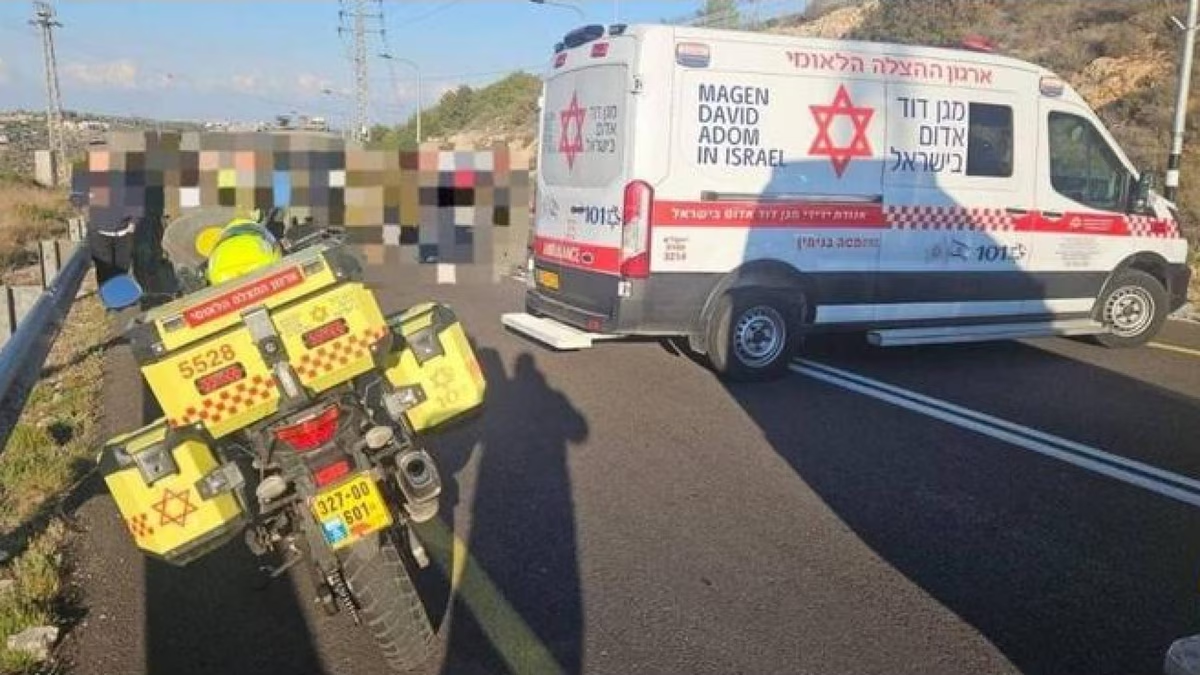
Injury of settlers in a stabbing operation near "Atir" .. and the occupation executes the perpetrator and prevents his rescue.

Hebrew media reported on Tuesday morning that a stabbing incident occurred near the settlement of "Atir" built on citizens' lands in the Ramallah district. The incident resulted in the injury of two Israelis, while the occupation army announced the martyrdom of the assailant after shooting him.

The occupation army's radio confirmed the injuries among the settlers. It quoted the "Israeli ambulance" crews as saying they provided first aid to the injured at the scene, describing their wounds as "minor."

In an initial statement, the occupation army claimed that it "received a report about the incident." It alleged that the Palestinian youth "attempted to stab soldiers at the site," prompting its forces to shoot him and "neutralize him immediately." Following this, the occupation army deployed "additional reinforced forces to the site of the incident," announcing that the details of the incident are still "under investigation."

The Palestinian Red Crescent Society revealed that the occupation forces imposed a security cordon around the injured Palestinian assailant. The Red Crescent confirmed that the occupation soldiers "prevented its crews from reaching the injured near the Atir settlement north of Ramallah" to provide him with the necessary treatment.

LATEST NEWS

Tue 02 Dec 2025 8:18 am - Jerusalem Time

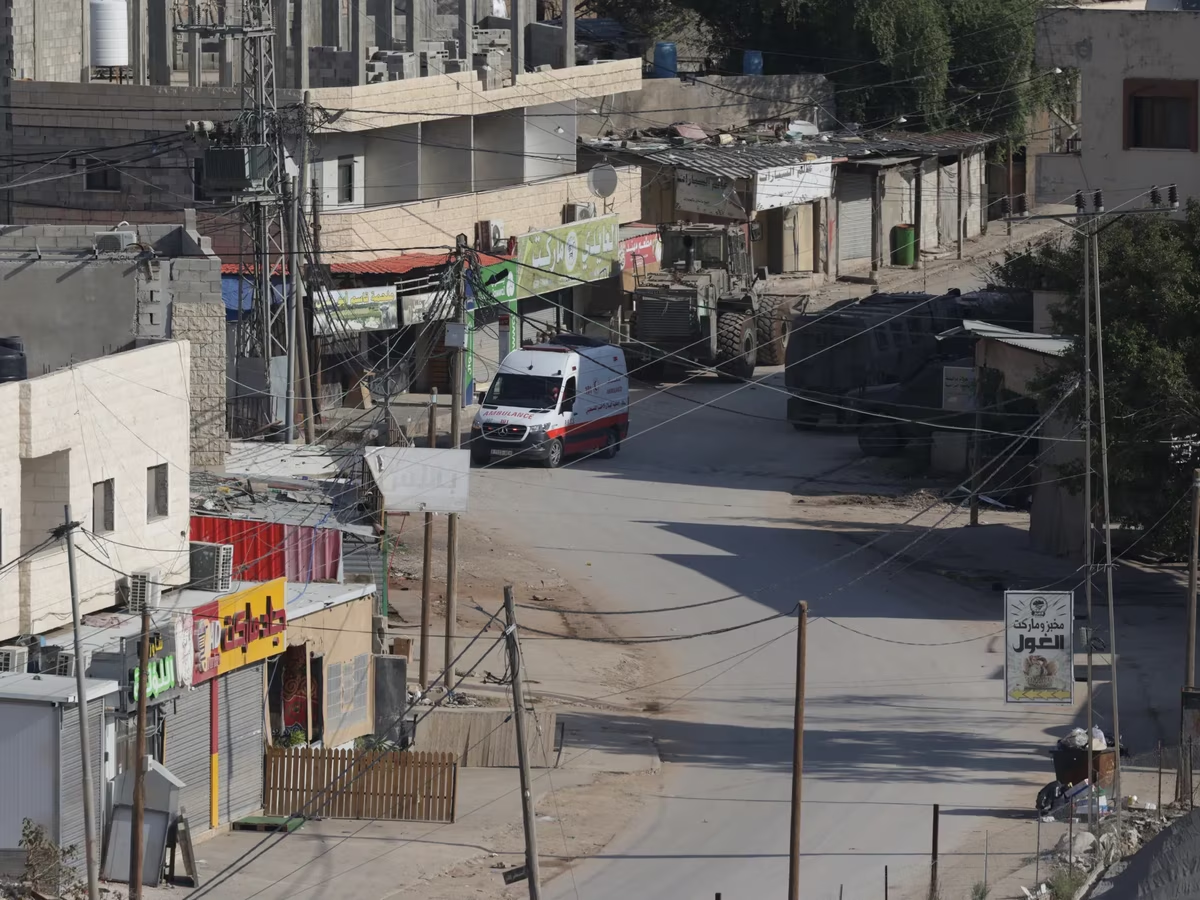
The occupation continues its aggression on Tubas and Aqaba: arrests and raids on homes and the ongoing imposition of a curfew.

The Israeli occupation forces continue, for the second consecutive day, to invade the city of Tubas and the town of Aqaba north of Tubas.

Local sources reported that the occupation forces raided several citizens' homes, searched them, and turned some into military barracks, in addition to raiding some shops and forcing their owners to close their doors.

The director of the Prisoners' Club in Tubas, Kamal Bani Odeh, stated that the occupation detained 18 citizens in Tubas and Aqaba, of whom seven were released.

Patrol movements of the occupation forces continue in Tubas and Aqaba, with the deployment of infantry units in some neighborhoods.

The Ministry of Education and Higher Education decided, for the second day, to cancel in-person attendance in all public and private schools and kindergartens in the Tubas governorate, while the suspension of work also continues in official and private institutions, coinciding with the ongoing imposition of a curfew by the occupation in Tubas and Aqaba.

PALESTINE

Tue 02 Dec 2025 7:44 am - Jerusalem Time

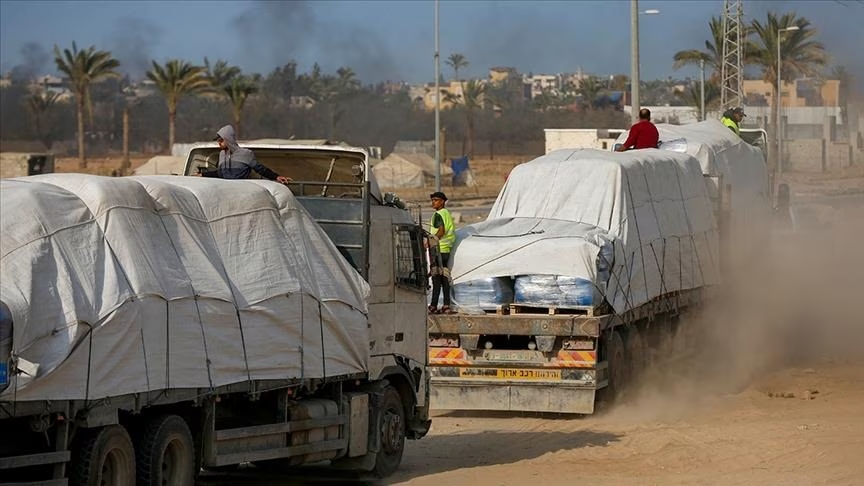
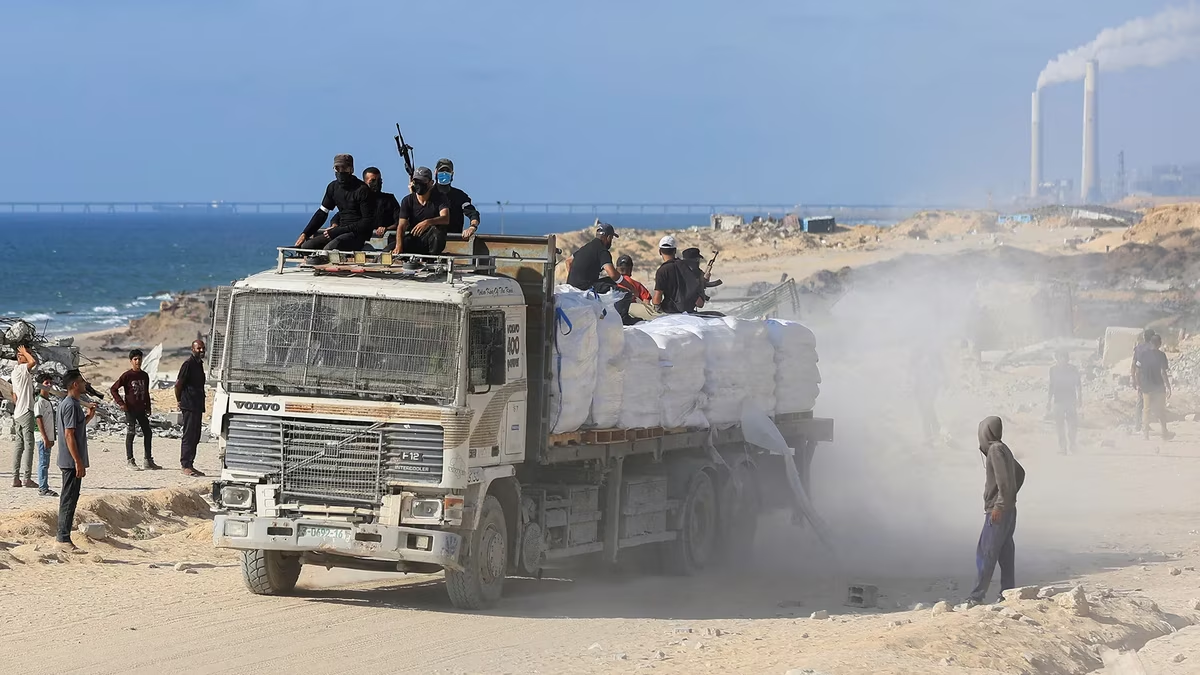
United Nations: Gaza's congested roads expose aid convoys to looting.

Stefan Dujarric, the spokesperson for the UN Secretary-General, stated that the congestion on the roads leading to Gaza to deliver aid exposes the convoys to security risks and looting.

He pointed out that the other routes available for the convoys are insufficient, causing traffic jams and putting the convoys at risk of looting and security threats.

He noted that 1.5 million people are still in urgent need of support, and that the needs are extremely high.

He mentioned that the UN Office for the Coordination of Humanitarian Affairs continues its operations throughout the Gaza Strip, despite the extremely dire humanitarian conditions.

He added that efforts to expand access to health services are still facing difficulties due to the severe shortage of essential materials and the significant damage to infrastructure during the war.

The Israeli genocide war in Gaza, which began on October 8, 2023, and lasted for two years, left more than 70,000 Palestinian casualties and about 171,000 injured, most of whom are children and women, along with massive destruction, with the UN estimating the cost of reconstruction at around $70 billion.

OPINIONS

Tue 02 Dec 2025 6:59 am - Jerusalem Time

The Palestinian state is a international and historical entitlement.

Sari Al-Q

Sari Al-Q

Opinion Writer

The right of the Palestinian people to self-determination and the establishment of their independent state along the lines of June 4, 1967, with East Jerusalem as its capital, is not merely a political demand, but a historical entitlement supported by international legitimacy. Today, the International Day of Solidarity with the Palestinian People is not just an annual commemoration, but a moment to revive the values of justice and renew the international moral and political commitment towards the Palestinian people and their historical rights.


The commemoration of the International Day of Solidarity with the Palestinian People comes amid unprecedented humanitarian conditions, the continuation of the genocide in the Gaza Strip, and the escalation of settlement activities and systematic violence in the West Bank, including East Jerusalem. This has resulted in significant human losses, direct targeting of civilians, and unprecedented destruction of Palestinian cities and camps, where the occupying government practices policies of erasure and ethnic cleansing. Among the most prominent aspects of this ongoing war is the continuous genocide inside the occupation prisons against Palestinian and Arab prisoners, who have been subjected to war crimes and crimes against humanity. Since the beginning of the genocide, according to data and human rights organizations, 98 detainees have died in the occupation prisons, with prisoner institutions announcing the names of 81 of them, while dozens of martyrs from Gaza remain subjected to enforced disappearance.


The crimes and atrocities committed by Israel during the war are merely an extension of a series of catastrophes that have not ceased against the Palestinian people. For decades, the world has failed to uphold justice and achieve freedom for our people, all supported by major powers racing to protect the existence of the occupying state, where its ministers compete to innovate new tools and policies to erase the presence of the Palestinian people, to excel in killing and pursuing them, tightening control over their lives, and creating justifications to sustain and entrench the occupation.

 Solidarity with the Palestinian people is not a symbolic or seasonal act, but a legal, humanitarian, and moral duty, and a fundamental step towards achieving a just and lasting peace that guarantees freedom, dignity, and justice for the Palestinian people, ends the Israeli occupation of Palestinian land, and ensures the exercise of the Palestinian people's inalienable rights, foremost among them the right to self-determination, independence, and return. Solidarity is in rejecting international inaction, rejecting colonialism, and the Palestinian people continue to live one of the longest and harshest chapters of human and political suffering in modern history, amid the absence of international accountability for the crimes and violations committed by the occupying forces for decades, especially in light of the genocide waged by the occupation in the Gaza Strip, and the continuation of its crimes in the West Bank, including Jerusalem.

 We highly appreciate all international efforts and the positions of the world's peoples who have genuinely stood in solidarity with the Palestinian people, confronted the crimes committed against them, formed international coalitions, and those who have taken courageous decisions to punish the occupation system for its crimes, including preventing the sending and exporting of weapons, imposing sanctions on the responsible Israeli terrorists and settlers, and cutting economic and diplomatic relations that contribute to feeding and sustaining the illegal Israeli occupation.


Collective action must be taken to establish a ceasefire in the Gaza Strip and ensure the free and unconditional flow of humanitarian aid, in activation of the provisions of Security Council Resolution 2803 and embodying the international consensus announced at the Sharm El-Sheikh Peace Summit, paving the way for the launch of a comprehensive political process that restores the legitimate rights of the Palestinian people, and emphasizing the role of the Palestinian Authority and the unity of Palestinian territories as an indispensable foundation for any sustainable settlement.

PALESTINE

Mon 01 Dec 2025 11:07 pm - Jerusalem Time

Israelis begin establishing a new settlement outpost northeast of Jerusalem.

Israeli settlers began establishing a new settlement outpost in the town of Mukhmas, northeast of occupied Jerusalem, on Monday.

The rights organization "Al-Baydar" stated in a press release that groups of Israeli settlers started building a new settlement outpost on the lands of citizens east of the town of Mukhmas this evening.

It clarified that the settlers set up facilities at the site "in a move that is part of the attempts to expand settlements that threaten agricultural lands and population centers in the area."

It pointed out that "the continuation of such actions increases tension, undermines the stability of the residents, and limits their ability to access their lands."

"Al-Baydar" called for the intervention of human rights and international bodies to monitor "this illegal expansion and to work on protecting the lands and local populations from the dangers that threaten them."

According to data from the Palestinian Authority's Wall and Settlement Resistance Commission, settlers established 114 settlement outposts during the years of the genocide war on Gaza, up until October 5, 2025.

Since Israel's occupation of the West Bank in 1967, successive Israeli governments have established hundreds of settlements, housing more than 700,000 settlers.

The United Nations confirms that this settlement is "illegal" and undermines the chances of implementing the two-state solution principle (Palestinian and Israeli) as stipulated in international resolutions, calling for its cessation for decades, but to no avail.

PALESTINE

Mon 01 Dec 2025 9:37 pm - Jerusalem Time

Injury of 5 Palestinians in Al-Bireh and an air drop by the occupation in Tubas in the West Bank.

Five Palestinians were injured during the Israeli occupation army's incursion into the city of Al-Bireh in the occupied West Bank. The occupation forces also renewed their incursion into the city of Tubas in the northern West Bank, a continuous operation that has lasted for about 20 hours, including an aerial drop.

The Palestinian Red Crescent stated in a statement that its crews provided field medical assistance to two children who were injured by rubber bullets during the occupation forces' incursion into the Surfa Marhaba area in Al-Bireh.

In a subsequent statement, the Red Crescent clarified that its crews also dealt with three injuries from tear gas in the area, including two girls who were transferred to the hospital, while one injury was treated on-site.

In this context, a large force from the occupation army stormed the Al-Shurfa neighborhood in Al-Bireh and imposed a siege on residential buildings.

Eyewitnesses explained that the forces closed the entrance to the neighborhood and spread out in its main and secondary streets before beginning to besiege several buildings and preventing movement in their vicinity, amid clashes erupting.

Witnesses indicated that the army fired metal-coated rubber bullets and tear gas canisters at dozens of Palestinians who threw stones at the forces.

In the city of Tubas in the northern West Bank, a reporter stated that the Israeli occupation surrounded the city, isolating it from its surrounding towns and launched a wide arrest campaign after imposing a curfew.

The occupation forces had sent military reinforcements to the city and the town of Aqaba, converting several homes into a military barracks, amid the presence of helicopters and drones.

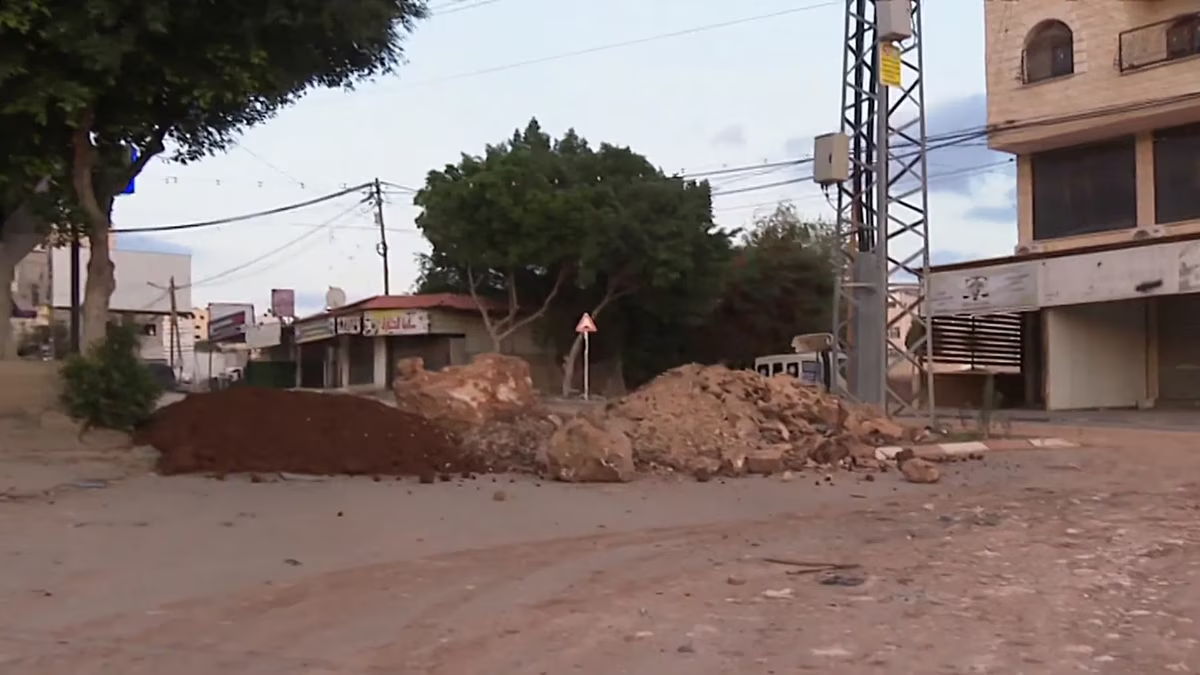
In an interview, Tubas Governor Ahmad Al-As'ad stated that the occupation imposed a curfew on the entire Tubas governorate and closed all entrances with military checkpoints and earth mounds.

He added that the occupation is conducting raids on homes in the city of Tubas and the town of Aqaba.

Meanwhile, during a field tour that included Tubas and the town of Tamoun, Israeli Chief of Staff Eyal Zamir stated that the army launched Operation "Five Stones" in the northern West Bank following attempts to form an armed organization.

He added that the army is continuously working to enhance defense and security in the settlements of the West Bank.

On another note, the Palestinian Information Center reported that a number of occupation soldiers were injured in a traffic accident that occurred near the Tayaseer checkpoint in Tubas governorate.

In the southern West Bank, a reporter stated that the Israeli occupation forces stormed the city of Al-Dhahiriya south of Hebron and raided several homes.

The reporter also noted that the occupation forces stormed the home of martyr Walid Sabarnah in the town of Beit Ummar north of Hebron.

In the town of Qusra southeast of Nablus, clashes erupted between Palestinian youths and the Israeli occupation forces.

In Jenin, a reporter stated that the occupation army forced families to evacuate their homes in the Al-Jabriyat neighborhood southwest of Jenin.

The occupation forces closed shops in the town of Qabatiya south of Jenin as part of their military campaign in the area.

The popular committee in the Jenin camp stated that the occupation demolished, destroyed, and burned more than 1,600 homes in the camp, displacing more than 20,000 Palestinians from the camp and its surroundings.

The Israeli occupation forces closed shops in the town of Qabatiya south of Jenin as part of their military campaign in the area.

The Israeli occupation army has been conducting a military aggression against the camps in the northern West Bank since January 21, which began in Jenin camp and then expanded to include the camps of Tulkarm and Nur Shams east of Tulkarm.

Since the start of the genocide war in the Gaza Strip on October 8, 2023, more than 1,085 Palestinians have been martyred in the West Bank by the bullets of the occupation army and settlers, and about 11,000 have been injured, in addition to the arrest of more than 21,000.

PALESTINE

Mon 01 Dec 2025 9:30 pm - Jerusalem Time

Palestinian injured by gunfire from an Israeli march east of Gaza

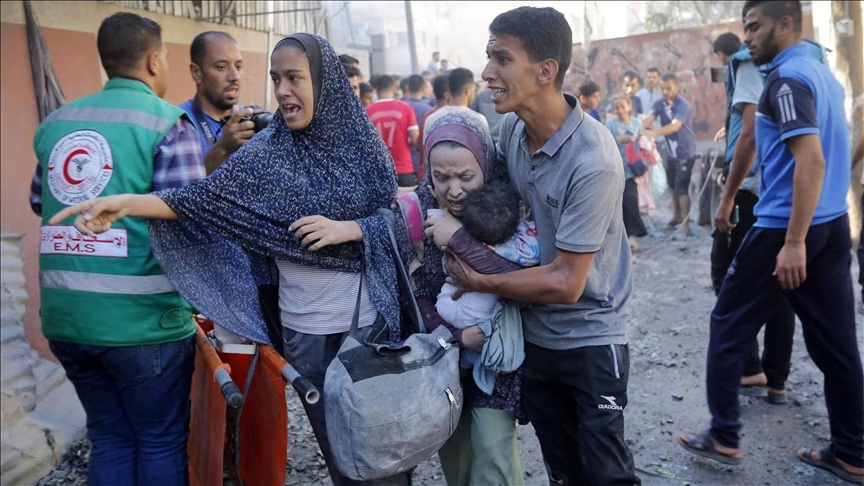
A Palestinian woman was injured on Monday evening due to gunfire from Israeli drones targeting the Al-Tuffah neighborhood in eastern Gaza City, in a new violation of the ceasefire.

Medical sources stated that a Palestinian woman was transferred to the Baptist Hospital in downtown Gaza after being shot by an Israeli drone of the 'Quadcopter' type. The sources did not clarify the nature of her injury or disclose her identity.

In turn, a reporter indicated that the Israeli gunfire occurred in areas from which the Israeli army had previously withdrawn under the ceasefire agreement that came into effect on October 10.

This constitutes a new violation of the ceasefire agreement mediated by Egypt, Qatar, and Turkey, and sponsored by the United States.

The reporter noted that Israeli drones of the 'Quadcopter' type fired and dropped bombs towards citizens' homes near the Al-Sanfar intersection in the Al-Tuffah neighborhood, coinciding with artillery shelling targeting the vicinity of the area.

No immediate comment has been issued by the Israeli army regarding the incident.

Israel continues its violations of the ceasefire it signed with 'Hamas', having committed approximately 591 violations since October 10, killing more than 357 Palestinians and injuring 903 others, according to the government media office in Gaza.

PALESTINE

Mon 01 Dec 2025 8:32 pm - Jerusalem Time

Trump calls Netanyahu amid efforts to calm tensions between Israel and Syria.

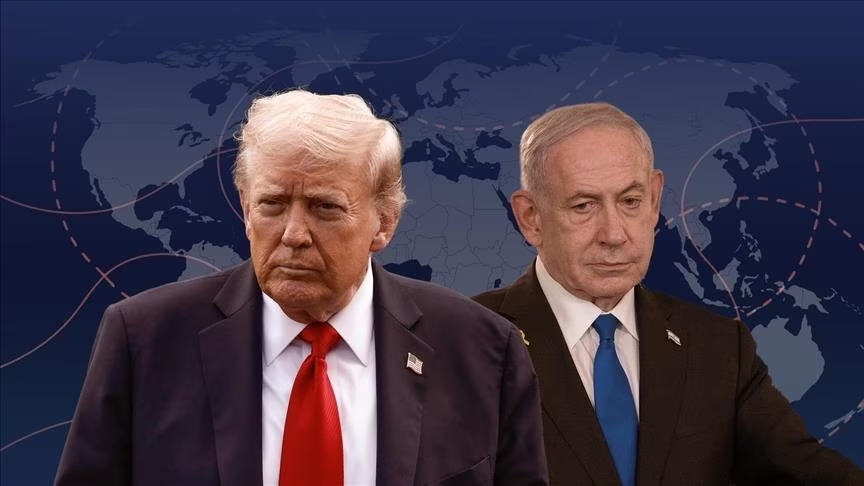
Israeli Prime Minister Benjamin Netanyahu and U.S. President Donald Trump spoke by phone on Monday evening, amid Washington's efforts to ease tensions between Tel Aviv and Damascus, according to Hebrew media.

Netanyahu's office stated: "The Prime Minister spoke shortly before with President Trump."

It added: "The two leaders emphasized in their conversation the importance and commitment to disarming Hamas and stripping the Gaza Strip of weapons, and discussed expanding peace agreements."

Trump invited Netanyahu to "meet at the White House in the near future," according to the same source.

While Netanyahu's statement did not mention Syria, the official Hebrew broadcasting authority reported that the phone call between the Israeli Prime Minister and Trump came against the backdrop of U.S. efforts to ease tensions between Israel and Syria following the Israeli incursion into the town of Beit Jann in the south of the country.

The authority added: "The United States is seeking to calm tensions between Israel and Syria after the incident that occurred last weekend, in which 6 Israeli soldiers were injured by gunfire directed at them in the village of Beit Jann in southern Syria."

For its part, the Hebrew newspaper "Yedioth Ahronoth" reported that the Netanyahu-Trump call "came one day after he (Netanyahu) submitted a request for pardon to President (Israeli) Isaac Herzog, and shortly after Washington sent a clear message to Israel amid the tensions with Syria."

Repeatedly, Trump has urged Herzog to grant Netanyahu a presidential pardon to end his trial on corruption charges against him in Israel.

PALESTINE

Mon 01 Dec 2025 8:22 pm - Jerusalem Time

Alternative nationality.. Thousands of "Israeli" settlers seek to obtain Portuguese passports.

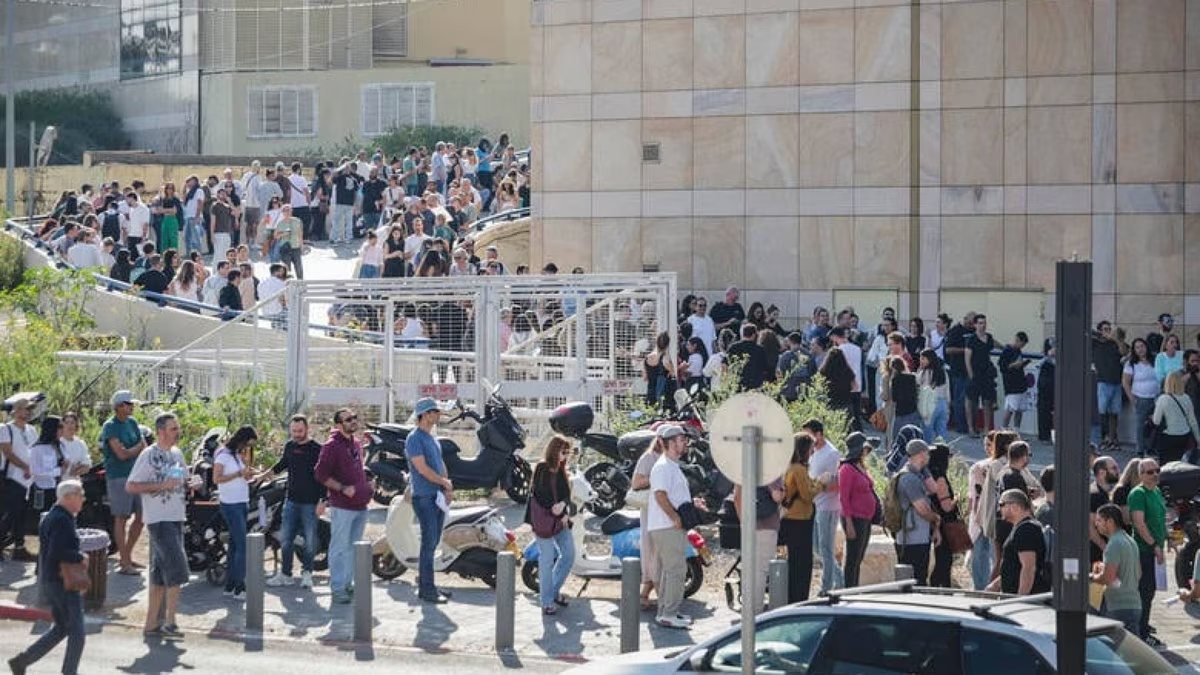
The Portuguese embassy in Tel Aviv organized a special and direct event. Thousands of 'Israeli' settlers formed long lines outside one of the venues in the 'Ramat Hasharon' settlement to secure appointments for renewing passports or obtaining Portuguese citizenship, indicating a rising interest in acquiring European citizenship as an alternative option.

Heavy turnout after surpassing the electronic booking system The Portuguese embassy in Tel Aviv held a special and direct event at 'Cinema City Galilot', where it exceeded its crowded online booking system, leading to this unprecedented congestion. The lines extended from the entrance to the underground parking lot, with many people arriving before dawn to reserve their spots, clearly demonstrating the growing interest in Portuguese citizenship among Israeli settlers.

This large event reflects a broader trend among 'Israeli' settlers seeking second passports. Since the onset of the aggression on Gaza in October 2023, there has been a significant increase in applications for Portuguese citizenship, as many seek alternatives amid security concerns.

PALESTINE

Mon 01 Dec 2025 6:34 pm - Jerusalem Time

Global Press: Trump the Key Player in Netanyahu's Pardon File

An article in the Israeli newspaper Maariv considered that U.S. President Donald Trump is the main player in the pardon file for Israeli Prime Minister Benjamin Netanyahu, who is wanted by the International Criminal Court, rather than Israeli President Isaac Herzog.

Writer Mati Tuchfeld in the newspaper viewed that the issue of pardoning Netanyahu is part of Trump's vision and the major moves he plans on a global level.

She noted that some in Netanyahu's circle realize that the real negotiations will not take place between the Prime Minister's lawyer and the head of state, but rather between him and American parties who see that Netanyahu's resignation is not on the table at all.

In a related context, the Jerusalem Post called in its editorial for Israel to find a way to move forward after years of Netanyahu's trial on corruption charges that have been prolonged due to bureaucratic complexities.

It pointed out that a large portion of Israelis are fed up with the trial, while others insist on its continuation until the end.

On the issue of Israeli expansion in the region, writer Nasreen Malik in the Guardian viewed what she described as "Israeli imperialism" expanding throughout the region, not limited to Gaza, but also continuing attacks on the West Bank, Syria, and Lebanon.

The writer noted that ceasefires are being violated and Israeli airstrikes and ground incursions continue, leading to an increase in fatalities.

On the military economic front, Politico pointed to a new report from the Stockholm International Peace Research Institute showing that revenues from the world's top 100 arms companies rose last year by nearly 6% to a record level of $679 billion in 2024.

The report attributed this increase to the growing demand fueled by the war in Ukraine and Gaza and rising military spending globally.

In developments regarding migrant issues, The Hill noted the U.S. Secretary of Homeland Security's acknowledgment of her agreement to deport Venezuelan detainees to El Salvador despite a court order to halt that.

PALESTINE

Mon 01 Dec 2025 5:33 pm - Jerusalem Time

After Trump's support.. Bishara Bahbah reveals the behind-the-scenes of American politics and the release of the American prisoner.

The founder and president of the "Americans for Global Peace" organization, Bishara Bahbah, narrated his political and intellectual transformations that essentially reflect the changes in Arab and Islamic communities in the United States. It is a story from which the narrator learned a harsh lesson about political promises, leading him to decide to turn electoral voices into a bargaining chip that would only be granted in exchange for written commitments rather than verbal ones.

In an extensive conversation, Bahbah reveals his vision for the future of the Palestinian cause, asserting that dialogue with the Israelis is the only realistic option in the absence of an influential Palestinian military force, stating, "What is the alternative to dialogue? Military action? The Palestinian people have no military action."

Bahbah continues to present a vision that may provoke widespread debate, based on a demilitarized Palestinian state, with only internal security forces, yet it is a state with full sovereignty over its human and natural resources, which he sees as a realistic vision given the current balance of power.

ARAB AND WORLD

Mon 01 Dec 2025 5:27 pm - Jerusalem Time

The deployment plan of the "Stability Force" in Gaza has stumbled amid increasing uncertainty about its missions.

Washington – Saeed Arikat 

The American plan to deploy an "International Stabilization Force" in the Gaza Strip, as outlined in President Donald Trump's initiative for a ceasefire, is experiencing a series of setbacks as several countries that had initially shown willingness to participate are now withdrawing. According to a report published by the Washington Post, efforts to form this force remain stuck in the consultation phase without any tangible progress, amid a lack of a clear vision regarding the nature of the tasks that will be assigned to it.

The newspaper quoted an American official as saying: "Commitments are still under consideration. No country is willing to send troops until it clearly understands what is required of them." This position reflects the extent of the political and practical ambiguity surrounding the mission of the force, amid numerous indications that countries fear the stabilization force could become embroiled in an armed conflict within the sector, rather than being a peacekeeping force aimed at restoring stability.

International Hesitation and Concerns of Confrontation

The report clarifies that the primary concern for the countries likely to contribute troops to the mission is the potential conflict between the role of the force and the ground reality, especially if its members are asked to use force against Palestinians. Indonesia had previously announced its readiness to send 20,000 soldiers before retracting and clarifying that the number represents its total capabilities in peacekeeping forces. An official in the Indonesian Foreign Ministry stated that his country might send only 1,200 soldiers, acknowledging that "many officers are very hesitant" due to fears of being drawn into direct confrontation.

Azerbaijan has linked its participation to a complete halt of Israeli military operations, which remains elusive amid ongoing attacks. In the same context, Pakistan confirmed that it would not be part of any mission aimed at disarming Hamas, considering that this "is not the role of the Pakistani army," as stated by its Foreign Minister Ishaq Dar.

Complete Arab Absence from the Initiative

Although the original American plan mentioned coordination with "Arab and international partners," no Arab country has shown willingness to send troops. Diplomats believe that this reluctance reflects an Arab awareness of the sensitivity of the situation and the dangers of sending forces amid ongoing occupation, and the absence of a comprehensive political framework that ensures the force will not become a tool for a security management that serves the interests of one party.

Stalemate in Implementing the Security Council Resolution

Meanwhile, Security Council Resolution 2803, which calls for placing Gaza under the administration of a "Peace Council" headed by Trump, is experiencing clear stagnation. Since the issuance of the resolution, no practical steps have been announced to form the council or define its structure, indicating political and legal obstacles that have beset the project since its inception.

Ongoing Occupation and Ground Reality Contradicting the Idea of Stability

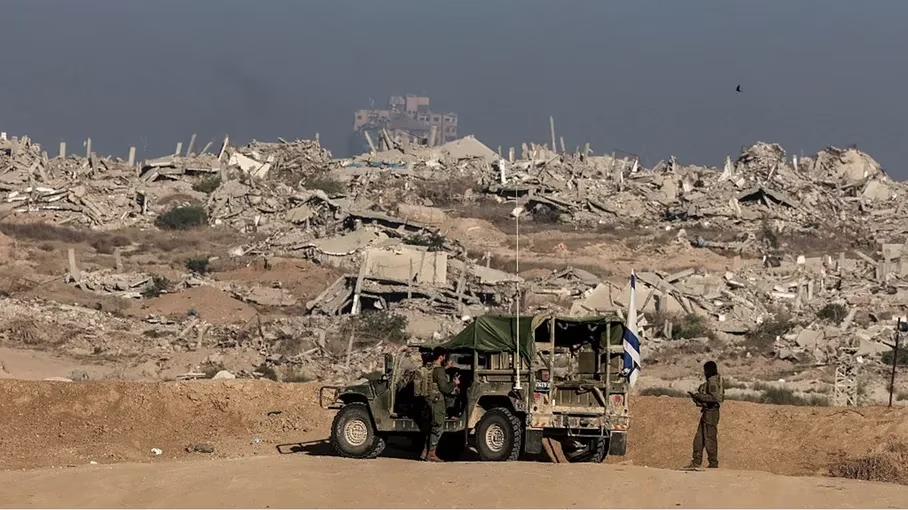
On the ground, the Israeli army continues to control more than half of the Gaza Strip, alongside conducting operations and attacks that have resulted in the deaths of more than 350 Palestinians since the announcement of the supposed ceasefire. Amid this, the American administration is promoting a reconstruction plan limited to areas under Israeli control, raising widespread concerns about an attempt to entrench a long-term divisive reality.

Analysts believe that the failure of efforts is due to the absence of a comprehensive political framework preceding any field action. A stabilization force cannot operate effectively in an environment devoid of political agreement, where military operations continue, and where there is ongoing occupation. Without a clear vision, any force will remain susceptible to failure or to being used to impose unilateral arrangements.

Experts also point out that the Indonesian and Pakistani reservations reflect an increasing awareness that the force could practically become a tool for imposing security arrangements that serve Israel more than they serve to protect civilians, placing the participating countries in a politically sensitive position before their peoples and the international community.

In the humanitarian context, observers note that Israel's continued obstruction of the entry of essential aid, particularly medicines and medical supplies, undermines any talk of "stability." The deteriorating health conditions and the collapse of infrastructure make any security initiative meaningless if it is not preceded by a genuine addressing of urgent humanitarian needs. This contradiction between political rhetoric and humanitarian reality deepens doubts about international intentions and the possibility of success for any stabilization force.

The difficulties in forming the "International Stabilization Force" reveal the extent of the contradiction between political ambition and ground reality in Gaza. The initiative appears to be beset by fundamental complexities: the absence of international consensus, the hesitance of countries, the ongoing occupation, and the escalating humanitarian disaster. In the absence of a clear vision for the post-war phase, any international force seems

LATEST NEWS

Mon 01 Dec 2025 4:44 pm - Jerusalem Time

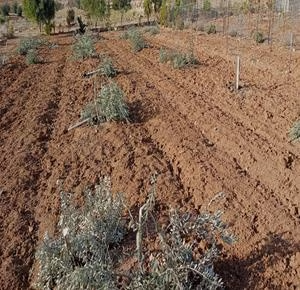
Colonizers uproot 850 olive and grape trees south of Hebron.

Today, Monday, colonists uprooted 850 olive and grape trees southeast of Yatta, south of Hebron.

Anti-settlement activist Osama Makhamra stated that armed colonists from the settlement of Susya, built on citizens' lands south of Hebron, stormed - under the protection of occupation soldiers - the lands of Khirbet Khillat al-Hummus southeast of Yatta.

He added that the colonists uprooted about 850 grape and olive trees, destroyed the contents of an agricultural room, and damaged barbed wire.

PALESTINE

Mon 01 Dec 2025 3:07 pm - Jerusalem Time

The heads of the Shin Bet and Egyptian intelligence discuss the Gaza file and the second phase.

On Sunday, Israeli Shin Bet chief David Zini held talks with Egyptian intelligence chief Hassan Rashad regarding the Gaza Strip file and the second phase of the ceasefire agreement during his visit to the capital, Cairo.

The agency, citing an unnamed informed source, indicated that Zini visited Egypt on Sunday and met with the head of Egyptian intelligence, marking his first foreign visit since taking office last October.

It noted that the meeting addressed the Gaza file and discussions on the second phase of the ceasefire deal, while no additional details were provided regarding the content of the talks or the outcomes of the visit.

No comment has been issued by the Egyptian side regarding what the Hebrew broadcasting agency reported, while a delegation from Hamas discussed on November 23 with the head of the Egyptian General Intelligence in Cairo the developments of the ceasefire agreement and the situation in Gaza, including the second phase of the agreement.

The Israeli occupation conditions the start of negotiations to implement the second phase of the ceasefire agreement on receiving all the bodies of the prisoners, claiming that the remains of two prisoners are still in Gaza.

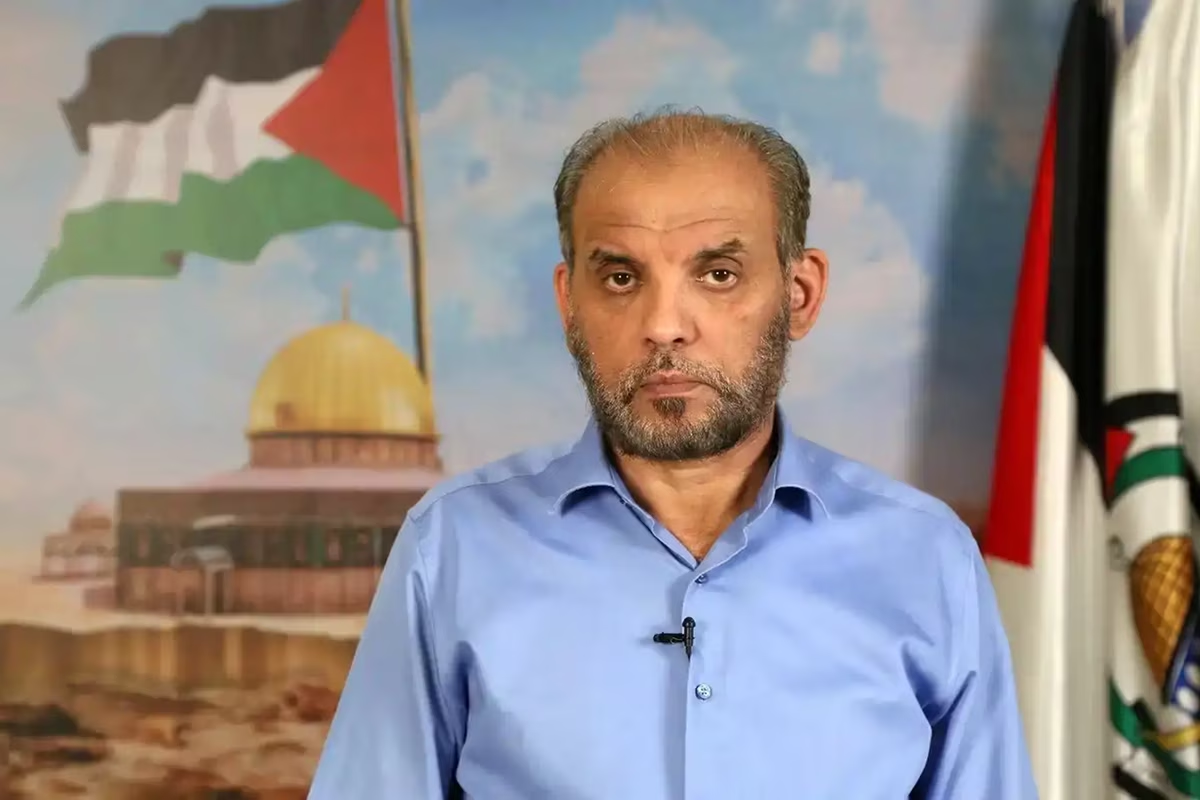
In statements on Sunday, Hamas leader Hussam Badran emphasized that the occupation uses the bodies as an excuse not to fulfill its commitments, pointing out that "in numbers, the resistance has only two bodies left, one of which is Israeli and the other is of a foreign worker, but the occupation, with its usual racism, only talks about the Israeli body."

Badran noted that the Al-Qassam Brigades are making daily efforts in cooperation with the Red Cross and with the mediation of intermediaries to reach the body, thus there is no obstruction from Hamas in implementing what was agreed upon in the first phase of the agreement.

He added: "Before discussing the second phase of the agreement, what is required from the entire world, especially the U.S. administration, and anyone who cares about the stability of the region, is to compel the occupation first to implement what was agreed upon in the first phase."

PALESTINE

Mon 01 Dec 2025 1:11 pm - Jerusalem Time

Global Press: Harsh Conditions for Netanyahu's Pardon and a Significant Decline in Trump's Popularity

Civil society leaders have set harsh conditions for granting Israeli Prime Minister Benjamin Netanyahu, who is wanted by the International Criminal Court, a general pardon after he submitted a request to Israeli President Isaac Herzog.

According to the newspaper "Yedioth Ahronoth," Netanyahu surprised everyone by submitting a request for pardon from President Herzog.

Netanyahu is effectively seeking a full pardon regarding his trial on corruption charges before facing public accountability for the October 7 attack.

The newspaper highlighted that one of the reasons for submitting the pardon request is Netanyahu's view of a "shaky, weak, and fearful judicial system in Israel."

In a related context, the "Guardian" reported that civil society and opposition leaders in Israel pledged to oppose any attempt to pardon Netanyahu, asserting that he cannot be granted a pardon without an admission of guilt, expression of remorse, and immediate withdrawal from political life.

Opponents argued that only the guilty seek pardons, emphasizing the need for Netanyahu to take responsibility and retire from politics, and only then will unity among Israelis be achieved.

On the domestic American front, "Newsweek" magazine noted 5 opinion polls that painted a bleak picture for President Donald Trump and the Republican Party.

Support for Trump has dropped to its lowest level in his second term, and the cracks in his coalition "Make America Great Again" have widened, with declining support from Latino voters.

The polls indicated significant gains for Democrats even in historically conservative districts, which could reshape control of Congress.

Regarding war crimes investigations, an independent investigation published by "The Times" revealed a cover-up of war crimes committed by British special forces in Afghanistan resulting from decisions made by the commander of those forces.

A senior officer reported that the statistics related to detentions compared to the number of deaths did not seem credible.

The officer explained that the responsible official deliberately handled the information misleadingly, confirming that the director failed to address any potential criminal activity despite being aware of what was happening on the ground, and testimonies included evidence of alleged killings between 2010 and 2013.

In terms of humanitarian conditions, "The Independent" described how the current winter in Gaza is erasing beautiful childhood memories.

In the past, winter was a season of warmth and joy, but now floods and fierce winds impose a daily challenge for residents to endure.

On the subject of natural disasters, "The Washington Post" covered heavy rainfall and record floods in Southeast Asia that resulted in the deaths of more than 500 people.

The region has been experiencing a nearly continuous series of storms since mid-September, while rising global temperatures have increased the saturation of the atmosphere with water and led to more severe storms.

On another note, an investigative report published by "The New York Times" sparked controversy in Washington after claiming that the U.S. military carried out a second strike targeting survivors of an attack on a boat in the Caribbean as part of the Trump administration's campaign against drug traffickers.

Lawmakers from both the Republican and Democratic parties called for an investigation into the incident, with Republican Representative Mike Turner stating that killing survivors is an illegal act, while Democratic Senator Tim Kaine considered that if the incident is true, it amounts to a war crime.

PALESTINE

Mon 01 Dec 2025 12:53 pm - Jerusalem Time

UNRWA: Israel is withholding aid and Gaza is facing a humanitarian disaster.

The media advisor for the United Nations Relief and Works Agency for Palestine Refugees in the Near East (UNRWA), Adnan Abu Hasna, stated that Israel is holding 6,000 trucks belonging to the agency carrying food supplies sufficient for the Gaza Strip for three months.

In addition to hundreds of thousands of tents and blankets that can accommodate 1.3 million Palestinians, at a time when the sector is suffering from a worsening humanitarian crisis.

Although Abu Hasna confirmed during an interview that the number of trucks entering Gaza currently exceeds what was entering before the ceasefire, he pointed out that the major issue lies in the mismatch between these quantities and the enormous needs.

Israel still prevents the entry of hundreds of items into the sector, including materials related to health, sanitation, water, and food supplies.

He noted that Israel allows more materials for the commercial sector than it does for humanitarian and relief organizations.

Abu Hasna said that most of Gaza's residents are entirely dependent on humanitarian aid, as people have no money except for a few thousand employees of UN organizations and what remains of Palestinian Authority employees.

He also indicated that humanitarian organizations are submitting requests to bring in specific materials such as spare parts for water desalination and sewage treatment plants, medical equipment, medical teams, and international staff, but Israel rejects most of these requests, limiting approvals to basic materials like canned goods, flour, and some medicines.

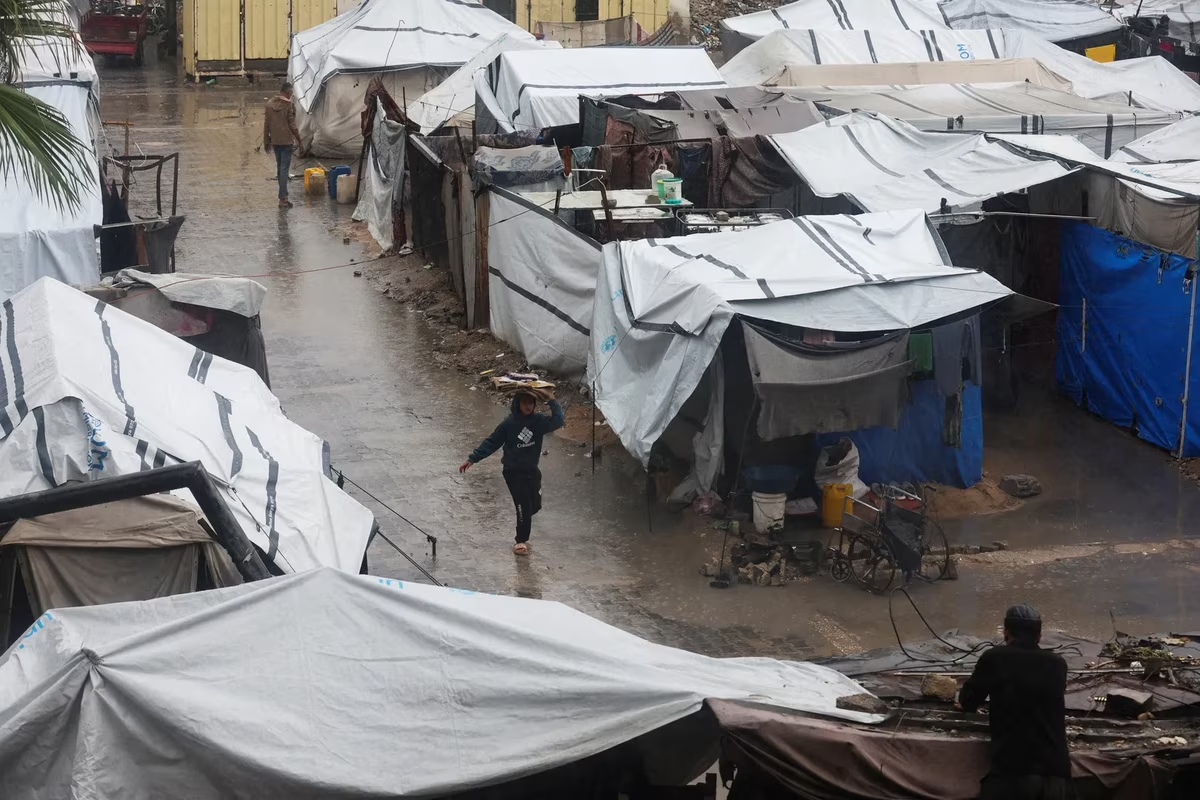
Abu Hasna warned that the continuation of the current situation will return Gaza to square one, citing what happened during two days of rain that fell for only a few hours, where rainwater mixed with sewage due to the destruction of the system, leading to massive collapses of tens of thousands of tents.

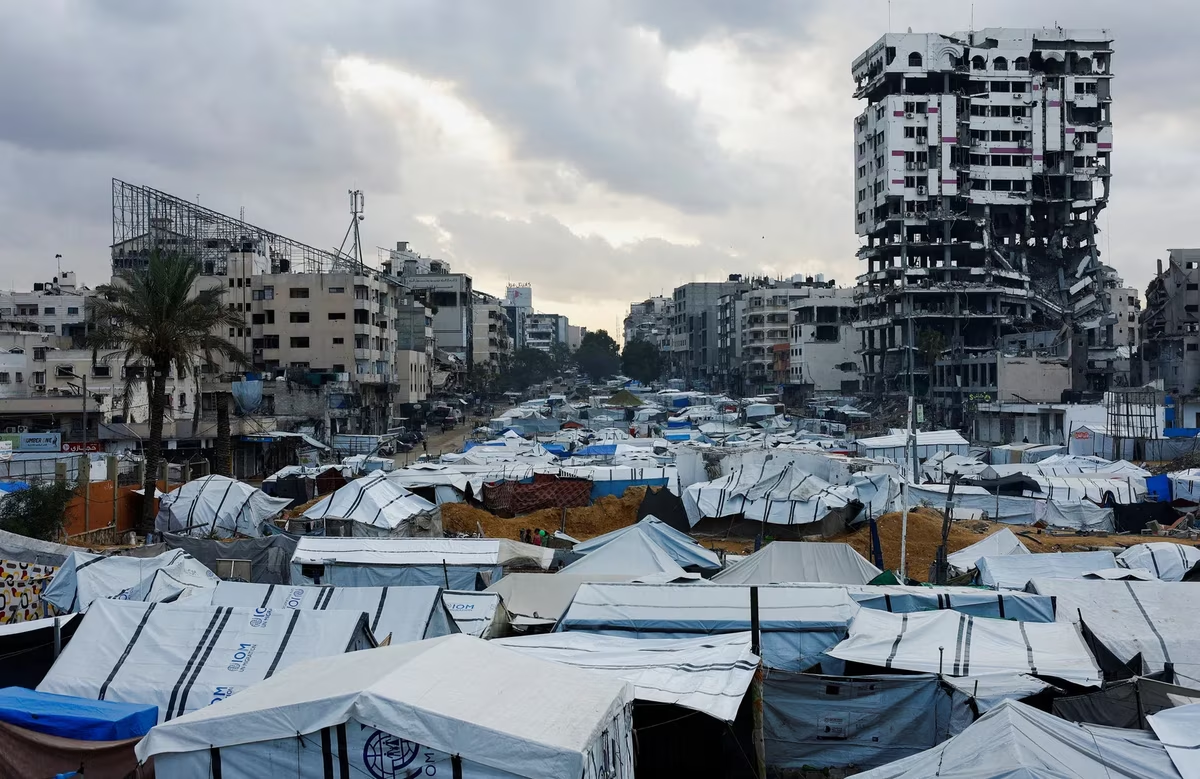
On another note, waste is piling up and sewage water is flooding the narrow streets near the tents of displaced people in the southern sector, with children living in swamps filled with diseases and epidemics according to testimonies from the displaced.

Municipal officials explained that the current fuel crisis is the largest since the outbreak of the war two years ago, affecting all aspects of municipal work.

Municipal vehicles and equipment are incapacitated due to fuel shortages, while the occupying authorities have not allowed new vehicles to enter.

On the other hand, the Civil Defense apparatus is facing extreme challenges with the severe fuel shortage, as its crews are unable to reach relief areas in a timely manner.

PALESTINE

Mon 01 Dec 2025 11:41 am - Jerusalem Time

Jerusalem in November.. Execution of 3 children and escalating violations at Al-Aqsa and settlement activities.

Israeli occupation forces executed, in November of last year, 3 Palestinian children from Jerusalem: Muhammad Taim and Muhammad Qassem in the town of Al-Jdeira northwest of Jerusalem, in addition to Sami Mshaikha in the town of Kafr Aqab north of Jerusalem, all of whom were 16 years old.

While Mshaikha's family and friends buried him in his final resting place, the occupation authorities continue to hold the bodies of the two children, Taim and Qassem, in their refrigerators.

At Al-Aqsa Mosque, daily violations continued throughout the month, as 4,266 settlers stormed the courtyards, with the highest number of incursions recorded on November 20, coinciding with the beginning of the Hebrew month and the "Sigd" holiday for Ethiopian Jews, who were urged by extremist Temple groups to invade.

The Mughrabi Gate was closed that day after 378 extremists stormed the courtyards.

Among the most dangerous violations documented by Al Jazeera Net was the success of extremists in smuggling a goat into the mosque with the aim of slaughtering it and offering it as a sacrifice at the first of the two qiblas, which, if performed, would allow Jews from all over the world to invade Al-Aqsa after meeting their condition of purity from the impurity of the dead according to their belief.

Although the settlers were unable to slaughter the goat - which they brought in through the Lions' Gate - and did not spill its blood inside the mosque, this violation, which has occurred for the second time in six months, is among the most dangerous goals that Temple groups seek to achieve at Al-Aqsa.

Al Jazeera Net also documented several other violations, including singing and clapping loudly, performing the "epic prostration" ritual (complete prostration, with the body lying flat on the ground with arms, legs, and face spread out, representing the utmost submission), in addition to announcing marriages and performing the Israeli national anthem "Hatikvah" inside the courtyards.

The senior U.S. military representative in Lebanon, Joseph Clearfield, also stormed the Buraq Plaza and performed rituals at the western wall of Al-Aqsa, while Dutch Foreign Minister David van Wil also entered this plaza and prayed at the Buraq Wall alongside rabbis.

Not far from the wall of Al-Aqsa Mosque but from the eastern side, settlers stormed the Islamic Cemetery of Bab al-Rahma and smashed the gravestones of several graves, marking not the first time this cemetery adjacent to the wall of the first qibla has been targeted.

Among the notable incursions into the mosque's courtyards was one carried out by a former officer in the General Security Service "Shabak," along with a number of settlers, as part of a "deep security tour" that also included the alleys of the Old City.

In terms of violations of freedoms, occupation forces arrested more than 61 Jerusalemites throughout the month, including 9 minors and two women, among the detainees were the two MPs forcibly exiled from Jerusalem, Muhammad Abu Tir and Ahmad Attoun, who was released after hours of interrogation.

Occupation courts also issued 7 administrative detention orders against prisoners from the Jerusalem governorate.

As part of the expulsion orders, the occupation intelligence issued 5 expulsion orders during the past month, 4 of which were from Al-Aqsa Mosque, and one expulsion order for 5 days from the city of Jerusalem against the released prisoner Aysar Abu Subaitain.

Demolition and Settlement: During November, 25 residential, agricultural, animal, Bedouin, and recreational facilities were demolished, with 4 of these facilities being demolished by their owners under duress to avoid hefty fines in case the occupation municipality's bulldozers proceeded with the demolition.

Simultaneously with the demolition of Jerusalemite homes and the confiscation of their livelihoods, the occupation authorities continued to approve several settlement projects, especially vertical ones, as the local planning and building committee recommended submitting and approving 5 new plans in "Pisgat Ze'ev, Kiryat Moshe, Bat, Old Qatamon, and Hebron Road" in Jerusalem, adding 1,700 new housing units for Jews in the occupied city.

The occupation authorities also approved a plan to establish 1,300 settlement housing units in the "Gush Etzion" bloc south of Jerusalem, and a new settlement outpost was established within this bloc, in an area referred to by Palestinians as "Esh Gharab" and called "Shidma" by Israelis.

PALESTINE

Mon 01 Dec 2025 10:52 am - Jerusalem Time

Global Press: Israeli Concern Over U.S. Rush on Gaza Plan

International newspapers have addressed the developments in Gaza, Sudan, and Ukraine, highlighting Israeli concerns regarding the American peace plan.

The newspaper "Israel Hayom" revealed that anxieties in Israel are rising over Washington's push to quickly move to the second phase of its peace plan for Gaza, which begins after receiving the body of the last deceased prisoner.

The proposed plan includes a gradual withdrawal of Israeli forces and the start of reconstruction under the supervision of an international disarmament force, despite the absence of any actual international commitments to participate.

Estimates from Israeli security leadership indicate that the United States is advancing with steps that do not take into account the ground reality, asserting that dismantling the Islamic Resistance Movement (Hamas) is purely an Israeli task.

In a related context, an article in the newspaper "Haaretz" noted that many questions about the future of Gaza remain unanswered even after the ceasefire and the continued rise in the death toll.

Palestinians are forced to cope with a collapsed healthcare system and a severe shortage of medical supplies, food, and shelter.

The article pointed out that the field developments suggest that the reconstruction process will not begin soon, warning that in the absence of a clear political horizon, the sacrifices made by the Palestinians of Gaza will have no consideration.

On the international justice front, the French newspaper "Libération" published an interview with international law professor Olivier de Frouville, in which he explained that international courts have never witnessed this number of accusations of crimes against humanity.

The French academic highlighted that the greatest obstacle to the progress of genocide and war crimes cases is the double standards in the policies of influential countries, citing what is happening in Gaza and Sudan.

On another note, an article on the American site "The Hill" discussed President Donald Trump's efforts to achieve a ceasefire in Sudan, noting that they face widespread skepticism.

The article highlighted the failure of recent American efforts to push the parties towards de-escalation, confirming that in the absence of real pressure, neither side of the conflict sees a reason to stop fighting.

At the European level, the British newspaper "The Times" revealed that the Ukrainian president is going through a highly complex phase where multiple crises converge simultaneously.

In the context of international repercussions, an article by writer Simon Tisdall in the newspaper "The Guardian" linked the U.S. administration's handling of the Ukraine war to the emergence of a bolder Chinese tone towards Taiwan.

OPINIONS

Mon 01 Dec 2025 9:29 am - Jerusalem Time

Why has the United States not recognized the Palestinian state...? Between the duality of Israeli influence and the rise of new lobbying powers.

Dr. Abdul Rahim Jamous

Dr. Abdul Rahim Jamous

Opinion Writer

Despite the increasing European recognition of the Palestinian state, and the joining of central countries like France and Britain to this path, the American stance remains stagnant, insisting on not recognizing the state of Palestine. This apparent steadfastness conceals a complex web of strategic calculations, internal power balances, and the dominance of pro-Israel lobbying groups that have formed a structural part of the decision-making process in Washington for decades.
The United States, unlike Europe, views the Middle East through the lens of Israel's security, linking its vital interests in the region to its ability to ensure its military and political superiority. Therefore, recognition of the Palestinian state has remained "outside American calculations," as any step of this kind would be interpreted as a threat to Israel's security or the organic structure of its alliance with it.
However, recent years, especially since the outbreak of the ongoing Israeli aggression against Gaza, have begun to witness tangible shifts within the American political, academic, and economic community, indicating a shaking of part of the traditional equation and a decline in the "political sanctity" of unconditional support for Israel.
First: The decline of the dominance of pro-Israel groups and the emergence of counter-lobbying forces ...
For the first time in decades, American lobbying groups have emerged seeking to counter Israeli influence within Washington, calling for a redefinition of American interests on an independent basis, rather than based on what Israel imposes.
Among the most prominent of these groups:
The Anti-Zionist Committee (AZAPAC), which recently appeared within American political institutions, presenting itself as a lobbying force working to restore balance within Congress and adopt policies that serve American national interests away from Israeli political blackmail,
Jewish Voice for Peace and IfNotNow, two influential Jewish organizations that have significantly expanded their role since the Gaza war, advocating for an end to unconditional support for Israel...
The rise of progressive politicians within the Democratic Party, such as Alexandria Ocasio-Cortez, Rashida Tlaib, and Bernie Sanders, who have openly criticized Israel and its racist and settlement policies.
These forces were previously unable to influence, but today they possess media presence and populist influence that makes ignoring their discourse impossible.
Second: American universities… the spark of the biggest transformation ...
American universities – from Harvard to Columbia and from Stanford to Michigan – have witnessed the largest wave of solidarity with Palestine in modern American history.
Protests, student alliances, academic boycott decisions, and pressures on administrations to condemn Israeli war crimes.
These movements were not just protests; they transcended that to the emergence of a new political culture within the rising generations, which considers that unconditional support for Israel harms America's image and puts it at odds with its declared values regarding human rights.
Third: The business and technology sector breaks its silence ..
Voices have grown within Silicon Valley and among major businessmen criticizing Washington's bias, calling for a more balanced policy, with public positions from influencers and major companies stating that America's international image has become a burden on its technological and economic interests due to its unconditional ties to Israel.
Fourth: The widening gap between European and American positions ...
With the continued recognition of the Palestinian state by Europe, Washington has begun to find itself internationally isolated.
Europe – especially France, Spain, Ireland, and Norway – has adopted a discourse that holds Israel responsible for aggression and calls for a political solution based on recognition of the Palestinian state.
Meanwhile, America remains a prisoner of red lines set by Israeli lobbying groups.
The continuation of this disparity will place Washington in the position of the only state obstructing the establishment of the Palestinian state, complicating its relations with its European partners and weakening its global image.
Fifth: The steadfast Arab positions and their rising role...
The Arab stance, especially the Saudi one, has become clearer:
Peace with Israel will not be possible without a real political price, which is the recognition of the rights of the Palestinian people, foremost among them the establishment of an independent Palestinian state.
This Arab steadfastness, supported by new regional equations (from energy to massive investments), has forced Washington to realize that ignoring Arab interests will not be possible in the next phase, and that the free protection of Israel has become strategically costly.

Towards a potential shift in the American position?
The sum of these transformations – within universities, the business sector, the political street, within the Jewish community itself, and between Europe and the Arab world – gradually opens the door to a change in American calculations.
Recognition of the Palestinian state may not come soon, but it has become a matter on the table of American politics, after being completely outside the discussion for decades.
America will soon discover that continuing to ignore Palestinian national rights will not protect Israel, but will make it a burden on the status and global influence of the United States.
And that any regional peace or broad normalization will not

PALESTINE

Mon 01 Dec 2025 8:41 am - Jerusalem Time

Removing the name "Herzog" from a park in Ireland sparks outrage from the occupation.

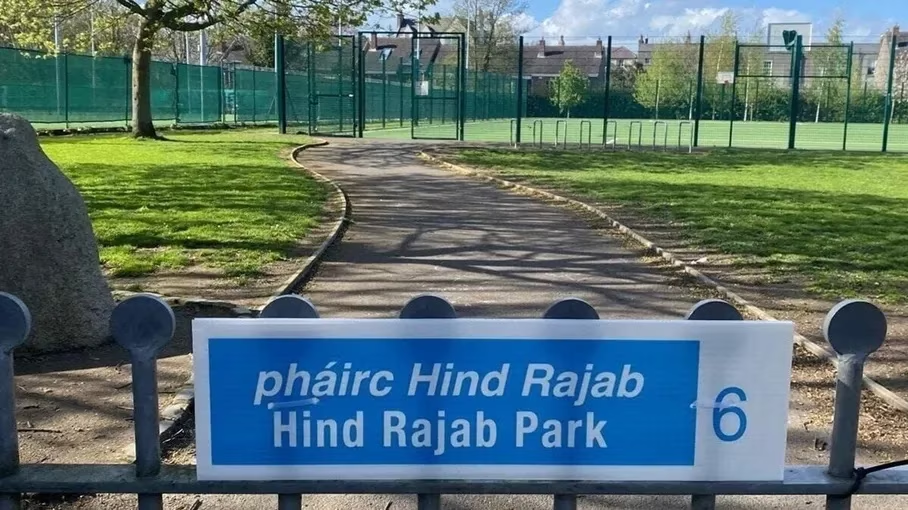
The Dublin City Council intends to vote on Monday on a proposal to remove the name of former occupation president Chaim Herzog, the father of the current president, Isaac Herzog, from a public park in the Rathgar area south of the city, a move that has sparked outrage from the occupation.

The park was named after him in 1995, as he was born in Belfast and spent his childhood in Dublin while his father served as the Chief Rabbi of Ireland.

The renaming committee of the council decided a few days ago to remove Herzog's name from the park and submitted the decision to the council for a vote to be officially adopted.

If approved by the council, it will be tasked with finding another name for the park and returning to the council again for approval.

The proposal calls for the removal of Herzog's name and proceeding with consultations to choose an alternative name. In June 2024, a proposal was made to name it after the girl Hind Rajab, who was martyred along with six family members by occupation forces on January 29, 2024.

Dublin City Council member Conor Reidy announced that over 2,700 people support renaming the park to "Hind Rajab Park."

However, the Dublin municipal regulations of 2017 stipulate that the new name must belong to a person who died less than 20 years ago or was born more than 100 years ago, making Rajab's name ineligible under the laws.

Other proposed names include "Free Palestine Park," "Gaza Park," and "Palestine Park."

This move has provoked anger from the occupation, and statements attacking the city council have been issued. Isaac Herzog's office stated that removing the name would be "shameful and disgraceful," considering that naming the park in 1995 represented an appreciation of his father's legacy and "the friendship between the Irish and Jewish peoples, but the relationship has deteriorated in recent years."

For its part, the Jewish Representative Council in Ireland warned that removing Herzog's name "will be widely understood as an attempt to erase the history of Irish Jews."

In an interview with the "Irish Times," Chief Rabbi Yoni Weider stated that "the Jewish story in Ireland deserves to be preserved, not whitewashed or erased," explaining that Herzog was known during his time in Dublin as the "Shin Fein Rabbi," referring to the Irish independence slogan.

From the occupation's side, Foreign Minister Gideon Sa'ar launched a scathing attack on Dublin, describing it as "the capital of anti-Semitism in the world."

In contrast, Dublin's Deputy Mayor John Stevens welcomed the discussion of the proposal, considering it right for discussions to be "open and transparent," while council member Rory Hogan stated that changing the name "will reflect the horror of the genocide of the Palestinian people" and that "the current name is inappropriate."

During the genocide in Gaza, Dublin and Ireland witnessed numerous events supporting Gaza and calling for accountability for the occupation's crimes against Palestinians in the sector.

PALESTINE

Mon 01 Dec 2025 3:37 am - Jerusalem Time

An "Israeli" general warns of the "most dangerous crisis" surrounding the occupation army.

Israeli reserve general Isaac Brick mentioned that the occupying army is facing the most dangerous humanitarian crisis in its history due to a significant shortage of personnel.

Brick stated in an article published by the Hebrew newspaper Maariv that thousands of officers and non-commissioned officers have evaded military service in recent months.

The retired general added that a large number of officers have requested urgent discharge, while young recruits are refusing to sign contracts for permanent service to extend their time in the army, resulting in a widespread shortage of professional personnel within the military.

He explained that the sharp decline in the quality of human resources is hindering the maintenance of military equipment and the operation of combat systems, indicating that the continuation of this situation could lead, in a short period, to the army losing its ability to operate entirely.

Brick also accused successive chiefs of staff of making inappropriate decisions in recent years, including extensive cuts in personnel and shortening the duration of military service (3 years for men and 2 years for women), which created gaps he described as enormous and not quickly repairable.

He pointed out that these gaps have driven skilled and experienced personnel to leave service, while incapable elements remain in sensitive positions unable to deal with the current battlefield challenges.

In his article, he affirmed that the human resources department in the army has been operating for years without professionalism or responsibility, ignoring fundamental issues related to human resource management and needs assessment.

He concluded by saying that the army suffers from informational blindness due to outdated technical systems and fragmented databases, warning at the same time that the human resources crisis could develop into a complete paralysis of the Israeli army's performance.

During two years of the Israeli genocide in the Gaza Strip, 923 Israeli soldiers were killed and 6,399 others were injured, according to army data, while about 20,000 soldiers suffer from post-traumatic symptoms, according to Hebrew media.

On October 8, 2023, the occupation began a genocide in the Gaza Strip that lasted two years, resulting in more than 70,000 martyrs and 170,000 Palestinian injuries, most of whom are children and women, along with massive destruction with reconstruction costs estimated by the United Nations at around 70 billion dollars.

PALESTINE

Mon 01 Dec 2025 3:01 am - Jerusalem Time

Hamas: Any international forces in Gaza should not replace the occupation.

Hossam Badran, a member of the political bureau of the Islamic Resistance Movement (Hamas), stated that any international force that may be deployed in the Gaza Strip should have a mission strictly limited to monitoring the ceasefire and separating Palestinian civilians from the occupation forces.

Badran emphasized in an interview that turning these forces into a substitute for the occupation army or a tool to fight the Palestinians "is impractical and will complicate the situation further."

Badran mentioned that the Palestinian factions, including Fatah, presented a unified position in Cairo regarding international forces, confirming that the Palestinian stance is based on protecting civilians and stopping aggression, not legitimizing any new foreign military presence.

He pointed out that the agreement was reached "after the world grew weary of the occupation's behavior, including the supporting American administration."

The Hamas leader added that stopping the daily genocide in Gaza was a fundamental goal for Hamas despite ongoing violations.

Badran confirmed that the resistance acted with "political wisdom and realism" and that there was a national consensus and Arab and Islamic support for this path.

He also stated, "We are the rightful owners of the land, and the world must direct its compass towards the occupation, not the victim."

Hamas and Israel reached a ceasefire agreement mediated by Egypt, Qatar, and Turkey, under American sponsorship, with the first phase of the agreement coming into effect on October 10.

The Israeli genocide war on the Gaza Strip has resulted in more than 70,000 martyrs and about 171,000 injured Palestinians, most of whom are children and women, in addition to widespread destruction, with the United Nations estimating the cost of reconstruction at around 70 billion dollars.

Regarding the issue of the resistance fighters stranded outside the "yellow line" in Rafah, Badran revealed that Hamas engaged in arduous negotiations with mediators to reach a solution that preserves the lives of the fighters, but the occupation presented "impossible conditions and repeatedly backtracked."

He clarified that the demand for surrender and disarmament was raised during some rounds but was met with a firm rejection from Hamas, asserting that "the fighters in the field cannot accept this option."

Badran accused the Israeli army of trying to exploit the issue to obtain a "victory image" after two years of war, stating that the occupation was the one that started attacking and targeting the fighters in Rafah, confirming that they "represent Gaza and the dignity of the Palestinian people, no matter the sacrifices."

In the occupied West Bank, Badran stated that the Israeli occupation continues to implement a "systematic escalation" since the war on Gaza began, referring to the recent military operations in Tubas and northern West Bank, as well as previous incursions in Tulkarem, Jenin, and Nablus.

He said that what is happening reveals "the falsehood of the Israeli narrative that links its crimes to the events of October 7," explaining that the West Bank did not participate in the October 7 attack, but the occupation continues to kill, confiscate, and fragment the geography.

The Hamas leader indicated that the current phase requires a unified Palestinian stance, and that Hamas is in contact with various forces to find mechanisms to protect the residents from settler attacks and the occupation's forces.

Badran affirmed that the resistance "will continue to defend its people by all means" and that the Palestinians will pay prices, but in the end, "they will attain their rights no matter how long it takes."

The occupation forces withdrew from Tubas in the northern West Bank after a military operation that lasted 4 days, during which they raided Palestinian homes and destroyed their contents, resulting in injuries to more than 166 Palestinians.

The Palestinian Prisoners' Club recorded about 200 cases of detention, most of whom were released earlier.

Regarding the relationship with the Palestinian Authority, Badran stated that there is no rupture, referring to meetings that took place in Cairo with Hussein al-Sheikh, the Deputy Head of the Palestinian Authority, and Majed Faraj, the head of the Palestinian intelligence, discussing national challenges and ways to confront them.

However, the Hamas leader added that the issues lie in the mechanisms of implementation and unifying the Palestinian stance.

Badran confirmed that the Authority and Fatah are an influential component, and that Hamas is keen to reach a minimum understanding in facing the occupation.

He stated that targeting Palestinians occurs at the level of geography and all components, not just Hamas, pointing out that Trump's plan and Security Council resolutions excluded the Authority from any role in Gaza, which confirms that the Israeli project aims to liquidate


PALESTINE

Sun 30 Nov 2025 10:04 pm - Jerusalem Time

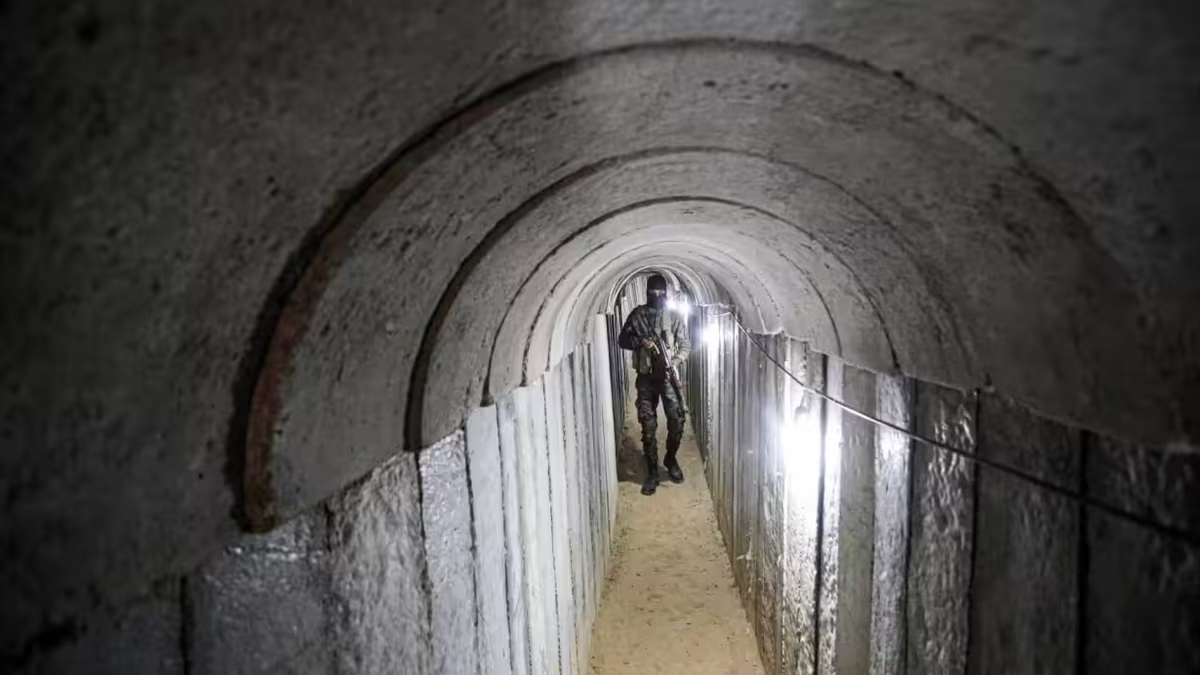
The occupation army claims to have assassinated more than 40 resistance fighters from "Hamas" in the tunnels of Rafah

The Israeli occupation army claimed on Sunday that it managed to assassinate more than 40 members of Hamas inside the network of tunnels located east of the city of Rafah in the southern Gaza Strip during the past week.
In an official statement, the spokesperson for the Israeli occupation army, Avichai Adraee, clarified that the army forces "continue to intensify efforts in the eastern Rafah area over the past forty days."

He pointed out that the aim of these operations is "to destroy the remaining underground tunnel routes in the area."

Adraee accompanied his statement with video footage showing the bombardment that targeted the area and the arrest operations of some members, claiming that this footage is "from the surrender and arrest of Hamas members in the Rafah area after a continuous pursuit and the destruction of tunnels in the tunnel network area."

Adraee concluded his statement by noting that "the army forces in the southern command are deployed in the area and will continue to work to eliminate any immediate threat," in accordance with the agreement reached.
PALESTINE

Sun 30 Nov 2025 9:39 pm - Jerusalem Time

Settlers storm Al-Aqsa while occupation forces continue to demolish homes in the West Bank.

A group of settlers stormed the courtyards of Al-Aqsa Mosque today, Sunday, alongside the continuation of their assaults in various areas of the West Bank and the ongoing incursions by Israeli occupation forces into cities and towns, demolishing homes.

Al Jazeera's correspondent reported that settlers conducted provocative tours in the courtyards of Al-Aqsa, performing Talmudic rituals in front of the Dome of the Rock Mosque under the protection of occupation police.

The Palestinian News Agency stated that the Israeli occupation authorities issued a decision today to expel a Jerusalemite citizen named Nawaf Al-Salaimeh from Al-Aqsa Mosque for six months, after having previously expelled him for a week.

It noted that this decision comes as part of a systematic policy aimed at expelling Palestinian citizens from Jerusalem from Al-Aqsa Mosque to empty it of worshippers and Jerusalemites.

It reported that the Jerusalem Governorate recorded 17 expulsion orders during October, including 16 orders related to Al-Aqsa Mosque.

In Jenin, northern West Bank, Al Jazeera's correspondent reported that occupation forces resumed the demolition of 24 homes and buildings and the leveling of streets within Jenin camp.

The occupation forces used bulldozers and heavy equipment to carry out the demolition operations that began last Friday in several locations within the camp.

For its part, the popular committee of the camp confirmed that more than 1,600 homes have been demolished, destroyed, or burned, while the occupation has displaced more than 20,000 Palestinians from the camp and its surroundings.

In the same context, the Palestinian news agency reported that Israeli occupation forces obstructed the movement of Palestinian citizens in the city of Qalqilya in the West Bank this evening, Sunday.

The Palestinian agency quoted eyewitnesses as saying that the occupation forces set up a military checkpoint at the eastern entrance of Qalqilya and stopped citizens' vehicles, checking the identities of their passengers, which caused a severe traffic jam.

Al Jazeera's correspondent also reported that Israeli occupation forces stormed the town of Sebastia northwest of Nablus in the West Bank.

The correspondent confirmed that clashes erupted between Palestinian youths and Israeli forces in the town of Aqraba south of Nablus during the incursion of occupation forces into the Palestinian town.

He also reported that occupation forces stormed the town of Sebastia northwest of Nablus, and clashes erupted following the incursion into the town of Aqraba south of the city.

Occupation forces had arrested a Palestinian youth from within the old city of Nablus and deployed military reinforcements during the incursion into the city, firing tear gas canisters and smoke bombs before withdrawing.

In Salfit Governorate, occupation forces carried out a campaign of raids and arrests, and Al Jazeera's correspondent reported that the occupation forces detained dozens of young men and interrogated them on-site after raiding their homes, searching them, and tampering with their contents.

In other developments, Al Jazeera's correspondent reported that four foreign activists were injured after being assaulted by a group of settlers in the village of Ein Duyuk north of Jericho.

Local sources reported that the settlers stormed a house in the village where foreign activists were present as part of a solidarity campaign and assaulted them, resulting in injuries to three Italians and a Canadian, all of whom were transported to the hospital.

In a related context, new video footage from surveillance cameras showed the moment armed Israeli settlers stormed the Khalayel Al-Lawz area south of Bethlehem in the West Bank yesterday, Saturday.

The footage showed the settlers assaulting a Palestinian family, besieging them inside their home, throwing stones at the house, breaking its windows, and attacking its residents.

Medical sources had reported to Al Jazeera that 10 Palestinians were injured in an assault carried out by settlers yesterday in this area, including one injury from live ammunition, in addition to three injuries resulting from severe beating.

According to the Palestinian Wall and Settlement Resistance Commission, settlers carried out 766 assaults against Palestinians and their properties in the West Bank during October.

The Israeli army and settlers continue their assaults and escalation in the West Bank since the beginning of the genocide war on Gaza, resulting in the martyrdom of at least 1,085 Palestinians, nearly 11,000 injuries, and the arrest of more than 21,000 others.

The Israeli genocide war in the Gaza Strip, which began on October 8, 2023, and lasted for two years, has resulted in more than 70,000 martyrs and about

PALESTINE

Sun 30 Nov 2025 9:17 pm - Jerusalem Time

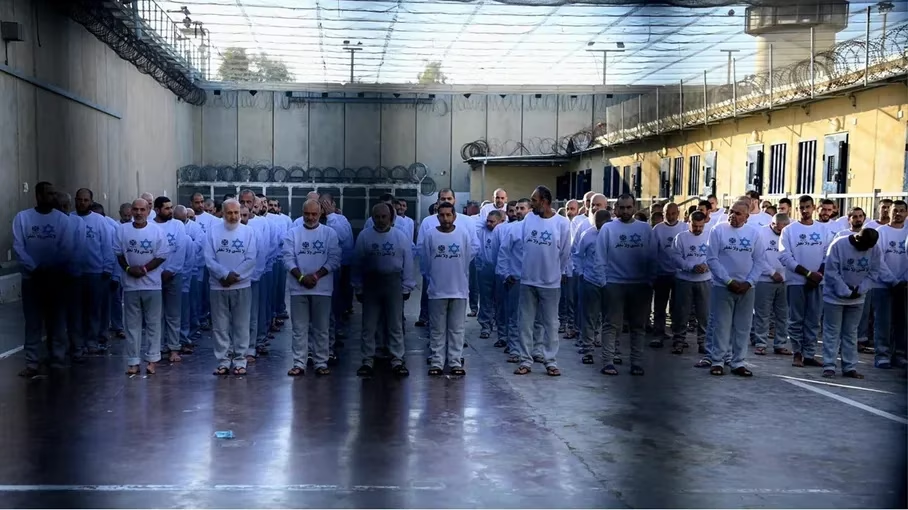
A UN committee confirms the occupation's systematic torture of Palestinian prisoners.

The United Nations Committee Against Torture has confirmed that there is evidence that the Israeli occupation implements a "state policy based on systematic and widespread torture," while the committee conducts periodic reviews of the records of all countries that have signed the Convention Against Torture, relying on testimonies from the governments of these countries and from human rights groups.

Israeli and Palestinian human rights groups presented shocking accounts during the review of Israel's file, with allegations stating that the occupation has arrested thousands of Palestinians since October 7, 2023.

Under the occupation's laws regarding administrative detention and "unlawful combatants," a category not treated as prisoners of war, suspects can be held for long periods without being allowed to contact a lawyer or their family members, according to a report by the BBC.

Palestinian families have confirmed that they waited for months before even knowing whether one of their members had been arrested, which the UN committee considered "enforced disappearance."

The committee specifically criticized reports of the occupation using the "unlawful combatants" law to detain entire groups of Palestinians, including children, pregnant women, and the elderly.

However, the most concerning aspect of the committee's findings, released on Friday, is the reported conditions of detention.

Evidence suggests that Palestinian prisoners are regularly deprived of food and water, subjected to violent beatings, dog attacks, electric shocks, waterboarding, sexual violence, and some are reportedly permanently shackled, denied access to toilets, and forced to wear diapers.

The committee concluded that this treatment "amounts to war crimes and crimes against humanity," emphasizing that the existence of a "real state policy based on systematic and widespread torture" is among the acts that constitute genocide under international law.

Committee members expressed deep concern over the lack of investigations or prosecutions regarding torture allegations, calling on "Israel" to open independent investigations and ensure accountability for those responsible, including senior military officers.

"Israel," which has long accused the United Nations of bias against it, has not made a public comment on the committee's findings, but during the hearings, its ambassador, Daniel Meron, described the torture allegations as "misleading information."

Meron stated that "Israel is committed to respecting its obligations according to its values and ethical principles, even in the face of challenges posed by a terrorist organization."

PALESTINE

Sun 30 Nov 2025 8:21 pm - Jerusalem Time

Washington and Tel Aviv's disagreements freeze the transition to the second phase in Gaza.

Washington – "Al-Quds" dot com - Said Arikat 

As the United States pushes for a transition to the second phase of the ceasefire agreement in Gaza, Israel appears determined to slow this process by imposing political and military realities that reinforce its military presence in the areas it controls within the enclave. Recent developments indicate that the Israeli government views post-ceasefire arrangements as a threat to its sphere of influence, particularly those involving the entry of international forces or the launch of a large-scale reconstruction process in areas outside Israeli control.

It also seems that Israel is using elements of the second phase as leverage, strongly opposing the entry of international forces that could restrict its military freedom in the future, and treating the reconstruction file and the obstruction of vital humanitarian aid as negotiating tools to prevent a return to normal civilian life before achieving its political and security objectives. Furthermore, the blockade imposed on Gaza hinders the access to essential medicines and medical supplies, increasing the humanitarian pressure on the civilian population and creating a worsening health crisis, especially in hospitals that are suffering from a severe shortage of necessary equipment and medicines to save lives.

As a result, civilians in Gaza are facing an escalating health tragedy, as restrictions on the entry of medicines and medical supplies lead to rising mortality rates among patients and the injured, and a lack of basic care for children, the elderly, and those with chronic illnesses. This crisis is a clear indicator that the political stalemate is no longer merely a matter of security or negotiating arrangements, but has become a direct threat to the lives of millions of people who rely on basic humanitarian aid to survive.

This approach seems to reflect the internal calculations of the Israeli government, which relies on the support of hardline right-wing parties that reject any withdrawal or international involvement in managing the situation within Gaza. Therefore, the slowdown in transitioning to the second phase and the obstruction of humanitarian aid cannot be separated from a political battle within Israel, where the government fears accusations of retreating in the face of international pressures or making concessions that could be used against it domestically.

In contrast, the U.S. administration is working to achieve tangible progress in implementing the second phase, driven by internal pressures related to increasing criticism of its handling of the humanitarian crisis in Gaza, as well as the need to demonstrate its effectiveness in managing regional issues. However, Washington's ability to make a real breakthrough is confronted by the limits of its traditional influence over Israel. The United States has political and diplomatic pressure tools, but it avoids taking sharp steps that could lead to tension in the strategic relationship that both sides have maintained for decades, or provoke anger from pro-Israel lobby organizations. This means that Washington is capable of persuasion, but it cannot compel without using pressure and threats, being prepared to bear the political costs both domestically and internationally.

It is clear that Israel is betting that the United States, preoccupied with complex global issues such as China, Ukraine, and domestic elections, may lean towards reducing pressure on Tel Aviv over time. This bet is not new, as Israel benefits from the differing priorities of Washington, and bets that the prolonged negotiations will ultimately lead to American acceptance of the reality it imposes on the ground.

Amid this tug-of-war, Gaza remains trapped in a cycle of political and humanitarian stagnation, where U.S.-Israeli disagreements hinder any significant progress in implementing the second phase. The absence of understanding between the two parties obstructs the necessary field and security arrangements, delays the entry of international forces that are supposed to play a guaranteeing role, and freezes the launch of the reconstruction process, while access to medical aid and medicines remains limited due to Israeli restrictions, exacerbating the suffering of civilians and threatening the lives of patients and the injured.

The repercussions of this stagnation extend beyond the current reality, as Israeli behavior reflects a long-term strategic desire to ensure control over the security landscape of the enclave for years to come, and to prevent any stable Palestinian governance model that could later evolve into a binding political negotiation framework. In contrast, the U.S. position reveals a broader crisis in Washington's ability to manage its alliances, especially when its humanitarian and political interests conflict with the priorities of a close ally like Israel.

Thus, a complex regional scene is formed where Gaza stands at the intersection of Israeli security calculations, U.S. political pressures, and humanitarian stability requirements. While the equation continues to revolve in a vicious circle, the second phase of the ceasefire agreement seems out of reach unless a decisive change occurs in the balance of pressures or in the calculations of the parties involved in the issue.

PALESTINE

Sun 30 Nov 2025 7:51 pm - Jerusalem Time

An Israeli plan to isolate Hamas and divide the Gaza Strip... "Checkpoints and inspections"

Israeli reports have revealed the outlines of the future plan to isolate Hamas and divide the Gaza Strip, through a media tour conducted by Israeli reporters in areas of southern Gaza under the control of the occupation army.

The Hebrew newspaper "Yedioth Ahronoth" stated that "the new Gaza plan aims to defeat Hamas and create a new life for the Palestinians," noting that the tour took place at the "Morag Crossing," which separates Khan Younis to the north and Rafah to the south.

The newspaper quoted its correspondent Ron Ben-Yishai, who was surprised during his visit by the piles of white bags and scattered boxes along the road, explaining that one of the officers described the scene to him, saying: "These are bags of flour and food boxes that fell from the trucks that loaded them at the Kerem Shalom crossing to be transported as humanitarian aid for civilians in Gaza."

Ben-Yishai spoke about the Israeli plan in Gaza, stating that its first phase consists of temporary neighborhoods, indicating that the army will remain in the sector for a long time, which is divided into areas controlled by Hamas and areas under Israeli control, which constitute 57% of its land.

He continued: "This plan, based on the American vision, is called (New Gaza), and the Israeli army elements who are striving to help Washington implement it as much as possible refer to it as (Green Gaza)."

The plan is supposed to resettle millions of Gazans who have temporarily evacuated their homes and rebuild the sector from its ruins, thus ending the long process of isolating Hamas, forcing the movement to disarm and cease being a dominant military and political force in the sector.

He pointed out that "the plan's first phase is scheduled to be implemented in the Rafah area east of the yellow line, meaning in the lands under Israeli army control. Nothing will happen in the areas controlled by Hamas."

Even humanitarian aid will not enter if the American plan enters the field implementation phase.

He clarified that in the first phase, an international stabilization force will enter the lands controlled by Israel east of the yellow line in the Rafah area, to supervise and secure the establishment of "new temporary neighborhoods" where civilians from Gaza who are not affiliated with Hamas will live, on behalf of the "Civil Peace Council," until the debris removal and construction of the planned new city in Rafah is completed.

He mentioned that "the 'temporary neighborhoods' will be established in open areas on the eastern outskirts of Rafah city or in sandy dune areas that were uninhabited even before the war and where there are currently no debris, unexploded ordnance, or mines that could endanger the residents of the 'temporary neighborhoods.'

He noted that "in the second phase of implementing the 'New Gaza' plan, residents of Gaza currently living in temporary shacks and plastic tents in the Mawasi area will be invited to move and live in temporary neighborhoods created for them with funding from donor countries and the United Nations.

The housing in these neighborhoods will be in trailers and tents arranged in well-planned complexes.

It is also important that the infrastructure for water, electricity, and sewage is available, in addition to hospitals, clinics, educational institutions, and mosques.

According to "Yedioth," the Americans estimate that the residents currently living in Hamas-controlled areas in western Gaza and the coastal area under almost inhumane conditions will be happy to move to the temporary neighborhoods, where they will receive housing and reasonable living conditions, including profitable work in debris removal and reconstruction projects that will begin simultaneously.

The newspaper noted that "to prevent Hamas members from infiltrating the temporary neighborhoods, the Israeli army and the General Security Service (Shabak) will establish crossings on the yellow line, including checkpoints and inspections, where they will ensure, among other things, through modern technological means (such as facial recognition and AI-based magnetic measuring devices) that Hamas members do not infiltrate or settle in the temporary neighborhoods, and that they do not smuggle weapons into them."

It confirmed that "the army has already begun working on planning these barriers and checkpoints that will allow the residents of (New Gaza) to be freed from the threat of Hamas and receive direct humanitarian aid from international relief organizations (the GHF organization, which operated under the auspices and funding of Israel, also halted its operations at the request of the mediators).

It added that alongside the establishment of aid distribution centers and the construction of temporary neighborhoods, contractors (likely Egyptians) will begin debris removal, then building the new Gaza, indicating that "the Israeli army has already begun assisting American planners in clearing mines and unexploded ordnance in the areas where it is already operating."

PALESTINE

Sun 30 Nov 2025 6:48 pm - Jerusalem Time

Global newspapers: Israel supports the thieves of Gaza and its police are a political tool for Ben Gvir.

Global newspapers and websites have addressed what they described as the worsening security chaos in the Gaza Strip, pointing to direct accusations against Israel for supporting groups that loot aid convoys, alongside the transformation of the Israeli police into a political tool under the influence of National Security Minister Itamar Ben Gvir.

The Guardian quoted French historian Jean-Pierre Filiu as saying he witnessed compelling evidence of Israeli support for looting operations targeting relief convoys in the southern part of the strip, confirming that the scale of violations reflects a systematic policy that goes beyond mere war chaos.

According to his testimony, the Israeli army fired at Palestinian security personnel accompanying the convoys, considering them part of Gaza's police, and recounted an incident near the Mawasi area when a convoy of 66 trucks came under rapid gunfire that led to the disintegration of the protection.

Filiu noted that he saw from a nearby location Israeli drones providing cover for attackers he described as thieves who targeted local protection teams, while Israel denied this, but acknowledged supporting the 'Popular Forces' militia, which included elements accused of looting.

In a parallel context, Haaretz considered that the Israeli police have become a political tool in Ben Gvir's hands, pointing to a rise in crime and an increase in arbitrary arrests of non-violent protesters during his tenure, indicating a deterioration of public trust in the security institution.

The newspaper explained that the police use repressive means including monitoring protests, interrogating protest leaders, and conducting humiliating searches, noting that officers who violated the law were not held accountable, with some receiving only nominal penalties and potential promotions.

Haaretz confirmed that this shift has led the police to seek to gain Ben Gvir's approval, which has resulted - as it put it - in the loss of fundamental values related to protecting democracy and serving the public, amid rising fears of the politicization of security agencies.

Meanwhile, Yedioth Ahronoth addressed what it described as the urgent need to maintain the 'buffer zone' in the Gaza Strip, considering that its depth is a central factor in Israeli security, and should not be compromised even under pressure from the United States.

The newspaper viewed that Gaza has not changed and will not change in the near future, and therefore, a return to the original border line should not be on the table, as this could lead - as it expressed - to dangerous outcomes for national security.

LATEST NEWS

Sun 30 Nov 2025 5:44 pm - Jerusalem Time

A new attack by the colonizers disrupts water well number

Colonizers have once again attacked water facilities in the Ain Samiya area east of Kafr Malik this evening, targeting water well number '6', which led to a complete halt of pumping from the well that serves as a primary water source for Palestinian communities east of Ramallah.

The Jerusalem Governorate Water Department stated in a statement that the repeated attacks on Ain Samiya wells threaten the water security of about 19 residential communities that rely primarily on these sources to meet their daily needs, reiterating its demand for urgent action and pressure on the occupation authorities to stop the repeated targeting of water sources in the area.

The department confirmed that its teams have been working since the evening to repair the damages and restore the well's operation in coordination with the relevant authorities, to ensure the resumption of water pumping as quickly as possible and to mitigate the impact of the interruption on the residents.

PALESTINE

Sun 30 Nov 2025 5:28 pm - Jerusalem Time

The toll of the Israeli massacre in the Gaza Strip exceeds 70,000 martyrs.

The Ministry of Health in the Gaza Strip announced that the number of martyrs due to the Israeli genocide has reached 70,103 martyrs and 170,985 injuries since October 7, 2023.

The ministry stated that "3 martyrs and 2 injuries arrived at hospitals in the Gaza Strip in the past 24 hours, while a number of victims remain under the rubble and in the streets, as rescue and civil defense teams are still unable to reach them at this moment."

It clarified that since the ceasefire on November 11, the number of martyrs has reached 356, with a total of 908 injuries, in addition to the presence of the bodies of 6-7 martyrs.

The ministry spoke about the difficult challenges that hinder the continued provision of specialized care for eye patients in the Gaza Strip, most notably the damage to diagnostic and surgical equipment, which has exacerbated the difficulty of surgical interventions and increased waiting times for operations.

The ministry confirmed that the pharmaceutical supplies for eye services are very limited and do not meet urgent needs, and the shortage of specialized medications for eye patients has doubled their acute and chronic suffering.

It added that there are 4,000 patients suffering from elevated eye pressure "glaucoma" who are at risk of losing their sight due to a lack of treatment and limited surgical procedures, calling on all relevant parties to urgently intervene to provide diagnostic equipment and specialized medications for eye patients.