ARAB AND WORLD

Thu 25 Dec 2025 1:33 pm - Jerusalem Time

World newspapers: American dismay at Israel's bid to strike Iran and debate in the Knesset

World newspapers spoke about American dismay at Israel's pursuit of directing a new military strike against Iran, noting that Tel Aviv is trying to prevent Tehran from acquiring the ability to disrupt its air defenses.

Indeed, it reported that American officials expressed their dismay at Israel's readiness to direct a new military strike against Iran, in a way that hinders Washington's efforts to achieve stability in the region.

And Israel considers -according to the newspaper- the opportunity opportune because Iran's missile launch capability is still weak, and its air defenses are weakened, while the ruling regime faces a number of challenges.

Also, Israel fears -according to the newspaper- that Iran may be able to produce thousands of missiles in the coming years, which is enough to disrupt any air defenses.

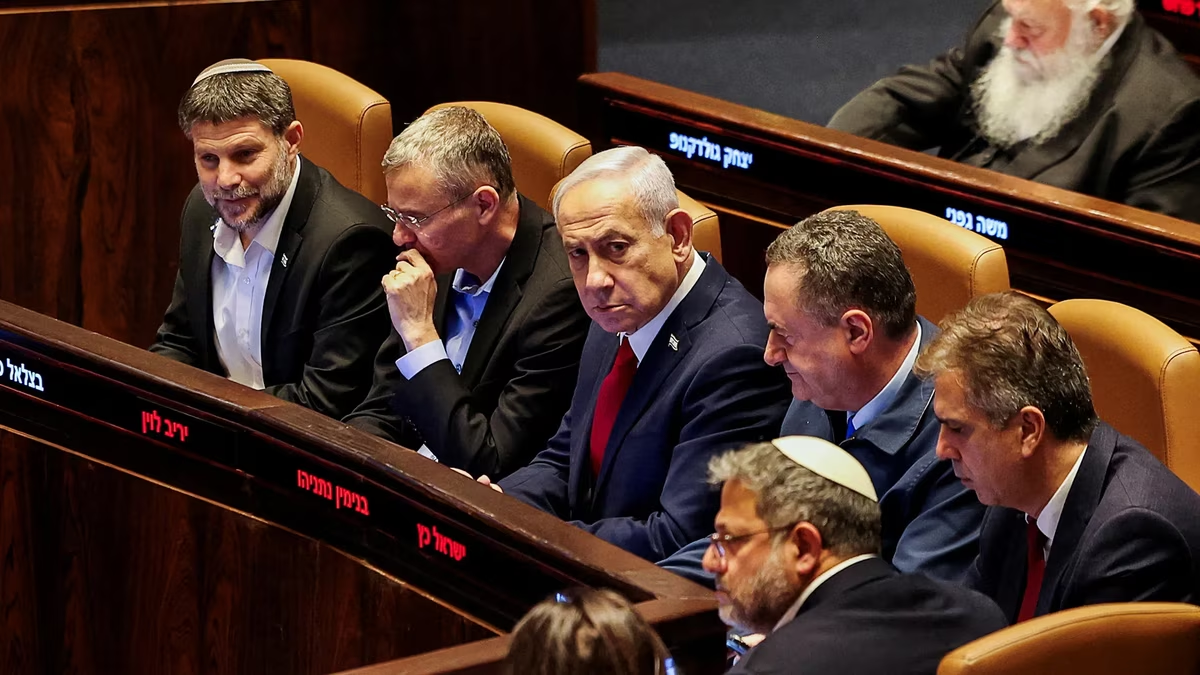
Regarding the investigation committee that Israeli Prime Minister Benjamin Netanyahu is seeking to form to investigate the October 7, 2023 attack, it said that a wide debate is taking place within the Israeli parliament (the Knesset), due to the draft law forming this committee.

And the newspaper said that the ruling coalition insists on passing the project because it limits Netanyahu's responsibility -wanted by the International Criminal Court- and the government, noting that it faces major obstacles.

And among the most prominent of these obstacles -according to the newspaper- the opposition of the government's legal advisor, and the possibilities of appealing it before the Supreme Court, in addition to disagreements within the coalition itself regarding the formula that allows politicians to choose committee members, which may expose it to serious legal problems in the coming period.

In a report, it said that Israel ranked last and recorded the biggest decline in its annual ranking on the Global National Brands Index amid a sharp decline in its image.

And the report clarified that the criticisms are no longer limited to the leaders only, but have extended to the society itself where Israel ranked last in the index of trust, sympathy, and goodwill towards citizens.

Also, it noted that Israelis face major challenges abroad including threats and severed relations in cultural and academic fields.

Regarding the situation in the Gaza Strip, it wrote that Israel has not stopped killing Palestinians for more than one or two consecutive days since the ceasefire came into effect.

And the newspaper noted that death may strike Gazans during a family outing or even while sleeping in a tent, and that Palestinians in Gaza may die just by crossing the yellow line, which represents the unclear borders between east Gaza and west Gaza.

And it considered that the rise in the number of Palestinian martyrs at the hands of the army "highlights the fragility of the truce with the existence of borders that are difficult to distinguish".

In the Syrian affair, it revealed that hacked communications and leaked analyses on social media sites showed plans by generals and officials in Bashar al-Assad's army to support the rebellion and arm Syrian fighters.

And the newspaper said that these efforts aim to undermine the nascent Syrian government, and perhaps regain part of the country through supporting an armed rebellion from exile, noting that one of them "supported a pressure campaign in Washington with millions of dollars".

And the newspaper concluded by saying that these hope to regain control from the Syrian coast as it is the homeland of many military and intelligence officials in the Assad regime.

ARAB AND WORLD

Thu 25 Dec 2025 1:32 pm - Jerusalem Time

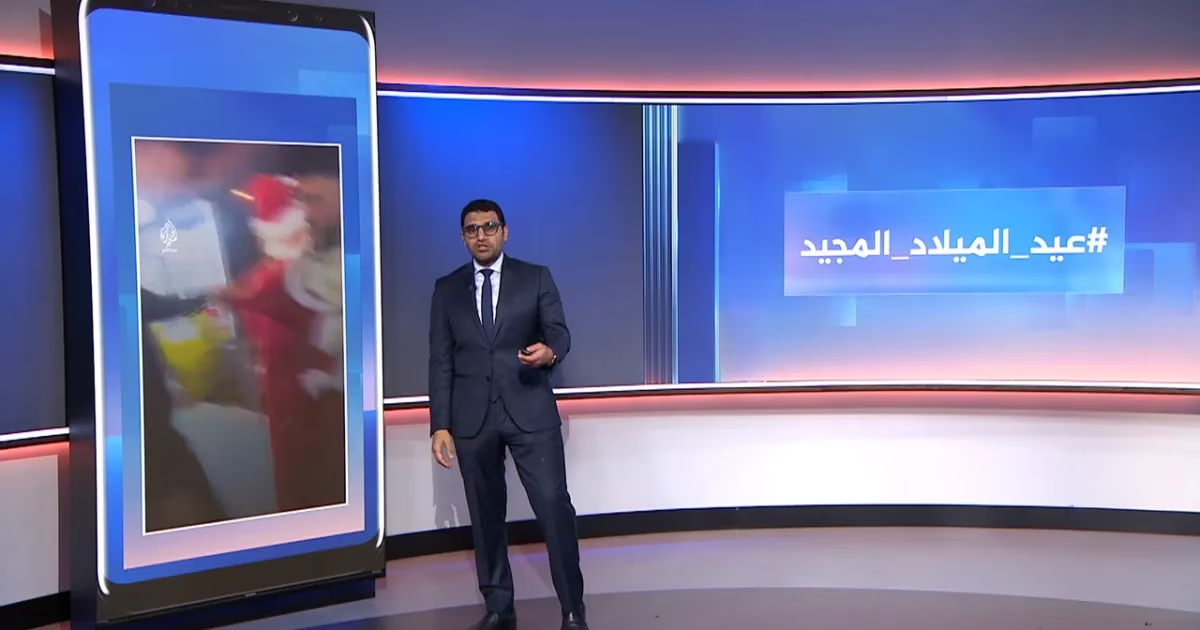
Israeli police assault on 'Santa Claus' in Haifa sparks global outrage

The assault by Israeli police in the city of Haifa, beating a person dressed as 'Santa Claus' or 'Santa Claus', has sparked widespread outrage on social media platforms.

The 'Hashtag' program (24/12/2025) aired a circulating clip on social media sites documenting the police assault on Christmas celebrants in the Wadi al-Nisnas neighborhood in the city of Haifa, including a person dressed as the fictional character.

The clip sparked global outrage, and the British politician George Galloway wrote

In turn, the American fighter Jake Shields wrote

And Don Luc Bernard

One blogger said that this is the true face of Israel, and wrote

The outrage also came from within Israel, as journalist Merav Zonszein emphasized that the assault was not from the settlers, but from the state.

In turn, Israeli journalist Noa Trenbolski pointed to the history of the far-right security minister Itamar Ben-Gvir, replete with convictions on charges related to hatred, and wrote:

PALESTINE

Thu 25 Dec 2025 1:01 pm - Jerusalem Time

Al-Awda Hospital in Gaza is on the verge of halting its services due to fuel depletion

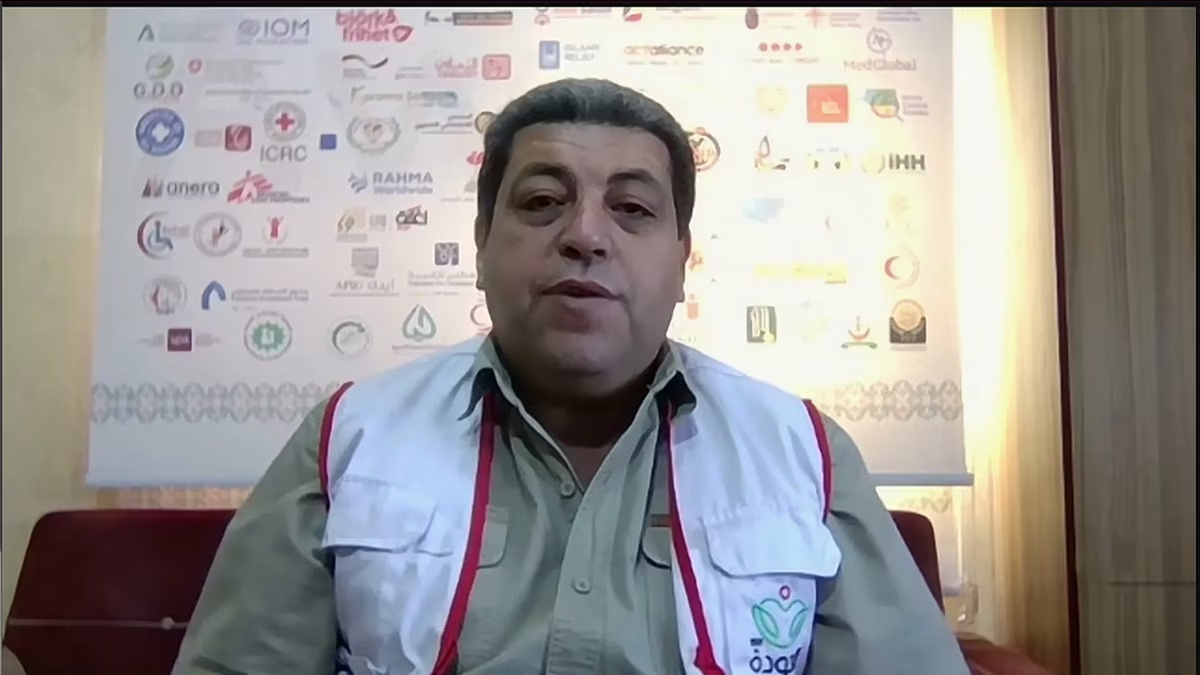
Al-Awda Hospital in the Nuseirat camp (central Gaza Strip) is on the verge of halting most of its services today, Thursday, due to fuel depletion, as confirmed by the general director of the Al-Awda Health and Community Association, Dr. Raafat Al-Majdalawi.

The hospital is struggling, like other hospitals in Gaza, to manage the fuel and fuel crisis since the beginning of the war, but Al-Majdalawi said they are about to halt most services later today, due to the unfair way diesel is distributed to hospitals.

Al-Awda Hospital provides surgical, maternity, pediatric clinical care, and emergency services, and it needs 2,600 liters of fuel daily, but it only receives a maximum of 1,000 liters, according to Al-Majdalawi.

The occupation has been providing fuel to national hospitals daily in quantities that do not allow for reserving part of it for emergency cases as supposed, while foreign hospitals are given all the fuel they need, according to Al-Majdalawi.

The Palestinian doctor described this method of fuel distribution as unfair, saying it is suspicious and raises questions, as it reflects a desire to disrupt local and national hospitals in favor of those managed by foreign teams.

Al-Awda Hospital serves thousands of residents daily, and it will face a difficult, complex, or even catastrophic reality if it cannot provide fuel in the coming hours, according to Al-Majdalawi.

It is impossible, according to the spokesperson, to schedule many services such as various types of deliveries, admissions, accidents, injuries, emergencies, and specialized surgical operations.

Currently, the hospital management is making attempts with the rest of the health system components to refer some cases to them, but the reality of these institutions is not better, and the situation may worsen today, tomorrow Friday, or the day after Saturday at most, as Al-Majdalawi said.

Since the start of the war, fuel used to reach hospitals through the United Nations Relief and Works Agency for Palestine Refugees (UNRWA), then the task shifted to the World Health Organization, and from there to an international institution, but the latter confirmed to the hospitals 10 days ago that it has nothing to provide them with fuel.

The sector is suffering from continuous deterioration due to the acute shortage of staff and specialists, and the malfunction of most necessary medical equipment, while the occupation continues to tighten restrictions on the entry of aid, medical supplies, medicines, and even food.

ARAB AND WORLD

Thu 25 Dec 2025 12:56 pm - Jerusalem Time

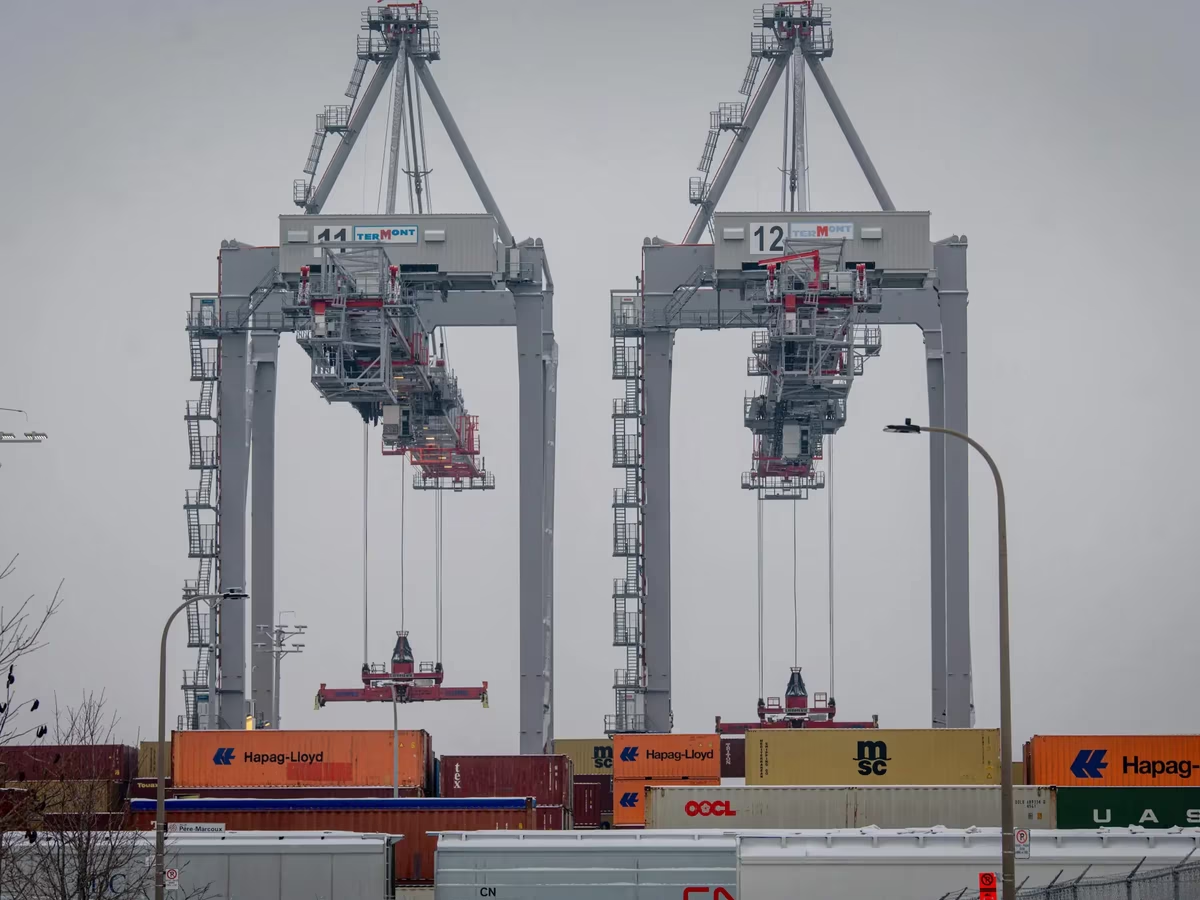
2026.. The New Year of Turmoil in Global Trade

As the global trade system concludes one of its most transformative years in a century, 2026 enters laden with additional risks threatening stability and growth, amid rising protectionism, reshaping of supply chains, and shaking of major trade agreements, according to an extensive analysis.

Despite the relative resilience of global goods trade during 2025, underlying indicators reveal increasing imbalances that could make 2026 another year of turmoil, especially with the start of the review of the North American Free Trade Agreement, the ongoing repercussions of the tariffs imposed by US President Donald Trump, and the absence of clear enforcement mechanisms in several recent trade understandings.

Data on maritime transport—cited by shipping expert John McCown—indicates that global container volumes rose by 2.1% in October compared to the previous year, reflecting apparent resilience in international trade.

However, this picture hides sharp disparities, as the United States recorded an 8% contraction in imports, compared to strong growth in Africa, the Middle East, Latin America, and India.

McCown wrote that "global supply chains have actually begun to adapt and reshape trade patterns," considering that the escalation of tariffs seen in 2025 may make 2026 "the year of tariff repercussions," with their effects transitioning from numbers to the actual structure of trade.

Among the most prominent anticipated milestones of 2026 is the start of the United States, Canada, and Mexico reviewing the "North American Free Trade Agreement" that came into effect in 2020.

US Trade Representative Jamieson Greer said this review "takes the three countries to new territories," noting that more than 1,500 submissions were received during the public comment period.

Greer explained that "many supported the agreement and called for its extension, but the majority also demanded its improvement," implicitly warning that any amendment might come at the expense of another party, at a time when Canadian and Mexican industries are suffering from US tariffs.

Tensions are increasing with Canada, after Washington ended trade talks with it in October in response to media campaigns opposing tariffs.

Shipping experts predict that 2026 will face two potential shocks in supply chains:

The first involves the gradual return of ships to the Red Sea and the Suez Canal after the decline in Houthi attacks, which could lead—according to Lars Jensen of Vespucci Maritime—to "flooding the market with additional shipping capacity" and "massive congestion in European ports."

As for the second shock, it may be driven by demand, as any strong acceleration in the US economy, as expected by the Trump administration, could unleash a wave of restocking inventories that exceeds the shipping sector's absorption capacity, reviving the logistical bottlenecks witnessed during the coronavirus pandemic.

It warns that many of the trade deals boasted by the White House during 2025 are not traditional binding agreements, but political understandings lacking clear enforcement mechanisms.

Moreover, the trade truce with China does not exceed one year, leaving the world's largest unbalanced trade relationship without a fundamental solution.

This fragility has begun to appear, with Chinese pressures on countries like Malaysia and Cambodia due to agreements with Washington, stalled negotiations with the European Union and India, amid US threats to retaliate against what it considers "excessive regulation" of American technology.

The uncertainty increases with anticipation of the US Supreme Court's decision on the legality of the "reciprocal" tariffs imposed by Trump, and if the administration loses the case, the issue of refunding billions of dollars in tariffs to American importers may arise, despite officials' skepticism about the practical feasibility of that.

Kevin Hassett, Director of the National Economic Council, said that imposing broad refunds "is administratively unlikely," while betting markets estimate the probability of Trump losing the case at around 75%, meaning the administration will resort to other tools to impose tariffs.

In this context, it concluded that 2026 does not seem closer to calm, but rather is a candidate to be another year of redrawing global trade, in an environment where traditional rules erode, and politics advances over market logic.

PALESTINE

Thu 25 Dec 2025 12:16 pm - Jerusalem Time

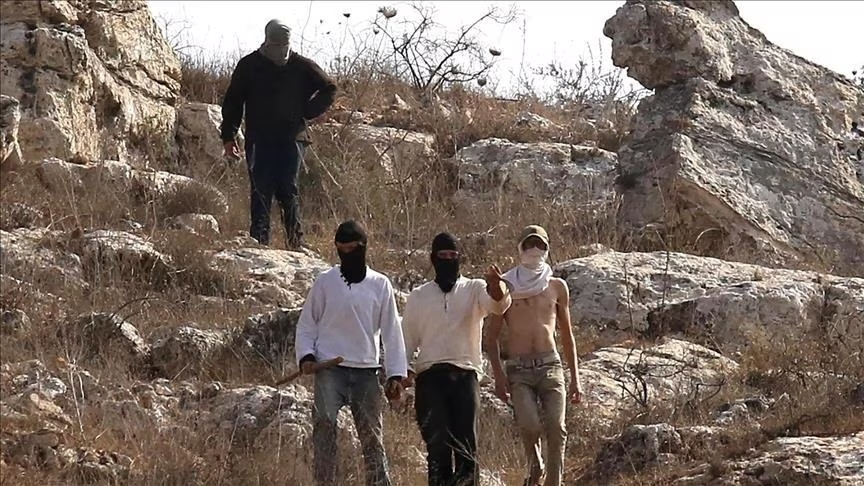
Settlers Burn Excavator Belonging to Palestinians South of the West Bank

Bethlehem/ Qais Abu Samra/

Israeli settlers, on Thursday, burned an excavator belonging to Palestinians and inscribed slogans in Hebrew south of the occupied West Bank.

Local sources said that settlers stormed the area of "Khala Hajji" east of the town of Beit Fajjar south of Bethlehem, and set fire to an excavator, causing significant material damage to the equipment.

The sources added that the settlers inscribed slogans in Hebrew (whose meaning was not immediately clear) before withdrawing.

The Palestinian town of Beit Fajjar and its surroundings are subjected to repeated assaults by extremist Israeli settlers.

About 750,000 settlers live in hundreds of settlements in the West Bank, including 250,000 in East Jerusalem, and they commit daily assaults against Palestinian citizens with the aim of forcibly displacing them.

In November/ Tishrei the past, settlers committed 621 assaults against Palestinians, their property, and their livelihoods in the West Bank, according to data from the Palestinian Anti-Wall and Settlement Resistance Commission (governmental).

Since the genocide war in Gaza began on October 8, 2023, the Israeli army and settlers in the West Bank have killed at least 1,102 Palestinians, injured about 11,000, in addition to arresting more than 21,000.

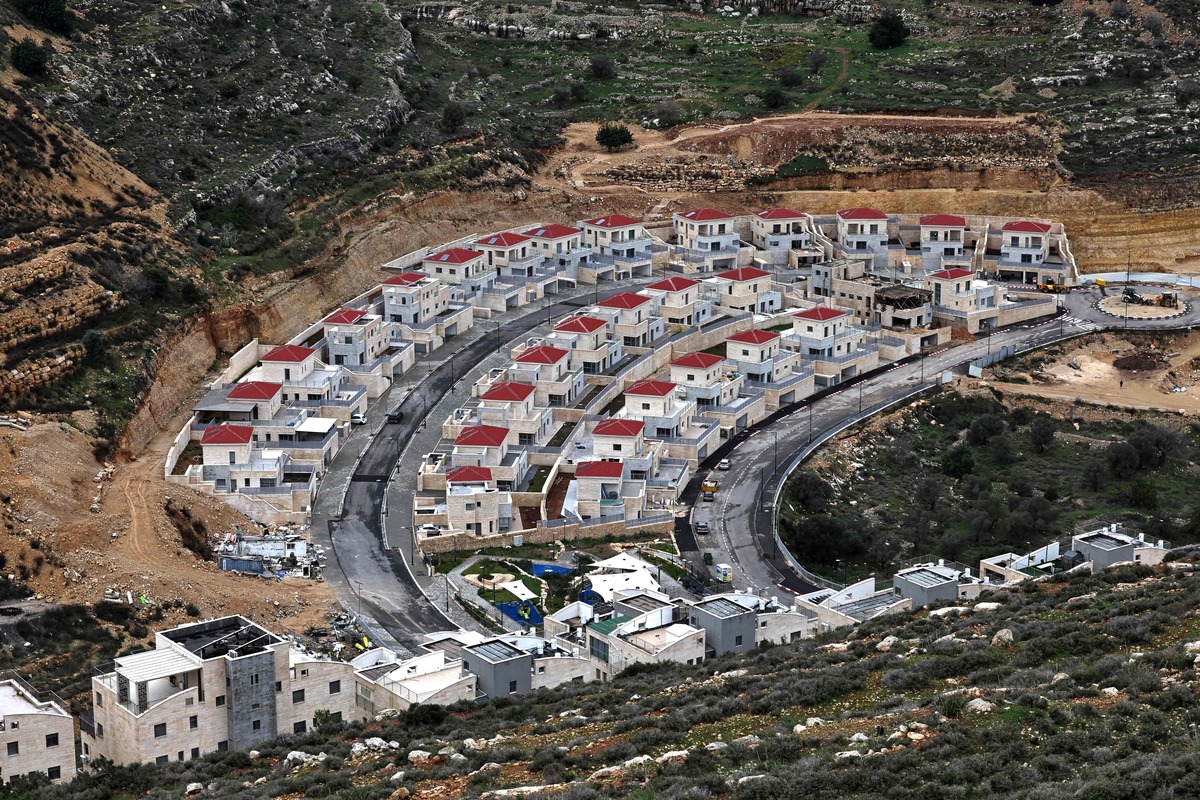
Israel is also intensifying its crimes to annex the West Bank to it, especially through demolishing Palestinian homes, displacing them, and expanding settlements, according to Palestinian authorities.

Israel's annexation of the West Bank would end the possibility of implementing the two-state solution (Palestinian and Israeli), as stipulated in resolutions issued by the United Nations.

Israel was established in 1948 on Palestinian lands occupied by armed Zionist gangs that committed massacres and displaced hundreds of thousands of citizens, then Tel Aviv occupied the rest of the lands, and refuses to withdraw and establish a Palestinian state.

PALESTINE

Thu 25 Dec 2025 12:06 pm - Jerusalem Time

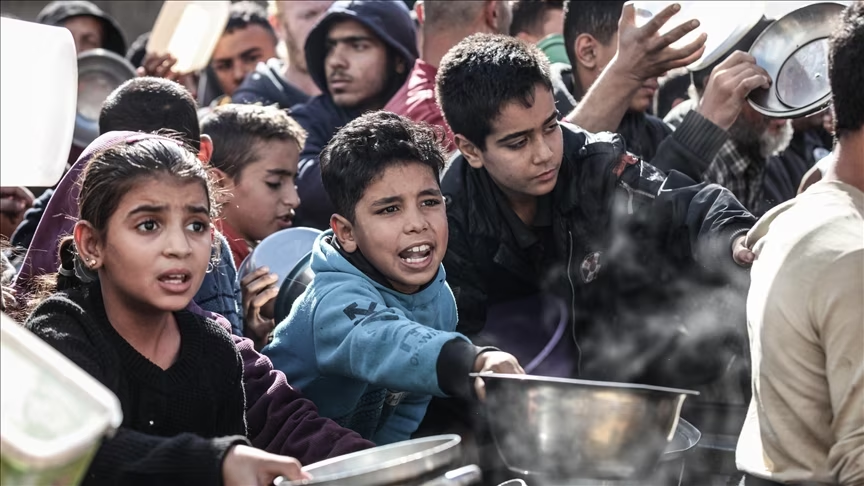
UNICEF: Suffering of Gaza's Children Continues Despite Ceasefire

The spokesperson for the United Nations Children's Fund (UNICEF) in Palestine, Kazim Abu Khalaf, stated that despite the ceasefire in Gaza, the suffering of children continues due to the severe cold, attacks, and malnutrition resulting from ongoing restrictions.

In his statements, Abu Khalaf clarified that the residents of the Gaza Strip, especially civilians, women, and children, are still suffering, and that Gaza has been witnessing extremely harsh attacks since October 2023.

He added: "According to reports, more than 80 children have been killed after the ceasefire was announced. The weather conditions are unbearable for children, as temperatures continue to drop. We have received reports of tents being flooded with water. And despite all the efforts made by UNICEF and other humanitarian organizations to provide assistance to those in need, the situation remains extremely difficult."

Abu Khalaf confirmed that children are the most affected by the Israeli attacks, and that they have suffered indescribable pain due to the ongoing attacks since two years ago.

Abu Khalaf reported that more than 20,000 children have been killed and more than 44,000 injured in the ongoing Israeli attacks since October 2023, and that the situation in Gaza affects not only the bodies of children, but also their psychological state and minds.

He continued: "Thousands of children have become orphans. Thousands of others have lost a leg or an arm, or perhaps both. All school-aged children, numbering 638,000, have lost two academic years."

He continued: "All children, who make up half the population of the Gaza Strip, need some form of psychological and social support."

He pointed out that some figures recently published by the World Health Organization indicate the need to evacuate about 4,000 children from Gaza for health reasons.

Since October 10, a ceasefire has been in effect, which Israel violates its terms and delays moving to the second phase, claiming that the remains of one of its soldiers remain captive in Gaza, despite the Palestinian factions continuing to search for him amid the massive destruction caused by Israel.

The agreement was supposed to end the genocide committed by Tel Aviv over two years starting from October 8, 2023, which resulted in about 71,000 Palestinian deaths and more than 171,000 injuries, mostly children and women, but Israel continues its violations and tight blockade on the sector.

Despite the end of the genocide war, the living reality for Palestinians in Gaza has not improved due to the strict restrictions imposed by Israel on the entry of aid trucks, thus violating the humanitarian protocol of the agreement.

PALESTINE

Thu 25 Dec 2025 11:50 am - Jerusalem Time

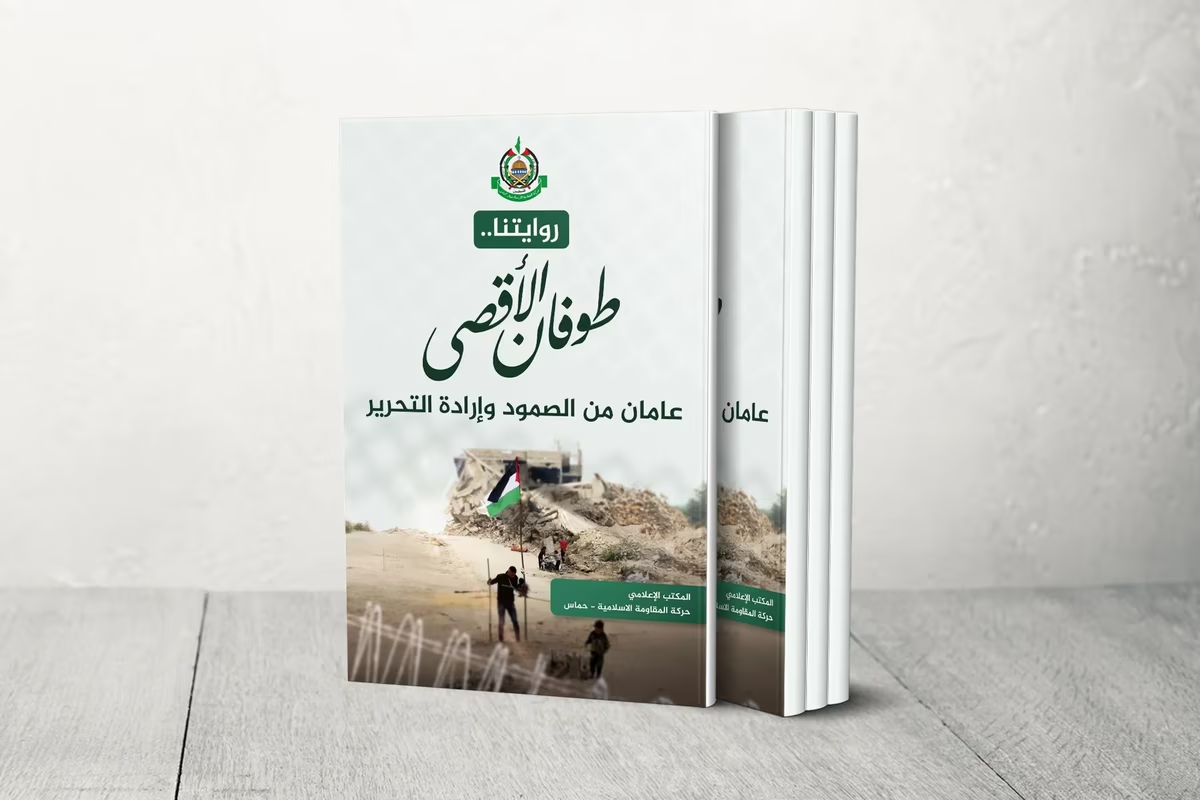
Hamas Publishes Its Second Account Regarding the Battle of Al-Aqsa Flood

On December 25, 2025, the Islamic Resistance Movement (Hamas) published what it called its second account regarding the Battle of Al-Aqsa Flood, which it launched on October 7, 2023, against settlements in the Gaza envelope.

The account came in a document titled "Al-Aqsa Flood.. Two Years of Endurance and the Will for Liberation," and the movement published it in both Arabic and English.

The movement stated in its statement that Al-Aqsa Flood "was not just a military event, but a blessed moment of birth, and the emergence of a free consciousness without deception or falsification." It added, "After two years of genocide and endurance, our narrative shines clear: a people that cannot be erased, a resistance that endures and is not defeated, and a memory that is not forgotten."

Hamas affirmed in its statement that "an independent Palestinian state, with Jerusalem as its capital, and the return of refugees to their land, is not a dream, but a goal recognized by all international and humanitarian covenants, and a historical and political entitlement imposed by a people who endured genocide and did not break."

The movement documented in its book the events of two years of the battle, reviewed the motives of Operation Al-Aqsa Flood and its historical contexts as a resistant response to occupation, addressed the military course of the war in the Gaza Strip, documenting the extent of destruction and casualties, while highlighting the Palestinian people's steadfastness against displacement policies.

Hamas reviewed the political efforts it made to stop the aggression on the sector, including dealing with international initiatives and prisoner exchange agreements, and addressed the strategic achievements of its battle, most notably bringing the Palestinian issue back to the forefront of the global scene and isolating the Israeli occupation legally and morally.

The movement concludes its book by affirming the failure of plans to liquidate the issue, emphasizing the right to self-determination and managing national affairs without external guardianship.

Hamas's account came in 8 chapters:

Chapter One: The Flood.. Motives and Contexts.

Chapter Two: Al-Aqsa Flood - The Blessed Crossing Day (October 7, 2023).

Chapter Three: Investigating the October 7 Attack: Yes to Revealing the Facts.

Chapter Four: The Course of the War on Gaza.

Chapter Five: Hamas's Efforts to Stop the Aggression and (US President) Trump's Plan.

Chapter Six: Achievements of Al-Aqsa Flood.

Chapter Seven: Hamas Cannot Be Isolated.

Chapter Eight: Priorities of the Stage.

And here is a link to read the full text of the document:

"Al-Aqsa Flood.. Two Years of Endurance and the Will for Liberation"

PALESTINE

Thu 25 Dec 2025 11:40 am - Jerusalem Time

The humanitarian situation in Gaza is becoming more complicated after two months of the ceasefire taking effect

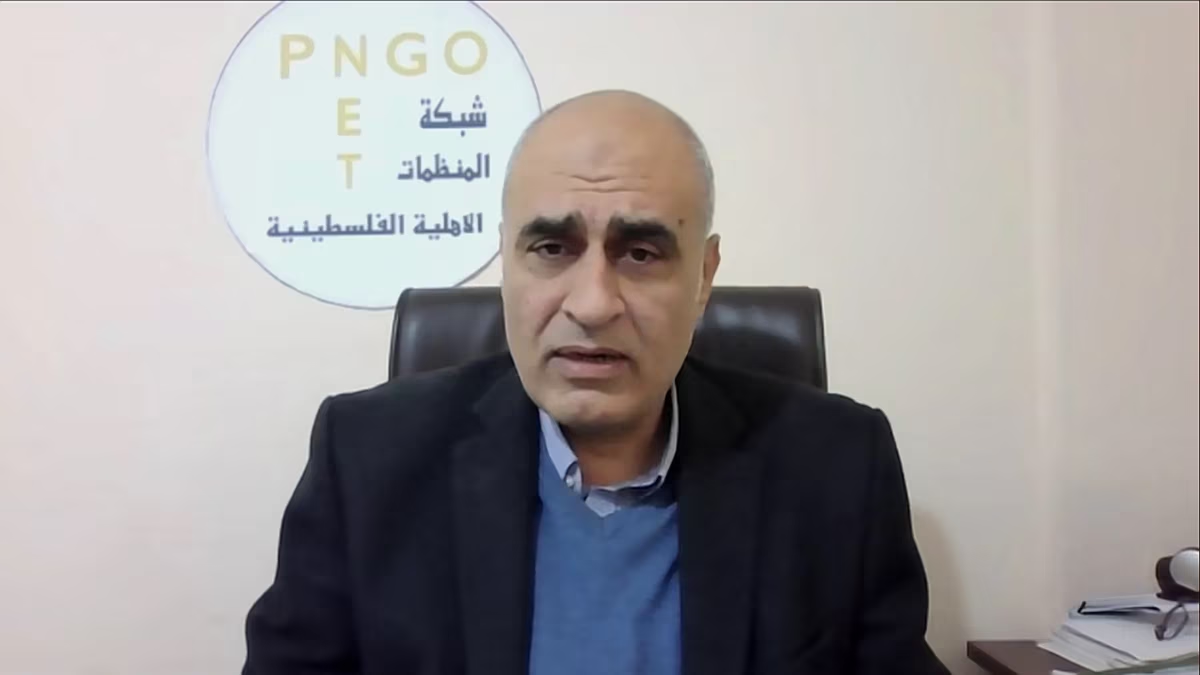
The humanitarian situation continues to become more complicated in the Gaza Strip after two months of the ceasefire taking effect, where forced displacement persists and living conditions worsen, according to Amjad Al-Shawa, director of the Palestinian Civil Society Network in Gaza.

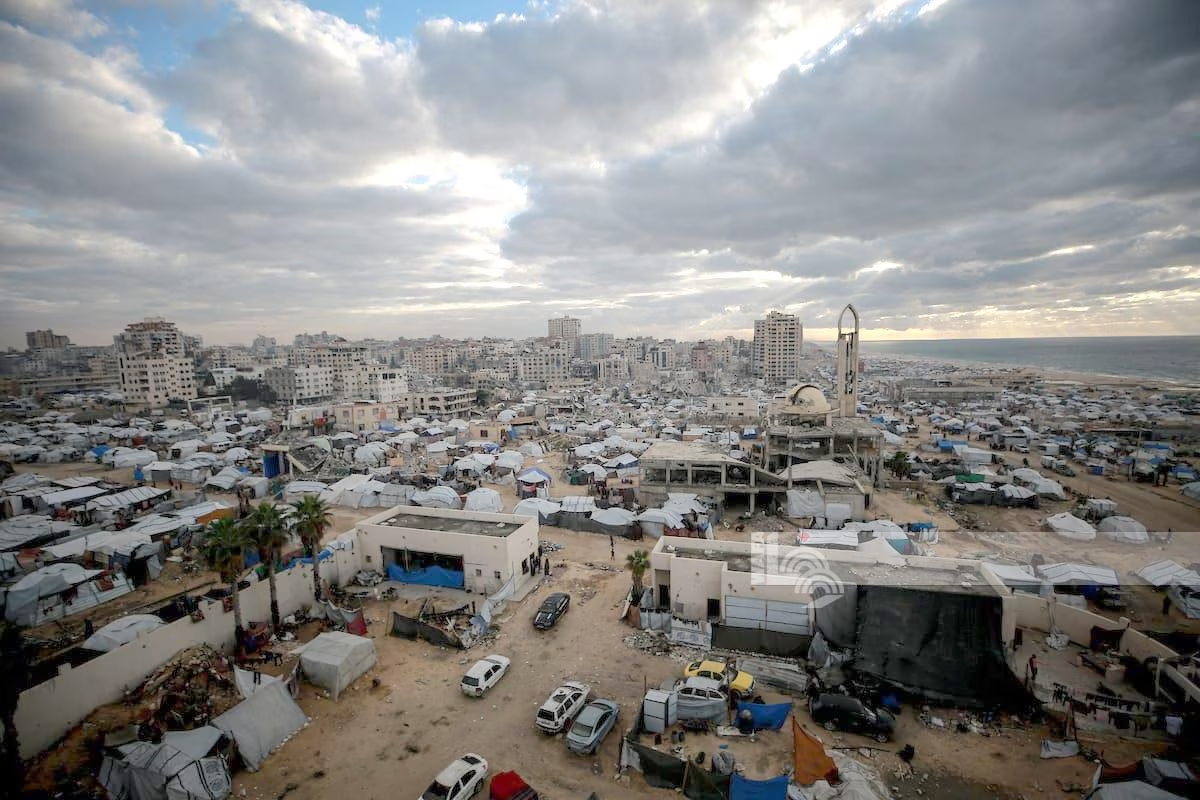
The occupation has confined hundreds of thousands of Palestinians to 41% of the sector's area (less than 100 kilometers) under harsher conditions, and more than half a million people have lost their homes, while thousands of residents live in the ruins of their destroyed homes, as confirmed by Al-Shawa in an interview.

Due to the shortage of materials, rising prices, and loss of livelihoods, 90% of the population has become unable to afford their basic needs, while the health crisis worsens due to the spread of waste and the destruction of water and sewage networks, according to Al-Shawa.

The limited aid allowed by the occupation to enter has not led to a tangible improvement in the residents' conditions, due to strict restrictions on the types of materials being imported, which deepen -according to the spokesperson- the gap in basic needs and prevent an improvement in the deteriorating humanitarian situation.

Israel allows the entry of very small quantities of the required basic materials, especially food, hygiene, and sanitation, according to Al-Shawa.

At the same time, displacement and the nature of shelters exacerbate the deteriorating health situation of the residents, specifically malnutrition, which Al-Shawa says is partly related to declining hygiene levels.

Merchants receive up to 20% of the fresh fruits, vegetables, and proteins needed for the population, but they are subject to high entry fees and coordination that cause their prices to rise beyond the capabilities of the vast majority of people.

Israel refuses, until now, to include basic protein materials, eggs, and fresh materials in the free aid, according to Al-Shawa, who confirmed the impact of this policy on the health of children and pregnant women in particular.

A catastrophic scene

No improvement has occurred, until now, in the aid reaching Gaza, which the United Nations has confirmed may face a catastrophic scene due to this policy within a few months, due to the occupation allowing a larger number of trucks while continuing to refuse to improve the quality of the aid being imported, according to Al-Shawa.

United Nations reports confirm that 77% of Palestinians in Gaza live in a continuous cycle of hunger, while 90% of them spend a full day without regular access to food.

Due to these strict restrictions on basic needs, 70% of children are born underweight, and about 100,000 children and thousands of pregnant women face potential malnutrition, according to UN reports.

There are only 9 hospitals in the sector out of 36 that were operating before the war, according to reports from the World Health Organization.

ARAB AND WORLD

Thu 25 Dec 2025 10:48 am - Jerusalem Time

Two people killed in Israeli strike on bus east of Lebanon

Two people were killed on Thursday by a drone strike carried out by Israel on a small bus in the Al-Hermel district east of Lebanon, in a new violation of the ceasefire.

A drone strike by Israel targeted a bus on the road to Hosh al-Sayyid Ali in the Al-Hermel district.

The strike "resulted in the fall of two martyrs who were transferred to the Petroleum Hospital in the city of Al-Hermel".

Earlier on Thursday, witnesses reported that a strike carried out by a drone targeted a car in the town of Hosh al-Sayyid Ali in northeastern Lebanon.

In this context, Israeli army spokesperson Avichai Adraei stated in a post on the American company "X" platform that the Israeli army and Shin Bet carried out an attack in the Al-Nasseriyah area.

Adraei claimed that the attack targeted a "terrorist element".

In the middle of the night last Wednesday, an Israeli drone targeted a car in the town of Janata in the Tyre district south of Lebanon.

The municipality stated that the strike caused injury to a person who happened to be passing by the place, and he was transferred to the hospital.

Despite the ceasefire between the two sides coming into effect at the end of last year, Israel carries out daily attacks on Lebanon, especially in the south of the country.

Israel has killed more than 4,000 people and injured nearly 17,000 others during its aggression on Lebanon, which it began in October 2023, before turning it into a full-scale war in September 2024, which stopped with an agreement for a ceasefire that came into effect in November 2024.

It has also violated the ceasefire agreement more than 10,000 times, according to the United Nations Interim Force in Lebanon (UNIFIL), resulting in hundreds of deaths and injuries, in addition to its occupation of 5 Lebanese hills that it controlled in the recent war, plus other areas it has occupied for decades.

ARAB AND WORLD

Thu 25 Dec 2025 9:39 am - Jerusalem Time

Israel Plans to Invest 110 Billion Dollars to Enhance the Independence of Its Military Industry

Israel intends to invest 350 billion shekels (approximately 110 billion dollars) over the next ten years to enhance the independence of its local military industry, according to what Prime Minister Benjamin Netanyahu announced on Wednesday, according to Israeli media reports.

During a speech he delivered at a graduation ceremony for new pilots in the Air Force, Netanyahu said that the program aims to reduce Israel's dependence on foreign suppliers 'including friends'.

Netanyahu pointed to Germany in his statements, saying that it, like other countries, seeks to buy 'more and more' weapons systems from Israel. Germany had temporarily suspended some arms exports to Israel following the devastating war in Gaza, which resulted in the deaths of tens of thousands of civilians, a step that negatively affected relations with Tel Aviv.

Other European countries and the United States, Israel's closest ally, have also imposed various restrictions, which were met with criticism from Netanyahu. The Prime Minister said that the new defense investment program aims to ensure Israel's strategic independence in the field of arms production.

Last week, Germany and Israel signed a contract to expand the 'Arrow 3' missile defense system, which equipped the German armed forces, designed to protect against potential missile attacks from Russia.

Israeli officials mentioned that the total value of the deal, including the basic system, is approximately 5.7 billion euros (6.7 billion dollars), making it the largest arms deal in Israel's history.

Germany has been supplying Israel with major weapons systems for decades.

PALESTINE

Thu 25 Dec 2025 9:00 am - Jerusalem Time

Israeli airstrikes on northern, central, and southern areas of Gaza Strip

The Israeli warplanes launched fierce raids at dawn on Thursday on northern, central, and southern areas of the Gaza Strip in new violations of the ceasefire agreement with Hamas.

Eyewitnesses stated that Israeli warplanes carried out fierce airstrikes, the sound of which was heard east of Gaza City in the north of the sector, in the central governorate, and in the cities of Khan Yunis and Rafah in the south.

The witnesses clarified that the raids targeted areas under the control of the Israeli army.

The Israeli artillery also shelled several areas east of Gaza City, coinciding with heavy gunfire from Israeli helicopters, according to the witnesses.

At the same time, Israeli naval vessels fired their machine guns heavily at sea off Gaza City and north of the sector.

In the same context, witnesses reported hearing loud explosions resulting from house demolition operations carried out by the Israeli army in areas under its control east of Rafah and Khan Yunis cities.

No information has been reported yet regarding casualties or injuries from the Israeli bombing and raids.

On Wednesday, the Israeli army announced that an officer was injured by an explosive device that targeted an armored vehicle in Rafah, while Prime Minister Benjamin Netanyahu claimed that Hamas was responsible for the explosion and threatened to respond to it.

In response, Hamas said in a statement: "The explosion that occurred in the Rafah area occurred in the area fully controlled by the Zionist occupation forces, and no Palestinian works there."

It added: "We warned in advance about the presence of war remnants in this area and others, and we are not responsible for them since the implementation of the agreement began, especially the remnants planted by the occupation itself in the area."

Since October 10, a ceasefire agreement has been in effect in Gaza, while Israel has violated some of its provisions and delayed moving to the second phase, citing the remaining body of one of its soldiers captive in Gaza, despite the Palestinian factions continuing their search operations amid the massive destruction left by the Israeli genocide.

The agreement was supposed to end a genocide committed by Tel Aviv over two years starting from October 8, 2023, which resulted in about 71,000 Palestinian deaths and more than 171,000 injuries, most of them children and women, but Israel continues its violations and suffocating blockade on the sector to this day.

OPINIONS

Thu 25 Dec 2025 8:11 am - Jerusalem Time

Palestinian Prisoners: The Pain of Prisons and the Test of National Dignity

Maamar Yusuf Al-Awawi

Maamar Yusuf Al-Awawi

Opinion Writer

The suffering of Palestinian prisoners is not just a story of prisons, but a tragedy of an entire nation whose sons, mothers, and children are imprisoned along with it. In the cells of the Israeli occupation, the prisoner is not only deprived of his freedom, but his humanity is confiscated day by day, under harsh detention conditions that deprive him of his most basic rights: sufficient food, treatment, visits, and even safe sleep.

Prisoners starve just as the people of Gaza starve, and they are besieged just as cities are besieged, but the prisoner's hunger is silent, behind the walls, without cameras or urgent headlines. It is deliberate hunger, a systematic policy of humiliation, and collective punishment that targets both body and soul.


The families of prisoners... the punishment that no one sees


And the suffering does not stop at the prison walls. Outside the prison, the families of prisoners live another siege no less cruel:

Wives bearing the burden of the family alone, children growing up on a deferred image of an absent father, and fathers and mothers aging at the prison gates.

The painful question that is not asked enough: Who supports these families? Who protects their economic dignity? And who turns their resilience from mere endurance into a real ability to continue?

These families pay a high national price, and yet they are often left on the margins of attention, as if their suffering is a side detail, not the essence of the issue.


Between official efforts and the absence of popular momentum


One cannot deny the efforts made by the Prisoners' Affairs Authority and the Palestinian Prisoners' Club in legal follow-up, solidarity stands, and continuous media presence. These are commendable and necessary efforts, but they remain limited in impact unless they turn into broad and pressing popular movement.

Why do the stands not exceed dozens or hundreds, in an issue that is one of the most central and fateful in Palestinian consciousness?

Why does the prisoners' issue not turn into a permanent mass engagement, not seasonal or occasional?


The absent street... and the postponed international pressure


The prisoners' issue is not an issue of a class or organization, but of the entire Palestinian people. And real international pressure cannot be built without a living street, and the occupation cannot be morally embarrassed without an active internal public opinion that makes prisoners a permanent priority, not a passing news item.

The absence of popular momentum not only weakens the prisoners' voice, but also drains their suffering of its ability to turn into a pressing human rights issue at the international level.


Dignity before salary... and rights before aid


Talking about the families of prisoners and martyrs is not complete without stopping at the economic aspect, not as a matter of 'aid', but as an authentic national right.

Any discussion about transferring salaries or allowances, to any party, must be a discussion based on dignity, value, and respect, not on cold administrative logic or narrow political calculations. For when money is given without dignity, it turns from support for resilience into a psychological burden, and from a national right into a feeling of belittlement.

The families of prisoners and martyrs need: real and stable economic empowerment, not temporary solutions. And clear policies that protect their rights away from blackmail and pressures.

An official discourse that recognizes that what is provided is a due for sacrifice, not a favor or a conditional reward.

It is time to move the issue of prisoners and their families: from the circle of speeches to the circle of real interaction, from verbal sympathy to actual participation, and from symbolism to practical pride.

When the prisoner feels that his family is protected with dignity, when the child feels that his imprisoned father's salary is a badge of honor not charity, and when the mother feels that the nation stands with her as support, dignity, and protection, only then does resilience turn from a slogan to daily practice.

The prisoners' issue is not only a battle for freedom, but a test of dignity, social justice, and national sincerity. And any national project that does not place the dignity of prisoners and their families at the core of its policies will remain an incomplete project... no matter how high its slogans, and no matter how much it talks about freedom.

Prisoners are not numbers, nor postponed files, nor pictures on walls. They are the pulse of freedom, the conscience of the cause, and our true moral test. And if their suffering does not turn into a popular outcry, the world will not hear the groans of the cells, and prisoners will continue to starve alone... behind the bars.

OPINIONS

Thu 25 Dec 2025 8:10 am - Jerusalem Time

When Service Turns into a Political Stance!

Amin Al-Haj

Amin Al-Haj

Opinion Writer

In a moment of Palestinian turmoil that is cruelly disrupted, the electoral atmosphere returns with the language of entitlements, lists, and alliances. While cities and villages are preoccupied with calculations of lists and chances of victory, Gaza drowns in material and political darkness due to a genocide war whose chapters have not ended, and the collapse of the foundations of life. This synchronization does not seem like a passing detail, but reflects a crisis in the national scene, where politics moves in one path, while our people live outside any political horizon. The return of elections in isolation from this open wound raises questions about the political system's ability to read the historical moment.

 In this context, the old debate with the local elections law is reopened. Are we facing service elections aimed at improving the management of daily affairs? Or a new political tool for re-sorting politically? The core of the problem is that the law requires candidates to commit to the organization's program and its international obligations and decisions of international legitimacy as a condition for candidacy. The condition is not a technical detail, but a direct political entry point for elections that are supposed to be local and service-oriented.

 The street does not deal with this text as a mere legal matter, but as a question about the relationship of the political program to a council required to repair a water network, remove waste, and repair a street destroyed by occupation bulldozers or depleted by years of neglect? Here, the discussion shifts from the right to candidacy to the right to service, and the implicit message is clear: local representation is conditional on a political ceiling, even if the candidate is the most administratively capable or the list has no partisan color. Instead of expanding the participation approach, it narrows it, and turns elections into a space of exclusion, not competition.

 The problem is not born of a legal text, but an extension of a long path, where service institutions were politicized and turned into links in the struggle of legitimacies. When bodies become part of a network of influence, or political satisfaction and conditional budgets, elections turn from a means of reform to a tool for protecting existing balances of power, and the condition becomes a safety valve for the system, not a service standard. But this bet ignores the fact that the citizen does not hold institutions accountable for their discourse, but for their performance.

 The most dangerous thing is that this redefines competence, so instead of integrity and management ability being at the forefront, the political cover becomes the protective shield, and with it, administrative failure turns into failure protected by loyalty, which explains the objections of civil and rights parties that saw it as an assault on pluralism.

 Here, the paradox emerges, as the law will backfire on the Fatah movement, not tightening on its opponents, and it is the one that bears the consequences of the general performance since Oslo, and has paid the cost of economic and service accumulations and others. When the local body fails, the citizen will not discuss the articles of the law, but will ask who was holding the joints, and when it is linked to conditions of sorting and exclusion, it becomes the facade of the coming failure, and closes on itself the door of pleading competition or pluralism.

 The prediction here is not an adventure, but a reading of a repeated experience, for whenever political options narrowed, anger widened. Local bodies are a point of daily friction, and the citizen may tolerate political debate, but he does not tolerate poor service, or paying bills without compensation, which reproduces the same cycle: service failure, anger, then political punishment.

 This burden becomes heavier in a moment when the street sees a blatant duality in the international system, especially with the continuation of aggression and settlement without accountability. When he sees his candidacy restricted by this logic, he will feel that what is required is not only a political stance, but acceptance of a system of restrictions and experiences that did not protect him, and this is enough to drain the elections of their content, and even turn them into a formal procedure that increases resentment, not relieves it.

 Defenders of the law may say that it will protect the system from the infiltration of opposing forces, or from politicizing bodies against the national project, but this logic will collapse before one single question: have these conditions succeeded in curbing failure and corruption? And reality says that politicizing services has not immunized politics, but weakened it, and the mixing between loyalty and administration is nothing but a recipe for a new crisis.

PALESTINE

Thu 25 Dec 2025 8:09 am - Jerusalem Time

Katz's Statements... Election Propaganda That Drew from His Credit After Being Forced to Retract Them

Dr. Ahmed Rafiq Awad: The rapid American anger at Katz's statements stems from considering them disruptive to Trump's plan, especially regarding the transition to the second phase

Mohammed Abu Alan Draghma: Katz's statements should be understood within the framework of electoral bidding, especially in light of the absence of any official Israeli decision confirming this direction

Niveen Abdel Hadi: These positions cannot be dealt with as implementable policy in light of the clear American rejection of any change in the war-ending plan

Dr. Abdel Majid Sweilem: Show-off statements that enjoy no acceptance and reflect concern in the ruling coalition that Netanyahu is heading towards making concessions required by America

Nizar Nazal: Any settlement in Gaza would disrupt the broader American project in the region, and Washington may allow Katz's statements but will not allow their implementation

Lubib Tah: Katz's statements are not transient but represent a mix of electoral discourse and the strategic vision and political and military doctrine of the Zionist project

The statements of Israeli Defense Minister Yoav Gallant (wait, correction: the text says يسرائيل كاتس, which is Yisrael Katz) regarding settlement in the Gaza Strip come to stir controversy, quickly retracted under direct American pressure, revealing that the goal of launching them was more electoral showmanship than practical.

And writers and political analysts, in talks with "Al-Quds", see that these statements came in a context of internal competitions within the right-wing camp, where tough language is exploited to gain popular support and raise the level of discourse, without reflecting implementable government orientations on the ground, but also coming within an electoral context.

And according to the writers and analysts, these positions show that the settlement file is used as a tool to send multiple messages, internally to prove strength before the Israeli street, and externally to test international reactions, while keeping Gaza's future ambiguous.

And the writers and experts see that Washington plays a fundamental role in regulating this Israeli discourse on settlement in Gaza, having allowed verbal escalation for internal consumption, but set strict limits to prevent its transformation into practical steps, fearing failure of President Donald Trump's plan to stop the war in Gaza.


A deeply rooted strategic position in the core of the Zionist project


The writer and political analyst Dr. Ahmed Rafiq Awad sees that the statements of Israeli Defense Minister Yisrael Katz regarding settlement in the Gaza Strip, which he launched and retracted after hours under American pressure, cannot be described as tactical or circumstantial, but reflect a deeply rooted strategic position in the core of the Zionist project, even if retracted formally.

And he explains that this retraction does not change the essence of the statements, as Katz expresses a complete vision that sees settlement as a central tool and more lethal than direct military force, as it is not limited to the geographical dimension only, but forms a cultural, economic, security, military, and demographic weapon, aiming to change the existing reality comprehensively.

And Awad points out that settlement in Gaza, like in the West Bank, serves long-term strategic goals of the current Israeli government and successive governments, including dismantling the Palestinian people, controlling their resources, preventing the establishment of an independent Palestinian state, and cutting off the geographical and political connection between the West Bank and Gaza Strip, in addition to reproducing old-new solutions emanating from the Zionist project with biblical roots.

And Awad considers that these statements cannot be separated from attempts to disrupt the relationship between Israeli Prime Minister Benjamin Netanyahu and the American administration, specifically President Donald Trump's plan, leading to embarrassing Washington and politically besieging it, despite the American administration opposing such steps verbally only, without opposing them practically on the ground.


Washington is unwilling to rein in Israel 


And Awad points out that the United States moves out of diplomatic motivation aimed at not angering its allies or the domestic public opinion, but in reality is unwilling to rein in Israel or prevent it from consolidating settlement in the West Bank and Gaza Strip.

And he notes that the rapid American anger at Katz's statements stems from considering them disruptive to Trump's plan, especially regarding the transition to the second phase, and from arousing concern among allies, funders, and parties nominated to participate in the planned stabilization forces.

And he confirms that these statements suggest that Israel is not interested in cooperating with any party, nor in implementing Resolution 2803, nor in transitioning to the second phase, but is committed to occupation as the only option, which practically means that funders will not provide financial support, and that any possible stabilization force will not come to serve the Israeli agenda.

And Awad sees that the American response, despite its speed and apparent severity, is not a real response to build on, warning against exaggerating reliance on the American position, as it often ends with adopting the Israeli position, despite Katz's formal retraction and the plan remaining on the table.


 Individual positions of some far-right ministers


The writer specializing in Israeli affairs Mohammed Abu Alan Draghma considers that Israeli statements about re-settlement in Gaza, the latest being Katz's statements, still fall within the framework of individual positions of some ministers belonging to the far-right, and do not reflect an official government direction or a binding political decision at the state level so far.

And he explains that talk of settlement in Gaza is limited to personalities known for their tough discourse, such as Itamar Ben-Gvir, Bezalel Smotrich, and Rotem Shtruck, and Yisrael Katz recently joined them, without this being matched by any official government decision or practical steps on the ground, such as approving budgets or adopting implementation plans. According to Draghma, these statements come in the context of attempting to gain more support within the Israeli right-wing street, especially with Israel entering a sensitive political phase.

And he points out that the electoral context plays a central role in escalating this discourse, as Israel prepares for general elections, in addition to Likud's tendency to hold internal elections (primaries), which pushes some of its leaders to launch tough positions to strengthen their political presence within their party bases.

And Draghma considers that Katz's statements about settlement in Gaza should be understood within this framework, especially in light of the absence of any official decision confirming this direction.

And in contrast, Draghma emphasizes the existence of a fundamental difference between what is raised regarding Gaza and what is actually happening in the West Bank, where the Israeli government recently approved the establishment of 19 new settlements, a step reflecting a clear strategic direction to enhance settlement as much as possible, aiming to eliminate any future political horizon, and definitively end the possibility of applying the two-state solution.

Despite ruling out the return of settlement to Gaza in the near term, Draghma did not deny that the occupation army seeks to impose long-term security control over the sector, and perhaps military occupation, considering that this path is different from the decision to re-settle, which requires governmental consensus and political and economic preparations not currently available.

And Draghma points out that reactions within Israel itself reinforce this assessment, as Israeli media spoke of shock in political circles following Katz's statements, and questions about their background, before the minister retracted indirectly.

And he notes that the American administration does not show a tough position towards these statements, aware that they are part of internal political competitions, and knowing that settlement in Gaza is not practically raised in the near term, while continuing to turn a blind eye to the accelerating settlement expansion in the West Bank.


"Marathon of show-off statements"


The writer and political analyst Niveen Abdel Hadi, editor-in-chief of Al-Dustour newspaper, sees that the far-right government in Israel has entered what resembles a "marathon of show-off statements", in which its ministers compete to launch positions far from political balance, carrying serious risks to the Palestinian cause, and to any real efforts to achieve fair and comprehensive peace and end the war on Gaza.

And she explains that the recent statements by Katz about future settlement in Gaza fall within this provocative context, noting that they do not reflect an integrated strategic vision as much as they express an electoral tendency and attempts to rally the far-right within Israel.

And Abdel Hadi confirms that these statements inject "political poisons" into the atmosphere of seeking peace, and contradict the Palestinian, Arab, and international efforts aimed at stopping the war and granting Palestinians their legitimate rights.

And she points out that Katz's talk about Israel's incomplete withdrawal from Gaza, and his pledge to establish new military and agricultural bases north of the sector instead of settlements, is a dangerous verbal escalation, especially as it came at a sensitive time when various parties are working to establish a political path to end the war.

And Abdel Hadi sees that these positions, despite their danger, cannot be dealt with as implementable policy, in light of the clear American rejection of any change in the war-ending plan.

And she confirms that Washington, as the main sponsor of the agreement to end the war in Gaza, will not allow undermining Trump's proposals through unilateral Israeli statements carrying ambiguous and dangerous dimensions.

And Abdel Hadi points out that the American reaction came quickly, where the American administration expressed surprise at Katz's statements, and demanded official clarifications, while affirming the necessity of the Israeli army's withdrawal from Gaza as an integral part of the American plan.

And she stresses that the insistence of the occupation government's ministers on launching statements contradicting the agreed path will lead to more political isolation, and perhaps put the Israeli government in direct dilemma with the American administration.

And Abdel Hadi points out that these statements, even if they cause tension or negative results on the ground, will remain mostly within the framework of electoral propaganda or attempts to "taint" the peace path, in light of the decisive American rejection of any return to settlement in Gaza.

And she explains that dealing with these positions should be with extreme caution Palestinian and Arab, with clear condemnation of them, and not underestimating the possibility that some Israeli government ministers may try to translate their words into practical steps, even partially.


Statements lacking any real political value


The writer and political analyst Dr. Abdel Majid Sweilem considers that Katz's statements about settlement in Gaza lack any real political value, describing them as show-off statements that their issuer does not believe and do not enjoy acceptance to be relied upon within Israel itself, in addition to lacking credibility at the international level.

And he explains that what came from Katz falls within the framework of struggles and bidding within the Israeli government coalition, and reflects a state of apprehension and concern prevailing within it, especially with the growing conviction in wide circles in the coalition that Prime Minister Benjamin Netanyahu is heading towards making concessions required by America.

According to Sweilem, these bidding seem outside any political or realistic logic, and do not express implementable policies.

And he points out that these statements are nothing but attempts to reassure the Israeli interior and the ruling coalition, in light of real fears of Israeli submission, whatever its form or formula, to American dictates, confirming that this submission has become inevitable in light of the existing balances, and that the positions declared by Katz or others, even Netanyahu himself, cannot constitute a real exit from this path.

And Sweilem points out that there are ongoing differences, even if not clearly appearing in the media, between the American and Israeli positions on several major files, including the Turkish role in the region, mechanisms for dealing with Hamas's weapon, the situation in Lebanon and the way to approach Hezbollah's weapon file. As for the Iranian file, Sweilem sees it settled, considering it an American file par excellence, and the decision in it belongs to the United States not Israel.

And Sweilem notes that the new American National Security Document, presented in Trump's name, but in essence the product of a broad dialogue within what is known as the American "deep state", clarifies that the Middle East is no longer an advanced priority in the American interests scale, and that engagement in wars is no longer raised within the current strategy.

And he confirms that the United States sees that Trump's plan for the region must start and be implemented, and there is no room for Israel to bypass the framework set by Washington, as any Israeli attempt to exit this context will create major crises within the ruling coalition.

And Sweilem points out that Washington will deal with Katz's statements in the usual way, by ignoring them and focusing on actions, placing these statements in the margin category, considering them "political bravado" that has no relation to reality or regional developments.


Election propaganda wrapped in a strategic dimension


The researcher specializing in Israeli affairs and conflict issues Nizar Nazal considers that Katz's statements fall within the framework of election propaganda wrapped in a strategic dimension, confirming that they are not feasible in the foreseeable term, and do not reflect a practical direction that Israel can actually pursue.

And he explains that these statements contradict the American vision currently presented, which speaks of transitioning to the second phase of understandings, including an Israeli withdrawal from areas still occupied in Gaza.

And Nazal notes that any real attempt to implement what Katz proposes requires a long time and radical changes in the regional and international contexts, which makes it, at the present time, mere political discourse for internal consumption.

And Nazal points out that Katz addresses through these statements the audience of the ideological right and settlers, at a sensitive political timing with the approach of the 2026 Israeli elections, and amid fierce competition within the right camp itself, especially with the pressures exerted by both Itamar Ben-Gvir and Bezalel Smotrich.

And he confirms that raising settlement in Gaza represents a high rhetorical ceiling and not implementable, given that the sector constitutes a security, demographic, and economic burden on Israel.

And Nazal explains that the real goal of these statements is to blackmail the right-wing partners within the Israeli government, and redefine the war as an "existential war", which justifies continuing military operations and not fully committing to stopping the war, in addition to attempting to project what is happening in Lebanon onto Gaza and create future negotiation pressure papers.

Regarding the American position, Nazal stresses that Washington deals with Katz's statements as internal political and media noise, and will not allow their transformation into practical policies.

And he explains that the United States looks at Gaza from the angle of regional stability and preventing the explosion of situations with Egypt and Jordan, especially in light of the state of military movement and instability that the Middle East witnessed after the Gaza war.

And Nazal confirms that any Israeli settlement in Gaza would disrupt the broader American project in the region, at its head the normalization path, and expel Arab allies from the scene, in addition to creating a clash with the official European position and the United Nations, noting that Washington may allow Katz the statements, but will not allow their implementation.


Katz's statements are not a political slip


The researcher and political analyst Lubib Tah considers that the statements of the Israeli Defense Minister regarding settlement in Gaza cannot be dealt with as a transient event or political slip, but represent a mix of electoral discourse and the strategic vision and political and military doctrine of the Zionist project, which has not changed since its inception, despite the change in international and regional circumstances and the change in its tools and mechanisms.

And he explains that the electoral dimension in these statements reflects one of the paradoxes of Israeli politics, where extremism, racism, colonial tendency, and military attitude towards Palestinians and Arabs become a basic means to harvest popularity within Israeli society, noting that any politician seeking to rise and achieve electoral gains finds himself forced to raise the level of aggressive discourse, which explains such statements in the context of internal competition.

In the strategic dimension, Tah stresses that Israel, according to its fixed vision, does not believe in final geographical borders, explaining that its borders, in the Israeli strategic mind, are the point where its army stands at a certain time point.

And Tah considers that this rule has become obvious and known worldwide, and that it forms the core of Israeli thinking that has not changed and will not change in the foreseeable future.

And he points out that the political and military doctrine, even the religious one, is based on expansion and seizure of others' lands and resources, under the pretext of security.

And Tah notes that the concept of security for Israel is a rolling concept, expanding continuously, where it starts by determining a certain point, then demanding a buffer zone, then establishing settlements, before moving to expansion again under the pretext of the need for "additional security", and this model may repeat not only in Palestine but perhaps in Lebanon and Syria.

And Tah points out that Israeli military expansion forms the other face of the political project, where military tools are used to serve political goals, while the political project is implemented through military mechanisms, confirming that the settlement project has been and remains one of the basic pillars of the Zionist project since the beginnings of the Zionist movement.

In commenting on the Defense Minister's retraction of his statements, Tah sees that what happened may be like a "test balloon" launched to measure reactions, but at the same time reflects what lurks within the Israeli political institution of ambitions and desires.

And he confirms that the rapid American opposition, and the request for clarifications, pushed Katz to retract and justify, despite the settlement ambitions not disappearing, recalling previous statements by Israeli ministers about settlement in Gaza, and even in Syria and Lebanon.

And Tah believes that the United States appears determined to implement its plan regarding Gaza in the current phase, despite the maneuvers of Israeli politicians, likely to proceed with it for reasons related to its own interests and the current international variables and circumstances.


OPINIONS

Thu 25 Dec 2025 8:06 am - Jerusalem Time

How do we prevent Gaza's recovery from turning into an eight-decade project?

Shelly Culbertson: American Foreign Policy Magazine

Shelly Culbertson: American Foreign Policy Magazine

Opinion Writer

Next year will determine whether reconstruction will lead to breaking the cycle of violence in the region and the world 

How do we prevent Gaza's recovery from turning into an eight-decade project?

The American magazine "Foreign Policy" published an article by Shelly Culbertson addressing the challenges and mechanisms for rebuilding the Gaza Strip after the war, focusing on the fact that the issue is not just an engineering or material operation, but a comprehensive project that combines the human, social, and political dimensions with realistic planning, financing, and implementation.

When wars end, the focus should shift to what follows: the hard work of reconstruction. In the Gaza Strip, this effort will be on the scale of what Europe witnessed when its cities were destroyed during World War II, as well as what happened in Iraqi and Syrian cities that were razed during the war against the "ISIS" organization.

The fragile ceasefire in Gaza, and the 20-point peace framework, raise a degree of hope, but implementation requires strict realism. The destruction in Gaza is immense; about 70% of buildings are damaged or destroyed, 90% of the population has been displaced, basic infrastructure has been crushed, entire neighborhoods have been razed, hospitals and schools have been disrupted, and basic services have been almost completely cut off. The total cost of comprehensive reconstruction is estimated at more than $70 billion.

Reconstruction cannot begin, of course, until the political and security obstacles are overcome, as neither "Israel" nor "Hamas" has shown genuine commitment to rebuilding Gaza or enabling the governance arrangements necessary for such an effort. Nevertheless, even with these issues unresolved, it is time to think carefully about the measures required for real recovery. If the international community and regional actors approach Gaza's reconstruction without a shared vision, realistic timelines, and sufficient planning, the project is doomed to failure.

If planners, funders, and governments coordinate from the outset, the reconstruction of the Gaza Strip will be a vital element in creating the conditions for lasting stability. The way Gaza is rebuilt in the coming years will determine whether this moment will break the long cycle of violence in the region or be just another false dawn.

The war in Gaza has destroyed Palestinian heritage, and the natural environment has been damaged to the extent that many Palestinians may be unable to recognize their homes and fields. While recognizing the extent of the loss and acknowledging the impossibility of fully restoring what was is necessary, moving forward may require viewing this moment as an opportunity to start anew and replan the sector's entire infrastructure.

The RAND Corporation has developed a documented vision for Gaza and the West Bank, and this work shows that Gaza can be rebuilt, not just to restore what was lost, but to become a modern, sustainable area serving its population, contributing to the regional economy, and perhaps attracting tourists in the future. Gaza's cities could join other major economic cities in the Middle East, such as Amman, Dubai, Muscat, and "Tel Aviv". This vision ensures transforming Gaza from a symbol of destruction into a model of regional renewal.

Nevertheless, even with a clear vision, reconstruction efforts in Gaza will take longer than reconstruction in Iraq after ISIS, or recovery from Hurricane Katrina in the United States, much longer than many leaders and donors expect. Plans that envision fully rebuilding Gaza within five years do not account for this reality. Despite the importance of accelerating the pace of reconstruction in the short term, even prosperous countries have found that recovery from major disasters often takes a decade or more, and in unstable and conflict-prone contexts, it may extend to generations.

Germany, for example, after World War II, is a clear model; even after ten years, West Germany was hailed as an economic miracle, while reconstruction in East Germany remained incomplete. Without a precise approach, the timeline for Gaza's reconstruction could extend to decades. This should not be a cause for despair, but for preparation. A practical reconstruction plan addresses inevitable challenges before launch, centered on unclear property rights, debris, the need for immediate housing, restrictions on materials, weak management, and labor shortages. Each of these challenges is capable of obstructing Gaza's recovery path before it begins. However, the impacts of these obstacles can be mitigated through foresight and advance planning.

Property ownership is a fundamental issue in Gaza's reconstruction. Every piece of land is owned by someone, but ownership is often unclear. Even before the war, the ownership system was a complex mix of local, Israeli, Ottoman, British, and Egyptian laws, intertwined with claims to rights amid lost records, leading to ongoing disputes. It is essential to establish a clear framework for ownership, compensation, and dispute resolution before embarking on new urban development and community restoration.

Dealing with debris is the next challenge, as Gaza faces an estimated 68 million tons of debris, a figure far exceeding what cities like Mosul experienced, where debris ranged between 7 and 8 million metric tons after the war with the Islamic State. Under Gaza's debris lie human remains, in addition to about 7,500 metric tons of unexploded Israeli munitions. The United Nations estimated that debris removal alone could take 20 years. In Mosul, where debris was only about 15% of Gaza's level, the cleanup process remains incomplete eight years after the war's end.

It will be necessary to prioritize areas that can be cleared and rebuilt first, cordon off dangerous areas, provide sufficient equipment, remove unexploded ordnance, secure aggregation sites for processing removed debris, and handle victims' remains carefully. Debris removal requires effective international cooperation, and perhaps adopting new technologies, such as AI-based risk mapping, to accelerate the work.

Similarly, Gaza's debris can be turned into a valuable resource if recycled in building roads, ports, or even offshore islands, as part of innovative reconstruction projects. This huge amount of material can contribute to building future Gaza. In contrast, providing housing for all displaced Palestinians during reconstruction will be a major challenge. With most homes damaged or destroyed, Gaza residents currently live in temporary shelters on the beach, in semi-destroyed schools, and in tents near the ruins of their destroyed homes.

Up to 1.5 million Palestinians may need temporary shelter in safe, weather-resistant buildings, in addition to the need for water and electricity, while their permanent homes are rebuilt. The usual option in post-conflict areas is to establish camps intended to last for months, but which in reality turn into permanent cities. About a third of registered Palestinian refugees still live in camps in the Middle East established after 1948 and 1967, a reality that is repeating today with the outbreak of the war in October 2023.

The optimal approach is to develop temporary housing designed to avoid long-term camping. Given the number of affected people, camps become inevitable. Therefore, the RAND Corporation's plan suggests creating purpose-built camps, "future-oriented", that can later be developed into permanent residential neighborhoods. These camps will include tents and mobile homes within planning frameworks that allow for the construction of permanent homes later, with provision of transportation and basic services linked to neighboring cities. This also includes rehabilitating partially habitable neighborhoods to enable families to stay in them during the gradual reconstruction process. In areas where destruction is total, everything must be demolished and rebuilt completely, often through contracts with major international construction companies.

Reconstruction materials pose another challenge. For years, Gaza's economy has suffered from strict restrictions on dual-use materials, as Israel has prevented their entry, which today requires a serious review of this policy that destroyed Gaza's construction sector without preventing Hamas from building its tunnel network. Continuing to ban basic building materials will only deepen Gaza's poverty, and thus lead to a new round of violence in the future. In contrast, Israeli security concerns can be addressed through effective monitoring mechanisms and transparent supply chains. Bearing some calculated risks regarding materials necessary to enhance recovery may be the safest path forward.

No less important is the issue of financing and managing reconstruction. Billions of dollars from donors and private investments are expected to flow into Gaza in the near future. However, money alone does not guarantee success, as Gaza cannot afford funding inflows faster than management mechanisms can absorb. In previous experiences, inadequate administration has often hindered post-conflict recovery. A recent military report pointed to several factors behind the failure of the $145 billion American investment in Afghanistan, including oversight structures that failed to prevent corruption.

Hence, the need for governance and administrative structures capable of prioritizing projects, integrating local decision-making with international expertise, overseeing major capital projects, coordinating donor efforts, and ensuring transparency in financial flows. Gaza will also need proven technological systems, including unified platforms for coordinating donor efforts, similar to those developed by the European Union for Ukraine.

Finally, Gaza's reconstruction will require a skilled and extensive workforce, including engineers, builders, accountants, planners, and administrators. Gaza's labor capacity has been depleted by the war, with thousands of men of working age killed or injured, while women's participation in the labor market remains low. Other recovery experiences show the danger of underestimating this issue; reconstruction of the US Virgin Islands after hurricanes slowed for years due to shortages of skilled labor and insufficient housing for incoming workers. To avoid similar paralysis, Gaza will need vocational training programs to qualify Palestinians for reconstruction work, in addition to bringing in international labor managed through large-scale contracts, with provision of nearby accommodations, such as in Egypt across the border.

However, physical rebuilding is only one part of the recovery process; it must be accompanied by social and institutional rehabilitation. Reconstruction cannot advance without sustainable security and political stability. The ceasefire may collapse, donor appetite may wane, or regional tensions may resurface. Planners should not underestimate the human dimension, as widespread psychological trauma, physical disabilities from injuries, loss of social cohesion, and lack of trust among Palestinians after years of war all constitute serious obstacles to recovery.

Nevertheless, history shows that countries and cities destroyed by wars, from Berlin to Ho Chi Minh City to Beirut, are capable of rebuilding and even thriving if given time and the right approach. Next year will determine whether Gaza's recovery begins on realistic foundations or remains stuck in a quagmire of waiting. The difference lies in the details, from workforce plans to institutional coordination mechanisms. These details may seem technical, but they are in fact the foundation of peace and prosperity. Ignoring them can abort even the most generous international efforts, while mastering them can give Palestinians what they have lacked for decades: not just temporary relief, but a real opportunity to rebuild and stay in their homeland.

OPINIONS

Thu 25 Dec 2025 8:01 am - Jerusalem Time

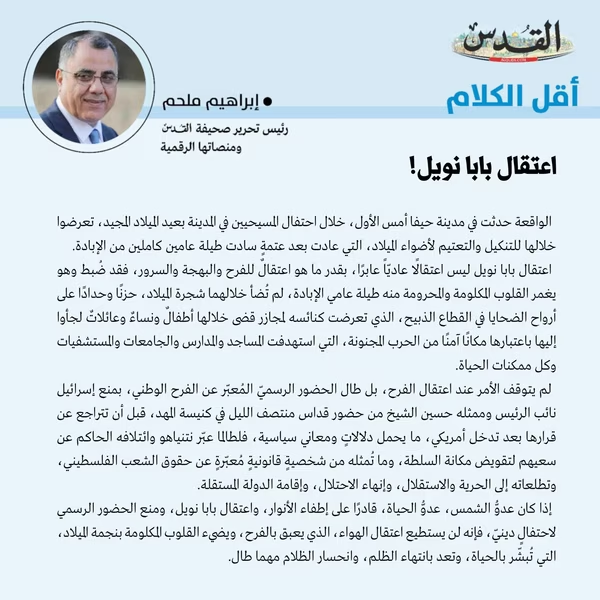
Arrest of Santa Claus!

Ibrahim Milhem

Ibrahim Milhem

Opinion Writer

The incident occurred in the city of Haifa the day before yesterday, during the Christians' celebration in the city of the glorious Christmas, during which they were subjected to mockery and the blackout of Christmas lights, which returned after a darkness that prevailed for two full years of extermination.

The arrest of Santa Claus is not an ordinary fleeting arrest, but rather an arrest of joy, happiness, and delight, as he was caught while flooding the hearts that were wounded and deprived of it throughout the two years of extermination, during which the Christmas tree was not lit, in mourning and grief for the souls of the victims in the slaughtered sector, whose churches were subjected to massacres in which children, women, and families perished who took refuge in them considering them a safe place from the mad war, which targeted mosques, schools, universities, hospitals, and all means of life.

The matter did not stop at arresting joy, but extended to the official presence expressing national joy, by Israel preventing the Vice President and his representative Hussein Al-Sheikh from attending the midnight mass in the Church of the Nativity, before retracting its decision after American intervention, which carries political connotations and meanings, for Netanyahu and his ruling coalition have long expressed their pursuit to undermine the status of the Authority, and what it represents as a legal personality expressing the rights of the Palestinian people, and their aspirations for freedom and independence, ending the occupation, and establishing the independent state.

If the enemy of the sun, the enemy of life, is capable of extinguishing the lights, arresting Santa Claus, and preventing the official attendance of a religious celebration, then he will not be able to arrest the air, which is fragrant with joy, and illuminates the wounded hearts with the Christmas star, which heralds life, and promises the end of injustice, and the receding of darkness no matter how long it lasts.

ARAB AND WORLD

Thu 25 Dec 2025 7:59 am - Jerusalem Time

Trump Administration Re-tests Israel's Military Superiority Equation in the Middle East

Cross-referenced information attributed to various diplomatic sources in the American capital, Washington, indicates that the administration of US President Donald Trump is conducting a sensitive review of the concept of Israel's "qualitative military edge," in the context of its preparations to conclude major arms deals with Gulf states, primarily the Kingdom of Saudi Arabia and Qatar. This review comes at a moment of extreme regional turmoil, where considerations of deterrence, alliances, and commercial interests intersect, in a scene that revives old questions about the limits of American commitment to Israel's security.

According to the sources, a high-level official from the Bureau of Political-Military Affairs at the US Department of State visited Israel last week, where he held talks described as partly aimed at addressing Israel's growing concerns. At the same time, American military officials held closed meetings in the Capitol building (Congress) with members of Congress, during which briefings were presented on potential defense deals and their implications for the military balance in the Middle East.

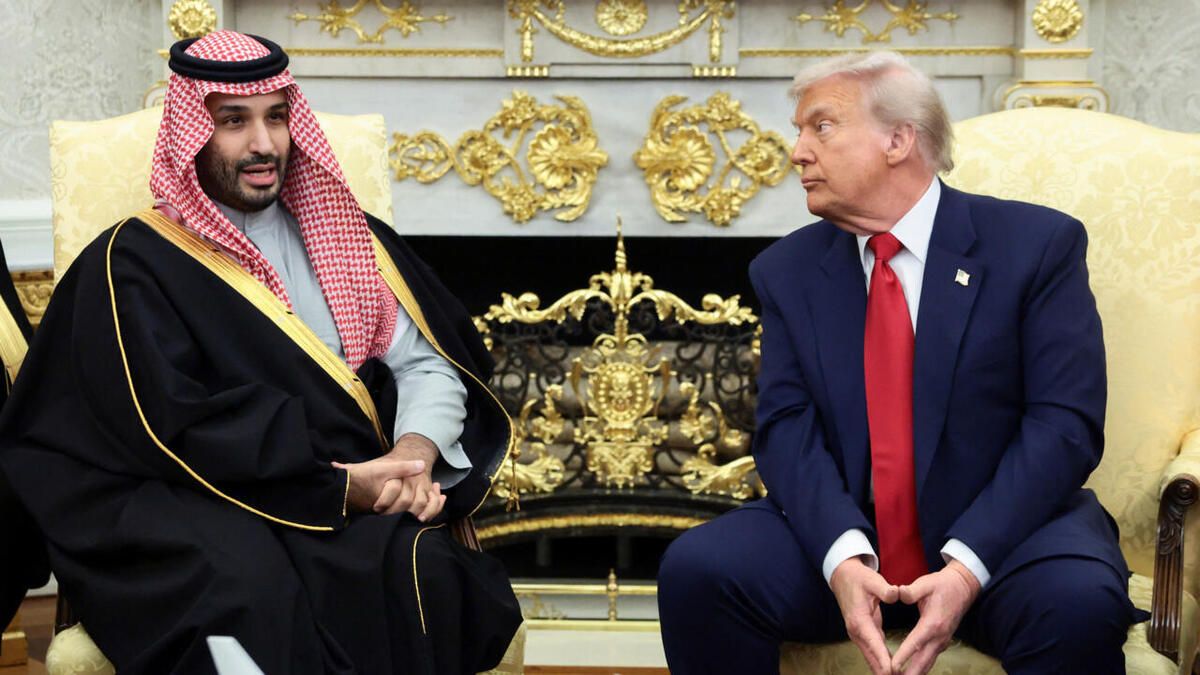
These discussions have been ongoing since the visit of Saudi Crown Prince Prince Mohammed bin Salman to Washington last November, which brought back to the forefront the file of advanced arms sales to Gulf countries. According to informed sources, the Trump administration is not only reviewing specific deals, but is also reconsidering the conceptual framework that has governed Israel's military superiority policy for decades.

An informed source told Al-Quds newspaper correspondent that this review reflects a gradual shift in American strategic thinking, where Israel's military superiority is no longer treated as a fixed given, but as an adaptable element within a broader equation that includes international competition, ensuring the loyalty of Gulf allies, and maximizing economic returns. The source, who requested anonymity, added that "this does not mean Washington is abandoning Israel by any standard, but rather redefining its position within a regional system whose balances are managed in the language of changing interests."

The Trump administration, according to informed sources, is seeking to formulate points of understanding before the end of the year, coinciding with the anticipated meeting between Trump and Israeli Prime Minister Benjamin Netanyahu on December 29, 2025. However, other sources express skepticism about the possibility of reaching a final formula at this time, given the complexities of the file and its sensitivity within the political and legislative institutions in the United States.

The discussions in Congress included members of the Senate Foreign Relations Committee and the House Armed Services Committee, and Senator Republican Lindsey Graham (from South Carolina) met with Israeli Prime Minister Benjamin Netanyahu at the beginning of this week, limiting his public statements to noting his awareness of data related to the rearming of Hamas and Hezbollah, in addition to Iran's ballistic missile program, without directly addressing the file of Gulf arms deals.

Graham's avoidance of publicly delving into the sales file reflects an awareness of its political sensitivity, not an absence of disagreement. Congress, despite Trump's repeated attempts to sideline it on military issues, still possesses effective tools to obstruct or delay arms deals. This makes any understanding with Israel insufficient unless it enjoys broad legislative coverage, especially amid growing divisions over American foreign policy.

According to leaked information, the Trump administration is studying two main deals: the first with Saudi Arabia, including the sale of F-35 fighters, and the second with Qatar within similar talks. Trump had publicly announced, during his meeting with Mohammed bin Salman (last November at the White House), his intention to sell these aircraft to the Kingdom, acknowledging that Israel is pressuring for Saudi Arabia to be provided with a less advanced version. However, the American president hinted at rejecting this proposal, affirming that both countries "are at a level that qualifies them to obtain the latest aircraft."

In contrast, Israel shows increasing concern that the influx of advanced weapons to Arab countries will lead to the erosion of its qualitative military superiority. This concern is inseparable from recent regional tensions, including Israel's targeting of Hamas negotiators in Doha, and Netanyahu's public opposition to selling F-35 fighters to Saudi Arabia.

The paradox is that Israel, which has built its security strategy for decades on monopolizing military superiority, today faces a more fluid regional environment, where power is measured by the ability to build flexible alliances, not by technological superiority alone. With Gulf countries seeking to expand their defense partnerships with Washington, maintaining Israel's superiority becomes a political negotiation matter, not an automatic guarantee.

The concept of Israel's qualitative military edge dates back to the Cold War era, when the United States was keen to ensure Israel's superiority over its Arab neighbors, especially after signing the peace treaty with Egypt in 1979. This concept was legally enshrined in 2008, with the obligation on the American administration to conduct periodic assessments of any arms sales to the Middle East.

Israel is the only country that enjoys an unprecedented right to modify American weapons systems, including F-35 fighters, in terms of software, stealth systems, and radar. However, these privileges, which have long formed the cornerstone of Israel's superiority, now appear to be subject to re-testing amid accelerating regional and international changes.


PALESTINE

Thu 25 Dec 2025 7:57 am - Jerusalem Time

Silent Takeover: How the Occupied West Bank is Being Forcefully Reengineered

The New York Times revealed in an extensive journalistic investigation published last Sunday a grim picture of what is happening away from the spotlight in the West Bank, where Palestinian villages are turning into a daily stage for a systematic land seizure operation. The investigation documents how settler attacks, supported by negligence or direct intervention from the Israeli army, have become a central tool to force Palestinians to abandon their historical lands. In the village of Al-Mughayyir northeast of Ramallah, the seventy-year-old farmer Rizq Abu Na'im recounts how his land is invaded weekly by herds led by armed settlers, who destroy olive trees and deplete water sources, in a clear attempt to push him and his family into forced displacement from land they have lived on for successive generations.

Abu Na'im's story, as presented in the investigation, is not an isolated incident, but part of a recurring pattern that has accelerated since the outbreak of the war on Gaza in October 2023. While the world was preoccupied with scenes of destruction in the sector, the West Bank was witnessing profound field transformations, redrawing its political and demographic map at an unprecedented pace. The land that is supposed to be the core of the future Palestinian state is eroding piece by piece.

The investigation indicates that throughout the West Bank, from Hebron to Jenin, the same mechanism repeats: an unlicensed settlement outpost suddenly appears on a hill near a Palestinian village, followed by an escalation in settler attacks, from crop destruction and livestock theft, to direct threats with weapons. Then the Israeli army intervenes, not to protect the indigenous population, but to issue military orders restricting Palestinian movement or declaring their lands "closed military zones" or "state lands".

In this way, Palestinian villages are pushed into slow suffocation. Roads are closed with iron barriers, agricultural lands are isolated behind wires, and farmers are prevented from accessing their fields. In contrast, the settlement outposts expand to become full settlements, with bypass roads built for them and schools and homes constructed. According to data from Israeli organizations, about 130 new outposts were established during 2024 and 2025, a number exceeding the total built over the previous two decades.

Violence forms the backbone of this policy, where United Nations data indicates an unprecedented surge in settler attacks, at a daily rate that is the highest since the documentation of these incidents began more than twenty years ago. The olive harvest season, which lasts no more than a few weeks annually, turns into a period of terror for Palestinian farmers, where dozens of assaults are recorded, often ending with the expulsion of the victims, not the perpetrators.

The investigation documents in the village of Hawara south of Nablus an attack by armed settlers on two brothers while they were working on their land, before the army arrived and prevented Palestinians from returning to the fields with a temporary military decision. In Singel, a similar clash ended with the killing of a Palestinian youth holding American citizenship, in an incident officially described as "under investigation," without announcing notable results.

According to the investigation, the demolition policy completes the circle of emptying. In just one year, more than 1,500 Palestinian structures were destroyed in the West Bank, double the annual rate in the previous decade. The village of Al-Ma'arjat al-Sharqiya in the Jordan Valley provides a stark example: a violent nighttime attack carried out by masked settlers, followed by mass displacement of residents, then gradual demolition of the remaining homes, while the army merely said it did not detect "violent events."

In all these facts, the imbalance in the scales of justice is evident. Settlers are subject to Israeli civil law and are rarely held accountable, while Palestinians are subject to military law that allows arrest without charges, and land confiscation without an actual judicial process. The Palestinian Authority, with limited powers, appears unable to protect its people, while the occupation consolidates its full control over the land.

The right-wing Israeli government does not hide its orientations. Statements by prominent ministers explicitly affirm that settlement expansion aims to bury the two-state solution. With the continuation of international silence, Palestinians' fears are increasing that what is happening is no longer reversible, and that the West Bank is being pushed toward a permanent reality of fragmentation and isolation.

What the facts in the West Bank reveal cannot be separated from the concept of settler-colonialism, where extremist civilian groups, protected by regular military force, are used to achieve long-term political goals. This model allows the state to deny direct responsibility, despite the fact that the field results clearly serve its project.

The international role, especially the Western one, is characterized by blatant hypocrisy. While warnings are repeated that settlement undermines peace opportunities, political and diplomatic support for Israel continues without effective conditions. This contradiction turns international law into a rhetorical tool with no practical effect.

According to experts, if these dynamics continue, the occupied West Bank is heading toward a model of isolated cantons, where Palestinians live in besieged pockets without sovereignty or political horizon. Then, the question will no longer be about the two-state solution, but about the nature of a permanent system of control and inequality, and its ethical and security implications for the region and the world


ARAB AND WORLD

Thu 25 Dec 2025 7:54 am - Jerusalem Time

Trump and Netanyahu at a Crossroads: Potential Escalation with Iran versus Cementing Gaza Ceasefire

Israeli Prime Minister Benjamin Netanyahu is heading to the Mar-a-Lago resort in Florida, where he will meet US President Donald Trump on Monday, December 29, in a visit that reflects a growing divergence in priorities between the two sides. While Netanyahu seeks to push for a renewed military confrontation with Iran, considering it Israel's most prominent strategic threat, Trump focuses on a different goal: pressuring Netanyahu to proceed with the second phase of the Gaza ceasefire agreement and prevent the region from slipping into a broader regional confrontation.

From Netanyahu's perspective, Iran remains the cornerstone of Israel's security doctrine. Recent Israeli intelligence estimates indicate that Tehran is working at an accelerated pace to restore its military capabilities damaged in recent months, including missile infrastructure and the development of deterrence means, alongside strengthening the influence of its regional allies. Netanyahu believes that delaying the confrontation gives Iran additional time to rebuild its strength, raising the cost of any future military action.

In contrast, Trump adopts a more cautious approach toward engaging in a new conflict in the Middle East. The US President, who strives to present himself as a deal-maker rather than a leader of open-ended wars, recognizes that any direct confrontation with Iran could entail broad political and economic repercussions, not only on the region but also on global US interests. From this standpoint, Trump sees maintaining the de-escalation path in Gaza as an immediate priority.

The second phase of the Gaza ceasefire gains particular importance, as it goes beyond the mere exchange of prisoners and hostages that characterized the first phase, to include a more sustainable halt to military operations, expanding the entry of humanitarian aid, and opening initial discussions on the future administration of the sector after the war. The Trump administration believes that achieving progress in this phase constitutes a fundamental condition for relaunching broader diplomatic paths in the region, including regional normalization projects, which would be severely damaged in the event of a war with Iran.

This divergence places Netanyahu before a complex domestic political equation. His government relies on a fragile alliance that includes extreme right-wing forces that reject any concessions in the Gaza file and push for constant escalation with Iran. Moreover, exploiting external threats has long been a political tool for Netanyahu to divert attention from internal crises, including widespread criticism of his war management, and accumulating judicial and popular pressures.

In contrast, Trump possesses effective leverage tools over the Israeli government. The United States remains Israel's most important military and diplomatic supporter, and Trump can threaten to reduce political cover, slow down arms supplies, or even issue public messages reflecting Washington's impatience with the continuation of the war in Gaza. Moreover, the personal and informal nature of the meeting at Mar-a-Lago gives Trump a wider margin to present direct demands without adhering to traditional diplomatic frameworks.

Regional calculations play an additional role in Trump's position. The Gulf states, despite their hostility toward Iran, do not desire a comprehensive war that threatens the stability of energy markets and their economies. Egypt and Qatar, the main mediators in the Gaza file, also pressure Washington to prevent any escalation that could undermine de-escalation efforts. For Trump, pushing Israel toward completing the ceasefire aligns with the interests of regional partners he relies on in multiple files.

Accordingly, the meeting is not expected to witness a public rupture, but it may reveal a reordering of priorities. Netanyahu may seek American guarantees to continue containing Iran through sanctions, intelligence work, and regional deterrence, without going to a direct military confrontation at the present time. In contrast, Trump will try to frame progress in Gaza as a strategic necessity to prevent a broader war, not as a political concession.

In conclusion, the Mar-a-Lago meeting reflects a deeper struggle between the logic of escalation and the logic of containment. Netanyahu's ability to reconcile his demands regarding Iran with Washington's pressures on Gaza will be a true test of the strength of the US-Israel alliance in a highly turbulent regional phase.

This divergence between Netanyahu and Trump reveals a growing gap between Israel's narrow security calculations and the broader American vision for regional stability. While Israel sees military force as a permanent preventive tool, Washington has become more aware of the political and economic cost of open-ended wars. This shift reflects an increasing American realization that managing crises, not igniting them, has become a condition for maintaining influence.

In contrast, the question arises about the extent of Netanyahu's ability to maneuver without colliding with his domestic reality. Responding to American pressures in the Gaza file may threaten the cohesion of his government, while ignoring them may expose his relationship with Washington to the most serious test in years. This dilemma illustrates that the crisis is no longer confined to foreign policy, but has become a direct reflection of a governance crisis within Israel itself.


PALESTINE

Thu 25 Dec 2025 4:22 am - Jerusalem Time

Clashes and Raids in the West Bank.. and Settlers Continue Their Attacks

Clashes erupted between Palestinians and the Israeli army during its raids on scattered areas in the occupied West Bank, on Wednesday evening, while settlers continued their attacks against Palestinians and their property.

With the occupation forces raiding the town of Silat al-Harithiya, west of Jenin, and the town of Anabta, east of Tulkarm, in the north of the West Bank.

The occupation soldiers assaulted a young man from the town of Kafr al-Labad, east of Tulkarm, which reported that a force from the occupation army raided the town, spread out in its streets and alleys, stopped citizens, detained a number of them, and assaulted one of them with severe beating.

An Israeli force raided the village of Madama, and fired a barrage of sound bombs and tear gas canisters towards citizens' homes, and closed the main entrances to the village and prevented citizens from passing.

Occupation vehicles carried out a large-scale demolition operation in the Rawabi al-Eisawiya area in the occupied city of Jerusalem. The Jerusalem governorate announced that the demolitions affected 4 residential apartments housing 18 individuals, in addition to agricultural facilities belonging to the Abu Riyala family on the pretext of lack of licensing.

In the center of the West Bank, Palestine Voice Radio (official) said that clashes took place between Palestinian youths and the Israeli army near the entrance to the Jalazoun refugee camp, north of Ramallah city, without indicating any injuries.

It said that the Israeli army raided the villages and towns of Yabrud, Silwad, Kafr Malik, and Turmus Ayya, north of Ramallah, and the town of Beita and the villages of Burin, south of Nablus city.

In the south of the West Bank, eyewitnesses said that the Israeli army raided the town of Sa'ir, north of Hebron city, and fired sound bombs.

In the context, residents thwarted an attack by settlers on the Omriyin gathering on the outskirts of the Mughayyir village, northeast of Ramallah, before the army intervened and fired bullets towards the Palestinians, without any source indicating recorded injuries.

Since the start of the genocide war on Gaza that lasted two years, the Israeli escalation in the West Bank, including occupied Jerusalem, has led to the martyrdom of at least 1103 Palestinians, the injury of nearly 11,000, and the arrest of more than 21,000, according to Palestinian data.

Meanwhile, the genocide launched by Israel with American support in Gaza on October 8, 2023, has left nearly 71,000 martyrs and more than 171,000 injured, mostly children and women, in addition to massive destruction, with reconstruction costs estimated by the United Nations at around 70 billion dollars.

ARAB AND WORLD

Thu 25 Dec 2025 3:18 am - Jerusalem Time

Israeli barrier in the Damascus countryside.. What is the truth of the circulating image?

Accounts and pages on social media sites circulated a picture of a military barrier next to an Israeli flag, and a sign that sparked controversy.

The circulating image shows Israeli soldiers under a large sign, written on it "Sleep soundly, O Muawiyah. For Damascus is ours until the Day of Judgment", with the Syrian flag, the phrase Youth of Construction and Renewal, and the word Damascus.

Circulators of the image claimed that it is of a military barrier recently established by the Israeli army in a village in the Damascus countryside, at a point where supporters of the Syrian government hung the aforementioned sign.

Old composite images

Upon verifying the circulating image, the website for combating fake news and information "Masbar" found that the claim is false, and that the image is composite.

According to the site, the original image dates back to 2022, and shows an Israeli barrier on the Jordanian border, specifically at the crossing point on the Israeli-Jordanian border in Wadi Araba, and was taken on April 30, 2020.

The site also added that the Jordanian flag can be observed in both the original and circulating images.

The site indicated that the original image was modified by adding visual elements, including the sign written on it: "Sleep soundly, O Muawiyah, for Damascus is ours until the Day of Judgment".

After "Masbar" conducted a reverse search for the sign appearing in the circulating image, it reached similar images published on social media sites with differences in the scene's background.

The original advertising sign shows the name "Noor Al-Salam Bakery" accompanied by the phone number 71615831, which after searching and verifying, turned out to be located in the Manara area in Lebanon.

A furniture transport vehicle also appeared, written on it "Furnishings for Brazil", and upon searching for the product name, it turned out to be a company existing in Lebanon.

The circulation of the alleged image comes as the Israeli occupation army continues to carry out repeated incursions in southern Syria since the fall of the Assad regime on December 8 last year.

PALESTINE

Thu 25 Dec 2025 1:03 am - Jerusalem Time

Occupation sources: The launch of the second phase of the Gaza agreement is contingent on a meeting between Netanyahu and Trump

Occupation sources: The second phase of the Gaza agreement will not begin before the return of the last detainee's body.

It was conveyed from informed sources that the current estimates indicate that the second phase of the ceasefire agreement in the Gaza Strip will begin after the anticipated meeting between Israeli Prime Minister Benjamin Netanyahu and US President Donald Trump.

And in the same context, the sources revealed that the implementation of this phase will not enter into effect before completing the operation of returning the body of the last detainee held by resistance factions in the sector.

PALESTINE

Wed 24 Dec 2025 5:18 pm - Jerusalem Time

Abbas explains the details of stopping the allowances for prisoners and martyrs and the role of the 'Tamkeen' institution

Following a wave of anger due to the Palestinian Authority stopping allowances and salaries for prisoners and martyrs, expressed by official and human rights institutions and members of the Central Committee of the Palestinian National Liberation Movement 'Fatah', the Palestinian President Mahmoud Abbas issued a statement clarifying the circumstances of stopping prisoners' allowances, the role of the 'Tamkeen' institution to which their files were referred, and linking this to the reform program adopted by the Palestinian leadership.

And Abbas confirmed in the statement -whose text was published by the official Palestinian news agency- 'with clarity and no ambiguity, that honoring the sacrifices of our righteous martyrs, our heroic prisoners, our wounded, and their steadfast families, is a firm national and moral commitment, not subject to bidding or political exploitation, and it is not permissible to use it as a means for incitement or to provoke division or harm our legitimate national state institutions'.

And he pointed out that the decision by law number (4) for the year 2025, related to the Palestinian National Institution for Economic Empowerment aimed at unifying social protection and care programs under the administration and responsibility of one national institution, which is the institution to which prisoners' allowances were referred, comes within a comprehensive reform vision 'aimed at unifying and organizing the social protection and care system, ensuring justice, transparency, and sustainability in providing allowances, according to adopted objective and professional standards, and in a way that preserves the dignity of beneficiaries and safeguards their rights'.

Incitement and distortion

In this context, Abbas confirmed that 'Tamkeen' is an official national institution with an executive character, working exclusively on implementing policies and decisions issued in accordance with legal provisions, and does not possess any legislative or political powers.

And he continued that 'burdening the institution or those in charge of it with responsibilities outside the framework of its legal role is considered mixing the cards, and unjustified harm to a national institution performing its duty within the framework of the unified reform and social protection system'.

And in last February, the Palestinian President issued a presidential decree 'to cancel the provisions in the laws and regulations related to the system of paying financial allowances to families of prisoners, martyrs, and wounded, in the Prisoners' Law and the regulations issued by the Council of Ministers and the Palestine Liberation Organization' and referred the powers of all social protection and care programs in Palestine to the 'Tamkeen' institution.

And the Palestinian President added in his statement that he follows 'with interest and responsibility the discussions and campaigns raised on some social media platforms, and what sometimes accompanies them of incitement and distortion of facts, which does not serve the supreme national interest, and does not align with the magnitude of the existential challenges we face' in reference to a wide campaign against the institution for not disbursing prisoners' allowances.
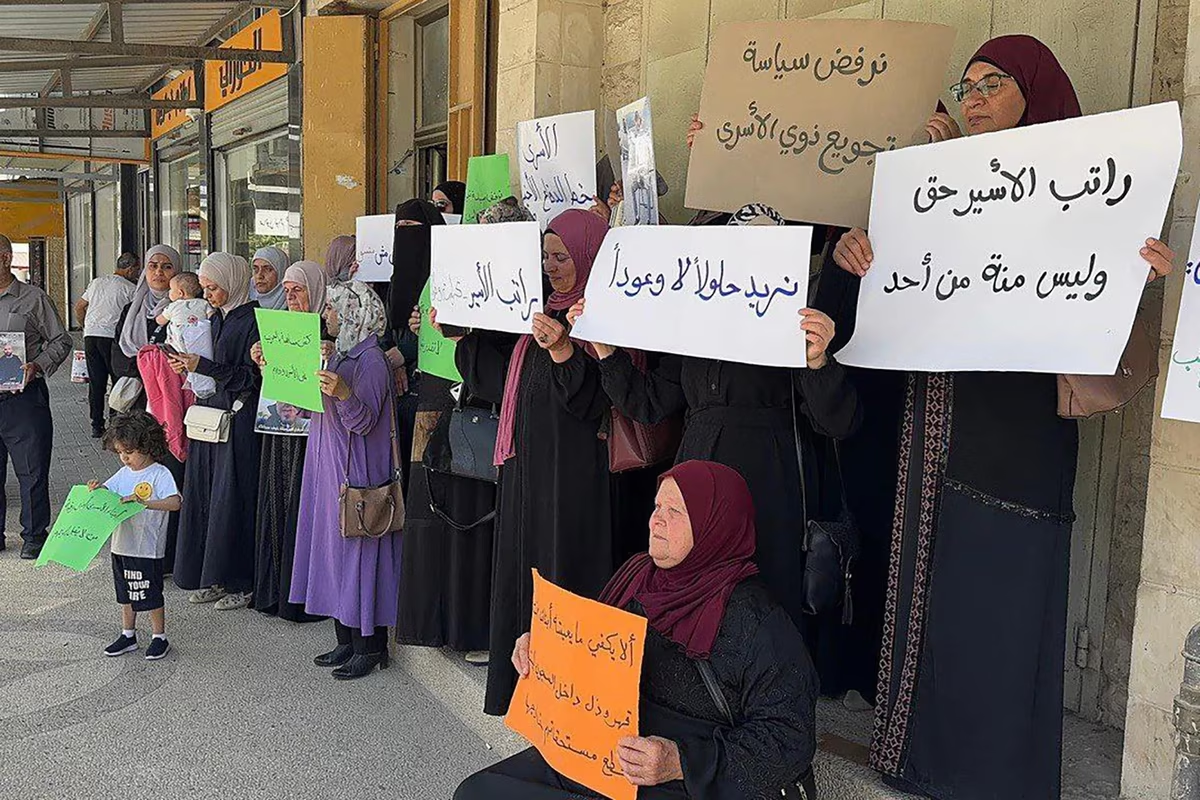
Abbas cancels the financial systems for paying prisoners' and martyrs' allowances and refers them to Tamkeen institution (social media sites)

Continuing with reforms

And the Palestinian President pledged to continue implementing a comprehensive national reform program, aimed at developing and updating the legal and institutional system of the State of Palestine, consolidating the rule of law, enhancing principles of good governance, transparency, accountability, and ensuring the separation of powers, in a way that serves the public interest and strengthens citizens' confidence in their state's institutions.

And he continued that the reform program includes 'reviewing and updating the laws regulating political, administrative, economic, and social life, and foremost among them the laws related to financial governance, public administration, judiciary, combating corruption, and enhancing the independence of oversight institutions, in a way that ensures efficiency of performance and fairness of application'.

And he affirmed his commitment 'to completing constitutional and political reform, including working on preparing the necessary constitutional frameworks for the organized transition from the national authority stage to the state stage, updating election laws, and issuing a modern law for political parties, on clear democratic bases, ensuring commitment to the political program of the Palestine Liberation Organization, international legitimacy, the two-state solution principle, the single law, and the single legitimate weapon'.

And he pointed out that the reform program also includes developing the education sector 'including reviewing and updating educational curricula according to international standards, in a way that aligns with our Palestinian national identity, and enhances values of tolerance, respect for the law, rejecting violence and incitement, without harming our fixed national rights or our historical narrative'.

And he emphasized that 'preserving our national unity, protecting civil and societal peace, and safeguarding our legitimate institutions, form basic pillars for confronting the occupation and its aggressive plans, and it is not permissible to allow any inciting or slanderous discourse to distract our national compass or weaken our internal front'.

Anger from 'Tamkeen'

And the recent days witnessed a wave of widespread anger from the 'Tamkeen' institution for not disbursing allowances to families of prisoners and martyrs, while the institution says that its work is governed by the law.

And on December 18 of this year, the institution confirmed in a statement the cancellation of the application of previous legislation related to prisoner payments, and that it does not, and will not, disburse any financial payments to families of prisoners or martyrs or wounded based on any legislation, or social allowances except according to the social research system.

And on Sunday, the head of the Prisoners and Ex-Prisoners Affairs Department affiliated with the Palestine Liberation Organization, Raed Abu Al-Hummus, responded to the institution's statement, calling for its exclusion from all details of the scene in disbursing allowances for families of martyrs, prisoners, and wounded, 'for what its policies carry of denial of the struggles of our people's sons'.

And Abu Al-Hummus called on the Central Committee of Fatah Movement to adopt a statement issued by him on this matter by member of the committee Tawfiq Tirawi 'as an official position' from Fatah Movement.

And Tirawi said in his statement that imposing social survey forms on prisoners and their families, and linking their financial and moral rights to evaluations and standards that do not befit their struggle history 'is a nationally and morally rejected behavior, and opens the door to branding this institution with suspicious behaviors that contradict national constants and our people's dignity'.

And he added that 'prisoners, wounded, and families of martyrs are not a social burden or emergency humanitarian cases, but they are the vanguard of the Palestinian national movement, and their rights are a national and legal duty not subject to discussion, bargaining, or reclassification'.

And Abu Al-Hummus said that Tirawi's statement 'came at a time when we found hundreds and thousands of prisoners and released prisoners, most of them leaders and cadres from Fatah Movement who spent long years in prison, alongside thousands of families of martyrs and wounded in a state of tension and confusion, due to the policies and decisions taken by Tamkeen institution, which wanted to turn categories of fighters into special social categories, according to a social survey form'.

Israeli and American pressures

And for years, the Palestinian Authority has been subjected to Israeli and American pressures because of paying allowances to families of prisoners and martyrs, where Israel deducts from Palestinian tax funds amounts equivalent to those paid to those families.

But despite several months having passed since stopping prisoners' allowances, Israel has not released the tax funds that exceeded 4 billion dollars, but continues to withhold the full funds, which has made the Authority unable to pay its employees' salaries in full.

And in 2018, Congress issued a law to prevent the Palestinian Authority from paying benefits to individuals from families of Palestinian martyrs and prisoners. And the law prevents the American government from providing economic aid that would directly benefit the Palestinian Authority until it stops providing these benefits.

And until 2020, the number of released prisoners' accounts reached 7500, while the total bill is approximately 50 million shekels (15.6 million dollars) monthly, according to previous data from the Prisoners Affairs Department

ARAB AND WORLD

Wed 24 Dec 2025 4:47 pm - Jerusalem Time

Trump Welcomes Netanyahu in Florida.. Thorny Files and Political Price

It is expected that US President Donald Trump will meet Israeli Prime Minister Benjamin Netanyahu, who is wanted by the International Criminal Court on charges of committing war crimes in Gaza, next Tuesday in Miami, Florida.

All eyes will be on the summit outcomes regarding ways to implement the second phase of the Gaza agreement, amid an atmosphere of disagreement between the two presidents on several points, including the timing of the start of the second phase of the Israeli withdrawal from the sector, the nature of forming the international force, and disarming the Islamic Resistance Movement (Hamas). The meeting will also address other thorny files, such as Lebanon, Syria, and Iran, and the future of US aid to Israel.

Former US State Department official Anne Slaughter said that "Trump's 20-point plan is highly flawed, and many of its aspects are not feasible."

Slaughter, who currently works as an expert at the Quincy Institute in Washington, added that "Arab forces will not be prepared to take on the role of occupying force and perform its tasks, nor will they be able to operate to maintain peace and protect the population from Israeli aggression. The United States should not take on this role either," considering that this task was impossible in Iraq and Afghanistan, and that most Americans have no interest in repeating it.

On the other hand, the Iranian file will be at the top of the agenda that Netanyahu will push during the meeting, and during his current visit to Tel Aviv, Senator Lindsey Graham, known for his closeness to Trump and his adoption of Israeli positions, stated that Tehran "still poses a great danger to Israel and Washington's interests in the region, by possessing a strong and massive missile arsenal."

After six months of Washington destroying Iranian nuclear facilities and supporting Israeli attacks on them, talk in the United States has renewed about the dangers of Iran's ballistic missile program and air defenses. Netanyahu and his team are preparing to brief Trump on Tel Aviv's fears that Tehran is expanding its ballistic missile program with China's help.

However, at the same time, Trump realizes that the broad support for Israel has caused a deep rift that is sweeping through the unity of his right-wing Republican stream, as clearly appeared in the annual conference event of the Charlie Kirk organization last weekend.

Osama Khalil, professor of international relations at Syracuse University in New York, said that "the Trump MAGA alliance focuses loosely on economic issues and putting America first. However, this current has faced Trump's strongly supportive policies towards Israel. With the promises Trump made to donors supportive of Tel Aviv like billionaire Miriam Adelson, this shakes the base of his political alliances."

Khalil considered that with the continuation of the Trump administration providing large amounts of economic and military support to Israel to continue the war in Gaza and expand it to Lebanon, Syria, Yemen, and Iran, this contradicts the US president's claim that he wanted to stop his country's involvement in foreign military adventures, with many of his allies expressing increasing criticism of Israel's genocide war in Gaza, including influential media figures in the MAGA movement.

In Israel, the upcoming meeting between Trump and Netanyahu is viewed as a highly sensitive political station, coming amid the continuation of bombing on the Gaza Strip, and the growing disagreements between the two sides on central regional files, most notably Iran, Lebanon, and Syria.

According to Israeli estimates, Netanyahu enters this meeting facing a complex task that has pushed Tel Aviv to conduct intensive discussions at the highest political and security levels, aiming to formulate a unified position and try to convince Trump to adopt the Israeli vision in issues it considers strategic.

These issues are topped by the demand to disarm Hamas and Hezbollah, and to tighten the stance towards Iran, especially in what Tel Aviv describes as the acceleration of ballistic missile production. Meanwhile, Israeli sources doubt Trump's readiness to give the green light for broad raids that could lead to a major regional escalation, whether in Gaza or Iran.

Military and intelligence analyst in "Yedioth Ahronoth" newspaper Ron Ben-Yishai wrote that this American hesitation reflects the essence of the disagreement between Washington and Tel Aviv, as Trump prefers to manage these issues with broader political calculations, and avoid slipping into open military confrontations.

With Netanyahu's pursuit of decisive American support, and Trump's desire to curb escalation and impose his own priorities, the upcoming meeting - according to Ben-Yishai - seems governed by a delicate balance between partnership and disagreement, making it a real test of the nature of the relationship between the two sides in a highly sensitive regional stage.

For his part, military analyst in "Haaretz" newspaper Amos Harel believes that Netanyahu is seeking to convince the US president to disarm Hamas and Hezbollah, maintain Israel's military superiority, and confront Iranian and Turkish influence, especially in Syria and Gaza.

Harel pointed to cautious Israeli optimism regarding the Lebanese government's progress in disarming Hezbollah, especially in southern Lebanon, with the possibility of moving to a second phase north of the Litani River, provided that it remains linked to international understandings and Washington's position.

In the Gaza file, the main disagreement focuses on the second phase of the ceasefire, as Israel fears - according to him - symbolic steps by Hamas that could open the door to international pressures for withdrawal, while Netanyahu conditions the recovery of the last captive's body and an actual disarmament of the movement's weapons before any political progress.

On the Iranian issue, Harel says that Tel Aviv realizes that Trump is not enthusiastic about military confrontation and does not see Tehran as an urgent priority for escalation, which weakens the bet on American green light for a broad strike and pushes Netanyahu to rely on political and intelligence pressure instead of the military option.

For his part, former Israeli Army spokesperson Avi Benayahu described the files on the table as "a herd of goats heading calmly to Mar-a-Lago," referring to Trump's private residence in Florida, hinting at Israel's readiness to pay high political and security prices behind this apparent calm.

He explained in an article in "Maariv" newspaper that these files include curbing Tel Aviv's response in Gaza, Syria, and Lebanon, moving to the second phase of Trump's plan, and the possibility of supplying Turkey and Saudi Arabia with advanced weapons, most notably F-35 fighters, in addition to "giving Ankara and Qatar a role in Gaza and presenting other surprises during the meeting."

According to Benayahu, Trump will show emotional and political support for Netanyahu, and may renew his talk about pardoning him, but it will not be free, as it will be met with a clear political price and concessions amid major regional challenges.

ARAB AND WORLD

Wed 24 Dec 2025 4:43 pm - Jerusalem Time

Israeli Defense Minister threatens to continue military operations in Lebanon, Syria, Gaza, and Yemen

On Wednesday, Israeli Defense Minister Yisrael Katz threatened to continue military operations in Lebanon, Syria, Gaza, and Yemen, despite international and regional efforts to calm the situation and restore stability to the region.

This came in a speech at the end of a training course for Israeli army pilots, attended by Prime Minister Benjamin Netanyahu and Chief of Staff Eyal Zamir, according to the Hebrew newspaper "Maariv".

Katz said that "Israel will continue its operations in Lebanon, Syria, Gaza Strip, and Yemen," despite the existence of cease-fire agreements.

He added: "In Lebanon, we will continue to apply maximum force against Hezbollah, and in Syria, Israel will not withdraw from Mount Hermon and the security zone, and in Gaza Strip, Israel is committed to dismantling Hamas and disarming the sector."

He continued: "Regarding Yemen, Israel will continue its operations to prevent the Houthis from strengthening their power."

PALESTINE

Wed 24 Dec 2025 4:27 pm - Jerusalem Time

Netanyahu threatens to respond to Hamas' 'violation' of the ceasefire

Israeli Prime Minister Benjamin Netanyahu threatened in a statement issued from his office today, Wednesday, to "respond" to what he called "the violation by the Islamic Resistance Movement (Hamas) of the ceasefire".

Netanyahu claimed that Hamas "continues to violate the ceasefire and the 20-point plan of US President Donald Trump", adding that the movement must adhere to the agreement.

He continued: "Hamas' open and ongoing refusal to disarm is a blatant and continuous violation, and its violent intentions and violations have been confirmed today", as he claimed.

Earlier today, the Israeli army said in a statement that an officer was injured by the explosion of an explosive device that targeted an armored vehicle in Rafah, southern Gaza Strip.

According to the army's statement, the field officer suffered minor injuries and was transferred to the hospital for treatment.

Netanyahu indicated in the statement issued from his office that "Hamas must be held accountable for the agreement it signed, which includes its exclusion from governance, disarmament, and combating its extremism, and Israel will respond accordingly".

The Israeli Prime Minister threatened by saying: "We will not be satisfied with what we have achieved, as our enemies are rearming themselves to strike us again".

Despite Netanyahu's claims, Hamas and Palestinian resistance factions have repeatedly affirmed their commitment to the ceasefire and the agreement to stop the war in Gaza, which entered into force on October 10 last year.

Since then, Israel has violated the agreement several times, continuing to demolish buildings in the Gaza Strip and preventing the entry of sufficient humanitarian aid to meet the needs of the sector's residents.

On Monday, the Government Media Office in Gaza announced that it recorded 875 Israeli violations of the ceasefire agreement since October 10, resulting in 411 martyrs and 1,112 injured.

PALESTINE

Wed 24 Dec 2025 2:57 pm - Jerusalem Time

Israeli Occupation Army: Officer Injured in Explosion of Explosive Device Targeting Armored Vehicle in Rafah

The Israeli occupation army acknowledged on Wednesday that one of its armored vehicles was exposed to the explosion of an explosive device during operational tasks in the city of Rafah, southern Gaza Strip.

The explosion resulted in an officer being injured with wounds described as minor, following which he was transferred to the hospital for treatment after informing his family of the incident.

The explosion damaged an armored personnel carrier that was active in the area, while the military apparatuses opened a comprehensive investigation to determine the timing in which the device was planted, and whether it was placed before the force's arrival or during the field movement path.

These developments come amid the continuation of fierce confrontations in various axes of penetration inside the sector, where Palestinian resistance factions rely on setting ambushes and mining paths to hinder the advance of vehicles.

This targeting reflects the complexity of the security scene inside Rafah's neighborhoods, which still witness military operations despite the heavy fire density of the occupation forces.
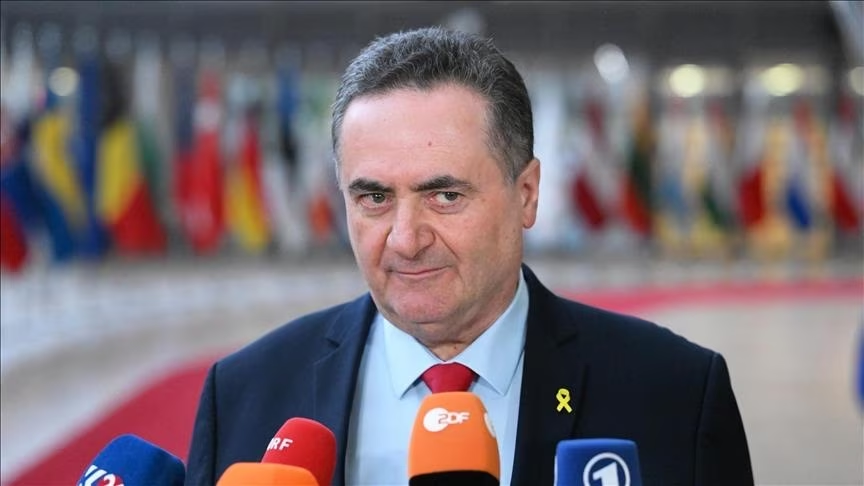
PALESTINE

Wed 24 Dec 2025 2:11 pm - Jerusalem Time

Al-Hindi: The Palestinian people's weapon cannot be handed over to the Israeli occupation

Mohammed Al-Hindi, Deputy Secretary-General of the Islamic Jihad Movement, affirmed that the Palestinian people's weapon cannot be handed over to the Israeli occupation.

Al-Hindi said in an interview with "Al-Masa'iya" yesterday Tuesday (23/12/2025) that there is an increasing need for this weapon, given the occupation's continued violations of the ceasefire agreement.

He emphasized that the resistance weapon will remain in the hands of the Palestinian people and will not be handed over to any party.

Regarding what has been circulating about the resistance proposing a truce with the occupation, Al-Hindi clarified that the resistance showed flexibility with the mediators regarding reaching a truce with the occupation, confirming that the resistance did not propose a specific time period for this truce.

On the second phase of the ceasefire agreement, Al-Hindi said that Israel is the one placing obstacles and conditioning the handover of the resistance's weapon, noting that the countries that will form the international force in the Gaza Strip have refused to do this.
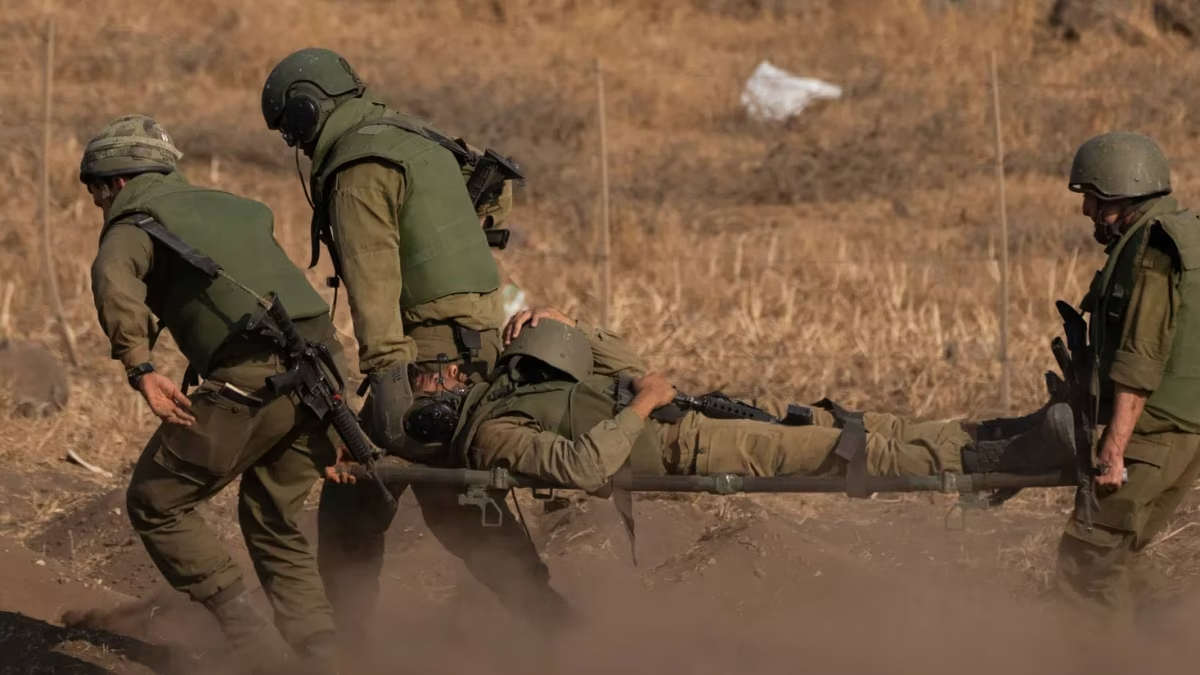
The Deputy Secretary-General of the Islamic Jihad Movement added that Israel failed to disarm the resistance over two years of war, and also rejected the participation of the Palestinian Authority in managing the Gaza Strip.
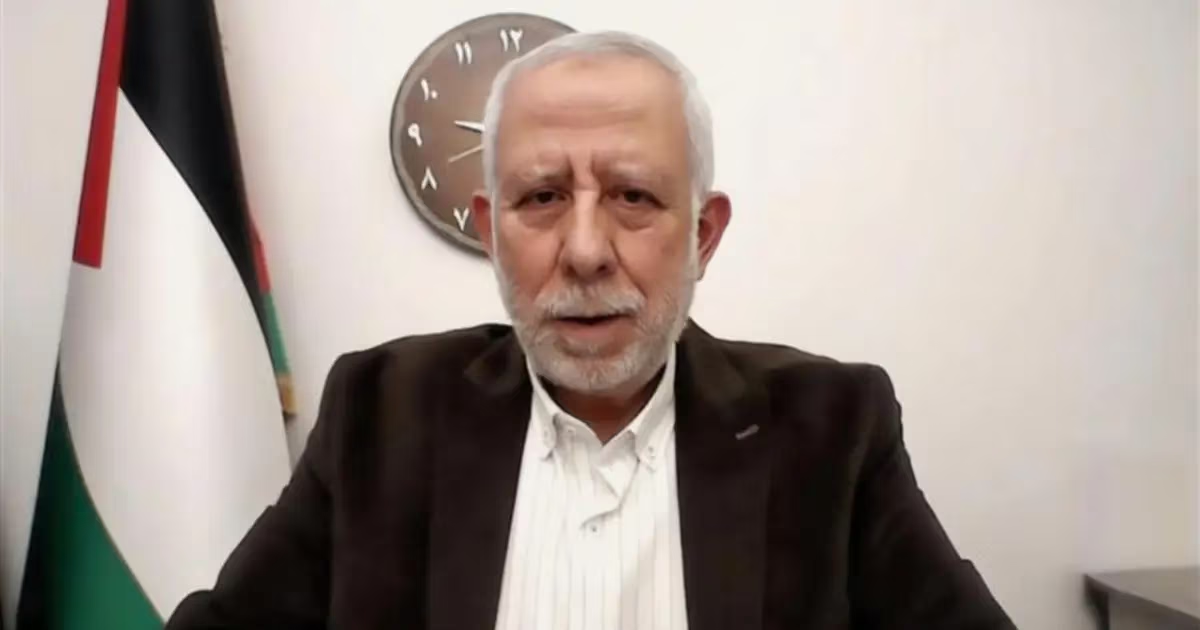
He said that the countries proposed to participate in the international force demanded more details about the locations of the force's deployment and its powers, noting Israel's rejection of Turkey's participation in the force.

Al-Hindi called on the mediators to pressure Israel to fulfill its commitments in the Gaza agreement regarding the entry of aid, warning of the continued suffering of the sector's people if Israel continues its procrastination.

PALESTINE

Wed 24 Dec 2025 9:57 am - Jerusalem Time

Jerusalem.. Inauguration of the Official Headquarters of the Chair of Moroccan Studies at Al-Quds University

Yesterday, Tuesday, at the headquarters of the Faculty of Engineering at Al-Quds University – Abu Dis, the official headquarters of the Chair of Moroccan Studies was inaugurated, in the presence of official and academic figures, led by the University President, Prof. Hanna Abdul Nour, the Ambassador of the Kingdom of Morocco to Palestine, Abdul Rahim Meziane, the Acting Director of the Bayt Mal Al-Quds Al-Sharif Agency, Mohamed Salem Al-Sharqawi, and the Chair's President, Dr. Safa Nasser Eddin.
This inauguration embodies the transition of the Chair's work from the establishment phase to the phase of institutional and knowledge empowerment, where on this occasion, summaries of the professors and students participating in the first research call of the Chair of Moroccan Studies were presented, addressing historical, cultural, architectural, and artistic axes related to the Moroccan presence in Jerusalem and its civilizational manifestations, within a specialized academic discussion, framed by the members of the Chair's scientific committee.
On this occasion, the President of Al-Quds University expressed his pride in opening the official headquarters of the Chair of Moroccan Studies within the university campus, confirming that this headquarters constitutes a distinctive aesthetic and architectural addition, and 'a valuable symbolic gift from Morocco to Palestine'.
Mr. Abdul Nour pointed out that the importance of the Chair lies in 'its documentary and academic role in studying the dimensions of the historical and urban Moroccan presence in Jerusalem, preserving the shared memory, and enhancing specialized scientific research in this field'.
For his part, the Ambassador of the Kingdom of Morocco to the State of Palestine expressed his happiness at participating in the opening of the official headquarters of the Chair of Moroccan Studies at Al-Quds University, appreciating the university's hosting of this unique academic project.
Mr. Meziane confirmed that allocating an official headquarters for the Chair represents 'an important step in consolidating its institutional presence, recalling that this Chair was born from the womb of the deep-rooted historical relationship that unites Morocco with Palestine, and embodies one of the forms of deep Moroccan solidarity with Jerusalem and the steadfastness of its people, especially in light of the symbolism of the Moroccan Quarter and the Moroccan Gate and the ancient Moroccan presence in the city'.
In turn, the Acting Director of the Bayt Mal Al-Quds Al-Sharif Agency confirmed that Al-Quds University's hosting of the Chair of Moroccan Studies 'provided it with a comprehensive academic and institutional framework that ensures its success and sustainability'.
Mr. Al-Sharqawi explained that the Agency, which operates under the supervision of His Majesty King Mohammed VI, President of the Al-Quds Committee, views education and scientific research as 'a fundamental pillar for protecting identity and supporting social stability'.
From her side, the President of the Chair of Moroccan Studies confirmed that the opening of the official headquarters of the Chair 'does not mean opening an administrative space only, but consolidating a long-term scientific and knowledge path, aimed at producing knowledge, preserving memory, and building deep research questions in the context of the Moroccan-Palestinian relationship, with Jerusalem at its heart'.
Ms. Nasser Eddin pointed out that since its establishment, the Chair 'was built as a sustainable knowledge project, not limited to studying the Moroccan presence in Jerusalem and Palestine, but starting from a broader vision concerned with the Moroccan experience in its civilizational and knowledge dimensions, with special focus on the Moroccan presence in Jerusalem as a living model of the Moroccans' contribution to protecting the city's identity, urbanism, and cultural memory'.
It is noted that the opening of the official headquarters of the Chair of Moroccan Studies comes as a culmination of a foundational academic path that began in March 2025, and constitutes a institutional base for implementing the Chair's future plan, enhancing its research presence within Al-Quds University, and consolidating the Moroccan-Palestinian academic space as a living space for producing knowledge and preserving shared memory.

PALESTINE

Wed 24 Dec 2025 9:34 am - Jerusalem Time

Belgium Officially Intervenes in the 'Genocide' Case Against the Occupation at the International Court of Justice

The State of Belgium has filed an official declaration to intervene in the legal case brought by the Republic of South Africa against the occupation before the International Court of Justice in The Hague, related to the application of the "Convention on the Prevention and Punishment of the Crime of Genocide" amid the ongoing war on the Gaza Strip.

The Court stated in a statement that this intervention was based on Article 63 of the Court's Statute, as Belgium is a party to the 1948 Convention, which grants states parties the right to participate when the interpretation of provisions is in legal dispute, and that the interpretation issued by the Court is also binding on them.

The Belgian legal contribution focuses precisely on the interpretation of Article II of the Convention, particularly regarding the "special intent" required to prove the commission of the crime of genocide.

The document submitted by Belgium included a substantive proposal stating that invoking the existence of a "military objective" does not automatically negate, from a legal standpoint, the possibility of inferring the existence of a "special intent" for genocide, thereby setting strict legal parameters for defining the crime and the requirements for proving it.

Following that, the International Court of Justice indicated that it had taken the necessary procedural measures by inviting both South Africa and the occupation to submit their written observations regarding this Belgian declaration.

This development comes to strengthen the international legal momentum of the case and completes a series of interventions from other countries seeking to participate in shaping the final legal interpretation of the Genocide Prevention Convention in this pivotal dispute.