PALESTINE

Tue 27 Jan 2026 12:02 am - Jerusalem Time

Hebrew media: America prepares to present a document on Hamas disarmament as part of a comprehensive plan

The rehabilitation task will be entrusted to the "Peace Council" proposed by President Donald Trump, which includes Turkey and Qatar as members.

Hebrew sources reported on Monday evening that the United States will deliver, in the coming days, an official document detailing the mechanism for disarming factions in the Gaza Strip, as part of a comprehensive plan to rearrange security and civilian conditions after intense American pressure.

Disarmament of factions in exchange for reconstruction and crossings

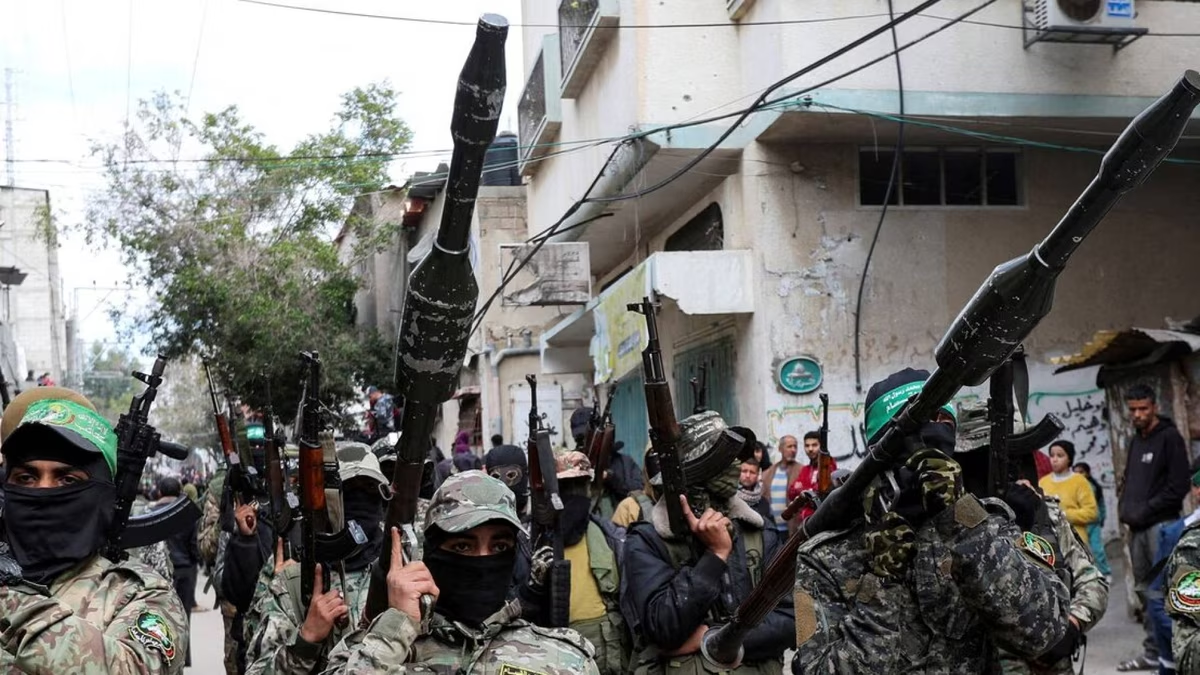
The proposed document stipulates granting the factions a grace period of several weeks to hand over their weapons to a "multinational force."

In return, the occupation will allow the opening of crossings, including the Rafah crossing in both directions, and the commencement of reconstruction of the Strip. The plan warned that if the deadline is not met, a green light will be given for military action without restrictions.

Shrinking the "buffer zone" and moving the yellow line

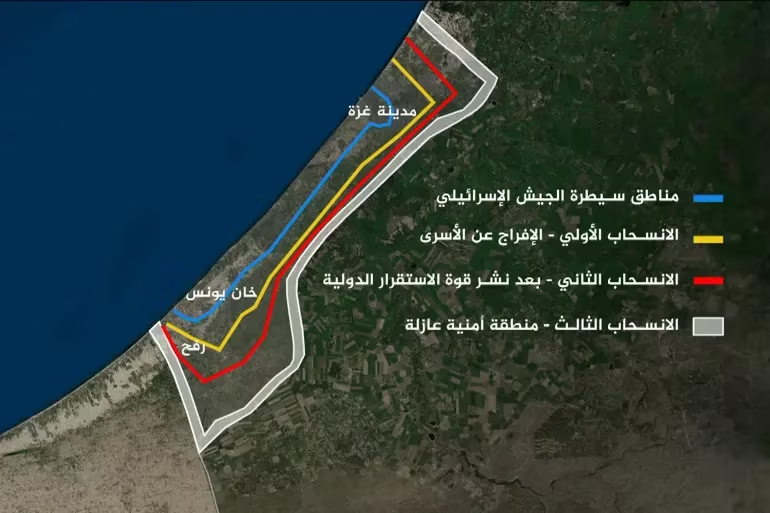
One of the most prominent features of the new plan is the gradual movement of what is known as the "yellow line" (the border between the Strip and the occupation) eastward, which means reducing the buffer zone within Gaza. This measure is part of understandings aimed at easing geographical restrictions once the disarmament process begins.

Supervision by the "Peace Council" and a technocratic government

On the civilian level, the rehabilitation task will be entrusted to the "Peace Council" proposed by President Donald Trump, which includes Turkey and Qatar as members. This council will oversee a Palestinian "technocratic" government to which civilian powers will be transferred to manage the affairs of the population in the Strip.

PALESTINE

Mon 26 Jan 2026 11:47 pm - Jerusalem Time

Agreement without withdrawal.. Israel redefines the Gaza war ceasefire on the ground

Developments in the Gaza war ceasefire agreement reveal a widening gap between what was stipulated in its provisions and what was actually implemented on the ground, as Israel transitioned from treating the agreement as a framework for de-escalation to a tool for re-establishing new field and security realities. According to the text of the agreement, Israeli forces were supposed to withdraw to the "Yellow Line" inside the Gaza Strip, as a sole line of contact where military operations would cease and the battlefield would be frozen behind it, in preparation for a subsequent phase including prisoner exchange, partial opening of crossings, gradual return of civilians, and the start of reconstruction.

However, this withdrawal was practically coupled with Israel maintaining control over more than half of the Strip's area, and linking any subsequent withdrawals to the disarmament of the Palestinian resistance and long-term security arrangements. On the ground, Israel did not treat the Yellow Line as a fixed withdrawal line, but rather as a starting point for redrawing the boundaries and depth of its control within Gaza, according to a report broadcast by sources.

Journalistic investigations supported by satellite images showed that concrete barriers were first placed at the location of the line as drawn on maps, before being pushed hundreds of meters inward into residential neighborhoods, after the destruction of dozens of buildings located between the lines. Demolition operations did not stop with the entry into force of the truce, but continued to clear entire areas around army positions and turn them into security belts devoid of residents.

During what was called a "ceasefire," hundreds of Palestinians were killed by direct Israeli fire, either by soldiers' bullets, drones, or shelling of inhabited homes, under the pretext of targeting wanted individuals or dealing with field threats. UN reports confirm that these operations occurred within areas supposedly covered by the truce, and that the Yellow Line itself was not fixed.

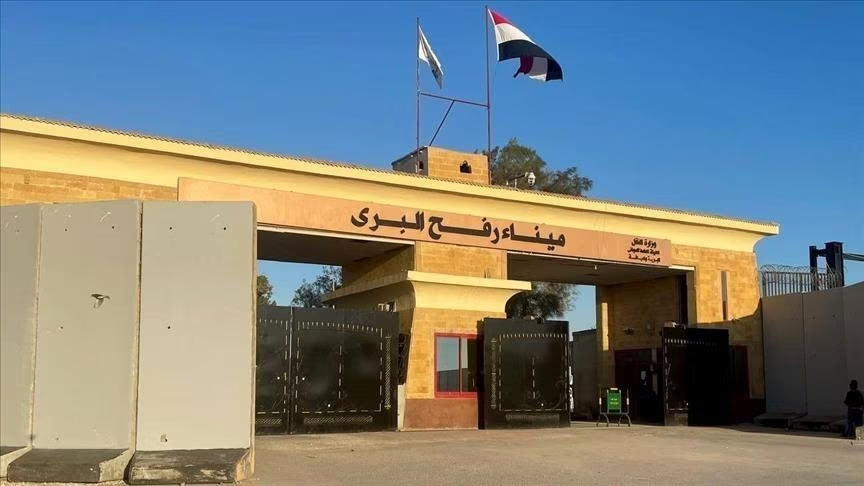
Regarding the crossings, the Rafah crossing emerged as a stark example of the gap between text and application. While the first phase spoke of a gradual opening of the crossing for humanitarian cases and movement of individuals, the crossing remained subject to strict restrictions, which transformed it from a supposed humanitarian lifeline into an additional pressure tool. In parallel, the occupation army announced during the truce the destruction of tunnels 4 kilometers long inside the Strip, considering that this was done "according to the agreement" because it was behind the Yellow Line.

With the announced transition to the second phase, the Yellow Line is no longer presented as a temporary ceasefire line, but is being established as a new security boundary, similar to what is known as the "Blue Line," which the United Nations drew in 2000 to confirm Israel's withdrawal from southern Lebanon. The Chief of Staff of the occupation army, Eyal Zamir, explicitly described the "Yellow Line" as a "new border line," and a line of defense and attack at the same time, in reference to a military approach that treats it as a permanent demarcation, not a transitional phase.

This reality leaves Israel in control of about 53% of the Gaza Strip, awaiting progress in the disarmament process, the deployment of an international force, and the completion of "technocratic governance" arrangements and reconstruction according to the American vision. In contrast, the United Nations affirmed its rejection of any change in the Strip's borders, considering that turning the Yellow Line into a new boundary contradicts the letter and spirit of the ceasefire agreement.

PALESTINE

Mon 26 Jan 2026 11:07 pm - Jerusalem Time

Trump: Hamas helped locate the body of the last detainee.. and now we must disarm it

US President Donald Trump, in statements to American media, revealed new and sensitive details related to closing the file of detainees in the Gaza Strip, pointing to a field role for "Hamas movement" in this process, and at the same time emphasizing the transition to new political and military entitlements.

Trump confirmed that the process of searching for and identifying the body of the "Israeli" police officer "Ran Gvili" was "extremely difficult."

He explained that the Hamas movement made great efforts alongside the occupation to find the body, indicating that the movement actively helped locate the body of the last detainee who was inside the Strip.

In a step reflecting the features of the next stage after ending the detainee file, Trump stated: "Now we must disarm Hamas as the movement promised."

These statements place the issue of Palestinian weapons at the top of the American administration's priorities in the context of discussing "post-war" arrangements in the Gaza Strip.

PALESTINE

Mon 26 Jan 2026 11:07 pm - Jerusalem Time

The Occupation Reveals the Inside Story of Recovering the Body of the Last Detainee from a Cemetery in the Gaza Strip

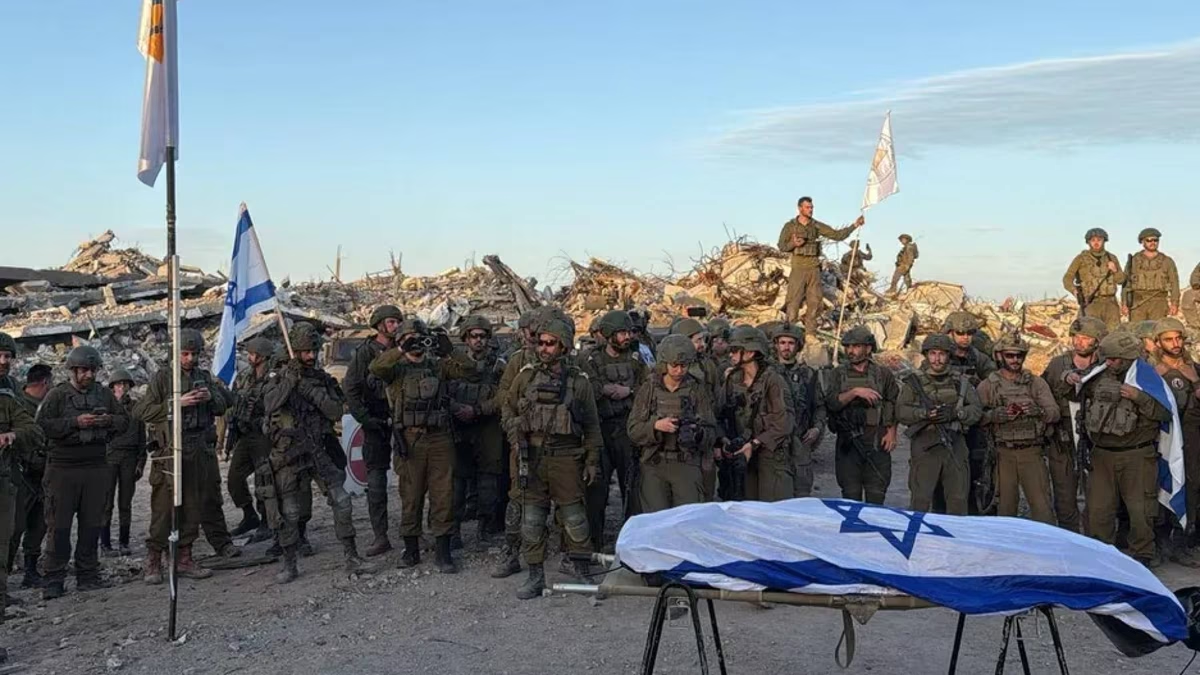
Military officials from the occupation acknowledged that the location of the body had been monitored among 4 possibilities for some time. On Monday, the occupation army revealed details of the military operation that led to the recovery of the body of the detainee "Ran Guili," who had been held by Hamas since October 7th.

The operation was carried out in the Shuja'iyya area north of the Gaza Strip in cooperation between the Southern Command and the "Yahalom" combat engineering unit. The statement claimed that the operation was based on intelligence gathered over two years, including interrogations of detainees from Gaza.

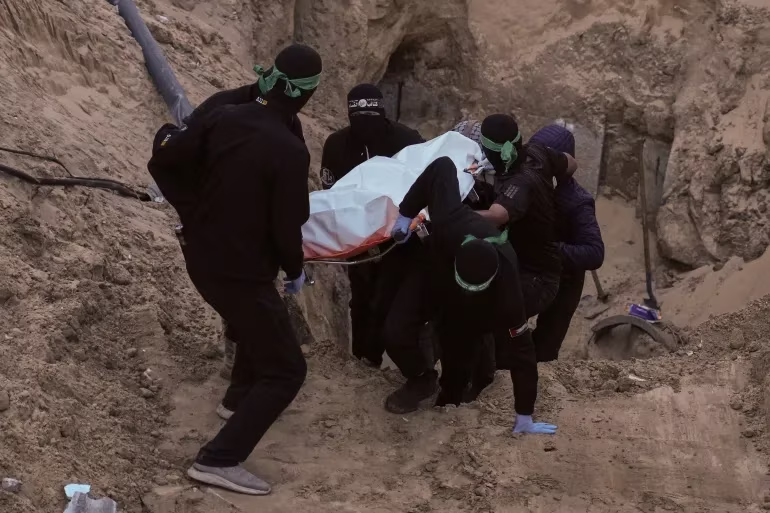
More than 20 dentists participated in the operation, examining approximately 250 bodies inside the cemetery within 24 hours using DNA samples and dental records to match identity.

For his part, US President Donald Trump told the "Axios" website that Hamas made "tremendous efforts" and coordinated with the occupation to help find the body of the last detainee.

Trump described the mission as "arduous and difficult," emphasizing that Hamas elements "were working with the occupation forces" to search for the body among hundreds of bodies in the area.

Trump stressed that this cooperation must be followed by practical steps, saying: "Hamas helped find the body of the last detainee, and now they must disarm as they promised."

Military officials from the occupation acknowledged that the location of the body had been monitored among 4 possibilities for some time, but the political leadership preferred to wait to give negotiations a chance before deciding on a field raid.

PALESTINE

Mon 26 Jan 2026 9:08 pm - Jerusalem Time

Kushner: Return of Officer 'Gvili's' Body Ends Gaza Detainee File and Establishes a New Phase

Jared Kushner, advisor to US President Donald Trump, stated that the recovery of the body of the "Israeli" police officer "Ran Gvili" from the Gaza Strip represents the end of one of the darkest chapters in the Middle East conflict. Kushner affirmed that for the first time since 2014, there are no longer any Israeli hostages held within the Strip.

Kushner clarified that all 20 living detainees, in addition to the bodies of 28 held hostages, described this development as an achievement that was previously considered "impossible."

He attributed this success to President Trump's leadership and intensive coordination between the US State Department's peace mission team, the Central Intelligence Agency (CIA), and occupation Prime Minister Benjamin Netanyahu, in cooperation with the Egyptian General Intelligence Service, Turkey, and Qatar, in addition to collaborators from within Gaza.

Kushner noted that this cooperation built unprecedented levels of trust, considering the mission to help Gaza residents start a new chapter free from what he described as the "tyranny of Hamas" crucial to preventing further destruction for both the occupation and Palestinians.

He believed that achieving this would contribute to ending the hotbed of tension exploited to fuel antisemitism and division.

Kushner concluded his statements by emphasizing that the US administration is trying new approaches to achieve different results, saying: "This is an end, but it is also a new beginning," in reference to the direction towards redrawing the features of stability in the region.

ARAB AND WORLD

Mon 26 Jan 2026 8:36 pm - Jerusalem Time

Iranian readiness and Israeli alert.. USS Lincoln enters the Middle East

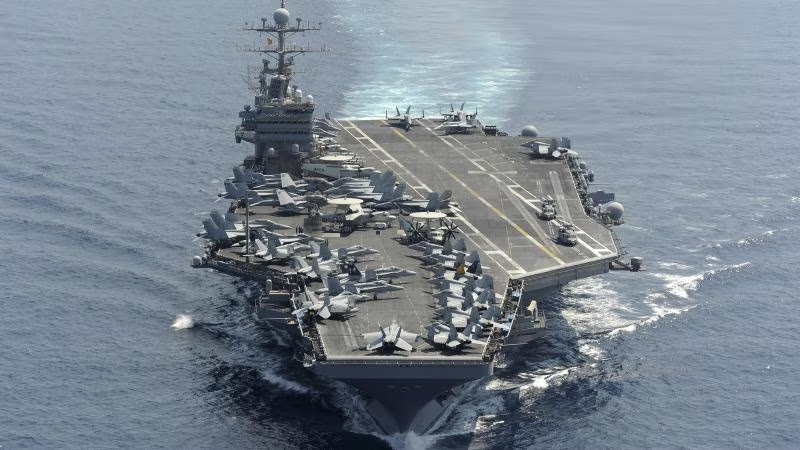
The US military announced today, Monday, that the aircraft carrier "USS Abraham Lincoln" and its group have arrived in the Middle East, significantly enhancing its firepower in the region amid escalating tensions with Iran. The US Central Command (CENTCOM) said in a post on the "X" platform that the aircraft carrier Lincoln and its strike group are "currently deployed in the Middle East to enhance regional security and stability."

For its part, the American newspaper "Wall Street Journal" quoted an American defense source and official data that the United States deployed F-15E fighter jets to a base in Jordan, while moving "Patriot" and "THAAD" air defense systems to the region to enhance the protection of American facilities and its allies from any potential counterattacks from Iran. The American official indicated that some equipment has already arrived, and more is expected within one to two weeks.

In this context, sources in Washington explained that this carrier includes various types of "F-16" and "F-15" aircraft, in addition to three destroyers that entered the Middle East operational area from the South China Sea about five days ago and have moved towards the Central Command's operational area in the Red and Mediterranean Seas.

Sources explained that this situation, according to observers, gives President Donald Trump wider options in dealing with Iran, as the lack of sufficient military assets in the region was one of the reasons that led the president to delay a strike on Iran. However, sources said that Trump, according to observers, sent the equipment but wants to give himself room to negotiate with the Iranians, pointing to ongoing negotiations, at least with Russia, in an attempt to impose something on the Iranians under the threat of battleships, and if these negotiations fail, Trump may resort to the second option.

Iranian readiness for all scenarios

In Iran, sources quoted Iran's permanent representative to international organizations, Ali Bahreini, as saying that Tehran is ready for all scenarios, as the policies of the current US administration cannot be predicted. He stressed that his country's military readiness has returned to what it was before the 12-day war, adding that his country has increased its capabilities in terms of its defense systems. The Iranian Ministry of Defense also confirmed this morning, Monday, that Tehran is today in full readiness and preparedness on the defensive front.

Alert in Israel

In Israel, sources in Jerusalem reported that the Israeli home front has raised its alert level to the maximum in recent weeks by deploying Iron Dome batteries and other military assets. He pointed out that the alert status has also moved to the civilian level, as Israeli authorities issued instructions to the education sector on the need to prepare for the possibility of transitioning to an emergency situation, and this applied to the health sector, hospitals, ambulance crews, civil defense, and firefighting. However, he noted at the same time that these preparations do not indicate a zero hour or an Israeli belief that an American attack on Iran is imminent, at least in the next few hours.

UAE refuses to allow its territory to be used

In addition, the UAE affirmed that it will not allow any attacks on Iran from its territory. The UAE Ministry of Foreign Affairs said in a statement that "the United Arab Emirates is committed to not allowing its airspace, territory, or waters to be used for any hostile military actions against Iran, and to not provide any logistical support in this regard." The Ministry of Foreign Affairs stressed "the UAE's belief that enhancing dialogue, de-escalation, adherence to international laws, and respect for the sovereignty of states represent the optimal foundations for addressing current crises." The UAE hosts thousands of American soldiers at Al Dhafra Air Base near the capital Abu Dhabi, which is one of several American military sites in the Gulf.

PALESTINE

Mon 26 Jan 2026 7:54 pm - Jerusalem Time

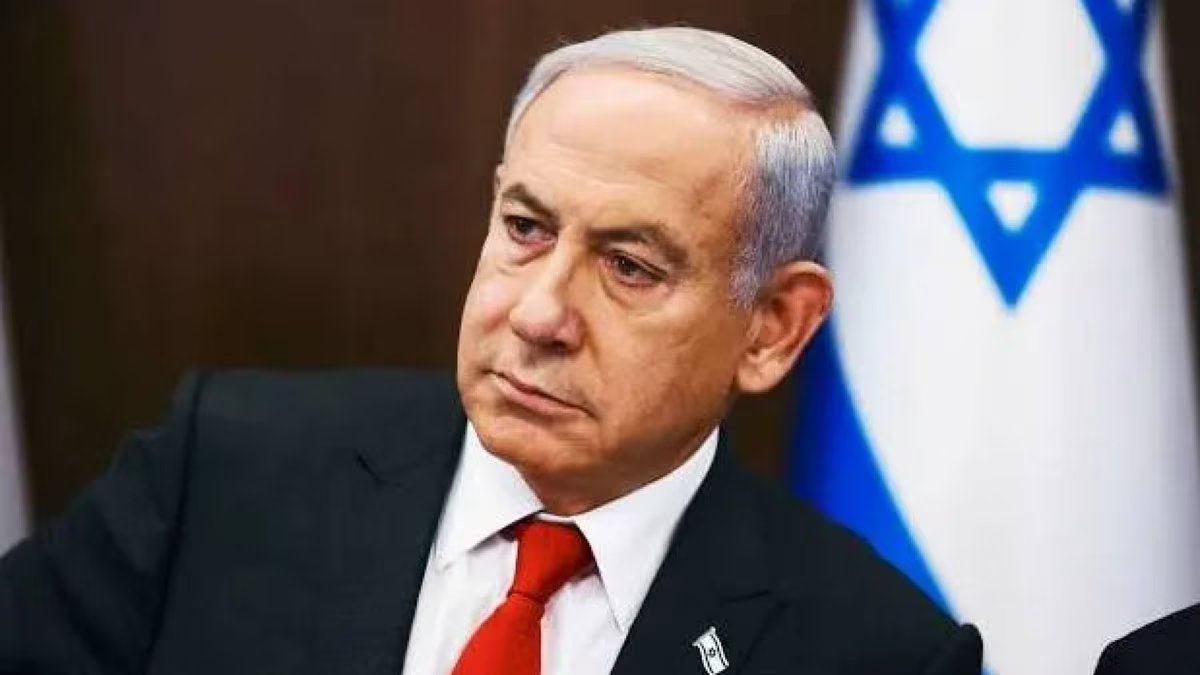
Netanyahu: "We brought everyone back" by recovering "Guili's" body.. The next stage in Gaza is "disarmament" not "reconstruction"

The Prime Minister of the Israeli occupation, Benjamin Netanyahu, on Monday, outlined the features of the next stage for dealing with the Gaza Strip after closing the file of detainees, unequivocally announcing that the top priority in the "second stage" will not be for reconstruction operations as the international community anticipates, but will be entirely focused on "disarming Hamas" and transforming the Strip into a completely demilitarized zone; to ensure no future threat.

Netanyahu's statements came after his official announcement of finding the body of "Ran Guili", the last of the detainees they were searching for in the Gaza Strip.

Netanyahu said that the central goal now is to strip the Hamas movement and other factions in the Gaza Strip of their remaining military capabilities, and impose a new reality that makes Gaza a safe, demilitarized zone, before talking about any development or reconstruction plans.

PALESTINE

Mon 26 Jan 2026 5:20 pm - Jerusalem Time

Occupation army announces return of the last detainee's body in Gaza Strip

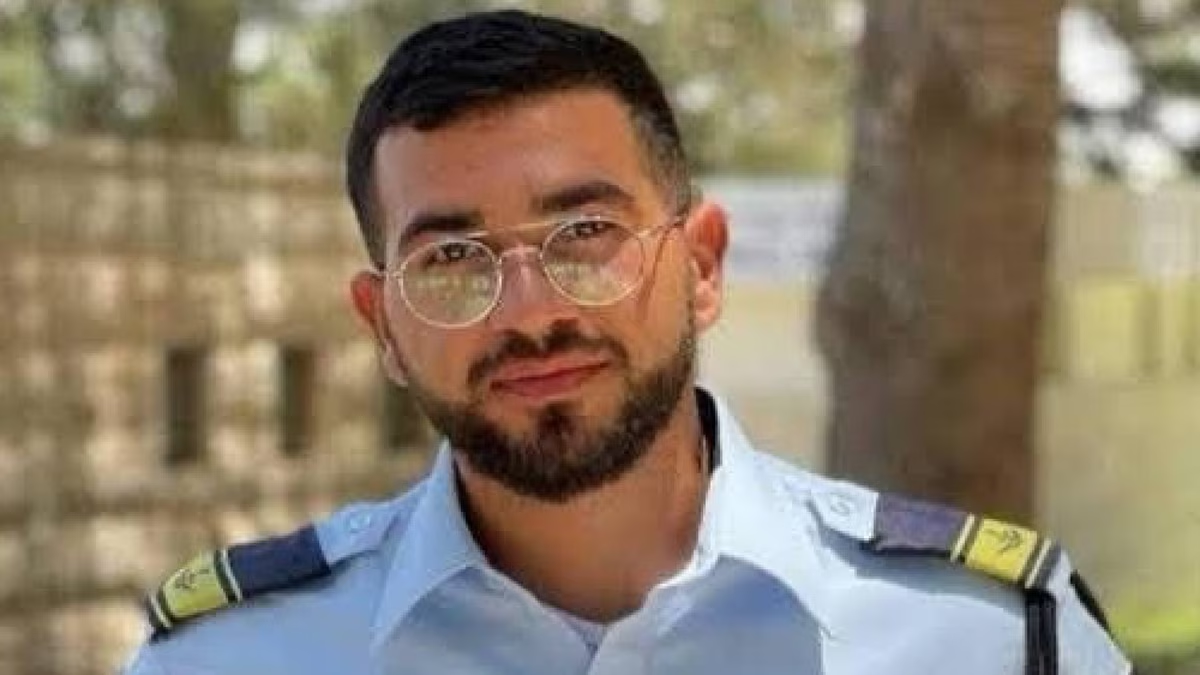
The Israeli occupation army announced the completion of the identification procedures for the body of "Ran Gvili" in a military statement issued on Monday. The Israeli occupation army announced the completion of the identification procedures for the body of "Ran Gvili", whose body was recovered from the Gaza Strip after an extensive excavation operation that included cemeteries in the northern part of the Strip and the Al-Zaytoun neighborhood.

The statement, issued in cooperation with the National Center for Forensic Medicine and the Military Rabbinate, clarified the following facts about the body: Identity: Ran Gvili (24 years old), a member of the police's special patrol unit (Yassam). Gvili was killed during the battles that took place on the morning of October 7, 2023. His body was transferred to the Gaza Strip since that date, and the fate of his body remained the subject of intensive intelligence research for more than two years.

With the announcement of the recovery of Gvili's body, the statement indicated that all detainees who were inside the Gaza Strip (whether alive or dead) have been returned.

This moment is a turning point in the political and military course, as Israeli Prime Minister Benjamin Netanyahu had linked the opening of the Rafah crossing to the completion of this specific mission.

ARAB AND WORLD

Mon 26 Jan 2026 4:08 pm - Jerusalem Time

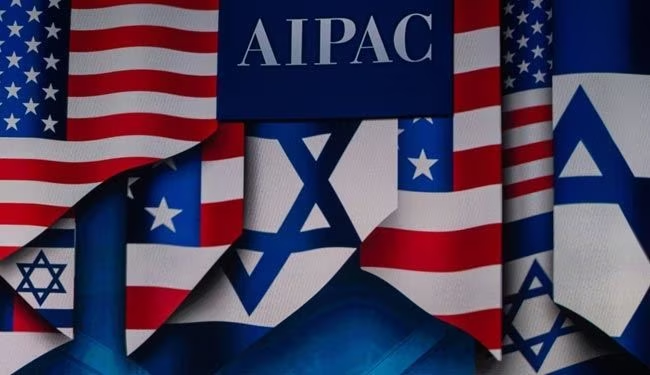
AIPAC Targets Former Allies Under the Pretext of Their Lack of Blind Support for Israel

Washington – Said Arikat

News Analysis

The disagreement with the "American Israel Public Affairs Committee" (AIPAC) is no longer confined to traditional critics of Israeli policies; it now extends to yesterday's allies themselves, whenever they show even limited hesitation in granting unconditional support to Israel. This was revealed in a New York Times report, which turned an early local election race in New Jersey into an explicit testing ground for the influence of political money, and for the narrow definition of "loyalty" within American politics.

The race is for a vacant congressional seat, but what is happening in it transcends its geographical boundaries. A super PAC known as "United Democracy Project," AIPAC's electoral arm, launched an aggressive advertising campaign against Tom Malinowski, a former Democratic congressman who was long classified among traditional supporters of Israel in Congress. The targeting did not come from his ideological opponents, but from the entity that previously supported him, in a scene that summarizes the profound shift in the behavior of pro-Israel lobbying groups.

The advertisement, which began airing weeks before a rare primary election held in February, attacked Malinowski under the pretext of his vote on legislation related to funding federal immigration law enforcement, in an attempt to link him to harsh deportation policies attributed to the Donald Trump administration. However, this pretext seemed flimsy, even contradictory, given the man's well-known fierce opposition to Trump, and his personal history as a former immigrant from communist Poland. It soon became clear that immigration was merely a cover, and that the real motive was deeper and more explicit.

According to those behind the campaign, Malinowski's actual "sin" lies in his hinting at the possibility of linking US aid to Israel with political or human rights conditions. This stance, which until recently was considered part of a legitimate debate within the Democratic Party, has become, in AIPAC's logic, a departure from the ranks, and even a sufficient reason to launch a costly exclusion campaign. Thus, support for Israel is no longer enough in itself, unless it is complete, absolute, and unquestionable support.

In this sense, the campaign does not express a fleeting disagreement, but rather a strict redefinition of the boundaries of what is "acceptable and unacceptable" politically. According to AIPAC's new definition, there is no room for the middle ground, and no recognition of multiple forms of support. Either full alignment without conditions, or exclusion from the "club of supporters." This is a shift that reflects the organization's transition from building broad alliances within both parties to imposing a narrow loyalty test that tolerates no differentiation.

The committee has spent more than $800,000 in this race alone, a huge sum in a local primary election involving 11 candidates. This financial generosity cannot be separated from a broader context, as AIPAC spent nearly $35 million in the 2024 elections, and contributed to the defeat of prominent progressive representatives such as Jamaal Bowman and Cori Bush. However, the irony in New Jersey is that this attack may benefit an explicitly progressive candidate, Analilia Mejia, known for her sharp criticism of the war on Gaza, which sometimes exposes the counterproductive effect of electoral intimidation policies.

Malinowski's response was not without warning, as he considered that narrowing the definition of "support for Israel" to this extent would ultimately empty it of its content. Prominent Jewish leaders criticized this approach, including Jeremy Ben-Ami of "J Street," who warned that turning political disagreement into a tool of exclusion could generate anger that extends beyond Israel to affect the American Jewish community itself. Former US Ambassador to Israel, Daniel Shapiro, also described the campaign as misleading and dishonest.

At the heart of this battle is a question simple in its formulation, profound in its implications: Is American support for Israel an absolute right that is not to be debated, or a policy that, like others, is subject to ethical and legal standards? AIPAC's insistence on the first answer, and the demonization of anyone who adopts the second, does not reflect strength as much as it reveals the fragility of a discourse that cannot tolerate dissent.

Malinowski's case reveals a more dangerous shift in the role of lobbying groups, from influencing policies to attempting to engineer the democratic landscape itself, by drawing the boundaries of debate and determining who has the right to run and who should be excluded. In this equation, not only are opponents punished, but a clear warning is issued to allies: thinking aloud may come at the cost of political execution.

Thus, limited-participation local elections become a mirror of the future of American politics, where the influence of external money is increasing, and the margin for legitimate disagreement is shrinking. The question is no longer who wins at the ballot box, but who has the power to determine the options available to voters in the first place, and who imposes on them a monolithic definition of loyalty that recognizes only one hundred percent support.

ARAB AND WORLD

Mon 26 Jan 2026 2:17 pm - Jerusalem Time

German police arrest Lebanese man on suspicion of Hamas membership

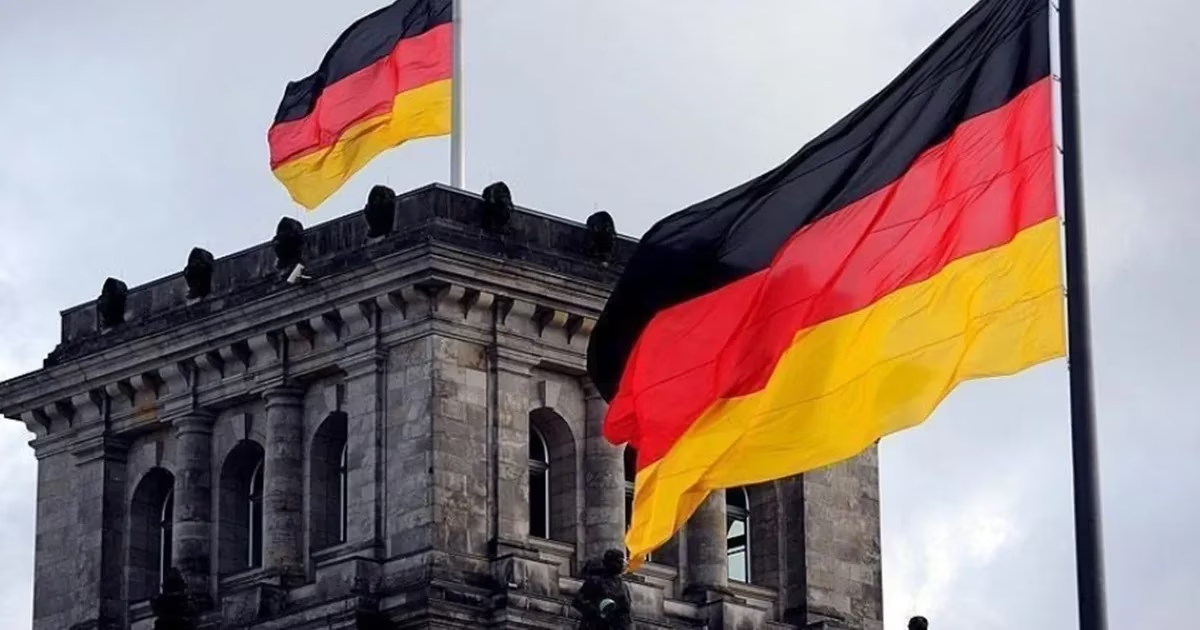
German police arrested a Lebanese national on suspicion of being a member of the Palestinian Hamas movement and planning "attacks" in Europe, at Brandenburg Airport in Berlin after his arrival from Beirut on Friday evening. Federal prosecutors said the suspect, in August 2025, helped acquire 300 rounds of ammunition and was involved in an "alleged plot to attack Jewish and Israeli institutions." The suspect is scheduled to appear before a federal judge who will decide whether he will be remanded in custody. Hamas is classified as a "terrorist organization" by the United States, Britain, "Israel" and many other countries.

German authorities say "Mohammed S." conspired with "Abdul al-J.", one of three alleged Hamas members arrested last October in connection with planning attacks on Jewish and Israeli institutions. The three were reportedly arrested while meeting to hand over weapons in Berlin. Two of them are German nationals, and the third is from Lebanon. Coinciding with the arrests, police carried out searches in the German cities of Leipzig and Oberhausen.

In a separate context, German authorities, in November, arrested another suspected Hamas member, also a Lebanese national, near the border with the Czech Republic.

ISRAELI AFFAIRS

Mon 26 Jan 2026 1:33 pm - Jerusalem Time

After its unity.. Arab parties and their chances of winning in the Israeli elections

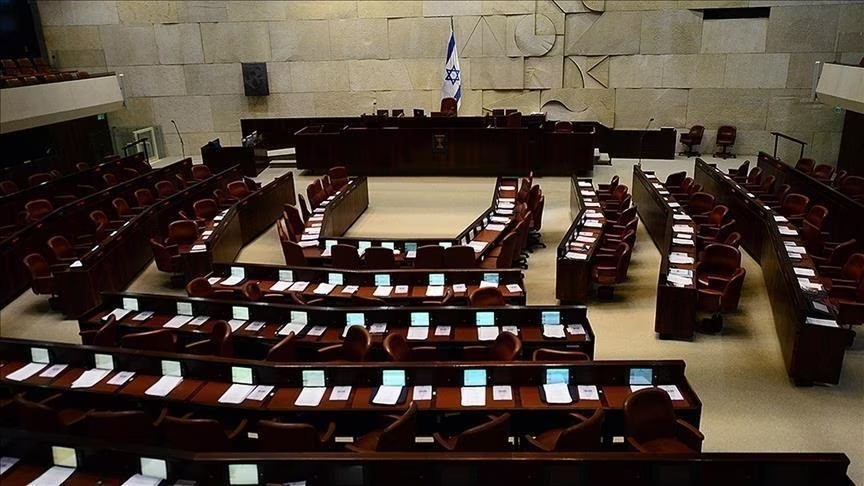
With the leaders of 4 parties representing Palestinians inside Israel signing a pledge to form a joint list to contest the upcoming elections, attention is turning to the Arab vote as a key factor in redrawing the balance of power within the Knesset and determining the features of the government.

The step taken by the four parties, according to two experts on Israeli affairs, will make the Arab vote decisive in the Knesset (parliament) elections, which has led officials in the Israeli right to anxiously monitor the movements of the Arab parties ahead of the elections.

The two experts believe that the decision by the leaders of 4 Arab parties to form a joint list to contest the elections carries significant implications that could increase the voting rate of Arabs, who constitute 21 percent of Israel's 10 million population.

However, they point out that it is too early to definitively say that unity will actually happen, given the need to agree on many details, most notably the political program, the stance on Jewish opposition parties, and who will lead the Arab list.

Under popular pressure, the leaders of the Democratic Front for Peace and Equality (secular) Ayman Odeh, the Arab List for Change (nationalist) Ahmed Tibi, the National Democratic Assembly (nationalist) Sami Abu Shehadeh, and the United Arab List (Islamist) Mansour Abbas, signed a pledge on Thursday to form a joint list to contest the elections.

Unless early elections are held in Israel, the general elections will take place as scheduled next October.

The pledge by the four parties came in the city of Sakhnin in northern Israel on Thursday evening, after intensive efforts in recent months to bring the leaders of these parties to unity proved futile.

But the unprecedented scene of tens of thousands of Arab citizens participating in a march against the spread of crime in the Arab community contributed to a significant step towards this unity.

The leaders of the aforementioned parties still need to finalize the details of this unity in preparation for the Israeli general elections.

While public opinion polls indicate that Arab parties would win 10 of the 120 Knesset seats, the unity of the Arab parties could raise the Arab voting rate, potentially increasing the number of Arab representatives to 15.

The same Arab parties had previously united in a single list called the "Joint List" in 2015, winning 13 seats, and this was repeated in the 2019 elections. In the 2020 elections, the Joint List won 15 seats.

However, the Joint List soon dissolved in 2021, with the Democratic Front for Peace and Equality and the Arab List for Change contesting the elections as a single list, and the United Arab List and the National Democratic Assembly running separately.

In the 2022 elections, the alliance of the Democratic Front for Peace and the Arab List for Change won 5 seats, while the United Arab List won 5 seats, and the National Democratic Assembly failed to win any seats.

Wadie Abu Nassar, an expert on Israeli affairs, says that the announcement of the intention to form a joint list is a first step, but there are many details that need to be agreed upon before a joint list is actually formed.

He explains: "There are many details that need to be agreed upon, such as the political program, the distribution of seats among the parties, taking into account the political weight of each party, who will lead the list, and the stance on a Jewish opposition government – will it be supported if it requests it or not? There are differing views among the Arab parties themselves on this matter."

According to Abu Nassar, "the devil is in the details, and the parties must agree on all these details before we can say that there is actually a joint Arab list."

He asks: "Will it be a technical alliance to garner the largest number of votes on election day, and then each party will work independently in the Knesset after the elections? This is an important question."

He pointed out that "there is widespread popular pressure in the Arab street to form a joint Arab list."

The speaker believes that "if the Arab parties unite, it would increase the voting rate of Arab citizens, and therefore we can expect the Arab parties to win 15 or perhaps 17 seats if the Arab voting rate is high."

Despite all the previous data, Abu Nassar believes that Arab votes "will be decisive in the upcoming elections in determining who will form the next Israeli government."

He adds: "The higher the voting rate of Arab citizens, the lower the chances of small right-wing parties succeeding, because they will have to cross the electoral threshold of 3.25 percent of the total number of voters."

He continues: "An example of this is the Religious Zionist party led by Finance Minister Bezalel Smotrich, which opinion polls say will not be able to cross the threshold, let alone if the Arab voting rate is high?"

However, Abu Nassar notes that the unity of the Arab parties and the estimates of an increase in the Arab voting rate could lead to an increase in the voting rate among Israeli religious and right-wing parties.

"Israeli religious and right-wing parties have a very large reserve of votes, and they may be motivated to vote. In this case, Arabs need to significantly increase their voting rate in order to compete," he explains.

He adds: "Also, Israeli Prime Minister Benjamin Netanyahu may push right-wing parties to unite to ensure their victory, as happened in the last elections when the Jewish Power party led by Itamar Ben-Gvir contested the elections in an alliance with Religious Zionism and then separated after the elections."

According to the political analyst, "the higher the Arab voting rate, the lower Netanyahu's chances of forming a government."

He says: "If the Arab alliance actually happens and the voting rate of Arab citizens is high, then Netanyahu will be in a difficult position."

Agreeing with Abu Nassar, expert Mohammed Halasa believes that Israeli right-wing parties are looking with great concern at the Arab parties' move towards unity and hope these efforts fail.

He says that "the Israeli view is that the chances of Arab parties uniting in a single list are still low."

Halasa points out that Arab parties could form a blocking bloc if they actually unite and succeed in raising the Arab voting rate.

He says: "Raising the voting rate of Arab citizens will make it difficult for Netanyahu to form a new government. Opinion polls indicate that Arab parties would win 10 seats if elections were held today, but if Arab parties unite and the Arab voting rate increases, Arabs could win 15-16 seats, and perhaps more, in the elections."

On the other hand, he mentions that the vast majority of Israeli Jewish opposition parties refuse to rely on an Arab party to form a government, thereby preventing Prime Minister and Likud party leader Netanyahu from forming a government.

He continues: "As an indicator of this, the leader of the opposition Blue and White party, Benny Gantz, published a propaganda video for his party in which he incited against Arabs by calling for a government that does not rely on Arabs."

He adds: "Some in Israel also bet on the failure of the unity effort due to disagreements between the parties regarding the possibility of supporting a government that replaces Netanyahu's government, and they specifically refer to the United Arab List led by Mansour Abbas, who previously supported the Naftali Bennett-Yair Lapid government from outside."

He notes: "Nevertheless, there is significant Arab pressure for the parties to unite in a joint list, which constitutes a driving factor for them to move forward with unity."

He points out that Israeli Jewish opposition parties will likely need the support of at least one Arab party to form a government and prevent Netanyahu from forming one.

According to Halasa, "public opinion polls indicate that the Jewish opposition will need the support of at least one Arab party to reach the 61 votes required to form a government."

He asks: "Will Jewish parties accept Arab support to form a government, especially after the rising voices against such an alliance following the October 7, 2023 attack? And will Arab parties, or at least one of them, agree to provide support to Jewish opposition parties to prevent Netanyahu from forming a government? And if this happens, what will be the fate of the Joint List if it is actually established?"

He concludes by saying: "The possibilities are open, and the scene is still hazy. Developments in the coming weeks and months need to be followed."

ARAB AND WORLD

Mon 26 Jan 2026 1:33 pm - Jerusalem Time

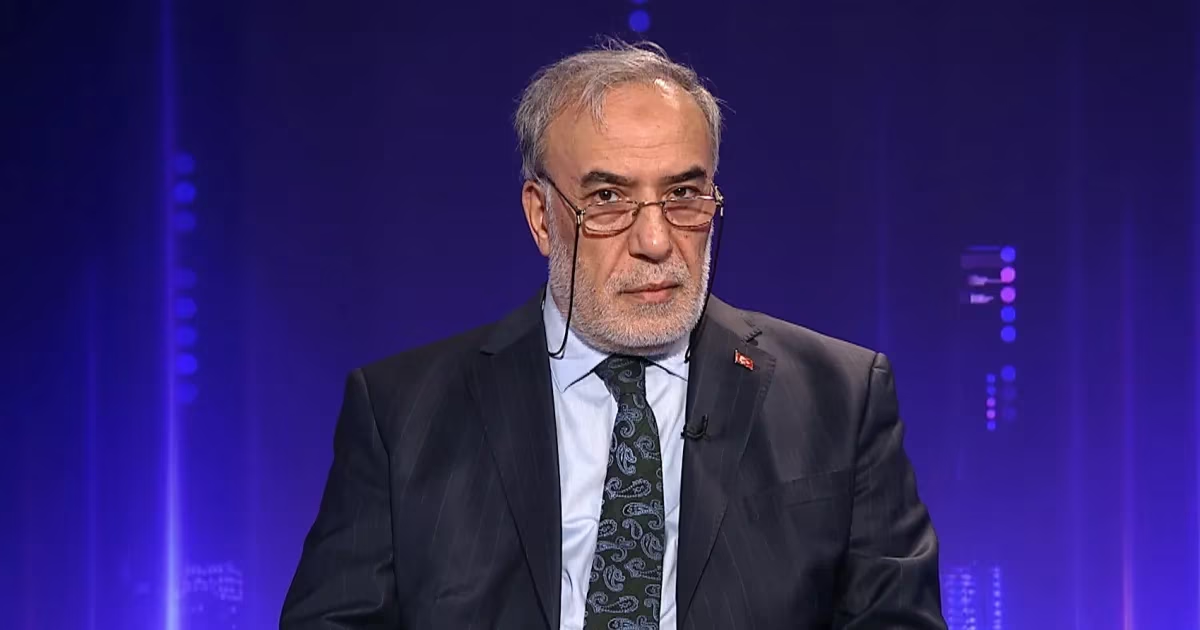
Turkish official: No place for any separatist entity in northern Syria, and President Al-Shara' deals wisely with Israeli provocations

Ambassador Musa Kulak Kaya, Turkish Deputy Foreign Minister, stressed that his country will not accept any attempt to establish a separatist entity in northern Syria, affirming that preserving the unity of Syrian territories and extending state control over all its lands is a strategic priority for Turkey.

Kaya indicated in statements that the Syrian government, led by President Al-Shara', is dealing wisely with Israeli provocations, and is working to protect internal security and achieve political stability, explaining that Turkey supports Damascus' efforts to resolve security problems, enhance national cohesion, and follow up on the transfer of ISIS prisoners and the application of cultural rights for minorities, including considering "Nowruz" a national holiday.

Regarding the "SDF" forces, the Turkish Deputy Foreign Minister affirmed that Turkey warns against the entry of "PKK" elements into Syrian territory, and calls on all parties to preserve territorial unity and prevent any attempt to establish an independent administration in the north of the country.

He explained that Turkish cooperation with the Syrian government includes the exchange of information and intelligence data to ensure state stability and the reintegration of all components under the umbrella of the government.

Kaya also stressed the importance of all parties adhering to existing agreements and the ceasefire, affirming that any failure in de-escalation will negatively affect civilians and infrastructure, and that the only solution to the crisis lies in the total integration between the different Syrian parties.

Regarding developments in the Gaza Strip, Kaya explained that Turkey, Qatar, and Egypt are making strenuous efforts to stop the bloodshed, affirming that the first phase of the Gaza agreement did not achieve the desired results due to repeated Israeli violations and obstruction of humanitarian aid delivery.

He affirmed that the second phase, which includes reconstruction and the formation of a committee of "technocrats," aims to achieve sustainable peace and secure long-term stability for Palestinians, and that Turkey is ready to join any international peacekeeping force militarily if invited.

Regarding regional tensions, the Turkish Deputy Foreign Minister indicated that Turkey is closely following the Iranian file, calling on all parties to dialogue and de-escalation, affirming that any attempt to change the regime or interfere in Iran's internal affairs will not achieve any results, and that political solutions are the optimal way to ensure stability.

Kaya also stressed the importance of the Turkish role in confronting Israeli threats in the region, affirming that Turkey supports initiatives aimed at achieving sustainable peace, and that cooperation with Islamic and Arab countries in this regard is positive and necessary, but he pointed out that there is no tangible military alliance yet, considering that any steps must be taken within the framework of international agreements and policies consistent with international law.

ARAB AND WORLD

Mon 26 Jan 2026 1:32 pm - Jerusalem Time

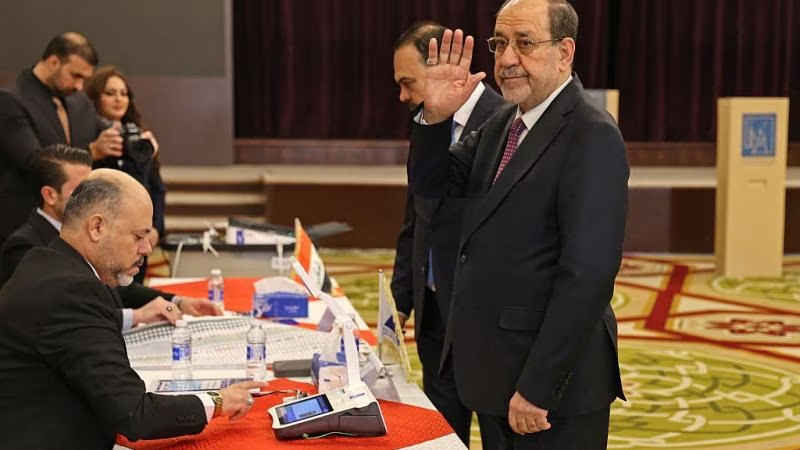
After Nouri al-Maliki's nomination.. Rubio warns Iraq about relations with Iran

US Secretary of State Marco Rubio on Sunday warned Iraq against forming an "Iran-aligned government." Rubio's warning came after the nomination of former Prime Minister Nouri al-Maliki, who left office in 2014 under pressure from the United States, by the Coordination Framework, the largest bloc in the House of Representatives, to assume the premiership again. During a phone call with current Prime Minister Mohammed Shia' al-Sudani, Rubio expressed his hope that the next Iraqi government would work to make the country "a force for stability, prosperity, and security in the Middle East," according to a statement from the US State Department.

US State Department spokesman Tommy Pigott said the Secretary stressed that "an Iran-dominated government will not be able to put Iraq's interests first, or keep the country out of regional conflicts, or promote a mutually beneficial partnership between the United States and Iraq."

America and Nouri al-Maliki's governments

In this context, an Iraqi political source reported that the United States informed Baghdad that it "views negatively the previous governments led by Nouri al-Maliki." American lawmakers also stated, in an official letter, that the choice of prime minister is a "sovereign Iraqi decision," but they stressed at the same time that the United States "will make its own sovereign decisions regarding the next government in line with American interests."

Al-Maliki first assumed the premiership in 2006, but Washington later withdrew its support for him. The Iraqi House of Representatives is scheduled to hold a session on Tuesday to elect a president, as the constitution requires the elected president to assign a head of government within 15 days.

PALESTINE

Mon 26 Jan 2026 1:31 pm - Jerusalem Time

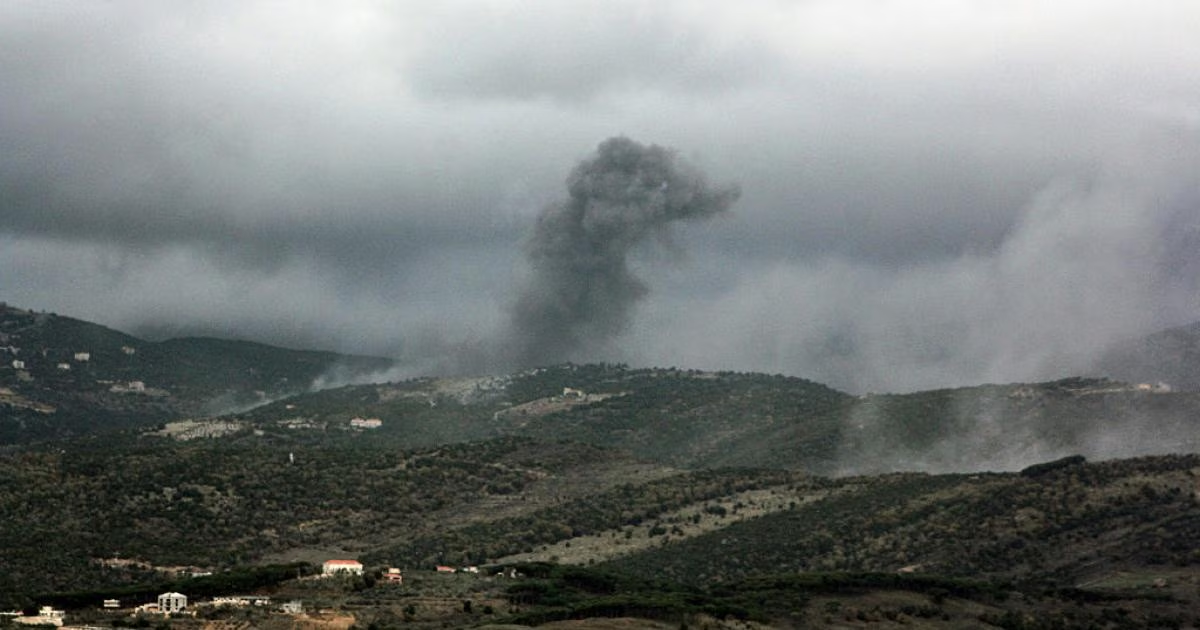
Israel's escalation in Lebanon.. Night raids on the heights of Iqlim al-Tuffah

The Israeli occupation army launched air attacks in southern Lebanon on Sunday night into Monday, after carrying out 14 raids on areas in the south and east of the country. Daily, the occupation violates the ceasefire agreement in effect with Lebanon since late November 2024, which has resulted in hundreds of martyrs and wounded, as well as widespread destruction.

Sources reported that Israeli warplanes raided the heights of Akmata, outside Louaize, in the Iqlim al-Tuffah region of southern Lebanon, after midnight.

The Israeli raid targeted the heights of Akmata, outside Louaize, in the Iqlim al-Tuffah region of southern Lebanon.

The 14 Israeli raids yesterday, Sunday, targeted: the heights of Maydoun in western Bekaa, eastern Lebanon, Al-Jubour, and between the heights of Al-Rihan and Louaize in the Jezzine district of the South Governorate, and Al-Aroush quarry also in the South Governorate, and the Wadi Barghaz area in the Nabatieh Governorate.

Earlier on Sunday, two people were martyred and six were injured as a result of raids launched by the Israeli army on three towns in southern and eastern Lebanon.

The Israeli army confirmed launching raids on areas in Lebanon, claiming that it "attacked Hezbollah infrastructure" in several areas in Lebanon.

More than 4,000 people have been martyred and about 17,000 others injured in Lebanon during an Israeli aggression on the country, which the occupation began in October 2023, then turned into a comprehensive war in September 2024.

PALESTINE

Mon 26 Jan 2026 1:10 pm - Jerusalem Time

Rafah Crossing: Netanyahu Maneuvers to Buy Time Before Opening Under US Pressure

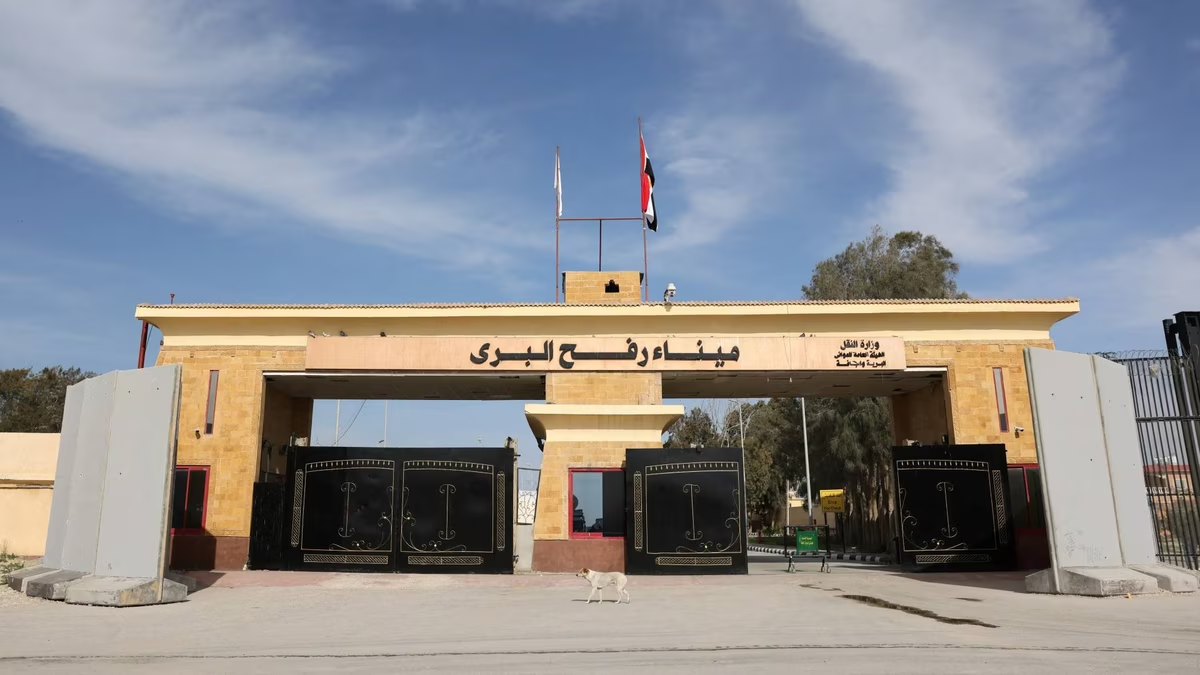
Israeli Prime Minister Benjamin Netanyahu appears to be maneuvering to buy more time before reopening the Palestinian side of the Rafah border crossing between the Gaza Strip and Egypt, amid increasing US pressure. While the US administration is pushing for the reopening, Netanyahu is trying to provide justifications to prevent its reopening, given opposition from right-wing ministers to the move. As a compromise to satisfy both parties, Netanyahu decided to open the crossing but linked its implementation to the results of a search operation by the Israeli army in northern Gaza for the remains of captive Ran Guily. This explains the ambiguous wording of the statement issued by Netanyahu's office late Sunday night, which said: "As part of US President Donald Trump's 20-point plan, Israel has agreed to a partial reopening of the Rafah crossing for pedestrians only, subject to a full Israeli inspection mechanism." However, it added: "The Israeli army is currently conducting a focused operation to exhaust all intelligence gathered in order to find and retrieve the remains of hostage Sergeant First Class Guily." It continued: "Once this operation is concluded, and in accordance with what was agreed upon with the United States, Israel will open the Rafah crossing," without specifying a timeframe for its completion or indicating its potential outcomes.

The "Al-Qassam Brigades," the military wing of the "Hamas" movement, announced on Sunday that it had informed mediators of all available details regarding the location of the body of the last Israeli captive in the Gaza Strip. It indicated that the Israeli army is conducting search operations in one of the locations based on that information. Since the start of the first phase of the ceasefire agreement, which has been in effect since October 10th last year, Palestinian factions have handed over 20 living Israeli captives and the remains of 27 others, while the remains of Guily remain, for whom "Al-Qassam" confirmed efforts are being made to search despite difficult conditions and lack of resources. In mid-January, Trump announced the start of the second phase of the Gaza agreement, as part of his 20-point plan to end the war in the Strip, which was adopted by the UN Security Council in its Resolution 2803 issued on November 17, 2025.

**Israeli Evasion

Netanyahu's office statement was issued after a meeting of the Ministerial Committee for National Security ("the Cabinet"), which discussed the implementation of the second phase of Trump's plan to end the war and open the crossing. Trump's plan stipulated the reopening of the crossing in the first phase of the agreement, but Israel did not adhere to this, reneging on a number of agreement clauses, including the cessation of hostilities and the entry of agreed-upon quantities of aid.

Israeli military sources said on Monday: "The crossing will not open with the return of Ran Guily, but after the ongoing military operation in the Shuja'iyya cemetery concludes. In other words, it doesn't matter if the operation yields a positive result or not, the crossing will open anyway." They added: "Let's remember that this operation has been postponed several times due to the political leadership's disapproval. Is it conceivable that someone waited and linked it to the current Rafah crossing opening date to mitigate public criticism?" referring to Netanyahu. The sources pointed to what was stated in Netanyahu's office statement: "Israel conditioned the reopening of the crossing on the return of all living hostages, and Hamas doing its utmost to find and return all dead hostages." They questioned: "In other words, if Israel allows the opening of the Rafah crossing, it is officially confirming that Hamas (did its utmost) to return all dead hostages! What an exaggerated Israeli compliment to Hamas."

**Crossing Mechanism

Military sources reported expectations of the reopening of the Palestinian side of the crossing in the coming days. Regarding its operating mechanism, the sources said: "Exiting Gaza to Egypt will not be subject to Israeli security inspection. Inspections and identity verification will be carried out by a European Union mission, with the participation of Gazan citizens approved by the security establishment and working on behalf of the Palestinian Authority." They continued: "The exit stamp will also be from the Palestinian Authority. While Israeli control over exits will only be remote." As for entering the Gaza Strip from Egyptian territory, the sources said that security inspection will be in two stages: "The first by the European Union mission at the Rafah crossing." They added: "After that, those entering will be transferred to the Gaza Strip via a special corridor established in Israeli-controlled territory, and they will be inspected there by Israeli security officials. This procedure aims to prevent smuggling and the entry of unauthorized persons." The sources indicated that "the final number of people entering and exiting has not been determined. The number is expected to reach a few hundred daily, depending on the capacity of the crossing and inspection procedures."

**"Buying Time"

For its part, the Israeli news website "Walla" interpreted Netanyahu's office statement as "buying time and neutralizing, or at least attempting to mitigate (the intensity of) opposition." It said: "It became clearer that this was a move whose main goal was to buy time, and not for long." It added regarding Netanyahu's office statement: "The announcement, phrased in vague language, did not clarify what exhausting the procedures means, what the timeline is, and what will be considered the completion of the effort. More importantly, it did not change the fundamental truth: no decision was made in the Cabinet. This step was not approved, withheld, or postponed. It was simply bypassed." The website claimed that "information regarding Guily's whereabouts has been in Israel's possession for about a month, as is known to the defense establishment and political elements." In this regard, the website referred to Trump's statements last week in which he said "that the Americans know his (Guily's) location. So, the operation (to search for his remains) was not born at the last minute. Rather, it had been forming for a long time and was announced at a remarkably precise time," referring to the issuance of Netanyahu's office statement after the Al-Qassam spokesman's statement about the army's search operations. It added: "This move by Netanyahu gives him some breathing room, for a few hours, and perhaps for days." It indicated that according to senior American officials, the Israeli message "is completely different: the Rafah crossing will be open by the end of the week, whether Guily is found or not. This step, from Washington's perspective, is irreversible," according to the website. It continued: "Internally, it is a conditional and vague Israeli announcement. Outwardly, it is a clear response to American pressure. Netanyahu seems not to have decided between the right wing and Washington, but rather bought himself temporary room for maneuver."

**Ministers' Opposition

For its part, the official broadcasting authority said on Monday: "A number of ministers expressed their prior opposition to opening the crossing, considering that the step paves the way for moving to the second phase of President Trump's plan." It quoted National Security Minister Itamar Ben-Gvir as saying in a Cabinet meeting that "opening the crossing is a big mistake and a very bad message." On Thursday, the head of the National Administration Committee for the Gaza Strip, Ali Shaath, said that the Rafah crossing would be opened next week, without clarifying the mechanism to be adopted. Israel has closed this crossing since it took control of it in May 2024, and destroyed and burned its buildings during a ground operation launched in the city of Rafah (south) as part of the genocide war that Tel Aviv began on October 8, 2023, and lasted for two years, leaving more than 71,000 dead and over 171,000 injured Palestinians, and destruction affecting 90 percent of the infrastructure in the Strip.

PALESTINE

Mon 26 Jan 2026 1:10 pm - Jerusalem Time

Why does the search for the body of the last Israeli captive in Gaza raise questions?

The Israeli occupation's announcement on Sunday of a wide-ranging operation to search for the body of soldier Ran Gozali, the last Israeli captive in the Gaza Strip, sparked a wave of widespread questions and controversy on social media platforms, amid skepticism about the timing and political motives of the move, linking it to increasing international pressure to move to the second phase of the agreement.

The announcement came hours after the Izz ad-Din al-Qassam Brigades, the military wing of the Islamic Resistance Movement (Hamas), confirmed that it had informed mediators of all available information regarding the location of the body, a development that brought the issue back to the forefront after months of stalemate.

According to the office of Israeli Prime Minister Benjamin Netanyahu, the Israeli occupation army has been conducting an extensive search operation in the northern Gaza Strip since the end of the week, based on all available intelligence information, stressing that the search operations will continue as long as necessary.

In contrast, sources quoted sources as saying that the search efforts are currently focused on the Al-Zaytoun neighborhood in the southern Gaza City.

However, the timing of the announcement raised widespread questions, especially as it coincides with American statements about the imminent opening of the Rafah crossing, which led activists to link the movement of the body's file to the escalating international pressure to push the occupation towards implementing the requirements of the second phase.

Tweeters believe that reopening this file on the ground may mean its approaching end, which threatens the collapse of one of the most prominent pretexts used by the occupation during the past period to obstruct political and humanitarian entitlements, foremost among them the opening of the Rafah crossing.

In this context, tweeters indicated that the Israeli Ministerial Cabinet (the "Kabinett") decided not to open the Rafah crossing until the search operation for the body of the last Israeli soldier in Gaza is completed.

In contrast, Israeli sources confirmed that Tel Aviv had intelligence information about the location of the body about a month ago, but Netanyahu did not give the green light to start search operations at that time, due to what was described as the sensitivity of the location.

This information raised additional questions about whether the delay in launching the operation was due to actual security considerations, or to political gain from keeping the body's file open as a pressure card used by Netanyahu to obstruct the transition to the second phase of the agreement.

Activists saw that the wording of Netanyahu's office statement carried striking implications, especially its use of the phrase "making an effort to find the body," instead of making finding it a decisive condition, which was considered an indication of an Israeli retreat under American pressure, with Washington convinced that Hamas had provided all its information and efforts in this file.

Some also paused at the statement's use of the phrase "limited opening of the Rafah crossing," considering it an ambiguous description, as it means opening the crossing for people to cross only, without the entry of goods, and not a limited opening in terms of the number of crossers, in addition to the statement's talk of "Israeli supervision" without mentioning a military presence on the ground inside the crossing.

In light of these developments, activists wondered whether the arguments used by the occupation in recent months to obstruct the start of the second phase were about to run out, especially with the transfer of the body's file from the level of political statements to actual field research inside the Gaza Strip.

Observers believe that the occupation's ability to use the Israeli soldier's body file as a pretext is gradually declining, after the resistance, through mediators, handed over all its information about the location of the body, which prompted the occupation army to announce the start of search operations based on this data, in parallel with American statements confirming Washington's assessment of its location.

Activists considered that this development practically puts the file on its final track, and turns the issue of finding the body into a matter of time, which means that the pretext under which political and humanitarian entitlements were frozen is now threatened with collapse.

With the acceleration of international pressure, bloggers saw that the occupation is closer than ever to losing its last delaying tactics, and that the next stage may witness the announcement of finding the body, which reveals that the delay was not technical as much as it was a postponed political decision, at a time when demands to open the Rafah crossing and end the stalemate are escalating.

Ultimately, observers believe that moving the body's file on the ground, after months of stalemate, reflects a shift in the occupation's approach to this file, in light of increasing international pressure to push for the requirements of the second phase. They argue that the coming days will be crucial in testing whether this development will translate into practical steps on the ground, or will remain within the framework of time management and political maneuvering.

PALESTINE

Mon 26 Jan 2026 9:46 am - Jerusalem Time

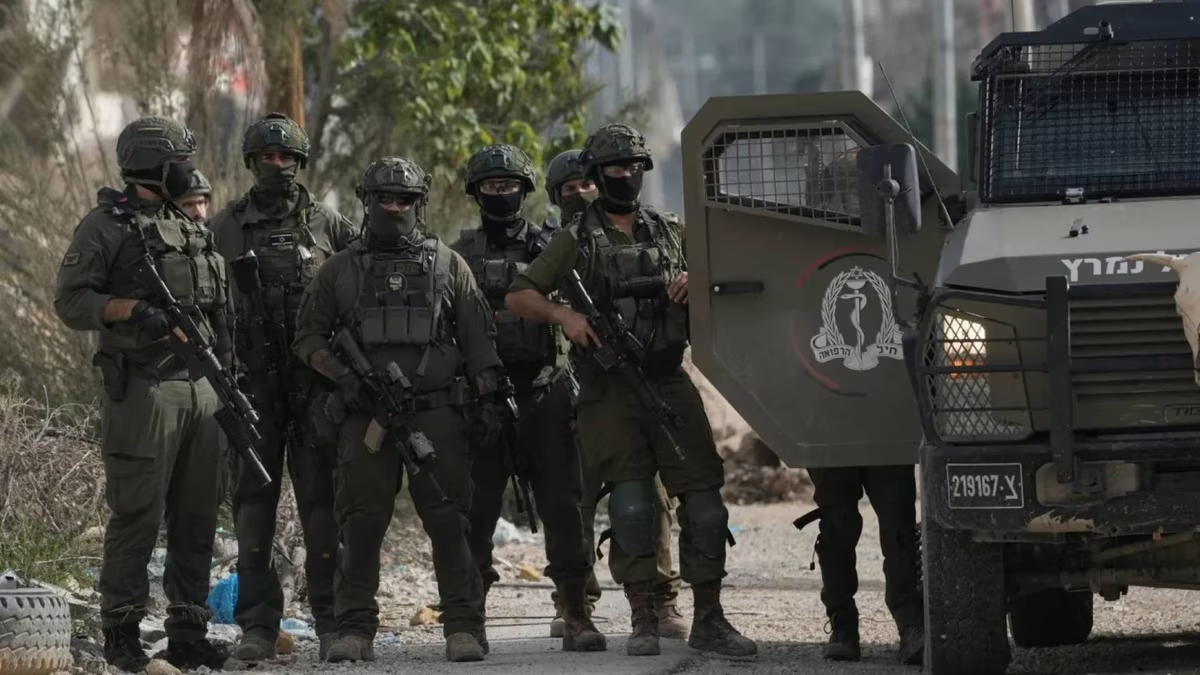
Widespread occupation campaign in the West Bank.. arrests include a deputy and citizens in several cities and towns

On Monday, occupation forces launched a widespread campaign of raids and arrests in several towns and cities in the West Bank, affecting a number of citizens, including a deputy in the Palestinian Legislative Council.

Palestinian sources reported that occupation forces stormed the towns of Allar and Seida, north of Tulkarm, where they raided and searched citizens' homes and assaulted their residents, while the deputy was arrested after his home in Seida was stormed.

In Nablus, occupation forces raided several homes in Balata refugee camp, east of the city, searched them, and assaulted their residents, resulting in five injuries, according to the Palestinian Red Crescent, who were transferred to the hospital for treatment.

Occupation forces also launched campaigns in Ramallah Governorate, where they arrested Ibrahim Khaled Abu Ayoush and the boy Amir Barghouti after storming the town of Kafr, north of the governorate, and arrested the released prisoner Samed Afaneh in Qalandia refugee camp, north of occupied Jerusalem.

In Hebron Governorate, occupation forces carried out raids in the town of Halhul and the town of Beit Ummar, north of the governorate, resulting in the arrest of several young men, including Issam Hani Abu Rayyan, Khalifa Al-Qashqish, and the boy Youssef Zuhdi Awad, with some citizens being assaulted during the incursions.

This campaign comes in the context of continuous escalation by the occupation in the West Bank, including widespread arrests and raids on Palestinian homes, amid widespread local condemnation of these measures.

OPINIONS

Mon 26 Jan 2026 9:41 am - Jerusalem Time

Alienating the Place and Manufacturing Inferiority.. The Other Side of Military Checkpoints

The definition of a checkpoint differs from the definition of a siege. A siege is a complete hostile relationship, a situation that may be long or short, aiming for surrender, occupation, or storming. A siege is a one-way relationship, characterized by the exploitation of willpower, steadfastness, and defiance. A checkpoint, however, does not include all of that; rather, it is a situation aimed at subjugation, normalization, engineering, and control. A checkpoint is a conditional relationship based on the principles of the Russian Pavlovian school or the American behavioral school pioneered by Watson and Crick. A checkpoint establishes or founds a relationship that may be more complex than the two aforementioned schools, which is what we claim in this article. Although a checkpoint uses the idea of punishment and reward, the echo of this condition exceeds expectations, as humans are more complex than physics, and the human psyche is not subject to laboratory laws. In this article, we aspire to provide an initial intervention into the sociology of the military checkpoint, a vision that has certainly been examined in security sciences, crowd psychology, and mass communication. Here, we are gathering, or inventing, aspects that may be new for this phenomenon to transform into a separate science, noting that the use of military checkpoints has become common, especially in light of globalization, which is witnessing ethnic, racial, and sectarian explosions, such that the military checkpoint has become an inherent feature in these wars. The military checkpoint has multiple definitions, different uses, various forms, near and distant goals, effects of different levels, and ways of dealing with it that exceed imagination. In our occupied territories, for example, the military checkpoint is further and deeper than merely preventing movement, humiliating people, cutting off roads, preventing the birth of a state, delaying the economy, or paralyzing social life. The military checkpoint usually performs the following functions:
First: The military checkpoint usually engineers people's daily lives. It determines the times of exit and entry, and specifies the times, types of acceptable and unacceptable situations and circumstances. This leads – over time – to the complete subjugation of the public, so that the checkpoint becomes an integral part of their lives, making the checkpoint the starting point and the reference for life itself. The connection of daily life to the checkpoint – with its intensity, strictness, capriciousness, violence, and humiliation – makes this life one with few ambitions and meager achievements, usually characterized by a desire to avoid contact with the checkpoint as much as possible.
Second: The military checkpoint usually normalizes reality. Based on what was mentioned in the previous point, it receives expected reactions from the public it deals with. A checkpoint that sets incomprehensible, illogical, and inhumane laws for who enters and who exits, and what enters and what is brought in, transforms in the eyes of the weak public into something akin to fate, characterized by power and mystery. This, over time, leads to the acceptance of the idea of the checkpoint and the rejection of revolution against it. The checkpoint, which usually uses machines, bars, glass, covered faces, and multiple weapons, reinforces this concept.
Third: The checkpoint usually alienates the place from its owners. The checkpoint is not only based on the idea of exclusion, prevention, and detention, but also on the idea of transforming the place into a frightening and forbidden place, and that whoever enters it must obtain a special permit. Over time, all places become strange and forbidden, and this separates citizens from their place, so that they lose the desire to know it, and begin to despise it and its resources, as they are not theirs and they do not enjoy them. The idea of alienation and prohibition is a deep and influential idea to the extent of thinking about emigration or leaving the entire place. The alienation and prohibition of a place is an old colonial idea, and it is used for a more dangerous and deeper issue. The occupier or colonizer usually presents a new narrative for the forbidden place, a narrative based on the principle of eligibility and use, meaning that the colonizer is more entitled to the land than its people because he is more advanced and can use and exploit it in a superior way. As for the Israeli occupation, it adds to this the idea of divine ownership, which this occupier believes is not repeated or is one of the strongest documents that can be presented or displayed for owning the place.
Fourth: The checkpoint, especially permanent ones, develops new interests for the public, as the checkpoint divides geography into before the checkpoint and after it, or beyond it and behind it. And because the checkpoint carries out selection, targeting, and filtering operations, the public behind the checkpoint – due to the inability to communicate and interact with others – over time develops different interests for themselves, and are forced to invent new ways of living, earning a living, education, and marriage. Thus, their interests are confined, narrowed, and defined within their areas. Developing local interests means new challenges, questions, and new responses, and this leads to the next point.
Fifth: The checkpoint usually develops new identities or establishes the emergence of new identities, due to the emergence of different interests, concerns, and challenges. Identities are usually not discussed clearly at first, but, over time, and with the help of the checkpoint and increasing pressure of interests, the new identity is expressed first by descriptions, then by geography, and finally by giving it a new name. There are clear examples of this here and around the world.
Sixth: The checkpoint usually pushes towards instinctiveness, meaning it pushes the public to act instinctively, spontaneously or non-spontaneously. Because the checkpoint is violent, unjust, dangerous, and may cause death, most of the public will act according to the rule of escaping harm and approaching safety. Therefore, the behavior of the public at checkpoints is usually characterized by much instinctiveness that manifests in opportunism, subservience, flattery, competition, rudeness, violence, and jostling. The idea of collectivism, organization, coordination, or unified action is usually absent, and this leads to the next point.
Seventh: The checkpoint usually pushes the public to feel like animals. The humiliating inspection processes, keeping them under the sun or rain or in crowds, looking at them from a distance, using weapons to terrorize them, using gloves so that there is no personal contact, and forcing them into specific paths of cement or iron, all of this leads to the idea of a herd that must be disposed of, confined, gathered, or released. Checkpoints usually lack bathrooms or any human services for the public, which reinforces this idea, in addition to the vulgar, abusive, and obscene language that may be used by those who manage the checkpoint.
Eighth: The checkpoint usually carries out extraordinary social control operations. First, it tends to allow the sick, weak, and incapacitated to enter or exit, and prevents the strong. It allows certain categories of those with special permits to pass and prevents the rest, so that the checkpoint effectively classifies the public into multiple categories: cooperative, less cooperative, more cooperative, wanted, and so on, which makes the checkpoint a place for differentiation and discrimination, and thus classifies the public who see this as tearing apart their unity or marginalizing the idea of unity and a single goal.
Ninth: The checkpoint is based on a sense of superiority between those who possess power and those who do not, and it exercises this power illogically and irrationally. Because it is capable of killing, the checkpoint practically presents blind force in its clearest forms. Over time, this superiority transforms in the public's conscience into a real inferiority complex, as the public sees itself as deserving of this treatment and considers it part of its punishment, which it believes it deserves. If this point is added to what was mentioned earlier, the public usually expresses this by saying, "We deserve what we are in." For this reason, the checkpoint reinforces the idea of inferiority among the public.
Tenth: The military checkpoint does not aim to impose security at all, as it is not logical for an individual or several individuals to bypass the checkpoint or think of bypassing it while carrying what is illegal or unlawful in the eyes of those who manage the checkpoint. And because the checkpoint's function is not to impose security, the checkpoint aims to impose a new reality, whose features include: stripping the public of the sense of security, normal life, ownership of the place, control of time, enjoyment of the land, or the feeling at any moment that they own their street, city, mountain, plain, or even their home. This new reality pushes the public, over time, to surrender, neglect, relax, and seek to adapt to a new, narrow, modest, and miserable reality. Therefore, options decrease and initiatives die out. The checkpoint aims first to impose a new, surprising, exceptional reality full of variables, and this leads to the next point.
Eleventh: The checkpoint, then, in the end, is a hundred percent aggressive policy, because it carries out discrimination between those who manage the checkpoint and the public for whom the checkpoint was first established, and it fragments this public second, and it dismantles geography third, and it dismantles the future fourth. The checkpoint can simply starve the public and prevent them from communicating, reproducing, integrating, and interacting. For all this, the checkpoint practically blocks the public from their future, meaning the checkpoint can prevent the establishment of a state, and it can stand as an obstacle to the birth of a unified identity for an entire people, and it can transform every geography into many geographies.
Twelfth: The checkpoint is also a racist policy, because it is based on the idea of exclusion, excluding the public from each other, and excluding them from their place, and excluding them from others. The checkpoint also excludes its personnel from communicating with the place or with its owners, as the checkpoint and those who manage it believe that owning the place means violating it and not sharing with it and in it, just as they believe that they are more entitled to movement than the public they govern. That is, defining, controlling, monitoring, and transforming the movement of the public into a trap and a place for reward and punishment and a way of life, means that there is a people better than another people, a culture better than another culture, and blood better than other blood, and this is the checkpoint in its ugliest forms.
Applying this to our current situation, I call on those concerned – politicians, human rights activists, and the public – to make checkpoints a priority to be added to many other priorities that Palestinians must bear and carry.
The sociology of checkpoints – as practiced in the world and also among us – requires us to know, to establish, and to study, because knowledge is freedom.



OPINIONS

Mon 26 Jan 2026 9:41 am - Jerusalem Time

Breaking News

Every day, every hour, indeed every moment, breaking news emerges, news with sharp teeth that gnaw at us, wound us, and grind us in its noisy texts.
I browse daily newspapers and media websites to find that we, the inhabitants of the occupied territories from Rafah to Jenin, have turned into breaking news: raids and mass arrests, field executions, continuous settler attacks on villages and farmers, looting of property, bombing and raids, demolition of homes and land leveling, construction of settlement units, closure of checkpoints and roads, installation of iron gates, an infant freezing to death in Gaza, prisoners dying from torture, hunger, and rape in stone-walled prisons, incursions into religious sites, leveling of refugee camps, demolition of UNRWA headquarters, accumulated humiliation and suspension of food aid in Gaza, escalating officially and ideologically supported Jewish terrorism, scattered short headlines that seem small and isolated, but when combined, they do not constitute news, but a complete war map.
This is not a war in the traditional sense, no official declaration, no zero hour, no siren, no military statement, not a decisive battle broadcast on screens; it is a different kind of war: a war of daily attrition, slowly exhausting and destroying society, making life costly, genocide by installments, so that oppression and repression transform from an exceptional event into a regular rhythm, from a shock to a habit, and from a crime to a piece of news.
Breaking news, a comprehensive war fragmented into news, and dismembered so that it is not seen, for the world only sees war when it is noisy and loud; it is an occupation that practices continuous structural violence against the Palestinian people geographically, psychologically, physically, and culturally, gradual annihilation, as if it tells us: you will die but not all at once, you will become extinct news after news, image after image, until you become able to live within death without screaming.
We live in the era of breaking news; the newspaper is no longer a window to the world, it has become an open coffin; every piece of breaking news is a daily exercise in death, killing here, bombing there, a family wiped out of existence, tents submerged in water, no medicine, no fuel, no food; headlines change and spread in all directions, but the tone is one and the ink is black, an unnamed obituary, bodies disappeared under the rubble, a funeral without mourners and a resurrection that never comes.
We read and then read, not to understand, but to get used to it, for habituation is the most dangerous form of defeat, helplessness, silence, paralysis; shock loses its ability to scream, death turns into routine, disaster into a number, and man into news, as if we live in laboratories for shaping peoples that colonial states practiced in Algeria, Vietnam, and South Africa previously, and in American protectorates, where you are not asked to deny injustice but to see it every day without your vision turning into political power; you are allowed verbal anger, digital sadness, canned condemnation, but you are forbidden to transcend language to meaning and action, or to awaken memory.
Breaking news, here at home and in the brain, in the street and at school, in writing and thinking, news chases us and we are its material, we have become part of the machine, we have become communities of breaking news, analysts, waiting commentators; it is administrative killing, to have your life managed in a spiral of toothed news, in a way that makes death a logical outcome, not a crime, and the occupation does not want you only dead, nor only alive, it wants you suspended, waiting for reconstruction in Gaza, waiting for your salary at the end of the month, waiting to pass this checkpoint or that, waiting for a political solution, waiting for the international community, waiting for God, while time works against you.
Breaking news fragments crime into small details, turning genocide into numbers, the newspaper into an archive of ruin, and man into a cold, molten, unconscious mass without will, for people are not physically absent, they are in their homes, on their phones, but on the level of history they are disabled and frozen; it is postponed living, to be allowed to remain but not allowed to live.
Breaking news, the divorce rate in Palestine is 70 percent, and the unemployment rate is 46 percent, stripping the individual of control over their destiny, and here the occupation practices a system of managing frustration, silent social genocide, and transforming Palestinian society into a permanent state of emergency.
Breaking news, leaders condemn and denounce escalating Israeli violations, politics falls into language, documenting violations instead of breaking them, waiting for intervention instead of initiating action, and here the people are re-formulated not as a political actor but as a wounded body in need of care, not liberation, the oppressed watch their oppression, a maze, no liberating authority and no resistance movement, it is a vacuum of sovereignty.
Breaking news, all leaders, organizations, media professionals, and thinkers consume news, discuss, analyze, and manage news and perception as professional witnesses, participating in managing the existential crisis, speeches without a liberating moral project, without a collective vision, statements without action, and a policy that adapts people to reality instead of changing it, the statement is no longer a means of mobilization, but has become a linguistic substitute for action and a psychological compensation for helplessness, we share the news to convince ourselves that we are still alive, we write and write, how heavy the news is as if it were bombs, the tank in front of the house, absent consciousness and absent leadership and breaking news.

OPINIONS

Mon 26 Jan 2026 9:40 am - Jerusalem Time

Private "elite" schools in Jerusalem... Occupational restrictions and major popular pressures

There is no doubt that the educational umbrella known as private schools, and foremost among them what I call elite schools, is the second educational umbrella in terms of the number of students enrolled in them, after the largest educational umbrella, government schools affiliated with the occupation municipality and its education ministry, which control them from A to Z, in terms of funding, salaries, buildings, teachers, administrations, activities, events, and curriculum.
 This educational umbrella, which manages private personal schools, associations, and ecclesiastical and endowment institutions, accounts for 38% of the total students in Jerusalem. Therefore, it has been targeted by the occupation government and its security and police apparatuses, especially if we know that among the 17 committees appointed by the occupation government to manage the affairs of the eastern part of the city, headed by former security officers, and regarding education, there is a five-member committee responsible for education in Jerusalem, the occupation municipality and its education department, the police, the "Shin Bet," and the Prime Minister's Office.
 Therefore, the pursuit of education in Jerusalem, with its various umbrellas, especially those affiliated with Islamic endowments and private schools, was at the top of the occupation state's priorities. It sees in their curricula, education, administrations, and teachers a danger to the occupation state, in terms of narrative, history, geography, and educational content, which they consider inciting and denying the existence of the occupation state, and not recognizing its right to exist. It also calls for "glorifying terrorism," resistance, martyrs, and prisoners.
 From here, we found that the occupation, since 2011, has sought to impose its control over private schools and intervene in the curriculum they teach (the Palestinian curriculum), using the weapons of funding and renovation. These schools resorted to taking funding from the occupation municipality. Some considered it a right for these schools, while others saw it as an entry point to control the curriculum of these schools, and that the occupation is not a charity or social affairs organization, and does not provide money for free. Therefore, this money became like a sword hanging over their heads.
 I remember that the amount spent on these private schools during that period was 30 million dollars annually, and meetings were held with the Minister of Education of the Authority and its Prime Minister at that time, to provide this amount to these schools, and to get them out of the "cocoon" of "blackmail" by the occupation municipality.
 But the Authority always promises and does not fulfill its promises, and there was great fear among the administrations of these schools that abandoning this money would deepen their crises and needs if the Authority did not fulfill its obligations towards these schools, and indeed their fear was justified.
 In this article, I do not want to delve into the continuous attack on these schools, where the threat of withdrawing licenses for these schools has become one of the titles of threat and blackmail if they implement the Palestinian curriculum in their schools.
 Many private schools in Jerusalem, which are called "elite" schools, and which are witnessing great pressure from students' parents to enroll in them, based on visions that they are the most educationally qualitative and the best in the educational environment, and the most competent administrations and teaching staff, even though the tuition fees of these schools are the highest, but parents want to invest in their children through knowledge, and therefore they do not want to teach their children in schools affiliated with the Ministry of Islamic Endowments "Palestinian Authority." Here there are many considerations that led to these schools being expelling teachers and students, and government schools, even though their tuition fees are considered symbolic compared to private school tuition fees, but there are considerations related to the quality of education, the "Israelization" of the curriculum, and prioritizing activities and projects at the expense of educational quality, and this does not negate that some of those who want to teach their children in private schools are not due to the factors I mentioned, but some consider it part of "prestige" and social status, as well as the multiplicity of options for these schools, through more than one educational system, not limited to the Palestinian Tawjihi system.
 There is no doubt that these schools suffer from a lack of buildings, as the Jerusalem municipality does not grant the necessary licenses to open new schools, outside of teaching the Israeli curriculum, but rather places many obstacles and impediments in front of these schools in obtaining licenses. Therefore, we find that the pressure on these schools may result in problems with parents, as the limited admission and great pressure and difficulty of choices create crises and open the door for some to say that these schools are open to a specific group of students.
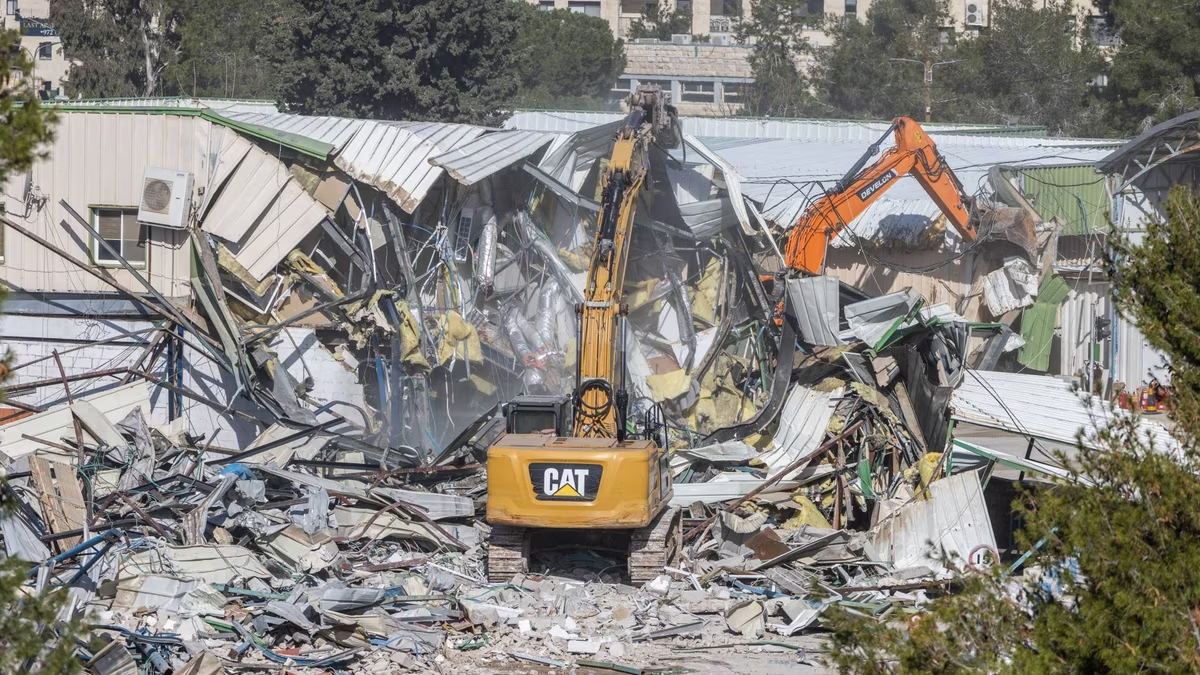
 From this standpoint, great pressure must be exerted by the bodies supervising these schools on the Jerusalem municipality and European countries, which sell us slogans and statements, and which continue to "look" at what is known as phrases of international legitimacy and the right to education, which fell at the gates of Sheikh Jarrah, with the demolition of buildings belonging to UNRWA, and the confiscation of its land leased from the Jordanian government in 1952, in order to establish a settlement on its land, called "Ma'alot Dafna," 1410 settlement units.
 And in order to clarify matters, I believe that it is the duty of the administrations of these schools and their educational authorities to issue a statement to the public, clearly stating that they wish to accommodate all students in Jerusalem, but the objective circumstances are beyond the will of these schools, as no licenses are granted by the occupation municipality to establish new school buildings that can accommodate the increasing number of students. The school buildings have remained as they are, and therefore the margin allowed to accommodate new students is limited, as priority is given to school students who are siblings and graduates of these schools, and they do not accommodate or accept students for social, sectarian, tribal, or geographical considerations, but rather they are open to serve all residents of the city from all its social classes, regardless of religion and beliefs.
 From my point of view, trials and reactions should be based on evidence, facts, and realities, and not on hearsay, or on projecting our feelings and emotions onto our preconceived notions.
They are academic institutions that we must preserve, support, and remain a banner and a beacon for preserving our curriculum, identity, culture, and existence in our Jerusalem.

OPINIONS

Mon 26 Jan 2026 9:36 am - Jerusalem Time

Gaza Between Administrative Peace and Power Peace: Where Does the Palestinian State Stand?

Today, Gaza is no longer merely a battlefield or an urgent humanitarian issue; it has transformed into a political and legal laboratory where new models for conflict resolution are being tested, re-marketed under the title of "long-term peace." However, this peace, as presented in international circles, is not based on ending the occupation or enabling the Palestinian people to exercise their right to self-determination, but rather on re-engineering the political and security reality in the Strip, within an equation that combines administrative peace and power peace, with a clear marginalization of the aspiration for an independent Palestinian state.
In this context, old ideas formulated since the beginning of the millennium are being brought to the forefront, which treated Gaza not as an integral part of a national liberation project, but as a densely populated area requiring administration and security control under external supervision.
What is being proposed today as "transitional administration" or a "technocrat committee" is not a product of the recent war, but a reproduction of approaches that view governance as a technical function, not a political practice stemming from popular will.
Administrative peace implicitly assumes that the core of the Palestinian crisis lies in "poor governance," not in the continuation of the occupation.
Hence, political representation is replaced by unelected functional structures, deriving their legitimacy from international acceptance rather than from the people.
These structures are not asked to defend national rights or represent the general will, but to manage the population: crossings, services, relief, and reconstruction, within a pre-drawn political ceiling.
In contrast, power peace constitutes the security aspect of this equation.
It is a peace conditioned on disarmament and on subjecting the Palestinian security sphere to strict oversight, through international arrangements or regional understandings.
Here, sovereignty, especially in its security dimension, transforms from an inherent right into a "deferred reward," granted only if the Palestinian side adheres to the imposed conditions of stability. Thus, disarmament is not a transitional step towards statehood, but a permanent tool to keep it deferred.
More dangerous than the reduction of powers is what this model entails in terms of re-dismantling the Palestinian geopolitical landscape.
Gaza is treated as a separate unit with its own governance system, which opens the door for generalizing the same logic to the West Bank later, transforming Palestine into a collection of administrative entities, each with its own permanent "transitional" arrangements, instead of being a single state under occupation striving for liberation.
This project is given moral cover today through humanitarian discourse, benefiting from the unprecedented catastrophe experienced by the Strip.
Amidst widespread destruction, displacement, hunger, and infrastructure collapse, people's primary concern becomes survival before any political discussion.
Here lies the ethical and political dilemma: utilizing real human suffering to pass arrangements that may shape the destiny of the Palestinian people for decades.
What is imposed in a moment of weakness may become a permanent framework for political life.
From the perspective of international law, any transitional phase under international supervision is supposed to have a defined goal and timeframe, and its purpose is to enable the people under occupation to exercise their full right to self-determination.
But what is proposed for Gaza today is closer to models of "modern guardianship": local administration in form, and effective external control in essence, with deferred sovereignty without a clear time horizon.
Therefore, the fundamental question is no longer: Who will administer Gaza administratively?
Rather, the more dangerous and deeper question is:
Is Gaza intended to be the nucleus of an independent Palestinian state, or a permanent laboratory for administrative peace and power peace, or the end of the Palestinian national project, at the hands of Israel and Hamas?
The answers to these questions will determine not only the future of Gaza, but the fate of the entire Palestinian national project.

OPINIONS

Mon 26 Jan 2026 9:33 am - Jerusalem Time

When Movements Exhaust Their Actions: Towards a Post-"Fatah" and "Hamas" Horizon

The idea here is not to issue a moral judgment on Fatah or Hamas, nor to solely blame either of them for the current state of the Palestinian situation, but rather to attempt to read the national experience from a deeper analytical angle: the angle of the "foundational act" produced by major movements at a critical historical moment, which then transforms over time into a structural imprint that reshapes the entire political sphere and stamps the movement itself with a character difficult to escape. In comparative literature, these moments are described as "critical junctures": moments that not only change the course of politics but also create new paths with self-reliance, constrain subsequent choices, and make the foundational act a silent reference for everything that follows.

In this sense, the Oslo Accords can be viewed as the foundational act for the Fatah movement in the contemporary era, not because it was necessarily a "moral error," but because it restructured the entire Palestinian political sphere. Oslo was not merely a negotiating track, but the establishment of a new governance model: authority without sovereignty, an economy dependent on donors, functional security under occupation, and a transition from the logic of a liberation movement to the logic of daily administration of the population. This transformation produced a hybrid political structure: neither a viable state nor a liberation movement capable of open engagement. Over time, the crisis of this path was no longer its faltering, but that it itself became the only possible policy, the source of legitimacy, and the horizon of thought. Thus, the Oslo imprint became attached to the Fatah movement as the movement that ushered Palestinians into an open transitional authority phase without a sovereign horizon, and the accompanying representational fragmentation, erosion of the meaning of liberation, and structural dependence on external arrangements.

In contrast, Hamas has historically been associated with the pivotal act of October 7th, as a moment that broke the logic of containing and normalizing the conflict, and reintroduced the Palestinian issue to the heart of global politics, but at an unprecedented human and political cost. This act was not merely a military operation, but a pivotal event that escalated the conflict to an extreme: a comprehensive war on Gaza, a global test of law and ethics, and a re-raising of the question of the day after, implying who governs? Who represents what? And what form can the national project take after the destruction? In this sense, the name Hamas is no longer separate from "Al-Aqsa Flood" as a historical defining act, just as Fatah is no longer separate from Oslo. Here, the issue is not intentions, but the trajectory effect: a single act that reshapes the field and places the movement in a position from which it cannot disengage, whether in defense or in criticism.

Many experiences show that major movements are often historically defined by a single moment: the African National Congress by the liberation of South Africa, the Algerian National Liberation Front by the war of independence, Sinn Féin by the transition from arms to settlement, the British Conservatives by Brexit, the Israeli Labor Party by Oslo, and Likud by redefining Israel as an expansionist nation-state. In all these cases, the foundational act becomes a source of legitimacy, then over time transforms into a structural burden when historical conditions change and the movement remains captive to its initial mark. At this point, the question is no longer: who was right? But: is this movement still capable of producing a new horizon that transcends its foundational act?

Talking about "post-" in the Palestinian context seems much more difficult than in other contexts, including the Israeli one, because this question is not posed on politically or sovereignly stable ground, but on an open historical void. In most other contexts, "post-party" is discussed within an existing state with established institutions. When "post-Likud" or "post-Netanyahu" is said in Israel, the discussion takes place within the framework of a complete state: the army, economy, judiciary, and general political identity all remain, and the disagreement remains confined to the directions of governance, not the existence of the entity itself.

As for the Palestinian case, the discussion about "post-Fatah and Hamas" does not take place within an existing state, but within an incomplete national project and a political entity that has not yet formed. The parties here do not compete to manage a stable state, but effectively act in place of the absent state. Fatah bears the burden of external representation and the structure of authority under occupation, while Hamas does not merely represent an opposition party, but a governing structure in Gaza and a military bearer of resistance. Therefore, thinking about "post-them" is not received as a normal political transition, but as a possibility of a comprehensive void in the basic functions that the state is supposed to perform: political representation, governance, negotiation, defense, and the organization of people's daily lives. In such a context, "post-" does not seem like a transition within an existing system, but a leap into the unknown, affecting the entire structure of the national project itself, not just the balances of power within it.

The matter becomes more complex because the Palestinian field is governed by the condition of occupation. In the absence of sovereignty, politics becomes laden with existential functions: survival, protection, recognition, and representation. In such a context, groups tend to cling to what exists, no matter how problematic, because the alternative seems like an existential risk, not just a political adventure. In Israel, one party can be replaced by another without fear for the continuity of the state; in Palestine, it is feared that "post-" would be a collapse, not a transition.

Furthermore, the Palestinian experience is burdened by a memory of accumulated setbacks: settlement failures, collapse of unity, siege, wars, and erosion of representation. This memory makes the political imagination poor and burdened with caution. The question becomes not "what is the better alternative?" but "do we even have the luxury of experimentation?". In such a climate, thinking about "post-" becomes a symbolic gamble, because it opens up possibilities of chaos as much as it opens up possibilities of renewal.

Based on this, a thesis can be formulated that the Palestinian political system has entered a phase of "deadlock of the ruling duality": where Fatah and Hamas, despite their fundamental differences, have become prisoners of two historical junctures that they are no longer able to overcome or produce a new meaning for national action outside their shadow. Fatah is governed by the Oslo structure and its accumulated institutions, affiliations, and political economy, and Hamas is governed by the moment of Al-Aqsa Flood and the existential questions it opened regarding cost, capability, protection, and meaning. Both possess historical legitimacy, but this legitimacy has become more past-oriented than performative; it is based on what was, not on what can be achieved in post-disaster conditions.

Here, the question of "post-Fatah and Hamas" arises not as an exclusionary call, but as a structural question about the ability of the existing duality to produce a viable national strategy. The intention is not the end of the two movements, but the end of their monopoly over the horizon and meaning of Palestinian politics. "Post-" means opening up a new horizon for representation, thought, and organization, transcending the Oslo/Al-Aqsa Flood equation as the limits of what is possible.

The actual entry into this phase can be tested through concrete indicators, not slogans: the erosion of the two movements' ability to monopolize the definition of "national," and the search by broad sectors, especially young generations, for alternative forms of representation; the emergence of organizational or intellectual initiatives that transcend polarization and speak the language of the project, not the language of the axis; the shift of public debate from the question of "who is with us?" to the question of "what is a viable strategy?"; and the revival of the demand to rebuild national representation on comprehensive and democratic foundations as an existential condition for any new project.

If these indicators are realized, we will have effectively entered the "post-Fatah and Hamas" phase, not as a political vacuum, but as a horizon for re-establishing Palestinian politics outside the captivity of old junctures. Remaining within the duality, however, means recycling the same history: authority without sovereignty on the one hand, and resistance without a unifying political horizon on the other, while the societal cost continues to rise and the margin of meaning and hope shrinks. This dilemma becomes more dangerous in light of profound and alarming global transformations, not least the escalating trend towards the "privatization" of the international system, as reflected in Trump's policies, and the increasing indications of the formation of a multipolar world order, with its repercussions for the Global South, at the heart of which lies the Palestinian issue. In a world where the moral and legal framework that governed the post-Cold War era is disintegrating, and the value of the weak in power calculations is declining, the ability to rebuild the political self becomes a condition for survival, not an intellectual luxury. At such a moment, the question of "post-Fatah and Hamas" becomes not a mental exercise or a desire for rupture, but an existential necessity: a question of how Palestinians can regain their ability to imagine their future, formulate their project, and carry their cause beyond a duality that has exhausted its historical energy, in the face of a world that pushes them, time and again, to the brink of erasing meaning before erasing place.

OPINIONS

Mon 26 Jan 2026 9:31 am - Jerusalem Time

Peace be upon the world!

Dr. Ibrahim Melhem

Editor-in-Chief

Since his ascent on the broken stairs of the international body, and his public reprimand of it for its obsolescence, corruption, and expiration, the man with the inflated ego has turned his cheek to the people, and began to walk proudly on earth, as if there was no one else in it; he wages wars, seizes people's properties, and threatens those who oppose him with malicious taxes, transforming the halls of politics into a casino where he alone forms the "Peace Council" to be an alternative to the international body, drafting its charter, and determining the price of admission tickets to it.
Like an elephant entering a pottery shop, Trump began to break the rules of right and justice and the values of humanity, acting like an actor in a long "Western" film, playing the role of the villain who shoots from atop his horse, and threatens with an "Armada" anyone who disobeys his command, threatening to kidnap leaders and their wives from their bedrooms, if they refuse to hand over the keys to their countries' treasuries and wealth.
In a bold dissection of the global scene, "Mark Carney", the Canadian Prime Minister, in his speech at the Davos Forum, unveiled the veil of values and ethics that had covered the nakedness of the global system for decades, revealing that it was nothing but a lie, hiding behind it the arrogance of power and double standards.
Mistaken is he who thinks that Trump is merely a "passing phenomenon" that will end with his departure; he is the naked face of America that has returned to its former self; a state ruled by numbers, not values. It sells allies in a "liquidation" auction, as happened with "Qasd" when its purpose as a "gun for hire" was exhausted, and feeds Ukraine to the Russian bear when ammunition bills became a burden on the budget, even its allies in "NATO" were not spared from commercial stings and customs duties on wine and champagne.
When Trump forms a peace council, his morals are its charter, and Netanyahu is among its gatekeepers.. then peace be upon the world. The late political fox Henry Kissinger was right when he said: "America's friends should fear it more than they fear their enemies."
Peace be upon the world! It is not just a farewell phrase in a theatrical text, but rather an "obituary" for an international system that has fed on slogans of democracy and human rights for decades, until Trump came to announce the end of the show.

PALESTINE

Mon 26 Jan 2026 8:46 am - Jerusalem Time

Escalation in Jerusalem.. UNRWA headquarters set on fire after being demolished

The deliberate burning of the UNRWA headquarters comes a few days after Israeli occupation bulldozers demolished parts of the building.

The headquarters of the United Nations Relief and Works Agency for Palestine Refugees (UNRWA) in occupied East Jerusalem witnessed a deliberate arson incident on Sunday, a few days after Israeli occupation bulldozers demolished parts of the building. This incident is a new episode in the series of targeting that the UN organization has been subjected to since its activities were officially banned.

UNRWA announced in a statement that its main headquarters in Jerusalem was set on fire after it was stormed and partially demolished by the occupation last week. The agency described this fire as a "continuous attempt to undermine the status of Palestinian refugees," stressing that its properties enjoy international immunity that legally obliges Israel to protect and respect them, according to statements by the agency's spokesperson, Jonathan Fowler.

For their part, fire and rescue teams confirmed their response to the report and their work to extinguish the fire to prevent its spread, without addressing the real causes of its outbreak, which adds to the ambiguity of the scene regarding the party responsible for the fire, given that the headquarters has been evacuated of employees since the beginning of 2025.

The East Jerusalem headquarters has been in a state of paralysis since January 2025, following the Israeli occupation's decision to prevent UNRWA from operating within the country, after accusing it of providing cover for Hamas elements. Although UN investigations have not provided conclusive evidence to prove the Israeli allegations, the field escalation against the agency's facilities has not stopped.

It is worth noting that UNRWA was established in 1948 to care for about 700,000 Palestinian refugees, and today it is the main artery for health and educational services in the West Bank and Gaza Strip, which makes targeting its headquarters in Jerusalem a clear political message affecting the issue of the right of return and Palestinian presence in the Holy City.

PALESTINE

Mon 26 Jan 2026 3:01 am - Jerusalem Time

Netanyahu's Office: We agreed to open the Rafah crossing in a limited way for the passage of individuals only, under our full control mechanism

The Rafah crossing is expected to open this weekend. The office of the Israeli occupation prime minister, Benjamin Netanyahu, issued a decisive statement on Sunday evening, outlining the official position on the reopening of the Rafah border crossing. Netanyahu linked this step to the completion of a specific military mission and the implementation of strict monitoring programs, within the framework of recent understandings with the administration of US President Donald Trump.

Netanyahu's office confirmed that the occupation would open the Rafah crossing once "the process of locating the body of detainee Ran Gvili is completed." Reports indicate that the Israeli occupation army is racing against time in extensive excavation operations in the Zeitoun neighborhood and northern Gaza to recover the remains, considering that "exhausting the search operation" is the only guarantee for moving forward with the agreement with Washington.

The statement clarified that the Israeli approval includes strict field controls, represented by: Restricted passage: The crossing will be allowed to open in a limited way for the passage of individuals only in the first phase, and the operation will be subject to a full Israeli control mechanism, to ensure that no elements or materials exit or enter without direct security scrutiny. Agreement with Washington: This mechanism comes in implementation of the understandings concluded with the United States to facilitate humanitarian cases within "Trump's peace plan."

Netanyahu's office stressed that the opening of the crossing was from the beginning conditional on the return of all hostages (alive and dead). The statement placed responsibility on the Hamas movement, demanding that it make "its utmost effort" to return them, considering that any delay in this file will lead to the disruption of the opening of the crossing or its re-closure.

This announcement represents an attempt by Netanyahu to balance American pressure aimed at easing the blockade, with the demands of the hardline "Israeli right" that refuses to make any "concessions" without heavy security costs.

The army's success in finding Gvili's body remains the trigger that will determine the moment of crisis relief at the Rafah border.

PALESTINE

Mon 26 Jan 2026 1:16 am - Jerusalem Time

Jerusalem Governorate: More land devoured for a settlement road

The Jerusalem Governorate announced on Sunday that the Israeli occupation municipality is moving to devour more land for a settlement road by approving a "huge" budget to expand the road north of the city.

The Governorate stated in a press release that the finance committee of the Israeli municipality "will hold a session tomorrow (Monday) to approve the budget allocated for the implementation of Road 45," known as the Quarries Road, north of Jerusalem.

It clarified that the existing road will devour about 280 dunams (a dunam equals one thousand square meters) of Jerusalem Governorate lands, and about half a billion shekels (about 160 million dollars) have been allocated for it under the item "development of Road 437".

According to the Governorate, the road extends from the Israeli military checkpoint of Hizma, northeast of Jerusalem, to the roundabout of Jaba' town, north of the city.

According to the Governorate, settlement projects are not merely infrastructure development, "but rather part of the occupation's strategy to strengthen the network of settlements and impose full control over the city and its surroundings, as part of what is known as 'accelerated colonial creep from planning to actual implementation'."

It added that the occupation exploits regional crises in the area, including the effects of the recent war of extermination in the Gaza Strip, "to accelerate colonial expansion projects and impose a new reality on Palestinian land."

It warned that Israeli policies "aim to isolate Jerusalem from its Palestinian surroundings, and transform Jerusalemite towns into scattered and isolated areas, while facilitating settlers' access to settlements at record speed and encouraging them to settle there."

The Governorate warned of widespread confiscation of Palestinian lands owned by citizens, "which constitutes a violation of international law."

It considered that the road planned for construction will constitute "a practical implementation of the so-called Greater Jerusalem plan according to the Israeli concept, and the annexation of settlements to the borders of the occupation municipality, with the occupation continuing to use all means to change the geography and Palestinian identity of the city, and exploiting all regional circumstances to accelerate the implementation of the plan, reflecting the escalation of violations and crimes in the holy city."

According to data from the Palestinian Wall and Settlement Resistance Commission, Israeli "planning committees" studied 107 structural plans during 2025, including 41 plans outside the occupation municipality's borders and 66 in settlements within the borders drawn by the municipality for the city of Jerusalem.

PALESTINE

Mon 26 Jan 2026 1:01 am - Jerusalem Time

Occupation Army: Search for the body of the "last detainee" is a complex operation and may last for days in northern Gaza

A large-scale military operation launched by the occupation since the end of the week to locate the body of the last detainee.

The Israeli occupation prime minister's office revealed on Sunday evening the start of a large-scale military operation that the army has been conducting since the end of the week to locate the body of the last detainee held by Hamas, "Ran Gvili."

These moves come amid increasing internal pressure to completely close the detainee file.

According to the official statement issued by Netanyahu's office, army forces are conducting precise excavation and sweeping operations in a cemetery located in the northern Gaza Strip.

Sources confirmed that these operations are particularly focused on the Al-Zaytoun neighborhood in eastern Gaza City, where engineering units and precise intelligence information have been used to locate the potential remains.

The operation includes the use of advanced geological survey techniques, with a tight security cordon imposed around the search areas.

The presidency indicated that these efforts fall within the government's commitment to recover all detainees, whether alive or bodies, for burial in Israel.

The Prime Minister's office clarified that Ran Gvili's family is regularly updated on all field developments.

Through this operation, Netanyahu is trying to affirm his position that "military pressure" is the only way to achieve the war's objectives, especially as the Gaza file moves into new stages coinciding with international mediations led by US President Donald Trump's administration to establish calm.

Although "Gvili" is considered the last official detainee on the occupation's lists, the exhumation operations in cemeteries have drawn widespread human rights and international criticism, as they represent a violation of the sanctity of the dead.

Nevertheless, the Israeli security establishment insists on completing the mission to close this file, which has lasted for more than two years.

OPINIONS

Sun 25 Jan 2026 9:44 pm - Jerusalem Time

Rafah Crossing: False American Understandings and Israeli Conditions to Perpetuate the Siege and Starve Gaza

Let it be clear that Israeli threats against Gaza will not stop, regardless of any “ceasefire agreement.” Genocide has become the daily reality, and the racist colonial settlement occupation sees the continuation of suffering and siege as the new old normal. This reality must be viewed and dealt with as the product of a systematic policy, because we are facing a society of perpetrators of genocide, not just a fleeting political adversary.


The Rafah crossing is no longer just a border crossing point; it has become a blatant mirror reflecting the nature of the political partnership between Israel and the United States in managing the war on Gaza, not only in its military dimension but in its humanitarian, political, and economic essence. The issue is no longer about technical procedures or security arrangements, but about a policy based on producing and then obstructing promises, and marketing “understandings,” while the siege is effectively managed as a tool of collective punishment.


According to what was revealed by Israeli Army Radio, Israel and the United States reached a preliminary understanding last week to open the Rafah crossing in both directions. However, this understanding, like other previous understandings, did not go beyond media statements, as Israel quickly drowned it with a series of conditions, restrictions, and renewed “security” pretexts, while preparing to hold a meeting of the Ministerial Committee for National Security Affairs (the Cabinet) to “decide the fate” of the crossing. This reflects the occupation's mentality, which views crossings as tools for control and blackmail, not as lifelines for Palestinians in the Gaza Strip.


This scene cannot be separated from the American role, which has not been a mediator or guarantor, but a full political partner. The United States merely produces vague understandings that are later used to whitewash the occupation's image before international public opinion, without any binding mechanisms or actual pressure. Thus, “American understandings” become a political cover for deliberate Israeli obstruction, while the essence remains the same: keeping Gaza under siege, and managing the catastrophe instead of ending it.


More dangerously, the complicity extends to the post-war phase, where the “second phase” is promoted, promises of reconstruction are launched, and new maps for Gaza are drawn under humanitarian and developmental slogans. However, these promises are made completely disregarding people's rights, and their right to land and to determine the shape of their cities and their future.


What is marketed as a reconstruction project is gradually revealed as a political-economic scheme, in which land ownership is confiscated under pretexts of “organization,” “security,” and “modern planning,” and rebuilding is done according to investment priorities that serve American economic interests and its partners, not the needs of the afflicted residents of Gaza. Thus, genocide and destruction are transformed into an economic opportunity, and the siege is completed with plans to rearrange the place and the people, in one of the most dangerous forms of contemporary colonialism.


In light of these joint policies, a humanitarian catastrophe is unfolding within Gaza City, where the city is suffering from a severe water crisis with its cutoff for the eighth consecutive day. According to the Gaza municipality, more than 85% of the city's area does not receive water, putting hundreds of thousands of civilians at direct health risk, and confirming that the قطع of basic services is not a side effect of the war, but part of a systematic strangulation strategy.


In parallel with this catastrophic reality, statements by Dr. Ali Shaat, head of the National Committee for the Administration of Gaza, are multiplying regarding the introduction of shelter caravans, the opening of crossings, and the improvement of humanitarian conditions. Despite the reassuring nature of these statements, they clash with the wall of Israeli restrictions supported by the US, and the absence of any real implementation guarantees. Thus, promises turn into tools to buy time and absorb anger, while the residents of Gaza are left to face thirst, hunger, and the collapse of basic services.


In conclusion, what is happening at the Rafah crossing is not a failure of coordination, but a success of a joint policy based on keeping Gaza in a state of permanent suffocation. Israel imposes conditions, the United States provides cover, and the international community merely observes. As for the price, it is paid by Palestinians alone: siege, starvation, land confiscation, and conditional reconstruction formulated outside their will and rights.


The Rafah crossing today is not only closed by gates, but closed by international political will. Its true opening begins by breaking the partnership of occupation and American cover, and restoring rights to the residents of Gaza, before humanity becomes merely a slogan circulated in the media.

ISRAELI AFFAIRS

Sun 25 Jan 2026 9:16 pm - Jerusalem Time

Warning to airlines.. Tel Aviv reveals date of "potential security escalation"

Tel Aviv warns international airlines: End of January is a "security-sensitive period."

An official message sent by the head of the Israeli occupation's Civil Aviation Authority, Shmuel Zakai, on Sunday, revealed serious Israeli concerns about the region entering a "security-sensitive period" by the end of this month, specifying particular dates that could witness a potential escalation, in a rare cautionary step for foreign airlines operating flights to "Ben Gurion" Airport.

According to published sources, the message addressed to the companies included clear indications that the upcoming weekend, specifically January 31 and February 1, 2026, could represent a security turning point and the beginning of a more dangerous and sensitive phase, necessitating the adoption of precautionary measures.

Regarding potential emergency scenarios, the Israeli occupation authorities have developed a plan to deal with the assumption of airspace closure in case of deteriorating conditions, as the message explicitly stated that "top priority" would be given to foreign flights departing from Tel Aviv; this is to facilitate the safe and rapid departure of international aircraft and their passengers before any other action.

Zakai stressed that officials would not hesitate to make the decision to close the airspace if it became clear that a reasonable level of flight safety could not be guaranteed, citing similar precedents where similar decisions were made in June 2025, as well as in April and October of 2024.

Despite the cautionary tone, Zakai clarified that current assessments issued by the Aviation Authority, based on instructions from the "Home Front Command," indicate continued stability over the next few days before the specified date. However, he did not fail to emphasize that air defense systems remain in a "state of full deployment" and at the highest levels of readiness, with intensive coordination mechanisms between the relevant authorities.

The message also contained a faint political hint, as the official alluded to a "possibility" – which he described as not high – of resuming negotiations between the United States and Iran, which, if it occurs, could contribute to reducing the level of tension in the region and avoiding the expected escalation.

OPINIONS

Sun 25 Jan 2026 3:58 pm - Jerusalem Time

How close is a military strike against Iran?

By: Murad Farid Hamidane.


Talk of a potential military strike against Iran is no longer just analytical material in research centers or fleeting press leaks; it has become a constant part of the tense regional landscape at the beginning of 2026. American military movements in the region, naval and air reinforcements, and official statements speaking of "strong options" are met with Iranian rhetoric that raises the ceiling of response to the point of considering any attack as an all-out war. Nevertheless, the difference between escalating deterrence and making a decision for war remains clear.

The reality is that the region is experiencing a moment of "acute balance," where military preparations intersect with precise political calculations. The decision for a strike, if taken, is not only about the possibility of military execution but also about the nature of the target: Is it nuclear facilities? Military sites? Specific leaders? It is also linked to the scope of the operation: Will it be a limited, containable strike, or the beginning of an open confrontation that could extend to more than one arena?

It is essential here to distinguish between three scenarios that are often conflated in public discourse. First: a direct and widespread American strike. Second: a unilateral or semi-unilateral Israeli strike. Third: operations below the threshold of war, such as cyberattacks, limited strikes, or covert operations. This distinction is crucial because the probability of each scenario differs radically from the others. An all-out war is not the only option, and perhaps the least likely in the short term, while limited operations remain more feasible because they are less costly and more deniable.

The most sensitive factor in this equation is Iran's nuclear program. Continued enrichment at high levels keeps Israeli and American concerns alive and fuels the rhetoric of a "narrow window of time" to prevent Iran from reaching the threshold of latent nuclear capability. However, concern does not necessarily equate to a military decision. A strike, if it targets nuclear facilities, may not end the program entirely, but it could ignite a wide regional confrontation that would be difficult to contain.

The United States so far appears more inclined to use force as a tool of deterrence and political pressure, not as a first option for military resolution. Washington understands that a war with Iran is not a swift operation, but rather a potential multi-front escalation that could include the Gulf, maritime passages, and perhaps other regional arenas. Moreover, any widespread confrontation would directly impact energy markets and global economic stability.

As for Israel, despite its continuous raising of the warning level, it realizes that the decision for a strike is not only about military capability but also about the ability to withstand subsequent responses. Managing a multi-arena war without sufficient international political and military cover is a high-risk gamble. Therefore, the scenario of a limited strike or undeclared operations remains more realistic than an open, uncontrolled war.

In contrast, Tehran raises the level of threat to fortify deterrence, asserting that any targeting will be met with a harsh response. This rhetoric is not just media escalation, but a strategic message aimed at preventing its adversaries from considering a "clean strike" without cost. Here lies the paradox: each party brandishes force to avoid using it.

The summary of the scene is that the region is not on the verge of an declared war, but it is also not in a state of stability. We are in a phase of escalating deterrence, where elements of pressure are accumulating without yet turning into a decision for a comprehensive confrontation. The most likely scenario in the short term is the continuation of mutual threats, and perhaps an escalation of limited or indirect operations, with the option of a widespread strike remaining a possibility linked to changes in political or nuclear data.

The Middle East today stands on the brink of calculated tension. A miscalculation, or an unexpected incident, could push things onto a different path. But for now, it seems that all parties prefer to keep war as a deterrent option, not as a decision for execution.