PALESTINE

Mon 02 Feb 2026 12:26 pm - Jerusalem Time

Gaza: Director of Nasser Medical Complex: Israeli Obstruction of Wounded Travel, No Cases Have Left Yet

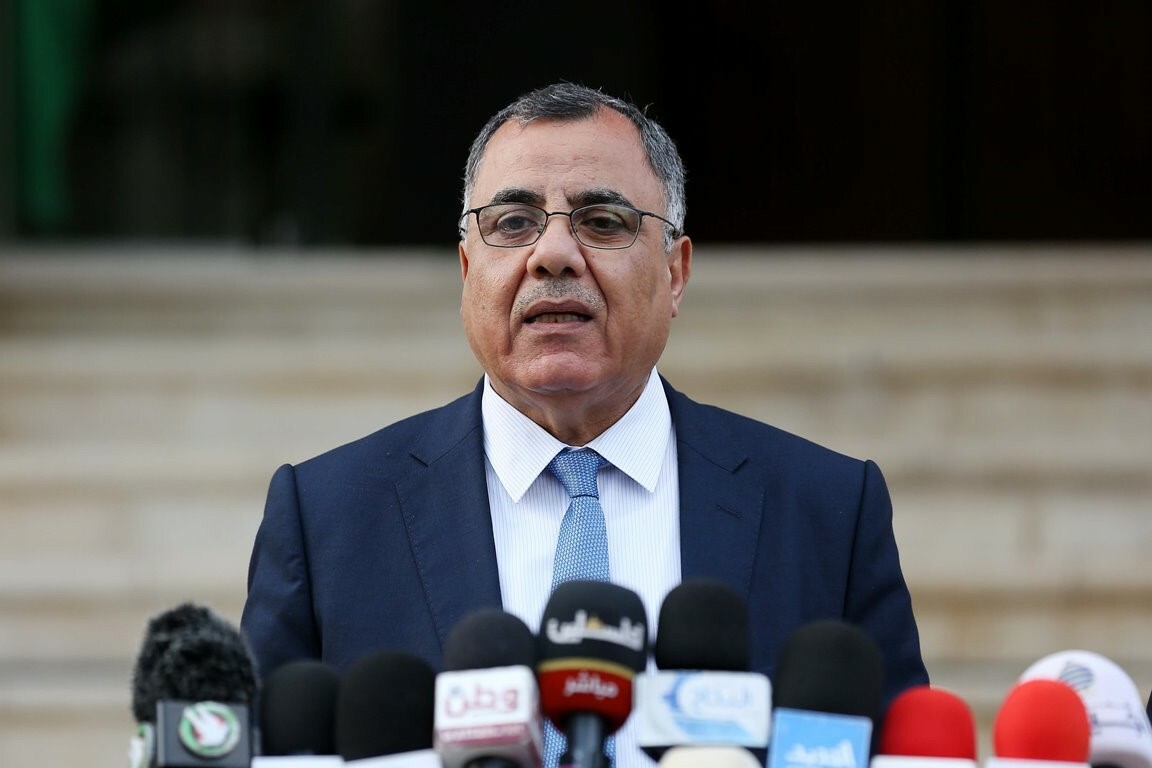
The director of Nasser Medical Complex in the southern Gaza Strip confirmed a clear Israeli obstruction of the travel of patients and wounded through the Rafah land crossing, revealing that the occupation authorities approved only 5 names out of a list that included 27 patients and wounded with difficult conditions.

The director of the complex stressed, in a press statement on Monday, that no patients or wounded have left through the crossing so far, despite the announcement of the start of operations.

He pointed out that there are more than 20,000 patients and wounded waiting for an opportunity to travel to receive necessary treatment after the deterioration of the health system in the Strip due to the continuous aggression.

The director of the complex said in his statement: 'The delay in travel procedures for these injured represents an actual death sentence for them due to the deterioration of their health, and we observe a state of ambiguity and lack of clarity in managing this file in an unusual way compared to what it was before.'

These statements refute expectations of a quick breakthrough in the medical crisis, as the security obstacles imposed by the occupation emerge as a major impediment to saving hundreds of critical cases in the Gaza Strip.

PALESTINE

Mon 02 Feb 2026 11:26 am - Jerusalem Time

A Palestinian Child killed and others injured due to occupation violations of ceasefire in Gaza

The northern Gaza Strip witnessed a limited incursion by occupation vehicles east of Jabalia al-Balad, where a child was martyred and several citizens were injured on Monday, as a result of repeated attacks that constituted a new violation of the ceasefire agreement in the Gaza Strip, accompanied by shelling and gunfire in several areas.

Palestinian sources stated that three-year-old child Iyad Ahmed Naim Al-Rabaia was killed as a result of shelling carried out by warships targeting tents housing displaced people in the Al-Iqlimi area south of Mawasi Khan Yunis, in the southern part of the Strip.

In the same context, occupation vehicles opened fire towards areas in the center and east of Khan Yunis city, and areas east of Al-Bureij refugee camp in the central part of the Strip were subjected to gunfire at more than one point.

The northern Gaza Strip also witnessed a limited incursion by occupation vehicles east of Jabalia al-Balad, coinciding with intense gunfire towards the displaced persons' tents extending along the old Gaza street.

The attacks extended to include the eastern areas of Juhor al-Dik town, southeast of Gaza City, where occupation forces fired bullets towards them, in addition to renewed gunfire east of Al-Bureij refugee camp in the central part of the Strip.

These violations come in the context of continuous breaches, which have led to an escalation of anxiety and fear among citizens and displaced persons, especially in the border and eastern areas of the Gaza Strip.

PALESTINE

Mon 02 Feb 2026 11:26 am - Jerusalem Time

Comprehensive Egyptian Emergency Plan to Receive Wounded Palestinians and Prepare 150 Hospitals

The Egyptian Ministry of Health announced its full readiness to receive Palestinian patients and wounded coming from the Gaza Strip, as part of a comprehensive emergency plan put in place by the state to deal with field developments.

The ministry clarified that 150 hospitals will be equipped to receive various medical cases, in addition to allocating 300 fully equipped ambulances to provide urgent medical services to Palestinians upon their arrival.

The plan also included mobilizing 12,000 doctors and 30 rapid deployment teams to meet the requirements of immediate medical intervention and deal with any emergency cases, ensuring the provision of necessary healthcare at the highest level of efficiency.

In the same context, the Egyptian Red Crescent confirmed the provision of integrated humanitarian services to Palestinian families returning from Egypt to the Gaza Strip, including medical and relief support to ensure their safety and comfort during their return journey.

These intensive preparations come within the framework of continuous Egyptian efforts to support Palestinian brethren and provide urgent medical and humanitarian assistance in light of the difficult circumstances facing the Gaza Strip.

PALESTINE

Mon 02 Feb 2026 10:11 am - Jerusalem Time

Settlers violate the West Bank: (634) attacks against Palestinian citizens and demolition of (189) homes and structures during last January

   The Palestinian Labor and Planning Department of the Palestine Liberation Organization issued its monthly report on settler attacks and the demolition of homes and structures in the West Bank and occupied Jerusalem, highlighting the following:-


First: Attacks by settler gangs

During last January, settler gangs carried out (634) attacks against Palestinian citizens and their properties, an increase of 78% compared to the same period last year 2025.

 These criminal attacks resulted in (78) citizens sustaining various injuries due to being beaten, shot, pelted with stones, and sprayed with gas, including (7) women and (5) children.

The attacks included (28) shooting incidents and two hit-and-run incidents against Palestinian citizens. Criminal settler gangs destroyed and uprooted (2000) fruit trees, and stole and killed (586) head of livestock belonging to Palestinian farmers, with the aim of harassing them and increasing the cost of their presence on their land. Damage was inflicted upon (53) vehicles as a result of being burned or pelted with stones, while settler gangs destroyed and burned (11) homes and agricultural, animal, and service facilities in villages and towns of the West Bank, concentrated in the governorates of Jerusalem and Hebron.


In the context of pastoral settlement expansion, the Labor and Planning Department monitored attempts last month to establish (4) new pastoral settlement outposts distributed in the villages and towns of Rummon and Deir Dibwan east of Ramallah and Al-Bireh Governorate, Khan Al-Ahmar and Beit Iksa village in Jerusalem Governorate, and Jabal Ain Aina between the villages of Qusra and Jalud south of Nablus Governorate.


The criminal attacks were concentrated in Nablus Governorate (150) attacks, followed by Ramallah and Al-Bireh Governorate (139) attacks, then Hebron Governorate (131) attacks, followed by Jerusalem Governorate (43) attacks, Tubas and Northern Valleys Governorate (39) attacks, Jericho Governorate (38) attacks, Bethlehem Governorate (36) attacks, Salfit Governorate (26) attacks, Jenin Governorate (15) attacks, Qalqilya Governorate (9) attacks, Tulkarm Governorate (8) attacks.


Second: Demolition of homes and structures

During last January, the Israeli occupation authorities demolished (189) homes and structures in the West Bank and occupied Jerusalem, including the demolition of (43) homes and (146) structures, among them (8) self-demolition operations in the towns of Silwan and Al-Issawiya in occupied Jerusalem, and the villages of Kafr Thulth and Al-Funduq in Qalqilya Governorate, and Al-Walaja town in Bethlehem Governorate. Their owners self-demolished them to avoid paying exorbitant fines. The demolition operations were concentrated in the governorates of Hebron, Bethlehem, Jericho, Nablus, Salfit, Ramallah and Al-Bireh, Jerusalem, Qalqilya, Jenin, and Tulkarm.

In the context of the collective punishment policy, the Zionist occupation army forces demolished two homes belonging to the families of martyrs and wounded, namely the home of prisoner Ahmed Abu Al-Rub from Qabatiya town in Jenin Governorate, and the home of martyr Imran Al-Atrash in Hebron city.

Settler gangs continued to sabotage and destroy citizens' facilities in the villages and cities of the West Bank, where the department documented settlers burning and destroying (11) homes and service, agricultural, and animal facilities, specifically in the Masafer Yatta communities southeast of Hebron Governorate, and the Khirbet al-Sidera Bedouin community near Mikhmas village northeast of Jerusalem Governorate.

The occupation authorities issued demolition and stop-work orders for (60) homes and structures, and the notifications included the governorates of Hebron, Bethlehem, Jerusalem, Jericho, Jenin, Nablus, Tubas and the Northern Valleys, Ramallah and Al-Bireh, and Qalqilya.


OPINIONS

Mon 02 Feb 2026 10:08 am - Jerusalem Time

Israel and the US-Iranian Tension: Divergent Goals and Strategic Implications

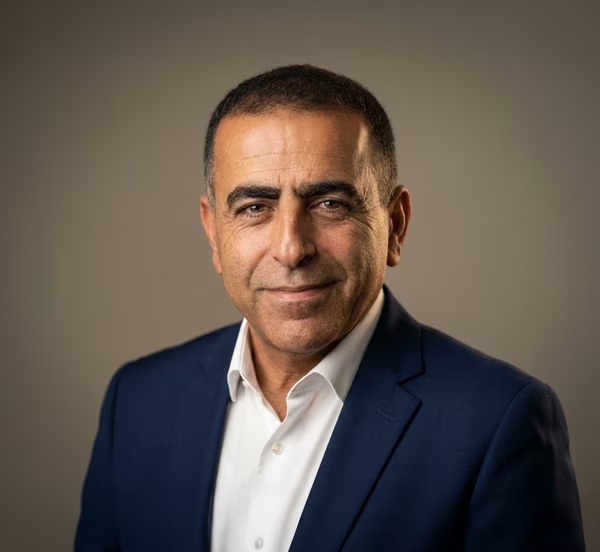
Dr. Ibrahim Nairat

Opinion Writer

Amidst the escalating debate about the future of the American-Iranian confrontation, a highly sensitive proposition emerges that transcends traditional readings of the conflict. It suggests that Israel may not be concerned with a comprehensive and swift American war against Tehran as much as it seeks to break the existing rules of engagement between Washington and Tehran, gradually pushing the United States towards a long-term conflict whose costs it alone bears. This would reshape the regional landscape in a way that resembles, in terms of outcomes but not mechanisms, what happened after the invasion of Iraq in 2003. This proposition lies in the grey area between what is thought within some Israeli circles and what is not openly stated; it is dangerous but not fanciful. It can be precisely formulated as follows: Israel does not necessarily seek a decisive American strike that topples the Iranian regime or ends its nuclear project, because it realizes that this goal, in addition to its exorbitant cost, has uncertain outcomes and could strategically backfire, threatening its internal cohesion and its ability to confront widespread regional repercussions.

The Israeli goal, according to this proposition, is to change the rules of the game itself, i.e., to break the controlled system of engagement that has regulated the relationship between Washington and Tehran for years, even if that leads to dragging the United States into a long-term conflict whose political, military, and economic costs it bears without burdening Tel Aviv with the direct confrontation. The current rules of engagement represent a gain for Iran more than for Israel, as they are based on indirect strikes, calculated messages, known escalation ceilings, and a mutual desire to avoid sliding into an open confrontation. Within this framework, Iran has managed its regional influence, built a complex network of allies and resources, and expanded its military and political maneuvering room without paying the price of a comprehensive war or direct confrontation with the United States. From the Israeli perspective, these rules provide Tehran with an undeclared protective umbrella, preventing direct power testing, but not effectively deterring it from regional expansion or gradual approach to the nuclear threshold. Therefore, Israel might consider breaking the rules of engagement a strategic achievement, even if it does not lead to a traditional military victory. The goal here is not decisive victory, but rather to reshape the strategic environment surrounding Iran, making it a state preoccupied with defending itself, with a gradual attrition of its capabilities and containment of its regional influence.

In this context, the involvement of the United States in a war of attrition serves Israel from two complementary angles: first, transforming Iran from an offensive player into a state preoccupied with defending its survival, similar, with a difference in context, to what happened to Iraq after 1991; and second, re-establishing Israel in American consciousness as an indispensable ally, rather than a strategic nuisance or a political burden on decision-makers in Washington. However, caution must be exercised when comparing this scenario to a "new Iraq," as Iran is not Iraq in terms of geographical and human size, political and institutional structure, or the network of regional relations and military capabilities it has accumulated over the past decades. The potential attrition will not occur through direct ground occupation, but through a complex pattern of mutual strikes, asymmetric responses, proxy wars, disruption of navigation, and continuous economic pressures. In such a scenario, American prestige is not enhanced but gradually eroded with each inconclusive round of escalation, and every open-ended commitment without a clear horizon.

The fundamental paradox is that what Israel might see as a tactical success to weaken its largest regional adversary could turn into a widespread American strategic failure. A long war of attrition would drain the United States politically, financially, and militarily, allowing China and Russia to expand their international maneuvering room, and destabilizing global energy markets. These outcomes contradict long-term American interests and its strategic priorities in the twenty-first century.

Does Israel actually have the ability to involve the United States in this scenario? The answer is not simple. Israel cannot directly or coercively impose a decision of war on Washington, but it possesses indirect tools of influence that begin with creating escalatory facts that raise the cost of American non-intervention, and do not end with playing on the chord of credibility and prestige, and exploiting internal political moments or personal leadership traits in the White House that tend to make major decisions out of symbolism or a show of force rather than long-term calculations. However, there is an important counter-calculation: if the United States engages in a long and costly war with Iran, the American public may not distinguish between the decision to go to war and who pushed for it, and Israel could become subject to political and moral accountability within the American domestic sphere, in a repetition of the "who entangled whom?" equation unprecedented in decades, which represents one of the biggest deterrents against any uncalculated Israeli impulsiveness.

Moreover, any long war of attrition means open fronts, internal economic pressures, and a gradual erosion of the deterrence image, even if American strikes are the most prominent feature of the scene. Any miscalculation or misjudgment of Iranian reactions could shift the conflict from a managed and controlled level to a widespread explosion that cannot be contained. Hence, the possibility of Israeli circles seeing breaking the rules of engagement and internationalizing the conflict with Iran as a better strategic option than maintaining the status quo remains a possibility, but it is fraught with risks, does not guarantee results, and could end in reproducing a strategic catastrophe similar to Iraq, in a more complex and less controllable regional environment. The fundamental question is not only whether Israel wants this path, but whether Washington realizes that it might be pushed, step by step, into a war that is not like the wars it thinks it knows how to start or how to get out of.


ARAB AND WORLD

Mon 02 Feb 2026 9:47 am - Jerusalem Time

The Iranian Nuclear Program: Between Trump's Contradictory Rhetoric and the Crisis of American Credibility

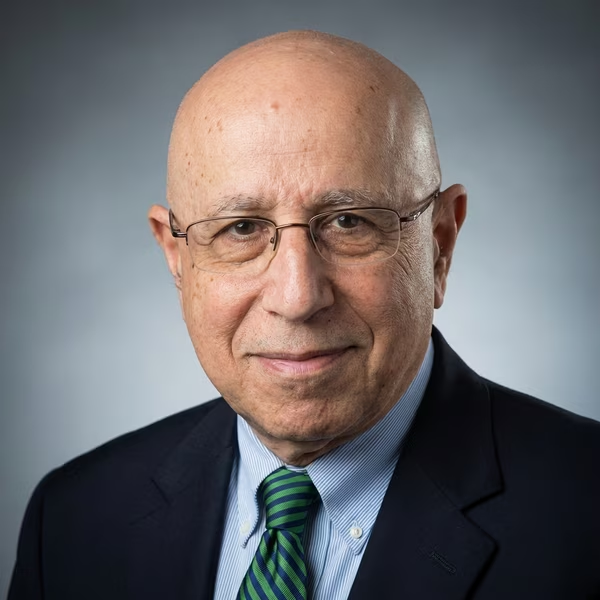
Said Erikat

Opinion Writer

US President Donald Trump said Saturday that he hopes Iran will reach an agreement with the United States to abandon nuclear weapons, asserting that Tehran is "holding serious talks" with Washington, while keeping the threat of military force on the table. Trump's statements, made aboard Air Force One, once again reflect the American approach based on combining conditional diplomacy with military escalation, in an attempt to impose a new negotiating equation with Iran.

However, this talk about the necessity for Iran to abandon its nuclear program to avoid war highlights a stark political paradox, indeed a fundamental contradiction in American discourse. President Trump had explicitly declared, on June 22, 2025, following the American bombing of the Fordow, Natanz, and Abadan facilities, that the Iranian nuclear program "was completely destroyed." If the program was indeed eliminated, as Trump said then, then the return today to conditioning its dismantling through negotiation raises serious questions about the credibility of the official narrative, and whether the Trump administration is treating the nuclear file as a security reality or as a flexible political tool that is re-formulated according to the requirements of pressure and negotiation.

When Trump was asked (on Saturday) about the latest developments in his stance on Iran, he initially appeared reserved, before indicating that the United States had sent "significant military reinforcements" to the region. He added: "I hope they negotiate something acceptable," an expression that reflects a desire to achieve a political gain without sliding into an all-out war, while keeping the military option present as a means of deterrence and blackmail simultaneously.

In response to statements by Saudi Defense Minister Khalid bin Salman, who said that not striking Iran militarily might encourage it to continue its regional policies, Trump merely said: "Some people think that, and some people don't think that." According to experts, this brief response does not hide the extent of disagreement within the American-regional camp regarding the utility of escalation, and at the same time reflects American hesitation between satisfying allies and pushing Iran to the negotiating table.

Trump affirmed that reaching a "satisfactory" negotiated agreement without nuclear weapons is still possible, adding: "They should do it, but I don't know if they will." Despite the tone of doubt, he stressed that the Iranians "are talking to us, and they are talking seriously," referring to existing communication channels, whether directly or through regional and international mediators.

In contrast, a high-ranking Iranian security official said that progress had been made in the negotiation process with the United States, in parallel with a warning issued by the Iranian army commander, cautioning Washington against the consequences of any new military strike. This divergence in Iranian discourse reflects an internal struggle between a pragmatic current that sees negotiation as a means to alleviate economic pressures, and another ideological current that considers American escalation an opportunity to strengthen the discourse of confrontation and fortify the domestic front.

On the ground, Washington continued to display its military might, deploying warships led by the aircraft carrier "USS Abraham Lincoln" off the Iranian coast. This move came in the context of threats made by Trump of military intervention, against the backdrop of Tehran's crackdown on anti-government protests, which added an additional human rights dimension to the crisis, albeit selectively in American discourse.

Analysts believe that the Trump administration seeks to leverage military and economic pressure to redefine the rules of political engagement with Iran, not only on the nuclear issue, but also regarding its ballistic missile program and Tehran's regional role. However, the contradiction between the previous announcement of "destroying the nuclear program" and the return to using it today as a negotiating chip weakens the American position and gives Tehran room to challenge the credibility of American intentions.

While the door to negotiation remains theoretically open, the continued military buildup and fluctuating political rhetoric leave the scene open to dangerous possibilities. The relationship between Washington and Tehran does not move along a clear diplomatic line, but rather oscillates between contradictory narratives, where war is sometimes used as a threat, and sometimes as an already accomplished achievement, while the entire region remains hostage to this American strategic confusion.

The fundamental problem in the Iranian file is no longer about proven nuclear capabilities, as much as it is related to a contradictory political narrative. Trump's announcement of destroying the program and then returning to conditioning its dismantling through negotiation weakens the American position and transforms the "nuclear threat" into a rhetorical tool. This fluctuation gives Iran an opportunity to question American intentions and undermines any serious negotiation path.

The Trump administration relies on a mix of military pressure and opening the door to negotiation, but this approach carries high risks. Coercive diplomacy may bring an adversary to the table, but it rarely produces stable agreements. In the Iranian case, excessive threats may strengthen hardline currents within the regime instead of weakening them.

The region is paying the price for the absence of a coherent American strategy. The contradiction in rhetoric, along with the military buildup, raises the level of concern among both Washington's allies and adversaries. Any miscalculation could ignite a confrontation that goes beyond the nuclear file, affecting regional security and the stability of global energy markets.

PALESTINE

Mon 02 Feb 2026 9:45 am - Jerusalem Time

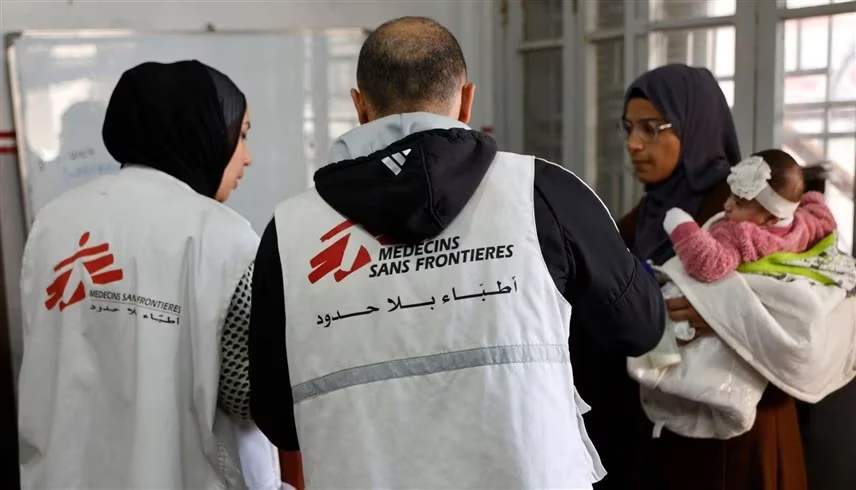
Israel bans "Doctors Without Borders" from operating in Gaza and the West Bank

Said Erikat

Opinion Writer

In a new escalation affecting humanitarian work, the Israeli occupation authorities have decided to ban the international organization "Doctors Without Borders" (MSF) from continuing its activities in the Gaza Strip and the occupied West Bank, after the organization refused to submit a detailed list of its Palestinian and international staff. The decision, which will force the organization to end its operations and leave Gaza by February 28, 2026, opens a new chapter of confrontation between the Israeli authorities and humanitarian organizations operating in the besieged sector.

The Israeli Ministry of Foreign Affairs justified the move with considerations it described as "security and transparency," accusing the venerable medical organization of having "something to hide" due to its refusal to provide the requested information. In a statement published on Sunday, the ministry said that the request for staff lists falls within mandatory registration procedures, aimed – according to the Israeli narrative – at protecting all parties, and not targeting humanitarian work.

In a striking post on platform X, the Israeli Foreign Ministry went further, considering that the organization's refusal to comply reflects a premeditated intention to withdraw from Gaza instead of adhering to what it called transparency. It added that MSF had publicly committed, in early January, to submitting the lists as part of an official registration protocol, but – according to the Israeli claim – it reneged on this commitment without justification.

The Israeli occupation authorities supported their position with direct accusations, claiming that two MSF staff members have ties to Hamas and Islamic Jihad movements, accusations that the medical organization categorically denied, considering them to lack any evidence, and to fall within a broader context of political and security pressure on international organizations operating in Gaza.

In contrast, Doctors Without Borders presented a completely different narrative. In a statement published on its website on Friday, the organization confirmed that it had agreed, "as an exceptional measure," to share the names of its Palestinian and international staff with the Israeli authorities, in a step that reflected – as it described it – its keenness to continue medical work in one of the most dangerous environments in the world.

However, this conditional approval, according to the organization, encountered a fundamental obstacle: the absence of any clear and binding guarantees regarding how that data would be used, and mechanisms for its protection. The organization said that it repeatedly sought assurances that staff information would be used for purely administrative purposes, and not exploited for security or to endanger workers, especially in a context that witnesses repeated targeting of medical personnel in Gaza.

The organization added: "Despite repeated efforts, it became clear that we were unable to build effective communication with the Israeli authorities regarding the concrete guarantees required." Accordingly, it concluded that it cannot, ethically and professionally, share its staff data under the current circumstances.

This decision did not pass without controversy within medical and humanitarian circles. MSF's initial compliance drew sharp criticism, most notably from the well-known Palestinian surgeon Dr. Ghassan Abu Sitta, who publicly warned that handing over lists of names increases the risks faced by humanitarian workers, and turns them into potential targets in a highly volatile military context.

This crisis comes in a broader context of escalating restrictions imposed by Israel on humanitarian organizations in Gaza. Last December, Israeli authorities announced plans to prevent 37 aid organizations, including "Doctors Without Borders," from operating in the sector starting March 1, on the pretext of not providing detailed information about Palestinian staff.

Human rights organizations see these measures as a systematic path to reshape humanitarian work according to Israeli security standards, thereby undermining the fundamental principles of neutrality and independence. These organizations warn that reducing the presence of international humanitarian actors will exacerbate the humanitarian catastrophe in Gaza, where the ongoing Israeli military campaign has destroyed health infrastructure, and made the population almost entirely dependent on international aid for survival.

Experts believe that the "Doctors Without Borders" issue goes beyond an administrative dispute to a fundamental question about the future of humanitarian work in conflict zones. Conditioning the submission of staff data without strict guarantees not only affects the safety of individuals but also strikes at the heart of the principle of neutrality. When aid is managed with a unilateral security logic, humanitarian organizations transform from independent actors into subordinate tools, which empties relief of its moral dimension, and makes its survival dependent on adapting to the logic of power, not to the needs of the victims.

Observers believe that in Gaza, the targeting of humanitarian organizations can only be understood as part of a conscious Israeli policy to manage the catastrophe, not to stop it. Instead of alleviating suffering, humanitarian work is being stifled and subjected to security conditions that redefine relief as a control tool, not a humanitarian duty. And the ban on "Doctors Without Borders" does not target a specific organization, but rather sends a warning to all international actors that aid will only be allowed if it submits to the logic of political and military control, in a dangerous precedent that transforms the right to relief into a privilege granted by power and denied whenever it wishes.

PALESTINE

Mon 02 Feb 2026 9:40 am - Jerusalem Time

Guardiola: I am not neutral.. I am Palestinian

Saleh Al-Rashed: What Guardiola is doing will not liberate Palestine, but it protects the truth from falsification and rings a bell that the whole world hears in support of the cause of Palestine and its people.
 Ahed Farawneh: This stance has a great impact in supporting our people, especially since it comes from the biggest and most important coach in the world, and the world awaits his statements.
Kazem Ladawiya: Guardiola did not hear Omar ibn al-Khattab's saying when he said: "He who lives only for himself does not deserve to be born," but he felt it with his humanity.
Hisham Tayem: Guardiola's stances reflect humanitarian motives that any citizen should have, regardless of their color, race, or religion, so as not to turn into a predatory animal.
Yass Al-Khafaji: What drives Guardiola to such stances is the human feeling of the tragedy experienced by the Palestinian people in general and the people of Gaza in particular.
Fathi Barahmeh: What Guardiola wants is to translate the humanitarian meanings of sports.. and football is the message of peace included in the slogans and principles of FIFA worldwide.


Exclusive to Al-Quds-

The statements of Spanish coach Pep Guardiola, Manchester City coach, supporting Palestine, generated widespread reactions among sports fans, expressing their appreciation for the Spanish star and his humanitarian stance and his bias towards the values of truth, justice, and freedom. A number of sports analysts and writers also expressed their appreciation for the Spanish star's stance, considering these statements as a wake-up call to make the suffering of the Palestinian people reach the whole world.


 Guardiola publicly supports Palestinian rights

Saleh Al-Rashed, a member of the Board of Directors of the International Sports Media Club, says:
The Spanish coach Pep Guardiola, coach of English Manchester City, continues to shed light on the truth and stand with it and publicly support Palestinian rights, which constitutes an important and distinctive phenomenon in European circles, most of which support Israel. Guardiola's stance is part of his personality with a humanitarian sense seeking to support the oppressed in the world, by focusing on humanity and justice.
He adds: It is known that Guardiola's support is not limited to Palestine alone, but he stands with the oppressed anywhere in the world. This makes his stance part of a broader vision of human justice, and in the current era, there is no people as oppressed as the Palestinian people who face global Zionism with its power and huge media machine to be the candle that illuminates the darkness and breaks the intensity of the darkness.
Guardiola relies on his statements to spread awareness among peoples, exploiting his sophisticated sports image accompanied by multiple achievements as one of the best coaches in the world, which makes many people interact with his statements. He also relies on them not to remain silent in the face of human suffering, as he considers silence to be acceptance of what is happening, and urges them with his humanitarian action to use their fame to remind people first, as they are global influencers, and they can use their fame to draw attention to the suffering of children and innocents, and he stresses the separation between humanity and politics in addition to having moral courage.
Al-Rashed continues: What Guardiola is doing will not liberate Palestine, but it protects the truth from falsification and rings a bell that the whole world hears in support of the cause of Palestine and its people, thus moving the issue from the regional framework to global awareness by breaking silence and stagnation, and it reduces the fear of other athletes from telling the truth that some are afraid to declare, and Guardiola creates a different opinion from what is circulated in Europe and America with moral and media pressure by directing athletes to be human before they are stars, and that their impact outside the field is greater than inside it in victory for truth and innocents.

Guardiola's humanitarian sense
Ahed Farawneh, Secretary of the Palestinian Journalists Syndicate, said: What drives Guardiola to such stances is his humanitarian sense, as he belongs to a national cause, which is the cause of the Catalonia region seeking independence, and has been exposed to multiple wars and lost thousands.. Therefore, he realizes the extent of the human tragedy we live in Palestine in general and the Gaza Strip in particular.. And what he sees of images and videos coming out of the war of extermination in Gaza has moved his human conscience, because he knows the extent of the injustice inflicted on our people by the Israeli occupation, which commits war crimes according to the International Criminal Court and the International Court of Justice.
He added: There must be supportive movements for Guardiola at all levels, especially sports, through thank you messages and holding supportive sports events, and highlighting this position appropriately and translating it into all languages of the world so that they know the extent of the injustice our people are exposed to.
Farawneh continued: Certainly, this stance has a great impact in supporting our Palestinian people and the occupation, especially since it comes from the biggest and most important coach in the world and has overwhelming popularity, and the world always awaits his statements, and therefore when he declares support for Palestine and against the injustice our people are exposed to, this constitutes a leverage for us before the world, and makes the spotlight more focused, which we greatly need to increase international support for us and provide protection and end the occupation and injustice.

A stance that carried many lessons and morals
For his part, Kazem Ladawiya, one of the stars of Palestinian football, said: Most world leaders, rich people, and celebrities suppress their humanity in their chests for fear of criticism, and losing position and gains, knowing the ferocity of the expected attack from the unjust and dark system in pressuring every person with a free word and stance, and this is a natural reaction for the general human souls, but whoever carries humanity in his heart truthfully, and strives in his life to raise values and support the oppressed, does not fall into the circle of cowards, but rather gains strength and certainty in the necessity of support at the expense of his fame and wealth, no matter what obstacles and impediments it costs.
He added: Those with exceptional stances constantly strive to initiate attracting others, and recruiting as many conscientious people whose consciences have been absent by misleading or negligence into the circle of truth and support tirelessly, and the greatest sacrifices come from a person who fights injustice even though this injustice did not fall on his society or his homeland, but on a strange society far from his homeland, and without knowing it, he sows shame and disgrace in the faces and chests of the disheartened people of that afflicted homeland, as they look and await support from strangers.
Ladawiya continued: Guardiola did not hear Omar ibn al-Khattab's saying when he said: He who lives only for himself does not deserve to be born, but he felt it with his humanity, and sought to deny it from himself by risking his history, achievements, and money in exchange for fighting for others with a word of truth and an honorable stance from every platform he steps on, to teach the world that sports carry ethics and humanity and raise values in addition to their physical importance.
Ladawiya concluded his speech by saying: Thank you, Guardiola, your stance is influential and carries many lessons and morals, and it will certainly have a positive reaction and an unforgettable impact on the path of liberation from injustice, and the liberation of souls from fear and discouragement.

Humanitarian motives regardless of color, race, and religion
Hisham Tayem, a former player and coach at Al-Wehdat Club, said: Pep Guardiola's stances reflect humanitarian motives that any citizen should have, regardless of their color, race, or religion, because an individual's abandonment of their humanity turns them into a predatory animal.
He added: I believe that in every country there should be movements led by our people, around which other peoples gather. The Palestinian national team in the Arab Cup played its role in introducing the justice of our cause more than dozens of Palestinian ambassadors, and it is the responsibility of Palestinian and Arab communities in every country to hold a day to introduce the cause, Palestinian heritage, and print booklets in the language of the people of the country where they are distributed, introducing Palestine and the injustice and aggression it is exposed to.
Tayem continued: The impact of Guardiola's words may seem simple due to the dominance of Zionist media in those countries, but times have changed, and the peoples' view of the issue has changed, so they have begun to align with our cause.

A global coach with a name
Yass Al-Khafaji, an Iraqi sports archivist, said: What drives Guardiola to such stances is the human feeling of the tragedy experienced by the Palestinian people in general and the people of Gaza in particular. There is no human being on earth who does not sympathize with the families of the afflicted victims, except those who do not have the right to express what is inside them, as you see them as kings and princes or rich people living in palaces, but in reality they are slaves.
He added: Guardiola has no fears whatsoever about his coaching future, as he is a global coach with a name and is sought after to work anywhere in the world, and the Zionist lobby has no authority over him.
Al-Khafaji continued: The required movements to capitalize on Pep's statements are to highlight the crimes of the usurping entity by raising slogans inside stadiums before matches, and Palestinian flags in stadiums, in addition to boycotting Israeli teams, and the absence of fans in stadiums to watch them.
He said: Certainly, the impact of these statements will contribute to clarifying the truth to the deluded Western peoples due to the paid media machine, which has portrayed and still portrays Zionists as victims of Arab peoples, and they are helpless and powerless, and their sole concern is to live in safety.

 Awareness of human conscience

Fathi Barahmeh, a sports journalist, said: If we look at the previous stances and statements of Spanish coach Pep Guardiola, and his keenness to wear the Palestinian keffiyeh, this reflects the awareness of human conscience, and deep sympathy with the cause of our people in its struggle, humanitarian, and ethical dimensions, and his return to launch calls again for solidarity with our people and what they are exposed to of systematic extermination, is an affirmation of the importance and value of broad popular solidarity in curbing aggression, and urging the world to break the intensity of the war, stop the genocide, and the extent of the impact of popular solidarity campaigns in changing the attitudes of many countries and their position on our cause and our national rights.
He added: Guardiola's global personality among millions of football fans will have a direct impact on global football fans, and mobilize more solidarity campaigns and global popular protest activities.
Barahmeh continued: What coach Guardiola wants is to translate the humanitarian meanings of sports, and football is the message of peace included in the slogans and principles of FIFA worldwide, and it is also expected that condemnation and denunciation campaigns will be organized through social media platforms globally, and raising the Palestinian flag and the Palestinian keffiyeh in stadiums around the world, and organizing more marches and chants in international stadiums.
Barahmeh said: Undoubtedly, Guardiola's stances embody the importance of sports and its global civil language in curbing injustice and aggression and doing justice to our people in practicing.

Guardiola wearing the Palestinian keffiyeh
Guardiola made his statements during his participation in a charity event held in Barcelona under the title Act x Palestine, with the presence of artistic, sports, and cultural figures, with the aim of raising awareness and supporting humanitarian issues in Palestine.
Guardiola appeared wearing the Palestinian keffiyeh, and said: "What an honor to be here. I think when I see a child in the last two years, through the images shown on TV, taking a picture of himself and wondering where his mother is, while she is buried under the rubble and he still doesn't know, I always think: What is going through their minds? I think we left them alone and abandoned them. I always think they are telling us: Where are you? Come and help us. And so far, we haven't done that."

PALESTINE

Mon 02 Feb 2026 9:38 am - Jerusalem Time

Demolishing UNRWA and its institutions... undermining humanitarian values and international laws

Hakam Shahwan: Israel is pursuing policies of imposing a new fait accompli, violating international laws and the immunities and privileges enjoyed by UN organizations.
Dr. Ismail Muslimani: Cutting electricity to the Qalandia training institute is a step with political and security implications that brings back the scenario of targeting UNRWA headquarters in Jerusalem.
Farah Hamad: The new Israeli measures and laws coincide with decisions by a group of countries, led by the United States, to cut funding to UNRWA.
Sami Masha'sha': What is happening at the Qalandia training institute is part of an integrated project to re-engineer the refugee issue from its roots: materially on the ground, institutionally, and legally.
Dr. Adnan Effendi: Cutting electricity to the Qalandia center comes within the occupation's attempts to end UNRWA's presence in Jerusalem, and it is not unlikely that the occupation will proceed to demolish it.
Mohammed Zuhdi Shaheen: The arbitrary and aggressive Israeli measures constitute a clear challenge and a violation of international law, aiming to liquidate the refugee issue and undermine the right of return. 


Exclusive to Al-Quds-
The United Nations Relief and Works Agency for Palestine Refugees (UNRWA) is subjected to a systematic Israeli attack and attempts to end its role and dissolve it. The latest of these measures is what some UNRWA institutions in and around Jerusalem and the Qalandia Vocational Training Center have been exposed to, under flimsy pretexts that are nothing but dust in the eyes, as the deep reasons for targeting it are related to the concept on which it was founded, and connected to Resolution 194 and the right of return.
Writers and analysts, in interviews with "Al-Quds", believe that the arbitrary and illegal measures taken by the occupation government in Jerusalem regarding UNRWA institutions are unprecedented globally, as electricity and water have been cut off from medical centers, schools, and training centers. They consider the weakness of international reactions and global silence to be the main factor allowing Israel to continue these attacks, which aim to liquidate the presence of UN institutions in Jerusalem.

Unprecedented Israeli measures

Hakam Shahwan, former head of the Executive Office and head of UNRWA staff, believes that what is happening now in Jerusalem, in terms of arbitrary and illegal measures by the Israeli government, is unprecedented globally.  
He adds: We have not found any government of any country in the world acting in such brutal and inhumane ways towards a UN organization whose original work is to provide relief and humanitarian aid.
Shahwan asks: How can electricity and water be cut off from medical centers and schools?
He says: The beneficiaries are innocent children and elderly patients who are most in need of these services.  
Shahwan emphasizes that the weakness of international reactions and global silence towards Israel is the main factor allowing these attacks to continue, expressing his surprise that the Commissioner-General of UNRWA has not taken any legal action to prevent the implementation of these decisions, and it was possible, indeed his legal and moral duty, to do so, at least to freeze the decisions.  
Shahwan adds: I am also surprised that the rest of the UN institutions operating in Jerusalem have actually abandoned supporting UNRWA during this difficult period, and that UNRWA had, for example, offered to hand over its headquarters in Sheikh Jarrah to other UN institutions to preserve the headquarters, but this offer was rejected.
He continued: Also, a number of other UN organizations refuse to assist UNRWA in many logistical matters and financial transfers, as if UNRWA has also become boycotted from within the UN system.  
Shahwan points out that there is popular silence until now, as we have not seen actual movements rejecting the closure of UNRWA headquarters, and this is certainly worrying, because the beneficiaries are in a great shock and still believe that UNRWA can deal with these attacks alone.  
Shahwan explains: Today we are facing a new reality, and Israel is the one that pursues policies of imposing a new fait accompli every time, and decisions of this kind would violate international laws and the immunities and privileges enjoyed by all UN organizations and are considered unprecedented decisions.
Shahwan believes that "the response to the decisions must come with unprecedented international and legal measures as well. I am in favor of immediate lawsuits by UNRWA, beneficiaries, and UN member states against the Israeli government, not only before international courts, but even before local courts."
Shahwan calls on all donor countries to UNRWA to file international and local legal cases demanding a halt to the attacks and compensation for UNRWA and the beneficiaries for the resulting damages.  
He says: There is confiscation of property and documents and destruction of buildings happening before the cameras of the local and international press without any regard for anyone. These countries can also take decisions they know well in order to pressure Israel to retract its attacks against UNRWA.
 Shahwan mentions that the UN Secretary-General had stated some time ago that he was studying the possibility of resorting to the International Court, believing that the study period has ended, and that the legal department at the New York headquarters should remove the restrictions on UNRWA regarding legal action and allow all necessary measures to be taken to confront the Israeli attacks against one of the largest UN institutions, and he said: We had prepared a complete action plan to deal with this scenario in 2019, and I had submitted it again to UNRWA for adoption and to bear the responsibility of fully defending its mandate.

An escalating path to end the presence of UN institutions

Jerusalemite writer Dr. Ismail Muslimani says: Cutting electricity to the vocational training center in Qalandia is not a fleeting technical measure, but a step with political and security implications that brings back the scenario of targeting UNRWA headquarters in Jerusalem, and raises a serious question: Are we facing an escalating path to end the presence of these institutions in preparation for liquidating their role?
He adds: First, in terms of significance, cutting electricity is used as a "soft" but effective pressure tool: disrupting work without an official closure decision, administrative and financial exhaustion, and pushing the institution to self-cessation. This method has been tried before with UNRWA through closures, eviction orders, legal restrictions, and then transferring the file to the category of "administrative violation" instead of being a direct political targeting.
Muslimani continues: Second, the specificity of the Qalandia center lies in its nature: a vocational training institution that serves a Palestinian youth segment, and provides economic and educational alternatives in an area considered sensitive security and politically. Striking this center means striking one of the pillars of social resilience, and not just a building or electricity services.

Expected scenarios

As for the expected scenarios, Muslimani indicates that three main paths can be drawn:
The first scenario: Gradual escalation: It begins with cutting electricity, followed by imposing fines, then closure orders under the pretext of "safety" or "licensing," leading to complete eviction. This scenario is consistent with what happened to UNRWA headquarters, and aims to create a new reality without direct international confrontation.
The second scenario: Temporary containment: Electricity may be restored after international pressure or legal intervention, but with the center remaining under threat and surveillance, and the file being used as a political bargaining chip in any subsequent confrontation with international institutions.
The third scenario: Internationalization and legal confrontation: If international or UN bodies move early, the file may turn into a legal-diplomatic issue, which limits the occupation's ability to proceed, but does not negate its long-term intentions.
Muslimani concludes: What is happening in Qalandia cannot be separated from a broader strategy to redefine the international and Palestinian presence in Jerusalem and its surroundings. Cutting electricity is a political message before it is a service measure, and a test of the limits of local and international silence. If this measure passes without a response, it will be a model to be replicated, just as happened with UNRWA.


 The attack on UNRWA is escalating
 
Farah Hamad, coordinator of the community activation unit at the Badil Resource Center for Palestinian Residency and Refugee Rights, says: In light of the accelerating Israeli measures against UNRWA in the previous two years, including draft laws to prevent UNRWA from operating in "Israel" and canceling the 1967 agreement between the agency and the Israeli system, and expelling international staff and/or not renewing their entry visas for work, and what followed later from stopping the provision of public services such as electricity, water, and licenses, and finally starting to demolish UNRWA headquarters in Sheikh Jarrah neighborhood in Jerusalem and targeting the vocational training institute in Qalandia, it must be emphasized that the attack on UNRWA is escalating.
Hamad points out that these measures are not new, nor were they merely part of the Israeli political escalation under the umbrella of the genocide war on the Gaza Strip. Rather, they are a complete and systematic campaign – with American and European support – to dismantle and abolish UNRWA, and to definitively eliminate the Palestinian refugee issue.
Hamad believes that the Israeli campaign against UNRWA during the previous period took multiple forms of attack, not limited to demolishing and evacuating buildings in the West Bank and Jerusalem, but also extended to targeting its buildings and staff with direct shelling in the Gaza Strip. She adds that "Israel" has primarily worked to obstruct UNRWA's work and paralyze its ability to provide services, exploiting the funding crisis that the agency has been suffering from for several years, in addition to international political pressure, and attempts to replace the agency with other international institutions.
Hamad affirms that these new Israeli measures, decisions, and laws coincide with decisions by a group of countries, led by the United States, to cut funding to the agency, investigate its neutrality, and work towards "reforming" it – considering it a promoter of hatred and anti-Semitism among Palestinians – according to the claims of those countries. She says: It is not possible to view each new decision and measure in isolation from the other, as they all work in favor of Israeli plans to obstruct UNRWA's work and then abolish and replace it.
Hamad believes that the fundamental flaw, in addition to the complicity of countries with "Israel," is the failure of countries and the United Nations to take serious measures against repeated Israeli crimes, and the leniency in dealing with its violations of international law, and the failure to impose political, economic, and military sanctions on it.

What is happening at the Qalandia training institute is not a fleeting measure

Sami Masha'sha', former media advisor to UNRWA, says: What is happening now at the Qalandia training institute is not a technical or administrative measure, but part of an integrated project to re-engineer the Palestinian refugee issue from its roots: materially on the ground, institutionally, and legally.
He adds: When electricity is cut off from the Qalandia training center, we are facing a political decision that practically aims to disrupt and close one of the oldest and most important vocational and technical training institutes in the Middle East, a center that receives hundreds of students from various parts of the West Bank, who will be deprived all at once of completing their educational programs, and a basic opportunity to acquire vocational skills will be taken away from them in an economy already suffering from unemployment and restrictions, leading to the imminent and permanent closure of the institute.
Masha'sha' emphasizes that the Qalandia institute is not an isolated case, but part of a systematic policy aimed at ending UNRWA's presence in Jerusalem and its surroundings, pointing out that the agency's headquarters in East Jerusalem was raided, its facilities vandalized and destroyed, and its contents confiscated, and a large settlement will be built on it. Also, schools and clinics in Shuafat refugee camp have been notified of closure decisions and have had their electricity cut off.
Masha'sha' believes that UNRWA facilities in the Old City and its surroundings are facing comprehensive and definitive administrative and service strangulation measures. In parallel, the northern West Bank camps – Jenin, Tulkarm, and Nur Shams – are subjected to repeated military operations that include demolishing homes, forced displacement, and destroying infrastructure. The rest of the camps are targeted. The goal is one: to remove UNRWA from Jerusalem, exhaust the camps in the West Bank and dismantle the social environment of refugees, and blur the status of "refugee" in preparation for emptying the land of its owners.
Masha'sha' believes that what is happening in Jerusalem and the West Bank is not separate from what is planned for Gaza. In both cases, politics is replaced by administration, rights by projects, and refugees by new maps that exclude them entirely. In Jerusalem, UNRWA is being dismantled through laws, cutting services, and gradual settlement.
He points out that all of this complements the Trump-Kushner vision and plan, which excludes UNRWA from rebuilding Gaza, excludes camps from reconstruction priorities (in reality, they will not be rebuilt), and replaces rights with investment frameworks. Infrastructure projects are offered instead of political solutions, and development is promoted as an alternative to return. Here, institutions are removed step by step, and there, geography is re-engineered under the title of "the day after." The result is one: ending UNRWA's political role, liquidating the centrality of the camp, and transforming the refugee issue from a matter of right to a manageable and closable humanitarian file.
He emphasizes that targeting UNRWA is not a matter of reform or resource management, but a central step in dismantling the right of return itself. When training centers are closed, services are weakened, and international recognition is gradually erased, the refugee is redefined as a temporary humanitarian case, not as a permanent rights holder.
Masha'sha' says: The Qalandia training center stands today at the heart of this battle. Its closure is a new harsh slap. We will sit on the fence watching its demolition and closure. And we will sit on the fence watching with exhaustion a systematic erasure, and intensive efforts in which refugees are pushed out of geography, out of politics, and out of the future.


A series of measures against UN institutions

For his part, Dr. Adnan Effendi, a specialist in Israeli affairs, says: The Israeli occupation state is cutting electricity to an important UNRWA institution, the vocational training center, which was established in 1953 to provide vocational education to the children of Palestinian refugees. According to UNRWA sources, 325 students from various camps in the West Bank study there.
Effendi confirms that this step comes after a series of extremist measures taken by the occupation state against UNRWA institutions, the latest of which was the demolition of UNRWA headquarters in Jerusalem in the Sheikh Jarrah area a short while ago, which the United Nations considered a violation of international law as a result of the law passed by the Israeli Knesset in October 2024, which prohibits UNRWA's work and prevents Israeli officials from communicating with it.
He points out that this extremist step by the occupation government will deprive a large number of Palestinian students studying at the center from continuing their vocational education inside the center, especially since the students are in the middle of the academic year, and cutting electricity to the center will completely paralyze the center from providing educational services to students.
Effendi believes that cutting electricity to the Qalandia vocational center comes within the occupation's attempts to end UNRWA's presence in East Jerusalem, especially since the occupation state claims ownership of the land on which the center is located, and the occupation may take a larger step by demolishing the center as happened in Sheikh Jarrah, and the step of cutting electricity may be in preparation for that and to test UNRWA's pulse and the reaction of local and international institutions, especially since the demolition of the headquarters in Sheikh Jarrah had a great international and local echo and protests from the United Nations.
Effendi believes that the occupation, which is governed by this extremist and most extreme right-wing government, will not hesitate to demolish the center, under the pretext that the land on which the center is located is owned by the occupation, as it claimed about the UN headquarters in Sheikh Jarrah.
He says: If the center is demolished, this step paves the way for ending the Palestinian refugee issue according to the Israeli vision that has been trying for years to target everything related to Palestinian refugees, from targeting Palestinian camps in the northern West Bank and trying to prevent UNRWA institutions from operating in the West Bank, especially in the northern camps.
Effendi adds: All these steps targeting the Palestinian refugee file come amid timid protests from international institutions and some countries in the world, and this will encourage the occupation state to take any step without hesitation.
Effendi believes that action is required, especially from Palestinian Authority institutions, and demanding intervention from international institutions, especially since UNRWA is an international institution affiliated with the United Nations, and its institutions must be protected, and the occupation must be prevented from taking extremist racist steps against its service and administrative institutions, to preserve the Palestinian refugee issue until the right of return, which has been recognized by all international institutions, is achieved.
   
A plan to liquidate UNRWA's presence in Jerusalem
In turn, writer and political analyst Mohammed Zuhdi Shaheen confirms that cutting off electricity to the Vocational Training Center (Qalandia Vocational Training College), an institution affiliated with the Relief Agency established in 1953, can only be interpreted as falling within the context of the systematic Israeli aggressive political plan represented by the hostile stance that seeks to liquidate the presence of the United Nations Relief and Works Agency for Palestine Refugees (UNRWA).
He points out that "this deep-seated hostile stance for decades has been officially translated into decisions by the Israeli Knesset in October 2024, which stipulated the prohibition of this international institution's work in East Jerusalem, and it was classified by Israel as a terrorist organization. Among the decisions were decisions to cut off water and electricity to properties occupied by UNRWA, and recently we witnessed the destruction of its facilities in the Sheikh Jarrah neighborhood."
Shaheen believes that these arbitrary and aggressive measures constitute a clear challenge and a violation of international law, and aim to undermine the right of return and impose Israeli sovereignty by force, despite widespread international condemnations.
Shaheen says: This Israeli arrogance and insolence are encouraged by the complete American bias towards Israel, and what is happening today has been paved and prepared for by the official recognition by President Donald Trump's administration on December 6, 2017, that occupied Jerusalem is the capital of Israel.



OPINIONS

Mon 02 Feb 2026 9:38 am - Jerusalem Time

Municipal Elections: Competence or Continued Failure?


As municipal elections approach in Palestine, the question is no longer: who will win? But rather the more dangerous question: will we reproduce the same failure?
The municipality is a fundamental service institution that affects the daily lives of citizens, yet for years it has been treated as a field for quotas, a social reward, or a platform for gathering votes.
The result is well-known: councils change, performance collapses, and services worsen.
The problem begins before the ballot box. The flaw does not start with the citizen, but with the committees for selecting lists. And that the citizen's choices should not be limited to bad and worse, but between competence... and the most competent.
Names are presented based on who "brings votes" not who has the ability to manage, and who has a popular base not who has a project, program, and experience.
Thus, whoever gets the votes wins... and the city loses new years of chaos and poor planning.
The mayor is not a social dignitary; we want a mayor with a high academic degree, real experience in management and planning, a firm leadership personality, and a diplomat capable of representing the city internally and externally.
We do not want a president who justifies incompetence, nor a council that hides behind circumstances.
The municipal council is a team of experts, not a list of courtesies. The municipality needs engineers, accountants, lawyers, specialists in management and services. It does not need names without specialization, nor members whose role is applause or recording positions.
A city managed without experience... is a city managed towards failure.
The criterion must change; the criterion is not: who has more votes, but: who has the ability to implement?
Not who raises a slogan, but who transforms the plan into fieldwork on the ground.
In times of crisis, it's either a municipality that leads, builds, and creates solutions, or a municipality that becomes an additional burden on the citizen.
Municipal elections are not a political game, but a test of awareness and responsibility.
We want a council that leads, not is led; builds, not justifies; and seeks solutions, not excuses.
As for reproducing the same councils with the same mentalities...
That is a sure recipe for continued failure, and the city can no longer bear it.

OPINIONS

Mon 02 Feb 2026 9:37 am - Jerusalem Time

Towards an early recovery plan to restore the educational process in Gaza to its normal state


The war on Gaza was not only in response to what happened on October 7th, but it was and still is a retaliatory war that conceals Israeli strategic goals to undermine everything in Gaza. First, by killing, exterminating, and besieging people, and second, by confiscating their rights that enable them to live a normal life, such as the right to housing, the right to education, the right to receive treatment and social care, and the right to protection from wars and organized terrorism. Consequently, they have no right to civil protection as stipulated by international laws. The education sector in Gaza was severely hit during this war. The occupation left no schools intact in the sector, with more than 90% of schools damaged according to UNICEF reports. Official reports state that Israel completely destroyed 204 educational institutions, including 190 schools and 14 universities, and damaged 305 other institutions, including 293 schools and 12 universities. The damage did not stop there; Israel destroyed many cultural and educational centers, museums, and private and public libraries that provided supplementary education services to thousands of students and deprived many of scientific research after forcibly burning university libraries that were rich with tens of thousands of references, periodicals, and scientific and educational journals.
Study at all levels was suspended during the war, and there was no form of in-person or even e-learning during the first year. After a period, the Ministry of Education and some schools were able to activate e-learning, but unfortunately, many did not enroll in this type of education due to the lack of internet services for many of our people in displacement areas or because they did not even own the necessary devices to engage in this type of education. Consequently, entire generations have been deprived of education and have faced, since the beginning of the war until now, the risk of ignorance and school dropout. This danger now threatens both genders, males before females, but it is noted that males are still at risk in terms of their enrollment in education because there is a severe shortage of educational institutions that provide education services in the upper and secondary stages, and males may have been busy providing for the needs of their displaced families, such as shelter, water, and food. As for the primary stage, the number of institutions that provide this type of learning is few, but they are insufficient and unqualified to accommodate large numbers; they are no more than learning points established in the form of tents in various displacement areas through popular or institutional efforts. UNICEF states in a report that 60% of Palestinian children in Gaza of school age do not receive in-person education and do not go to schools, and that back-to-school programs operate by providing learning centers to accommodate only 336,000 children. The report added that there is a severe shortage of learning materials, stationery, and recreational tools that these centers desperately need to implement activities to relieve psychological pressure on children and remove the effects of war-related trauma.
All educational programs and private and government-affiliated or UNRWA educational institutions rely on a remedial plan to compensate for the loss in achievement, which is closer to a rescue plan rather than an early recovery plan, to try to save what can be saved and compensate basic education groups for the past period. However, it is clear that these programs are currently being implemented under great pressure, as the war has not yet ended, and there are no qualified institutions or sufficient schools that can be returned to service because many damaged schools that could be reopened are being used as shelters for residents in Gaza without a corresponding plan to evacuate these schools of displaced persons and accommodate them in alternative camps, and thus rehabilitate these schools with any number of classrooms to begin in-person education and the return of students to them. The truth is that the educational process in the Gaza Strip has suffered severe injuries due to the war, whether in buildings that could be used as schools or in the resources required to start a sound and successful educational process, or even in the educational staff capable of providing education to children, especially as they suffer from the effects of trauma and the repercussions of the brutal war that destroyed their future. The need for an early recovery plan for the educational process today has become urgent and a priority, even over reconstruction and finding suitable shelter for millions of residents of the Strip, especially after a ceasefire was announced in Gaza, at least a halt to the war of extermination and a reduction in the daily and indiscriminate killing, and the beginning of hope among people here for a daily life without death and without hunger, at least.
Any early recovery plan for the sector must take into account and prioritize a comprehensive plan for the destroyed education sector to restore the educational process in the sector to at least a semi-normal state. This plan must take into account ten important points, which are: -
- Establishing a cell of specialized educational and academic experts working through the Ministry of Education and with the participation of relevant international institutions and organizations to monitor the implementation of the plan and ensure the integrity of the path of restoring the educational process to its normal state through an evaluative system capable of meeting all the requirements of the recovery program.
- Preparing a map for the deployment of as many temporary schools and learning points as possible in all displacement areas, camps, and remote areas to facilitate the enrollment of all children in the educational process.
- Implementing a community awareness campaign through social media, local radio stations, and official television about the importance of all children and adults engaging in different learning stages, and conducting field visits to families and population centers to encourage their children to join the educational process.
- Developing a preparation plan for schools, kindergartens, and universities, with work to be done on preparing them as an initial stage to remove hazards and unexploded ordnance. This requires international teams and companies with trained staff and expertise in this field.
- Equipping suitable caravans with alternative energy to add new classrooms and establish new schools to replace those destroyed by the war.
- Importing school desks, school supplies, and stationery, including textbooks, blackboards, tables, pens, furniture, and other recreational tools suitable for the stage and age of the children.
- Training teaching staff to provide them with the most important appropriate educational methods and teaching strategies that enable them to build compensatory and empowering plans that proceed sequentially.
- Building a sound evaluation system to achieve real academic achievement outcomes that ensure smooth transition from one learning stage to another, taking into account the age of each stage.
- Setting a timeline for the implementation of the recovery plan, not exceeding one year from the start date of the plan as a maximum, to restore the educational process to its normal state.
- Activating the supplementary learning and popular learning system to achieve effective academic support that facilitates in-person education and achieves satisfactory results.
The situation our people in Gaza are living in and the imminent danger facing our students at all levels today compel us to pay attention to the risks of the educational process remaining in an unsatisfactory state as we observe now, and compel everyone to bear social and national responsibility to work with the national collective as a partner in building this society that is experiencing catastrophe and suffering due to the war, and which yearns to recover from the effects of this cursed war to be granted life anew and live without anxiety about the future of these generations whose war destroyed all foundations and elements of life and survival, and are now in imminent danger regarding their future. This is a historical responsibility so that we do not find our Gazan society eventually becoming a society at the bottom of the list of educated societies after it was at the forefront.

OPINIONS

Mon 02 Feb 2026 9:36 am - Jerusalem Time

Iran and the United States: Between Containment Policy and the Possibility of Slipping to the Brink


The strained relationship between the United States and Iran returns to the forefront of the regional and international scene at a highly sensitive moment, where signals of de-escalation intertwine with the logic of deterrence, and an increasing awareness prevails on both sides that slipping into an open confrontation would not be in either's interest.
US President Donald Trump's statement that "Iran is communicating with us and we'll see what we can do" is met by the Iranian President's affirmation that "war is not in the interest of either party," which reflects, beyond diplomatic language, a shared conviction that the cost of war would be exorbitant, and that managing the conflict might be less costly than resolving it militarily.
Since the victory of the Islamic Revolution in 1979, the relationship between Washington and Tehran has been characterized by structural tension, yet it has never been a relationship of absolute severance or permanent conflict.
This relationship has witnessed unannounced cooperation and coordination when the interests of both parties converged, revealing a pragmatic nature governing their behavior, and explaining each's ability to separate ideological rhetoric from the requirements of strategic interest.
Points of convergence in interests: History as a key to understanding ...
During the Iran-Iraq War, the "Iran-Gate" affair revealed the leakage of American weapons to Iran, in the context of Washington's endeavor to prevent a decisive victory for either side and maintain a fragile regional balance.
In the crisis of the Iraqi occupation of Kuwait in 1990, Iran did not align itself with Saddam Hussein's regime; instead, it adopted a positive neutral stance that practically contributed to facilitating the formation of the international coalition against him, in line with its regional calculations at the time.
The most significant juncture was the American invasion of Iraq in 2003, where Iran played a pivotal role in overthrowing the Ba'ath regime and contributing to the dismantling of the Iraqi state structure, benefiting from the vacuum created by the invasion.
 American and Iranian interests practically converged in getting rid of a common strategic adversary and facilitating the reshaping of the Iraqi political system, despite the deep divergence in long-term visions.
Nor can the indirect coordination between the two parties in Afghanistan after 2001 be overlooked, where their interests converged in overthrowing the "Taliban" regime and fighting "Al-Qaeda."
These historical junctures confirm that the relationship between Iran and the United States is a manageable, adaptable conflict, interspersed with circumstantial cooperation whenever interests dictate, which opens the door for a realistic understanding of the possibilities of the current phase.
The Nuclear File: The Legal Framework and the Limits of Political Disagreement ...
The nuclear file constitutes the core of the existing tension, and it is a file with a clear international-legal nature.
Iran, as a signatory to the Treaty on the Non-Proliferation of Nuclear Weapons (NPT), possesses a legal right to develop nuclear energy for peaceful purposes.
However, this right is matched by an explicit commitment not to seek to acquire nuclear weapons and to be subject to an effective monitoring and inspection regime by the International Atomic Energy Agency.
In contrast, the United States proceeds from the principle of non-proliferation as a cornerstone of international security and believes that any ambiguity in the Iranian nuclear program threatens regional and international stability.
 Hence, the essence of the disagreement is not in the legal texts, but in the level of trust, verification mechanisms, and the political-security dimension associated with Iran's regional behavior.
The Most Likely Scenario: A Phased Understanding and Calculated Management of Tension ...
In light of these facts, the most likely scenario appears to be neither an all-out war nor a final peace agreement, but rather a phased understanding or a limited agreement that re-establishes the rules of engagement and prevents slipping to the brink, an understanding based on:
A clear Iranian commitment not to seek to acquire nuclear weapons.
Enhanced and verifiable international oversight.
Practical recognition of Iran's right to the peaceful use of nuclear energy.
Gradual and measured easing of economic sanctions.
Unannounced understandings regarding regional behavior, without requiring the dismantling of Iranian influence all at once.
This type of understanding does not end the conflict, but it transforms it from a potentially explosive situation into a managed conflict within calculated limits.
The Regional Role: From Mediation to Preventing Explosion ...
Regional powers play an increasingly important role in tipping the balance towards de-escalation.
 The Arab Gulf states, led by Saudi Arabia, now view regional stability as a fundamental condition for development and security, and seek to neutralize the region from major conflicts that drain resources and hinder strategic projects.
Oman and Qatar also play quiet mediation roles, while Turkey operates within a complex equation that combines competition and coordination according to its own interests.
In contrast, Israel remains a major pressure factor, as it views any understanding that does not strictly constrain the Iranian nuclear program as a direct threat to its security, making its position a present element in American calculations.
In conclusion:
Containment as a rational option for decision-making centers ...
Ultimately, it is clear that the relationship between Iran and the United States is not an existential conflict, but a manageable conflict of interests and influence.
 Therefore, the most realistic option for decision-making centers is a rationally managed mutual containment that does not seek to change the regime in Tehran, nor does it simultaneously allow Iran to acquire nuclear weapons.
This containment is not based on trust, but on a balance of deterrence and interests, and on partial, renegotiable agreements, but it remains less costly than war, and more consistent with the ongoing transformations in the international system, where the appetite for direct confrontations is declining, and reliance on crisis management instead of explosion is increasing.
However, the success of this path remains conditional on a clear political will and an effective regional role capable of transforming de-escalation from a temporary measure into a sustainable path. Failure to capitalize on this moment will mean a return to the logic of the brink, where small errors accumulate, and indirect confrontations expand, until an explosion occurs without a conscious political decision.
Between containment and escalation, the fragile but viable understanding remains the most rational option to spare the region a new war and give it an opportunity to reorder its priorities in a highly turbulent international system.

OPINIONS

Mon 02 Feb 2026 9:35 am - Jerusalem Time

Aggression, Settlement, and Imposing the Demographics of Occupation

The Israeli occupation authorities' permission for extremist settlers to bring in biblical Jewish "prayer leaves" during their incursions into Al-Aqsa Mosque, in an attempt to violate the sanctity of Al-Aqsa Mosque and change the existing reality there since the occupation of Jerusalem in 1967, and this escalation comes at a time when the occupation authorities are tightening the noose on worshippers and guards of the blessed Al-Aqsa Mosque, through arrests and issuing expulsion orders, in implementation of their extremist plans and policies towards it, in a desperate attempt to empty it of its defenders, in parallel with allowing extremist settlers to desecrate it under the protection of the occupation army and police, which constitutes a blatant provocation to the feelings of Muslims worldwide, and that the blessed Al-Aqsa Mosque is a place of worship for Muslims, and the Islamic Endowments Department in Jerusalem is responsible for managing its affairs.
 
The continuation of the occupation's projects around the city of Jerusalem has become a serious danger and a dangerous escalation in the pace of colonial projects around occupied Jerusalem, following the implementation of Road (45), known as the "Quarries Road" north of the new Jerusalem, which connects the settlements north of the city and east of Ramallah with the colonial roads (443), (Atarot), and (Begin), and is built on about 280 dunams of Jerusalem Governorate lands, in addition to the "development" of colonial Road (437) extending from the Hizma checkpoint to the Jaba' roundabout and the beginning of Road (60), which completely changes the geography of the Jerusalem area.
 
These projects are not merely infrastructure development, but rather come within a comprehensive colonial strategy aimed at strengthening the network of settlements and imposing full control over Jerusalem and its surroundings, within what is described as the accelerating colonial creep from planning to implementation, as the occupation government exploits the current regional conditions, including the repercussions of the war of extermination on the Gaza Strip, to accelerate the pace of colonial expansion and impose new realities on the ground.
The fierce colonial attack against all Palestinian cities, villages, and refugee camps, and the settlers' thuggery and attacks on unarmed citizens, in addition to their destruction of Palestinian property and setting fire to the homes of unarmed citizens, all within the context of the new occupation plan aimed at annexing the West Bank and entrenching the occupation, and that the occupation policies aim to isolate Jerusalem from its Palestinian surroundings, and transform Jerusalemite towns into isolated and fragmented islands, in contrast to facilitating the movement of settlers and encouraging them to settle in the settlements through a network of fast and safe roads for them.
 
The occupation continues its aggression against the Ibrahimi Mosque and emptying it of its custodians and worshippers, and that is a heinous crime that leads to depriving Muslim worshippers of performing their religious rituals in this historical mosque, in exchange for leaving it open to settlers to perform their religious rituals, and that these arbitrary measures carry serious dimensions, and come within the context of implementing the plan to impose Israeli sovereignty over it amidst suspicious Arab, Islamic, and international silence, and that the Ibrahimi Mosque, like the blessed Al-Aqsa Mosque, belongs to Muslims alone, given that heavenly religions forbid harming holy places designated for worship, and emphasize their sanctity, however, the occupation authorities deny that, and by these practices, they violate the right to freedom of worship called for by heavenly laws and guaranteed by international laws and norms.
 
The cancer of settlement is spreading at the expense of Palestinian lands and their legitimate owners, in an attempt to impose new demographics, control and exploit Palestinian natural resources, and deprive the Palestinian people of benefiting from their property and the riches of their country, and to pressure them to force them to leave their homes and land, in implementation of a plan aimed at displacing Palestinians and emptying Palestinian land for the benefit of extremist settlers.


OPINIONS

Mon 02 Feb 2026 9:34 am - Jerusalem Time

The National Committee for the Administration of Gaza: A National Responsibility in Difficult Times


More than two years and three months have passed for our Palestinian people in the Gaza Strip, and they are living in the most complex circumstances, where the catastrophe is no longer limited to widespread destruction and heavy human losses, but has affected society's ability to endure and persevere, especially concerning their daily lives.
 In light of this exceptional reality, the positive reactions of Palestinians to the formation of the National Committee for the Administration of the Gaza Strip came as an urgent national response, aiming to fill a dangerous void and protect society from chaos and collapse, away from any factional calculations or alternative projects to Palestinian legitimacy.
 The formation of the National Committee came in accordance with UN Resolution 2802 and an announcement by the Peace Council. This announcement, for several reasons, was welcomed by the Palestinian National Authority as a temporary step that serves the interests of our people in Gaza and is consistent with the general national effort aimed at preserving the unity of the land and institutions, and alleviating the suffering of citizens until conditions are ripe for the full return of the Palestinian National Authority to exercise its duties in the Strip.
The positions issued by the legitimate leadership, all factions, and the broader segment of our people, especially in the Gaza Strip, in support of this committee, do not stem from a vacuum, but from a deep understanding that its members are trusted national figures, known for their professional and national history. They are from the Gaza Strip, live among their people, and their families are still under fire. They have tasted – like other members of our people – the horrors of war, lost homes and loved ones, and bear the same daily suffering. This gives their work an ethical and national dimension, and makes them more attached to people's actual needs and priorities, away from any theoretical approaches or decisions isolated from reality.
In my opinion, the National Committee has a real opportunity to provide the minimum services, in terms of relief and shelter, and to secure dignity for our people in the Gaza Strip, after they have shown the highest levels of steadfastness.
And coordinating relief efforts, and supporting municipalities and local institutions, in a way that preserves the citizen's ability to remain, and strengthens their steadfastness. It also forms a framework through which societal trust can be rebuilt, and independent national competencies can be involved, thereby solidifying the concept of comprehensive national administration, and paving the way for a more stable political and administrative phase. This is possible if the entire nation deals with the success of the National Committee as everyone's responsibility. Yes, the committee has an opportunity to achieve this, but it is not without challenges, foremost among them the spread of weapons outside the framework of a single national authority. The absence of national control over weapons poses a direct threat to any civil administration, undermines civil peace, weakens the committee's ability to perform its duties, and most importantly, it gives the occupation pretexts to continue its aggression and destructive policies against our people. This is what we saw yesterday, 31/1/2026, where the number of martyrs reached more than 33 people in one day, in addition to the wounded..
Palestinian weapons must be disciplined national weapons, subject to a unified political decision, and under a comprehensive national authority. The unorganized multiplicity of power centers does not protect Gaza, nor does it serve the national project, but rather exacerbates crises, threatens social unity, and weakens the Palestinian position in confronting the occupation.
Yes, we support the National Committee for the Administration of Gaza, but we must emphasize that the Palestine Liberation Organization is the supreme political authority and the sole legitimate representative of our Palestinian people, and that the Palestinian National Authority is the constitutionally authorized body to manage the affairs of the Palestinian land. Of course, the success of the National Committee is measured by its commitment to these authorities, and this is what we know about its members and about the committee and its ability to work as an interim body, preparing the ground for the return of the National Authority to the Gaza Strip, preserving the unity of Palestinian geography, and rejecting any projects of separation or permanent alternative administration. The success of the committee in its work is a success for all Palestinians, and everyone in the Gaza Strip, especially the Hamas movement, must not obstruct the committee's work in any way.
Supporting the National Committee for the Administration of the Gaza Strip is a responsible national support, but we must not ignore the risks, but rather we must balance the necessities of reality with the constants of the national project. Support aimed at protecting the Palestinian individual, preserving the unity of the land and decision, and transforming this difficult moment into an opportunity to rebuild the Palestinian house, on the basis of partnership, unity, and legitimacy, and I believe this is our opportunity, otherwise we will have entered a stage of exposure, and this is everyone's responsibility. The important thing is that we prioritize the interests of our people over the interests of our parties.


OPINIONS

Mon 02 Feb 2026 9:28 am - Jerusalem Time

Gaza Between the Illusion of Calm and the Reality of Ongoing Genocide


The return of intense Israeli shelling on the Gaza Strip on Saturday morning was not a surprising or sudden event that could be isolated from its political and military context. Rather, it came as a new episode in a continuous path of organized aggression that has not truly stopped since the announcement of the ceasefire. The massacres that resulted in dozens of martyrs and wounded, and the targeting of displaced persons' tents and refugee areas, confirm that the occupation has never viewed the truce as a political or moral commitment, but rather as a tool to manage the conflict and control the pace of killing according to its own calculations.
The Israeli narrative that accompanied this escalation, which claimed that the raids were in response to Palestinian violations, is nothing more than a repeated version of a justificatory discourse that Tel Aviv has accustomed itself to using to cover up its crimes. The claim of targeting leaders and military structures does not explain the shelling of residential neighborhoods, the burning of displaced persons' tents, or the deaths of children and women. Nor does it justify expanding the scope of targeting to include areas that are supposed to be safe according to any humanitarian or legal logic.
At the heart of this escalation lies an internal Israeli crisis related to the failure to achieve war objectives. The ceasefire was imposed on Benjamin Netanyahu's government under international pressure before it succeeded in eliminating resistance leaders, disarming them, or imposing a political surrender equation. With the truce entering a stalemate phase between its first and second stages, fears escalated within the Israeli security establishment that the resistance might have used this time to reorganize its ranks and strengthen its presence, which made the option of escalation seem to Tel Aviv as a means to regain the initiative and break what it considers a comfortable situation for the resistance.
More dangerously, the shelling focused on areas outside direct Israeli military control, which now contain the largest population density after waves of forced evacuation. This reflects a clear policy aimed at transforming these areas into uninhabitable zones, pushing residents towards further displacement and forced migration, in full harmony with the vision of the Netanyahu government, which has never abandoned the idea of emptying Gaza of its inhabitants or dividing it geographically and demographically.
This escalation coincides with a sensitive international political moment, as it comes at a time when US President Donald Trump is seeking to market his plan for Gaza by talking about a peace council or an international stabilization force, amidst his administration's focus on rallying against Iran. At this specific time, Israel appears to be trying to impose new facts on the ground before any political arrangements are crystallized, so that any future path is entered from a position of strength, not from the position of failure that the war produced.
As for the talk of mutual violations, it falls before the fact that the occupation has committed more than fourteen hundred violations since the announcement of the truce, which confirms that the ceasefire was nothing but an empty title, used by the occupation to alleviate international pressure, without any real intention to stop the aggression. The shelling never stopped, but its intensity and tools changed, while the goal remained constant: to exhaust Palestinian society and break its will.
In contrast, the role of regional and international mediators is limited to statements of condemnation and calls for restraint, positions that have become familiar and do not constitute a real deterrent to the occupation. The absence of pressure tools, and leaving Israel without political or legal cost, gives it a green light to continue the escalation, and transforms mediation from an effective role to a formal function of managing the crisis, not solving it.
In conclusion, what is happening in Gaza today is not a fleeting violation of the ceasefire, but rather a confirmation that the occupation is using the truce as an additional weapon in its war, and that talk of peace or stability amidst shelling, displacement, and siege is nothing but a political illusion. Gaza is not being shelled because it violated the agreement, but because it stood firm and was not defeated, and because Israel has not yet learned that force alone does not create security or eliminate a people who refuse to surrender.

OPINIONS

Mon 02 Feb 2026 9:27 am - Jerusalem Time

Epstein's Scandal Through Palestinian Eyes


Wherever the Israeli is, we are also there. The Israeli carries us with them as a permanent excuse for sympathy, deepening victimhood, legitimacy of existence, and the embodiment of all prophecies. And on Epstein's island, we were also present. The gathering of senior leaders, financial magnates, arms and technology brokers, and journalists, against a backdrop of endless debauchery, documented with sound, image, and word, all leads to the conclusion that the matter goes beyond seeking new pleasures or breaking the familiar and routine. It is clear that the matter is much more than that; it is akin to controlling resources, sharing wealth and geography, marginalizing the existing, and reconfiguring it, through controlling individuals, governments, and elites. The imagined conspiracy truly turns into reality.
Imagine with me the gathering of all these controllers of almost everything. What brings them together? Not perversion, certainly, as no one is forced to expose themselves to everyone. The matter is much larger than that; these are meetings for planning, control, and dominance, through a deep bond, almost religious, that unites everyone around it. A bond that forces them to come and indulge in the offered pleasures and accept those scandalous situations that the whole world sees. Epstein, the math teacher who suddenly became a billionaire and had complex relationships with the most powerful leaders and figures, was merely the address, the place, and the coordinator. He accepted to be at the forefront, and when he was finally cornered, he was eliminated, but the strong unifying bond was not. The mysterious dream island resembles other mysterious places where leaders and figures gather annually for planning and control.
As for what is new on the dream island, it is documentation for blackmail in all its forms and levels. Things are no longer hidden from anyone; there is an intention for permanent blackmail and continuous control to serve Epstein's operators. And here is the crux of the matter: the continuation of support, the flow of weapons, the control over the decisions of administrations and international institutions, the drawing of the region's geography, its borders, and its peoples, and the looting of wealth wherever it may be, are near and distant goals. And for this, we were present there, a poor and fragmented people, exposed, forbidden for the attendees to sympathize with, stand by, or defend. More than that, they are asked to condemn it with terrorism, ostracism, and siege.
Now, after the scandal that erupted like a hurricane, we may also pay the price, through a planned war, or through another diabolical plan. This scandal will pass like other scandals, if it is considered a scandal in the West, for the West is accustomed to these mysterious bodies and secret societies with terrible rituals. The dilemma here is that we may pay the price for that scandal, as I said, or the entire region may pay the price.
What can we do about all this? The West will see that democracy is capable of overcoming the effects of the scandal as if it never happened. As for us, we have no choice but to change direction entirely... Enough waiting, surrender, and fascination.


OPINIONS

Mon 02 Feb 2026 9:26 am - Jerusalem Time

Joint Arab-Hebrew demonstration in Tel Aviv


The largest joint Palestinian-Israeli, Arab-Hebrew, Islamic-Christian-Jewish-Druze demonstration – and I do not say, as is the deliberate Zionist term, “Arab-Jewish” – took place in Tel Aviv on Saturday evening, January 31, 2026. It was called for by: 1- The Follow-up Committee for the Palestinian Arab Community, which serves as the daily political leadership for Palestinians in the 1948 territories, headed by Dr. Jamal Zahalka, and 2- The Committee of Heads of Arab Local Councils in the 1948 territories, headed by Mazen Ghnaim, Mayor of Sakhnin. Both delivered speeches to the joint crowd participating in the “Black Flags” demonstration, in response to and rejection of the widespread violence and criminal acts, which are planned, programmed, and colluded with by political security agencies and the Israeli police, with the aim of confusing, weakening, and tearing apart the Palestinian Arab community in the 1948 territories, the people of Carmel, Galilee, the Triangle, the Negev, and the historical mixed coastal cities.
A massive demonstration attended by tens of thousands, described as the largest joint Arab-Hebrew demonstration to take place in Tel Aviv since the colonization of Palestine in 1948.
The joint Tel Aviv demonstration sent a message in two directions:
First, it demonstrated the unity of the Palestinian Arab community in the 1948 territories, and it eliminated and overcame the “Palestinian division” ailment. It also demonstrated the unity of suffering due to the racist behavior and national discrimination faced by the Palestinian Arab community in the 1948 territories. It presented a model of unified action by parties, parliament members, and Palestinian activists in the 1948 territories. As a result, a coalition formula was reached to contest parliamentary elections with a joint party electoral list from the four active parties: 1- The Islamic Movement, 2- The Democratic Front, 3- The National Democratic Assembly, 4- The Arab Movement for Change, which will reflect itself in an increase in those willing to go to the polls, and an increase in the parliamentary representation of Palestinians inside to 15 seats or perhaps more.
Second, it demonstrated the existence of a common ground for action between Arab political forces and progressive democratic Hebrew forces, between Palestinians and Israelis, between Muslims, Christians, Jews, and Druze. And on the occasion of mentioning the Druze, the head of the Druze community in Palestine, Sheikh Muwafaq Tarif, called for the participation of Druze and Druze local councils in this protest against violence and criminal acts.
The existence of a Palestinian-Israeli, Arab-Hebrew partnership provides a climate and ground that can be built upon, strengthened, and documented by both parties: by Palestinians and Israelis, and by the Arab and Hebrew nationalities, and among the adherents of the Islamic, Christian, Jewish, and Druze religions, all together, against Zionism, occupation, racism, and their projects of expansionist, replacement occupation at the expense of the rights of the Palestinian people, their homeland, their land, and their legitimate aspirations for equality, independence, and return.
The Saturday demonstration was described by Ibrahim Sarsour, the former head of the Islamic Movement in the 1948 territories, who wrote to me:
“We are indeed facing a new stage, which requires our leaders to free themselves from all personal, factional, and partisan considerations and selfishness, and to prioritize the supreme interests of the Palestinian people, and to preserve this unprecedented popular cohesion, and to invest it in strengthening national unity, which is the safety valve in confronting all challenges and dangers.”
He wrote: “The miracle of Sakhnin on Thursday, January 22, 2026, which gave birth to the largest demonstration witnessed by our Palestinian Arab masses inside, is the same one that gave birth to the new ‘Joint List’ as a political project that may begin as technically pluralistic, but I am confident that it will quickly transform into a comprehensive and inclusive national project. It is the same one that gave birth to the Tel Aviv demonstration on January 31, 2026, which marks the beginning of a new decisive stage, and we must realize that in the lives of peoples there are turning points that constitute new beginnings that deeply separate a previous stage from a subsequent one.”
What Ibrahim Abdullah Sarsour said and wrote is what Jamal Zahalka, Mazen Ghnaim, Ayman Odeh, Sami Abu Shehadeh, Abbas Mansour, Ahmed Tibi, and Yousef Jabareen said, reinforcing what they did for their people, and for their aspirations for a better tomorrow, towards victory for equality, independence, and return.


OPINIONS

Mon 02 Feb 2026 9:22 am - Jerusalem Time

The Crossing... Between Operational Testing and Sabotage Impulses!

Dr. Ibrahim Melhem

Editor-in-Chief

The Least Said

After the pretext of the "corpse" that he used to hang the deal was withdrawn, now comes the file of recovery, reconstruction, and restoration of stability, to be the new "scapegoat" on which the wolf hangs the weapon of resistance. This is a behavior that reflects ill intent, through which he seeks to sabotage the start of the second phase, which he does not want to budge an inch from the yellow line, drawn by his ambitions carried by impulses of control and dreams of expansion.
Yesterday, the crossing was opened at a low experimental pace, and today operations begin, but according to Israel's "ruler" and its timings, its anxieties and reservations, its dominance, and its control over the numbers of those leaving and returning.
We do not know what is going on in the mind of the "wolf" who is lurking at the crossing. We might wake up to news of its closure, on the pretext that armed men emerged from its tunnels and infiltrated through its sides, or a bus of returnees might be bombed and flimsy pretexts created to stop their flow, so that their numbers do not exceed the numbers of those leaving, while Cairo insists on the principle of parity.
The opening will not be free of traps that the wolf will detonate before his anticipated trip in two weeks to meet Trump at the White House. It is a bargaining chip he carries in his diplomatic bag to appear as a "facilitator," while harboring ill intent to pounce on any understandings that hinder him from achieving his ambitions.
And on the waiting platform, these complex calculations mean nothing to the stranded traveler or the exhausted displaced person but a glimmer of hope they fear will be extinguished. Behind every name on the departure lists is a story of pain, a patient awaiting healing beyond the borders, and a student fearing the loss of their future.
Transforming the "crossing" from a lifeline into a political "sabotage" arena is the height of tormenting people's hopes. While the "wolf" is busy setting his political traps in preparation for his anticipated trip to the White House, eyes remain fixed on the iron gate, awaiting the moment of liberation and the removal of the haze of waiting.

PALESTINE

Mon 02 Feb 2026 8:26 am - Jerusalem Time

Resumption of individual movement through Rafah crossing amid tight security restrictions and continuous violations

On Monday, the movement of individuals through the Rafah border crossing between the Gaza Strip and the Arab Republic of Egypt will resume in both directions, within a limited scope and under strict security restrictions, after a period that witnessed violations leading to the martyrdom of individuals in the Strip, amid widespread condemnations from the European Union and Arab and Islamic countries.

This step comes after the Israeli occupation army announced on Sunday the completion of establishing a screening and inspection corridor for those coming from Egypt, named 'Rigavim', which will be managed by Israeli security agencies in an area under army control; to verify the identities of those crossing based on pre-approved lists.

For his part, the coordinator of the occupation government's activities in the Palestinian territories clarified that the opening of the crossing on Sunday was a trial phase in coordination with the European Union mission and Egypt, noting that the return of those who left the Strip during the war requires Egyptian coordination and Israeli security approval, with the European mission undertaking the initial screening of travelers.

In contrast, Hazem Qassem, spokesman for the Hamas movement, warned that any Israeli obstruction or conditions regarding the crossing constitute a blatant violation of the ceasefire agreement, calling on mediators and guarantor states to monitor the occupation's field behavior.

On the medical front, the opening of the crossing offers a glimmer of hope for transferring the wounded and sick for treatment abroad, as Adnan Abu Hasna, media advisor to the 'UNRWA' agency, confirmed that the World Health Organization will supervise these operations, while emphasizing the need to evacuate large numbers due to the inability of local facilities to provide services.

A wide gap emerges here; Israeli estimates set the ceiling for departures at about 150 people daily, while Ismail Al-Thawabta, director of the Government Media Office, confirms the presence of about 22,000 patients and wounded in urgent need of travel, meaning that their evacuation according to current rates may take nearly five months, in addition to the urgent need for 600 aid trucks to enter daily.

On the ground, the occupation army continued its violations of the ceasefire agreement, as medical sources reported the martyrdom of a Palestinian in a drone strike northwest of Rafah, and occupation forces also blew up residential buildings in the Al-Tuffah neighborhood in Gaza.

The Ministry of Health in the Strip announced an increase in the number of casualties since October 7, 2023, to 71,795 martyrs and 171,551 injured, explaining that the truce violations alone have claimed the lives of 523 martyrs so far.

In a diplomatic reaction, foreign ministers of eight Arab and Islamic countries, in a joint statement, condemned these violations, considering them a dangerous escalation that threatens the political process and hinders stability efforts. The European Union also reiterated its call for respect for international humanitarian law, denouncing the repeated violations that undermine peace opportunities.

PALESTINE

Mon 02 Feb 2026 3:41 am - Jerusalem Time

Lazzarini: West Bank faces a silent war, occupation violence reaches record levels

The Commissioner-General of the United Nations Relief and Works Agency for Palestine Refugees (UNRWA), Philippe Lazzarini, affirmed that Israeli violence in the occupied West Bank has reached 'record levels'. In a statement today, Sunday, Lazzarini described what is happening as 'Israel's silent war' that has not received sufficient coverage, noting that more than a thousand Palestinians, a quarter of them children, have been martyred since October 2023.

Lazzarini explained that, concurrently with the start of the war of extermination in the Gaza Strip, the occupation, through its army and settlers, intensified the commission of crimes in the West Bank, which included killing, demolition of homes, displacement of Palestinians, and colonial expansion.

These attacks resulted in the martyrdom of 1,110 Palestinians and the injury of more than 11,500 others, while the number of detainees exceeded 21,000, according to official statistics.

The Commissioner-General pointed out that settler attacks continue unabated, with Palestinian communities being subjected to intimidation, uprooting from their lands, and destruction of their livelihoods amidst a state of impunity.

He added: 'Tens of thousands remain displaced a year after Israel launched the Iron Wall operation, the largest displacement since 1967, while Israel is now gradually demolishing their homes to prevent their return.'

TECHNOLOGY

Mon 02 Feb 2026 1:20 am - Jerusalem Time

New Revelation: Google Aided Israeli Army in Identifying Military Targets via 'Gemini' During Gaza War

International press reports, based on a confidential complaint filed by a whistleblower, revealed that Google provided advanced technical services to the Israeli army to support its military operations in the Gaza Strip. Sources clarified that the complaint filed with the US federal government accuses Google of violating its own policies that prohibit the use of artificial intelligence in weapons development or surveillance activities, by assisting a security contracting company working with the Israeli army in analyzing drone footage.

According to internal documents included in the complaint, the Israeli army used Google's 'Gemini' artificial intelligence technology at a time when the company was publicly trying to distance itself from Israeli military operations. Data shows that Google's cloud computing division received a technical support request in July 2024 from an account linked to the Israeli army, aimed at improving the system's ability to identify targets, such as armored vehicles and soldiers, through aerial imagery.

Sources reported that Google's cloud computing unit employees responded to the request by providing technical proposals and conducting internal tests, which the whistleblower considered a stark contradiction to the company's declared 'AI Principles'. The complaint filed with the US Securities and Exchange Commission states that Google misled investors by violating its stated policies listed in official filings.

For its part, a Google spokesperson denied these allegations, claiming that the use was 'very minimal' and did not exceed a few hundred dollars per month, making any effective military use impossible, according to his description. The spokesperson added that the company provided routine technical support information in response to a general inquiry, without providing additional specialized technical assistance for wartime operations.

These leaks come amid escalating internal pressure within Google, as the company fired more than 50 employees in April 2024 who organized protests against 'Project Nimbus', a $1.2 billion cloud contract signed with the Israeli government. Reports also indicated that Google amended some of its policy provisions last February to allow assistance to governments in areas previously prohibited under global competition intelligence.

It is worth noting that these accusations place Google alongside other technology companies such as Microsoft and Amazon, which have faced similar criticism regarding the role of their cloud services in supporting Israeli military and intelligence infrastructure during the ongoing war on the Gaza Strip, amid increasing public and union rejection of these partnerships within the United States.

PALESTINE

Mon 02 Feb 2026 1:20 am - Jerusalem Time

Occupation extends military closure and siege of Nur Shams camp until the end of March

The commander of the occupation army in the West Bank, Major General Avi Bolot, signed a military order to extend the restriction of movement and declare Nur Shams camp a closed military zone, in a move indicating a possible security escalation in the region during the next two months.

This decision, which is the 8th extension for 2026, clearly indicates the occupation's intention to extend its military operation in the camp located in Tulkarm city until the end of next March, amidst the continuation of systematic restrictive policies.

The document issued by the occupation army command specified a set of strict restrictions that will be applied on the ground, directly targeting Nur Shams camp. The decision is effective from its signing date on January 30, 2026, until March 31, 2026, at 23:59.

The imposed restrictions include preventing anyone from entering or exiting the cordoned-off area except with a special permit, with the exception of the occupation's army and police forces, thereby completely isolating the camp from its surroundings.

This military order confirms the continuation of the siege and restriction policy on the residents of Nur Shams camp, as the occupation forces continue their field operations and destruction of infrastructure, exacerbating the humanitarian conditions for Palestinian citizens inside the besieged camp.

PALESTINE

Mon 02 Feb 2026 12:10 am - Jerusalem Time

A year of aggression: Displacement of 25,000 Palestinians and destruction of thousands of homes in Tulkarm and Nur Shams camps

With a full year having passed since the continuous Israeli aggression in the Tulkarm refugee camp in the northern occupied West Bank, unprecedented humanitarian, economic, and human rights dimensions are unfolding. The military operation, which began on January 27, 2025, has resulted in one of the largest waves of forced displacement within the West Bank in years, turning the camps into disaster-stricken areas.

Faisal Salameh, Deputy Governor of Tulkarm, reported that the aggression led to the displacement of about 25,000 refugees from the Tulkarm and Nur Shams camps, who were forced to leave their homes under the weight of incursions and infrastructure destruction. Salameh explained that families initially sought refuge in schools and mosques, before many were forced to rent housing in the city's suburbs amidst suffocating financial burdens and a lack of income sources.

Tulkarm camp is considered the second most densely populated refugee camp, with about 25,000 refugees residing there and in the adjacent Nur Shams camp. Since January 21, 2025, Israeli operations have transformed these areas into what resembles "ghost towns," with more than 50,000 Palestinians displaced across the West Bank and 2,300 others arrested during this period.

Salameh indicated that the occupation completely destroyed 2,000 housing units, meaning the displacement of 2,000 families, as buildings in the camp include several floors inhabited by extended families. About 4,000 other housing units were partially damaged, including wall vandalism, destruction of electrical appliances, and destruction of internal water and electricity networks, rendering them uninhabitable without comprehensive maintenance.

Economically, military operations caused the destruction and damage of about a thousand commercial shops, which constituted the economic backbone of the two camps. Local committees also documented the destruction of about 800 vehicles belonging to residents, which were used as essential work tools, leading to a complete paralysis in the lives of families and their livelihoods.

Regarding infrastructure, sources confirmed that water, sewage, electricity, and communication networks were completely destroyed, with sewage water now flowing inside the remaining homes. Salameh held the international community and UNRWA legally responsible for aiding the refugees, emphasizing that the scale of destruction exceeds the capabilities of the Palestinian Authority and local entities.

Salameh considered the targeting of the camps a political scheme to erase the symbolism of the Nakba and liquidate the refugee issue by changing the demographic reality and reducing population density under security pretexts. He concluded by emphasizing the refugees' adherence to the right of return according to UN Resolution 194, calling for urgent international intervention to stop forced displacement and ensure reconstruction.

PALESTINE

Sun 01 Feb 2026 10:43 pm - Jerusalem Time

Occupation notifies of demolition of 14 homes in Silwan to pass the Biblical Gardens project

On Sunday, the Israeli occupation authorities issued demolition notices for fourteen homes in the 'Al-Bustan' neighborhood of Silwan in occupied Jerusalem, demanding immediate implementation of the decision under the pretext of building without a license. This new wave of notices comes in the context of forced displacement efforts pursued by the occupation municipality against Jerusalemites in areas adjacent to the blessed Al-Aqsa Mosque.

The Jerusalem Governorate clarified in a press statement that the targeted homes house about one hundred and twenty Jerusalemites, most of whom are children and women, who now face the risk of displacement after decades of stability in their properties.

The Governorate stressed that the pretext of 'lack of licensing' is merely a cover for a larger settlement plan, aiming to erase the Palestinian presence in the Al-Bustan neighborhood and transform its lands into what is called 'Biblical Gardens' to change the historical character of the city.

Intense tension prevails throughout Silwan with increasing fears that bulldozers will storm the neighborhood at any moment, while human rights activists view these measures as part of systematic 'ethnic cleansing'.

The residents of the neighborhood affirmed their attachment to their homes despite the threats, appealing to international and UN institutions to intervene urgently to stop this real estate massacre that violates human rights conventions and international humanitarian law.

PALESTINE

Sun 01 Feb 2026 10:43 pm - Jerusalem Time

Occupation Army Adopts 'Regavim' Corridor for Security Screening of Those Crossing into Gaza via Rafah Crossing

The occupation army announced on Sunday the successful completion of the construction and equipping of a new security screening corridor designated for individuals entering the Gaza Strip via the Rafah land crossing, named 'Regavim'. This step comes as part of the limited trial operation of the crossing, which began today, to enhance security measures at the borders.

This inspection corridor is located within the area under the military control of the occupation forces, specifically about 300 meters from the main crossing complex, to serve as an additional checkpoint aimed at ensuring 'maximum control' over the identities of those entering from the Egyptian side, according to the occupation army's statement.

The operational mechanism of the 'Regavim' corridor relies on a pre-arranged security coordination system, where Egyptian authorities send lists of names one day before crossing to be screened by the General Security Service 'Shin Bet' and the occupation army. After travelers undergo initial inspection by the European Union mission and accredited local personnel, they proceed to the 'Regavim' corridor for advanced technological screenings, including facial recognition systems and remote electronic scanning, eliminating the need for direct physical presence of soldiers inside the main crossing buildings.

This step comes as part of the limited trial operation of the crossing, which began on Sunday, allowing partial movement of individuals in both directions, with an average of about 150 departures and 50 returns daily as a first phase. The opening of the crossing represents a significant advancement in implementing the second phase of the ceasefire agreement, which followed the recovery of the body of security officer 'Ran Gvili'.

PALESTINE

Sun 01 Feb 2026 8:20 pm - Jerusalem Time

Hebrew Broadcasting Authority: The trial day for managing the Rafah crossing was very successful and it will open on Monday for travelers

The trial day dedicated to testing the new management mechanisms for the Rafah land crossing was crowned with complete success.

Sources reported, on Sunday evening, that the "trial day" dedicated to testing the new management mechanisms for the Rafah land crossing was crowned with complete success.

Sources clarified that all technical and security measures imposed have proven their effectiveness, paving the way for the official opening of the crossing for traveler movement starting from Monday morning, after a long period of closure and political tensions.

This coincides with what sources reported about the opening of the crossing for the first time as part of a "trial operation" plan aimed at testing control systems, with official operation for travelers to begin on the morning of Monday, February 2, as confirmed by the head of the National Committee for Gaza Management, Ali Shaath.

The occupation authorities seek to gradually increase the pace of work to reach a capacity of 150 departures per day, prioritizing patients, humanitarian cases, and foreign nationals, while only 50 people return to the Strip.

PALESTINE

Sun 01 Feb 2026 7:08 pm - Jerusalem Time

"Land of the Nativity" Cries for Help.. "Church Affairs" Calls on the World to Stop "Settler Terrorism"

The Presidential Higher Committee for Church Affairs in Palestine, on Sunday, issued an urgent global appeal to all churches around the world, calling on them to break their silence and take a public and explicit stance to stop what it described as the escalating "settler terrorism" against Palestinian civilians, especially Christians among them, warning that these attacks threaten their "historical presence" in their land.

In its message, signed by its head, Dr. Ramzi Khoury, a member of the PLO Executive Committee, the committee revealed a map of recent attacks that targeted the areas of Birzeit, Al-Makhrour, Taybeh, Ain Arik, and Ush al-Ghurab. The message clarified that these attacks were not limited to physical assaults and arrests, but evolved into land confiscation and the expansion of settlement outposts, as part of a systematic policy aimed at changing the demographic and geographical character of the region, and imposing forced displacement on the indigenous population.

The committee refuted the narrative that portrays these crimes as isolated incidents, asserting that they are "an organized campaign of violence and terrorism carried out under the protection of the occupation army." The message relied on statistics from the Wall and Settlement Resistance Commission, which documented during 2025: 4723 attacks carried out by settlers. 720 joint attacks with the participation of occupation forces. The United Nations confirmed that settlement expansion has reached its highest levels since 2017.

The committee linked settler terrorism in the West Bank to what is happening in occupied Jerusalem and the Gaza Strip, including the war of extermination, siege, and demolition of homes, considering that the entire scene reflects "collective punishment" and a blatant violation of international humanitarian law.

The message concluded by calling on the churches of the world to exercise their spiritual, moral, and diplomatic role to pressure for: providing effective international protection for Palestinian civilians, including Christians. Holding the occupying state accountable for its crimes in accordance with international law. Rejecting all policies that lead to displacement and undermine historical existence.

The committee concluded its message with poignant words, stating: "The land that witnessed the birth of the Lord Christ, glory be to Him, must not be emptied of its children.. And true faith is not limited to prayer, but is manifested in an explicit stance in the face of injustice and bias towards justice and human dignity."

PALESTINE

Sun 01 Feb 2026 7:07 pm - Jerusalem Time

A plea from under siege.. 20,000 patients in Gaza face the risk of death awaiting evacuation

Health authorities in the Gaza Strip have issued a final cry for help regarding the catastrophic situation faced by thousands of wounded and sick, confirming that delays in opening safe corridors for medical evacuation have turned waiting lists into "death registries."

In press statements, the Director-General of the Palestinian Ministry of Health in Gaza revealed alarming figures reflecting the depth of the humanitarian tragedy experienced by the besieged Strip.

The Director-General of the Ministry explained that there are approximately 20,000 patients facing a real risk of losing their lives if they continue to be prevented from leaving the Strip to receive necessary treatment. While the situation becomes more complex with the collapse of the local medical system, the Palestinian official pointed out that there are 5,000 very critical cases among these patients, requiring immediate surgical and medical intervention that is not available in Gaza's exhausted hospitals due to targeting and lack of supplies.

In a painful description of the reality, the Director of Health indicated that the sector loses about 10 patients daily whose lives could have been saved if they had the opportunity for treatment abroad. This continuous human bleeding comes amid diplomatic deadlock and the cessation of medical coordination operations, which has turned simple medical cases into hopeless injuries due to lack of medicine and the absence of complex medical devices.

These statements place the international community and human rights organizations before their moral responsibilities, as appeals are increasing for the necessity of pressure to open crossings and facilitate the exit of humanitarian cases. The issue is no longer merely a shortage of fuel or supplies, but has become a matter of "life or death" for thousands of families who watch their children dying before their eyes, awaiting an exit visa that may never come.

PALESTINE

Sun 01 Feb 2026 7:07 pm - Jerusalem Time

Occupation forces raid Balata refugee camp in Nablus, and settler terror besieges Qalqilya and the Jordan Valley

A large number of military patrols stormed the eastern area of Nablus city. The occupied West Bank governorates witnessed, since the dawn hours of Sunday, a dangerous wave of field escalation, with roles divided between the Israeli occupation army forces and settler gangs, represented by a series of military incursions, arrests, armed attacks on homes, and even besieging educational institutions.

In a remarkable military development, sources reported that a large number of military patrols stormed the eastern area of Nablus city, before establishing their positions at the main entrance to and around "Balata refugee camp."

The sources indicated that the operation was accompanied by an intensive and dangerous deployment of infantry teams between the alleys, amidst an atmosphere charged with tension. In a related context, another force raided the village of "Duma" south of the city, and arrested the young man Muhammad Mustafa Dawabsheh after destroying the contents of his home.

To the north, Jenin was not spared from the occupation's brutality, as vehicles stormed the "Jabal Abu Dhahir" neighborhood, raided a residential building and searched several homes, before spreading around the "Cinema Roundabout" and the main market, where soldiers deliberately smashed street vendors' carts in a retaliatory act targeting citizens' livelihoods.

In another chapter of settler terror, the family of citizen Hijazi Yamin in the village of "Fara'ata" east of Qalqilya experienced moments of horror, after settlers from the "Havat Gilad" settlement attacked their home with stones.

Yamin confirmed that the settlers unleashed a wild dog towards the family members, causing panic among the children, noting that this attack is the second within a week, and aims to force them to leave their home adjacent to the settlement.

As for the northern Jordan Valley, violations reached the sanctity of educational institutions, where settlers obstructed the access of educational staff to the "Al-Maleh School," attempting to prevent the start of the school day, according to the director of Tubas education. This coincided with the erection of a new settlement tent in "Khirbet Samra," in a step aimed at seizing more pastoral lands.

In the context of collective punishment, occupation forces continue for the second day to close the main entrance to the town of "Turmus Ayya" north of Ramallah, exacerbating the suffering of citizens, as part of the checkpoint policy, which has reached 916 checkpoints in the West Bank, including 243 gates established after October 7th.

PALESTINE

Sun 01 Feb 2026 7:06 pm - Jerusalem Time

Civilians injured in occupation attack in Tarqumiyah, south of Hebron

The Palestinian Red Crescent reported on Sunday that its crews dealt with four injuries among citizens in the town of "Tarqumiyah" southwest of Hebron, following an attack carried out by the occupation forces.

Sources explained that the injuries resulted from direct beating and abuse during the forces' raid on the area, where first aid was provided to the injured on site.

The town of Tarqumiyah is experiencing increasing pressure as a result of restrictive policies and land confiscation for the benefit of settlement expansion.

Observers link this escalation to the occupation's desire to impose a tight security grip on vital contact points, leading to continuous skirmishes that hinder the daily lives of citizens and increase the state of tension throughout the Hebron Governorate.