ISRAELI AFFAIRS

Wed 18 Feb 2026 9:42 am - Jerusalem Time

Sharp political division in Tel Aviv over Netanyahu's pardon, Herzog accuses the latter of crossing red lines

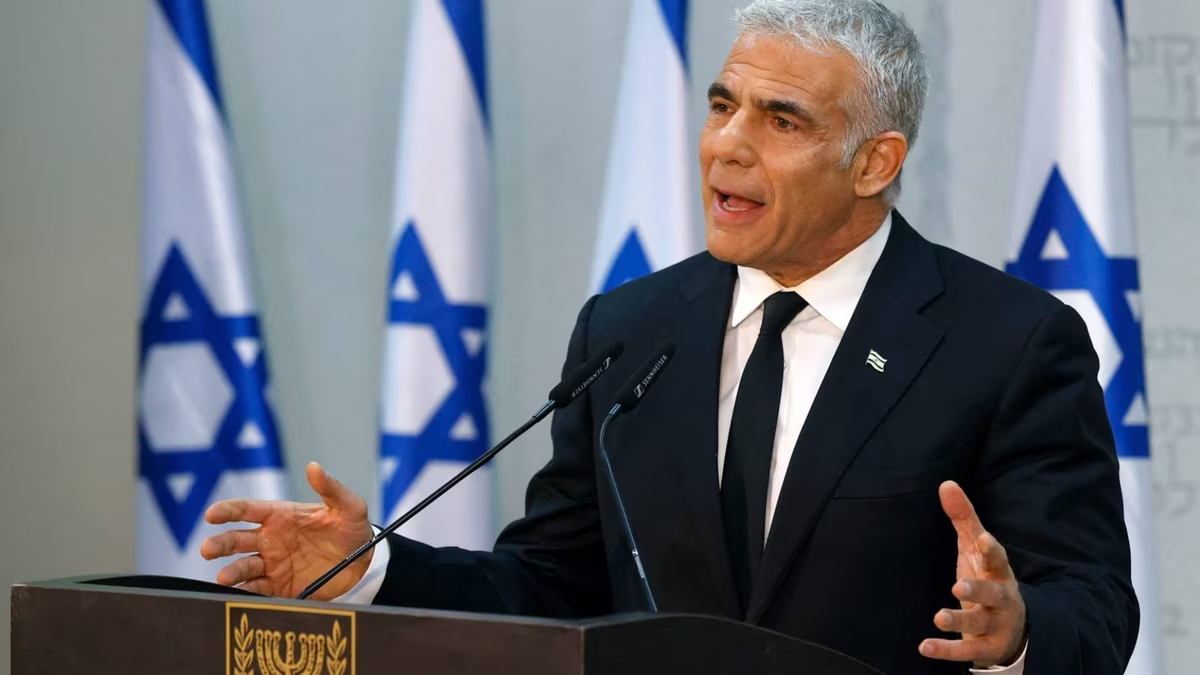
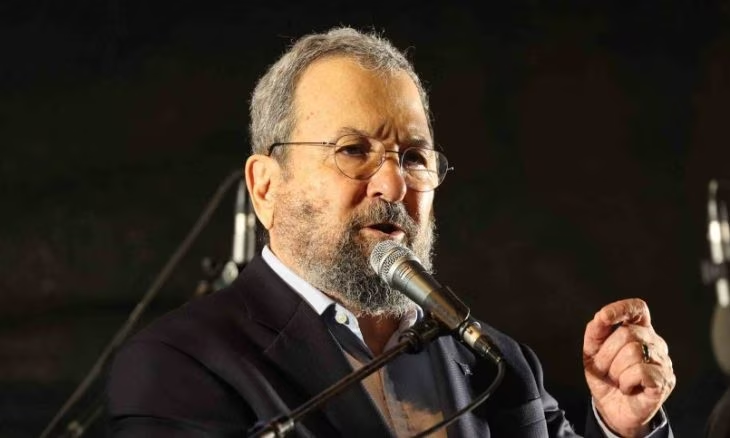
Political and legal circles in Tel Aviv are witnessing a sharp division over the possibility of granting Prime Minister Benjamin Netanyahu a presidential pardon that would end his legal prosecution. Opposition leader Yair Lapid linked any serious movement on this issue to the necessity of submitting a new legal request that includes an explicit admission of guilt, an expression of remorse, and acceptance of what is known as 'legal stigma'. This came after consultations held by Lapid with the President of the entity, Isaac Herzog, emphasizing that these conditions are the only way to deal with the issue according to official frameworks.

For her part, the Attorney General Gali Baharav-Miara intervened in the crisis to clarify the legal position, denying reports that a final professional opinion on the matter was imminent. Baharav-Miara affirmed that the pardon request had not yet undergone thorough technical examination, stressing that this issue would be dealt with exclusively according to established legal procedures without favoritism or exceptions for any political party, regardless of its position.

In a related context, the Presidency's office clarified that the pardon file is currently with the Ministry of Justice to obtain the necessary legal advice before taking any step. The statement issued by the office indicated that President Herzog has not yet made a final decision, and that he intends to study the file away from any internal or external pressures that may be exerted on him. The office stressed the importance of maintaining the independence of the presidency in making sensitive sovereign decisions.

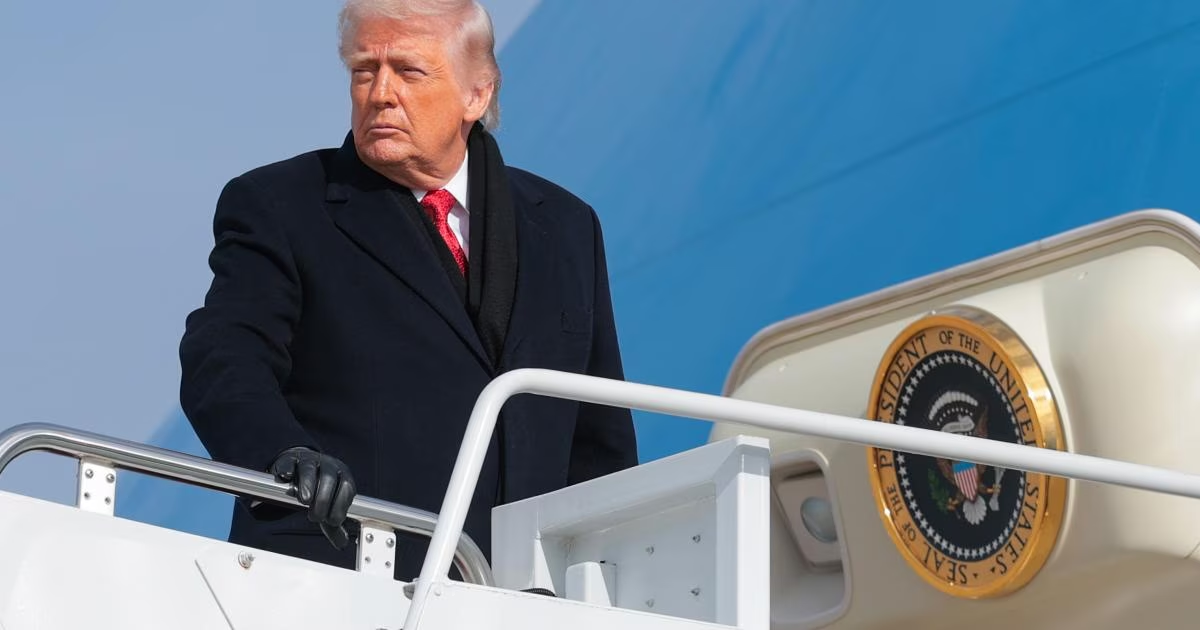
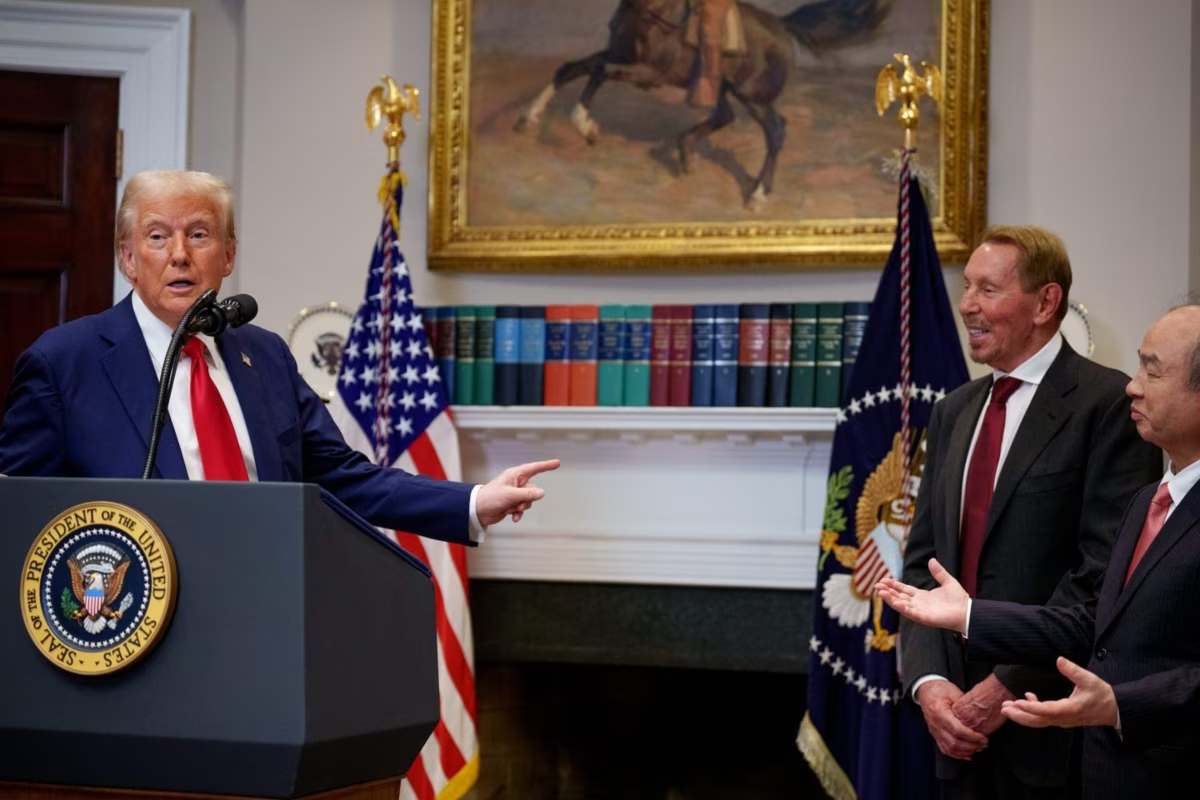
The crisis took an unprecedented international dimension after the sharp attack launched by former US President Donald Trump on Herzog, describing the refusal to grant Netanyahu a pardon as 'disgraceful'. Trump demanded that Herzog retract his position, considering that the continuation of the trial harms the status of the United States' most prominent ally. This intervention led Herzog to consider Netanyahu's behavior in this context as crossing red lines and a direct infringement on national sovereignty and independent decision-making.

In contrast, Prime Minister Benjamin Netanyahu's entourage quickly denied any prior coordination with the American side regarding these controversial statements. Sources close to the Prime Minister's office confirmed that Trump spoke based on his personal view of events without a request from Netanyahu. Despite this denial, observers believe that the current debate deepens the gap between judicial and political institutions in Israel, and puts Netanyahu's political future at stake in light of the opposition's intransigence and the judiciary's adherence to procedures.

Herzog considered Netanyahu's stance in this context as crossing red lines and an infringement on sovereign status.

PALESTINE

Wed 18 Feb 2026 9:42 am - Jerusalem Time

Palestinian child martyred by explosion of occupation military remnants in the Jordan Valley

Palestinian medical and local sources announced on Tuesday evening the martyrdom of a child and the injury of two others, one of whom was described as being in serious condition, due to the explosion of military remnants belonging to the Israeli occupation army in the town of Jiftlik in the central Jordan Valley, east of the occupied West Bank.

Local sources reported that the explosion occurred in the 'Froush Beit Dajan' community, part of Jiftlik town, where the ammunition was remnants of previous training by occupation forces in the area, leading to casualties among the children who were present at the scene.

For its part, the Palestinian Red Crescent Society confirmed that its teams received the body of the martyred child, aged 13, from the Israeli occupation army, and he was immediately transferred to Jericho Governmental Hospital for necessary procedures.

In a related context, occupation forces imposed a strict security cordon around the explosion site, preventing citizens and paramedics from approaching the area for a period of time, while the occupation army claimed that the injuries resulted from 'tampering' with ammunition remnants near the 'Tirtza' military base.

The Palestinian Jordan Valley is one of the areas most susceptible to such incidents, as Israel classifies vast areas of it as closed military zones or firing ranges, turning the lives of Palestinian residents into a constant danger that pursues them in their pastures and agricultural lands.

The Jordan Valley, which constitutes about 30% of the West Bank's area, is under full Israeli security and administrative control within the areas classified as (C), where training camps are spread, leaving behind large quantities of mines and unexploded ordnance.

Human rights reports indicate the presence of about 12 occupation army camps around Jericho and the Jordan Valley, surrounded by minefields and training areas that pose a direct threat to the lives of civilians, especially children who are unaware of the nature of these explosive objects.

With the martyrdom of the child in Jiftlik, the number of martyrs in the West Bank since the start of the Israeli aggression on October 8, 2023, rises to 1115 martyrs, including 231 children who were killed by occupation bullets or as a result of its military remnants and settler attacks.

This incident coincides with the escalating pace of Israeli violations in various governorates of the West Bank, which include field executions and mass arrests targeting about 22,000 Palestinians, in addition to forced displacement policies and settlement expansion.

Observers believe that leaving military remnants in populated areas or near Palestinian communities is part of a systematic policy of pressure to push residents to leave their lands, which exacerbates the suffering of Palestinians under siege and daily threat.

Occupation forces prevented Palestinian citizens from approaching the explosion site after it occurred in the Froush Beit Dajan community.

OPINIONS

Wed 18 Feb 2026 9:27 am - Jerusalem Time

Americans in Israel’s Army: A Protected Pipeline of Impunity From Gaza to Washington

News Analysis

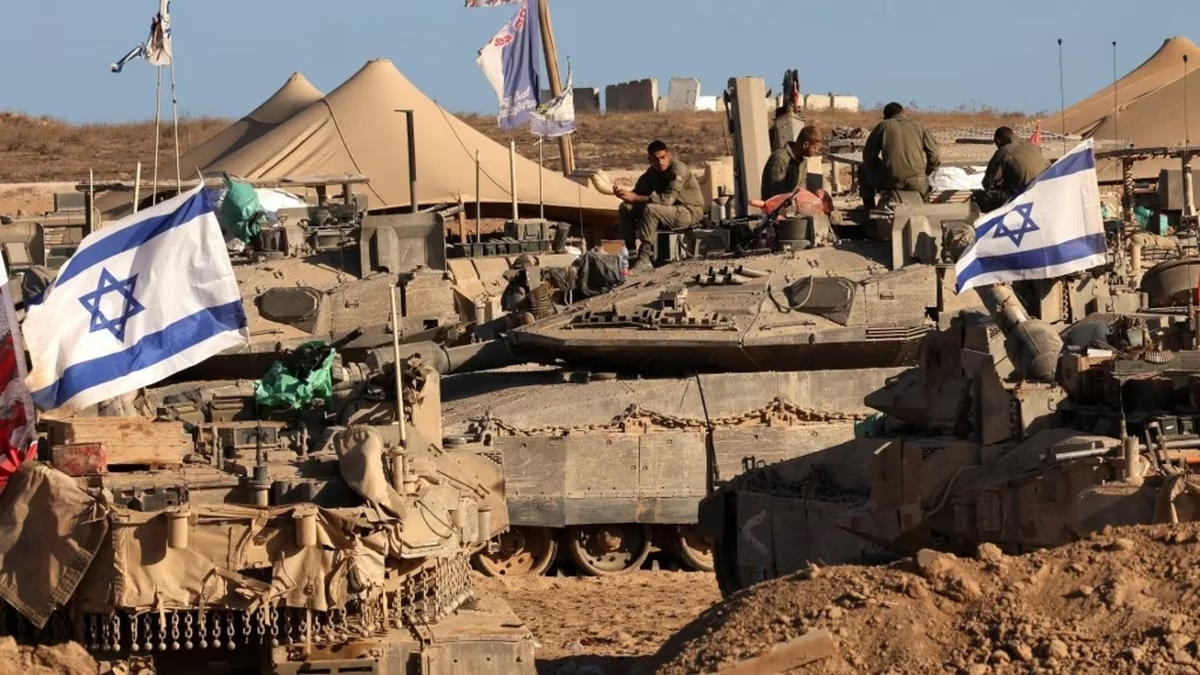
Israel’s claim that thousands of Americans are currently serving in its military raises more than a technical legal question. Based on newly released official Israeli military data, the number of American citizens currently serving in the Israeli military (IDF) is approximately 13,342—a figure lower than previous unverified reports.


Whether the number is 13,000 or 23,000 is not the core scandal. The scandal is what the number represents. A significant American presence inside a foreign military is a structural extension of the US–Israel alliance—one that quietly imports foreign violence into the American political sphere while allowing Washington to claim distance from the consequences.


A legal gap that is not accidental


Contrary to common assumptions, the United States does not broadly prohibit Americans from serving in foreign militaries. This permissiveness is often portrayed as a legal quirk, but in practice, it functions as a deliberate political arrangement. US law contains tools to restrict foreign recruitment, yet enforcement is uneven. When Americans fight for groups hostile to US interests, the state responds aggressively. When they fight for a close ally, the system becomes protective.


This is an enforcement hierarchy shaped by geopolitics. Israel sits at the top of that hierarchy. The Israeli military is armed, funded, and defended by US institutions. Consequently, Americans who enlist are treated as extensions of an alliance—and therefore politically insulated.


Dual citizenship: the mechanism that normalizes participation


Many of these Americans are dual citizens, or become Israeli citizens rapidly under the Law of Return. Once Israeli citizenship is secured, enlistment is reframed as civic duty. But this legal framing does not change the underlying reality: US citizens are serving in a foreign army engaged in operations widely condemned internationally, including in occupied Palestinian territory.


In Gaza and the West Bank, Israeli military actions have repeatedly produced large-scale civilian deaths. Major human rights organizations have argued these actions often violate international humanitarian law. It is statistically likely that some American or dual US–Israeli citizens have participated in military actions contributing to those deaths. Modern warfare distributes responsibility across units and command structures; accountability extends to the system—and to those who voluntarily joined it.


The US response: silence, denial, and selective outrage


If Americans had participated in killing civilians while serving with a group hostile to US interests, Washington’s response would be swift. Prosecutions, surveillance, and public condemnation would follow. But when the foreign force is the IDF, the US posture flips. The default becomes silence—and in some cases, active protection.


This is policy. The United States has created a political shield around Israel that also shields Americans who fight for it. The law is treated as optional when the ally is Israel. Impunity is not an accident of bureaucracy; it is the predictable outcome of alliance politics.


Should Americans who served in Gaza or the West Bank be prosecuted?


If a US citizen participates in acts that meet the threshold for war crimes—such as intentionally targeting civilians—there are pathways for investigation under US law. The obstacle is not the absence of legal architecture; it is the absence of political will.


The United States has systematically avoided legal confrontation with Israel’s military conduct and has blocked international accountability efforts. Prosecuting Americans who fought in Israeli operations would be politically explosive—and therefore institutionally resisted. The US state has chosen to treat this as a non-problem, and that choice has become a form of complicity.


War crimes vs crimes against humanity: why the distinction matters


Critics of Israel argue that patterns of conduct in Gaza—including repeated large-scale civilian casualties, mass displacement, and destruction of infrastructure—raise questions of not only war crimes but potentially crimes against humanity. This claim has entered mainstream discourse because the scale of civilian harm has become impossible to dismiss.


If that broader framing is accepted, the question of American participation becomes even more urgent. A US citizen serving inside a military engaged in systematic attacks on civilians could face liability not merely for discrete incidents but for participation in a wider campaign.


Impunity as doctrine


From Israel’s perspective, foreign volunteers strengthen its claim to global legitimacy. An army with Western volunteers becomes easier to frame as part of “the West” rather than as a regional occupying force. But this internationalization is one-sided: Israel welcomes diaspora participation but rejects international scrutiny.


The United States enables this by treating Israel as exceptional. Americans can fight in Gaza—where civilian death in the 10s of thousands is a documented outcome—and return home without investigation. That reality would be unimaginable if the foreign army were Russian or Iranian. The difference is alliance.


The question, then, is whether the United States is willing to treat Palestinian civilian life as worthy of the same legal concern it claims for others. So far, the answer has been a resounding no

OPINIONS

Tue 17 Feb 2026 3:35 pm - Jerusalem Time

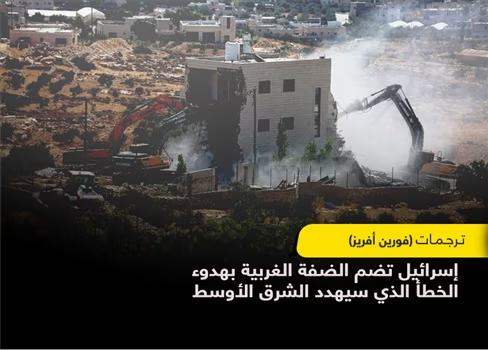
Israel Quietly Annexes the West Bank.. The Mistake That Will Threaten the Middle East

Written by: Shira Efron

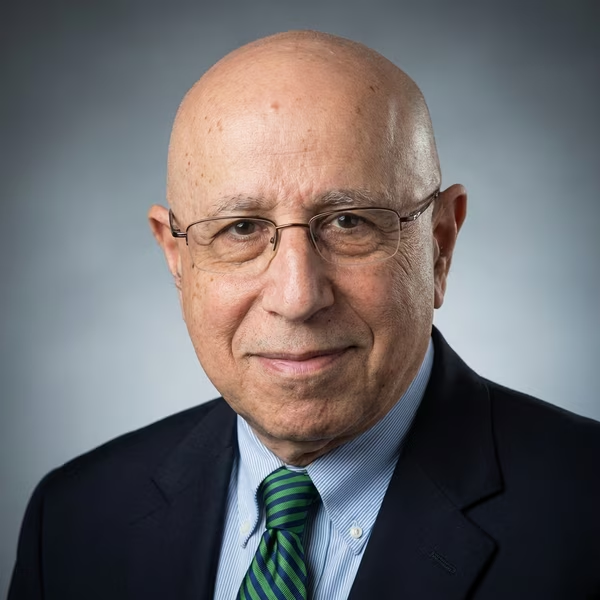
She is the Distinguished Chair of Israeli Policy and a Senior Fellow at the RAND Corporation.

The Middle East is not without its upheavals. In the wake of protests in Iran, Washington has threatened a military strike; violence continues in Gaza despite a ceasefire; Hezbollah is rearming itself in Lebanon; and factional conflicts destabilize Syria. But the next front that could erupt might be one that decision-makers consistently neglect: the West Bank.

Since October 7, 2023, and the Israeli military offensive in Gaza, the Israeli government has launched a de facto annexation campaign, intensifying its military presence in the West Bank, exerting continuous pressure on the Palestinian Authority to weaken it, accelerating the approval of Jewish settlements, and retroactively legalizing outposts. Acts of violence by settlers have become almost daily occurrences.

Then, on Sunday, the Security Cabinet, headed by Israeli Prime Minister Benjamin Netanyahu, approved an exceptional set of measures that transform the de facto annexation of the West Bank into legal policy. The timing of this move was extremely bold, preceding Netanyahu's visit to the White House. Israel will ease restrictions on land sales to settlers and will assume authority to determine how land is used in Areas A and B, which were officially under Palestinian Authority rule. Israeli Finance Minister Bezalel Smotrich stated that the goal is to "eliminate the idea of a Palestinian state."

This move is but the latest development in a situation that has brought the West Bank to the brink of a real crisis. The Palestinian Authority may be unable to pay its debts within months, which would lead to a halt in essential services for millions of Palestinians and undermine security cooperation efforts with Israel that have so far prevented widespread unrest. Ramadan begins next week, a historical event that fuels tensions around the Al-Aqsa Mosque in East Jerusalem, known to Muslims as Al-Haram Al-Sharif and to Jews as the Temple Mount. Changes in Israeli police methods that weaken restrictions on provocative behavior, coupled with the absence of effective external mediation channels to help de-escalate tensions, pose a real risk that incidents at holy sites could spark wider unrest.

These hotspots are not accidental; they are an Israeli strategy. Influential Israeli ministers have long argued for the annexation of the West Bank into Israel's political and administrative sphere. A 2017 statement by Smotrich titled "The Decisive Plan" laid out a roadmap for this strategy: Israel should create an irreversible reality on the ground, eliminating any possibility of a Palestinian state, and forcing Palestinians to accept a status of permanent dependency or leave the West Bank.

Since October 7, Smotrich and other Israeli right-wing leaders have exploited the fog of war to turn this vision into policy. While Netanyahu's stance is more ambiguous – he has repeatedly insisted that Israel does not wish to assume full governance over Palestinian territories – his political survival depends on religious nationalist voters, limiting his ability and incentive to rein in leaders seeking annexation. Many Israeli moderates and international actors cling to the comforting assumption that upcoming Israeli elections later this year can reset the country's approach to the West Bank. But relying on such a reset is extremely risky. Many changes over the past two years are irreversible, especially since the Israeli opposition has not offered a clear alternative to the vision of annexation proponents.

Settler attacks against Palestinians and Israeli security forces in the West Bank increased by 27% between 2024 and 2025. The number of serious incidents classified as terrorism also increased by more than 50%.

Settler attacks against Palestinians and Israeli security forces in the West Bank increased by 27% between 2024 and 2025. The number of serious incidents classified as terrorism also increased by more than 50%.

If annexation proponents are not curbed soon, their cumulative actions will increase the likelihood of renewed unrest, necessitate continuous mobilization of the IDF, deepen Israel's diplomatic isolation, and force it to bear the burdens of civil governance in the West Bank, no matter how much Netanyahu claims otherwise. This will also seriously undermine the implementation of the 20-point peace plan for Gaza proposed by US President Donald Trump, which relies on the return of a reformed Palestinian Authority to administer that area. The conditions on the ground already make the stability of the Strip impossible and create the necessary conditions for it to become a permanent, irreversible insurgency zone.

According to the research institution "Tamror Politography," which collects data on Israeli control over Palestinian territories, this Israeli government has seen a massive surge in settlement expansion in the West Bank since 2023. In 2025 alone, it issued nearly double the number of approvals for housing units compared to 2019 and 2020. This recent surge far exceeds the usual multi-year totals of the previous decade and indicates a clear acceleration in both new settlement approvals and the retroactive legalization of illegal outposts.

"E1" Project

These moves are not only increasing the number of Israelis residing in the West Bank but are also weakening the Palestinian Authority day by day and fundamentally changing the face of the region. The Israeli government has begun establishing strategic control corridors by expanding administrative boundaries, creating bypass roads, and connecting infrastructure between settlements, making it difficult for Palestinian security forces and their political leaders to exercise their authority in the short term, and undermining any long-term opportunity for a geographically contiguous Palestinian state.

Rarely is there a clearer example of this process than the efforts to connect East Jerusalem to the large existing Ma'ale Adumim settlement, located 4.5 miles to the east, through the construction of thousands of housing units, as well as tourism and industrial infrastructure. Previous prime ministers, under international pressure, refrained from significantly advancing the development project – first proposed in the late 1960s and now known as "E1" – recognizing that it would effectively separate the West Bank and eliminate any chance for Palestinians to exercise their authority over a geographically contiguous area there. However, over the past year, the government has accelerated the implementation of the E1 project; in August, Smotrich officially approved the construction of 3,400 homes in the corridor, openly boasting that "the Palestinian state is being removed from the negotiating table not by slogans, but by actions. Every settlement, every neighborhood, every housing unit, is another nail in the coffin" of the two-state solution.

The E1 project is not an exception, but a adopted model. Similar logic underpins new construction projects and zoning plans around Gush Etzion, Ariel, and Ma'ale Adumim: they aim to strengthen Israeli control areas and fragment Palestinian territories. At the same time, small outposts are spreading throughout the West Bank. Some outwardly appear as pastures, but they serve a clear political function by seizing land and making Palestinian Authority over valuable areas impossible.

The Israeli government has even changed its rhetoric to legitimize outposts that were previously considered illegal. It is increasingly promoting the necessity of establishing "security farms," a rebranding process that transforms unlicensed outposts into alleged strategic assets. Just last week, in a video address at an "Appreciation Conference" for illegal agricultural outposts, attended by Smotrich and Settlement Minister Orit Strock, Defense Minister Yisrael Katz announced that he would legalize approximately 140 unlicensed agricultural outposts in the West Bank; he praised the illegal settlers as "pioneers of our era," "weakening Palestinian efforts to establish their presence in the area." Netanyahu himself recently indicated his support for official recognition of these sites. This type of land seizure may be less dramatic than annexation, but it is no less effective.

My Written Work

Palestinians are also facing a sharp escalation in violence committed directly by Israeli settlers, a type of violence implicitly endorsed by the Israeli government. In 2024 and 2025, settlers committed an unprecedented number of arson attacks, acts of vandalism, and physical assaults. According to statistics published by the Israeli army and the Shin Bet (internal security service) last month, settler attacks against Palestinians and Israeli security forces in the West Bank increased by 27% between 2024 and 2025. The number of serious incidents classified as terrorism also increased by more than 50%, mostly concentrated in hotspots such as Nablus, Hebron, and Ramallah.

However, the most significant characteristic of these attacks is not their frequency, but rather the Israeli government's allowance of them. Enforcement of laws prohibiting settler violence has been intermittent, often absent. Investigations are often minimal or non-existent. Prosecutions are rare, and the conviction rate is extremely low. The Israeli army does not believe its mission is to arrest Jewish extremists, and the police – controlled by Itamar Ben-Gvir, the controversial far-right National Security Minister – turn a blind eye. Last month, for the first time in Israel's history, the Israeli defense establishment reported more Jewish terrorist acts against Palestinians in the West Bank than Palestinian terrorist acts against Jews there and within Israel itself.

Decisions made at the highest levels of the Israeli government have given these perpetrators greater authority. In November 2024, Katz announced that his office would stop using administrative detention, a preventative measure allowing detention without charge, often used against Palestinians, against Jewish settlers, signaling the government's acceptance of settler violence at a time when Israel desperately needed to demonstrate more deterrence. In an interview with Fox News in late December, Netanyahu claimed that the international press exaggerated its coverage of settler violence, attributing it to the misconduct of "about 70 young people" who came from "broken families" outside the West Bank. Netanyahu did not clarify the source of his data, but his implication that most settlers do not support this violence is incorrect: in a poll conducted by Reichman University in June 2025, nearly half of respondents agreed that "violent resistance by Jews against Palestinians may be justified at this time," while slightly more than a third believed that such violence should be punished.

Hostile Takeover

Despite his political opportunism, Netanyahu has historically avoided pushing the Palestinian Authority to complete collapse. He understands that any short-term ideological gains such a move might achieve would come at a prohibitive long-term cost. Without the Palestinian Authority, Israel would be forced to assume responsibility for providing civil services – salaries, health, education, and security – to millions of Palestinians.

However, with Netanyahu prioritizing his political survival, he no longer has full control over the West Bank file; it is managed by Smotrich and his partners. They have deliberately sought to stifle the region's economy and undermine the Palestinian Authority's ability to function effectively, slowing its approval of Palestinian construction projects and restricting Palestinians' ability to earn a living in Israel. Since May 2025, the Israeli government has halted the transfer of customs and tax revenues to the Palestinian Authority; some – but not all – of these transfers are legally restricted due to the Palestinian Authority's practice of providing so-called "martyr payments" to prisoners, fighters, and their families.

The Public Works Authority can now only pay partial salaries to its 150,000 employees, in addition to a larger number of retirees and contractors. Schools have shifted to a four-day school week, limiting parents' ability to work. Healthcare and waste collection services have also been curtailed, leading to a deterioration in living standards.

The Israeli executive is leading the annexation efforts, but the Israeli parliament has contributed to the attempt to strangle the West Bank, making it even harder to reverse. Over the past two years, the Knesset has sought to enact legislation that tightens its financial, economic, and legal grip on the West Bank and directly weakens the Palestinian Authority. Additionally, lawmakers recently introduced proposals that would allow Israeli victims to retroactively file civil lawsuits against the Palestinian Authority for past terrorist attacks, which would overwhelm the Palestinian Authority to the point of collapse if passed.

Palestinian Authority Reform

The Palestinian Authority suffers from serious flaws and extreme fragility. Years of corruption, administrative failures, and inability to negotiate a state with Israel have eroded its credibility among Palestinians. But Israel needs a more effective Palestinian Authority, not a more fragile one. The same applies to Trump: his 20-point peace plan for Gaza states that an improved Palestinian Authority will eventually regain its authority over Gaza. The peace process cannot continue unless Palestinians have legitimate, competent, and stable political representation, which currently depends on the institutions of the Palestinian Authority, if not its current leadership. Arab and European donors, who are supposed to bear the responsibility for Gaza's reconstruction, have demanded a path towards a two-state solution, a path that only passes through the Palestinian Authority. There is currently no credible alternative with legal legitimacy and operational capacity. Burning down the Palestinian Authority in the West Bank undermines Gaza's recovery process before it even begins.

For this reason, immediate steps must be taken to halt the destructive Israeli approach towards the West Bank. Avoiding an explosion in the West Bank does not require resolving the entire Israeli-Palestinian conflict, but rather taking immediate steps to prevent the deliberate destruction of Palestinian institutions.

The only entity the Israeli government cannot refuse is Trump. If Washington wants to prevent another front from opening in the Middle East while on the verge of confrontation with Iran, it must also do more to ensure that Israel does not destroy the Palestinian Authority. This means working with Israel to restore revenue transfers, demanding that it stop enacting anti-Palestinian Authority legislation, and obliging it to enforce its laws against violent settlers. These concrete measures would remove immediate threats to the Palestinian Authority's existence.

The far-right in Israel seems to believe that destroying Palestinian governance will give Israel more power. Quite the opposite, it is a grave mistake that will become costly, bloody, and self-destructive, accelerating resentment and violence. Washington will also lose much by ignoring the situation in the West Bank: the collapse of the Palestinian Authority will remove any possible path towards regional stability and effective post-war settlement, which the Trump administration has relied on for much of its foreign policy legacy.

PALESTINE

Tue 17 Feb 2026 3:34 pm - Jerusalem Time

Economic Settlement: An Israeli Plan Devouring the West Bank's Food Basket and Redrawing its Geography

Israeli steps are accelerating to redefine vast areas of occupied West Bank land under the guise of 'state land,' a path that goes beyond the traditional legal dimension to reshape the economic and agricultural geography of the region. This systematic seizure does not only affect the land as a physical space but extends to strike at the Palestinian food basket and rural livelihoods on which thousands of families depend.

Recent decisions target vital agricultural lands that form the backbone of Palestinian food security, coming at a time when the agricultural sector is reeling under repeated attacks, including bulldozing, sabotage, and prevention of access to fields. These practices multiply economic losses and undermine the productive capacity of the Palestinian farmer in the face of settlement expansion, which has turned into a tool of financial and livelihood pressure.

According to official data, settlement expansion has transformed from mere urban sprawl into an economic strategy that reshapes the West Bank's infrastructure. Responsible sources have monitored a significant escalation in attacks on water sources and uprooting of trees. In the first week of February alone, approximately 777 olive trees were uprooted, causing material losses exceeding $600,000, concentrated in the Hebron and Nablus governorates.

This escalation is classified in Palestinian circles as 'economic settlement' proceeding at a faster pace than residential construction, as agricultural areas available to Palestinians are shrinking, especially in areas classified as 'C'. These areas, which constitute about 60% of the West Bank's area, have become the scene for the establishment of dozens of new pastoral outposts and settlement farms that are devouring pastures and fertile fields.

Recent confiscations have focused on the northern and central Jordan Valley areas, in addition to the vicinity of Salfit, Ramallah, Bethlehem, and southern Hebron governorates. Estimates indicate the loss of thousands of dunams of highly productive irrigated land, threatening the sustainability of the agricultural sector, which is one of the pillars of Palestinian steadfastness in the face of occupation.

The economic impact of these policies is evident in the decline of the agricultural sector's contribution to the GDP, where the percentage decreased from 7% to only about 5%. Technical reports also documented direct losses amounting to $103 million during the past year, in addition to the profound repercussions on supply chains and income in rural and marginalized areas.

In a related context, field reports revealed the classification of more than 26,000 dunams as 'state land' in preparation for the complete seizure of Palestinian control over them, in parallel with plans to legalize 140 settlement farms. These moves come amid escalating settler attacks, especially in the Masafer Yatta and Hebron governorate areas, to provide legal cover for land control operations.

Economist Dr. Thabet Abu Al-Roos believes that expanding the definition of 'state land' represents a legal cover for the Israeli side to impose facts on the ground without regard for international legitimacy. He explained that this path is not new but an extension of policies that began decades ago aimed at isolating Palestinians in narrow enclaves and depriving them of their natural and economic resources.

Abu Al-Roos warned that this economic aggression aims to exhaust the Palestinian productive base and weaken its ability to resist, linking what is happening in the West Bank to the ongoing aggression on the Gaza Strip as an integrated policy to destroy livestock and agriculture. This systematic destruction will necessarily lead to rising prices of basic goods and an exacerbation of unemployment rates among workers in this sector.

The economist also predicted an increased dependence of the Palestinian market on the Israeli economy due to the contraction of local production and the necessity for traders to turn to Israeli sources to cover the deficit. These developments intersect with major settlement projects such as the 'E1' project, which aims to separate the north of the West Bank from its south, thereby entrenching a geographical reality that prevents the establishment of a contiguous Palestinian entity.

What is happening is a systematic economic aggression targeting the structure of the Palestinian economy to exhaust the productive base and weaken the ability to resist.

PALESTINE

Tue 17 Feb 2026 3:34 pm - Jerusalem Time

Israeli Annexation Plans: How Is the Future of the West Bank Being Reshaped?

Today, the West Bank is going through one of its most dangerous historical phases since its occupation in 1967, as systematic Israeli policies to reshape its geography and demography are accelerating. Benjamin Netanyahu's government, supported by the far-right current, seeks to impose a new reality on the ground aimed primarily at erasing any future prospect for the establishment of an independent and geographically contiguous Palestinian state.

These policies take multiple forms, starting from intensive military operations in refugee camps in the northern West Bank, specifically in Jenin and Tulkarm, to tightening the siege through thousands of checkpoints and iron gates. These measures work to transform Palestinian cities and villages into isolated enclaves, while settlements expand and random outposts are legalized to become an integral part of the region's fabric.

The occupation authorities use security cover as a pretext to achieve strategic goals that go beyond confronting armed resistance, as military operations aim to divide the West Bank into local administrative squares. This approach seeks to re-impose military rule in a disguised manner, reducing the powers of the Palestinian Authority and transforming it into symbolic roles lacking any real political or sovereign content.

Refugee camps are witnessing dangerous structural transformations, as Israel attempts to deal with them as ordinary residential neighborhoods affiliated with the surrounding Palestinian municipalities. This step aims to strip the camps of their political and legal status as symbols of the right of return, transforming the refugee issue from an international political file into merely a matter of services and simple local administration.

This targeting coincides with a deliberate and systematic marginalization of the role of the United Nations Relief and Works Agency for Palestine Refugees (UNRWA) within the West Bank and Jerusalem. Through these pressures, Israel seeks to remove the camps from their international legal framework, paving the way for imposing direct Israeli administrative sovereignty over them under various organizational designations.

Regarding laws, the current government, led by the Religious Zionism party, is working to entrench what is known as 'creeping annexation' through unprecedented administrative and legal measures. These steps included appointing an additional minister in the Ministry of Defense to handle settler affairs, and transferring building permit issuance powers directly from the army to the civil administration to facilitate settlement expansion.

Israeli Finance Minister Bezalel Smotrich affirmed in his statements that the West Bank is an integral part of the 'Land of Israel,' emphasizing efforts to thwart any attempt to establish a Palestinian state. This vision aims to equalize settlers' rights with those of Israeli citizens within Israel, while keeping Palestinians under a complex and unequal security control system.

Informed sources reported that the occupation intensified its efforts in occupied Jerusalem in parallel with the ongoing aggression on the Gaza Strip, where Judaization operations were accelerated unprecedentedly. According to researchers, the 'Shield of Jerusalem' campaigns launched at the end of 2025 led to the demolition of dozens of Palestinian properties in record time, reflecting a desire to resolve the conflict demographically.

Israeli scenarios for the future of the region range between three basic options, the first of which is the annexation of the Jordan Valley, which represents about 22% of the West Bank's area. This plan ensures control over the eastern borders and the mountain slopes overlooking them, while minimizing the Palestinian population presence in those strategic areas.

The second scenario is the implementation of the 'Trump Plan,' which stipulates the annexation of about 30% of the West Bank's area, including major settlement blocs and 17 isolated settlements. This plan relies on connecting these settlements with a sophisticated road network that ensures Israeli geographical superiority and creates a reality that will be difficult to reverse in any future negotiations.

The third option proposed is limited annexation targeting 10% of the area, focusing on settlement blocs close to the Green Line to ensure the lowest number of Palestinian residents within the annexation borders. Despite the variation in these scenarios, they all share the goal of reducing the area of the future Palestinian state and transforming it into scattered entities.

Ultimately, the facts on the ground indicate that the West Bank is gradually transforming into a system resembling apartheid, where Palestinian communities are surrounded by electronic gates. With the continued amendment of land registries and the facilitation of property purchases for settlers, it appears that the occupation is racing against time to impose a final reality that makes the two-state solution merely an inapplicable historical memory.

The ultimate goal of the occupation is to transfer the Jewish population weight from the coast to the Palestinian interior, so that cities like Hebron and Nablus become a model for reshaping the demographic composition.

ARAB AND WORLD

Tue 17 Feb 2026 3:34 pm - Jerusalem Time

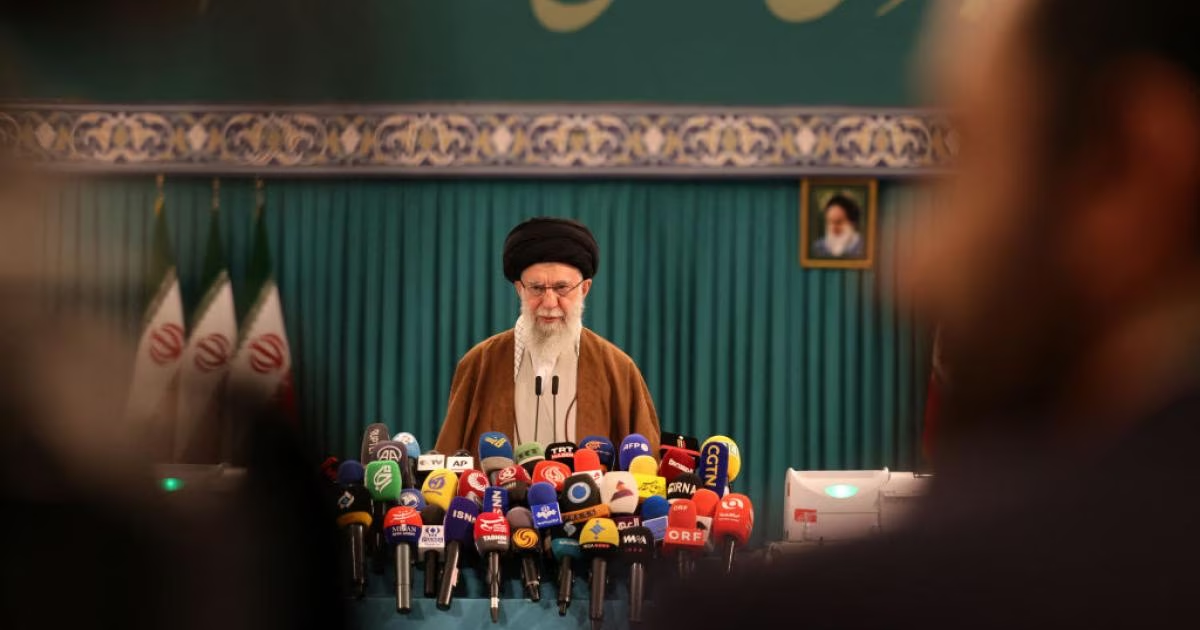
Khamenei Calls Predicting Negotiation Outcomes 'Foolish' and Threatens to Sink US Aircraft Carriers

The Supreme Leader of the Islamic Republic of Iran, Ali Khamenei, sharply criticized attempts to preempt the outcomes of negotiations between Tehran and Washington, describing such predictions as political 'foolishness.' Khamenei explained during a public meeting with a delegation from East Azerbaijan province that charting diplomatic paths before they begin reflects a limited understanding of international reality, emphasizing that the Iranian decision stems exclusively from supreme national interests.

In a direct response to the escalating statements by US President Donald Trump, Khamenei affirmed that the political entity of the Islamic Republic is immune to collapse or removal by any external power. He indicated that American rhetoric based on military showmanship cannot alter the existing balance of power on the ground, considering Iranian steadfastness to be the optimal response to intimidation policies.

The Iranian leader touched upon American boasting of military might, noting that possessing the world's strongest army does not protect it from receiving devastating blows that could cripple its ability to move and rise again. He considered that the language of threat adopted by the current US administration reflects a desire to impose a political will through military pressure, which Tehran completely rejects in its international dealings.

Khamenei raised the ceiling of military threat by speaking about his country's deterrent capabilities, hinting at the possibility of sinking American aircraft carriers if Iran is subjected to any direct aggression. He stated that these massive warships, despite being advanced destructive tools, remain targets for Iranian weaponry, which possesses the ability to send them to the bottom of the sea, in a clear reference to Tehran's possession of unique missiles or naval technologies.

These hardline stances come at a sensitive time when the region is witnessing an exchange of intense political and military messages between the two sides, amidst reports of the possibility of opening diplomatic channels. Khamenei's latest statements reflect the fragility of the negotiation process and the difficulty of reaching common ground given the wide divergence in visions and mutual threats dominating the scene.

Even the strongest army in the world can receive a blow that renders it unable to rise, and the weapon capable of sinking an aircraft carrier is more dangerous than it.

PALESTINE

Tue 17 Feb 2026 3:34 pm - Jerusalem Time

Field escalation in Gaza: A dead in Jabalia and continuous Israeli obstruction of relief operations

Israeli occupation forces continue their field escalation in various areas of the Gaza Strip, with sources reporting the martyrdom of a Palestinian child today, Tuesday, after being targeted by a drone strike in the town of Jabalia, north of the Strip. This attack coincided with a series of air raids and bombing operations targeting residential neighborhoods, reflecting the continued violations of existing truce agreements.

In the open sea west of Gaza City, occupation forces attacked a Palestinian fishing boat with live ammunition before arresting several of them and taking them to an unknown destination. Another citizen was also injured with varying degrees of wounds in the Maghraqa area in the center of the Strip, due to a drone dropping a bomb on a gathering of civilians, amid intense Israeli air traffic.

The northern and southern areas were not spared from the escalation, as the occupation army carried out extensive bombing operations inside residential squares where it penetrates around the town of Beit Lahia. In Khan Yunis, warplanes launched a series of raids accompanied by demolition operations of buildings, while Israeli artillery targeted populated areas in the city of Rafah, in the far south of the Strip.

On the humanitarian front, the spokesperson for the UN Secretary-General, Stéphane Dujarric, revealed the continued Israeli obstacles preventing the arrival of aid. Dujarric explained that the occupation only allowed half of the coordinated relief convoys to pass between February 6 and 11, exacerbating the living crisis for the besieged population.

Regarding travel through the Rafah crossing, the government media office announced limited statistics for departures and arrivals, with the total number of travelers not exceeding 925 people over two weeks. These meager figures come compared to the target number of 3,000 travelers, due to the strict restrictions imposed by the occupation authorities on the movement of the crossing.

Official data issued by the Ministry of Health indicate that the death toll from Israeli violations since last October has reached 603 martyrs and more than 1,600 injured. The ministry confirms that these numbers are constantly increasing as a result of the direct targeting of civilians and the violation of humanitarian protocols related to the entry of fuel and essential medical supplies.

In light of the deteriorating health system, there is an urgent need for about 22,000 injured and sick people to leave to receive treatment abroad to save their lives. These patients face a real danger as most hospitals are out of service and the war of extermination continues, which has almost completely destroyed the medical infrastructure in various governorates of Gaza.

Israeli authorities only allowed half of the coordinated relief initiatives to enter the Gaza Strip despite the ceasefire agreement.

PALESTINE

Tue 17 Feb 2026 1:00 pm - Jerusalem Time

Occupation extends detention of Jerusalemite journalist on charges of collaborating with a media network

The Magistrate's Court of the occupation in occupied Jerusalem issued a decision to extend the detention of independent Palestinian journalist Shireen Al-Obeid for an additional three days. This decision came after the occupation police charged the journalist with providing services to an organization described as 'terrorist' according to Israeli classifications, based on her professional activity in documenting field events.

The details of the case date back to last Sunday, when occupation forces arrested Al-Obeid while she was walking in a street in East Jerusalem. Hebrew sources claimed that the journalist was sending news videos to the 'Al-Qastal' media network, a platform that former occupation security minister Yoav Gallant placed on the banned lists in late 2023.

Journalistic reports stated that the video materials on which the indictment was based do not contain any incitement or calls for violence, but are merely documentation of public events. Nevertheless, the occupation authorities insist on prosecuting Jerusalemite journalists who provide local platforms with news content, in an attempt to restrict the Palestinian narrative in the Holy City.

During the court session, the occupation police requested to extend Al-Obeid's detention for seven days to complete the investigations, claiming a security risk in her activity. However, Judge 'Ghad Arnberg' decided to suffice with only three days, indicating that the narrative presented by the journalist needs legal examination and scrutiny before taking longer-term measures.

For his part, lawyer Muhammad Mahmoud, who is representing Al-Obeid, criticized the behavior of the prosecution and the police, stressing that the prosecutor tried to mislead the court by implying that the published materials were very recent. Mahmoud clarified that the videos under investigation date back to the end of last year and the beginning of January, which negates the alleged urgency or danger.

The defense questioned why the occupation resorted to direct field arrest instead of an official summons for investigation, especially since an arrest warrant had been issued against her a month ago without being executed. The lawyer considered that this laxity in execution proves that the security services did not see any real threat in the journalist throughout the past weeks.

Lawyer Mahmoud pointed out that it would have been more appropriate to officially inform the journalist of the ban on dealing with that media network if the goal was to apply the law, rather than surprising her with an arrest. He stressed that his client works independently and was not necessarily fully aware of the complex legal classifications imposed by the occupation on media institutions.

In a related context, informed sources stated that the targeted 'Al-Qastal' network continues its journalistic work by relying on open-source materials and field reports from Jerusalem and the West Bank. The targeting of its collaborators comes within a broader campaign launched by the occupation authorities against media institutions that report on settler violations and incursions into Al-Aqsa Mosque.

Despite an appeal against the extension decision, the Central Court in Jerusalem rejected the appeal submitted by the defense team and upheld the Magistrate's Court's decision. This decision means that journalist Al-Obeid remains in detention centers under ongoing investigation, raising human rights concerns about her detention conditions and her deprivation of exercising her work.

Data indicates that the occupation has begun to use the charge of 'providing services to terrorist organizations' as a legal pretext to prosecute anyone who contributes to conveying news from within Jerusalem. This policy directly targets independent journalists who do not enjoy major institutional protection, making them vulnerable to continuous arrest and abuse.

Human rights centers confirm that the prosecution of Shireen Al-Obeid falls within the systematic 'silencing of voices' policy in the Holy City, where professional journalistic work is criminalized. These centers consider the classification of media institutions as terrorist organizations to be a political tool aimed at isolating Jerusalem from its Arab and international media environment.

It is worth noting that journalist Al-Obeid had documented a series of important events in Jerusalem in recent months, including restrictions on worshippers and house demolitions. It appears that this intensive field activity is the real reason behind her prosecution, far from the security justifications put forward by intelligence agencies in courtrooms.

At the end of the session, the judge confirmed that the journalist did not deny sending the videos, but he acknowledged that this confession alone is not enough to prove criminal intent related to supporting terrorism. Nevertheless, he maintained the detention decision on the grounds of 'reasonable suspicion,' a vague legal term used by the occupation to justify administrative and temporary arrests.

Journalistic circles in Jerusalem await what the coming days will bring, amidst calls for international protection for Palestinian journalists who face the daily risk of arrest. Al-Obeid's case remains a stark example of the challenges faced by media professionals under the emergency laws and unjust security classifications imposed by the occupation.

Throughout this period, my client was not considered dangerous, and suddenly she became dangerous? And why was she not summoned instead of being arrested in the street?

OPINIONS

Tue 17 Feb 2026 1:00 pm - Jerusalem Time

Palestinian Democracy: Between the Ballot Box and the Deal

When elections are announced under the banner of reform, it sends a political message to the outside world before the inside, about the ability to renew legitimacy and improve performance. However, what happens through consensual lists not only empties elections of their meaning but turns them into an indictment. When results are decided in cafes, the ballot box becomes an accessory, and democracy becomes a special privilege, not a public right. Here, we are not talking about administrative arrangements, but about a comprehensive redefinition, where the citizen does not choose, but rather blesses what has been decided by networks of interests and influence.

The danger of this extends from legitimacy and society to the general image of Palestine. Elections are not just a procedure, but a social contract that rebuilds trust and measures the extent of representation. When competition is replaced by conditional endorsement, legitimacy turns into mere decoration. The election law emphasized freedom, secrecy, and individuality, and left a window for endorsement in very specific cases. This window has turned into a gateway, and the exception has become the rule, pushing some towards a single list through partisan and family pressures, or balances of interests, and presenting what was not a consensus as if it were one.

Even if consensus is viewed as a way out of local divisions in normal circumstances, it becomes problematic under occupation. Local governance forms the first line of defense, from food and water security to steadfastness and relief, and from protecting lands to managing daily crises, especially in light of the suffocating financial crisis, or what resembles governmental paralysis. This makes the municipality more than just a service provider, but a pillar of steadfastness. When its leadership arrives through intermediaries, not through the ballot box, it becomes weak, distant from the street, and closer to networks of influence, thus reproducing a culture of dependency. This makes its leaders indebted to intermediaries, not to voters, and they tend to appease instead of engaging with people's real problems, and they seek to satisfy intermediaries, not to build their legitimacy through transparency and good performance, or to instill a culture of accountability.

The truth, understood by those who follow the scene, is that these agreements are merely a tool to evade the real test. Some replace competition with side arrangements that preserve their presence and influence, and postpone confronting the question of representation, amid a growing realization that public sentiment is no longer guaranteed to produce certain results. Consensus in this form turns into a deadly social epidemic, making expertise and competencies redundant, simply because the criterion for selection is loyalty, not competence; kinship, not ability; and appointment, not election. Over time, frustration turns into disengagement from public work, and then later hostility towards it, which opens the door to more dangerous social ills, making it easy to dismantle these societies, or make them prone to internal explosion, and less capable of organizing and confronting the successive shocks of the occupation.

Nor does the matter stop there; it also affects Palestine's image internationally. The Palestinian discourse presented it as a state project under occupation, demanding protection, recognition, and support. However, the world in general, and donors or international institutions in particular, no longer look only at the justice of the cause, but also at governance. When elections are repeatedly postponed, or turn into pre-arranged agreements, that is not just counter-propaganda, but a ready-made recipe for mixing cards, linking support to stricter conditions, and perhaps justifying circumvention of Palestinian institutions, thereby transforming the issue from national liberation to an administrative file.

The most bitter truth is that this is happening while the assault on the West Bank is escalating, and official silence has become policy, or part of the scene. Consequently, destroying the immunity of local governance is not just an administrative error, but also a danger to community security. When institutions weaken, the ability to steadfastness weakens, and salvation becomes an individual choice, not a collective act, which is precisely what the occupation seeks: a fragmented society, leaders without real mandate, and internal conflicts that drain energies and resources, instead of melting them into one crucible to confront imminent dangers.

PALESTINE

Tue 17 Feb 2026 1:00 pm - Jerusalem Time

Day of Disruption Inside.. A Loud Cry to Stop Police Complicity with Crime

Dr. Imtanes Shihadeh: Protest is not just anger, but an act of empowering society and a message of refusing submission and fear

Amir Makhoul: We need organized collective action alongside popular initiatives, as together they form the power of change

Sawsan Surour: What is happening can no longer be reduced to numbers but to real suffering, especially among bereaved families

Dr. Thaer Abu Ras: The Palestinian society inside has woken up and said: Enough, we want a solution to the cancer of violence and crime

Wadie Awawdeh: There are attempts to drown us in the search for safety instead of focusing on the core issue

Wadie Abu Nassar: Protest is important but not enough without strengthening education and awareness to reduce violent crimes and crime

Exclusive to Al-Quds

The national day of disruption, called for by the families of murder victims in the 1948 territories last Tuesday, represents an additional development in the course of popular protests against the escalation of crime and violence, in parallel with official neglect from the Israeli government.

According to writers, analysts, and specialists in separate interviews with "Al-Quds," crime in Palestinian society within the 1948 territories is not merely a disturbing social phenomenon or numbers that dominate headlines, but has transformed into an existential crisis threatening personal security, economic stability, and the cohesion of the entire social fabric. Amidst an unprecedented rise in the number of victims and the expansion of violence, there is a growing general feeling that society stands at a crucial crossroads: either surrender to the reality of blood and fear, or move towards organized collective action that forces real change.

In this context, popular protests emerged as a pivotal moment in the confrontation; not just as a cry of anger, but as a practical step aimed at moving the issue from the margin of suffering to the center of action. These movements carried a dual message: direct pressure on the Israeli government to assume its responsibilities, and an internal message confirming that society is no longer willing to remain silent or coexist with the imposed reality of crime.

Analyses indicate an expanding circle of accusation to include the ruling establishment and law enforcement agencies, amidst accusations of deliberate negligence, and even complicity, in light of glaring gaps in dealing with crime between Arab and Jewish communities. As calls for protest and escalation to civil disobedience increase, a broad popular movement is crystallizing, led by victims' families and various civil segments, in an attempt to secure safety and impose a change in policies.

Political Crime.. A Tool to Fragment Society

Dr. Imtanes Shihadeh, Director of Israel Studies Programs at Mada al-Carmel, believes that the phenomenon of crime and violence in the interior has clearly emerged over the past ten years within Arab society, under the patronage and complicity of the ruling establishment, especially the police.

He points to common interests between criminal gangs and some official bodies, whose goal is to fragment Arab society, weaken it, and spread fear among its ranks.

Shihadeh adds that part of these outcomes leads to emigration, as a significant percentage of middle-class individuals, including youth, intellectuals, and teachers, now see that personal security is no longer tolerable, and economic development has become difficult due to the spread of "protection money" and the control of criminal gangs, posing a direct threat to life and stability.

Shihadeh emphasizes that this phenomenon is a form of punishment directed against Arab society, and part of what can be described as social and economic genocide. While the Palestinian people in Gaza are subjected to a war of extermination, and the West Bank witnesses continuous occupation, settlement expansion, and incursions and attacks by settlers, Palestinians in the interior face the terrorism of criminal gangs.

Shihadeh stresses that the central address of responsibility is the police, who must bear their full responsibilities, asserting that without a clear political decision, the phenomena of crime and violence cannot be seriously addressed.

Protest as an Act of Empowerment, Not Just a Cry of Anger

Shihadeh adds that protests represent part of empowering society, and they are a cry of anger expressing rejection of this phenomenon. He says that they aim first to influence the ruling establishment through demonstrations and strikes, which may make it fear the accumulation of organized political action, and second, to send an internal message to Arab society about the necessity of staying away from this path, rejecting involvement in it, and not succumbing to fear of violence and crime gangs.

Shihadeh emphasizes that the phenomenon is very disturbing and dangerous, and threatens the cohesion of Arab society in the interior, both socially and economically, which necessitates a collective reaction from various components of Palestinian society in the interior, including civil society institutions, the Follow-up Committee, and trade unions, to confront this escalating phenomenon.

A Qualitative Leap in the Path of Struggle

Amir Makhoul, a specialist in Israeli affairs, says that the national day of disruption is effectively a blessed and necessary step.

He adds that there is a role for organizers and organizations, while the importance of the participation of new sectors, such as doctors and universities, stands out, which indicates broader prospects for future work, as he affirmed that this work is cumulative, as organized crime cannot be eliminated or policy changes imposed on the state in a short breath.

Makhoul points out that there is a broad struggle led by the Follow-up Committee and the political movement in general, referring to the High Follow-up Committee for Arab Citizens in Israel, as the entity framework for this society, which has been following this file for many years and seeks to change policies or impose their change.

Makhoul confirms that the disruption constitutes a qualitative leap, as happened days ago in the disruption march towards Jerusalem and the office of Prime Minister Netanyahu.

He says: "We stand by and support the movement we have witnessed recently. Our people in the interior need both: organized collective action and popular initiatives."

Escalating Popular Disobedience

Makhoul believes that there are hundreds of popular initiatives in every town, every residential gathering, and every city, playing a truly enormous role, and it is these, alongside the Follow-up Committee, that have kept the flame of struggle alive throughout the past years. This latest launch also came after the qualitative act of disobedience carried out by shop owners in Sakhnin, led by Mr. Ali Al-Zubaydat about two weeks ago, which stirred the street and launched a widespread popular solidarity operation, not just mere solidarity or political adoption.

He adds: "Today we are witnessing a major transformation in this context, towards multiple forms of disobedience against policies, leading to their change. However, we do not expect the Israeli government to change its policies, as it is not interested in doing so in the first place, because crime is part of its policy and not outside it. There is a political function for the crime system, which is to maintain right-wing rule, weaken society, and strike at the cohesion of Palestinian society from within, a policy applied to sabotage Palestinian society wherever it exists, not only in the interior."

The Importance of Protest for Policy Change

Makhoul adds: "Days ago, we heard about the scandal of smuggling goods into Gaza with the participation of the brother of the head of the Shin Bet, but more dangerous than that is the flow of tens of thousands of dangerous narcotic pills used to sabotage Palestinian society wherever it is, with the aim of undermining it, facilitating policies of displacement and ethnic cleansing, and distancing it from politics and work.

Makhoul believes that the crime file constitutes a top priority, with the need for organized collective action and spontaneous action, along with the importance of protesting every incident that occurs in any town, as well as supporting and strengthening popular work and popular initiatives, while emphasizing that all these paths converge in one path, which is the path of popular struggle to change policies, and this is the basis.

Makhoul explains that it is natural, given that the Palestinian people within the 1948 territories are a national group in their land and homeland, to have their own entities, and for all activities to support this basis, and for the Palestinian Arab masses to lead this struggle, whether at the national level, or through the Follow-up Committee, or through various popular bodies and initiatives, and for them to determine their own destiny.

He emphasizes the importance of organizing victims' families and their involvement in activities, which was clearly evident in the recent disruption actions, as this organization represents a moral voice that adds an important moral dimension to political work. Therefore, we need integration between all these efforts.

Makhoul explains that the Palestinian people in the occupied interior face real Israeli fascism, and need the support of all concerned forces, including progressive Jewish forces, not out of pity or courtesy, but in order to confront fascism and impose policy changes on the Israeli government.

Numbers Breaking Records and Escalating Bloodshed

For her part, journalist and critic of the political scene in Israel, Sawsan Surour, asks how many victims of crime have there been in Palestinian society in the interior?! This question is asked by every journalist from the Palestinians of the interior every morning!

She says: "So far, the number of Palestinian Arab victims in Israel has reached 45 killed since the beginning of this year, while the number of victims at the same time last year was 31, knowing that last year was burdened with the blood of victims and the heavy weight of rampant crime, reaching an unprecedented level."

She clarified: "252 victims is a heavy number that breaks the previous record set in 2023 with 244 victims, making 2025 the bloodiest year in the history of Palestinian society within the 1948 territories, and we are still in the middle of the second month of this year, so how many will the list of victims close with?!"

Surour adds, for comparison only, 66 Jews were killed in 2024, and 38 Jews in 2023, knowing that the number of Jews in Israel is about four times that of Arabs.

Israeli Police Negligence in Confronting Crime

Surour confirms that, according to data, the Israeli police solve 65% of murder cases in Jewish society, while this percentage does not exceed 20% in Arab society, all of which are data that cast their harsh and dire shadows on the reality and existence of Palestinians in the country.

Surour believes that the Israeli police's negligence in confronting the escalation of crime in Palestinian society in the interior is deliberate, and Prime Minister Benjamin Netanyahu bears responsibility for it, as he almost never speaks about the phenomenon of crime in Palestinian society, but he touched upon it, days ago, by praising Police Minister Itamar Ben-Gvir following the police campaign carried out in the village of Tarabin Al-Sane in the Negev and the killing of citizen Muhammad Hussein Al-Tarabin by police gunfire.

She points out that according to data published by the Taub Center for Social Policy Studies in "Israel," until 2015, the ratio of murder crimes in Arab society to Jewish society was 4 Arab victims for every one Jewish victim, and this ratio rose in 2023 to 13 Arab victims for every one Jewish victim, and rose in 2024 to 14 Arab victims for every one Jewish victim. After these numbers, will silence remain the master of the situation for Palestinians in Israel? The answer, of course, is no, and this is what actually happened.

Surour says that because the public discourse among Palestinians in "Israel" has recently taken a remarkable turn in dealing with crime, it no longer focuses on the number of dead, and crime is no longer reduced to a daily number or an annual toll only. Bereaved and affected families, civil bodies, and activists have launched a remarkable social movement, playing a prominent and advanced role compared to official institutions and elected leaders, which has brought about an important transitional development in dealing with crime, especially if opportunities, fields, and capabilities are provided to them and to the social movement in finding a lifeline.

Surour continues, from the cry of pain of businessman Abu Ibrahim Ali Zubeidat, which gave birth to the dignity uprising and the rejection of extortion in Sakhnin, to the almost daily demonstrations or activities condemning the spread of crime and the compliance of official leaders with these pressures and their submission to the request to unify Arab parties and not continue the fragmentation among them and to re-form the Joint List for the sake of the supreme goal of protecting people, a step that, it seems, was necessary, and left no opportunity for any opponent to refuse.

Participation of Bereaved Families Translates the Pains of Crime

Surour emphasizes that the undeniable truth is that the steps taken by the National Committee of Heads of Arab Local Authorities, and the Follow-up Committee for Arab Citizens in "Israel," against crime and violence have proven ineffective in isolation from the social movement, which is led by the sighs and pains of bereaved families and orphans of crime, and those physically, psychologically, and economically affected, who can translate the losses of crime not only in numbers but in real pains and suffering.

Surour believes that the days of disruption witnessed by the country last week were important, but they attracted a very fragile segment from all over the country, not exceeding a few thousand, as this activity succeeded in attracting some Hebrew media outlets, after coverage was previously limited to Arab media.

She described it by saying: "The feeling and reality confirm that what happened in terms of activities was just a summer cloud that passed."

Surour clarifies the necessity of continuing and escalating the non-partisan civil social movement so that its impact remains noticeable and influential, both on the ordinary citizen and on decision-makers in the Israeli government.

A State of Emergency Before a General Strike

Surour considers the Follow-up Committee's decision to call a general strike for three days to condemn the spread of crime a blessed step, "but until the date of this strike (supposed to start two months from now), a state of emergency must be declared immediately, while continuing to organize and implement disruptions, demonstrations, and unifying activities, if not daily then weekly, leading to civil disobedience, if necessary, in order to make the struggle successful and not lose the compass that has long pointed and always points to the radical solutions that must first come from the Israeli government," according to her.

The Peak of a Movement Not Seen in the Interior for 25 Years

Political analyst Dr. Thaer Abu Ras believes that the national day of disruption is the culmination of several diverse activities in the interior over the past two weeks, and this is the central point in his opinion.

He adds: "We are facing the peak of political action or political mass activity that we have not seen for at least 25 years in the Palestinian interior. There is a general feeling that society has woken up and said: Enough, we want a solution to the cancer of violence and crime that has been spreading within society for many years."

Abu Ras emphasizes that under the current Israeli government, the data has reached numbers that people can no longer accept; the period between 2022 and 2023 witnessed an increase of more than 200% in murder victims, and from 2023 until today there has been a continuous and significant increase in the number of victims. Even in 2026, during the first month or month and a half, the number of deaths and shooting incidents reached unbelievable levels.

The Most Violent in the World

Abu Ras points out that if Arab society in the interior were an independent state, it would be among the most violent countries in the world, even more than countries with a bad reputation in this field such as Colombia or Mexico, for example.

Abu Ras believes that this mass organization alone is the most prominent event, and what helped it succeed is that, for the first time, it did not come from the leadership and was not imposed by political elites on society, but emerged from the womb of Arab society itself; those who practically initiated the first strike, and then the Sakhnin demonstration, which was the largest in the history of the Arab masses, were actually from the merchant class in Sakhnin, who protested against the phenomenon of "protection money" in Arab society, and against the state's inability or unwillingness, as well as the Israeli police's, to deal with this phenomenon.

An Election Year Changes the Rules

Abu Ras asked: Will there be continuity for this momentum? And will it be exploited to impose the crystallization of a real action plan on the Israeli government to deal with this issue, especially since we are in an election year, which is the most important variable?

Abu Ras says: "Being in an election year means that there are listening ears in the Israeli government and the Israeli political elite, which may allow the possibility of taking some step in the end."

He also points out that the Israeli government is not interested in the Arab masses coming out to vote in the upcoming elections, and it knows that the issue of violence provokes these masses, and may be an incentive for them to go to the polls, and perhaps this is what may push the Israeli government to feel the need to do something, so that the Arab masses do not use this file against it in the next elections.

A Strategic Threat Requires a Strategic Response

Israeli affairs specialist Wadie Awawdeh says that the Palestinian people in the occupied interior face a strategic threat, and therefore the reaction must be strategic from the Palestinian Arabs in "Israel."

Awawdeh emphasizes the need to prepare an action plan, a persistent plan, and a long breath, and to search for partners and allies on the Jewish side.

A Complicit Government Setting the House on Fire from Within

Awawdeh adds: "We are facing a government that is insensitive, blatantly and flagrantly complicit with criminal gangs against us, in an attempt to set the house on fire from within, and distract us from the core political issue, whether local or the Palestinian issue related to our people, and drown us in issues of searching for safety and security, which is the basic and primary right of every citizen and every human being."

Awawdeh stresses the need for pressure and continued protest. Palestinian Arab society in "Israel" stands before a major strategic challenge that threatens all that has been achieved previously, and that threatens the Palestinian past, present, and future.

Silent Displacement Through Spreading Despair

Awawdeh explains, describing it: "It threatens our past because it squanders what we have achieved in terms of steadfastness, development, and preservation of identity and its flame; it corrupts our present because it occupies us with side issues that should not have overshadowed our priorities, and distances us from fundamental and core issues; and it threatens our future because it opens the door to emigration, and perhaps that is the intended goal, which is to push young people to despair and emigrate from here."

Awawdeh adds that this is part of this government's vision to resolve the conflict with Palestinians through displacement, including silent displacement, by spreading despair and hopelessness and so on.

Awawdeh emphasizes that the response must be a long breath, perseverance, broad participation, and unity of ranks, based on the principle that what happens today to my neighbor may happen tomorrow in my home. And whoever thinks that he will be immune from these situations, and does not intervene or participate in the protest, is mistaken.

Awawdeh concluded by saying: "Unfortunately, political and civil activities and their capabilities in mobilization, rallying, and dealing with this file need a lot of support and a lot of reform. The discourse has become ossified, the mobilization language is weak, and there is no clear action plan or integrated vision. In fact, I doubt the existence of an action program and a clear vision among the leaders, as a result of obsolescence, political corruption, and the decline of political work, among other things."

Official Indifference Fuels Crime

For his part, political analyst Wadie Abu Nassar confirms that the escalation of crime within Arab society in the interior is dangerous and infuriating, and causes great concern, as there is no longer a safe place, nor a feeling that conditions are improving, but on the contrary, there is a sense of continuous decline.

He points out that the primary responsibility lies with the state, especially the Israeli government, which seems not only silent, but deals with a degree of indifference, as if it is fueling crime instead of seriously and effectively combating it.

Abu Nassar adds that despite the contribution of the majority of our community members to protesting the rampant crime through various means, the government and state institutions still ignore these movements, and do not play their role in fighting crime as they do in Jewish society.

Strengthening the Educational System Limits the Spread of Crime

In contrast, Abu Nassar stresses the need not to overlook the existence of an educational imbalance among some members of society, for while acknowledging the state's shortcomings, it must be noted that Arab citizens have suffered from racial discrimination since the establishment of the state, and this discrimination has significantly worsened in recent years.

Abu Nassar emphasizes that what is required is not limited to protest, despite its importance, but extends to strengthening education and awareness starting from the family and school, which contributes to limiting the spread of crime within society.

Abu Nassar believes that the matter requires great efforts, especially under the right-wing government that does not respond to strikes, demonstrations, and demands, pointing out the importance of seeking to internationalize the issue by urging influential international parties, especially the United States of America and diaspora Jews, to pressure the Israeli government to assume its responsibilities in this regard.


OPINIONS

Tue 17 Feb 2026 1:00 pm - Jerusalem Time

Beyond the Austerity Discourse: Have Earth's Solutions Ended, or Has the Era of Dependency?

By: Dr. Saeed Sabry, International Economic Advisor, and Board Member of International Digital Transformation

When an economic decision-maker announces the adoption of an “austerity” policy, it is not merely a financial measure to balance the general budget, but an expression of a genuine moment of constraint in the margin for maneuver. In the Palestinian case, the austerity discourse goes beyond being a financial policy to being an implicit acknowledgment of the blockage of economic decision-making tools on the ground. Hence, the fundamental question arises: Have Earth's solutions truly ended, or has the era of economic dependency ended? This question is not a linguistic metaphor, but an accurate description of a long-term structural blockage that has shackled the Palestinian economy for decades, transforming it from an economy striving for development into an economy preoccupied with managing survival under the weight of accumulating financial, monetary, and sovereign crises.

Anatomy of the Crisis: When Numbers Expose the Limits of the Model

The Palestinian austerity cannot be understood without resorting to the language of numbers, not as rigid data, but as indicators of a deep structural imbalance. The Palestinian public debt is estimated today at about 15 billion dollars, including direct obligations, arrears to the private sector, bank debts, and pension authority obligations. When compared to the GDP, which actually ranges between 13 and 14 billion dollars after years of contraction, we find that public debt has exceeded 100% of the national economy's size. In any normal economy, this ratio is a red alert. However, in an economy that lacks monetary sovereignty, does not possess a national currency, and does not control its crossings or resources, it represents an entry into a phase of complete depletion of financial capacity.

The most dangerous aspect of the debt size is the cost of its service. Public debt service consumes between 250 and 300 million shekels monthly, which is equivalent to 60-75% of available local revenues in some months, before spending reaches salaries, services, or investment. Thus, the financial discussion shifts from “how do we direct resources?” to “how do we keep liquidity alive?”

And when the salary bill, approaching 900 million to one billion shekels monthly for nearly 150,000 employees, retirees, and quasi-salaries, is added to that, the general budget becomes governed by a zero-sum equation, where investment disappears from calculations, not as an option, but as an inevitable victim.

Pledging the Banking System: Paralyzed Liquidity and the Correspondent Banks Trap

The depth of the crisis is also evident in the situation of the Palestinian banking system, which is supposed to be a driver of growth, but instead becomes a victim of monetary strangulation. The annual wait for the “extension” of correspondent banks' relations with the Israeli side is no longer a technical issue, but has become a structural pressure tool that threatens the entire financial stability.

Refusing to receive surplus cash shekels is not an ordinary banking procedure, but a strangulation policy that paralyzes the function of liquidity itself. Local banks find themselves drowning in paper liquidity that cannot be disposed of externally or invested internally, which limits their ability to productive lending, increases the fragility of public finance, and deepens the private sector crisis.

Here, traditional “Earth's solutions” lose their effectiveness. Banks are without tools, the government is without sovereignty, and the economy is without growth engines.

Why Have Earth's Solutions Stopped?

In sovereign states, governments possess three basic tools: monetary policy, fiscal policy, and control over trade. In the Palestinian case, these tools are either disabled or forcibly restricted. Since the economy relies more than 70% on local consumption linked to public spending, any reduction in salaries or expenditures automatically turns into self-contraction.

Salary cuts reduce purchasing power, weakening demand, harming the private sector, leading to a decline in tax revenues, and returning the government to a deeper deficit. It is a closed loop that traditional austerity measures do not break, but rather exacerbate.

From Deficit Management to Model Redesign

If Earth's solutions have been exhausted within the existing model, the alternative lies not in searching for additional traditional tools, but in redesigning the economic model itself. This requires a shift from the logic of “deficit management” to the logic of “capacity building.”

First, productive austerity: any austerity that does not target investment or stifle growth-capable sectors, but rather focuses on reducing waste, reordering priorities, and linking all public spending to a measurable economic impact.

Second, digital sovereignty as a cumulative path: not as an immediate solution, but as a gradual path to disengage from the physical constraints of cash. An integrated national digital payment system can give the economy greater flexibility in liquidity management and alleviate the blackmail associated with paper currency circulation, without claiming to eliminate political restrictions all at once.

Third, transforming aid into risk mitigation tools, thereby opening the door for diaspora investments in strategic sectors such as food security and renewable energy, and reducing the import bill, which is the largest source of financial leakage outside the economy.

Conclusion: The End of Dependency or the Beginning of Transformation?

The austerity discourse is not the end of the road, but a final warning bell. The real question is no longer: how much will we cut spending? But rather: how do we rebuild the capacity to produce in an economy whose debt has exceeded its output?

Perhaps the Earth's solutions related to the dependency model have narrowed, but the spaces for innovation, digitalization, and redefining economic tools are still open. The real challenge is not a lack of ideas, but having the will to move from managing the crisis as a permanent fate to breaking the model that produced it.

We do not just need austerity, but a restoration of the ability to plan and create horizons, before austerity turns from a rescue tool into a permanent way of life.

OPINIONS

Tue 17 Feb 2026 1:00 pm - Jerusalem Time

An equation: Making Palestine as Jewish as England is English

Striking for its scientific analytical thought is a statement by one of the Zionist leaders, Chaim Weizmann, in 1919, that the goal of Zionism was to make Palestine as Jewish as England is English. This was more than a hundred years ago. At that time, there was no state of Israel, no Nakba of Palestine, no setback for the nation, and no occupation of the rest of Palestine, the Golan, and Sinai. There was no PLO or its various factions, no Stone Intifada, and no Oslo Accords or a Palestinian Authority capable of an independent state after five years.

Today, the discussion and debate focus on striking Iran, and whether America, along with Israel, which is nearly eighty years old, will carry out their threats, or if Iran will succumb to avoid this dark fate that is at its doorstep, looming from the muzzles of the death fleets lurking nearby.

 A quick review by Arab, Islamic, and regional decision-makers of this "Middle" East is enough to provide the answer, not necessarily for a century, but only for half of it or less. After the departure of the great Arab nationalist leader Gamal Abdel Nasser, his Egypt "drifted" towards peace with Israel, and the Front of Steadfastness and Confrontation was formed, which succeeded in moving the headquarters of the Arab League from Cairo to Tunis. Its pillars were Syria under Hafez al-Assad, Libya under Muammar Gaddafi, Iraq under Saddam Hussein, Algeria under Houari Boumédiène, and the PLO under Yasser Arafat. Most of these leaders were assassinated, and their countries fell into the clutches of Israel and America as if they had never existed. Their historical capitals were occupied, and their civilizations, some of which extend to pre-written history, were trampled. This front ended, and with it, steadfastness and confrontation. All of this happened in less than fifty years, and the "knowledgeable" and, of course, the ignorant, will not know when such a front will rise again.

 It is important, as we read this very, very recent history, because many of us lived through it and were witnesses to it, or at least to some of it, to note a striking development: the shift of targeting from Arabs to non-Arabs. Iran is not Arab, but regional, supporting the Palestinian cause as the Arab Front of Steadfastness and Confrontation supported it before. And if Iran is Islamic, then Venezuela, which was targeted with the arrest of its president at the beginning of the new year, is neither Arab nor Islamic. This, in turn, opens up the intellectual field: will Iran be the last to be targeted?

 In 1938, 19 years after Weizmann's statement, and ten years before the establishment of the state, Ben-Gurion made a statement in which he said: "I support forced transfer, and I see nothing immoral in it." So why do we seem surprised and open-mouthed at the "new developments" that are, in fact, old axioms?

 The great Egyptian writer Mohamed Hassanein Heikal was asked about the reason for his opposition to Hosni Mubarak, and he said that throughout his 30 years of rule, he had not read a book.

OPINIONS

Tue 17 Feb 2026 11:11 am - Jerusalem Time

The Authority Between Contraction and the Risk of Disintegration.. What to Do to Redefine the National Project?

The Palestinian crisis is no longer reducible to an imbalance of power with Israel, nor to the bias of an American administration here or a retreat of a European stance there. We are facing a historical phase that goes beyond diplomacy and daily politics, to a question of meaning and function: What remains of the national project when the Authority, which was born as a transitional framework towards a state, contracts to find itself today closer to an apparatus managing a population under occupation, if not within the context of its own plan?

In light of the accelerating creeping annexation in the West Bank and the Judaization of Jerusalem, the continued siege and obstruction of Gaza's reconstruction, the fading of any political horizon during the Trump administration, and the international community's contentment with the rhetoric of a "two-state solution" without enforcement tools, the challenge is no longer solely external for Palestinians. The deeper danger is the gradual transformation from a supposedly temporary authority to a permanent administrative reality, stripped of sovereignty and horizon. The erosion here does not come in the form of a resounding collapse, but in the form of a slow habituation to contraction.

The most likely scenario in the foreseeable future is a formal survival of the Authority, more financial and political tightening, accelerating expansion of settlement facts, and a cumulative decline in popular trust. But it is not an entirely predetermined path. Even in the context of erosion, the question remains: Is the Authority's function redefined, or is the crisis managed with the bare minimum?

Redefinition means transforming the Authority from a service apparatus into a tool for societal resilience; from managing salaries to protecting land; from waiting for external transformation to investing internally. It means redirecting resources towards supporting productive sectors, fortifying Jerusalem and threatened areas, strengthening the resistant local economy, and opening up public space for genuine political participation that restores trust. Reform with its national content here is not a moral demand, but a condition for political survival. For an authority without societal legitimacy becomes more fragile in the face of any external pressure.

However, erosion may slide into functional disintegration or disorganized collapse, under accumulated financial-security pressure. Here, the issue is no longer managing contraction, but confronting a vacuum. And a vacuum in the Palestinian context is not a neutral space; rather, it is an open invitation for external arrangements, or for internal chaos, or for a forced reshaping and engineering of the political system. Therefore, thinking of a reserve national framework, "a broad consensus network of political and societal forces capable of managing an organized transition," is not a coup, but a preventive measure that protects society from collapse turning into liquidation.

In contrast, the possibility of re-establishment remains, even if it seems less spontaneous. This path can only be achieved by rebuilding national representation on comprehensive democratic foundations, redefining the relationship between the Palestine Liberation Organization and the Authority, and formulating a political contract that defines the Authority's function as a tool subject to the national project, not a substitute for it. The essence of the transformation is shifting the center of gravity from relying on external factors to restoring legitimacy from within, so that society itself becomes a lever of pressure to redefine the direction.

In this context, the call for National Council elections or engaging people with a draft constitution emerges. In principle, renewing representative legitimacy and drafting a new constitutional contract represent undeniable national entitlements. But the value of any electoral or constitutional process is not measured by its announcement, but by its political conditions. Elections held amidst deep geographical and political division, and without prior agreement on a comprehensive national program, may turn into a reproduction of existing power balances, or a mechanism for managing the crisis rather than solving it. And a constitutional discussion in the absence of actual sovereignty, and continuous erosion of geographical space, is nothing more than an illusory compensation for field impotence, or an internal rearrangement of the system without affecting the core of the predicament.

The problem is not with elections or the constitution, but with the danger of the compass shifting from the priority of the question of liberation to the question of administration. When the conflict shifts from protecting land to organizing texts, the national project becomes vulnerable to being reduced to limited governance engineering, while facts on the ground redefine borders and sovereignty without waiting.

Hence the central question arises: Who has the ability to break this path?

The answer does not lie in a single institution, nor in a specific faction, but in what can be called the "historical bloc," i.e., a broad alliance of social, cultural, trade union, economic, and political forces whose interests intersect at protecting the national project from final contraction.

The responsibility of this bloc is not limited to criticism or issuing statements. Its historical responsibility is on three interconnected levels:

First, imposing the priority of political unity as a condition for any electoral or constitutional process. There is no meaning in renewing procedural legitimacy without restoring the minimum level of unity and a common program.

Second, restoring the public space as an arena for discussion, accountability, and participation. Legitimacy is not restored by a top-down decision, but by re-engaging society in defining the path.

Third, transforming steadfastness from rhetoric into public policy through supporting local production, protecting land, fortifying civil peace, and building community solidarity networks capable of absorbing shocks.

The historical bloc is not a new party, but an organized collective consciousness, pushing to redefine the Authority's function before it is redefined from outside. It is the force capable of preventing erosion from becoming fate and collapse from becoming liquidation, and elections or the constitution from becoming cosmetic illusions to fill the vacuum.

The current moment of contraction carries a deep paradox: the narrower the political space, the heavier the burden of internal responsibility. Either the national project is reproduced from within, or it is reshaped from without. It is not enough to wait for changes in administrations or shifts in international positions. History does not grant peoples the luxury of long waiting when the land itself is in the process of redefinition.

So what is to be done?

Not a coup or an adventure, but a transition from crisis management to redirecting the path. And if the moment is one of contraction, the response is not withdrawal, but a rearrangement of power balances within society itself. Here, responsibility shifts from a moral question to a historical duty for the broad national bloc.

First: Establishing the minimum national base; the first step is not an election or a constitution, but a political agreement on undisputed priorities: stopping creeping annexation, lifting the siege on Gaza, protecting Jerusalem, and preventing the entrenchment of geographical and political separation.

This minimum is not a factional program, but a unifying umbrella under which secondary differences are suspended. Without this foundation, any political process "electoral or constitutional" becomes merely a reproduction of division, not its transcendence.

Second: Restoring the public space as an internal sovereign domain; legitimacy cannot be restored without reopening the public sphere.

Political freedom is not a luxury, but a condition for mobilization. What is required is to free trade union, student, and civil work from restrictions, and to restore the importance of public debate as a tool for correction, not a threat to stability.

For an authority that fears its society loses its ability to represent it. And a society that is excluded from decision-making loses its willingness to defend it.

Third: Practically redefining the Authority's function;

Instead of the Authority remaining an apparatus for managing salaries and services, it must be transformed into a tool for steadfastness:

•Redirecting budgets towards productive sectors, agriculture, and small industries.

•Supporting the steadfastness of areas threatened by annexation through real, not symbolic, empowerment plans.

•Transforming municipalities into community protection institutions, not platforms for administrative competition.

Here, the economic dimension becomes part of resisting imposed realities, not just managing the financial crisis.

Fourth: Rebuilding national representation;

Addressing the erosion of legitimacies controlling the national destiny must start from acknowledging their failure, leading to the building of democratic national representation that responds to current priorities in strengthening people's ability to steadfastness and preserving the unifying identity, the right to self-defense, and confronting plans to liquidate the right of return and self-determination. As for constitutional discussion, it must be linked to redefining the national project and the Authority's function, and not entrenching the current situation that has led the national cause to this impasse; otherwise, it becomes merely a distraction that contradicts popular priorities, especially in the absence of real sovereignty and imminent existential dangers.

Fifth: Building a transitional safety net;

In the event of collapse or forced transformation, a reserve national framework "non-confrontational" capable of managing any sudden transition must be established.

This framework includes personalities, community forces, and factions that agree in advance to protect civil peace and prevent the vacuum from turning into chaos or guardianship. For preparing for the worst-case scenario is a condition for preventing it from happening.

Sixth: Shifting the center of gravity from external to internal;

This does not mean closing the door to diplomacy, but reordering priorities. External reliance without an internal base turns into a long wait. But when the external relies on cohesive internal legitimacy, it becomes a supporter, not a substitute. Negotiating power is not derived from statements, but from the unity and resilience of society.

Seventh: Crystallizing the historical bloc as a carrier of change;

The historical bloc is not a slogan but a cumulative process through an alliance between cultural elites, trade unions, the business sector, youth forces, and political leaders willing to make mutual concessions for the larger project. Its function is not to overthrow the system, but to redirect it. And not to dispute legitimacy, but to restore it.

This roadmap does not promise quick solutions, but it prevents erosion from becoming fate, collapse from becoming liquidation, and elections or the constitution from becoming cosmetic tools or a distraction to buy time. It moves the question of "What is to be done?" from the level of rhetoric to the level of organized action.

The question is no longer: Will circumstances change?

But: Will a collective will capable of transforming the moment of contraction into a moment of re-establishment be formed, before Palestine is redefined from outside, not by Palestinians themselves?

OPINIONS

Tue 17 Feb 2026 11:11 am - Jerusalem Time

Palestine Between Inherent Right and the Legislation of Annexation: When Force Becomes Law...!

The conflict over Palestine is not a dispute over a geographical name, but a deep conflict over the source of legitimacy: Is it an inherent right rooted in land, identity, and history, or a right created by force and clothed in legislative and theological garb?

The Palestinian whose ancestors lived in this land for continuous centuries derives his legitimacy from a stable historical and social presence, and from the right to self-determination affirmed by international conventions.

In contrast, the Zionist project emerged in a European colonial context, combining modern nationalism with the utilization of religious narrative, leading to the establishment of Israel as a political fait accompli.

Historically, Palestine was not a land without people. Multiple civilizations succeeded one another, and its local inhabitants remained its living fabric.

It is true that some Arab Jews lived in Palestine during historical periods, as did others, but religious or historical presence does not automatically transform into political sovereignty after a long interruption, otherwise the rules of contemporary international stability would collapse.

History proves diversity and continuity, and does not grant an exclusive privilege to a specific group.

Legally, United Nations resolutions have affirmed the principle of the inadmissibility of acquiring territory by force, and recognized the right of the Palestinian people to self-determination.

The West Bank, including East Jerusalem, as well as the Gaza Strip, are considered occupied territories since 1967 according to international law, and are subject to the provisions of the Fourth Geneva Convention, which restricts the authority of the occupation and prevents it from changing the legal status of the territory or annexing it.

The occupation authority, by definition, is temporary and limited, and does not have the power to transfer ownership or impose permanent sovereignty.

In this context comes what the Knesset approved on February 15 regarding the initiation of procedures for settling and registering West Bank lands as "state lands" or "Israeli government property."

This decision is not a neutral administrative measure, but a political step with serious legal implications, paving the way for transforming the land from a temporary occupation status to an actual, disguised annexation.

Classifying the land as Israeli government property implies sovereignty, and sovereignty does not arise from occupation.

Legislating annexation internally does not grant international legitimacy. National law, no matter how strong within the state, does not supersede the peremptory norms of international law.

If the international community established after World War II the rule prohibiting the acquisition of territory by force, then violating it today opens the door to the erosion of the entire international legal system.

Therefore, any decision that exceeds the powers of the de facto authority and consecrates unilateral annexation remains null and void from the perspective of international legitimacy, even if implemented on the ground.

The danger in the decision lies not only in its legal effect, but in its political implication: the transition from managing an occupation to establishing unilateral sovereignty, which means undermining any prospect for a just settlement based on mutual recognition. For when the Palestinian's land becomes "state land" by an Israeli parliamentary decision, the owner of the land is redefined from an inherent owner to a resident under an administration claiming ownership.

Here lies the essence of the conflict between a deeply rooted natural right and a presumed right based on the logic of control.

In conclusion:

All Israeli measures in the occupied Palestinian territories — in the West Bank, including East Jerusalem, and in the Gaza Strip — remain, from the perspective of international law, null and void and have no recognized legal effect.

They are occupied territories that represent the territory of the occupied State of Palestine, the state that has been granted observer non-member state status in the United Nations, and recognized by more than 160 countries around the world.

The sovereignty of the State of Palestine over these territories is an existing legal sovereignty, even if it is suspended by the occupation.

Therefore, annexation decisions, or reclassification of lands, or imposing Israeli laws on the occupied territory, do not change the legal nature of these lands, nor do they create a sovereign right for Israel over them.

Falsehood does not turn into truth over time, and occupation does not turn into sovereignty by legislation.

The Palestinian right will remain firm, supported by the rules of international legitimacy, and bolstered by the increasing international recognition of the State of Palestine, until the occupation is lifted and the land is restored to its owners according to the principles of justice and law.

PALESTINE

Tue 17 Feb 2026 11:11 am - Jerusalem Time

Arab-Islamic Bloc Condemns Occupation's Confiscation of West Bank Lands

Eight Arab and Islamic countries, today, Tuesday, issued a unified stance strongly condemning the Israeli occupation authorities' classification of vast areas in the occupied West Bank as 'state lands'. The diplomatic alliance included Saudi Arabia, Jordan, the UAE, Qatar, Egypt, Turkey, Pakistan, and Indonesia, affirming in a joint statement that this step aims to impose a new administrative and legal reality that accelerates de facto annexation operations.

The signatory countries to the statement emphasized the absence of the occupation's sovereignty over Palestinian territories, considering these practices an attempt to displace the Palestinian people and obstruct any international efforts to achieve stability in the region. This move comes at a time when the occupation authorities, since mid-February, have begun unprecedented measures to register lands in Area C - which represents about 61% of the West Bank - under the categories of 'absentee property' and 'state lands', in a step that is the first of its kind since 1967.

For its part, the United Nations entered the crisis, with international sources reporting Secretary-General António Guterres' condemnation of these measures, affirming that settlement expansion in the West Bank and East Jerusalem lacks any legal legitimacy. Previous reports warned that the occupation government seeks to approve a proposal aimed at gradually annexing 15% of Area C by 2030, exploiting legal loopholes to seize lands whose Palestinian owners do not have officially registered ownership documents.

These illegal measures constitute a grave violation of international law, contradict Security Council resolutions, particularly Resolution 2334, and undermine peace prospects.

PALESTINE

Tue 17 Feb 2026 11:10 am - Jerusalem Time

Kenneth Roth: International Law Faces a 'Breaking Point' in Gaza and Sudan, and the ICC is Shackled

American legal expert Kenneth Roth believes that international humanitarian law remains the only necessary tool to address atrocities and grave violations in the Gaza Strip, Sudan, and Ukraine. Roth, the former director of Human Rights Watch, explained that this law is currently facing unprecedented challenges that threaten its effectiveness in protecting civilians during armed conflicts.

Roth based his analysis on a comprehensive study of current conflicts, noting that humanitarian law has reached a 'critical breaking point' due to major powers ignoring international standards. However, he considered that the widespread global reactions to the targeting of civilians confirm that it is too early to declare the death of this global legal system.

Regarding the aggression on the Gaza Strip, Roth affirmed that Israel flagrantly violated the Geneva Conventions, which are the cornerstone of international law. He pointed out that the occupation army adopted a policy of indiscriminate bombing of residential areas, directly targeted civilians, and used starvation as a weapon through the deprivation of food and necessities.

The legal expert criticized the paralysis that has afflicted the UN Security Council as a result of Washington's use of the 'veto' to protect Israel from accountability. Despite this obstruction, Roth noted that the UN General Assembly and the Human Rights Council continued to issue repeated condemnations and activated monitoring mechanisms that confirmed the occurrence of genocide.

The article touched upon the international judicial process, where the International Court of Justice is considering genocide accusations against Israel, with a clear demand to end the illegal occupation. The movements of the International Criminal Court also emerged, which directly accused Benjamin Netanyahu and Yoav Gallant of committing crimes against humanity.

In the context of the American position, Roth observed a sharp contradiction, as Washington continued to provide absolute military support to Israel despite documented crimes. He considered that this behavior made the United States appear as a partner in the atrocities committed, which weakened the prestige of international law that it claims to protect.

Roth drew a comparison between the international reaction to Gaza and to the Russian invasion of Ukraine, where Moscow faced widespread sanctions and international prosecutions. He believed that this response, despite the obstruction of the Security Council, proves that the international community does not accept illegal behaviors when there is political will.

As for the African continent, Roth noted a significant weakness in the international response to the bloody civil war in Sudan and military interventions in eastern Democratic Congo. He considered that this disparity in dealing with humanitarian crises fuels the feeling of double standards and undermines the universality of international law.

Regarding the role of the International Criminal Court, the Princeton University professor affirmed that it is the most appropriate body to enforce justice and prosecute war criminals. However, he warned against continuous attempts to undermine it, especially by the American administration which imposed sanctions on court officials to deter them from prosecuting Israeli leaders.

Roth revealed an internal crisis within the International Criminal Court, as it suffers from a vacancy in the position of the chief prosecutor since May 2025. This obstruction comes against the backdrop of investigations into prosecutor Karim Khan for harassment allegations, which prevented decisive action on the Gaza and Sudan files.

The article explained that this deteriorating situation prevented the court from issuing public accusations regarding the violent bombing campaigns in Gaza or the settlement expansion in the West Bank. Prosecutions were also absent for perpetrators of atrocities in Sudan, which gave the perpetrators a sense of permanent impunity.

In conclusion of his analysis, Kenneth Roth called on the 125 member states of the International Criminal Court to take urgent action to appoint a permanent prosecutor. He stressed the need to unite international efforts to defend victims and ensure the consistent enforcement of law, away from narrow political calculations.

International humanitarian law does not face an existential threat, but it has reached a critical breaking point in light of what is happening in Gaza and Sudan.

PALESTINE

Tue 17 Feb 2026 11:10 am - Jerusalem Time

UN warnings of forced displacement of Palestinians due to expanding Israeli control in the West Bank

Ravina Shamdasani, spokesperson for the UN Human Rights Office, expressed deep concerns regarding the expansion of Israeli occupation authorities' control in the occupied West Bank. Shamdasani affirmed that these moves are directly aimed at facilitating the forced displacement of Palestinians from their lands by creating an environment that expels residents.

The UN official clarified in press statements that Israel's decision to expand surveillance and control activities in areas administratively under the Palestinian Authority raises serious legal and human rights questions. She pointed out that these measures impose cumulative pressures on Palestinian citizens, pushing them towards indirect forced departure without the need for official eviction orders.

Shamdasani warned that the accelerating Israeli steps reinforce a reality that leads to the illegal annexation of Palestinian lands, which constitutes a blatant violation of international law principles. She considered that these policies aim to change the legal and civil status in the occupied West Bank to impose permanent Israeli sovereignty over it.

The Israeli Ministerial Committee for Political and Security Affairs, 'the Cabinet,' approved on February 8 a series of decisions aimed at changing the reality on the ground in the West Bank. These decisions grant the occupation authorities broad powers of surveillance and enforcement in areas classified as 'A' and 'B' that were administratively under the Palestinian Authority.

The occupation authorities justify their new decisions by pursuing what they describe as unlicensed building violations, water issues, and the protection of archaeological and environmental sites. However, these pretexts open the door wide for the implementation of widespread demolition and confiscation operations of Palestinian properties in the heart of cities and villages under Palestinian control.

These developments undermine what remains of the 'Oslo II' agreement understandings signed in 1995, which divided the West Bank into three administrative and security zones. While Area 'A' was under full Palestinian control, it is now threatened by direct Israeli administrative and security encroachment that ends its legal specificity.

The UN spokesperson affirmed that the West Bank is experiencing an extremely 'pressurized environment' whose intensity has escalated since October 7, 2023, coinciding with the ongoing war on the Gaza Strip. She indicated that the narrowing of the available space for Palestinians to live and work was an existing approach and has dramatically escalated in recent months.

The UN Human Rights Office documented the killing of at least 1,052 Palestinians in the West Bank, including East Jerusalem, since the beginning of the latest escalation. Reports clarified that these victims fell by the bullets of the occupation forces or during attacks carried out by settlers whom the international organization describes as illegal.

UN sources monitored multiple patterns of systematic violations, including severe beatings and arbitrary detention of Palestinians in conditions described as inhumane. She also drew attention to the escalation of restrictions on freedom of movement, which hindered residents' access to food, basic health, and educational services.

Shamdasani stressed that these restrictions prevent Palestinian farmers from accessing their agricultural lands and workplaces, destroying the economic and social structure of local communities. She considered that this systematic siege falls within a broader plan to consolidate the reality of illegal annexation on the ground.

In her assessment of the human rights situation, the international official indicated that the United Nations has observed systematic violations of Palestinian rights for decades. She affirmed that the office documented forms of continuous discrimination that may amount in their legal description to the level of an apartheid system.

The spokesperson called on the international community to urgently intervene to stop this escalatory approach and oblige Israel to respect its responsibilities as an occupying power under international law. She called for greater attention to what is happening in the West Bank in terms of rapid demographic and legal changes.

For its part, official Palestinian data indicates more tragic figures, as the number of martyrs in the West Bank since October 2023 has reached about 1,112 martyrs. Medical teams also recorded injuries to more than 11,500 Palestinians, while the number of detainees in occupation prisons exceeded 21,000 detainees.

Shamdasani concluded that the intensification of Israeli attacks, including killings, arrests, and settlement expansion, paves the way for the official annexation of the West Bank. She warned that international silence towards these measures will lead to the consolidation of an illegal reality that will be difficult to reverse in the near future.

Israeli decisions create conditions that facilitate indirect forced displacement by accumulating pressure on residents, rather than resorting to official eviction procedures.

OPINIONS

Tue 17 Feb 2026 6:45 am - Jerusalem Time

Brinkmanship Negotiations: The Game of Power and Legitimacy in the American-Iranian Conflict

Dr. Ibrahim Nairat

Opinion Writer

Dr. Ibrahim Nairat

In the international political landscape, wars do not begin with a sudden shot, but with a precise narrative carefully constructed within closed rooms. Here, the American and Iranian delegations sit at opposite ends of a long table, with thick files and calculated diplomatic smiles between them, while behind closed doors, the threads of power and legitimacy that will determine the course of events later are being woven. The United States, by mobilizing its air and naval forces, expanding its military bases, and at the same time opening the door to negotiations, is not moving in two contradictory directions, but in two parallel paths: the first displays power, and the second builds legitimacy for public opinion and institutions that diplomacy was given a chance and then exhausted.

When the head of the American delegation rises to announce that negotiations have failed, the words are carefully chosen: the other party was intransigent, crossed red lines, and rejected necessary conditions. But this moment is not just a casual event; it is part of a carefully orchestrated scenario. The United States knows in advance that Iran will not accept the imposed conditions, as the negotiations are not really aimed at reaching an agreement but at highlighting Iran's rejection of international pressure. The deeper American goal at this stage is not to impose conditions on Iran, but to accelerate the process of regime change and open the way for expanding military and political pressure.

This moment is not the result of zero hour, but the accumulation of years of suspicion and accusations, especially regarding the Iranian nuclear file, where every technical advance in enrichment is read in Washington as approaching a dangerous threshold, and every additional sanction is read in Tehran as a new link in an open economic war. Between these readings, the trust gap widens, but Iran is not a naive party; it realizes that negotiation can be a strategic tool in itself, giving it time, alleviating international pressure, and highlighting it as a party willing to dialogue even if the chances of success are limited.

However, the United States and Israel will undoubtedly benefit from the momentum created by these pressures so far. By Iran accepting negotiations, even though it did not respond with a strong challenge to American crowds and Israeli pressures, Iran appears as the party forced to accept, which strengthens Washington's and Tel Aviv's position in the international arena. At this moment, the United States and Israel gain the power to justify their position that they have offered every opportunity to reach a peaceful settlement, but Iran's refusal to respond seriously will show it as an intransigent party, unwilling to accept the conditions.

On the other hand, the personal characteristics of US President Donald Trump added a new dimension to this crisis. If the American president had been someone else, like previous presidents who followed more traditional and diplomatic policies, Iran would have read the message completely differently. Iran might have considered the American military buildup as a direct declaration of war, and it would have expected a more traditional reaction from Washington in this context. Trump, who has become known for his unconventional interventions, as happened in Venezuela, affects Iran's reading of the situation. Iran carefully observed Trump's personality and history, so instead of seeing the American military buildup as a direct threat of imminent war, it saw it as merely a media maneuver or a temporary pressure game that might not be followed by a comprehensive military step. This duality in messages made it difficult for Iran to make a decisive decision, as it did not know whether Trump was serious about escalating the situation or was continuing to pursue a chaotic and unpredictable policy approach.

In the regional background, a new element appears in the equation: Israel's role. According to analyses, the role Israel might play is to ignite the first spark — carrying out a limited action or a calculated provocation against Iran-linked targets, leading to a direct response from Tehran. This response becomes the ideal pretext for the United States to intervene later, either by increasing military pressure or carrying out limited operations, allowing it to appear as a defensive intervening force rather than an aggressor. In these calculations, the division of roles between Washington and Tel Aviv seems not just a casual coordination, but a precise tactic: Israel moves first to generate the event, and the United States waits for the opportunity to present the intervention as a legally and politically justified option to the world.

But this strategy carries a significant risk; Israel's first step could quickly spiral out of control, and Iran's response could expand geographically, including direct and indirect response tools through its regional allies. The United States, even if it is aware of or partially involved in the planning, bears the largest part of the political and diplomatic burden later, especially if the conflict expands or prolongs.

While to an outside observer there appears to be clear tension between the United States and Israel, this actually appears as a division of roles. One appears more rigid and potentially violent, while the other maintains the option of negotiation, creating a dual pressure equation: "an agreement on our terms, or a worse scenario." Internally, this allows each leader to address their electoral base, and externally it creates a state of uncertainty for Iran, making the messages multi-layered: it is impossible to determine whether the disagreement is real or merely a calculated political theater.

In this way, the room from which the American delegation exited, seemingly a moment of diplomatic failure, transforms into part of a larger play: each party plays its role in the conflict, with Israel appearing as the initial provocateur, and the United States appearing as an intervening force to protect its interests and allies, while maintaining the legitimacy of its decision before the international community. In contrast, Iran tries to read these signals, sometimes exercising self-restraint, and calculating every step according to its strategic, economic, and political interests.

International politics is not a stage with a fixed script, but a long chess game, where parties move cautiously between military buildup, provocations, and diplomatic opportunities. Between the moment of withdrawal from the room and the expected Iranian response, and between the buildup in the Gulf and strike plans, the course of the conflict is determined, and the question of when and where the major spark will be ignited becomes a matter of precise probabilities rather than a predetermined and inevitable decision.

In the end, this moment is not summarized by failed negotiations or a division of positions, but by an intricate interaction between power strategy, legitimacy calculations, the division of roles among allies, and the adversary's reading of every step. The gray area between escalation and de-escalation is what ultimately determines the course of the conflict, not merely words spoken at the negotiating table.

OPINIONS

Tue 17 Feb 2026 6:45 am - Jerusalem Time

The Justice of the International Community in the Balance: From Epstein's Island to Gaza

Ramallah - "Al-Quds" dot com

Ramallah - "Al-Quds" dot com

Opinion Writer

Day after day, horrific chapters of what was happening on what is known as Jeffrey Epstein's 'Devil's Island' unfold, with reports indicating that the number of kidnapped and raped child victims has exceeded 1,500. These crimes, which occurred at the heart of a system that promotes democracy and freedoms, affected innocent children, some as young as nine years old, amidst a suspicious judicial silence.

Sources quoted eyewitnesses from Epstein's inner circle, including his head housekeeper and main chef, detailing chilling accounts of death chambers, human kitchens, and pits used to dispose of victims. These testimonies were not mere hearsay; they were corroborated by audio and visual evidence that places financial, political, artistic, and military figures in the direct line of accusation for committing brutal crimes.

Despite a deluge of confessions from Epstein's private doctor and personal pilot about horrors that extend beyond sexual assault to include murder, mutilation of bodies, and organ theft, justice remains elusive. It seems these weighty files have been reduced to mere media material and documentaries for viewing, without any genuine intention to bring those involved to investigation and accountability platforms.

This deliberate absence of justice raises fundamental questions about the selectivity of international justice, especially when compared to the speed with which Guantanamo and Abu Ghraib detention centers were built. The powers that today fail to hold the criminals of 'Devil's Island' accountable are the same ones that attacked countries and executed their leaders based on reports later proven false, exposing the falsity of their moral slogans.

The world bitterly recalls how pretexts were used to invade Iraq, destroy its civilization, and displace its people, an aggression that caused the death of over a million people under the false pretense of possessing weapons of mass destruction. After the Iraqi president was executed and the country was destroyed, the same powers coldly admitted that those weapons never existed, in a clear disregard for the blood of peoples.

This does not stop at distant history but extends to current practices where heads of state are kidnapped and tried according to laws tailored by major powers to suit their interests. This double standard gives the green light to continue tampering with the destinies of peoples, as long as the 'international judge' turns a blind eye to the crimes of elites close to global decision-making circles.

In the Gaza Strip, this lame justice manifests in its ugliest forms, where life in all its forms—human, animal, and inanimate—is annihilated without real deterrence. What is happening in Palestine is an extension of the same mentality that allows Epstein's crimes to go unpunished, where human ethics are sacrificed on the altar of major political and military interests.

Epstein's file contains all the legal elements of a crime: known defendants by name and description, conclusive material evidence, close eyewitnesses, and thousands of grieving victims. Yet, the judge remains the only absent element from the scene, confirming that the international legal system was designed to protect the powerful and oppress only the weak.

Ultimately, belief in the democracy and freedoms promoted by these powers remains a mere illusion that grants them a mandate for further destruction on Earth. While the testimonies of chefs and doctors on Epstein's island remain locked in drawers, the war machine continues to claim lives in other parts of the world, awaiting a justice that may not come from Earth but from heaven.

One element was missing in the Epstein case: the judge... That is their justice, which evaporates when it concerns their elites.

ARAB AND WORLD

Tue 17 Feb 2026 6:45 am - Jerusalem Time

Trump warns Tehran of consequences of failure to reach an agreement ahead of Geneva talks

US President Donald Trump issued a strong warning to the Iranian leadership, stressing that Tehran would face dire consequences if a final agreement on its nuclear file was not reached. These statements came during his conversation with journalists aboard the presidential plane while heading to Washington D.C., where he indicated the Iranian side's desire to reach understandings to avoid increasing pressures.

Trump announced his intention to indirectly participate in the upcoming round of negotiations in the Swiss city of Geneva, to ensure that the talks proceed according to the new American vision. He explained that the current administration is closely monitoring diplomatic movements, emphasizing that the time has come to make decisive decisions that end the state of tension that has existed for many years.

For its part, Tehran showed cautious optimism towards the recent shifts in American rhetoric, with the Iranian Foreign Ministry describing Washington's stance as more realistic compared to previous periods. Iranian sources considered that this change might pave the way for overcoming the technical and political obstacles that hindered previous agreements.

Iranian Foreign Minister Abbas Araghchi arrived in Geneva to lead his country's delegation in the second round of talks, which begin on Tuesday, affirming that Tehran has serious ideas to reach a fair settlement. Araghchi stressed that his country would not succumb to the policy of threats, and that any agreement must respect Iran's sovereign rights in the peaceful nuclear field.

This round comes as a continuation of the diplomatic efforts that began in the Omani capital, Muscat, at the beginning of February, where the Sultanate of Oman plays the main mediating role in bringing viewpoints closer. These indirect meetings aim to set a specific timeline for lifting sanctions in exchange for clear restrictions on the Iranian nuclear program.

The spokesman for the Iranian Foreign Ministry, Ismail Baqaei, confirmed that previous discussions showed an implicit recognition of Iran's inalienable rights under the Nuclear Non-Proliferation Treaty. Baqaei indicated that the right to enrichment for peaceful purposes remains a red line that cannot be compromised in any future draft agreement.

On the ground in Geneva, the White House announced that a high-level delegation including Steve Witkoff, the President's envoy to the Middle East, and Jared Kushner, the President's son-in-law, would oversee the negotiations. The presence of these figures close to Trump reflects the utmost importance the US administration attaches to quickly resolving the Iranian file.

Diplomatic movements in Geneva are not limited to the Iranian file only, but also include American sponsorship of separate negotiations between Russia and Ukraine aimed at ending the ongoing war. This synchronicity indicates Washington's desire to play a pivotal role in resolving major international crises through comprehensive deals.

Western powers insist on the necessity of strict guarantees to prevent Tehran from developing a nuclear weapon, which Iran consistently denies, emphasizing the peaceful nature of its program. The results of the current Geneva round will determine the path international relations in the region will take, whether towards comprehensive de-escalation or a return to the square of economic and political escalation.

I will participate in those talks indirectly, and I don't think the Iranians want to bear the consequences of not reaching a deal.

PALESTINE

Tue 17 Feb 2026 6:45 am - Jerusalem Time

Human rights reports reveal occupation prisons turning into execution platforms for Palestinian prisoners

International human rights warnings are escalating regarding the transformation of Israeli detention centers and occupation prisons into systematic execution grounds for Palestinian prisoners. The latest data shows that approximately 115 prisoners died inside these prisons between 2023 and 2025, amid a complete absence of punitive measures against those responsible for these violations.

Data from monitoring bodies indicates that the occupation authorities have taken disciplinary action in only ten cases out of the total recorded deaths. More alarmingly, only one case has been referred for criminal investigation, reflecting absolute leniency by the Prison Service towards wardens involved in the repression and oppression of detainees.

Media sources quoted observers stating that the reality inside prisons has become a 'shield for killers,' where wardens are given the green light to inflict abuse without fear of prosecution. Reports confirm that this approach has exacerbated the humanitarian tragedy of prisoners who face detention conditions that lack the lowest international standards.

In documented testimony, sources revealed the case of a Palestinian prisoner in his forties, who was in good health at the time of his arrest during the ongoing war. After only one year of detention, he passed away due to a severe health deterioration that led to him losing about half of his normal weight without receiving adequate medical care.

The medical file of the deceased prisoner, obtained by his family, showed that he was not transferred to the hospital until his condition had reached a hopeless stage. An expert doctor who examined the materials on behalf of the Public Committee Against Torture confirmed that the death was a direct result of the deprivation of approved treatment and deliberate negligence.

The medical examination clarified that the prisoner was returned to the detention center despite his deteriorating health instead of being kept under intensive care. The report concluded that saving his life would have been possible if his condition had been diagnosed and treated according to recognized medical standards, but negligence was paramount.

The Public Committee Against Torture is following this case with great concern, demanding the disclosure of the reasons for the misdiagnosis and the severe deterioration in the detainee's health. The committee considers what happened to be a joint crime of negligence between the prison staff and the medical teams in Israeli detention centers and hospitals.

Reports indicate that the scarcity of open criminal investigations points to a systematic cover-up of crimes committed behind bars. Testimonies from lawyers and autopsy reports confirm that detainees have been subjected to severe physical violence and extreme medical negligence since the outbreak of the current confrontation in October 2023.

These violations come within the framework of an official policy adopted by National Security Minister Itamar Ben-Gvir, which includes restricting the amount of food provided to prisoners and depriving them of medication. This policy aims to tighten the noose on Palestinians and turn prisons into retaliatory tools that exceed international laws.

For his part, Noam Gielman Hofstatter, an official at the Public Committee Against Torture, affirmed that the absence of accountability grants actual immunity to investigators and wardens. He pointed out that the Prison Service treats the death of a Palestinian detainee as a simple disciplinary matter that does not warrant opening in-depth criminal investigations.

Despite repeated human rights demands to open criminal investigations in every death case, the occupation authorities refuse to apply this standard to Palestinians. This blatant discrimination is evident in the handling of detainees' lives, where files are often closed without any real charges being brought against those involved.

Regarding the role of oversight bodies, sources revealed severe weakness in the performance of the entities responsible for monitoring the conduct of wardens and the Shin Bet. Over the past two years, only two criminal investigations have been opened out of more than two hundred complaints filed against occupation practices within interrogation centers.

This oversight failure extends to previous decades, where only three criminal investigations have been opened out of 1,450 complaints filed against the Shin Bet in the past twenty years. These figures raise major questions about the fate of these investigations and their effectiveness under a judicial system that provides cover for violations.

In conclusion, human rights activists emphasize that international silence on these crimes encourages the occupation to continue its policy of 'silent killing' of prisoners. Occupation prisons remain a witness to a major humanitarian tragedy, where thousands of Palestinians face the risk of death due to torture and systematic negligence away from the eyes of international oversight.

The death of a Palestinian detainee is considered a simple disciplinary matter from the perspective of the Prison Service, and there is no real accountability but actual immunity for wardens.

PALESTINE

Tue 17 Feb 2026 6:45 am - Jerusalem Time

Hamas Rejects Occupation's Ultimatum to Surrender Weapons, Affirms: Netanyahu's Threats Will Not Achieve Their Goals

The Islamic Resistance Movement (Hamas) announced its absolute rejection of the ultimatum circulated by Hebrew media reports, which claim to grant the movement 60 days to surrender all its weapons in the Gaza Strip, including individual weapons. The movement affirmed that these reports are not based on any official basis in the ongoing negotiation rounds, but rather fall within the psychological warfare practiced by the occupation.

In press statements, Hamas leader Mahmoud Mardawi clarified that the resistance has not received any official notification from mediators or any other party regarding this alleged ultimatum. He indicated that what Benjamin Netanyahu is promoting through the media is an attempt to impose impossible conditions that have no basis on the ground or in political circles.

Mardawi stressed that the Israeli occupation is waging a comprehensive religious war targeting the Palestinian presence in Jerusalem and the West Bank, and not merely a traditional military occupation. He cited the continuous violations in the Ibrahimi Mosque and Rachel's Tomb, considering that the policies of annexation and displacement primarily aim to Judaize Islamic and Christian landmarks.

The Hamas leader affirmed that the occupation's attempts to push Palestinians towards forced migration, whether from Gaza or the West Bank, will fail in the face of the steadfastness of a people clinging to their land. He pointed out that Palestinians in villages, neighborhoods, and cities realize the magnitude of the conspiracy aimed at liquidating their cause, and they are ready to defend their holy sites by all available means.

Mardawi warned that any military escalation that the occupation might undertake after the expiry of the alleged ultimatum would lead to an explosion of the situation in the entire region. He explained that the Palestinian people will not raise the flag of surrender, and that Israeli threats will only increase the resistance's determination to extract legitimate national rights.

Regarding national unity, Mardawi revealed the existence of ongoing dialogues between various Palestinian factions, including Fatah and the Palestinian Authority, to formulate a unified position. This coordination aims to confront the plans of Judaization and land seizure in the West Bank, emphasizing that the absence of unity represents the greatest danger to the cause.

The movement called for the necessity of forming a collective and firm Arab and Islamic stance to confront Israeli policies aimed at liquidating the Palestinian presence. It considered that the protection of holy sites and land is a national and religious responsibility that falls on the entire nation, and not merely an internal Palestinian affair, to confront rejected partial peace projects.

For his part, occupation Prime Minister Benjamin Netanyahu reiterated his assertion that the Gaza Strip will not pose any security threat to Israel in the future, claiming that this will be achieved by all available means. Netanyahu claimed that the disarmament of Hamas is a strategic goal that his government will not compromise on to ensure that the events of October 7 are not repeated.

Netanyahu demanded that Hamas surrender light weapons such as Kalashnikovs, in addition to rocket launchers and mortars, claiming that the movement's heavy military capabilities have been significantly undermined. He indicated that Israel seeks to possess a completely independent military force to repel attacks and reduce reliance on external support in defensive operations.

In conclusion of his statements after returning from Washington, Netanyahu affirmed that the relationship with the United States will remain based on strategic partnership despite the pursuit of military self-sufficiency. These statements come at a time when the region is witnessing escalating tension with the occupation's insistence on imposing a new security reality in the Gaza Strip and the West Bank.

Any threat from the occupation will have serious repercussions for the region, and the Palestinian people will not raise the white flag, no matter the sacrifices.

PALESTINE

Tue 17 Feb 2026 6:45 am - Jerusalem Time

Occupation claims assassination of 9 resistance fighters in a tunnel east of Rafah

The Israeli occupation army claimed today, Monday, that it had assassinated nine Palestinian resistance fighters during a military operation targeting an underground tunnel in the eastern area of the city of Rafah, located south of the Gaza Strip. An official statement issued by military sources affiliated with the occupation stated that the operation began with monitoring a combat group that emerged from a tunnel opening and engaged with soldiers from close range.

The sources clarified that the sweeping and search operations conducted yesterday, Sunday, inside the targeted tunnel, led to the discovery of the bodies of three fighters, before the occupation later announced the killing of six others during complementary military activities at the same location, bringing the total number of those targeted in this incident to nine.

This announcement coincided with the continued military escalation in the southern areas of the Strip, especially in Rafah and Khan Yunis, where these areas are witnessing continuous air raids and field clashes. In a related context, the latest data issued by the Ministry of Health in Gaza indicate that the death toll from the ongoing aggression since October 7, 2023, has exceeded 72,000 martyrs, with casualties continuing to fall daily.

Israeli forces in southern Gaza last week spotted a group of armed men emerging from an underground tunnel opening and firing at soldiers.

PALESTINE

Tue 17 Feb 2026 6:44 am - Jerusalem Time

Draft of the Provisional Palestinian Constitution: Features of the Transitional Phase and Questions of Timing and Powers

Palestinian President Mahmoud Abbas announced the submission of the draft 'Provisional Constitution of the State of Palestine' for public discussion, opening the door for institutions and the public to submit their observations within a sixty-day period. This step comes after a seven-month gestation period of continuous work by the drafting committee formed by the Palestinian presidency in August of last year.

This draft is a new attempt to frame the transition from the national authority phase to the embodiment of the state, and it is not the first attempt in Palestinian history; it was preceded by drafts that underwent revision since 1999, leading to the 2003 version, whose committee was chaired by Nabil Shaath at the time.

The current path began on August 18, 2025, with a presidential decree to form a committee headed by Dr. Mohammed Al-Haj Qassem, which included prominent legal, political, and community competencies. The committee was entrusted with the task of drafting a document consistent with the Declaration of Independence and international law to serve as a legal basis for the transition towards an independent state.

Over seven months, the committee held about 70 intensive meetings and workshops, culminating in the submission of the final draft to the President on February 5, 2026. The committee presidency affirmed that the document adheres to the principles of political pluralism and the separation of the three powers, while enhancing the oversight role of the future parliament.

The draft consists of 162 articles divided into 13 chapters, with its preamble emphasizing the Palestinian Liberation Organization (PLO) as the legitimate and sole representative of the Palestinian people. The initial texts also stress the Arab identity of Palestine and the democratic republican system of government based on the balance of powers.

Article three explicitly states that Jerusalem is the eternal capital of the state and its spiritual and political center, while Article four designates Islam as the official religion of the state, with the principles of Sharia as a primary source of legislation, while ensuring full respect for Christianity and all other religions.

Among the most prominent new articles in this version is Article 79, which grants the head of state the authority to appoint a deputy and assign specific tasks to them or relieve them of those tasks. This amendment opens the door for new leadership arrangements that were not clearly present in the currently applicable Basic Law.

Despite the organizational nature of the draft, it faced sharp legal criticism; experts believe that the current timing is inappropriate given the existential threats facing the Palestinian cause. Legal scholars point out that the Basic Law is still valid for managing the current phase without the need for a provisional constitution.

Legal sources reported that the draft significantly expanded the powers of the President compared to previous legislation, which could upset the principle of separation of powers. Some also criticized the use of terms that diminish the prestige of the judiciary, such as replacing 'the profession of judiciary' with 'the judicial function'.

Observers noted the absence of explicit texts in the chapter on the judiciary guaranteeing the abolition of the death penalty or granting judges the right to form their own associations. Questions were also raised about the mechanism for appointing the head of the Constitutional Court, which some considered an infringement on the independence of the judiciary from the executive branch.

Politically, the former deputy speaker of the Legislative Council criticized the draft's lack of clear reference to the borders of the Palestinian state or an affirmation of the right of return for refugees. He considered that ignoring these constants in a constitutional document could raise popular concerns about the ceiling of national demands in the next phase.

There are fears that the adoption of this constitution under international pressure could marginalize the role of the Palestinian Liberation Organization (PLO), which is the legal entity representing Palestinians in international forums. Critics believe that the priority should be to strengthen the resilience of citizens amidst the war rather than being preoccupied with secondary constitutional issues.

In contrast, the Palestinian presidency defends the move as part of comprehensive reform efforts and preparation for general elections. Official sources confirm that the constitution will be the reference for amending election laws, ensuring that all political forces adhere to the national program and international commitments.

The debate remains ongoing about the extent to which this draft can achieve national consensus, especially since its last article stipulates that the document must be put to a general popular referendum. The next two months will be crucial in determining the fate of this document based on the volume and quality of observations submitted by the active forces in Palestinian society.

The draft maintained political pluralism and the separation of powers, and aims to enable parliament to exercise its oversight and legislative powers.

PALESTINE

Tue 17 Feb 2026 6:44 am - Jerusalem Time

Occupation targets Palestinians north of Gaza on pretext of approaching 'Yellow Line'

Field sources reported that the Israeli occupation army carried out direct targeting operations against two Palestinians in the northern Gaza Strip, on the pretext of their approaching what is known as the 'Yellow Line'. The occupation authorities claimed that this measure comes within the framework of implementing strict security rules to neutralize what it described as an 'imminent danger' to its forces stationed in that area.

In a related context, civil defense crews in Gaza confirmed that they were able to recover the body of one of the martyrs who fell as a result of this targeting, while the fate of the other person remains unknown. This escalation coincided with intense artillery shelling carried out by occupation vehicles targeting points east of the Bureij camp in the central Strip, which led to a state of extreme tension in the border areas.

These developments come amid the occupation's continued imposition of buffer zones and intensified firing on anyone approaching the lines it has militarily drawn, as the occupation army claimed that immediate use of weapons was necessary to prevent any potential threat, which frequently results in casualties among civilians and displaced persons.

Occupation artillery targeted sites east of the Bureij camp, coinciding with firing on Palestinians on the pretext that they posed an imminent danger.

PALESTINE

Tue 17 Feb 2026 6:44 am - Jerusalem Time

'State Land' Law.. Israel's New Weapon to Swallow What Remains of West Bank Lands

Legal expert Hassan Breijieh revealed serious implications of the Israeli occupation authorities' decision to resume registering occupied West Bank lands under the name 'state land'. Breijieh explained that this measure directly targets Area C, where Tel Aviv seeks to seize all land for which its Palestinian owner does not possess official registered ownership documents, threatening vast areas of historical lands.

The 'Land Registration' unit, affiliated with what is called the Israeli Government Coordinator of Activities in the Territories (COGAT), has full oversight of this process. The new powers include issuing sales permits and collecting fees, a step aimed at completely excluding the Palestinian Authority from exercising its administrative and legal duties in these areas, thereby strengthening absolute Israeli control.

Breijieh pointed out that this announcement is not entirely new, but rather a renewal of a decision taken by the Israeli government in May 2025 to resume procedures that had been suspended since the 1967 occupation. Israel is exploiting legal loopholes resulting from the freezing of 'settlement' operations that existed during the Ottoman, British, and Jordanian eras, to pass current confiscation plans.

Under the 'Oslo II' agreement signed in 1995, the West Bank was divided into three areas, with Area C, which constitutes 61% of the area, under Israeli control. These arrangements were supposed to be temporary until 1999, but the occupation turned them into a permanent tool to prevent Palestinians from registering their lands and establishing their historical rights in them.

Palestinians face a major dilemma, as many own lands inherited through generations without official 'Tabu' deeds due to deliberate Israeli freezing. Farmers often rely on customary 'bills of sale' or tax receipts, documents that prove land disposal but are not recognized by the occupation today as definitive ownership deeds in its new procedures.

The registration process currently imposed by Israel requires complex and costly proofs, including inheritance records and cadastral maps that are difficult to obtain under occupation conditions. Observers believe that these complexities are intentional to drive Palestinians to despair of establishing their ownership, making it easier to later transfer these lands to the settlement project and settlers in a supposedly 'legal' manner.

The Palestinian expert linked this decision to the political orientations of Israeli Finance Minister Bezalel Smotrich, who seeks to strengthen control over the West Bank to win the favor of settlers. These steps come within a package of decisions recently approved by the Israeli government, aimed at bringing about a radical change in the legal and civil reality in the occupied territories.

Among the most prominent legal changes imposed by the occupation is the annulment of Jordanian law, which prevented the sale of land to Jews in the West Bank, in addition to lifting the secrecy of land records. Israel has also expanded its oversight and enforcement powers to include Areas A and B, in a clear and explicit violation of the agreements signed with the Palestinian side.

Human rights sources confirm that these measures violate international humanitarian law, particularly the 1907 Hague Convention, which obliges the occupying power to respect the laws in force in the occupied territory. The United Nations and the international community consider all settlement activities and land confiscation operations in the West Bank and Jerusalem illegal and an impediment to the peace process.

In a related context, Breijieh stressed that Israel is implementing what is called 'creeping annexation' of the West Bank, ignoring UN resolutions, including Security Council Resolution 2334. He also drew attention to the advisory opinion of the International Court of Justice issued in July 2024, which clearly affirmed that the continued Israeli presence in the Palestinian territories is an illegal act that must be ended.

For his part, Israeli Defense Minister Yisrael Katz stated that land regulation is a 'security necessity' to ensure Israeli control, while Smotrich described the process as a 'settlement revolution'. These statements reflect the true intentions of the occupation to turn administrative procedures into political tools to impose full Israeli sovereignty over the heart of the West Bank.

Data from the Wall and Settlement Resistance Commission indicate that the occupation has seized about 58,000 dunams since the start of the current war, under various pretexts, including 'state lands'. The head of the commission, Moayad Shaaban, affirmed that these measures aim to cancel all that the Palestinian government has achieved in the land settlement file in recent years and impose irreversible facts.

The Israeli government claims that this step comes in response to the Palestinian Authority's attempts to settle lands in Area C, claiming that it will end legal disputes. However, the reality indicates that the real goal is to settle 15% of the area for the Zionist project by 2030, according to Hebrew press reports.

This 'creeping annexation' represents an existential threat to the possibility of establishing a geographically contiguous Palestinian state, as Palestinian villages and cities are fragmented by settlement blocs registered as 'state lands'. Popular steadfastness and adherence to the land remain the last line of defense against these plans that attempt to legitimize the looting of Palestinian resources and rights with internationally invalid administrative decisions.

What is happening is the dispossession of land from Palestinians and its registration in the name of the state, and then its transfer to settlers, which poses a threat to most of the West Bank lands.

PALESTINE

Tue 17 Feb 2026 6:44 am - Jerusalem Time

Palestinian Alliance Sues FIFA and UEFA Presidents at International Criminal Court for Complicity with Occupation

A broad Palestinian alliance has brought global football leaders into an unprecedented legal confrontation by filing an official complaint with the International Criminal Court. The list of plaintiffs includes 16 diverse Palestinian entities, comprising sports clubs, affected players, and landowners, in a move aimed at holding accountable those responsible for legitimizing sports activities in illegal settlements.

The lawsuit directly targets Gianni Infantino, President of the International Federation of Association Football (FIFA), and Aleksander Čeferin, President of the Union of European Football Associations (UEFA). The two officials face serious accusations of complicity in war crimes and crimes against humanity, resulting from the organizations' continued provision of sports and legal cover for settlement activities in the occupied territories.

The core of the case revolves around allowing 11 Israeli clubs to conduct their official activities and compete in local leagues on occupied Palestinian lands in the West Bank. Legal experts view this action as a clear violation of FIFA and UEFA regulations, which prohibit any national association from organizing matches on another association's territory without explicit consent, which the Palestinian Football Association has never granted.

In this context, Jill Thompson, spokesperson for 'Scottish Sport for Palestine,' explained that Palestinian efforts to rectify this situation have not ceased for over a decade and a half. She noted in press statements that the Palestinian Football Association has repeatedly demanded the application of international laws and the exclusion of settlement clubs, but international organizations have preferred a policy of silence and disregard.
The lawsuit addressed the issue of 'double standards' adopted by international sports bodies in dealing with humanitarian and political crises. Sources quoted a professional Palestinian player involved in the lawsuit, expressing his dismay at FIFA's quick response to incidents affecting foreign players, in contrast to a complete disregard for the suffering of Palestinian athletes officially registered with the international federation.

The Palestinian alliance cited in its legal file the case of the late star Suleiman Al-Obeid, known as the 'Palestinian Pelé,' who was martyred during the aggression on the Gaza Strip last summer. Despite his illustrious sports career and representation of the national team, the international federation did not issue any obituary or statement of solidarity, which the plaintiffs considered additional evidence of blatant bias against Palestinians.

These judicial actions seek to compel football organizations to adhere to their own charters and international law, and to halt all sports activities that contribute to entrenching the occupation. This complaint represents a significant legal escalation that could place global sports leaders under international prosecution, in light of the documented ongoing violations against stadiums and players in Palestine.

For 15 years, the Palestinian Football Association has not stopped demanding that FIFA apply its laws and exclude settlement clubs, but silence has been the only response.

ISRAELI AFFAIRS

Tue 17 Feb 2026 6:44 am - Jerusalem Time

Unveiling Ehud Barak's Old Plans: Replacing Jews from Arab Countries with 'White Immigrants'

New data has revealed the behind-the-scenes ideas proposed by former Israeli Prime Minister Ehud Barak during meetings held approximately 13 years ago with Jeffrey Epstein and former US Treasury Secretary Larry Summers. Barak's proposals at the time were not limited to what he called the 'demographic problem' concerning Arab citizens, but extended to a sharp desire to change the demographic composition of Jews themselves within the country. Barak harshly criticized the state's founders, considering them not 'selective' enough when they brought Jews from North African and Arab countries during the early days of establishment.

According to what was published, Barak sought to correct what he saw as a 'structural flaw' by bringing in one million immigrants from Russia, emphasizing that they must be white-skinned, even if their origins were not Jewish. To achieve this goal, Barak proposed breaking the Chief Rabbinate's monopoly on marriage, burial, and conversion files, to facilitate the integration of these immigrants into Israeli society. This vision reveals criteria based on 'immigrant quality' according to racial and health considerations, including physical fitness and intelligence level, in line with the concept of the 'chosen people' who accept only the chosen from other nations.

These statements reopen the debate about the nature of Zionism as a European product that tried to separate itself from its Eastern surroundings. Historical studies indicate systematic discrimination practiced against Mizrahi Jews from the very first moments of the state's establishment. While immigrants from Arab countries were seen as a tool to solve the European minority's crisis, they were denied property rights and equal housing compared to Ashkenazim. Barak's thinking of transforming Israel into a 'white state' threatens the legitimacy of its existence as a refuge for all Jews worldwide, and turns it into an entity based on racial and class segregation.

In light of the current reality, observers believe that the 'villa in the jungle' mentality promoted by Barak has transformed into an internal conflict threatening the cohesion of Israeli society. A state that ignores its Arab citizens and leaves them to face crime and organized terrorism betrays its legal essence and descends into a state of chaos. Linking the control over Arabs with the control over Jews themselves based on skin color or ethnic origin puts Israel before a fateful question about its identity: Is it a state of law for all its citizens, or merely a settlement project that sanctifies the white race?

The chosen people accept only the chosen from other nations; this is how Barak summarized his vision for immigrant quality.

ARAB AND WORLD

Tue 17 Feb 2026 5:23 am - Jerusalem Time

The Ellison Media Empire and the Remaking of America’s Israel Narrative

February 17, 2026

News Analysis

By early 2026, Oracle founder Larry Ellison and his son David had assembled one of the most consequential media-and-tech power blocs in modern U.S. history. Through Skydance Media—financially backed by Larry Ellison—David Ellison acquired Paramount Global, the parent company of CBS, placing a major broadcast news operation and a vast entertainment library under a family whose political and ideological commitments are not subtle. In parallel, an investor group led by Ellison and Oracle secured majority control of TikTok’s U.S. operations, shifting the most influential youth-facing platform in America into the orbit of the same billionaire network. Reports also indicated that Warner Bros. Discovery—owner of CNN, HBO, and a major Hollywood studio—was being discussed as a future target.

To understand why this matters, one must abandon the comforting fiction that media ownership is a neutral business arrangement. Ownership is narrative infrastructure. It is the power to decide what a society sees, what it ignores, what it calls “complicated,” and what it calls “criminal.” Over the past two years, Israel has faced an unprecedented collapse in global moral credibility as images, casualty figures, and legal arguments circulated faster than traditional gatekeepers could contain them. For Israel’s strongest American backers, the central problem is no longer simply policy; it is legitimacy. And legitimacy, in the modern age, is manufactured as much through platforms and entertainment as through Congress.

Ellison’s role is especially significant because it merges three forms of power that are often treated separately: Silicon Valley data dominance, traditional media distribution, and partisan political influence. Ellison is not merely a wealthy donor with opinions; he is a strategic actor with the capacity to reshape the information ecosystem. The Paramount-CBS purchase matters not just because it controls news programming, but because it controls cultural output. The TikTok stake matters not just because it controls an app, but because it controls the algorithmic pipeline through which political reality is consumed by millions of Americans, especially those under 30.

This is where the Israel issue becomes central. Ellison has long been associated with pro-Israel political networks and philanthropy, including support for organizations that bolster the Israeli military’s image and material strength. That support is politically potent in the United States because it exists inside a legal structure that treats such giving as charitable, even when it effectively subsidizes a foreign army. The result is a moral asymmetry: U.S. tax policy can indirectly assist the Israeli occupation’s coercive apparatus, while Palestinian advocacy is often treated as suspicious, radical, or legally precarious.

The acquisitions arrive at a precise historical moment: Israel is losing the narrative war among global publics, and U.S. elite institutions are working to contain the reputational damage. The new strategy is not persuasion through evidence. It is narrative management through infrastructure. You do not need to “win” debates if you can control what counts as debate, who is invited, and what vocabulary is allowed.

This logic became explicit when Paramount announced it was acquiring The Free Press and named its co-founder, Bari Weiss, editor-in-chief of CBS News. That appointment matters because Weiss represents a new type of gatekeeper: not a traditional editor committed to neutral framing, but a culture-war operator who treats pro-Palestinian activism as a moral threat and Israel’s critics as suspect by default. Her approach does not simply defend Israeli policy; it delegitimizes the language of accountability itself. Apartheid becomes a slur. War-crimes allegations become hysteria. International law becomes naïve. Dissent becomes antisemitism-adjacent. This is not designed to persuade committed critics. It is designed to keep liberal audiences from defecting.

TikTok is the most strategically important piece. Unlike cable news, TikTok is not simply a broadcaster; it is an amplifier. It is where Gaza was narrated in real time by civilians, medics, journalists, and diaspora communities, often bypassing the filters that traditionally protected Israel from sustained scrutiny. It became, in effect, the largest pro-Palestinian communications platform in the Western world—not because the company endorsed Palestine, but because its structure rewarded raw footage, eyewitness testimony, and emotional immediacy. That is precisely why political pressure to “solve” TikTok intensified. A U.S. TikTok under Ellison-linked control would not need overt censorship to reduce pro-Palestinian reach; algorithmic downranking, content “safety” policies, shadow-banning, and selective enforcement would be sufficient. The implicit aim is not to ban speech, but to make it invisible.

If Warner Bros. Discovery enters this orbit, the implications would be profound. CNN still serves as a national legitimacy machine: it tells the political class what is “serious,” what is “balanced,” and what is “extreme.” HBO and the studio system shape the emotional imagination of the public: who is humanized, who is exoticized, who is feared, and who is mourned. This is why media consolidation by ideologically motivated billionaires is not a side story—it is the story.

What emerges is a vertically integrated narrative empire: broadcast news, prestige commentary, entertainment, and algorithmic social distribution. This is not simply pro-Israel bias in the familiar sense. It is the construction of a new informational order in which Israel’s conduct becomes insulated from accountability by default. When evidence of atrocities surfaces, the system does not deny it outright; it reframes it, dilutes it, buries it, or distracts from it until outrage expires.

The danger is democratic hollowing. Citizens still vote, but the range of morally thinkable positions is narrowed. Palestinian life becomes background noise. International law becomes a punchline. Calls for sanctions or arms embargoes are treated as fringe. And a foreign state’s military campaign is normalized through the soft power of American media. This is why the Ellison empire matters: it is not only about Israel, but about the future of truth.