PALESTINE

Fri 19 Jun 2026 11:39 am - Jerusalem Time

Gaza Death Toll Exceeds One Thousand Since October Truce Amid Intense Diplomatic Moves

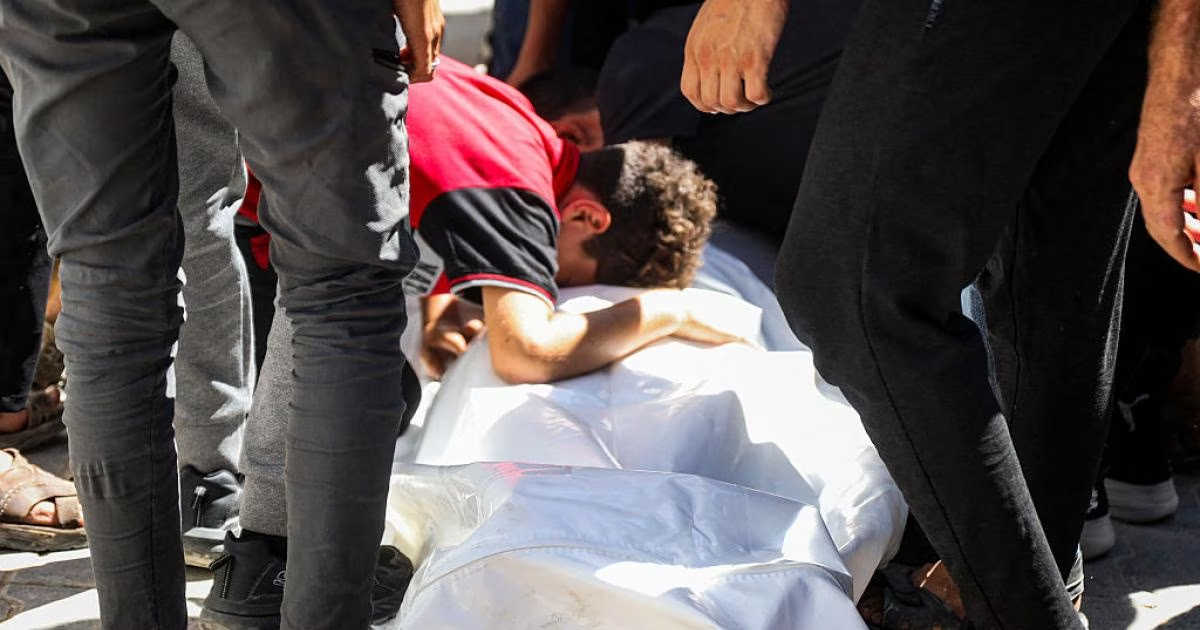
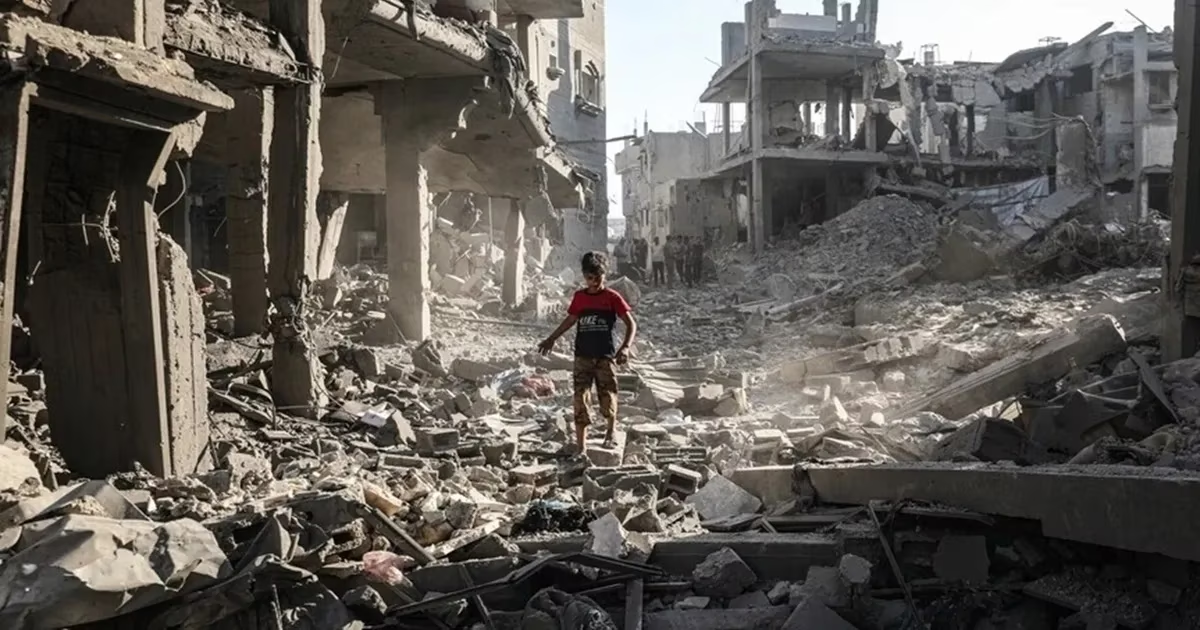
Health authorities in the Gaza Strip announced that the number of Palestinian martyrs has exceeded one thousand since the ceasefire agreement came into effect in October 2025. These shocking figures come amidst ongoing Israeli military operations that have not ceased despite international efforts to revive the stalled negotiation process.

On the ground, medical sources reported the martyrdom of three Palestinian citizens following an Israeli airstrike that targeted a civilian vehicle on Omar Al-Mukhtar Street in the heart of Gaza City. The occupation army claimed that the attack targeted elements belonging to the Hamas movement, as part of what it described as operations to thwart imminent threats against its forces.

In a separate incident, paramedics confirmed the martyrdom of another Palestinian by the bullets of occupation forces stationed near the central areas of the Strip in recent hours. The Israeli side has not issued any immediate comment on the circumstances of the shooting, which raises the death toll recorded by the Ministry of Health to 1008 martyrs since the start of the truce.

On the other hand, the Israeli army acknowledged the killing of four of its soldiers during the same period, confirming the continuation of its military activity within the Strip. The Israeli leadership claims that these operations are necessary to prevent any attacks that Palestinian factions might carry out, despite increasing international criticism of the continued bloodshed.

Diplomatically, informed sources revealed new moves led by Nikolay Mladenov, the envoy of the Peace Council formed by Trump, to break the current political stalemate. Mladenov held intensive talks in the Egyptian capital, Cairo, with mediators from Egypt, Qatar, and Turkey, to discuss Palestinian responses to the American 'roadmap'.

According to the sources, the international envoy handed the Palestinian factions a modified version of the political document aimed at addressing the reservations expressed by the Palestinian side. However, Mladenov stressed that the new amendments maintain the essential 'red lines' set by the American administration within its proposed plan.

For its part, the Hamas movement, through one of its officials, confirmed that it had received the modified document and began carefully studying its provisions to ascertain the extent of its responsiveness to national demands. The movement did not provide any additional details about its final position, pending the completion of internal consultations with the rest of the Palestinian forces and factions.

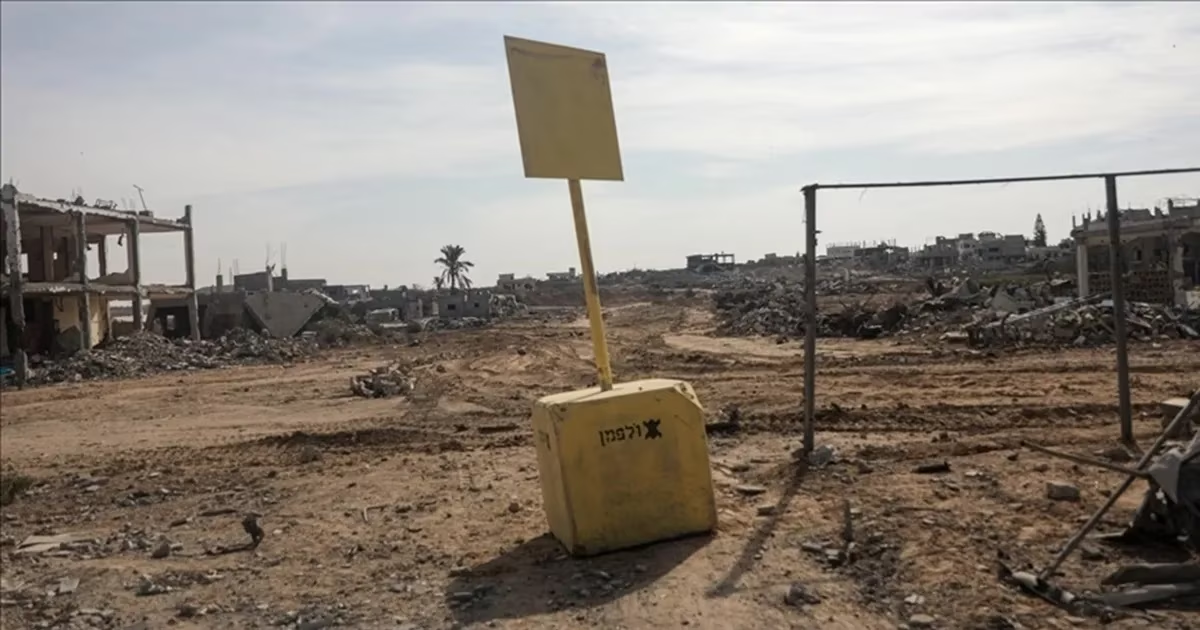
Regarding the field situation, occupation forces continue to impose their military control over more than 60% of the Gaza Strip's area. Systematic destruction operations and repeated evacuation orders have changed the features of vast areas, further complicating the already deteriorating humanitarian situation in the besieged Strip.

Approximately two million Palestinians face harsh living conditions in a narrow coastal strip, most of whom reside in temporary tents or semi-destroyed buildings after repeated displacement. The humanitarian crisis is exacerbated by ongoing restrictions on the movement of individuals and goods, placing the international community before its responsibilities towards civilians.

The total number of Palestinian martyrs since the start of the truce brokered by US President Donald Trump last October has risen to 1008 martyrs.

PALESTINE

Fri 19 Jun 2026 11:38 am - Jerusalem Time

Warnings of a complete collapse of the basic services system in the Gaza Strip

The Union of Municipalities of the Gaza Strip issued a strong warning about the service system reaching the brink of complete collapse, as a result of the occupation authorities' continued obstruction of the entry of essential operating materials. Municipal sources explained that the current crisis has gone beyond fuel shortages to reach a critical stage related to the imminent depletion of industrial oils, which are the primary engine for all heavy equipment and machinery that municipalities rely on to provide their daily services to residents.

In press statements, the spokesman for the Gaza Municipality, Husni Muhanna, affirmed that the absence of these oils represents the most serious threat at present, as the cessation of machinery will lead to a complete paralysis in vital sectors. Muhanna pointed out that this cessation will directly lead to an exacerbation of humanitarian suffering and a deterioration of the health situation, given the inability to operate facilities that serve millions of besieged citizens in the Strip.

Immediate risks include the cessation of drinking water wells, which will deprive a large segment of the population of access to potable water, in addition to the breakdown of sewage pumping stations. This breakdown increases the likelihood of wastewater overflowing into crowded streets and residential neighborhoods, which portends an environmental and health disaster that cannot be controlled given the limited capabilities currently available.

Regarding waste management, the Palestinian official revealed the accumulation of nearly 700,000 cubic meters of solid waste in the alleys and streets of Gaza City alone, as a result of the systematic destruction of municipal machinery and equipment by the occupation. He explained that municipalities are now unable to deal with these huge quantities, which has led to the spread of foul odors and an increased risk of outbreaks of epidemics and infectious diseases among displaced persons and residents.

In conclusion of the warning, municipal authorities stressed the need for urgent and immediate international intervention to pressure the occupation to allow the entry of industrial oils and essential materials. They considered that international silence regarding this crisis contributes to accelerating the humanitarian catastrophe, emphasizing that the continued operation of municipalities is the last line of defense for public health and what remains of the elements of life in the Gaza Strip.

The depletion of industrial oils has become the most urgent and serious threat, and the cessation of vital services will mean a doubling of humanitarian suffering and a threat to public health.

ARAB AND WORLD

Fri 19 Jun 2026 11:38 am - Jerusalem Time

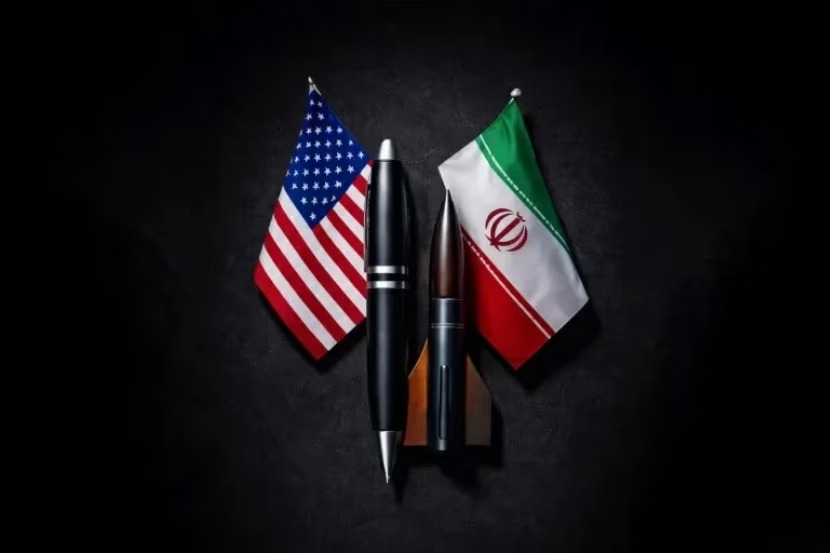
A Comprehensive Comparison of Trump's and Obama's Approaches to the Iranian File: From Nuclear Deals to Development Funds

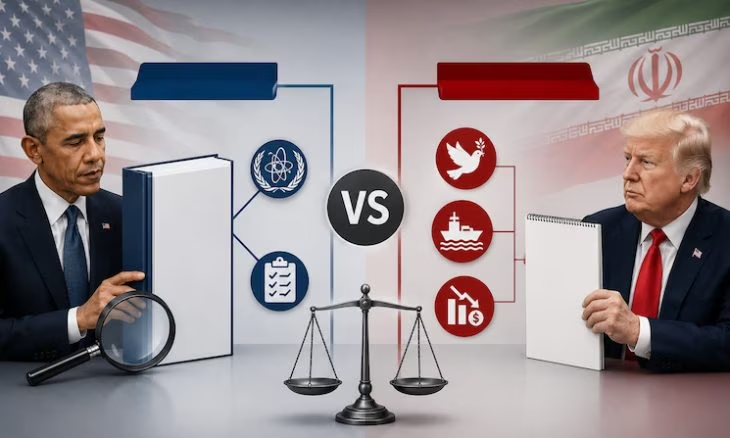
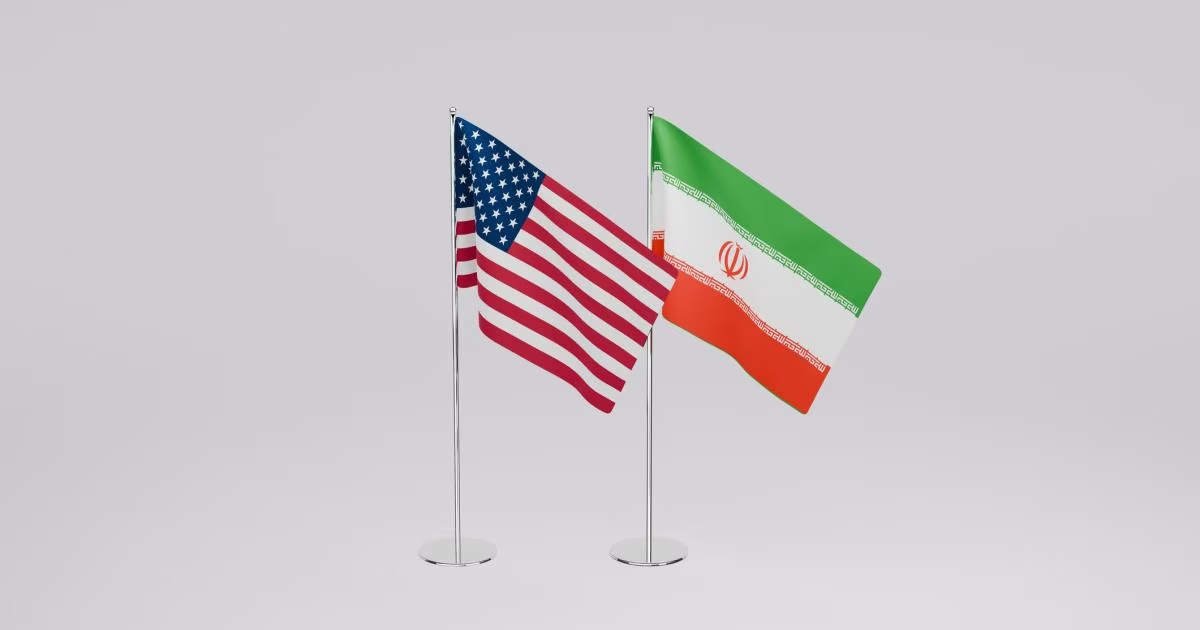
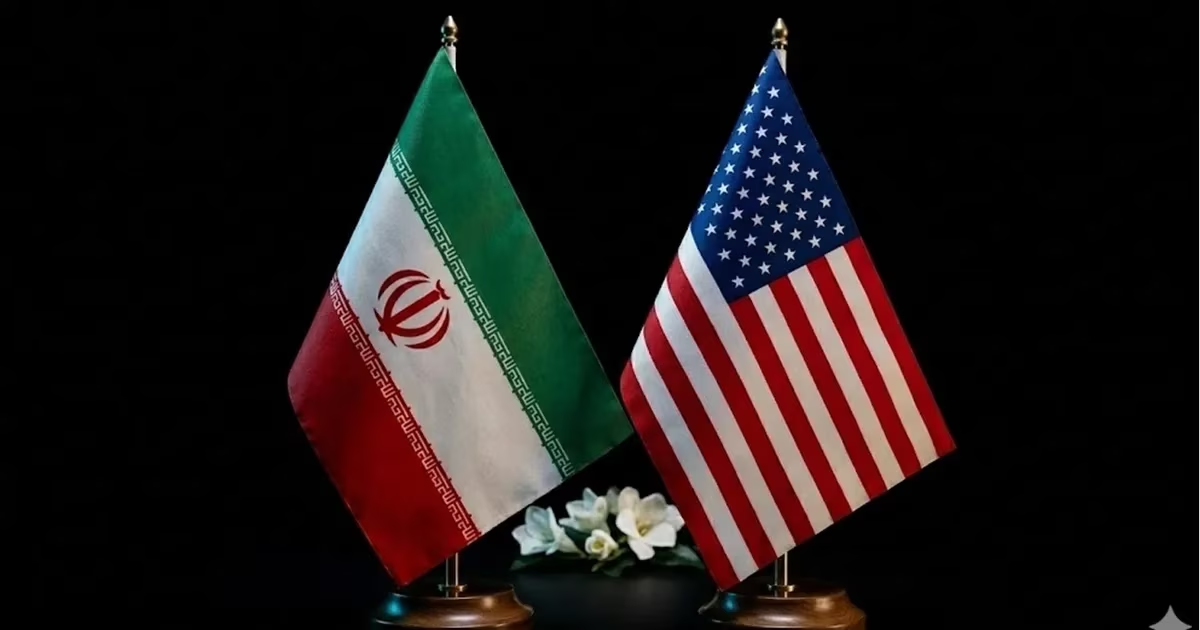
The sharp contrast between the current US administration and former President Barack Obama's approach to managing the conflict with Tehran is evident, with Donald Trump promoting his latest memorandum as an achievement superior to the 2015 agreement. Observers believe that a comparison between the two documents reveals a fundamental difference in negotiating philosophy, as Washington has shifted from multilateral international agreements to direct bilateral understandings.

The memorandum of understanding signed by Trump is considered merely a preliminary framework, not exceeding one and a half pages, and includes 14 key points aimed at opening the door for negotiations for two months. In contrast, the Joint Comprehensive Plan of Action (JCPOA) signed by Obama was a complex technical and legal document exceeding 160 pages, which placed precise temporal and structural restrictions on Iran's nuclear program.

Regarding the nuclear program, Trump claims that Tehran had not previously pledged not to acquire nuclear weapons, information that contradicts the texts of the 2015 agreement, which included explicit commitments in this regard. Trump's current vision relies on a general course of discussion within 60 days, without specifying immediate technical restrictions on uranium enrichment levels or the number of centrifuges.

Reports indicate that the current memorandum hints at Iran's readiness to address its highly enriched uranium stockpile crisis through a 'dilution' mechanism at its nuclear sites. However, this measure remains pending a final agreement, unlike Obama's agreement, which imposed strict and immediate international oversight by the International Atomic Energy Agency.

The economic sanctions file represents the most prominent point of contention between the two approaches, as Trump offered immediate incentives to Tehran by allowing it to resume oil exports before reaching a final agreement. This approach represents a reversal of Obama's policy, which stipulated verification of Iran's implementation of its nuclear commitments before initiating any gradual easing of imposed sanctions.

Trump's plan includes a controversial clause calling for the establishment of an economic development fund for Iran worth up to $300 billion, with the participation of Washington's allies in the Middle East. This proposal has drawn widespread criticism within Republican Party circles, with some considering it a financial concession far exceeding what the Obama administration previously offered.

Looking back at recent history, Trump had strongly criticized Obama's return of $1.7 billion in frozen Iranian assets, describing it as a catastrophic deal. However, current data suggests that the current administration may release amounts many times that figure as part of its efforts to end the military tension in the region.

The current memorandum differs from its predecessor in its comprehensiveness of non-nuclear issues, foremost among them the security of navigation in the Strait of Hormuz, which has been severely affected over the past four months. Obama had deliberately separated the nuclear file from regional issues to ensure the success of negotiations, while Trump sees the necessity of integrating all files into one basket.

Tehran insists in the ongoing negotiations on extracting an administrative and sovereign role in the Strait of Hormuz, a demand that was not on the table before the outbreak of recent military confrontations last February. This demand represents a significant challenge for the American negotiator, as accepting it could lead to a change in the naval balance of power in one of the world's most important energy corridors.

The war launched by the United States and Israel on February 28th left a deep impact on the structure of current negotiations, making the cessation of military operations a top priority. The memorandum of understanding aims to transform this fragile calm into a sustainable settlement, despite the significant obstacles that still stand in the way of reaching a final and comprehensive agreement.

On the diplomatic front, Trump preferred to marginalize major international powers such as Russia, China, and the European Union, focusing on a direct and bilateral communication channel with the Iranian leadership. This path gives Washington greater flexibility in maneuvering, but it weakens the international cover for any agreement that may eventually be reached.

The current memorandum of understanding lacks the strict inspection mechanisms that characterized the 2015 agreement, as the document did not clearly refer to the return of international inspectors to sensitive facilities. Critics believe that this ambiguity may give Tehran an opportunity to maneuver and develop its capabilities away from the eyes of international oversight during the stipulated sixty-day period.

The Trump administration faces internal pressure from hawks who see the proposed economic deals as a lifeline for the economically exhausted Iranian regime. In contrast, the administration is betting that economic openness will necessarily lead to a calming of Iranian military ambitions and ensure the stability of global energy prices affected by the war.

The fundamental question remains about the ability of the parties to transform this brief memorandum into a binding and detailed agreement that meets the aspirations of all concerned parties. As the sixty-day deadline approaches, all eyes are on Washington to see if Trump will actually succeed in concluding the 'better deal' he promised his constituents.

While Obama's agreement focused on restricting nuclear activities with strict standards, Trump's memorandum opens the door to massive financial flows in exchange for a general path to arms control.

ARAB AND WORLD

Fri 19 Jun 2026 11:38 am - Jerusalem Time

UN warnings of 'imminent catastrophe' in Sudan's El Obeid as RSF mobilizes forces

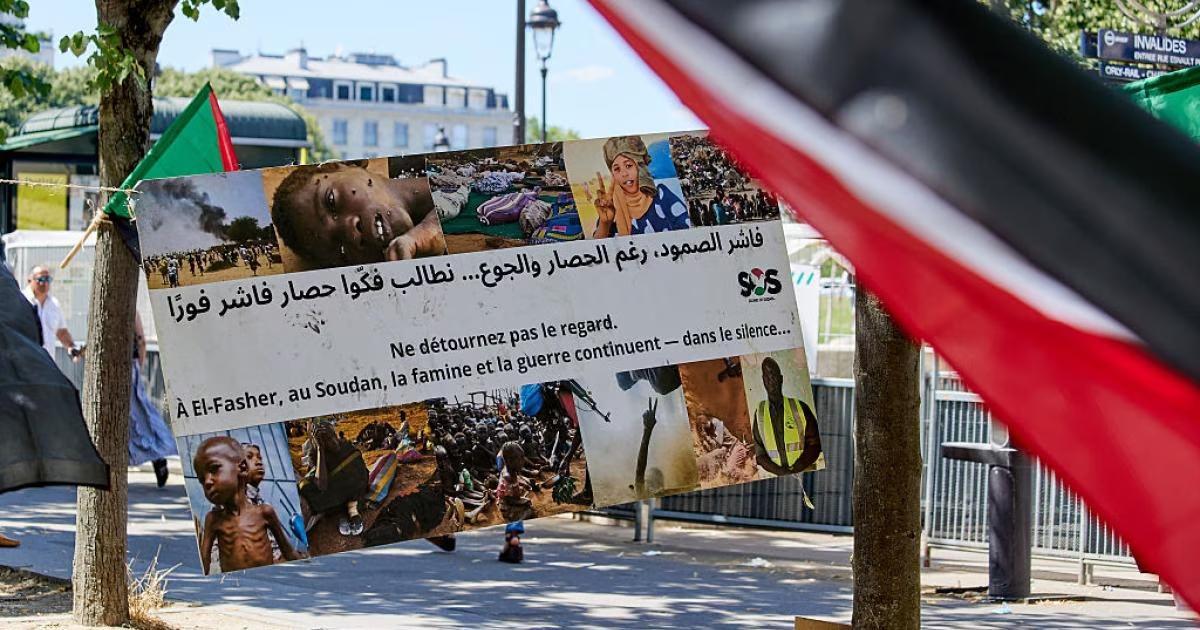
The United Nations issued an urgent appeal on Thursday, demanding that the Rapid Support Forces (RSF) withdraw from their plans to launch a military attack on El Obeid, the strategic capital of North Kordofan state. The international organization warned that any military escalation in this densely populated area would lead to catastrophic consequences, the extent of which cannot be predicted, for unarmed civilians.

UN Secretary-General António Guterres expressed deep concern over field reports indicating the arrival of massive military reinforcements for the RSF around the city. His spokesperson, Stéphane Dujarric, clarified that these movements portend an imminent ground attack that could turn the city into a large-scale battlefield, putting hundreds of thousands of lives at grave risk.

For his part, the High Commissioner for Human Rights, Volker Türk, stressed the need for immediate intervention to stop what he described as 'military madness' before it is too late. Türk noted that the increasing drone strikes and indiscriminate artillery shelling around El Obeid recall the bloody scenarios witnessed in other areas of Sudan in recent months.

El Obeid holds immense geographical and military importance, as it lies on the main road connecting the Darfur region in the west with areas controlled by the Sudanese army in the east. Since the outbreak of the conflict in April 2023, the warring parties have sought to control this vital corridor to enhance their logistical and field influence.

The UN official warned against a repeat of the 'atrocities' documented by international organizations in El Fasher and the Zamzam IDP camp, emphasizing that the world cannot stand by and watch a new tragedy unfold. He added that civilians in Kordofan face an existential threat if the current military escalation is not curbed and humanitarian aid is not allowed to pass unhindered.

Türk described the current situation as a 'stark warning' to the international community of a horrific deterioration in the human rights situation and the overall humanitarian situation. He called on countries with regional and international influence to exert real pressure on the parties to the conflict to cease hostilities and return to the negotiating table to protect what remains of the infrastructure.

In a related context, sources from the United Nations Office for the Coordination of Humanitarian Affairs (OCHA) reported that the situation in El Obeid is highly volatile and rapidly deteriorating. The sources confirmed that the escalation of hostilities has already led to a complete paralysis of relief operations, threatening the lives of thousands who depend on aid to survive.

Local reports indicated that fear of the imminent attack has led residents to close most schools, markets, and shops, and humanitarian warehouses have ceased operations. The United Nations called for the need to secure safe corridors for civilians wishing to leave the city and to ensure that they are not targeted while attempting to save themselves.

Sudan has been living for more than two years under the weight of a devastating conflict that has killed tens of thousands and displaced more than 11 million people inside and outside the country. The United Nations describes this crisis as the worst displacement and hunger catastrophe in the modern world, with no immediate prospect for a comprehensive political solution.

Recent months have witnessed an unprecedented intensification of battles in the Kordofan region and Blue Nile state, especially after the fall of El Fasher to the Rapid Support Forces. The cities of Kordofan, rich in natural and agricultural resources, are a strategic target for both parties, making the conflict over them characterized by excessive violence and widespread destruction.

Previous reports by the Independent Fact-Finding Mission concluded that the siege imposed on Darfur cities bore 'characteristics of genocide.' Human rights experts expressed concern that these practices might spread to El Obeid, where drones are being increasingly used, raising the rate of civilian casualties.

In a parallel diplomatic move, 29 countries at the Human Rights Council in Geneva expressed grave concern about the risks of deliberate killings in Sudan. These countries, including Britain, France, Germany, and Canada, demanded that the Rapid Support Forces immediately and unconditionally cease their attack on El Obeid.

The joint statement by the countries affirmed that approximately 500,000 civilians, including more than 100,000 displaced persons who sought refuge in the city fleeing previous battles, now face the risk of falling victim to heinous crimes. The statement stressed that the international community will not tolerate any grave violations of international humanitarian law in this region.

UN sources concluded by warning that the international community's failure to take coordinated action could lead to a complete collapse of the social system in North Kordofan state. Hope remains for the warring parties to respond to international appeals to spare the city and its inhabitants the horrors of a devastating street war.

We cannot allow a repeat of the atrocities that were avoidable, and which we documented in El Fasher and Zamzam camp last year.

PALESTINE

Fri 19 Jun 2026 11:38 am - Jerusalem Time

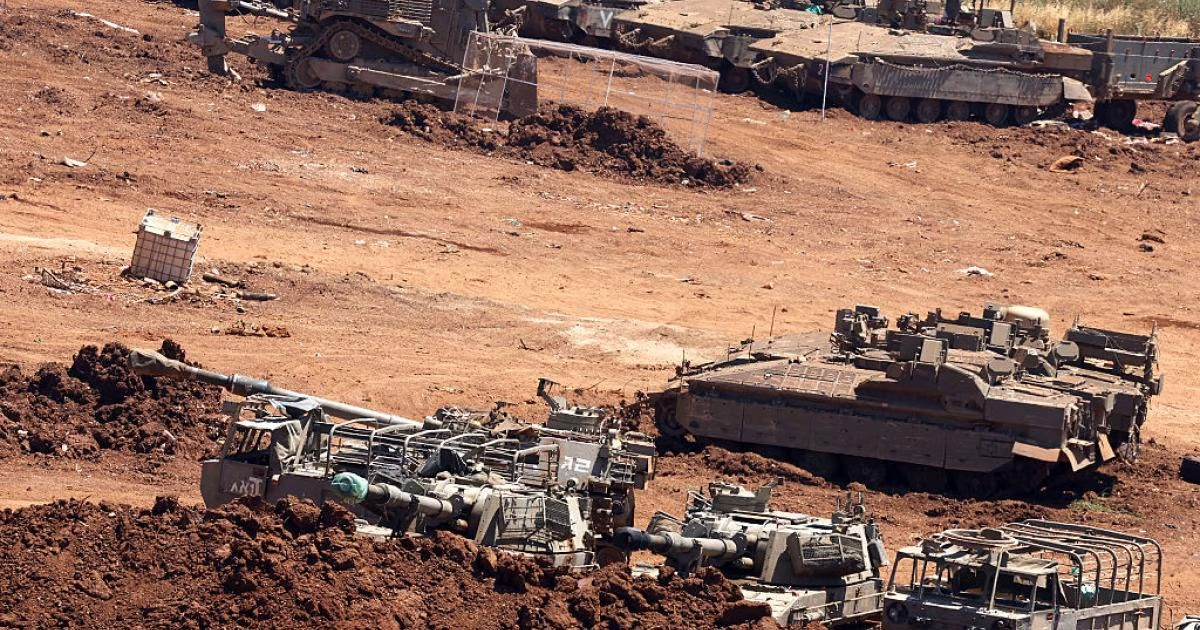
Bloody escalation in southern Lebanon: 3 Israeli tanks destroyed and massacres in the Nabatieh district

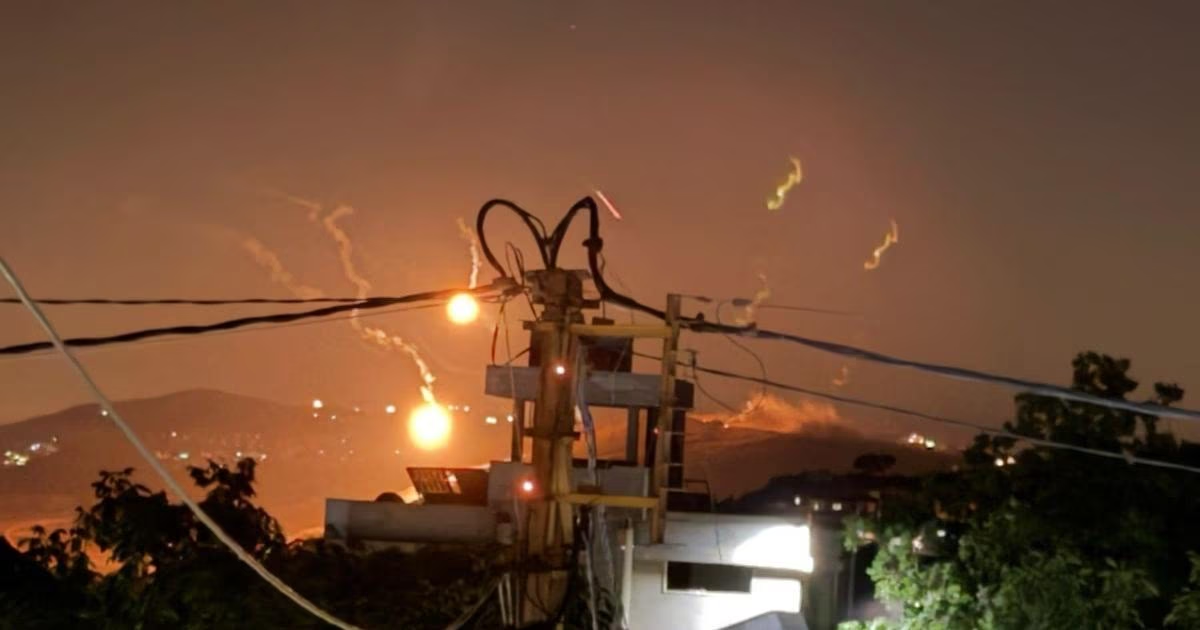
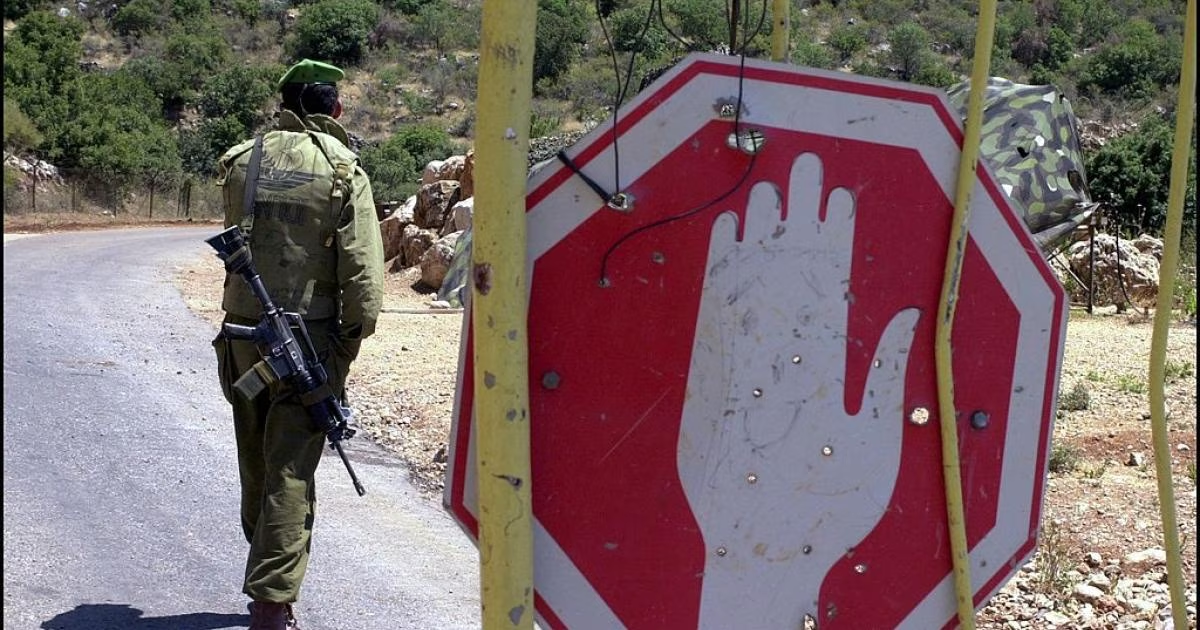
Southern Lebanon experienced one of its most violent nights on the ground since the start of the aggression, as the pace of military operations escalated significantly despite recent political understandings. Field sources reported that confrontations focused around the city of Nabatieh, amidst repeated Israeli attempts to advance towards strategic points under heavy air and artillery cover.

Hezbollah announced in an official statement that its fighters successfully destroyed three 'Merkava' tanks using guided missiles, confirming that they were completely engulfed in flames. This targeting came after precise monitoring of an Israeli armored force and an infantry force that were attempting to infiltrate towards the northern heights of the Ali Al-Taher area.

The 'Ali Al-Taher' height is considered a site of extreme strategic importance, as it directly overlooks the city of Nabatieh and its surrounding towns, making it a constant target for infiltration attempts. Reports confirmed that the resistance managed to thwart the infiltration attempt and force the attacking force to retreat after suffering equipment losses.

In parallel with the ground operations, the occupation army committed a series of massacres at dawn today, Friday, targeting inhabited homes in the towns of Al-Sharqiyah, Harouf, and Kafrsir. These violent air raids led to a large number of martyrs and wounded, while rescue teams are still searching for missing persons under the rubble.

In details of the bloody toll, medical sources confirmed the martyrdom of eight citizens in the Harouf and Kfarjouz areas, in addition to four martyrs in the Al-Ash'amiyah area located between Al-Sharqiyah and Al-Duwair. The town of Kafrsir also recorded the death of three more martyrs due to the concentrated shelling that targeted residential neighborhoods.

The attacks did not stop at air raids, but also included direct targeting of civilians on the roads, as an Israeli drone bombed a motorcycle on Al-Abbasiyah road. This attack resulted in one martyr and one injured, while warplanes continued their intensive flights over the Zahrani and Tyre areas.

These field developments come amidst conflicting news about the effectiveness of the agreement recently signed between Washington and Tehran to stop the war. Although the first clause of the agreement stipulates the immediate cessation of military operations on all fronts, including Lebanon, the reality on the ground indicates the exact opposite.

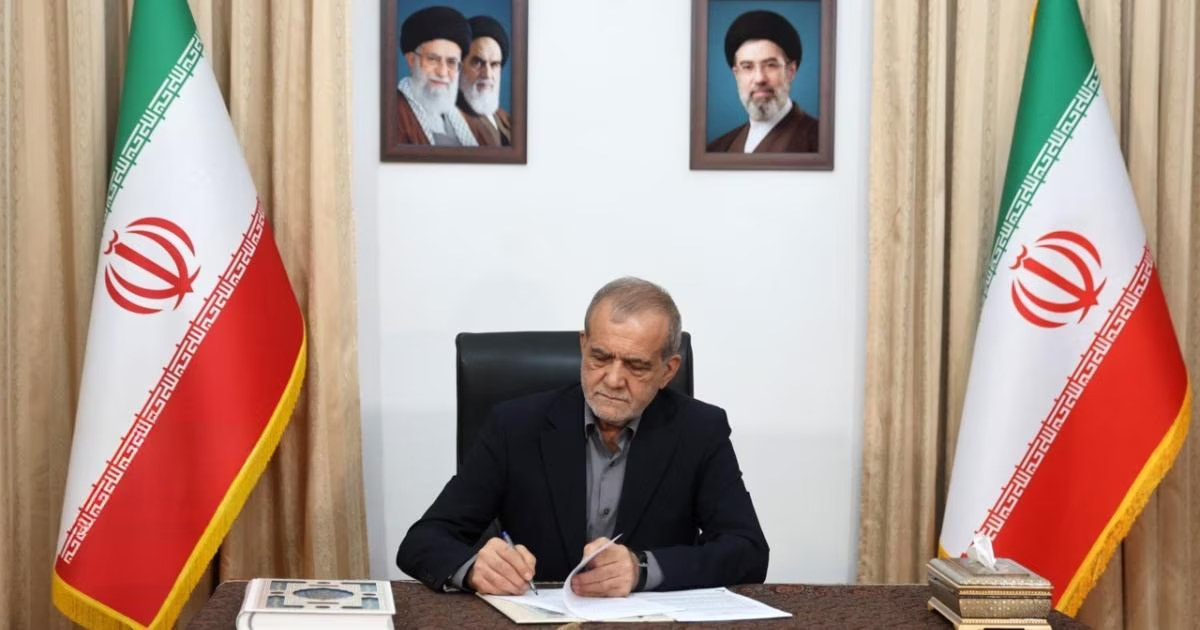
For his part, Iranian President Masoud Pezeshkian published the text of the 14-point agreement, in which the parties pledge to guarantee the safety and sovereignty of Lebanese territories. However, this agreement faces fierce opposition within the Israeli government, especially from far-right ministers who reject any de-escalation.

Observers believe that the recent Israeli escalation aims to impose a new reality on the ground before entering into any final international commitments. Voices within the Israeli cabinet insist on continuing military operations in southern Lebanon, while adhering to the direct occupation of some border areas to ensure what they describe as security.

_The intensity of Israeli raids in the days preceding the agreement reached between 60 to 80 raids daily, including the destruction of entire residential blocks and systematic bombing operations. These figures reflect the enormous scale of destruction that has afflicted the infrastructure and Lebanese border villages since the start of the widespread aggression.

According to the latest updates from the Lebanese Ministry of Health, the toll of the ongoing aggression since early March has risen to 3912 martyrs. The number of injured has also exceeded 11,000, amidst a suffocating displacement crisis that has displaced more than one million Lebanese away from their destroyed villages and cities.

Resistance fighters targeted 3 Merkava tanks with guided missiles, destroying them and setting them on fire during a failed infiltration attempt.

PALESTINE

Fri 19 Jun 2026 11:38 am - Jerusalem Time

Vance Rebukes Israeli Ministers: Do Not Attack Your Only Ally, Crises Cannot Be Solved by Killing Alone

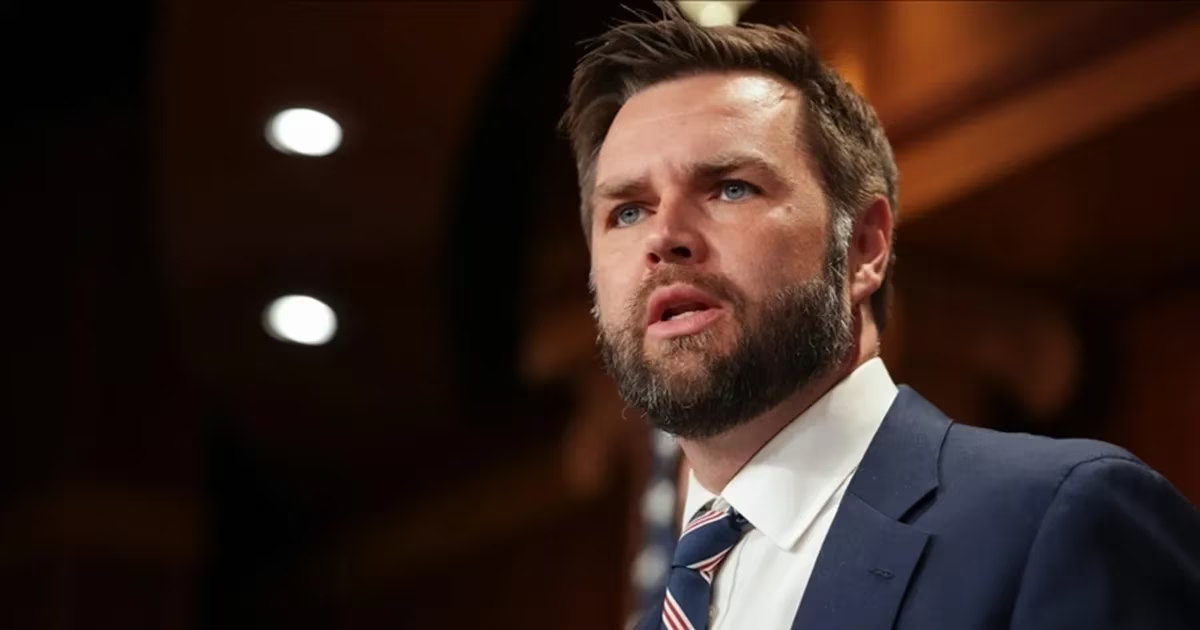
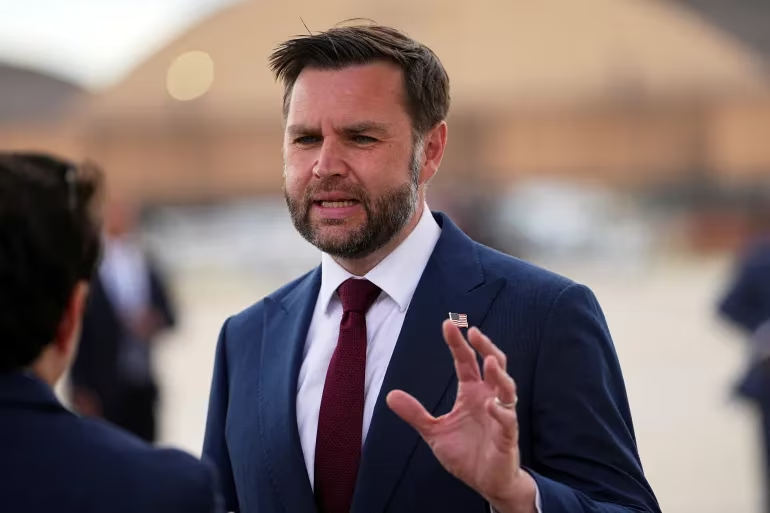
US Vice President J.D. Vance launched a sharp attack on members of the Israeli government who criticized the recently signed memorandum of understanding between Washington and Tehran. Vance clarified during a press conference at the White House that the positions rejecting the agreement reflect a lack of appreciation for the current political reality, emphasizing that President Trump represents the only international leader who shows genuine and tangible sympathy for Israeli interests at this sensitive stage.

Vance directed a direct rebuke to Israeli officials, warning them against attacking their country's only remaining strategic ally on the international stage. He indicated that political wisdom dictates maintaining strong relations with Washington instead of issuing hostile statements against the US administration, which provides the necessary political and security cover for the continued existence of the Hebrew state in facing regional challenges.

In the context of his discussion of military support, the US Vice President revealed figures reflecting the extent of Israeli reliance on the United States, explaining that two-thirds of the defense systems and measures protecting Israel are the product of purely American industry and funding. Vance called on those he described as 'unaware' within Israel to wake up and realize that their country's problem is not with the US administration, but in understanding the defensive and financial reality that links the two parties.

Vance also specifically mentioned the occupation's security and finance ministers, Itamar Ben-Gvir and Bezalel Smotrich, criticizing their strong opposition to the agreement that ended the war that erupted last February. He stated in remarks to international media that Netanyahu seems more aware of the details and importance of the agreement, while other ministers rush towards verbal escalation without possessing realistic alternatives or viable political solutions on the ground.

The US Vice President concluded his criticisms by posing a rhetorical question to the extremist ministers about their alternative proposals for ensuring national security away from diplomacy. Vance clearly affirmed that not all security and political dilemmas can be addressed by resorting to force and killing alone, noting that international agreements represent a strategic necessity that cannot be bypassed by mere internal political slogans.

If I were a member of the Israeli government, I would not attack my only strong ally left in the entire world.

LATEST NEWS

Fri 19 Jun 2026 11:37 am - Jerusalem Time

Trump: No limits to my power after war with Iran, agreement saved us from global depression

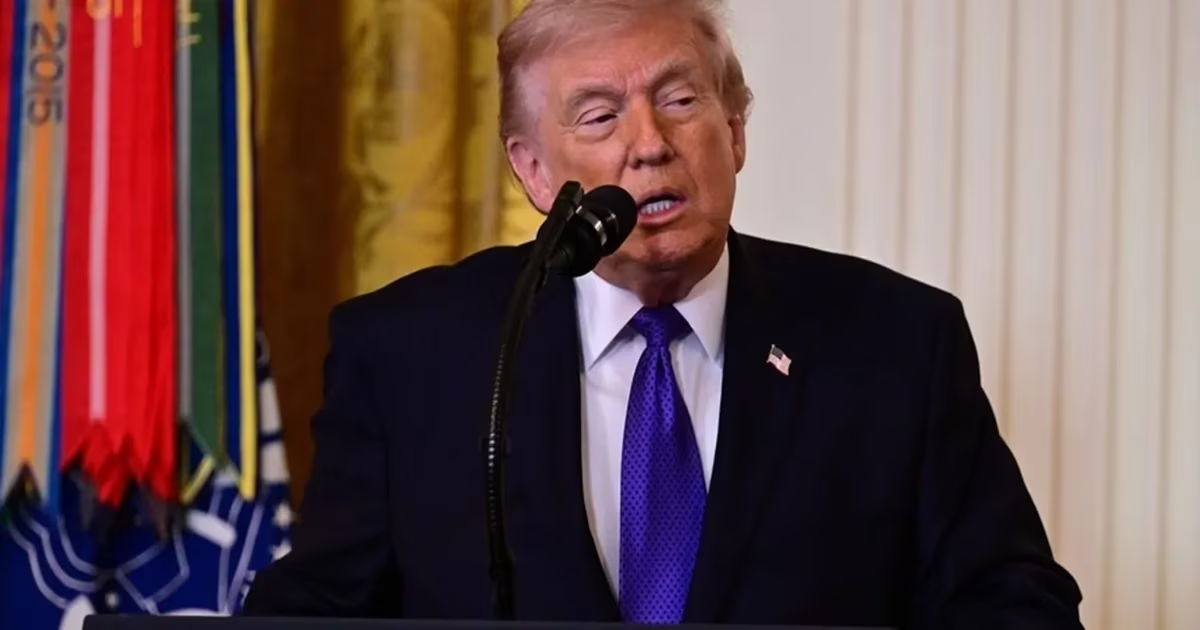
US President Donald Trump sparked a wave of political controversy following statements he made to 'The Axios Show,' in which he asserted that he sees no limits to his executive power following the end of the military confrontation with Iran. These comments came after a memorandum of understanding was reached that ended the fighting, even though it did not achieve the condition of 'unconditional surrender' that Trump had set as a strategic goal at the beginning of the armed conflict.

During his interview with journalist Mark Caputo, Trump stressed that the recent military experience did not weaken his ability to exert American influence; rather, he considered it a shining proof of Washington's military might. He added confidently that despite his awareness of theoretical legal or political limits, he practically feels there is no ceiling to what he can achieve anymore.

Regarding the retreat from high demands, the US President admitted that he agreed to a political settlement instead of a complete military resolution to avoid an economic catastrophe that could sweep the world. He explained that continued escalation would inevitably lead to a state of great global depression, which prompted him to make the decision to de-escalate in crucial moments.

Trump claimed that the US armed forces were able to completely defeat the Iranian side on the field before signing the recent agreement. He described the memorandum of understanding as essentially amounting to surrender, noting that the naval blockade imposed by Washington was so suffocating that it prevented the passage of any supplies or ships through vital waterways.

Trump sharply criticized hardline voices within and outside the US administration who called for continued military operations until the end. He believed that pursuing the option of bombing for additional weeks would have caused a permanent closure of the Strait of Hormuz, which would mean a halt to global oil flows and an irreparable collapse of international energy markets.

Informed sources revealed that the US President expressed deep concern in closed rooms about the depletion of global oil reserves during the war. This concern about a price shock in the energy sector was the primary driver behind the White House's acceptance of an agreement that observers see as far less than the ambitions announced by the administration in the early weeks of the war.

Political analysts believe that Trump's statements aim to reframe the domestic political scene by portraying diplomatic concessions as economic wisdom and military strength. Despite his insistence that what happened reflects the expansion of his influence, the limited understandings remain a hot topic of discussion regarding the extent to which the American strategy succeeded in achieving its ultimate goals.

This interview reflects the challenges Washington faced in balancing military pressure with the stability of the global economy linked to supply chains in the Middle East. Trump's talk of 'power without limits' remains an indicator of the nature of the next phase in his handling of thorny international issues after closing the file of direct confrontation with Tehran.

I know there are limits, but for me, there are no limits to my power after what we achieved militarily.

OPINIONS

Fri 19 Jun 2026 11:37 am - Jerusalem Time

G7 Summits: Entrenching Global Economic Malady and Demanding Sacrifices from Peoples

Ramallah - “Alquds ” dot com

Ramallah - “Alquds ” dot com

Opinion Writer

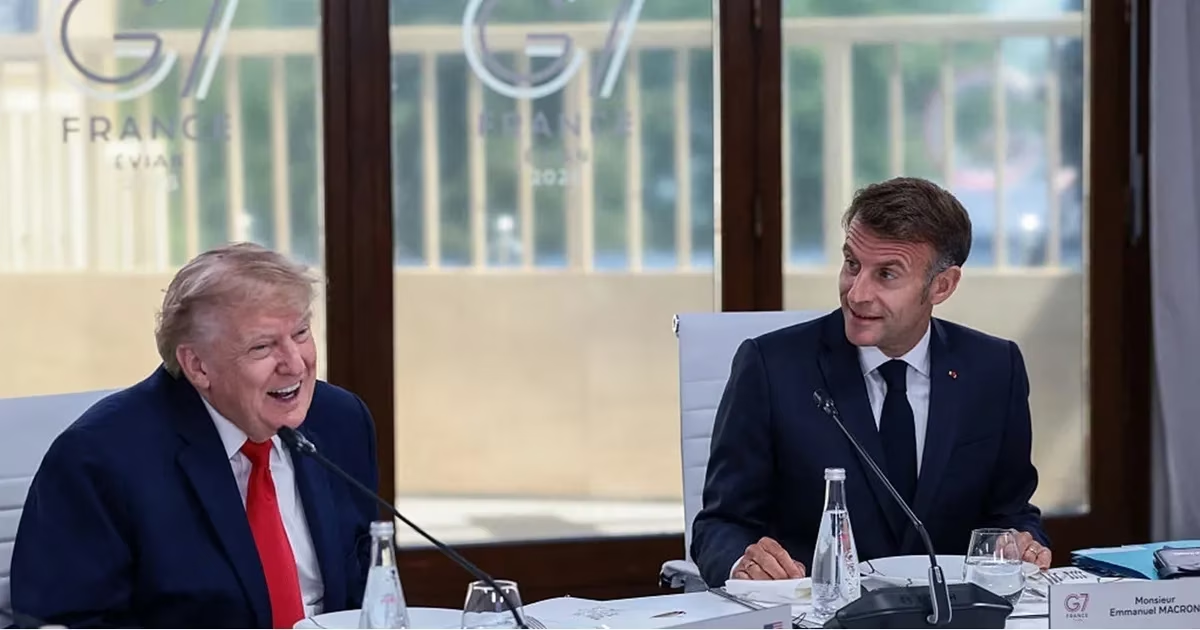
The behind-the-scenes of G7 meetings are filled with details that may seem marginal or amusing on the surface, but they conceal a bitter reality witnessed by the world outside the borders of the seven major countries. While leaders are preoccupied with protocols of flattery towards the White House occupant or following global sporting events, economic policies are being drawn up that deepen the gap between the North and the South and entrench the dominance of traditional powers over the destinies of poor nations.

Data from the international organization 'Oxfam' revealed shocking figures reflecting the priorities of these powers, with reductions in development aid budgets for low-income countries reaching approximately $49 billion between 2024 and 2025. The irony is that this enormous sum is equivalent to the wealth accumulated by the group's billionaires in just nine days, revealing a structural imbalance in global wealth distribution.

The ethical gap in the group's policies is evident when comparing military spending with humanitarian aid, as development budgets for 2025 did not exceed 0.75% of the group's total military spending. This trend reflects a clear desire to strengthen war arsenals at the expense of combating hunger and poverty in the most needy regions around the world.

In the energy sector, oil giants within the group's countries benefited from international crises and wars, achieving astronomical profits averaging $400 million per day. These profits did not come from nothing; rather, they were reaped from the wealth of nations and from the pockets of taxpayers who suffer from rising fuel prices at distribution stations within the group's own communities.

The damage did not stop at the energy sector but extended to global food security, with basic commodity prices rising by 3 to 4 times within a few months. These price jumps, driven by monopoly policies and wars, pushed more than 32 million people to the brink of extreme poverty, threatening global social stability.

Some European powers, led by France, try to purify the summit agendas of issues that might provoke the ire of the American administration, fearing sharp diplomatic reactions. Nevertheless, American nightmares continue to haunt European leaders, starting from tariffs and policies towards Ukraine, to continuous pressure to increase financial contributions to the Atlantic Alliance.

The Chinese specter emerges as the biggest existential challenge facing the G7, as the Asian giant no longer competes only in traditional markets but also offers an independent economic model. Unlike Russia, whose membership was previously frozen, China has the world's second-largest economy, and it moves freely in historical spheres of influence for the group, especially in the African continent.

When deliberations concern thorny issues such as war crimes in the Gaza Strip or violations in the West Bank and Lebanon, the group resorts to using wooden language characterized by ambiguity and diplomatic stammering. This evasion of moral and political responsibility makes the summit statements mere empty slogans that do not translate into real pressure to stop conflicts or hold transgressors accountable.

Crucial statistics indicate a decline in the group's actual influence, as its share of global GDP decreased from 60.5% in 2018 to about 44.1% currently. This decline is accompanied by a decrease in demographic weight, raising major questions about the group's legitimacy in continuing to represent the world's economy and make its fateful decisions.

Ultimately, G7 summits remain true to their historical approach of prioritizing the interests of the powerful at the expense of the rest of the world's peoples, who are forced to pay exorbitant prices. The international economy remains ailing due to these policies that transform the resources of developing countries into mere raw material mines and consumer markets, without offering real solutions to the structural crises plaguing the world.

The international economy is ailing from head to toe because of the group's own countries, which only want the victim to remain captive to offering more sacrifices.

OPINIONS

Fri 19 Jun 2026 11:36 am - Jerusalem Time

Washington and Tehran Agreement Reveals Failure of US-Israeli War to Change Regional Balances

Washington - Said Arikat - 19/6/2026

News Analysis

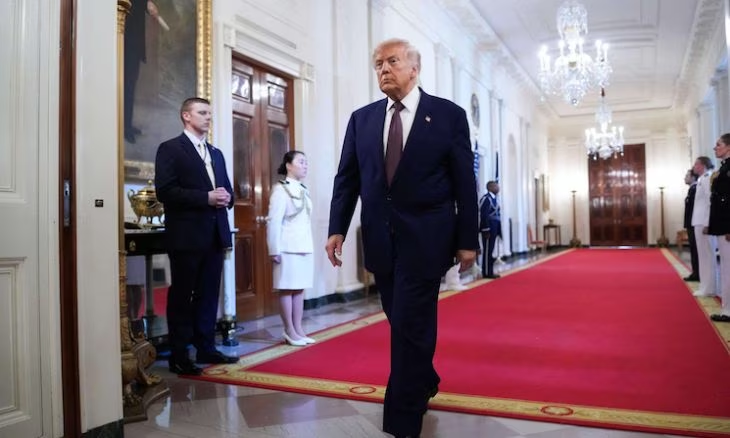
In a scene with striking political and historical implications, US President Donald Trump, on Wednesday, signed a memorandum of understanding with Iran at the Palace of Versailles in France to end hostilities between the two countries. For many observers, this step seemed an implicit acknowledgment of the failure of the US-Israeli war to achieve its stated goals or to bring about the strategic transformations that Washington and Tel Aviv sought at the beginning of the confrontation.

The signing took place at the Palace of Versailles, which more than a century ago witnessed the signing of the peace treaty that ended World War I, in a symbolic choice reflecting the parties' desire to give the agreement a historical character. Footage showed Trump signing the document in the presence of French President Emmanuel Macron and US Secretary of State Marco Rubio. After the signing, the US President announced that oil prices were falling and financial markets were making gains, considering this evidence of his policy's success.

However, the official celebration of the agreement did not obscure the growing wave of criticism from experts and observers who believed that the war ended with results contradicting the objectives raised at its outset. The US administration had presented the confrontation as a means to reshape the Middle East, reduce Iran's regional influence, and force it to make fundamental concessions. However, the new agreement indicates Washington's return to the negotiating table without clearly achieving those goals.

According to available data, representatives from the United States and Iran had electronically signed the memorandum of understanding before the official signing ceremony, initiating a new sixty-day negotiation phase, which is supposed to discuss the future of Iran's nuclear program, regional security issues, and bilateral relations between the two countries.

Critics of the war point out that its actual results were far from the expectations that accompanied its beginning. Iran did not experience political or military collapse, nor did military operations succeed in dismantling its regional alliance network or undermining its ability to influence regional issues. On the contrary, Tehran managed to withstand months of fighting before returning to negotiations while still a key player in the Middle East equations.

In contrast, the war left widespread economic repercussions. Global energy markets witnessed severe disruptions, and transportation, insurance, and shipping costs increased. International supply chains were also affected, and economic growth forecasts in several major economies declined. Despite the US administration's talk of market improvement after the agreement, the effects of the crisis are still evident in the global economy.

As for the human cost, it is one of the most controversial aspects of the war. Estimates indicate thousands of dead and wounded in Iran, in addition to widespread damage to civilian infrastructure, including schools, water networks, and service facilities. The repercussions of the war also extended to other countries in the region, especially Lebanon, where Israeli military operations led to thousands of casualties and the displacement of large numbers of people.

One of the most prominent political outcomes of the war, as observers see it, is a decline in the Israeli role during the final stage of negotiations. The Israeli government, which strongly pushed for confrontation with Iran, ultimately found itself facing an agreement in which it was not a major party in its drafting, while the goal of weakening Iran or eliminating the influence of its regional allies was not achieved.

Despite the importance of the memorandum of understanding, the most sensitive issue remains unresolved: Iran's nuclear file. The document sets a general framework for future negotiations, but it does not include crucial details regarding the future of enrichment, monitoring mechanisms, or mutual guarantees. For this reason, experts believe that the path towards a comprehensive settlement is still long and complex.

Some analysts argue that the main paradox is that the war ended by bringing the parties back to the diplomatic track that existed before its outbreak. After months of military confrontation, mutual escalation, and enormous human and economic losses, Washington and Tehran returned to negotiate the same issues that were on the table before the war, which raises fundamental questions about the utility of a conflict that could have been avoided through a political path from the outset.

Failure of the Regime Change Project

The most significant implications of the agreement lie in the collapse of the goal that was raised from the early days of the war: changing the Iranian regime. US President Donald Trump spoke more than once about the possibility of bringing about radical political change in Tehran, adopting a vision long promoted by Israeli Prime Minister Benjamin Netanyahu. However, this goal clashed with the realities of history, geography, and politics, as many of Trump's senior advisors and national security experts warned that overthrowing the Iranian regime by force could lead to widespread regional chaos and the collapse of state institutions. After months of war and destruction, the entire project ended in direct negotiations with the very regime that was supposed to be overthrown, making the war evidence of the failure of the theory of regime change by military force.

Netanyahu Convinced Washington of a War Without Horizon

The results of the war reveal the extent of Netanyahu's influence in pushing the US administration towards a military option that did not enjoy consensus within the American establishment. The Israeli argument was based on the premise that military strikes would lead to the collapse of the Iranian regime or an internal uprising that would overthrow it, a premise not based on factual evidence as much as it relied on political bets and ideological wishes. Numerous reports indicated reservations within American security and military circles regarding this approach, but Trump ultimately adopted the Israeli vision. Today, after reaching an agreement with Tehran, that theory appears closer to a political illusion than a well-thought-out strategy, while the region and the world bear an enormous human and economic cost as a result of this failed gamble.

Return to Diplomacy After an Unnecessary War

The great irony is that Washington ultimately returned to the point that many diplomats and experts advocated before the outbreak of the war. Instead of overthrowing the Iranian regime or forcing its surrender, the US administration found itself negotiating with the Iranian leadership on the same issues that were on the table before the confrontation. This reinforces the impression that the war was not a strategic necessity as much as it was a response to a vision adopted by Netanyahu and convinced Trump of, despite the reservations expressed by a number of his senior advisors. From this perspective, the agreement may be seen as a belated acknowledgment that diplomacy was the most rational option from the beginning, and that the war only delayed the settlement and increased its human, economic, and political cost for all parties.

OPINIONS

Fri 19 Jun 2026 11:35 am - Jerusalem Time

Paris Conference: Funded Diplomacy and Illusory Representation... Are Civil Society Organizations Becoming Unaccountable and Un-elected Parties?

When the French Ministry of Foreign Affairs hosted a conference in Paris that brought together dozens of Palestinians and Israelis under the title of supporting peace and the two-state solution, the picture initially appeared positive and encouraging. France, like other friendly nations to the Palestinian people, continues to try to maintain a political horizon in a time of increasing wars, extremism, and despair. Furthermore, involving civil society organizations in the discussion about the future of the region remains a legitimate and desirable goal.

However, behind this facade hides a phenomenon that has been expanding in recent years: the rise of a class of non-governmental organizations, some of which have exceeded the natural role of civil society and have gradually begun to act as an alternative to political parties and national factions.

During long years of division, stagnation, absence of elections, and decline of democratic life, parties and factions have lost a large part of their vitality and their ability to attract new generations. Their diplomatic, intellectual, and media presence on the international stage has also declined, and they have distanced themselves from many discussions revolving around the future of the Palestinian cause.

With the decline of organized political action, non-governmental organizations emerged that succeeded in building extensive relationships with funders, diplomatic missions, and international institutions. It was natural for these institutions to play an important role in the fields of development, human rights, community dialogue, and capacity building. However, some of these institutions decided to transform from their civil role to an undeclared political role, where figures associated with this sector began to speak on behalf of Palestinians in international conferences, participate in drafting political initiatives, sit at informal negotiation tables, and be presented to foreign governments as representatives of Palestinian society.

Over time, a new class of unelected political elites emerged. They enjoyed diplomatic invitations, became addicted to international conferences, and were captivated by ceremonies, protocols, and official meetings. Some of their members traveled between Paris, Brussels, Geneva, and Washington more than they traveled between Nablus, Hebron, Gaza, and the Palestinian camps. And because the international community always looks for ready and familiar partners, the same faces kept reappearing at the same conferences, speaking the same discourse, and receiving the same funding year after year.

Perhaps the most prominent example of this reality is what we recently witnessed: the distribution of approximately 18 million euros through a French government agency to a specific group of institutions working in this sector. The intention here is not to object to supporting civil society or funding initiatives aimed at dialogue and peace, as such support can be legitimate and beneficial if it is subject to standards of transparency, accountability, and justice. But Palestinians have the right to ask: How were the beneficiaries chosen? What criteria were adopted? What is the real impact these institutions have achieved within Palestinian society over the past years? And why do the same names and the same organizations recur in most international funding programs?

More importantly, how can the injection of millions of euros into a sector that claims to represent Palestinian society be justified, while this society itself remains unaware of the details of these funds, how they are spent, and their results? Some institutions working in this field manage annual budgets that exceed those of active political parties and forces, and some of their senior officials receive salaries and allowances that exceed what Palestinian ministers and officials receive. While the Palestinian employee, teacher, and worker struggle to secure their basic needs, a financially comfortable professional class has emerged around part of this sector, whose sustainability is linked more to the continuation of external funding than to measuring its real impact within Palestinian society.

The issue is not only about legitimacy but also about accountability. No one elected these institutions. No one authorized them to speak on behalf of Palestinians. And no organization, no matter how important its contributions, can claim to represent an entire society or replace political parties, movements, and national institutions. Political parties, despite all the criticisms that can be directed at them, remain obligated to their public to justify their positions and decisions. However, part of this new sector has succeeded in combining political influence with a lack of popular accountability. Hence, the necessity of launching a serious national discussion about transparency arises.

If some of these organizations wish to play a direct political role, and if they demand to be seen as partners in shaping public policies and representing Palestinian society, then Palestinians have the right to know more about them... Where does their funding come from? Who are the members of their boards of directors? How are their decisions made? Who determines their political priorities? And what are the mechanisms that make them accountable to the society they claim to represent?

External funding is not an accusation, civil work is not a crime, and association with the international community is not a flaw. But political work without transparency, claiming representation without authorization, and demanding influence over the future of the Palestinian people without being subject to societal oversight are matters that deserve discussion and accountability. However, the Palestinian cause does not need to replace old elites with new elites, nor to replace factions with non-governmental organizations, nor to transfer national decision-making from political institutions to the rooms of funded projects. What Palestine needs today is to revive politics itself.

We need free elections, modern parties, new leadership, accountable institutions, and a strong and independent civil society that plays its natural role in oversight, awareness, and defending rights, rather than becoming an alternative to political life. Democracy is not built by projects, representation is not granted through diplomatic invitations, and legitimacy is not issued by European embassies.

Any civil society organization has the right to defend its ideas and initiatives, but no one has the right to demand a political and representative role without first accepting the rules of transparency, accountability, and popular oversight to which democratic political work is subject. Palestinian democracy cannot be built by replacing parties with non-governmental organizations, just as a state cannot be built by replacing citizens with funders.

Politics is made by the people's representatives, not by project owners. Legitimacy is granted by voters, not by donors. And the future of Palestine must be decided by Palestinians through their elected institutions, not through funding networks and international conferences, no matter how good the intentions of those in charge.

PALESTINE

Fri 19 Jun 2026 11:35 am - Jerusalem Time

Settlers burn two mosques in Ramallah under the protection of occupation forces

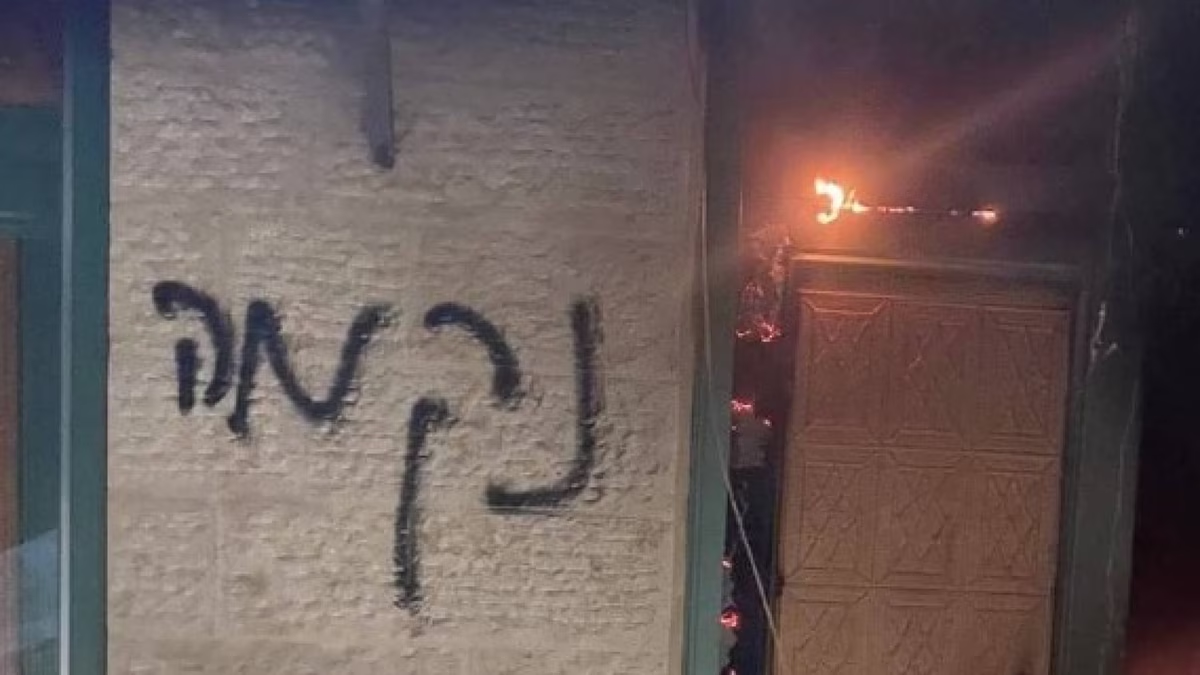
Groups of extremist settlers launched a destructive attack targeting places of worship in the Ramallah governorate, central occupied West Bank, early Wednesday morning. Local sources reported that settlers infiltrated the towns of Jaljulia and Mazari al-Nubani, where they set fire to two mosques and spray-painted racist and incitement slogans on their walls, in a move that reflects the escalating pace of settlement terrorism against Palestinian holy sites.

In the town of Jaljulia, residents rose up to confront the settlers who attempted to burn the 'Grand Mosque,' leading to clashes during which occupation forces intervened to secure the withdrawal of the attackers. The army forces heavily fired toxic and tear gas canisters at citizens, providing security cover for the settlers and preventing Palestinians from protecting their mosque. This was repeated in the town of Mazari al-Nubani, where the 'Al-Farouq' mosque suffered extensive material damage to its contents and basic facilities.

These attacks come amidst international and official reports warning of an explosion of the situation, as the United Nations Office for the Coordination of Humanitarian Affairs (OCHA) documented more than a thousand attacks carried out by settlers since the beginning of this year. These systematic attacks have led to the displacement of more than 2,200 Palestinians from their communities, amid international silence and field complicity by the occupation army, which provides protection to settlers during the commission of their crimes.

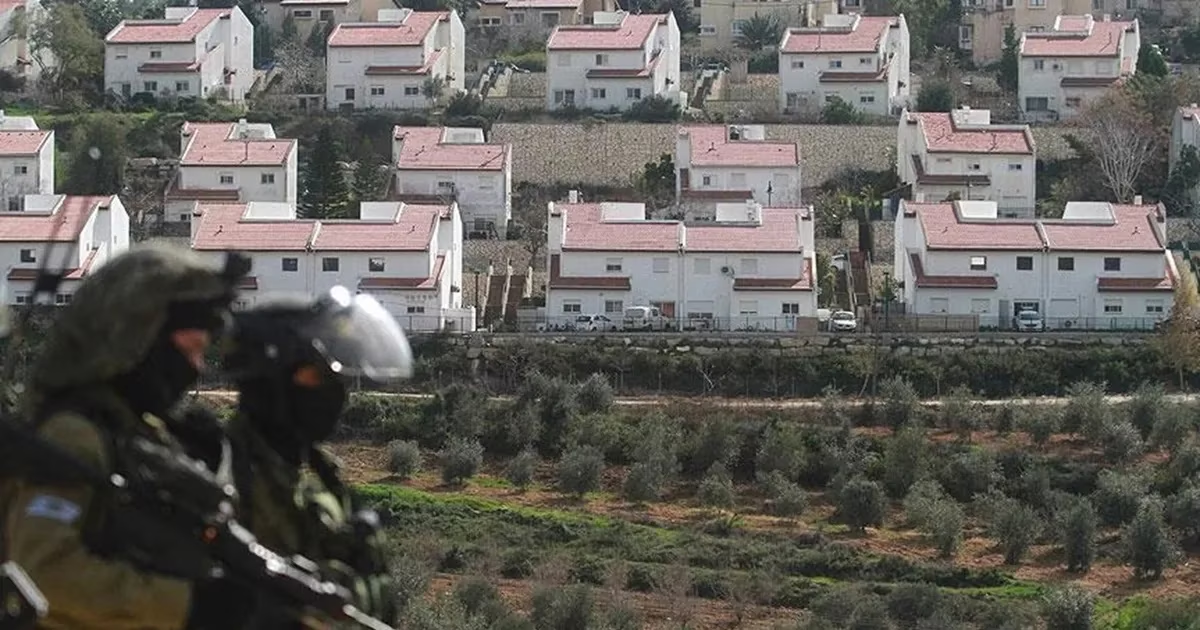
For its part, the Wall and Settlement Resistance Commission revealed shocking figures indicating that the occupation army and settlers carried out more than 1,600 attacks in just one month in various areas of the West Bank. Approximately 750,000 settlers currently reside in the West Bank, distributed among 141 settlements and 224 outposts. These outposts serve as launching pads for daily attacks targeting Palestinian property, holy sites, and lives.

The residents of Jaljulia confronted the settlers during their attempt to burn the Grand Mosque, which prompted the occupation forces to storm the area and provide protection for the attackers.

ARAB AND WORLD

Fri 19 Jun 2026 11:35 am - Jerusalem Time

US-Iranian Negotiations in Switzerland Stalled, JD Vance's Visit Canceled

Official sources at the Swiss Ministry of Foreign Affairs reported the cancellation of the round of talks that was scheduled to begin in the Bürgenstock mountain resort between the United States and Iran. This step reflects a sudden setback in the implementation of the comprehensive agreement that ended the military confrontation between the two powers, raising questions about the resilience of recent understandings.

The Swiss announcement followed confirmations from the White House stating that US Vice President JD Vance had canceled his scheduled visit to Switzerland. Vance was supposed to meet with Iranian negotiators to oversee the start of technical discussions related to the implementation of the fourteen agreed-upon articles of the agreement between the two sides.

A White House spokesperson attributed this setback to what he described as logistical complexities, noting that the US delegation was preparing to depart as soon as final arrangements were completed. The spokesperson explained that the nature of these negotiations is always unpredictable, which made organizational aspects an obstacle to completing the meeting on its scheduled date.

For its part, Tehran adopted a reserved stance towards official ceremonies, with the Iranian Ministry of Foreign Affairs considering a signing ceremony in Geneva unnecessary. Tehran based its position on the fact that the presidents of the two countries had already signed the agreement document last Wednesday, making the focus on procedural steps more important than protocol displays.

In a related context, media sources quoted Iranian negotiators expressing their desire to seek practical and tangible indications of Washington's commitment to its pledges before engaging in any new rounds of negotiations. Although Tehran expressed its readiness for technical discussions after extending the ceasefire for sixty days, mutual trust remains the biggest challenge for both parties.

On the ground, these diplomatic developments coincided with the continuation of Israeli military operations in southern Lebanon, which puts additional pressure on the strength of regional understandings. Reports indicated that Iran tried to impose its own interpretations of the clauses related to the Lebanese situation, which was met with reservations from other international parties involved in monitoring the agreement.

Inside Iran, sharp statements emerged from Supreme Leader Mojtaba Khamenei, who considered that the American signing of the agreement came as a result of a state of despair within President Donald Trump's administration. Khamenei warned that the upcoming negotiations on the nuclear program would not be easy, affirming his country's absolute rejection of what he described as exaggerated American demands.

The controversial agreement includes a two-month deadline to reach a final settlement on the Iranian nuclear file, with promises to establish an international fund for the reconstruction of Iran worth up to $300 billion. The agreement also includes a package of economic incentives aimed at ensuring regional stability and permanently halting military escalation.

In Washington, informed sources revealed that the US Department of Defense may request massive additional funding of up to $80 billion to cover war expenses and related operations. This figure represents a huge jump compared to previous estimates announced by the Pentagon last April, which limited the cost to only $25 billion.

The new funding request faces fierce opposition within Congress, as lawmakers express growing concern about the repercussions of these expenditures on the struggling American economy. Critics believe that the extent of concessions made in the agreement is not commensurate with the exorbitant costs incurred by the US Treasury during the conflict, opening the door to a long internal political debate.

The logistical aspects of these negotiations have never been easy or predictable.

OPINIONS

Fri 19 Jun 2026 11:30 am - Jerusalem Time

The Architect of Failure: Netanyahu’s War, Trump’s Diplomacy, and Israel’s Strategic Isolation


By: Said Arikat


June 19, 2026


News analysis


Washington, D.C- Israeli Prime Minister Benjamin Netanyahu finds himself trapped by the consequences of a war he spent years promoting and ultimately helped bring about. The campaign against Iran, which he championed relentlessly and reportedly persuaded President Donald Trump to join, has failed to produce the strategic transformation he promised. Instead of weakening Iran into submission, the war exposed the limits of military force, heightened fears of regional instability, and accelerated the very outcome Netanyahu has spent decades trying to prevent: direct diplomacy between Washington and Tehran.


For Netanyahu, this is more than a policy setback. It is a profound political and strategic defeat.


Few leaders have invested more personal capital in portraying Iran as an existential threat requiring perpetual confrontation. For years, Netanyahu warned that diplomacy was naïve, compromise was dangerous, and military pressure was the only language Tehran understood. Successive Israeli governments under his leadership worked tirelessly to shape American policy around that premise. Whether through public speeches, private lobbying, or direct intervention in American political debates, Netanyahu consistently sought to steer Washington toward a harder line against Iran.


The result was a strategy built on a simple assumption: that sufficient military pressure would either force Tehran to capitulate or create conditions for internal upheaval. Yet the war delivered neither outcome. Iran suffered significant damage but remained intact. Its government survived. Its institutions endured. Rather than producing a decisive victory, the conflict generated uncertainty, economic disruption, and growing concern about the risk of a wider regional war.


As the costs mounted, Washington began confronting a reality that Netanyahu had long sought to avoid. There was no clear military endgame. The prospect of an open-ended conflict stretching across the Middle East offered little strategic benefit to the United States and considerable political risk. Faced with that reality, the Trump administration increasingly gravitated toward diplomacy as the only viable path to de-escalation.


That shift has left Netanyahu politically stranded.


The irony is difficult to miss. The Israeli leader who devoted much of his career to preventing an American-Iranian accommodation may ultimately be remembered as the man whose failed war made such an accommodation unavoidable. Far from discrediting diplomacy, the conflict strengthened the argument for it. The longer the fighting continued, the clearer it became that military force could not deliver the sweeping political objectives promised by its advocates.


More troubling for Netanyahu is the growing perception that he played a decisive role in drawing the United States into a conflict that served Israeli political interests more than American national interests. Critics increasingly argue that Washington was encouraged to enter a dangerous regional quagmire without a clearly defined objective beyond escalation itself. The expectation that military pressure would somehow produce a fundamentally different Middle East proved as unrealistic as it was costly.


This perception matters because the political environment in the United States has changed dramatically.


For decades, support for Israel was among the least controversial positions in American politics. Today, however, public opinion is increasingly against Israel. Younger Americans, independents, and even portions of the traditional pro-Israel constituency have become more critical of Israeli policies. The images emerging from Gaza, the expansion of settlements, the continued occupation of Palestinian territories, and allegations of apartheid-like practices have reshaped public perceptions. Criticism once confined to the margins has entered the political mainstream.


Netanyahu himself has become a central symbol of that shift.


To many Americans, he no longer appears as a statesman safeguarding Israeli security. Instead, he is increasingly viewed as a politician who has repeatedly chosen escalation over diplomacy, conflict over compromise, and political survival over regional stability. The perception that he encouraged the United States to become involved in another costly Middle Eastern war has only deepened that skepticism.


Indeed, a growing number of Americans regard Netanyahu not as a trusted ally but as an ungrateful and manipulative partner—one willing to leverage American power in pursuit of objectives that many believe neither advance American interests nor contribute to regional peace.


Yet even as his standing erodes abroad, Netanyahu faces mounting pressure at home.


The emerging American-Iranian agreement threatens the ideological foundations of the coalition that has sustained him politically. Many of his most ardent supporters reject not merely this agreement but virtually any agreement that limits Israel’s freedom of action. Their vision of regional order rests on permanent military superiority, indefinite occupation, and the belief that force rather than diplomacy should determine political outcomes.


For these factions, any accommodation with Iran is unacceptable. More broadly, they oppose diplomatic arrangements that might constrain Israeli power, whether related to Iran, the Palestinians, or regional security. Their preferred outcome is not coexistence but uncontested dominance.


This places Netanyahu in an increasingly impossible position.


On one side stands Trump, who appears eager to transform a costly and inconclusive conflict into a diplomatic achievement. On the other stands a political base that regards compromise as surrender. Netanyahu cannot afford to alienate either.


Unlike his famous confrontation with former President Barack Obama over the 2015 nuclear agreement, however, Netanyahu’s room for maneuver is severely limited. When Obama pursued diplomacy, Netanyahu openly challenged him, lobbied Congress against him, and effectively inserted himself into American domestic politics. He calculated, correctly, that he could defy a Democratic administration without suffering lasting consequences.


Trump presents a different challenge altogether.


Netanyahu understands that openly undermining a Trump-backed agreement could provoke a backlash from the very political forces upon which Israel has increasingly relied. Whatever influence he once wielded in Washington, he cannot casually challenge Trump in the way he challenged Obama. The political risks are simply too great.


Consequently, Netanyahu finds himself trapped between the failure of the war he promoted and the diplomacy he cannot embrace.


The deeper problem is that the regional landscape is changing in ways that undermine the foundations of his strategy. The assumption that military escalation would produce political transformation has been discredited. Regional actors increasingly favor stability over confrontation. Washington appears more interested in preventing another endless war than in sustaining one. Even among Israel’s closest partners, enthusiasm for permanent conflict is fading.


For Netanyahu, these developments are not merely unwelcome; they are existentially threatening to the political narrative that has defined his career. For decades, he positioned himself as the indispensable guardian against Iranian power and the principal advocate of confrontation. Now diplomacy is advancing precisely because confrontation failed.


That is the essence of his predicament. The war he encouraged did not achieve its objectives. The quagmire he helped create is one Washington increasingly wishes to escape. And the diplomatic process emerging from its ruins threatens to expose the central flaw in Netanyahu’s long-standing strategy: the belief that military force could indefinitely substitute for political solutions.


If the American-Iranian agreement succeeds, it will represent more than a diplomatic breakthrough. It will stand as a verdict on the failure of the politics of perpetual escalation. And no leader will find that verdict more difficult to accept than Benjamin Netanyahu.


ARAB AND WORLD

Thu 18 Jun 2026 7:39 pm - Jerusalem Time

Economic Assessment: US-Iran Memorandum of Understanding Grants Tehran Sweeping Strategic Gains

A recent economic assessment conducted by a team specializing in Middle Eastern affairs showed that the recently signed Memorandum of Understanding (MOU) between the United States and Iran heavily favors Tehran. The report indicated that the 14-point document grants Iran a clear advantage in 9 key provisions, while Washington achieved explicit gains in only two provisions, with three remaining in the framework of procedural neutrality.
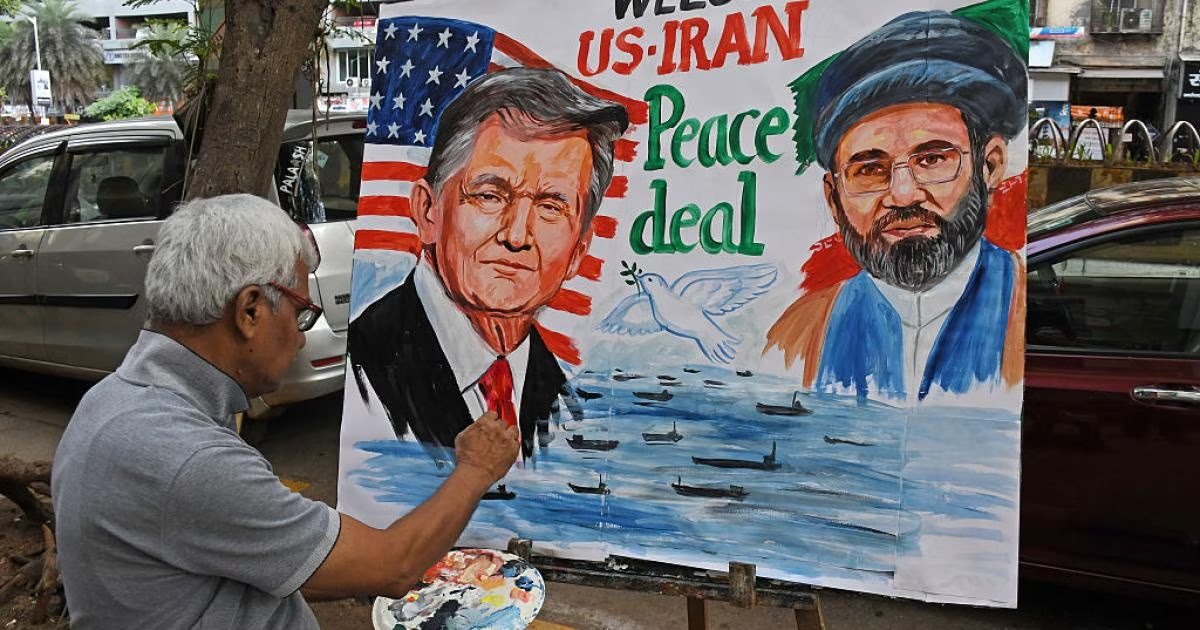
Analysts considered the first provision, concerning the cessation of military operations on all fronts, including the Lebanese arena, a political victory for Iran. This commitment places the United States under direct responsibility to contain its ally Israel and prevent it from launching attacks, providing security cover for Tehran's allies in the region under the umbrella of the new international agreement.

Regarding respect for sovereignty and territorial integrity, the assessment clarified that this provision restricts the American side more than its Iranian counterpart. Realistically, Tehran does not possess the technical or military capability to target American territory, making Washington's commitment not to interfere or target a fundamental security concession that serves the stability of the Iranian regime.

Sources also highlighted the fourth provision, which obliges the United States to completely lift the naval blockade and withdraw its forces from Iran's vicinity within a specified period of 30 days. Experts believe that the ambiguity of the term 'Iran's vicinity' may give Tehran an opportunity to demand broader withdrawals, thereby reducing US military influence in vital waterways in the region.

As for navigation in the Strait of Hormuz, the assessment considered that the current wording serves the Iranian agenda, as Tehran commits to ensuring safe passage for only 60 days without fees. This short timeframe opens the door for future negotiations with Gulf and Omani states, enhancing Iran's negotiating position in managing one of the world's most important waterways.

Provision six, concerning reconstruction, represents the cornerstone of Tehran's economic gains, as it stipulates a development plan with funding of no less than $300 billion. Although the sources and mechanisms of funding will be determined in the final agreement, the mere approval of this huge amount is an international recognition of the need to support the Iranian economy, which has been exhausted by years of isolation.

In a related context, the report stressed the importance of the seventh provision, which stipulates the termination of all forms of US sanctions, including those issued by Congress or the United Nations. This comprehensive commitment to the gradual lifting of primary and secondary sanctions represents a response to Tehran's historical demands and paves the way for its full return to the global financial and trade system.

On the other hand, the eighth provision emerged as one of Washington's few gains, in which Iran affirmed its non-pursuit of developing or possessing nuclear weapons. However, the assessment noted that the implementation mechanisms still lack precise details, with fundamental nuclear issues deferred to subsequent rounds of negotiations, which may reduce the actual value of this American commitment.

Regarding the current status of the nuclear program, the report considered that the ninth provision serves Iran because it prevents Washington from imposing new sanctions or strengthening its military presence in exchange for freezing nuclear activities at their current level. This balance prevents American escalation without imposing a real dismantling of the nuclear infrastructure that Iran has developed over the past years.

The memorandum also included immediate exemptions for Iranian oil and petrochemical exports, which analysts described as a vital and rapid gain for Tehran. These exemptions are not limited to crude sales but extend to banking, insurance, and transportation services, ensuring the legal and regular flow of hard currency into the Iranian treasury.

Regarding frozen assets, the agreement granted Tehran full right to access its restricted funds abroad and use them to settle its obligations or transfer them freely. This provision ends years of legal and financial conflict over Iranian funds held in international banks and restores full control to Tehran over its idle financial resources.

As for the provisions related to implementation mechanisms and the path of final negotiations in Switzerland, they were classified as neutral procedural steps aimed at organizing the transitional process. However, the last provision, which stipulates the adoption of the agreement by a binding resolution of the UN Security Council, represents a major legal guarantee for Iran, aimed at preventing a repeat of the scenario of unilateral US withdrawal that occurred in 2018.

The assessment concluded that these gains, despite their magnitude on paper, remain linked to the Iranian state's ability to translate them into tangible reality that addresses internal crises. Informed sources confirmed that the next round of negotiations in Switzerland will be crucial in transforming these understandings into a final and comprehensive agreement that ends decades of tension between the two parties.

The US-Iran agreement overwhelmingly favors Tehran, as most provisions of the memorandum of understanding grant Iran greater political, economic, and security gains than the United States.

OPINIONS

Thu 18 Jun 2026 7:38 pm - Jerusalem Time

Vance Defends Understanding with Tehran: Lifting Naval Blockade and Starting Countdown to Permanent Agreement

Urgent: Washington's Message

Washington – Said Arikat – 6/18/2026

The memorandum of understanding signed between Washington and Tehran has entered the practical implementation phase, after US Vice President J.D. Vance announced the start of the sixty-day official negotiation period to reach a permanent agreement between the two countries, while simultaneously confirming the lifting of the naval blockade imposed by the US Navy on Iranian ports.

Vance's statements came during a press conference held at the White House, dedicated to defending the new understanding in the face of increasing criticism from the administration's opponents inside and outside the United States, who question the agreement's ability to achieve its stated goals or ensure Iran's commitment to its pledges.

Vance said that the lifting of naval restrictions allowed more than a dozen ships carrying approximately 12.5 million barrels of crude oil to pass through the Strait of Hormuz, considering this step to be an implementation of the obligations required from the American side under the preliminary phase of the agreement.

The US Vice President indicated that the sixty-day period represents a crucial test of Tehran's seriousness and its readiness to fulfill commitments related to reducing high-level uranium enrichment, an issue that has remained the main point of contention between the two countries for years.

In response to journalists' questions regarding previous statements by President Donald Trump hinting at the possibility of Iran retaining some missile capabilities, Vance clarified that any future arrangements in this area would be limited exclusively to defensive capabilities and would not allow the possession of systems that pose a threat to regional security or the international community.

He also stressed that the administration is not providing money to Iran, denying the accusations made by critics of the agreement. He affirmed that any sanctions exemptions or economic facilities will remain directly and fully linked to the extent of Tehran's commitment to the terms of the understanding and the ongoing negotiation framework.

The Trump administration seeks to market the agreement as a historic opportunity to end decades of animosity between the two countries, at a time when negotiations are preparing to move to a more complex phase during upcoming diplomatic summits and consultations that may define the features of the US-Iranian relationship for many years to come.

However, doubts still surround the negotiation process, especially in light of the strong opposition the agreement faces from political parties within the United States, in addition to Israeli and regional reservations that believe any easing of sanctions could give Iran additional resources to strengthen its influence in the region.

Test of Trust After Four Decades of Hostility

The importance of the announcement lies not only in the lifting of the naval blockade or the start of the negotiation deadline, but in that it represents the first practical test of the possible level of trust between Washington and Tehran after more than four decades of estrangement and repeated clashes. The two parties are not only negotiating technical issues related to enrichment or sanctions, but also about redefining the rules of political and security engagement that have governed their relations since 1979. Therefore, the success of the sixty-day period will largely depend on each party's ability to convince the other that it is ready to move from crisis management to addressing its root causes.

The Retreat of the Logic of Force in Favor of Pragmatism

The decision to lift the naval blockade reflects a significant shift in the Trump administration's approach to Iran. After years of maximum pressure, sanctions, and threats of military force, it appears that the White House has become more convinced of the utility of political and economic incentives in pushing Tehran towards long-term settlements. This does not mean that Washington is abandoning its pressure tools, but rather reordering its priorities to achieve strategic goals at the lowest possible cost. This shift may have broader implications for overall US policy in the Middle East.

Israel Faces a New Strategic Reality

The progress of negotiations is likely to raise increasing concern within Israel, which has built a large part of its regional strategy over the past years on the continuation of US-Iranian tension. The closer Washington and Tehran get to stable understandings, the less able the Israeli government will be to use the Iranian threat as an absolute priority in relations with the United States. Furthermore, the success of the agreement may strengthen voices within Washington calling for a re-evaluation of traditional policies towards the Middle East, including the approach to the Palestinian-Israeli conflict.

A Narrow and Risky Diplomatic Window

Despite the positive atmosphere that the US administration is trying to project, the path to a permanent agreement is still fraught with obstacles. The issues at hand go beyond the nuclear file to include ballistic missiles, sanctions, regional influence, and security arrangements in the Gulf. Moreover, any unforeseen military or political incident could threaten to derail the entire process. Therefore, the sixty-day deadline seems more like a narrow diplomatic window that both parties must quickly utilize, before the forces of extremism and confrontation regain the initiative and return relations to the cycle of escalation once again.

OPINIONS

Thu 18 Jun 2026 7:34 pm - Jerusalem Time

Christians in Palestine... The Latest Chapter in Demographic Bleeding

The Christian presence in Palestine has never been merely a religious minority living in a holy land; rather, it has been an integral part of the historical and cultural identity of this land, a living witness to the succession of civilizations, religions, and cultures over thousands of years. However, this presence, which has endured wars, empires, and major transformations, today faces unprecedented challenges that threaten its continuity, amidst escalating attacks, increasing emigration, and a worrying decline in numbers. Recent data indicate a significant escalation in attacks targeting Christians and their holy sites in Jerusalem and the rest of the Holy Land. 155 incidents were documented in 2025, ranging from physical assaults on clergy, vandalism of church properties, racist graffiti, and repeated harassment of pilgrims and visitors. In the first months of 2026 alone, more than 88 new incidents were recorded, reflecting an escalating trend that portends further tension and targeting. These attacks cannot be viewed as isolated or separate incidents; rather, they occur within a political, security, and social environment that pressures the Christian presence and drives many of its members to consider emigration. Difficult economic conditions, rising living costs, declining job opportunities, and restrictions on movement and construction are all intertwined factors that create an unwelcoming environment for indigenous populations, including Christians. Demographic figures reveal the extent of the transformation that the Holy Land has witnessed over the past decades. In Jerusalem, where Christians once constituted a significant proportion of the city's population, their presence has dwindled to a narrow margin not exceeding about 2% of the population, after their proportion was much higher in previous historical stages. In Bethlehem, the city whose name is associated with the birth of Christ, the percentage of Christians has decreased from about 80% to approximately 10% only, in one of the most alarming demographic shifts in the region. This decline represents a loss not only for Christians but also for Palestine and for the entire global human and religious heritage. The religious and cultural diversity that characterized Jerusalem, Bethlehem, and Nazareth for centuries was one of their most important strengths and unique features. When the components of this diversity shrink, the Holy City itself loses a part of its soul, history, and identity. Churches and Christian institutions warn that the continuation of current conditions will lead to an accelerated pace of emigration, especially among young people who seek security, stability, and economic opportunities outside the country. With every family that leaves, society not only loses some of its members but also loses a part of its memory, history, and connection to its roots extending in this land since the beginnings of early Christianity. The painful irony is that the world, whose millions of people annually flock to visit and bless the holy places, often stands helpless or silent in the face of the continuous erosion of the local Christian presence that has preserved and cared for these places over the centuries. Holy sites are not just stones and ruins; they are also people, communities, and living cultures that give these places their true meaning. The danger facing Christians in the Holy Land today is not only the decline in their numbers but also the possibility of their historical presence becoming merely a memory or a limited symbolic presence. If the attacks, restrictive policies, and forced emigration continue in their current form, Jerusalem and Bethlehem may witness profound demographic changes in the coming decades that will be difficult to reverse or compensate for their effects. The issue at its core is not a matter of a specific sect or religious group, but a matter of an indigenous people and a part of the history of this land. Protecting the Christian presence in Palestine is not the responsibility of Christians alone, but a humanitarian, moral, and political responsibility related to preserving the identity, diversity, and heritage of the Holy Land, which is part of the global human heritage. What is happening today in Jerusalem, Bethlehem, and the rest of the Holy Land is not just a transient demographic decline, but a slow process of attrition of one of the oldest indigenous components of this land. When Christians are forced to leave under the weight of attacks, restrictions, and lack of prospects, the issue goes beyond population numbers to affect the identity of the place itself. Jerusalem, which is being emptied of its historical diversity, and Bethlehem, where the children of the cradle of Christ are diminishing year after year, are not just cities losing a part of their inhabitants, but losing a part of their soul and memory. If the world continues to merely observe this bleeding in silence, the danger will not be only to the Christian presence, but to the historical narrative of the entire Holy Land. Then, a day may come when churches are full of pilgrims and tourists, but empty of their indigenous people who kept the flame of this heritage alive for long centuries. At that point, the question will not be: Why did the Christian presence in Palestine decline? But rather, why was the Holy Land left to lose its people one after another before the eyes of the world?

ARAB AND WORLD

Thu 18 Jun 2026 7:34 pm - Jerusalem Time

Washington publishes full text of memorandum of understanding with Tehran: Comprehensive cessation of war and $300 billion for reconstruction

The United States of America officially announced the details of the Memorandum of Understanding reached with the Islamic Republic of Iran, named 'Islamabad Memorandum of Understanding'. This announcement paves the way for a transitional phase aimed at ending military and political tensions in the region through a specific temporal roadmap.

The memorandum includes a fundamental clause stipulating the immediate and permanent cessation of all military operations on all active fronts, with explicit mention that this cessation includes the Lebanese arena. Both parties also pledged to refrain from launching any future attacks or threatening the use of force, while guaranteeing the full sovereignty and territorial integrity of the concerned states.

Regarding the field aspect, Washington committed to immediately begin lifting the naval blockade imposed on Iran, with this blockade to be fully lifted within thirty days. The agreement also included a US pledge to withdraw military forces from areas surrounding Iran within one month of the signing of the anticipated final agreement.

For its part, Tehran pledged to secure commercial navigation in the Gulf and Oman Sea for sixty days, and to begin technical operations to remove naval mines within thirty days. Iran will open a dialogue with the Sultanate of Oman to regulate the future administration of the Strait of Hormuz in line with international laws and the rights of riparian states.

On the economic front, the document revealed a massive plan for the reconstruction and development of Iran worth no less than 300 billion US dollars, to be implemented in cooperation with regional partners. The US administration will issue all necessary financial licenses to ensure the flow of these investments as part of the final agreement to be approved.

The memorandum also stipulated a US commitment to end all forms of sanctions imposed on Tehran, whether unilateral sanctions or those issued by the UN Security Council and the International Atomic Energy Agency. This will be accompanied by a clear timeline ensuring the gradual and systematic lifting of restrictions on the Iranian economy during the negotiation period.

In the nuclear file, Iran reiterated its commitment not to seek nuclear weapons, and both parties agreed on a mechanism to reduce uranium enrichment levels at existing sites. This process will be under the direct supervision of the International Atomic Energy Agency, taking into account Iran's peaceful nuclear needs in the final agreement.

Under the new understandings, the US Treasury Department will issue immediate waivers allowing Iran to export crude oil, its derivatives, and petroleum products without hindrance. These waivers include all logistical services associated with export, including insurance, transportation, and international banking transactions that were previously prohibited.

The United States also commits to providing full access to frozen Iranian funds and assets abroad immediately upon the implementation of the memorandum's provisions. Mechanisms for transferring these funds to settle payments specified by the Central Bank of Iran will be agreed upon, with all necessary legal permits issued to facilitate these operations.

The memorandum set a sixty-day period to reach the final version of the agreement, with the possibility of extension if both parties agree. During this period, the current status of Iran's nuclear program will be maintained in exchange for no new US sanctions or additional troop deployments in the region.

Informed sources reported that the final round of negotiations will begin in Switzerland next Friday, where discussions will focus on technical details and implementation mechanisms. A joint monitoring mechanism will oversee ensuring the commitment of all parties to the memorandum's provisions to ensure a smooth transition towards a comprehensive agreement.

Finally, the memorandum emphasized that the final agreement reached will be submitted to the UN Security Council for adoption as a binding resolution under Chapter VII. This approach reflects the desire of both parties to give the understandings a permanent international legal character, ensuring long-term stability in the region.

The United States of America and the Islamic Republic of Iran pledge to respect each other's sovereignty and territorial integrity, and to refrain from interfering in each other's internal affairs.

PALESTINE

Thu 18 Jun 2026 7:34 pm - Jerusalem Time

Blood on Wedding Invitations.. Occupation Assassins Palestinian Groom in Central Gaza

In a new crime reflecting the harsh reality in the Gaza Strip, Israeli occupation missiles assassinated the dream of young Abd Al-Jawad Abu Laban, who was racing against time to arrange the details of his promised wedding. While he was eagerly touring the streets to distribute wedding invitations to relatives and friends, occupation aircraft surprised him with a treacherous raid targeting his vehicle in central Gaza City, turning the anticipated wedding suit into a shroud wrapped around his pure body.

Local sources reported that the targeting not only resulted in Abu Laban's death but also led to the martyrdom of two other young men who were with him, in addition to varying injuries among passersby. The area where the bombing occurred turned into a scene of sorrow and shock, as wedding invitations bearing the names of the guests were scattered, mixing with the blood of the martyrs and the wreckage of the destroyed vehicle in a heartbreaking scene.

The farewell scenes at the hospital were extremely harsh, as members of Abu Laban's family appeared in a state of complete shock and bewilderment before their son's body. The martyr's uncle recited moving words as he embraced his body, reminding him that next Friday was supposed to be his grand wedding day, bitterly pointing out that the invitation cards, whose distribution journey was incomplete, were still in his possession.

For his part, journalist Islam Badr documented the first moments after the bombing through video footage, showing images of the charred vehicle wreckage and remnants of colored paper bearing the details of the wedding ceremony. These images spread like wildfire on social media platforms, making the story of the 'Gaza Groom' a new symbol of the ongoing suffering experienced by the residents of the Strip under the weight of direct targeting.

Activists and journalists widely reacted to the tragedy, with blogger Mahmoud Al-Sharif writing words expressing oppression, explaining that the occupation deliberately kills joy in the hearts of Palestinians. Al-Sharif affirmed that the presence of invitation cards inside the targeted vehicle summarizes the story of a people deprived of their most basic rights to life and celebrating their social occasions amidst death lurking at every corner.

In the context of international and local condemnation, Yahya Bashir bitterly questioned the concept of hope and life that the world talks about in light of these repeated crimes. Bashir denounced the form of life imposed on Palestinians, where anyone who tries to restore the pulse of their normal life faces missiles that end their dreams in an instant, emphasizing that this targeting is a cowardly act that fears the stability of the Palestinian people.

For her part, journalist Nusaiba Helles explained that the occupation practices a policy of assassinating joy before its birth, noting that the martyr Abd Al-Jawad was distributing his invitations hoping for a peaceful life. She added that these crimes aim to break the morale of Palestinians, but in return, they increase their determination to expose the true face of the occupation to the international community that stands silent in the face of these violations.

On the statistical front, the Government Media Office in Gaza revealed terrifying figures related to Israeli violations, with 3269 breaches of the ceasefire agreement recorded since October 2025. These continuous violations have led to the death of more than 990 martyrs and the injury of over 3138 citizens, confirming that the Strip is living in a state of continuous war despite all declared understandings.

Friday is the wedding day, and the invitation cards are still with you, my son.

PALESTINE

Thu 18 Jun 2026 7:33 pm - Jerusalem Time

International Distress Call to Save Palestinian Prisoners from Scabies Outbreak in Occupation Prisons

Palestinian institutions specializing in prisoner and ex-prisoner affairs have launched an urgent humanitarian appeal to the World Health Organization, demanding immediate intervention to stop the escalating health catastrophe within Israeli occupation prisons. Al-Dameer Foundation, the Palestinian Prisoners' Club, and the Commission of Detainees and Ex-Detainees Affairs all confirmed that scabies has become widespread and alarming among prisoners, warning of serious repercussions for their lives in the absence of even minimal medical care.

Human rights sources explained in a joint statement that field data and recent testimonies indicate an unprecedented deterioration in the health condition of detainees, despite previous warnings directed to international organizations in April of last year. The institutions noted that the occupation continues to impose punitive measures that have exacerbated the health crisis, turning prisons into a fertile environment for the transmission of infectious and skin diseases among thousands of Palestinians.

Human rights reports documented the severe suffering experienced by infected prisoners, who endure intense itching and acute skin inflammations leading to constant pain and complete deprivation of sleep and rest. This suffering was not limited to adults but extended to child prisoners who face harsh detention conditions lacking the most basic standards of public health, leaving deep physical and psychological scars on their tender bodies.

The institutions attributed the rapid spread of scabies to the policy of extreme overcrowding within cells, and the deliberate deprivation of prisoners of essential cleaning supplies by prison administrations, as well as a sharp reduction in bathing periods. The sources also pointed out that the occupation authorities refuse to isolate the infected from the healthy and prevent the access of necessary medicines and treatment protocols, which confirms a deliberate intention of medical negligence as a tool of abuse.

Palestinian bodies stressed that these practices constitute a blatant violation of the Geneva Conventions and international human rights standards, which oblige the occupying power to provide full healthcare to detainees. The institutions held the occupation authorities fully responsible for the lives and physical safety of prisoners, considering that international silence on these crimes encourages the occupation to proceed with its repressive and inhumane policies.

As part of the required action, the institutions called on the World Health Organization to send independent international medical teams to conduct field visits to prisons and closely examine the extent of the health catastrophe. They also called for real pressure on the occupation government to compel it to provide immediate treatment for the infected, ensure the introduction of personal hygiene supplies, and work to reduce overcrowding to prevent further infections.

It is worth noting that occupation prisons currently hold about 9,500 Palestinian prisoners, including 360 children and 95 female prisoners, living in conditions described as the most tragic in decades. Reports confirm that prisoners are subjected to systematic torture and starvation, in addition to medical negligence, which has recently led to the martyrdom of dozens of detainees due to the lack of necessary healthcare.

Continued policies of deliberate medical negligence constitute a blatant violation of international humanitarian law and directly threaten the lives of thousands of prisoners.

PALESTINE

Thu 18 Jun 2026 7:33 pm - Jerusalem Time

'Yellow Line' plan swallows 70% of Gaza's area, occupation squeezes displaced into narrow coastal strip

Israeli occupation forces continue to implement a systematic plan to expand their field control over the lands of the Gaza Strip, in what has become known as the 'Yellow Line'. These rapid movements have led to the seizure of about 70% of the total area of the Strip, which is 360 square kilometers, unprecedentedly tightening the noose on residents and displaced persons.

Field data indicate that the occupation, which controlled about 53% of the Strip's area in previous stages, has exceeded these percentages by annexing new neighborhoods and areas to the Yellow Line. This expansion has pushed tens of thousands of Palestinians towards a very narrow coastal strip, lacking the most basic necessities of life and suffering from massive overcrowding amid the faltering arrival of humanitarian aid.

In the northern part of the Strip, the Yellow Line extends from the western roundabout of Beit Lahia city eastward along Sheikh Zayed roundabout road, to include most of the city's neighborhoods except for the 'Al-Mashrou'' area and the vicinity of Al-Qassam Mosque. Displaced families in those remaining pockets move with extreme caution, due to their direct exposure to the fire control of the occupation army, which also besieges Izbat Beit Hanoun.

The Yellow Line penetrated deep into Jabalia refugee camp, passing Salah al-Din Street and Al-Sikka Street to reach the central Al-Houja and Al-Tarns areas. Jabalia البلد (Jabalia Town) was also divided into two parts, with the line extending south to the outskirts of Al-Tuffah and Al-Shuja'iyya neighborhoods, with yellow cubes marking permanent Israeli control points in those vital areas.

As for the central region, sources reported that control extended to include large parts of Al-Bureij and Al-Maghazi camps, which are located east of Salah al-Din Street. Military movements also included Al-Masdar village and Wadi Al-Salqa area east of Deir al-Balah, areas that were crowded with displaced people before turning into closed military operation zones.

Moving to the south, the Yellow Line is clearly visible at Bani Suheila roundabout in Khan Yunis, where the occupation army placed its construction markers before heading towards Abu Hamid roundabout. The path then curves to include the 'Al-Batan Al-Samin' and Jawrat Al-Lout areas, reaching the sea coast along the administrative borders of Rafah city, isolating large areas from their geographical surroundings.

Field maps confirm that most of the border city of Rafah is now effectively within the direct Israeli control within this line. Only a narrow coastal strip remains for Palestinians in the Mawasi Rafah area, which has become the last refuge for hundreds of thousands of displaced people facing catastrophic humanitarian conditions as a result of the complete siege.

The occupation expanded the 'Yellow Line' to include new neighborhoods, displacing tens of thousands towards a narrow coastal strip suffering from severe overcrowding.

PALESTINE

Thu 18 Jun 2026 7:33 pm - Jerusalem Time

Trump Praises Hamas's 'Calm' and Affirms Work to Disarm Gaza

US President Donald Trump expressed cautious optimism regarding the situation in the Gaza Strip, praising what he described as 'discipline' shown by the Hamas movement recently. Trump clarified, in a speech delivered on Wednesday on the sidelines of his participation in the G7 summit, that the US administration places the issue of disarmament in Gaza at the top of its priorities for the next phase, to ensure long-term stability.

The White House chief indicated that the ongoing shifts in negotiations with Iran might pave the way for broader peace agreements covering the entire Middle East region. He drew attention to the recent absence of major military operations by the movement, stating: 'Look at what we've achieved there, Hamas has remained silent and is no longer making headlines with hostile actions, and we are now making diligent efforts to strip them of their military capabilities.'

In his assessment of the nature of fighters in Gaza, Trump described the field challenge as complex due to the military upbringing of entire generations there, considering that changing this reality requires exceptional effort. He added that the movement has started to behave 'well' compared to its historical pattern, emphasizing that the diplomatic path seeks to change the reality imposed on the region for decades.

They grew up with guns in their hands... I believe that from birth they were born with guns in their hands, so it's not easy.

PALESTINE

Thu 18 Jun 2026 7:33 pm - Jerusalem Time

Occupation expands 'security zone' in southern Lebanon, publishes new 10-kilometer deep incursion map

The Israeli occupation army revealed an updated map of what it calls the 'security zone' in Lebanese territories, clarifying that its forces intend to be stationed and deployed up to ten kilometers deep inside the borders. This step comes amidst the occupation's efforts to impose a new reality on the ground aimed at eliminating what it described as military threats and securing northern settlements, disregarding the terms of the recently signed memorandum of understanding between Washington and Tehran, which calls for a cessation of hostilities.

Field sources reported that the new map showed the inclusion of towns and geographical areas that were not under direct Israeli control two weeks ago, most notably the town of Majdal Zoun in the western sector. Occupation forces had carried out incursions into this town before the previous ceasefire agreements faltered, using it as a starting point to move towards areas north of the occupied town of Al-Bayada to strengthen their influence on that front.

In the eastern sector, the occupation expanded its control to include the town of Kafr Tibnit and the strategic Ali Al-Taher heights, areas that have been targets of intense military operations in recent days. This expansion indicates an Israeli desire to control the commanding hills and vital corridors that overlook vast areas of southern Lebanon, complicating efforts to return to the pre-escalation lines.

The area covered by the Israeli map extended to regions north of the Litani River, in addition to a significant expansion in the central sector stretching from the city of Bint Jbeil to the outskirts of the town of Tibnin. These areas witnessed violent airstrikes targeting the towns of Hadatha, Haris, and Beit Yahoun, in an attempt to impose a security belt that prevents any military or civilian presence threatening the security of the occupation's northern borders.

On the political front, media reports revealed increasing American pressure on Tel Aviv to force it to withdraw from the areas it infiltrated in southern Lebanon. Informed sources describe the ongoing negotiations between the two sides as 'stubborn and arduous,' as the occupation attempts to extract long-term security guarantees in exchange for any step towards withdrawal or redeployment away from Lebanese border villages.

Media sources quoted Israeli Channel 12 as saying that the military establishment categorically rejects the principle of 'linking fronts' that international memoranda of understanding might include, and instead seeks to conclude quick bilateral agreements with the Lebanese side. In a related context, the Israeli Broadcasting Corporation stated that the withdrawal issue will be the focus of upcoming talks in Washington next week, where technical details and the proposed timeline will be discussed.

On the ground, military escalation has not stopped despite diplomatic activity, as an Israeli drone targeted a civilian car at the Kafr Tibnit roundabout in the Nabatieh area, resulting in one martyr and one injured. The same town was subjected to renewed artillery shelling, causing severe material damage, while two people were injured after a drone dropped a bomb on the town of Yahoun, in a continuation of the policy of direct targeting of field movements.

In contrast, signs of a gradual return to life have begun in some villages, as residents of the town of Hadatha in the Bint Jbeil district started returning to their homes in coordination with units of the Lebanese army and ambulance teams. This return comes after a harsh period of forced displacement due to intensive raids and military operations that turned large parts of the town into uninhabitable areas in recent weeks.

Lebanese army units, in cooperation with the Al-Risala Association and the Health Authority, are working to open closed roads and remove rubble and obstacles left by the continuous Israeli shelling. Specialized teams have also begun operations to retrieve the bodies of martyrs from the vicinity of the affected towns, under complex security conditions due to the continued intensive overflight of occupation drones over southern skies.

Occupation forces will deploy in this area up to ten kilometers deep inside Lebanese territory to remove threats and enhance northern protection.

PALESTINE

Thu 18 Jun 2026 7:33 pm - Jerusalem Time

After 15 years of work.. 'Euro-Med' closes its office in Gaza under the weight of Israeli threats

The Euro-Mediterranean Human Rights Monitor announced today the official closure of its field office in the Gaza Strip, thus ending nearly 15 years of continuous work in documenting human rights violations. Ramy Abdu, Chairman of the Monitor, explained that this difficult decision came as a necessary precautionary step to protect the working staff in light of the escalating direct threats and punitive measures imposed by the Israeli authorities against the organization.

Human rights sources confirmed that the decision aims primarily to avoid direct targeting of field workers, especially after widespread incitement campaigns launched by official Israeli bodies and officials were observed. These pressures come against the backdrop of the active role played by the Monitor in exposing crimes committed against Palestinians and providing international bodies with documented data on grave violations.

Recent weeks have witnessed an unprecedented escalation in Israeli rhetoric against the Monitor, especially after it published detailed reports documenting systematic sexual violence crimes against Palestinian prisoners and detainees in Israeli prisons. The organization considered that this systematic campaign aims to tarnish its reputation and link its independent human rights work to false political claims that lack any legal or factual basis.

Ramy Abdu pointed out that the threats sometimes reached the point of hinting at killing key members of the work team, due to their involvement in documenting acts described as falling within the framework of genocide. He added that the current environment has become extremely dangerous, which necessitated taking decisive decisions to ensure the safety of employees and volunteers who face real risks while performing their duties.

At the end of last May, the Israeli authorities imposed severe punitive measures that included restrictions on the movement of 40 members of the Monitor's staff, including members of the board of directors, employees, and international partners. The Monitor considered that these restrictions fall within the policy of silencing and preventing the truth from reaching international forums that have become fed up with continuous Israeli violations.

The Monitor's administration stressed that the closure of the physical office in Gaza does not in any way mean the cessation of human rights work or a retreat from ethical obligations towards the victims. It affirmed that documentation will continue through alternative mechanisms that ensure the continuity of information and reports flowing to the judicial and international bodies concerned with holding perpetrators of crimes accountable.

The Monitor held the Israeli authorities fully responsible for the safety of all its team members, considering that targeting human rights defenders is part of a broader pattern of intimidating witnesses and silencing voices that convey the suffering of civilians. It described these practices as a desperate attempt to cover up the overwhelming evidence that condemns Israeli military and security conduct in the occupied territories.

The roots of the recent official campaign go back to a report published by American writer Nicholas Kristof in the 'New York Times', in which he relied on data provided by the Monitor regarding rape crimes in prisons. This report sparked widespread anger among the Israeli government, which prompted Benjamin Netanyahu to threaten to take legal action against the newspaper and the writer on charges of defamation.

The Israeli Ministry of Diaspora Affairs accused the Euro-Mediterranean Monitor of being the main driver of the Palestinian narrative in international forums, claiming that it operates an integrated network for media and legal pressure. The ministry claimed that the Monitor's activity goes beyond human rights documentation to the extent of international incitement and contributing to placing Israeli forces under international sanctions.

In April, the Monitor issued a shocking report revealing brutal patterns of sexual torture, including the use of trained dogs and electric shocks in sensitive areas of detainees. Documented testimonies confirmed that these practices in some cases led to death under torture or caused permanent disabilities, which strengthened the files for international legal prosecution.

These reports intersected with the results of UN investigations that concluded that sexual violence is being used as a weapon of war by Israeli forces, which led to their inclusion on the UN blacklist. This agreement between independent human rights reports and UN findings increased the intensity of the Israeli attack on the institutions that were the source of this information.

It is worth noting that the Euro-Mediterranean Human Rights Monitor began its work in 2011 as a human rights initiative to confront oppression in the region, taking the city of Geneva, Switzerland, as its main headquarters. The Monitor has a wide network of regional offices, and its work is overseen by a board of trustees that includes prominent international figures in the field of international law and human rights.

The Monitor's board of trustees is chaired by Richard Falk, the former UN Special Rapporteur on the situation of human rights in the Palestinian territories, which gives the organization's reports significant international weight. This strong legal background has made the Monitor a constant target of Israeli incitement that seeks to undermine the credibility of its reports before the international community.

In conclusion of its statement, the organization renewed its commitment to continue working for justice and accountability, noting that the closure of offices will not obscure the truth that has become clear to the whole world. It called on international institutions to provide protection for human rights defenders in the Palestinian territories who face an oppressive machine aimed at isolating them from the world.

The closure of the Gaza office is an emergency measure imposed by legitimate concerns for the lives of workers, and does not mean a retreat from our professional responsibilities.

PALESTINE

Thu 18 Jun 2026 7:33 pm - Jerusalem Time

London real estate exhibition promotes Israeli settlements, sparking political and legal storm

International press reports have revealed a real estate scandal in the British capital, London, where an exhibition was held last Sunday promoting settlement projects built on occupied Palestinian lands. Sources clarified that the event, held in North London, included offers for properties in settlement outposts located deep within the occupied West Bank and Jerusalem, representing a blatant challenge to international laws.

Documents and publications obtained from inside the exhibition showed promotion for projects in major settlements such as 'Ma'ale Adumim,' 'Givat Ze'ev,' and 'Kfar Eldad,' in addition to settlement neighborhoods in occupied Jerusalem. This move comes at a time when international warnings are escalating against the expansion of the settlement project, which undermines peace prospects in the region.

The exhibition sparked a wave of widespread anger in British political circles, with over a hundred lawmakers, along with human rights organizations, calling on the government to intervene to prevent the event. Signatories to the protest petitions considered that allowing such activities contradicts the United Kingdom's obligations under international law and economic guidelines regarding settlements.

For his part, MP Andy McDonald, co-chair of the British-Palestinian Parliamentary Group, confirmed initial evidence proving the promotion of land in illegal settlements. McDonald stressed that this activity represents a clear violation of the law, demanding executive authorities take deterrent legal action against the organizers and involved companies.

London Mayor Sadiq Khan entered the crisis, expressing his grave concern before the event, as he contacted the Metropolitan Police to assess the situation. Sources reported that the police received criminal allegations related to the illegal sale of properties and are in the process of evaluating this material to open a formal investigation into the circumstances of the incident.

The London event is part of an international promotional tour that included major cities such as Toronto and New York, where organizing companies sought to attract buyers under the slogan 'Dream Home.' Organizers used promotional language inviting exploration of British-style neighborhoods within settlements that the British government itself considers illegal.

In an attempt to absorb the anger, organizers initially claimed that the exhibition was limited to properties within the 'Green Line,' describing the accusations as 'ridiculous.' However, they later retracted and apologized for what they described as an 'error' in the promotional brochures that included names of settlements in the occupied territories, which observers considered an attempt to evade legal responsibility.

Sessions of the British House of Commons witnessed sharp debates on the issue, with MP Ellie Chowns directing scathing criticism at Foreign Secretary Yvette Cooper. Chowns questioned the government's inability to prevent the marketing of illegal properties on its soil, considering the failure to take concrete action as a green light for the continuation of these violations.

The British government, for its part, referred the file to the Advertising Standards Authority to investigate evidence related to the promotion of settlements. Minister of State Hamish Falconer stressed the necessity of adhering to British legal standards, noting that the ministry is following the matter very seriously to ensure that such transgressions are not repeated.

Amnesty International strongly criticized the government's stance, describing the referral of the case to the Advertising Standards Authority as an 'insufficient ploy.' The organization believed that this measure ignores the human suffering and destruction that settlements inflict on the daily lives of Palestinians, demanding more decisive political and judicial decisions.

MP McDonald compared the stance on Israeli settlements to other international crises, noting that the government would never accept the promotion of occupied lands in Ukraine. He added that this contradiction in the application of international law angers the British public and causes citizens to lose confidence in the current political leadership.

The exhibition coincided with an unprecedented escalation in settler violence in the West Bank, which prompted Western countries, including Britain, to impose sanctions on settlement entities. Despite these sanctions, there is still widespread parliamentary pressure to completely ban trade with illegal settlements to ensure non-complicity in war crimes.

On the ground, the vicinity of the exhibition witnessed massive protests involving anti-Zionist Jewish activists, leading to the arrest of 14 people by the police. Participants in the protests affirmed that verbal condemnations from the government are no longer sufficient, and what is required is the imposition of concrete sanctions to stop the settlement project.

In conclusion of the developments, the Charity Commission began assessing the regulatory role of the synagogue that hosted the event, after reports of serious incidents. While the synagogue defends its position by claiming that the properties on display were legal under third-party checks, the issue remains open to the possibility of prosecution.

There is evidence indicating the advertising of land in illegal settlements, which is against the law, and the government must act immediately.

ARAB AND WORLD

Thu 18 Jun 2026 2:53 pm - Jerusalem Time

Politicization of the World Cup: A heated debate between Taiwan and China over 2026 World Cup broadcasting rights

The intensity of political tension between Taiwan and China has escalated to include the sports arena, as the Taiwanese government strongly criticized an offer made by Beijing to fans on the island to watch the 2026 World Cup matches. Authorities in Taipei clarified that its citizens do not need to resort to Chinese platforms, asserting that the matches will be readily available through local channels and media outlets within Taiwan.

The Taiwan Affairs Office in the Chinese capital, Beijing, had sparked controversy by announcing that China holds the full broadcasting rights for the global tournament. The office urged residents of the island to use Chinese digital websites and applications, or even travel to the mainland to watch the competitions directly from there, which Taipei considered an attempt to interfere in matters not related to the basic tasks of the Chinese office.

For his part, the spokesperson for the Chinese office, Chen Binhua, stated during an official press conference that his country welcomes all Taiwanese citizens who wish to enjoy the football festival through Beijing's digital platforms. He indicated that facilities are available for those who wish to attend in person to watch the matches, a move observers see as an attempt to enhance China's soft power towards the island's residents.

In response, Taiwan's Mainland Affairs Council issued a firm statement, describing the Chinese claims as completely misleading and baseless. The Council stressed that Taiwanese media companies have already obtained all legal rights to broadcast the tournament, which obviates the need for viewers to use any applications or websites subject to Chinese censorship or management.

The Taiwanese statement accused the Taiwan Affairs Office in Beijing of being preoccupied with marginal issues outside its jurisdiction, criticizing the entanglement of the sports file in the ongoing political conflict. This debate comes at a time when relations between the two sides are experiencing continuous tension, as Beijing insists on its sovereignty over the island, while Taipei adheres to its people's right to self-determination.

On the sports front, both the Chinese and Taiwanese national teams will be absent from the 2026 World Cup finals after failing to qualify during the qualifiers. However, this absence did not prevent Taiwan from showing its interest in the tournament, as it officially announced its support for the national teams of Paraguay and Haiti, which represent a few of the countries that still maintain full diplomatic relations with Taipei.

In a symbolic move, Taiwanese Foreign Minister Lin Chia-lung posted a video on his social media accounts, in which he was seen waving the flags of allied countries participating in the World Cup. The minister expressed his pride in seeing Taiwan's international partners in this largest sporting event, clearly reflecting how football has become a new arena for expressing diplomatic and political stances.

Chinese claims about Taiwanese people's inability to watch World Cup matches are absolutely incorrect, and broadcasting rights are available locally.

LATEST NEWS

Thu 18 Jun 2026 2:52 pm - Jerusalem Time

Leaks Reveal Behind-the-Scenes of Secret 'Dialogue' Society: Provocative Agendas and Influential Global Figures

International media reports have revealed extensive leaks from the internal records of a mysterious secret society known as 'Dialogue,' which is believed to have been co-founded by the renowned businessman Peter Thiel, a co-founder of Palantir. The roots of this entity trace back to 2006 when it was established by a Swiss cyber activist, and since then, it has operated away from the public eye through a strict membership system based exclusively on personal invitations extended to elites.

Informed sources stated that the leaked data included personal information of approximately 222 members who had registered to participate in the society's upcoming annual meeting, scheduled to take place in the Irish capital, Dublin, next August. These lists reveal a complex network of relationships connecting high-ranking government officials, military leaders, and executives from major global technology and finance companies.

Heavyweight names topped the leaked attendance list, including the Supreme Commander of NATO forces in Europe, Alexis Grenkevich, and US Treasury Secretary Scott Bessent, in addition to senators such as Ted Cruz and Cory Booker. The list also included billionaire Elon Musk, LinkedIn founder Reid Hoffman, and Kaya Kallas, the EU's High Representative for Foreign Affairs, reflecting the extent of influence enjoyed by this gathering.

The leaked meeting agendas raise profound questions about the nature of the objectives pursued by this society, as session titles included unconventional and alarming topics such as 'World War III' and 'Founding a Cult.' Participants also discuss issues related to 'establishing political parties' and 'modern battlefield technologies,' alongside philosophical and economic discussions about the return to nuclear energy and whether money can buy happiness.

According to the reports, the activities of the 'Dialogue' society are not limited to political and strategic discussions but also extend to the private social aspects of its members. The society has a closed electronic application aimed at building emotional relationships and facilitating introductions among unmarried members, reinforcing the idea of it being a closed society seeking to build an integrated social and political fabric among the global elites.

These leaks shed light on the growing power of secret societies that combine money, power, and technology in shaping visions that could affect international policies. Although meetings are held behind closed doors, the public release of this data places these leaders under public scrutiny regarding the nature of understandings reached away from official institutions and democratic transparency.

The meeting agenda includes controversial sessions on World War III and the possibility of establishing new cults and political parties.

ARAB AND WORLD

Thu 18 Jun 2026 2:52 pm - Jerusalem Time

Historic Agreement to End War: Trump and Pezeshkian Sign Comprehensive Memorandum of Understanding

The international arena witnessed a dramatic development with the signing of a historic memorandum of understanding by US President Donald Trump and his Iranian counterpart Masoud Pezeshkian, separately, aimed at ending ongoing military conflicts. The signing ceremony for the American side took place at the Palace of Versailles in France on the sidelines of a formal dinner hosted by French President Emmanuel Macron, and in the presence of Secretary of State Marco Rubio. At the same time, official Iranian sources confirmed that President Pezeshkian signed the memorandum from Tehran, opening the door to an entirely new phase in the strained relations between the two countries.

The signed memorandum immediately puts an end to all hostilities on various active fronts, with a special focus on ending the war in the Lebanese arena, which has suffered from continuous escalation. The agreement also stipulated the necessity of the full and unconditional resumption of maritime navigation in the strategic Strait of Hormuz, to ensure global energy flow and secure international waterways. This step is considered a fundamental pillar in the new understandings to ensure regional stability and prevent any future military friction in vital passages.

On the economic front, the agreement included fundamental provisions, including the complete and immediate lifting of the American blockade imposed on Iranian ports. Washington also pledged to cancel the series of economic sanctions that have suffocated the Iranian economy for years, in addition to releasing all frozen financial assets in international banks. These steps aim to enable Tehran to return to the global financial system and restore its ability to export its natural resources without restrictions.

In a massive economic initiative, the memorandum revealed the launch of a comprehensive rehabilitation plan for the Iranian economy worth up to 300 billion US dollars. This plan aims to modernize dilapidated infrastructure and support productive sectors in Iran to ensure long-term internal stability. This financial support is seen as part of the incentive package provided by the US administration to ensure Tehran's commitment to the provisions of the comprehensive agreement and to direct its resources towards economic development instead of military escalation.

Regarding the thorny nuclear issue, Iran renewed its strict commitment not to develop or possess nuclear weapons, a position that the memorandum affirmed Tehran's adherence to as a strategic choice. These security guarantees provide Washington and its allies with the necessary reassurance to move forward with normalizing diplomatic and economic relations. This clause is a cornerstone in building mutual trust, as both parties seek to close this file, which has been a major cause of international tensions over the past decades.

As a result of this rapid development, sources in the Iranian Foreign Ministry announced the suspension of talks that were scheduled to be held in Switzerland between the delegations of the two countries. The Foreign Ministry spokesman explained that the direct signing by the heads of state made the previously scheduled technical meetings unnecessary at this time. This suspension indicates that the agreement has bypassed traditional diplomatic channels to reach the summit level, which enhances the chances of its immediate implementation on the ground.

The memorandum of understanding includes an immediate end to the war on various fronts, including the Lebanese arena, along with a full resumption of maritime navigation in the Strait of Hormuz.

ARAB AND WORLD

Thu 18 Jun 2026 2:52 pm - Jerusalem Time

Intense American Pressure on Israel to Withdraw from Southern Lebanon and Mount Hermon

A state of frustration and anger prevailed within political and security circles in Israel, following the revelation of details of a memorandum of understanding signed by the United States with Iran. This memorandum aims to de-escalate regional tensions and open a new negotiation path, but it included clauses obliging the parties to maintain calm in several arenas, foremost among them the Lebanese front.

Informed sources reported that the American administration began exerting actual pressure on Tel Aviv to push it towards withdrawing from five strategic points in southern Lebanon. American demands also included the necessity of withdrawing from the parts of the Syrian Mount Hermon that the Israeli army had controlled since early 2024, to ensure that the political process with Tehran is not obstructed.

Reports quoted an Israeli official close to Prime Minister Benjamin Netanyahu describing the ongoing negotiations with Washington as 'difficult and complex.' The official affirmed that Israel still shows reluctance to retreat from its current military positioning in southern Lebanon, despite firm American messages.

Washington is threatening to take practical measures against Israel if it continues to reject withdrawal demands, with these measures potentially including delaying vital arms shipments. Israeli sources indicated that the pressure could escalate to imposing security and military restrictions similar to an undeclared ban on the supply of combat equipment.

Through these pressures, the American administration seeks to extract a formal commitment from Netanyahu to withdraw, to present it as a prominent political achievement for the American president. This comes at a time when Israel believes that the memorandum does not serve its supreme security interests, especially since it ignores the issue of Iranian ballistic missiles.

On the ground, military sources revealed a near-complete halt to the advance of Israeli forces towards the depths of Lebanese territory in recent hours. It appears that the Israeli army has begun to reposition itself in line with the charged political atmosphere, despite its public demand to retain freedom of military movement.

Press reports stated that Israeli units that crossed the Litani River are currently stationed in exposed areas, making them vulnerable to targeting risks. Accordingly, strict military instructions were issued to the forces to entrench themselves inside buildings and dig defensive trenches to reduce human losses in the event of sudden confrontations.

Concerns are growing among the Northern Command of the Israeli army about Hezbollah's success in accurately identifying the positions of the stationed forces during the current period of stagnation. Military commanders believe that keeping the forces in a defensive posture without advancing increases the likelihood of them being subjected to missile attacks or precise sniper operations.

For its part, diplomatic sources confirmed that Lebanon was mentioned three times in the text of the American-Iranian memorandum of understanding, which confirms its centrality to the agreement. The spokesperson for the Iranian Foreign Ministry considered that this presence reflects the parties' commitment to de-escalating the northern front of Israel as part of a broader regional deal.

Israeli concerns are not limited to the temporary sixty-day cooling-off period but extend to what the final negotiations will yield. Security circles in Tel Aviv fear the imposition of permanent ground realities that will limit the army's ability to confront Hezbollah's threats in the future.

Political circles in Israel are discussing various scenarios for dealing with the American demand, ranging from withdrawal to a narrow 'security zone' or complete withdrawal. The option of complete withdrawal is one of the most sensitive options, due to its internal political repercussions that could threaten the stability of the ruling coalition.

Amidst this anticipation, the question remains about Netanyahu's ability to maneuver politically to obstruct any agreement that imposes restrictions on Israeli military action. Israeli circles are awaiting the results of upcoming negotiation rounds to determine the path of confrontation or de-escalation on the northern border.

Israel is conducting difficult negotiations with Washington regarding the continued deployment of its forces, and there is no intention to retreat from our positions in southern Lebanon.

ARAB AND WORLD

Thu 18 Jun 2026 2:51 pm - Jerusalem Time

60-Day Challenges: Thorny Issues Threaten the Path of US-Iranian Negotiations After the Memorandum of Understanding

The United States and Iran have entered a new and critical phase of negotiations following the signing of a memorandum of understanding in Switzerland, aiming to establish a 60-day timeframe for reaching a comprehensive agreement. Although this step has eased military tensions, observers doubt the ability of both parties to overcome the thorny issues inherited from years of conflict and recent aggression.

The nuclear file stands out as the biggest challenge facing President Donald Trump's administration, with the dispute centering on Iran's stockpile of highly enriched uranium. While Washington insists on destroying this stockpile or transferring it out of the country, Tehran shows only limited flexibility in reducing concentration levels without giving up the material itself.

Tehran adheres to what it describes as its 'sovereign right' to enrich uranium in the future, which the United States rejects, having previously demanded a complete halt to enrichment operations. Sources indicate that current discussions may lead to a temporary halt ranging from 5 to 20 years, but reaching a final formula remains elusive.

The issue of international oversight represents another knot, as the question arises about Iran's acceptance of the return of strict inspection levels stipulated in the 2015 agreement. Trump had withdrawn from that agreement in 2018, creating a significant trust gap between the International Atomic Energy Agency and Iranian authorities.

On the economic and navigational front, the memorandum of understanding stipulates the reopening of the Strait of Hormuz to global shipping traffic after a period of de facto closure. This passage is vital for global energy supplies, with about one-fifth of internationally consumed oil passing through it, making its reopening a top priority to calm markets.

Iran demands a fundamental role in managing the strategic waterway, leveraging the influence it gained during the recent conflict. In contrast, the United States insists that passage be free and without fees, amid extreme caution from global shipping companies awaiting tangible security guarantees.

Frozen Iranian funds abroad represent an additional stumbling block, as Tehran seeks an immediate lifting of sanctions and access to billions of dollars. The US administration believes that sanctions relief must be gradual and linked to Iran's full compliance with the terms of the final agreement, which irritates hardliners on both sides.

President Trump faces internal pressures due to rising fuel prices and the decline of the US strategic reserve to its lowest levels since 1983. The war in the Middle East consumed about 172 million barrels of oil, making the acceleration of the memorandum's signing an economic necessity for his administration before the upcoming elections or political deadlines.

In contrast, the Israeli position emerges as an external obstructive factor, with Prime Minister Benjamin Netanyahu insisting that Tel Aviv is not bound by any understandings between Washington and Tehran. Netanyahu affirms that military operations in Lebanon and the region will continue separately from the path of nuclear or political negotiations.

Iran stipulates that a comprehensive de-escalation requires the agreement to include a ceasefire in Lebanon, which Israel has so far rejected. Washington is pressuring Tel Aviv to withdraw from Lebanese territories to ensure the success of the memorandum of understanding, but any new field escalation could completely undermine diplomatic efforts.

The negotiation styles between the two teams differ radically, with Trump's team, including J.D. Vance and Jared Kushner, tending to seek quick and impressive results. Meanwhile, Iranian negotiators are known for their high ability to prolong complex technical discussions, making the 60-day deadline seem very short.

The crisis of trust casts a shadow over the negotiating table, especially after the mutual military attacks over the past year. Washington views with caution the tendencies of the new Supreme Leader Mojtaba Khamenei, who took power under tragic family circumstances following an airstrike, and is known for his more radical stances towards the West.

Trump's aides warn against Tehran resorting to a stalling strategy to gain time and alleviate economic pressures without making substantial concessions. At the same time, the Iranian side fears Trump's fluctuating positions or his succumbing to pressure from hardliners in Washington who oppose any rapprochement with the 'axis of resistance'.

The possibility of failure remains if the language of violent threats returns to dominate the scene again, or if interpretations of the memorandum of understanding conflict. If a comprehensive settlement is not reached, both parties may settle for a limited agreement that prevents a slide into all-out war, with the fuse of tension remaining lit in the region.

The fate of the Iranian nuclear program is the factor that carries the greatest risk for the final negotiations.

ARAB AND WORLD

Thu 18 Jun 2026 2:51 pm - Jerusalem Time

Iranian warnings against the occupation undermining understandings with Washington regarding Gaza and Lebanon

Sources familiar with the ongoing negotiations between Tehran and Washington revealed that the Gaza Strip issue represents a fundamental pillar in the spirit of the current understandings between the two parties. The sources clarified that any continuation of the escalation policy pursued by the Israeli occupation, whether in Gaza or on the Lebanese front, would undermine the foundations upon which the potential political agreement was built. This warning comes amid Iranian emphasis that regional stability cannot be fragmented, and that signing papers is not a sufficient guarantee without actual implementation.

For his part, US Vice President JD Vance outlined a broader framework for this agreement, indicating that it extends beyond bilateral relations to include arrangements concerning Lebanon and the Gulf states, in addition to the occupying state. Vance described this path as aiming to achieve comprehensive regional peace, reflecting the US administration's desire to calm inflamed fronts through major deals that ensure all parties' commitment to long-term de-escalation.

In the context of parallel diplomatic efforts, Iranian Parliament Speaker Mohammad Bagher Ghalibaf, during coordination with his Lebanese counterpart Nabih Berri, stressed the necessity for Washington to exert real pressure to compel the occupation to cease its aggression. Both sides affirmed that ending the war on Lebanon is a top priority to ensure the success of any political path in the region, considering that the American role must shift from mediation to actual guarantee of a ceasefire.

On the procedural level, Iranian Foreign Minister Abbas Araghchi affirmed that the withdrawal of the occupation army forces from Lebanese territories is not merely a demand, but a clause clearly included in the draft memorandum of understanding with the United States. Araghchi indicated that Tehran is seriously monitoring the seriousness of other parties in implementing these clauses, considering that the true measure of diplomatic success lies in tangible change on the ground and a complete cessation of military operations.

The arenas are interconnected, and what happens in Gaza affects the entire region, and commitment on the ground is the measure of success for any agreement.