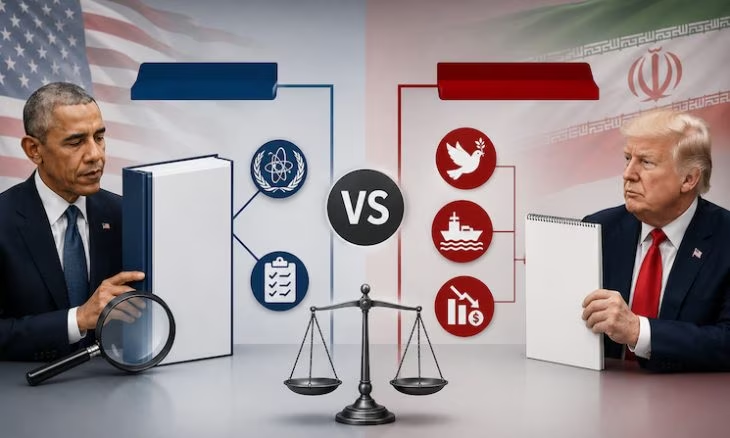







The sharp contrast between the current US administration and former President Barack Obama's approach to managing the conflict with Tehran is evident, with Donald Trump promoting his latest memorandum as an achievement superior to the 2015 agreement. Observers believe that a comparison between the two documents reveals a fundamental difference in negotiating philosophy, as Washington has shifted from multilateral international agreements to direct bilateral understandings.
The memorandum of understanding signed by Trump is considered merely a preliminary framework, not exceeding one and a half pages, and includes 14 key points aimed at opening the door for negotiations for two months. In contrast, the Joint Comprehensive Plan of Action (JCPOA) signed by Obama was a complex technical and legal document exceeding 160 pages, which placed precise temporal and structural restrictions on Iran's nuclear program.
Regarding the nuclear program, Trump claims that Tehran had not previously pledged not to acquire nuclear weapons, information that contradicts the texts of the 2015 agreement, which included explicit commitments in this regard. Trump's current vision relies on a general course of discussion within 60 days, without specifying immediate technical restrictions on uranium enrichment levels or the number of centrifuges.
Reports indicate that the current memorandum hints at Iran's readiness to address its highly enriched uranium stockpile crisis through a 'dilution' mechanism at its nuclear sites. However, this measure remains pending a final agreement, unlike Obama's agreement, which imposed strict and immediate international oversight by the International Atomic Energy Agency.
The economic sanctions file represents the most prominent point of contention between the two approaches, as Trump offered immediate incentives to Tehran by allowing it to resume oil exports before reaching a final agreement. This approach represents a reversal of Obama's policy, which stipulated verification of Iran's implementation of its nuclear commitments before initiating any gradual easing of imposed sanctions.
Trump's plan includes a controversial clause calling for the establishment of an economic development fund for Iran worth up to $300 billion, with the participation of Washington's allies in the Middle East. This proposal has drawn widespread criticism within Republican Party circles, with some considering it a financial concession far exceeding what the Obama administration previously offered.
Looking back at recent history, Trump had strongly criticized Obama's return of $1.7 billion in frozen Iranian assets, describing it as a catastrophic deal. However, current data suggests that the current administration may release amounts many times that figure as part of its efforts to end the military tension in the region.
The current memorandum differs from its predecessor in its comprehensiveness of non-nuclear issues, foremost among them the security of navigation in the Strait of Hormuz, which has been severely affected over the past four months. Obama had deliberately separated the nuclear file from regional issues to ensure the success of negotiations, while Trump sees the necessity of integrating all files into one basket.
Tehran insists in the ongoing negotiations on extracting an administrative and sovereign role in the Strait of Hormuz, a demand that was not on the table before the outbreak of recent military confrontations last February. This demand represents a significant challenge for the American negotiator, as accepting it could lead to a change in the naval balance of power in one of the world's most important energy corridors.
The war launched by the United States and Israel on February 28th left a deep impact on the structure of current negotiations, making the cessation of military operations a top priority. The memorandum of understanding aims to transform this fragile calm into a sustainable settlement, despite the significant obstacles that still stand in the way of reaching a final and comprehensive agreement.
On the diplomatic front, Trump preferred to marginalize major international powers such as Russia, China, and the European Union, focusing on a direct and bilateral communication channel with the Iranian leadership. This path gives Washington greater flexibility in maneuvering, but it weakens the international cover for any agreement that may eventually be reached.
The current memorandum of understanding lacks the strict inspection mechanisms that characterized the 2015 agreement, as the document did not clearly refer to the return of international inspectors to sensitive facilities. Critics believe that this ambiguity may give Tehran an opportunity to maneuver and develop its capabilities away from the eyes of international oversight during the stipulated sixty-day period.
The Trump administration faces internal pressure from hawks who see the proposed economic deals as a lifeline for the economically exhausted Iranian regime. In contrast, the administration is betting that economic openness will necessarily lead to a calming of Iranian military ambitions and ensure the stability of global energy prices affected by the war.
The fundamental question remains about the ability of the parties to transform this brief memorandum into a binding and detailed agreement that meets the aspirations of all concerned parties. As the sixty-day deadline approaches, all eyes are on Washington to see if Trump will actually succeed in concluding the 'better deal' he promised his constituents.
While Obama's agreement focused on restricting nuclear activities with strict standards, Trump's memorandum opens the door to massive financial flows in exchange for a general path to arms control.


Share your opinion
A Comprehensive Comparison of Trump's and Obama's Approaches to the Iranian File: From Nuclear Deals to Development Funds