






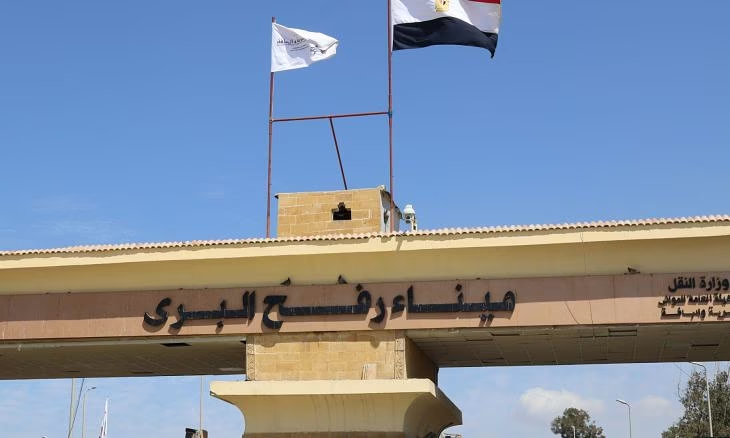
The Gaza Centre for Human Rights expressed its strong condemnation of the Israeli occupation authorities' continued practice of arbitrary policies that prevent Palestinian citizens from returning to their homes in the Gaza Strip. The Centre affirmed that these measures affect vulnerable groups, including women, children, the sick, and the elderly, reflecting a growing Israeli trend to restrict the right of return, deepen the fragmentation of Palestinian families, and impose facts on the ground that solidify forced displacement.
The human rights center clarified in a statement that it has recently received an increasing number of testimonies confirming the occupation's prevention of residents of the Strip from returning through what is called 'security refusal.' This process occurs through a complex mechanism that begins with registering names at the Palestinian Embassy in Cairo or through private coordination companies. The lists are then submitted to the occupation's security apparatus for review, a process that can extend for weeks and often ends with sudden rejection decisions.
The report indicated that rejection decisions are issued without providing any clear legal reasons, and there is no effective mechanism to appeal these unjust decisions. This situation has transformed the citizen's inherent right to return to their homeland, guaranteed by international laws, into a 'privilege' subject to the unilateral will and security whims of the occupation authorities, exacerbating the suffering of those stranded abroad.
The Centre documented painful humanitarian cases of women stranded outside the Strip for many months, deprived of reuniting with their husbands and children who are living through war conditions inside Gaza. The data also included cases of patients who completed their medical treatments abroad but remained deprived of return, placing them in extremely harsh humanitarian and psychological conditions due to forced separation from their families.
In a poignant testimony, citizen (M.M.), 34 years old, said that she left Gaza for treatment, leaving behind her husband and children. When she tried to return via Egypt, she was shocked by the decision to prevent her for security reasons. She added bitterly that she thought only a few hours separated her from embracing her children, but she is now in a state of shock, not knowing the reasons preventing her from meeting her family for nearly two years.
For her part, Ms. Aisha (42 years old) recounted her experience with the ban, affirming that she decided to return despite the risks of death and hunger in Gaza to be with her family, some of whom she had lost. She indignantly questioned why the occupation's approval was required for her return to her destroyed home, describing her life as now suspended by a decision of unknown reasons and timing, reflecting the extent of oppression experienced by the displaced.
The elderly were not spared from this policy. Abdul Aziz (68 years old) stated that he left the Strip for treatment, assuming that his return would be easy once he recovered. Abdul Aziz expressed his deep pain from loneliness abroad and constant worry about his children and grandchildren in Gaza, affirming that his only wish is to return to be with his family, no matter how difficult the conditions inside the Strip.
The human rights center stressed that these measures constitute a blatant violation of freedom of movement and the right to return to one's homeland, noting that those fortunate enough to obtain approval suffer a humiliating return journey. This journey includes lengthy inspections and repeated interrogations at border crossings, in addition to the confiscation of personal belongings and exposure to deliberate humiliation by occupation soldiers.
The report also revealed the documentation of arrests of returning citizens despite having prior approvals, as well as some of them, including women, being subjected to beatings, ill-treatment, and extortion during crossing procedures. The Centre considered these practices to be grave violations of the rules of international humanitarian law and international human rights law that protect civilians in times of conflict.
In conclusion, the Centre warned in its report that controlling crossings and using freedom of movement as a weapon against civilians primarily aims to reduce the Palestinian presence in Gaza. It affirmed that this policy aims to create an expelling environment that pushes residents to remain outside their homeland, practices that completely contradict the legal obligations imposed on Israel as an occupying power under international agreements.
I feel that our lives are suspended by a decision whose reasons we do not know and whose timing of change is unknown; why does my return to my destroyed home require approval from the occupation?


Share your opinion
Human Rights Report: Occupation Solidifies Forced Displacement by Preventing Return of Women and Elderly to Gaza