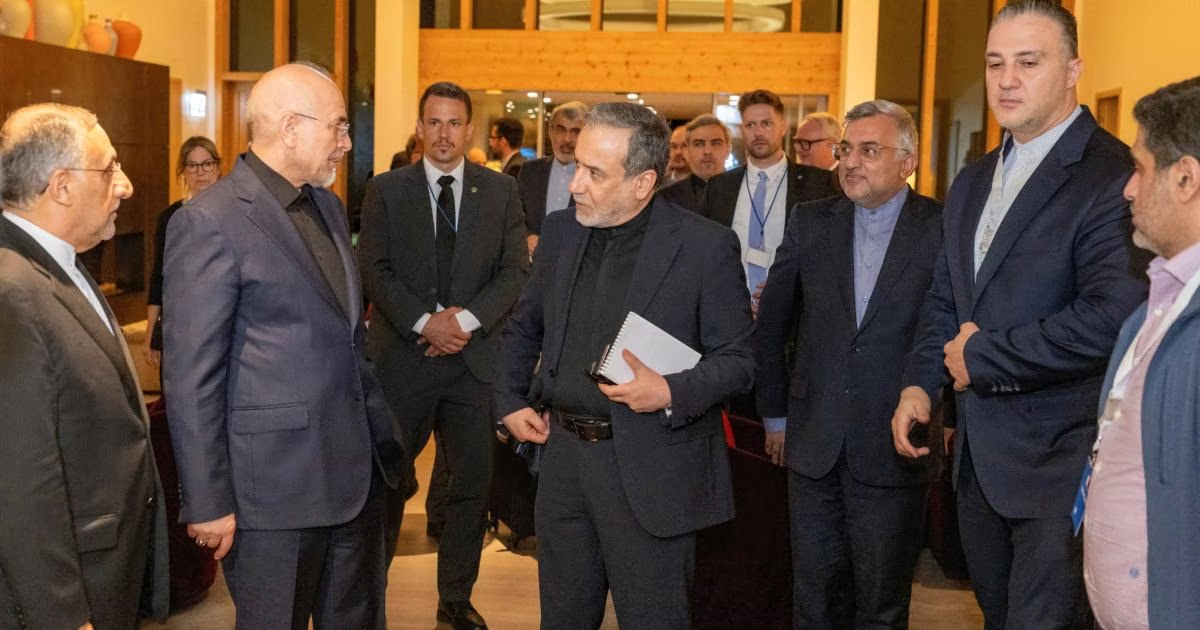







American press sources revealed exciting details regarding Israel's attempts to assassinate senior Iranian negotiators, coinciding with Washington's sensitive talks with Tehran last spring. According to American officials, these Israeli moves were directly aimed at undermining efforts to reach a temporary peace agreement between the two parties.
Reports indicated that American concerns significantly escalated regarding the targeting of Foreign Minister Abbas Araghchi and Parliament Speaker Mohammad Bagher Ghalibaf. These anxieties began with the launch of ceasefire negotiations last April, as Washington considered any harm to these two figures would mean the end of the diplomatic path.
Due to fears of derailing the negotiations, the United States resorted to unprecedented steps by asking regional countries to warn Tehran of the possibility of Israel targeting its officials. This step reflects the extent of the divergence in views between Washington and Tel Aviv, as the latter saw assassinations as a means to overthrow the Iranian government.
Officials in the American administration acknowledged that Araghchi and Ghalibaf were legitimate targets for Israel during the intense phases of the war, given their prominent positions. However, the American perspective changed with the start of serious negotiations, as preserving their lives became a necessity for the continuation of dialogue and to prevent the re-ignition of a full-scale military confrontation.
The roots of the current conflict trace back to the Israeli strike on February 28 that resulted in the death of Supreme Leader Ali Khamenei and other senior officials. While American operations focused on neutralizing naval and missile capabilities, Israel prioritized the elimination of political and military leadership as a strategic objective from the very beginning.
Israel's assassination list included figures described as pragmatic, with whom Washington had hoped to reach understandings to end the crisis. Prominent among these were Ali Larijani, a senior national security official, and Kamal Kharrazi, the former foreign minister, who were killed in airstrikes while engaged in communication channels with the United States.
These facts reveal the rapid divergence between the war objectives of the United States and Israel after a period of alignment. While Washington pushed for lasting peace, Israel expressed deep skepticism and tried to obstruct this path by targeting key figures in the negotiation process.
Ghalibaf and Araghchi are considered the main drivers of the negotiations that took place in several regional and international capitals with the aim of reaching a ceasefire. Informed sources confirmed that Israel had included the two men on its target list since last March, before being forced to temporarily remove them under direct American pressure.
Reports revealed that Mohammad Bagher Ghalibaf miraculously survived death on two previous occasions, one during the Twelve-Day War in 2025. The second time was this year when an Israeli airstrike targeted a secret fortified underground bunker where a meeting of senior Iranian officials was taking place.
According to testimonies from Iranian officials, Ghalibaf was pulled from under the rubble in both incidents, prompting Tehran to take extremely stringent security measures. These measures included changing movement and travel protocols, especially during foreign trips that require security coordination with host countries and intermediaries.
Last April, as Ghalibaf headed to Islamabad to meet with US Vice President JD Vance, Tehran requested strict security guarantees. Iran, through Qatari and Pakistani intermediaries, sought American assurances to prevent any secret Israeli operations targeting the Iranian delegation participating in the talks.
Fighter jets from the Pakistani Air Force escorted the Iranian plane carrying the 70-official delegation to secure it from any aerial interception. Despite these precautions, the delegation faced a serious security threat on the return journey, after movements of Israeli fighters were detected near Iran's western borders.
Security sources reported that Ghalibaf's plane was forced to make an emergency landing in the city of Mashhad, near the Pakistani border, to avoid the Israeli aerial threat. The Iranian delegation then had to complete its journey to the capital Tehran by land in a arduous eight-hour trip under heavy guard.
Despite these risks, the negotiation rounds continued, with Araghchi and Ghalibaf later traveling to Qatar and Switzerland to continue discussions with the American delegation. These events demonstrate the complexity surrounding the peace process in the region, amidst a clash of wills between the American desire for de-escalation and Israel's insistence on military resolution.
Any attempt to assassinate Iranian leaders would end the talks and reignite the fighting.

Share your opinion
Behind the Scenes of Israel's Attempts to Assassinate Araghchi and Ghalibaf During Peace Negotiations with Washington