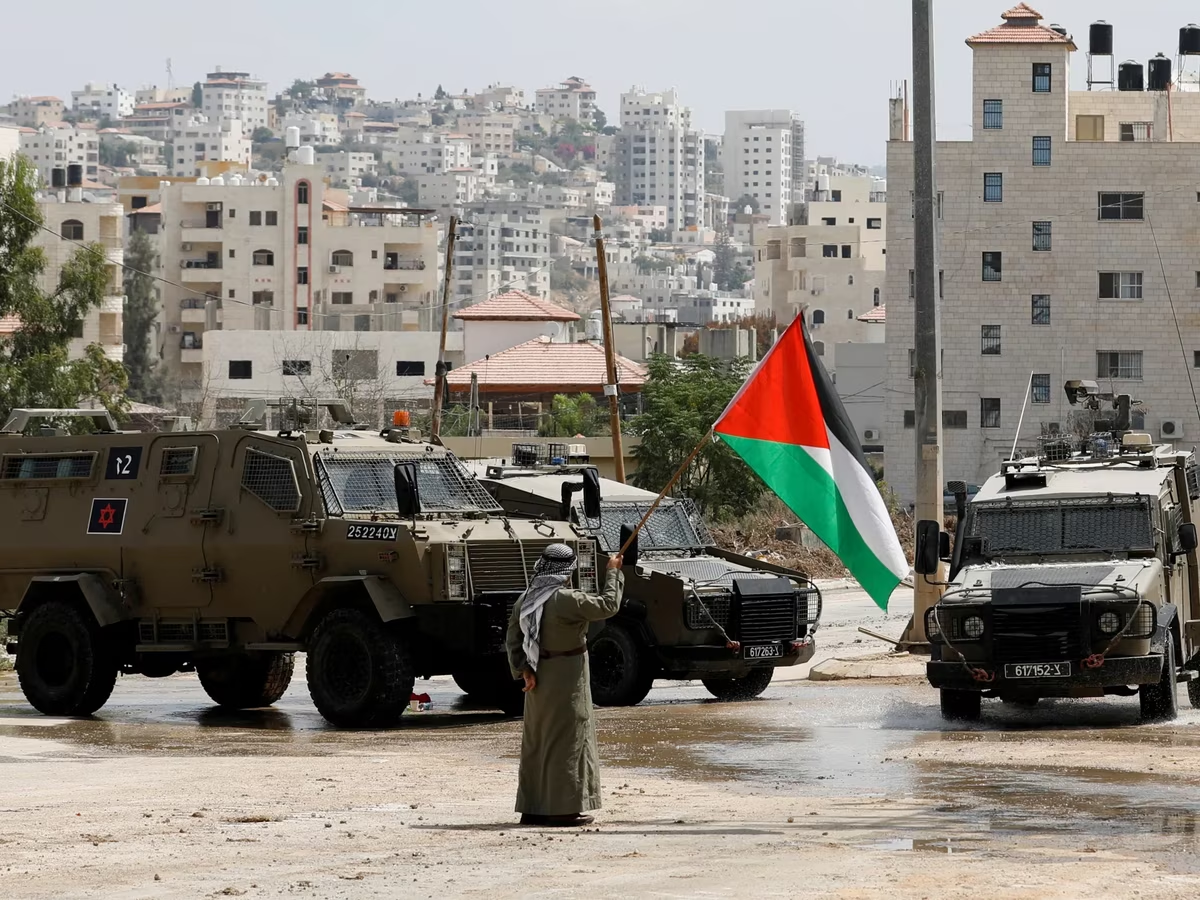







Recent Israeli reports have revealed an unprecedented acceleration in the pace of settlement expansion within the occupied West Bank, as part of a systematic strategy led by Finance Minister Bezalel Smotrich. These moves aim to impose a new geographical and political reality that thwarts any opportunity for the establishment of a Palestinian state in the future, amidst human rights warnings that these policies are turning into de facto annexation of lands.
Smotrich clarified in press statements that the current government has brought about what he described as a 'revolution' in the settlement project, where approximately 160 settlement farms have been established and over 100 new settlements approved. The measures also included the return of settlement to areas in the northern West Bank after the cancellation of clauses from the Disengagement Law, supported by massive investments amounting to billions of shekels.
The new Israeli vision relies on transforming settlement farms from mere isolated residential clusters into tools for creating 'territorial continuity' that connects settlements to each other. This plan seeks to fragment Palestinian geographical contiguity and transform Arab towns and villages into isolated enclaves besieged by Jewish construction.
The Israeli minister indicated that this plan crystallized after reviewing previous maps that showed a superiority in Palestinian geographical connectivity, which the current government is working to completely reverse. Israeli authorities are racing to legalize the status of the largest number of settlement outposts before any potential political change, to ensure the difficulty of their evacuation in the future.
In a related context, Smotrich accused parties in the Israeli opposition of attempting to resume the political process with European officials, warning that any government change could threaten the settlement project. He considered that the events of October 7 changed the general Israeli mood, where the discussion about the West Bank became linked to national security, not just ideology.
For its part, press reports confirmed that what is happening in the West Bank goes beyond traditional expansion, representing an organized project to completely redraw the political and geographical map. Sources explained that the current government alone approved the establishment of 103 new settlements, compared to 127 settlements established from 1967 until it took power.
Data indicates the existence of over 300 settlement outposts being worked on for legitimization, 140 of which are close to receiving official recognition, raising the total number of settlement sites to 470. This shift came as a result of granting Smotrich broad powers within the Ministry of Defense to directly oversee planning and land files in 'Area C'.
Under the new administrative amendments, the role of the Minister of Defense in granting building permits has been reduced, which has led to an unprecedented acceleration in the approval of settlement projects. These measures aim for complete control over 'Area C', which constitutes about 60% of the West Bank's area according to the Oslo Accords divisions.
According to announced plans, the government approved the construction of 60,000 new housing units in settlements by the end of 2025, a huge number compared to previous decades. These constructions are accompanied by the strengthening of the security system, which currently includes 925 military checkpoints restricting Palestinian movement daily.
UN sources confirm that the roads connecting Palestinian areas suffer from continuous deterioration, while huge budgets are allocated to develop highways serving only settlers. The movement of Palestinians between their villages has become a complex task subject to the whims of checkpoints that open and close without prior notice.
Observers believe that the density of settlements along main roads confines Palestinians to gradually shrinking areas, deepening the separation between Arab population centers. This strategic distribution of settlements aims to prevent any geographical contiguity necessary for the establishment of a viable Palestinian state.
The 'Peace Now' movement warned that the last three years have witnessed a radical transformation through the injection of billions of shekels into settlement infrastructure and the weakening of the Palestinian Authority. The movement explained that these policies impose heavy security and political burdens on the region and increase Israel's international isolation.
Estimates from Israeli research institutes also indicated that the ongoing expansion carries strategic risks, as it increases the dispersion of army forces to protect distant outposts. Reports stated that the government allocated approximately 19.8 billion shekels to develop road networks linked to settlements, reflecting the scale of investment in the annexation project.
In conclusion, unprecedented phenomena emerge, such as the legalization of settlements within military firing zones or on private Palestinian lands by political decisions. While some believe that the scale of the expansion has made reversing it impossible, other experts believe that the political and security costs of these policies will continue to escalate.
The settlement project implemented by the current government has brought about a revolution in the West Bank by creating territorial continuity that prevents the establishment of a Palestinian state.



Share your opinion
Smotrich's Plan to Judaize the West Bank: 100 New Settlements and a Road Network to Fragment Palestinian Geography