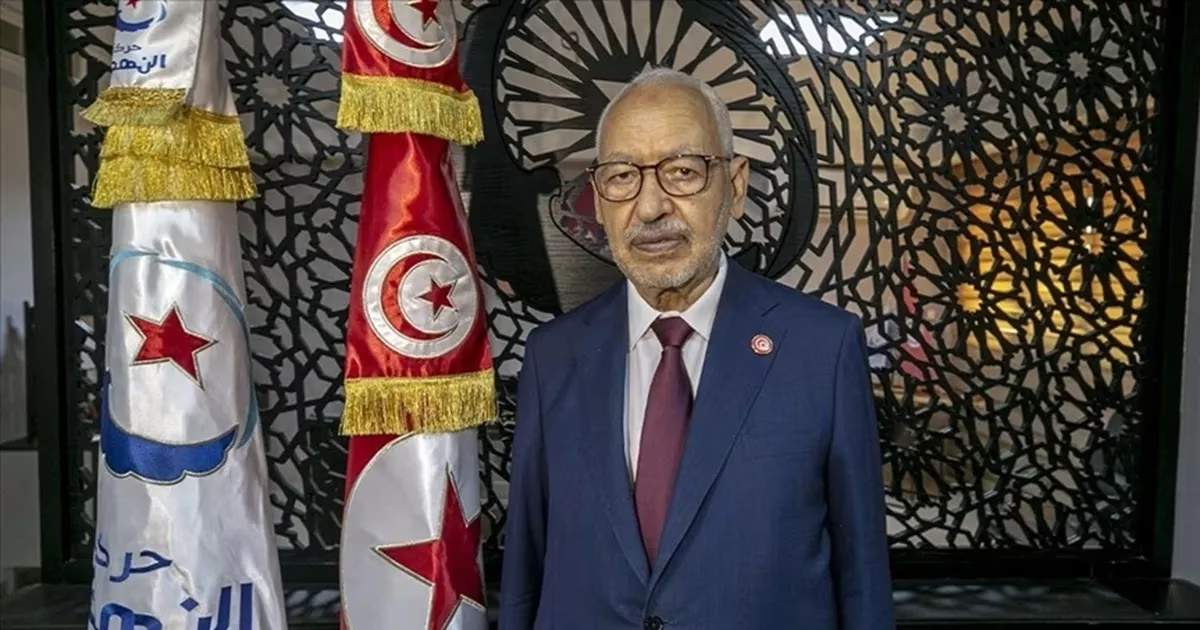







The Tunisian political scene raises profound questions about the utility of the Islamist current coming to power after the Arab Spring revolutions in 2011. Observers believe that this experience, which began as a harbinger of democracy, has turned into a heavy burden on the country and on the movement itself, placing it in direct confrontation with internal and international forces that reject the exercise of sovereignty outside established frameworks.
This situation brings to mind the experience of the Hamas movement in the Gaza Strip after its victory in the 2006 elections, where facts proved that the democracy that brings Islamists to power makes them a constant target. It appears that there is an undeclared international 'recipe' that prevents any political entity with an Islamic background from investing in democratic tools to achieve a liberation project free from global hegemony.
Islamists were long seen as guardians of identity and struggling victims who linked ethics with political action, making them a dream for broad sectors. However, their involvement in the corridors of power revealed carefully laid traps to entangle them in complex social, security, and moral crises, which they failed to effectively confront for a decade.
Over the past ten years, Ennahda movement leaders have fought battles in multiple and overlapping arenas, but they found themselves unable to prove their innocence from the suspicions and accusations that pursued them. With the exacerbation of living crises, the public no longer paid attention to facts as much as it observed the authority's inability to control chaos and address the ongoing economic collapse.
This inability led to what can be described as 'shattering the mirror,' where the image of Islamists was distorted in people's consciousness, paving the way for their isolation and imprisonment. Ideological media exploited this situation to incite public opinion, awaiting the preparation of legal files that legitimize their complete exclusion from the political scene.
In this context, clear pressures emerged on the judiciary, manifested in official statements warning judges against acquitting the accused, considering anyone who acquits them as their partner. These atmospheres led to the issuance of rulings described as severe in controversial cases such as the 'secret apparatus' case, which combined life imprisonment with additional years in prison and administrative surveillance.
These judicial rulings, according to analyses, do not occur randomly in the world of politics, but rather are subject to precise estimations involving experts in psychology and politics. It seems that the goal has shifted from distorting the movement's mental image to breaking the will and resilience that Islamist leaders were known for in facing previous adversities.
These legal procedures are considered part of a systematic 'political burial' process, aimed at pushing leaders to offer apologies or seek pardon from the current authority. It is an attempt to impose a new reality in which everyone declares their inability to bear a crisis that everyone participated in producing, but one party is intended to pay the full price under the weight of the 'logic of dominance.'
Nevertheless, politics remains governed by the laws of history that are not slow to manifest in the form of logical equations linking premises and conclusions. Political history proves that attempts at forced exclusion may lead to counterproductive results if crises are not addressed with a human essence and a cool head, far from impulses of revenge and settling scores.
Tunisia's current situation reflects a bitter struggle to control the scene, where force is resorted to instead of political rationality. In light of this deadlock, it seems that finding a 'way out' requires more than just patience; it requires sensing opportunities for breakthroughs that may appear on the horizon of intractable crises.
Analysts believe that the continuation of the current approach in dealing with the political opposition may further complicate the internal Tunisian scene. A state suffering from suffocating economic crises needs participatory approaches instead of 'breaking pride' policies that may increase societal and political division.
The bet on the disappearance of the Islamist current through judicial rulings may be a risky bet, given the social roots that this current possesses. Historical experiences indicate that excessive pressure generates unexpected explosions, or leads to transformations in the structure of political movements towards more radical paths.
Ultimately, the question remains about the Tunisian state's ability to restore its democratic balance away from the logic of exclusion. The country's political future largely depends on the ability of all parties to overcome the moment of confrontation and search for common ground that ensures institutional stability and the protection of rights and freedoms.
What is happening today in Tunisia is a real test of the values of justice and politics, where personal impulses intertwine with the requirements of governance. The light of hope will remain dependent on the ability of Tunisian society to produce political alternatives that respect pluralism and end the era of zero-sum conflicts that have drained the country's energies for many years.
The 'recipe' for dealing with Ennahda movement leaders has moved from 'shattering the mirror' to break the image in people's eyes to 'shattering the will.'
Share your opinion
From Image Shattering to Will Breaking: A Reading of the Fates of Ennahda Leaders in Tunisia