






Washington's Message
Washington – Saeed Erikat – 15/6/2026
News Analysis
American and Iranian officials stated on Sunday that they had reached an agreement on a peace framework aimed at ending the war between the two countries, lifting the American blockade on Iran, and reopening the Strait of Hormuz; these steps could lead to a drop in energy prices once oil shipments resume through this vital waterway.
US President Donald Trump wrote on his "Truth Social" platform - around 5:30 PM Washington time (21:30 GMT) on Sunday - saying: "The agreement with the Islamic Republic of Iran is now complete." His post came shortly after Pakistani Prime Minister Shehbaz Sharif - whose country played a mediating role - announced an agreement early Monday local time.
Sharif wrote that the agreement would be officially signed on Friday in Switzerland.
The exact terms of the agreement were not immediately clear; Sharif stated in a post on the "X" platform that the agreement stipulates "an immediate and permanent cessation of military operations on all fronts, including Lebanon."
Lebanon had been a thorny issue in the negotiations, with both Israel and Hezbollah ignoring calls from Trump and others to cease their mutual attacks in recent weeks.
Trump also stated that the Strait of Hormuz - a key shipping lane for global energy supplies that Iran had effectively closed for several months - would open on Friday, noting that he had issued an order to end the US blockade of Iranian ports.
Trump wrote: "Ships of the world, start your engines. Let the oil flow!"
Oil prices fell following the news; Brent crude futures dropped by 4% in early Monday trading, while US West Texas Intermediate crude fell by more than 4.6%.
Kazem Gharibabadi, Iran's Deputy Foreign Minister, stated that a broader agreement would be negotiated during the sixty-day ceasefire period, including sanctions relief. The fate of Iran's nuclear program would also be discussed in those subsequent talks, according to sources who spoke to Reuters earlier.
Thousands have been killed, mostly in Iran and Lebanon, since US and Israeli forces launched their first attack on Iran on February 28. Iran launched attacks on Israel and Gulf states hosting US bases, and effectively blockaded the Strait of Hormuz, leading to a rise in global energy prices; in response, US forces imposed a blockade on Iranian ports.
Political and diplomatic developments in the region accelerated with US President Donald Trump's announcement on Sunday of an agreement with Iran, a move described as potentially paving the way to end one of the most dangerous confrontations the Middle East has witnessed in recent years. While Trump spoke confidently about an almost complete agreement, and referred to ending the naval blockade on Iran and opening the way for a new phase of understandings, the scene appeared more complex from the Iranian side, where official ambiguity and hesitation persisted regarding the final ratification of the memorandum of understanding.
According to circulating information, the anticipated agreement will open the door for sixty-day negotiations aimed at solidifying the cessation of military operations and laying the foundations for a broader settlement that includes thorny security and strategic issues. Reports also spoke of an Iranian commitment not to seek nuclear weapons in exchange for arrangements related to freedom of navigation and regional tension reduction, but the final details remain far from fully clear.
While Pakistan, which played a pivotal role in mediation, announced that the official signing ceremony would be held in Switzerland in the coming days, sources close to the Iranian negotiating team confirmed that the final decision is still under legal, political, and technical review. This disparity between American enthusiasm and Iranian reservation reflects a clear gap in both parties' understanding of the nature and political limits of the understanding.
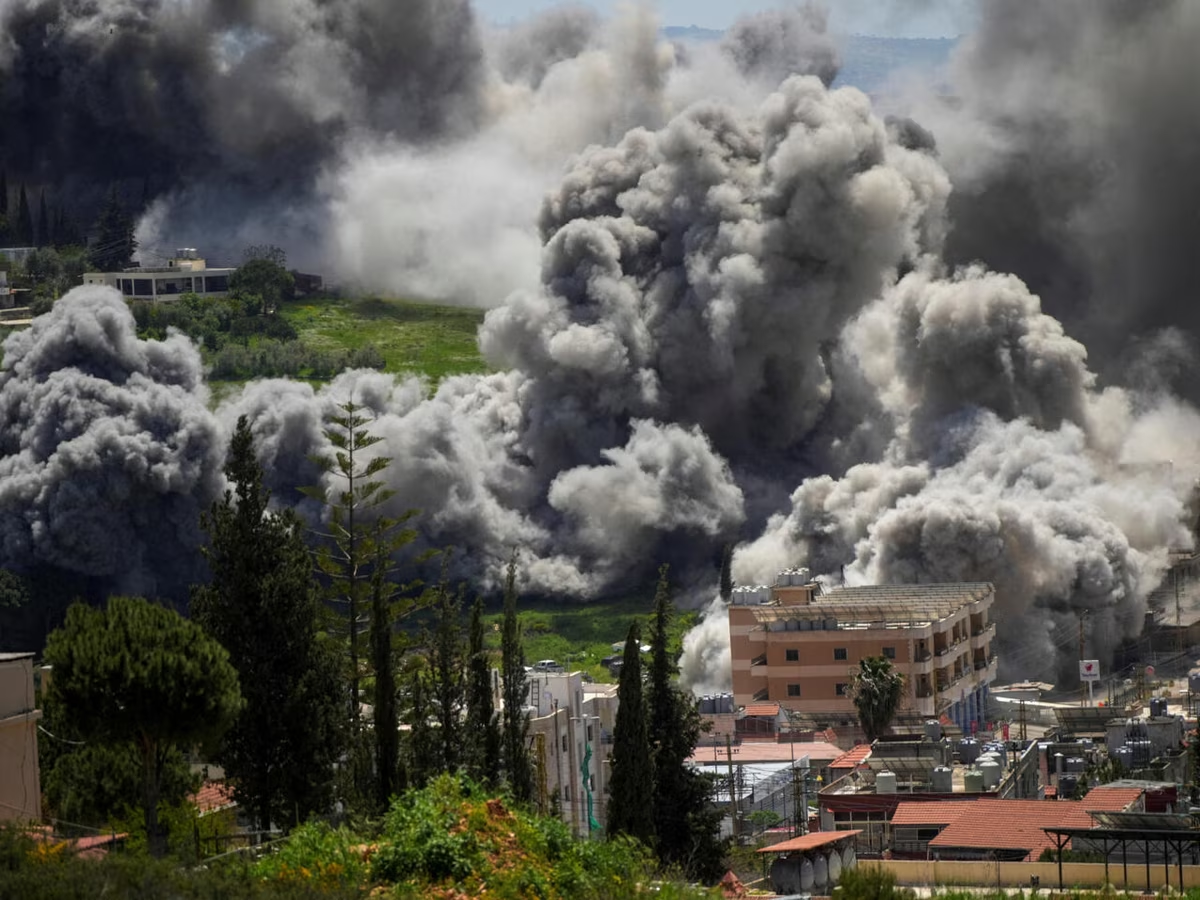
Israeli strikes on Beirut further complicated the scene. The raids targeted sites Israel claimed belonged to Hezbollah, resulting in casualties and rising smoke plumes over the Lebanese capital. Although Benjamin Netanyahu's government justified the operation as a response to attacks targeting northern Israel, its timing raised widespread questions, especially as it came at a sensitive moment preceding the final announcement of the anticipated agreement between Washington and Tehran.
Trump did not hide his displeasure with the military operation, considering that the Israeli attack "should not have happened" at a time when the region was approaching a rare opportunity for political understanding. This stance is an additional indicator of increasing discrepancies between the US administration and the Israeli government on how to manage the next phase, especially since any escalation in Lebanon could threaten to derail the entire negotiation process.
In parallel, Qatar re-emerged as an active mediator by sending delegations to Tehran to finalize the understanding, while Saudi Arabia and Turkey continued to support efforts to solidify the agreement. The multiplicity of mediators indicates a broad regional awareness that any collapse of negotiations would return the region to a cycle of military and economic escalation.
The manner of announcing the agreement reveals the extent of the imbalance in the political narratives between Washington and Tehran. While Trump seeks to present the agreement as a historic achievement proving the success of his pressure and power policy, the Iranian leadership tries to avoid appearing as the party that made concessions under pressure. Therefore, Iranian statements seem more cautious and ambiguous. The real battle is no longer just about the terms of the agreement, but about how to market it to domestic public opinion in both countries, and who will convince their audience that they emerged victorious from the long confrontation.
The Israeli strike on Beirut cannot be separated from the political context surrounding the negotiations. Israel views with suspicion any American-Iranian rapprochement that could lead to easing Tehran's isolation or its gradual reintegration into the regional system. From this perspective, the recent military operations appear to be a political message as much as a security operation. They also remind Washington that any future arrangements cannot ignore Israeli calculations, even if the US administration prefers to prioritize diplomacy over military escalation.
Rising protests within Iran reveal a deep division that goes beyond mere disagreement over a specific agreement. Hardliners see any understanding with the United States as a threat to the political identity on which the Islamic Republic has been founded for decades. Supporters of negotiation, on the other hand, believe that continued open confrontation imposes heavy economic and social costs. Between these two trends, the Iranian leadership finds itself facing a complex equation: the need to alleviate external pressures on one hand, and the fear of inciting internal political conflict on the other.
Despite increasing talk of peace, the path to a stable settlement remains fraught with obstacles. Issues related to sanctions, frozen Iranian funds, the nuclear program, and the future of Tehran's regional influence have not been definitively resolved. Moreover, any security incident in Lebanon, the Gulf, or Iraq could quickly reshuffle the cards. Therefore, the anticipated agreement seems more like an initial framework for managing the conflict rather than a final settlement. Its actual success will depend on the parties' ability to overcome their internal crises before facing the region's challenges.
The Middle East stands at a pivotal moment that could open the door to a new phase of de-escalation or reproduce conflicts in different forms. Between the optimism expressed by Trump, the reservation shown by Tehran, the rising internal Iranian objections, and the clear Israeli concern, the region appears to be facing a complex political test whose results will determine the nature of regional balances for years to come. Until the anticipated signing date, the fundamental question will remain: Are we witnessing the beginning of true peace or merely a temporary truce preceding a new round of conflict?
Share your opinion
Washington and Tehran's Agreement Between Promises of Peace and Risks of Explosion: Lebanon Reveals the Fragility of the Anticipated Understanding