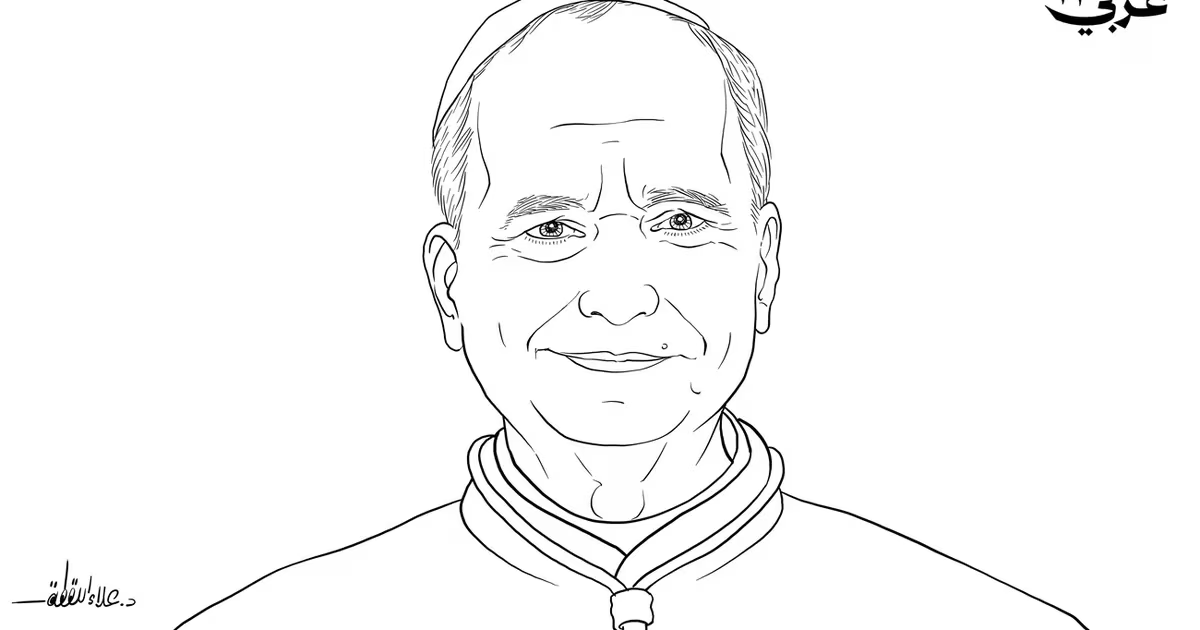







The relationship between the Vatican and the White House has entered a dark tunnel of unprecedented tension, with US President Donald Trump finding himself in a direct confrontation with Pope Leo XIV. This clash, which has gone beyond diplomatic norms, came against the backdrop of sharp criticism directed by the Pontiff at the policies of the US administration, especially regarding military threats against Iran and issues of dealing with migrants and the poor.
Pope Leo XIV, formerly known as Cardinal Robert Francis Prevost, is a native of Chicago and the first Pope to hail from the Augustinian order. Since his election last May as the 267th Pontiff, he has adopted a reformist approach that extends the path of his predecessor, Pope Francis, focusing on social justice and human rights, which has put him on a collision course with the unbridled mindset of the Trump administration.
The spark of disagreement ignited when the Pope criticized statements by US Vice President J.D. Vance, asserting that classifying love for others contradicts the teachings of Christ. The matter did not stop there but extended to criticizing the forced deportation operations carried out by the US administration, considering these measures to lack the human spirit that should prevail in the international community.
The intensity of the confrontation escalated dramatically after the Pope described Trump's threats of 'annihilating an entire civilization' in Iran as 'absolutely unacceptable.' This strict moral stance prompted Trump to respond with a personal attack, describing the Pope as 'weak' and a failure in understanding foreign policy, even going so far as to question the legitimacy of his ascension to the papacy, claiming that his influence brought him to the Vatican.
In a clear and firm response, Pope Leo XIV rejected all manifestations of violence and injustice, affirming in a speech from the balcony of St. Peter's Basilica that 'God is not with the oppressors.' The Pontiff called for building bridges of dialogue instead of beating the drums of war, emphasizing the need to stop worshipping self, money, and the display of power that leads to the destruction of peoples.
The crisis was not without strange scenes, as Trump posted an AI-generated image on his 'Truth Social' platform showing him in a form close to Jesus Christ, before deleting it later. This move sparked a wave of resentment within church circles, where observers considered it an attempt to employ religious symbols in narrow political and electoral battles.
For his part, the President of the US Conference of Catholic Bishops, Paul Coakley, expressed his deep disappointment with Trump's statements insulting the Pope's religious standing. Church sources confirmed that these insults do not only affect the Pope personally but also millions of Catholics who see the Vatican as a supreme moral and spiritual authority that should not be dragged into political squabbles.
In contrast, Vice President J.D. Vance tried to defend the administration's position, calling on the Vatican to focus on purely moral issues and leave politics to governments. However, this defense did not reduce the extent of confusion within the Republican Party, which fears losing the support of the influential Catholic bloc in the midterm congressional elections scheduled for next November.
International press reports indicate that this clash has turned into a 'political earthquake' shaking the traditional foundations of the religious right in America. The high sensitivity of the Catholic vote, especially in swing states, makes Trump's attack on the Pope an uncalculated risk that could cost him dearly at the ballot box.
Pope Leo XIV, who is fluent in several languages and has an academic background in mathematics and canon law, has demonstrated a great ability to manage crises with calmness and firmness. Since taking office, he has been keen to establish the foundations of 'social doctrine' that advocates for workers and the poor, inspired by the approach of Pope Leo XIII, who reigned at the end of the nineteenth century.
This crisis comes at a time when the American economy is suffering from increasing pressures and rising energy prices due to escalating tensions with Tehran. Analysts believe that Trump's insistence on escalating with the Vatican adds a moral dimension to the economic crisis, putting the American voter before difficult choices between party loyalty and religious principles.
Informed sources reported that prominent Catholic activists, who were previously part of religious freedom committees in the Trump administration, have begun to express their public displeasure with the President's behavior. This shift in positions constitutes real confusion for the Republican electoral machine, which relies heavily on mobilizing religious people behind its candidates.
The current conflict between the White House and the Vatican is no longer just a disagreement over the concept of 'just war' or public policies, but has become a confrontation over fundamental values. While the Pope calls for 'building bridges' and unity among peoples, the Trump administration seems to insist on an approach of confrontation and international isolation, even if it is at the expense of its relationship with the largest religious institution in the world.
The question remains in Washington political circles: Will Trump succeed in containing the anger of Catholic voters before it's too late? Current indicators suggest that Pope Leo XIV, with his quiet demeanor and measured statements, has indeed placed the American President in the most difficult electoral bind he has faced since entering the political arena.
God is not with the wicked, nor with the oppressors, nor with the arrogant... Enough of dragging the name of the Lord into speeches of death.
Share your opinion
Political Earthquake Between the Vatican and Washington: Pope Leo XIV Puts Trump in an Electoral Bind