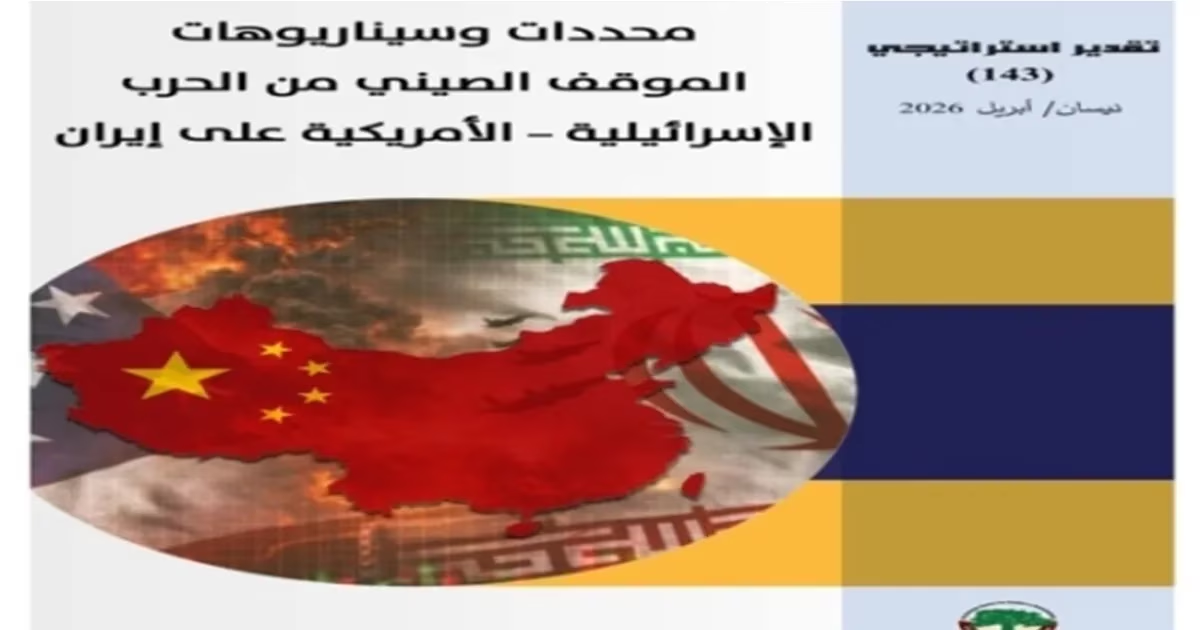







Al-Zaytouna Centre for Studies and Consultations issued a new strategic assessment, number (143), prepared by researcher Mohammed Makram Balawi, to shed light on China's complex stance regarding the ongoing confrontation between the US-Israeli axis and Iran. The report proceeds from the view that Beijing does not merely observe the crisis as a fleeting regional event, but rather deals with it as a real test of its international standing and vital interests.
China's actions in this matter are driven by three fundamental determinants: ensuring the flow of energy supplies, protecting its major geopolitical projects, and managing the escalating power struggle with Washington. Iran emerges in this equation as an indispensable strategic ally, not only because it is a major oil supplier, but also because of its position as a vital node in the Belt and Road Initiative.
By strengthening its relationship with Tehran, Beijing seeks to create alternative land corridors that reduce its historical reliance on maritime routes dominated by Western influence, specifically the Strait of Malacca. Consequently, any attempt to destabilize the Iranian state is considered a direct threat to China's national security and its vision for redrawing global trade maps.
Despite this strategic alignment, China pursues a very delicate balancing policy aimed at maintaining its extensive economic relations with Arab Gulf states and channels of cooperation with Israel. This balance compels decision-makers in Beijing to work to prevent Iran's collapse without engaging in a direct and open military confrontation with the United States.
The strategic assessment clarifies that Chinese support for Iran takes an indirect character, as Beijing continues to purchase Iranian oil despite severe international sanctions. It has also activated innovative financial tools such as the Chinese payment system (CIPS) to serve as an alternative to the global 'SWIFT' system, giving Tehran an economic lifeline away from dollar dominance.
Diplomatically, China leads active efforts within the corridors of the UN Security Council to block any resolutions that legitimize preemptive strikes or aim to change regimes by force. Beijing fears that such moves could turn into international legal precedents that might be used against it in the future in sensitive issues such as Taiwan or South China Sea disputes.
Beijing is also working to internationalize the Iranian crisis through alternative international platforms such as the 'BRICS' group and the Shanghai Cooperation Organization, with the aim of mobilizing a unified international stance against unilateral sanctions. This approach reinforces the 'Global South' narrative adopted by China to counter what it describes as the unipolar hegemony exercised by Washington and its allies.
On the operational and technical level, the assessment reveals that China provides advanced intelligence and technological support to the Iranian side, including sensitive cybersecurity areas. Beijing also allows Tehran to use the 'Beidou' satellite navigation system, which enhances Iran's defensive capabilities without the need for direct Chinese military involvement on the ground.
The report believes that China finds in the continuation of the current state of tension an opportunity to drain American resources and distract Washington's attention from the East Asia and Pacific region. This draining serves China's long-term ambition to accelerate the pace of transition towards a multipolar international system that ends American unipolarity in global decision-making.
Regarding future scenarios, the assessment suggests that China will continue its 'cautious ascent' approach, as long as the military confrontation remains within current controllable limits. Under this scenario, Beijing will continue to provide economic and diplomatic cover for Tehran while monitoring field developments with extreme precision to avoid any strategic surprises.
The assessment indicates the existence of clear Chinese 'red lines', the most important of which is preventing the collapse of the Iranian regime or the comprehensive destruction of its oil infrastructure, which could cut off energy supplies. Should Israeli or American attacks cross these lines, Beijing may be forced to raise its level of technical and intelligence intervention to unprecedented levels to protect its interests.
Broader strategic involvement, including a Chinese naval presence in the Strait of Hormuz or the protection of energy lines by force, remains an option in the event of an existential threat to Chinese interests. However, this option remains linked to the extent of American escalation and Tehran's ability to withstand increasing military and economic pressures.
Al-Zaytouna Centre concludes in its assessment that China's position represents a central factor in determining the outcomes of the conflict in the Middle East and Iran's ability to maneuver. China's policy, which blends caution with strategic maneuvering, may ultimately lead to a reshaping of the balance of power not only in the region but in the entire international system.
In conclusion, the report affirms that Beijing fully understands that the battle for Iran is part of a larger struggle over the shape of the coming world, and therefore it will not allow a strategic defeat for Tehran. This Chinese commitment, though wrapped in diplomacy and economics, represents a real bulwark against American and Israeli ambitions to reshape the region by force.
China views the war as a strategic opportunity to drain the United States and divert its focus away from East Asia, serving its ambition to transition towards a multipolar system.

Share your opinion
Strategic Assessment: How Beijing Manages the Balance of the US-Israeli Conflict with Iran?