






Washington – Said Arikat – 14/4/2026
News Analysis
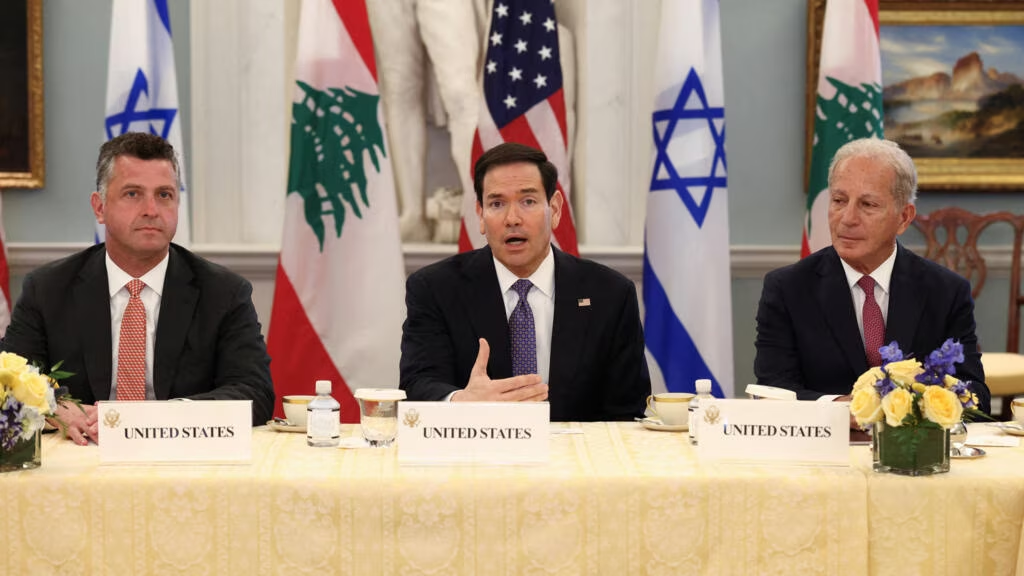
In a move that sparked widespread political debate, the US capital, Washington, hosted a meeting between the Lebanese Ambassador to the United States, Nada Mouawad, and the Israeli Ambassador to Washington, Yehiel Leiter, under the patronage of US Secretary of State Marco Rubio, and with the participation of the US Ambassador to Lebanon, Michel Issa, the US Ambassador to the United Nations, Mike Waltz, in addition to the advisor at the US State Department, Michael Wyndham.
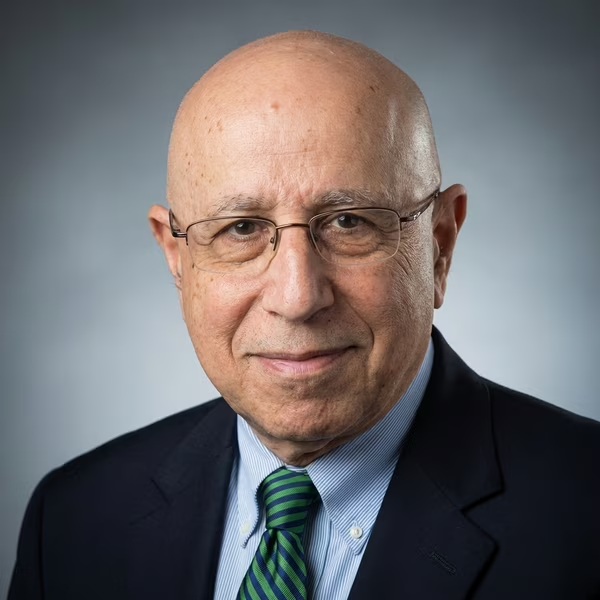
Israeli Ambassador Leiter is known for being one of the most extreme settlers. He was born and raised in America before making a settlement located north of Ramallah in the occupied West Bank his residence for many years. He did not stop at living there but also contributed to the establishment of 'One Israel Fund,' an organization dedicated to raising financial donations to support settlement projects and consolidate the presence of settlers in the occupied Palestinian territories.
According to a US State Department official who spoke on condition of anonymity, preparations for this meeting lasted for about a full month, i.e., before the date of the US-Iranian negotiations in Islamabad was set, in a clear attempt to separate the two tracks, despite their temporal overlap. The official stressed that the US administration believes there is no link between the talks with Iran and this Lebanese-Israeli meeting, indicating Washington's desire to keep each file within an independent negotiating framework.
In the same context of statements, the official emphasized that Iran “has dragged the Lebanese people into a war that it cannot then claim to protect them from,” considering Hezbollah an “unworthy terrorist organization that should have no political role, and its weapons must be completely disarmed,” affirming US support for this goal. He added that Washington would not allow Tehran to determine Lebanon's future, and that this meeting falls within broader efforts to redraw balances in the country away from Iranian influence.
On the humanitarian front, the official revealed that the US State Department recently approved new funding of $58.8 million to support humanitarian programs in Lebanon, aimed at providing vital assistance to displaced persons, including food, healthcare, water, sanitation services, and shelter, as well as supporting emergency response for those most affected by the conflict. He noted that Washington continuously coordinates with international organizations and donors to ensure that this aid is utilized within a coherent and effective international response.
Despite the official diplomatic nature of the meeting, political and media circles viewed it as a step lacking seriousness, considering it merely an attempt to create a visual scene showing Lebanon and Israel side-by-side under an American umbrella, without reflecting actual progress on core outstanding issues. This interpretation suggests that the meeting reflects a desire to achieve media breakthrough rather than a genuine negotiating path, in the absence of any indications of the parties' readiness to address sensitive files.
Critics also believe that the timing of the meeting and the nature of its diplomatic representation suggest that it is closer to a public relations initiative than a serious political effort, especially given the sharp internal Lebanese divisions regarding any form of communication with Israel. They add that this type of meeting may exacerbate internal tensions instead of contributing to their resolution, by giving the impression of an undeclared normalization process.
Observers warn that the American focus on disarming Hezbollah, regardless of addressing the broader context of the Lebanese crisis, may lead to counterproductive results, as this approach is seen as ignoring complex internal balances and reducing the crisis to its security dimension only, overlooking its political and economic roots.
This meeting reflects a traditional American approach that focuses on managing crises rather than solving them, where the emphasis is on creating superficial dialogue platforms without providing the necessary political conditions for their success. The absence of a clear agenda and the non-involvement of key Lebanese parties make it difficult to consider this meeting a serious step towards a sustainable settlement. Moreover, the insistence on separating negotiating tracks, despite their actual interconnectedness, reflects a simplistic reading of the complexities of the regional scene, which limits the chances of achieving a real breakthrough.
The meeting also raises the issue of Lebanese sovereignty, as its arrangement and management appear to have been largely carried out according to an external agenda, without clear internal Lebanese consensus. This reality reinforces the impression that Lebanon remains an arena for settling regional and international scores, rather than being an active party in determining its political path. Furthermore, focusing on disarming Hezbollah as the sole entry point for a solution ignores internal power balances and may complicate the scene rather than simplify it.
It is clear that the media dimension was strongly present in this meeting, as the appearance of representatives from Lebanon and Israel in one picture under American patronage constitutes a symbolic message directed at more than one party. However, this symbolism, in the absence of real political content, may be counterproductive, as it reinforces doubts about the meeting's objectives and fuels narratives rejecting any diplomatic openness. Therefore, the success of any future path requires moving beyond the logic of image towards a deeper and more realistic approach.
Share your opinion
Washington's Lebanese-Israeli Meeting: A Contentless Showcase and a Path Lacking Seriousness