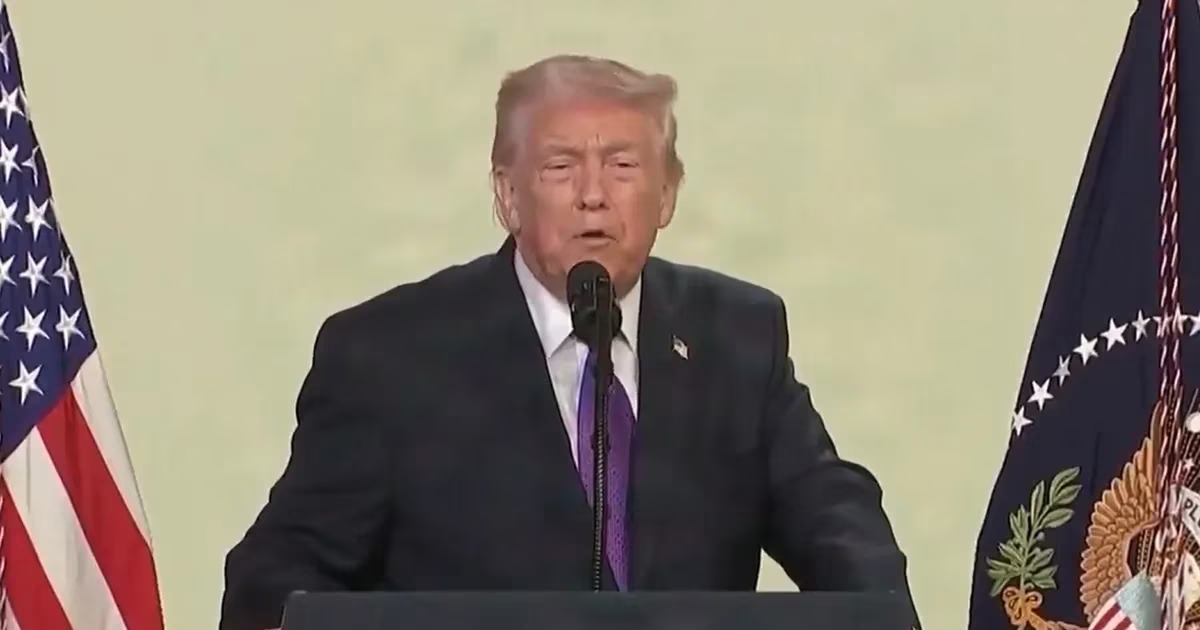







Amidst increasing military complexities between Washington and Tehran, calls have emerged from within the American analytical elite urging President Donald Trump to re-evaluate his strategic goals. Writer Thomas Friedman, in an article in the 'New York Times,' considered that the only available way out currently is to secure Iran's stockpile of enriched uranium, instead of clinging to the illusion of regime change, which facts have proven difficult to achieve.
Friedman pointed out that Trump and Israeli Prime Minister Benjamin Netanyahu waged a war on Iran based on false assumptions about the ease of overthrowing the authority there. This miscalculation led to underestimating the Iranian leadership's military resilience and its ability to threaten America's allies and close the world's most important waterways for energy transport, putting the global economy at risk.
The article touched upon the confusion experienced by the White House, where Trump issues contradictory statements about imminent victory at one time, and his inability to regain control of the Strait of Hormuz at another. This confusion reflects the absence of a clear plan for after military escalation, making the American administration appear as if it is placing the world's strongest army in a highly explosive environment without the slightest security precautions.
Friedman strongly criticized the government formation surrounding Trump, describing it as chosen based on personal loyalty rather than competence or commitment to the Constitution. He highlighted Secretary of Defense Pete Hegseth, pointing to reports about his adoption of extremist religious beliefs calling for the practice of 'overwhelming violence' against opponents, which transforms political conflict into a dangerous ideological confrontation.
Regarding the proposed solution, the writer believes it is necessary to simplify American demands to be limited to two fundamental items that guarantee regional security. The first item is Tehran's abandonment of more than 950 pounds of highly enriched uranium, in exchange for the second item, which is official American guarantees not to seek to overthrow the Iranian regime or target its political stability.
This trade-off, according to the article, will lead to an end to all mutual hostilities, including aerial bombardment, ballistic missiles, and the blockade of maritime passages. It will also prevent the United States from sliding into a ground war on Iranian soil, a step everyone fears due to its catastrophic consequences for the stability of the entire Middle East.
Friedman quoted Professor John Arquilla as saying that the essence of the conflict lies in the Iranian regime's desire to survive, versus Washington and Israel's desire to prevent a nuclear bomb. Arquilla believes that both parties can achieve their primary goals if they have the courage to concede secondary goals that hinder reaching a comprehensive and sustainable settlement.
It appears that Trump has already begun paving the way for this tactical retreat, having recently described Iranian leaders as 'very rational' in surprising statements to reporters. Friedman considered this description nothing more than a cover for Washington and Israel's attempt to conceal their overestimation of their ability to resolve the conflict through air power alone without ground intervention.
Leaked information indicates the existence of back-channel negotiations taking place through Pakistan, where Trump's team is communicating with Iranian Parliament Speaker Mohammad Bagher Ghalibaf. Ghalibaf, who has wide influence within the Revolutionary Guard, is believed to be the party capable of striking a deal that guarantees the regime's survival in exchange for fundamental concessions on the nuclear file.
The article compared Trump's reckless approach with former President Barack Obama's policy, which was based on a deep understanding of the complexities of the Iranian scene. The 2015 agreement succeeded in imposing strict restrictions on the enrichment program, keeping Iran far from a nuclear bomb with enough time for an international response, which Trump destroyed with his unilateral withdrawal.
After years of 'maximum pressure' policy, the United States found itself facing a bitter reality, where the time Iran needs to produce a nuclear weapon has shrunk from a full year to a few weeks. This strategic failure places the current Trump administration before difficult choices, the least bad of which is bitter, in the absence of any effective alternative to the agreement that was torn up in 2018.
Friedman emphasizes that simplifying the problem is the only way to a solution, by providing guarantees to stop the destruction of Iranian infrastructure and ease crippling oil sanctions. In return, Tehran must hand over all fissile materials that can be used in nuclear weapons under strict international supervision to ensure no return to escalation.
The success of this vision depends entirely on the Iranian leaders accepting this deal, which puts Trump's political fate in the hands of his sworn enemies in Tehran. The writer considered that matters reaching this point is conclusive evidence of the failure of American foreign policy that relied on threats without possessing the real tools for implementation.
In conclusion, Friedman warns that continuing the 'regime change' approach will inevitably lead to a comprehensive regional war from which no one will emerge victorious. Therefore, returning to the logic of mutual interests and securing the nuclear file as a top priority is the only rational option remaining to avoid a major explosion in a region that cannot tolerate more crises.
Trump must abandon his 15-point plan and condense it into two points: Iran giving up highly enriched uranium in exchange for Washington giving up its efforts to change the regime.

Share your opinion
New York Times: Trump must trade 'survival of the Iranian regime' for enriched uranium