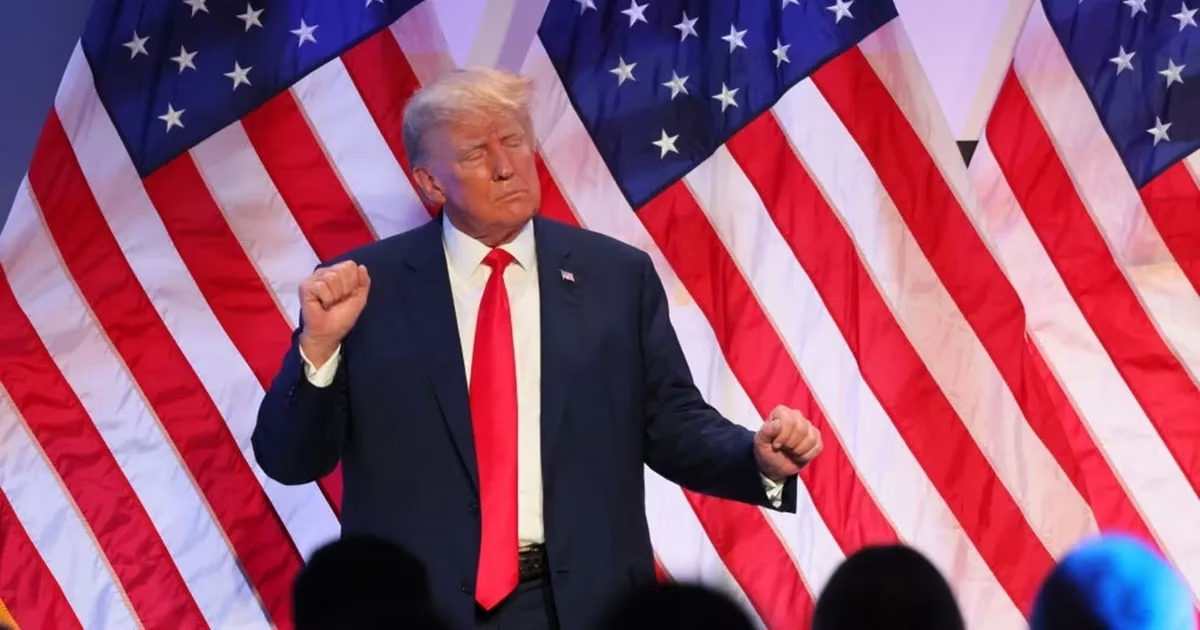







The turbulent political scene has brought renewed attention to the book 'The Dangerous Case of Donald Trump,' a collaborative work co-authored by 27 psychiatrists and mental health experts. Edited by Dr. Bandy Lee, the book sparked widespread debate about the limits of expert intervention in public affairs and the legitimacy of analyzing leaders' personalities from a scientific perspective.
The contributors to this work do not offer a direct medical diagnosis of Trump, adhering to professional standards that prohibit diagnosis without a clinical examination. However, they relied on the ethical principle of 'duty to warn,' considering it the right of specialists to alert to dangers when it concerns a personality controlling the fate of an entire society.
The authors focus on recurring behavioral traits in Trump's public performance, most notably extreme narcissism, impulsivity, and a lack of empathy for others. Experts believe that the combination of these qualities in a person with vast authority could lead to unpredictable decisions characterized by high risk.
The book discusses what is known as 'the Trump effect,' which is the potential for polarizing and hostile discourse patterns to spread from the top to the base of society. This effect could change the general political culture and create a state of permanent tension in social and political relations within and outside the United States.
Reactions to the book varied between supporters who saw it as a responsible attempt to interpret influential leadership behavior, and opponents who considered it an unacceptable mixing of science and politics. Critics argue that using psychoanalysis as a tool in political conflict opens a dangerous door to the politicization of psychiatry and its employment against adversaries.
The true value of the book transcends diagnosing a specific man, extending to questioning the system that allows personal temperament to control the fate of nations. The central question here concerns how the keys to power are handed to a personality whose decisions rely on mirrors of admiration and a continuous search for public applause.
From a professional angle, the book draws attention to a behavioral pattern based on rapid escalation and heavy reliance on direct public influence. This pattern transforms momentary emotional reactions into official political signals, confusing international calculations and making it difficult to predict future steps.
A balanced assessment places Trump's behavior in a gray area that blends a strong presence and ability to mobilize with arrogance and constant volatility. This mixture raises legitimate questions about the extent of rationality and stability in managing major crises that require calm and wisdom away from emotional outbursts.
In the context of the ongoing confrontation with Iran, a question arises about the extent to which these personal traits reflect on the complex conflict's trajectory. Despite the role of military and diplomatic institutions, the individual leadership style remains a crucial factor in steering escalation or de-escalation in critical moments.
Sharp statements and fluctuating signals can raise the level of risks by pushing other parties towards more rigid positions due to misunderstanding. In an environment charged with nuclear and regional issues, political language carries a weight equivalent to military field movements on the ground.
On the other hand, observers believe that this ambiguity and impulsivity could act as a psychological deterrent, making adversaries fear taking escalatory steps. An adversary facing an unpredictable leader often tends to be extremely cautious to avoid unconventional reactions that might surprise their strategic calculations.
However, this type of deterrence remains a double-edged sword, as it increases the likelihood of fatal miscalculation among warring powers. When contradictory signals multiply and the tone changes rapidly, it becomes difficult for international parties to control the pace of the crisis and prevent its slide towards an all-out confrontation.
Analytical readings suggest that Iran might benefit from this contradiction by deeply analyzing Trump's statements and hedging against all possible eventualities. Prior knowledge of a leader's tendency to declare what they intend to do gives the adversary an opportunity to prepare for the worst-case scenarios and strip fiery statements of their shocking effect.
Ultimately, this case reflects an unprecedented overlap between psychology and public life in the modern era. It puts contemporary civilization to a real test on how to protect international institutions from the whims of individuals and the instincts of leaders who excel at tension more than diplomacy.
The true value of the book lies in exposing a time when personal temperament controls the fate of nations, where momentary reactions turn into official policies.


Share your opinion
Between Psychology and Politics: A Reading of 'The Dangerous Case of Donald Trump' and Its International Repercussions