







Washington - Said Arikat - 27/3/2026
News Analysis
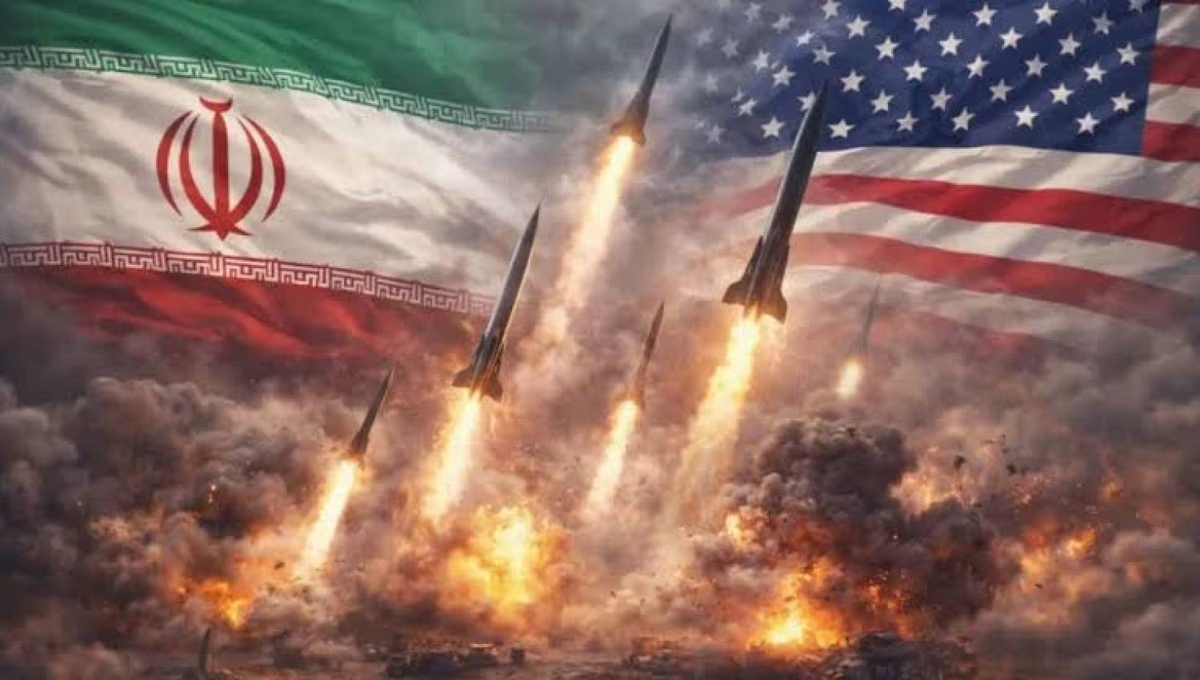
US President Donald Trump's statements on Thursday reveal structural contradictions in managing the confrontation with Iran, where the rhetoric of military decisiveness intersects with a tendency to keep the door to negotiation ajar, without a coherent strategy linking the two paths. His announcement that military operations are progressing at a "very advanced" pace not only attempts to market a quick achievement but also raises questions about the accuracy of initial assessments and the limits of declared objectives.
Trump's talk of exceeding the timeline for the operation, estimated between four and six weeks, cannot be separated from the political need to demonstrate superiority, especially given domestic sensitivities towards long wars. However, this rhetoric deliberately ignores the complexities of the field, where progress is not measured solely by time, but by the extent to which sustainable strategic goals are achieved. In this context, it appears that the US administration is confusing tactical achievement with strategic success, a confusion that has often led to prolonged crises in previous experiences.
More problematic is Trump's hesitation regarding concluding an agreement with Iran, despite acknowledging the Iranians' negotiating skill. This hesitation does not reflect calculated caution as much as it reveals the absence of a clear vision for the end of the conflict: Is the goal to change Iran's behavior, weaken it militarily, or impose a settlement on American terms? Leaving these questions open weakens the credibility of American discourse and gives Tehran wider room for maneuver.
Regarding the references to Iranian "signs of goodwill," such as allowing oil tankers to pass through the Strait of Hormuz, Trump's presentation of them seems closer to propaganda than to a realistic reading. Such steps, if true, might be part of an Iranian tactic to buy time or relieve pressure, and not necessarily evidence of a strategic shift. However, the US administration is quick to present them as proof of the success of military pressure, in an attempt to bolster its domestic narrative.
The vague talk of an Iranian "gift" in the energy sector reflects a recurring pattern in Trump's rhetoric of making grand statements without providing details, which opens the door to interpretations and undermines transparency. This ambiguity not only serves the negotiating tactic but also confuses allies and weakens confidence in the credibility of the American position, especially when coupled with a controversial proposal about the possibility of controlling Iranian oil.
This latter proposal clearly reveals the economic dimension of the American approach and raises questions about whether the war is also being driven by resource-related motives, and not just security or stability. Moreover, invoking the Venezuela model in this context reflects an oversimplification of fundamental differences between the two cases, reinforcing the impression that foreign policy is sometimes formulated with a transactional logic rather than a comprehensive strategic vision.
In contrast, the negotiating track, as presented by US envoy Steve Witkoff, appears to operate relatively independently of the President's political rhetoric. The reference to a "working list of 15 items" and the existence of "strong indications" of a potential settlement reflects a more traditional diplomatic effort, based on a mix of pressure and incentives. However, the success of this track remains contingent on its consistency with messages emanating from the White House, a consistency that seems to be missing so far.
The role of mediators, especially Pakistan, gains double importance in light of this disparity, as it constitutes a necessary channel to avoid misunderstandings between the two parties. But the increasing reliance on mediators also reflects a lack of direct trust and confirms that the crisis has not yet reached a stage of true negotiating maturity.
In this context, Trump's decision to extend the deadline for striking Iranian energy facilities by ten days, ending on April 6, can be read as additional evidence of a lack of decisiveness in decision-making. The move, presented as a response to an Iranian request, may in fact reflect hesitation to bear the consequences of escalation, especially if things get out of control. It also reveals a pattern of crisis management based on tactical retreat without a comprehensive reassessment of strategy.
Ultimately, the current American approach seems closer to daily crisis management than to a long-term strategy. The combination of military escalation, optimistic rhetoric, and the hint of negotiation, without a clear framework linking these elements, creates a state of ambiguity that could increase the risks of miscalculation. In an incendiary regional environment, such an approach not only threatens to prolong the conflict but also raises the probabilities of it sliding into a wider confrontation that would be difficult to contain.

Share your opinion
When Escalation Precedes Calculation: US Confusion in Managing the Confrontation with Iran