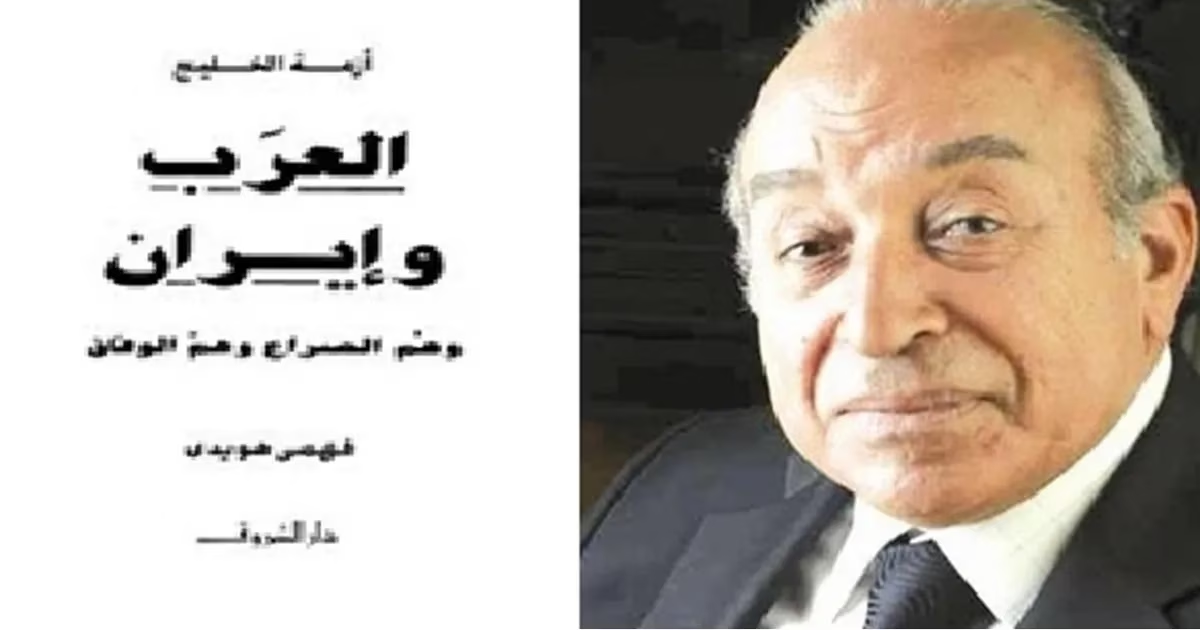








Fahmy Howeidy's book, 'The Gulf Crisis, Arabs and Iran: The Illusion of Conflict and the Illusion of Accord,' is an important reference for understanding the complexities of the relationship between the two sides of the Gulf. The book, whose first edition was published in the early nineties, was the result of a precise monitoring of major conflict stations, attempting to deconstruct prevailing narratives about historical and geographical animosity.
Howeidy's analysis is based on the premise that the Middle East region rests on three main pillars: Egypt, Turkey, and Iran, while the balance of power in the Gulf is formed by the triangle of Saudi Arabia, Iraq, and Iran. This description makes Tehran a common denominator that cannot be overlooked when discussing any security or political arrangements in the region.
The author argues that the essence of the existing dispute is not sectarian between Sunnis and Shiites, as some promote, but rather a political struggle par excellence over influence and interests. He believes that political regimes often invoke history and dress it in religious garb to mobilize the masses and justify military clashes, citing the use of terms such as 'Qadisiyah' and 'Majus'.
In the concept of 'the illusion of conflict,' Howeidy warns of the danger of believing in the inevitability of perpetual war, considering that this perception serves the interests of external powers and the Zionist project. The depletion of the region's resources in zero-sum wars prevents its peoples from achieving the sustainable development and stability that future generations seek.
Conversely, the author introduces the concept of 'the illusion of accord' to criticize the superficial emotional view that ignores unresolved strategic issues. True reconciliation is not achieved by overlooking issues such as the occupation of islands or interference in internal affairs through proxies, but by confronting them clearly at the negotiating table.
The book also addresses the historical depth of Egyptian-Iranian relations, noting that they extend for many centuries before Christ, through various Islamic eras. He emphasizes that this relationship witnessed periods of intellectual convergence, the most prominent of which was the decision of the former Grand Imam of Al-Azhar, Mahmoud Shaltout, to recognize the Ja'fari school of thought.
Howeidy stresses a fixed geographical reality: Iran is a neighboring country whose existence in the region cannot be canceled or bypassed. Therefore, any attempt to achieve security in the Gulf by excluding Iran or allying against it with strange international powers will only lead to further tension.
The Iranian Revolution in 1979 constituted a radical turning point, as the state transitioned from the role of a 'policeman' allied with the West to a revolutionary force seeking to change the regional map. This transformation raised deep concerns among the Arab side, leading to a widening gap and a deepening state of mutual suspicion between the two parties.
Although the book did not keep pace with recent events in Syria, Yemen, and Iraq, its analytical framework remains valid for understanding Iran's national and Islamic motives. Each facet of the Iranian state has its own project that requires Arabs to have a precise understanding to deal with its field and political repercussions.
The author believes that the solution lies in adopting an approach of 'interest-based coexistence,' a necessity imposed by geography and shared history. This path requires courage to move from a mindset of continuous conflict management to a mindset of managing mutual interests that guarantee the rights of all parties.
Reducing the sectarian dimension is a fundamental step in this direction, by ceasing to inflame sectarian sentiments and focusing on legal and political issues. Disputes over borders and influence are negotiable and resolvable matters, unlike doctrinal conflicts that are endless.
Howeidy emphasizes the necessity of possessing an independent political will, away from international interventions that feed on the continuation of the Arab-Iranian conflict. Major powers often find in this conflict a market for weapons and a pretext for imposing guardianship over the region's resources and peoples.
Fahmy Howeidy's style in this book is characterized by diligent effort in collecting and organizing information, far from randomness or blind bias. He respects the reader's intellect and presents rich intellectual material that requires reading and contemplation, even if some disagree with some of his final conclusions.
In conclusion, the book remains a cry in the wilderness, calling for rationality and political realism in a region exhausted by wars. Building a comprehensive regional security system in which everyone participates is the only way to ensure stability in the Middle East, away from the illusions of conflict and false accord.
The acceptance of perpetual zero-sum conflict and the inevitability of war is a dangerous idea that serves the Zionist project more than it serves the peoples of the region.
Share your opinion
Between the Illusion of Conflict and the Illusion of Accord: A Reading of Fahmy Howeidy's Vision for Arab-Iranian Relations