





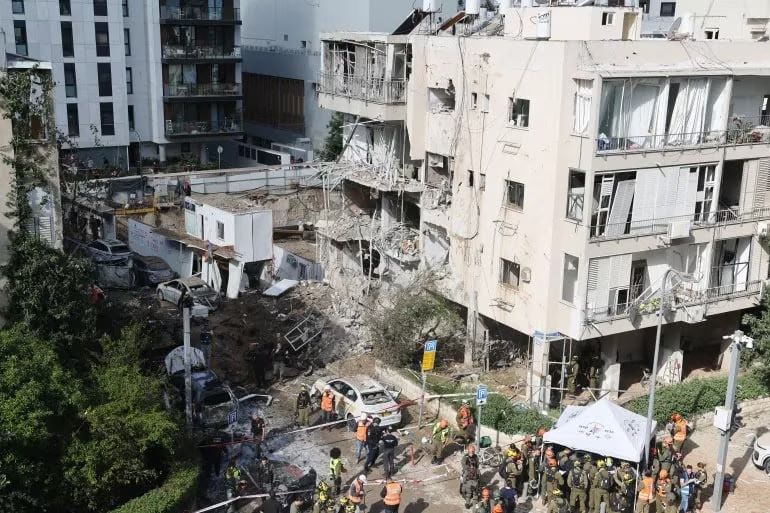
According to "The Hill" newspaper, based on reports issued in March 2026, the US-Israeli war on Iran, known as Operation "Overwhelming Fury," has sparked growing concern within decision-making circles in Washington, amidst clear indications of the depletion of US military resources and a decline in its operational readiness. Since the start of operations on February 28, 2026, field developments have shown that the high pace of fighting and the intensive use of munitions pose unprecedented challenges to US military capabilities.Data indicates a rapid consumption of air defense missile stockpiles and high-precision munitions, in light of intensive and continuous operations, with thousands of missiles and drones launched or intercepted during the first few weeks of the campaign alone, reflecting the unprecedented scale of escalation in this conflict. Reports also indicated the destruction of at least 16 American aircraft during the first three weeks, signaling the intensity of the confrontations and the ability of Iranian defenses to inflict tangible losses. In parallel, the US Navy faces significant logistical pressures, as about 40% of available aircraft carriers have been deployed in the region, limiting the ability to respond to other potential crises.These data raise serious questions about the nature of modern warfare, which increasingly relies on advanced technology and precision munitions. The rapid consumption of these resources reveals a gap between production capacity and operational expenditure in wartime, which may force the United States to re-evaluate its military strategies. It also reflects a shift in the balance of power, where military dominance is no longer measured solely by technological superiority, but also by the ability to sustain long-term conflicts. Hence, the challenge no longer seems limited to achieving superiority on the battlefield, but extends to the ability to maintain this superiority for long periods without severe depletion.In the same context, US Department of Defense officials warned that the continuation of the campaign at this pace could negatively affect the readiness of US forces to confront other threats, especially in the Indo-Pacific region, where tensions are escalating with rival international powers. These warnings indicate the possibility of a "strategic pause" in US deterrence capability on multiple fronts, which could open the door for other adversaries to test the limits of US power in different regions of the world. Regarding human casualties, operations during the first three weeks resulted in injuries to more than 200 US soldiers, in addition to the deaths of 13 others, increasing political and internal pressure on the US administration.These developments reflect a shift in the nature of the confrontation between major powers and regional adversaries, where relatively weaker parties resort to unconventional strategies to prolong the conflict. Instead of direct confrontation, the focus is on exhausting the adversary economically and militarily, which may lead to a change in traditional rules of engagement. In this context, Iran seems to be betting on the factor of time, benefiting from the complexities of the regional scene and the intertwining of international interests, making a quick resolution elusive, and pushing towards more complex scenarios where military dimensions may intertwine with economic and political ones.The repercussions of the conflict extended beyond the direct operational arena, as Iran launched retaliatory attacks targeting US bases and infrastructure of Washington's allies throughout the Middle East. These developments also led to the closure of the Strait of Hormuz to navigation, a vital passage through which about 20% of global energy supplies pass. This closure caused significant disruptions in global markets, with sharp increases in the prices of some raw materials reaching 165%, reflecting the fragility of the global economy to geopolitical shocks, and raising concerns about broader economic repercussions.The repercussions of the closure of the Strait of Hormuz reveal the strategic importance of maritime passages in the global economy, where a single choke point can cause widespread disruptions. This crisis also highlights the deep interconnectedness between security and energy, as any threat to supplies immediately reflects on markets and prices. In this context, the crisis may push major countries to accelerate plans to diversify energy sources and reduce reliance on traditional passages, which may reshape the global energy map in the future, and open the door for long-term geopolitical and economic shifts.In parallel, American analysts and officials raised concerns about the ability of the US defense industrial base to keep pace with the requirements of simultaneous conflicts in multiple regions, including the Middle East, Europe, and Asia. Previous warnings, dating back to 2024, when Israel exhausted huge quantities of American weapons and munitions in its war on Gaza, had pointed to this challenge, confirming that current military production may not be sufficient to support large-scale operations for long periods. These concerns are exacerbated by the rapid consumption of advanced missiles and munitions, which puts additional pressure on supply chains and manufacturing capabilities, and raises questions about the readiness of the United States to fight multi-front wars simultaneously.Overall, these developments reflect a complex picture of a conflict that extends beyond its military boundaries to include global strategic and economic dimensions, at a time when warnings are increasing about long-term repercussions that may reshape the international balance of power, and force major powers to reconsider their defense priorities and strategies in managing international crises.

ARAB AND WORLD
Tue 24 Mar 2026 2:12 pm - Jerusalem Time
Escalating Concerns in Washington Over the Depletion of US Military Capabilities Amidst Widening Confrontation with Iran

Tags
MORE FROM ARAB AND WORLD

Trump's Only Condition for War: Behind the Scenes of US Efforts to Avoid All-Out Confrontation with Iran

Trump: We don't need a deal to get Iran's uranium, and we've made progress on the Lebanon file

"Flamingo Revolution" Sweeps Albania: Widespread Protests Against Trump Family Investment Projects

Share your opinion
Escalating Concerns in Washington Over the Depletion of US Military Capabilities Amidst Widening Confrontation with Iran