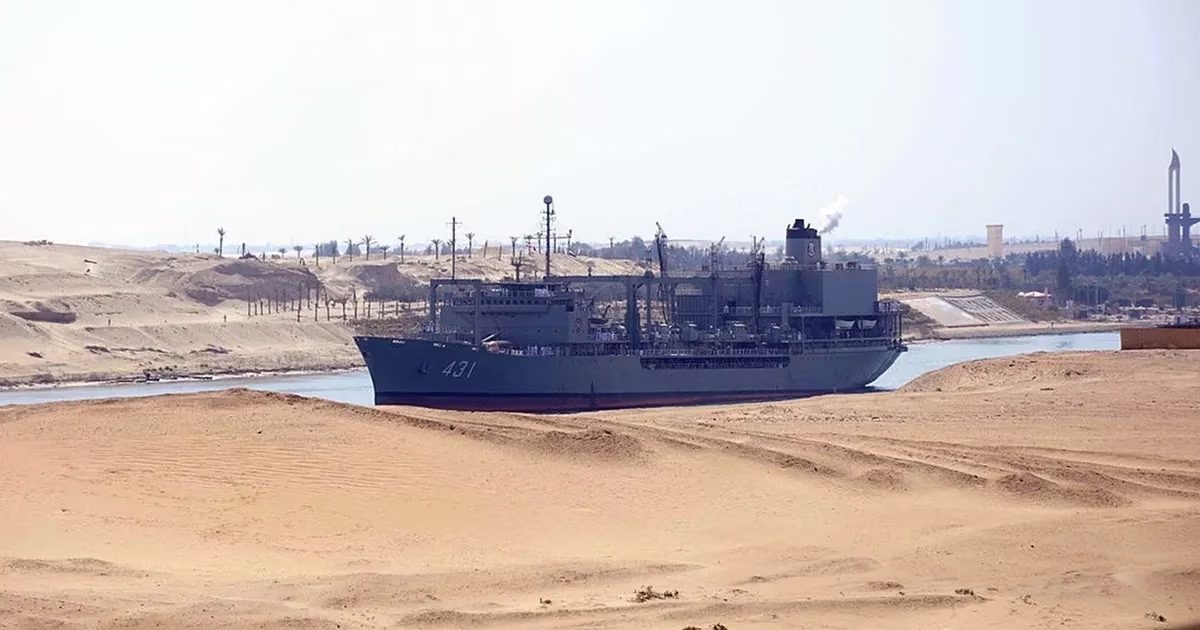







As the military escalation between the United States and Israel on one side, and Iran on the other, enters its fourth week, US President Donald Trump finds himself facing complex challenges in forming international cover for his operations. These moves come amidst internal accusations that Trump is drifting behind Benjamin Netanyahu's agenda, which aims to protect the Zionist project more than American national interests.
The White House is currently seeking to announce an "international coalition" under the pretext of protecting global navigation in the Strait of Hormuz, a demand that Trump failed to achieve before the current confrontations erupted. The conflict has gradually transformed into what resembles an "energy war," especially after Tehran succeeded in tightening its grip on vital passages for global oil supplies.
Informed sources confirm that the real goal behind the American call is to entangle international powers in a war aimed at overthrowing the Iranian regime, after Washington and Tel Aviv failed to achieve this goal individually. However, this desire has met a solid wall of European rejection led by major capitals such as Paris, Berlin, and London.
Statements from Britain, France, Germany, and Italy reflect a deep rift with the Trump administration, as these countries refuse to engage in an ill-defined military adventure. It appears that European leaders have learned from past lessons, preferring to maintain their political independence away from American dictates that could harm their economic interests.
European Commission President Ursula von der Leyen had paved the way for this trend with her statements about Europe's need to strive for strategic independence in a radically changing world. This trend is now translated into European eagerness not to get involved in a war aimed at absolute American control over the region without regard for the shares of other partners.
European interests are evident in the necessity of returning to the negotiating table to ensure the flow of oil and gas and the stability of global markets suffering from severe disruptions. Europeans believe that the continuation of the war threatens to permanently close the Strait of Hormuz and Bab al-Mandab, which would lead to an economic catastrophe that their peoples cannot bear the consequences of.
On the other hand, Iran is imposing its own rhythm on energy markets by establishing new equations, including the condition of using the Chinese Yuan as a currency for exchange in return for passage through the Strait of Hormuz. This tactic represents a direct challenge to American dominance over the global financial system and further complicates the military and field situation.
Iranian threats to strike vital energy facilities in the region, such as Kharg Island, have prompted the US administration to reconsider its targeting of Iranian oil facilities. The commander of the Iranian Revolutionary Guard stated that any attack on this island would create a harsh and unprecedented equation in global energy distribution.
Trump's confusion in his statements about American ships escorting commercial tankers reflects an inability to protect navigation unilaterally. His repeated request for other countries to participate in a "protection force" clearly shows the failure of American tactics in confronting Iranian countermeasures in waterways.
While Netanyahu insists on continuing the war to achieve aggressive goals, it appears that Trump has begun to look for a way out that saves face through a compromise agreement with the Iranian leadership. This outcome may essentially resemble the nuclear agreement that Trump previously canceled, but the divergence of positions between Washington, Tel Aviv, and European capitals remains the dominant factor.
French President Emmanuel Macron affirmed in his contacts with the Iranian side that security can only be achieved through a new political framework, which is consistent with the German position rejecting NATO's role. The German Chancellor clearly stated that his country will not participate in this war and calls for its swift end to avoid further economic deterioration.
Italy, for its part, expressed through its foreign minister that diplomacy is the only correct approach to dealing with the Strait of Hormuz crisis, which strengthens the European rejection front. This European consensus weakens the legitimacy of any upcoming American military action and deprives Washington of the international cover it needs.
European rejection also stems from internal pressures, as European peoples suffer from skyrocketing prices and inflation resulting from successive energy crises. European leaders do not want to repeat the scenario of the Russian-Ukrainian war, which drained their economies for the sake of American geopolitical objectives.
Ultimately, Europeans realize that being drawn into Trump's and Netanyahu's policies could ignite a widespread regional conflict that threatens European territories themselves with Iranian missiles. Therefore, political wisdom dictates that they adhere to diplomatic solutions and demand an immediate cessation of aggression, which further isolates the American-Israeli position in the region.
Peace and security for all can only be guaranteed through a new political and security framework.

Share your opinion
The International Coalition's Dilemma: Can Trump Rally Europe Against Iran?