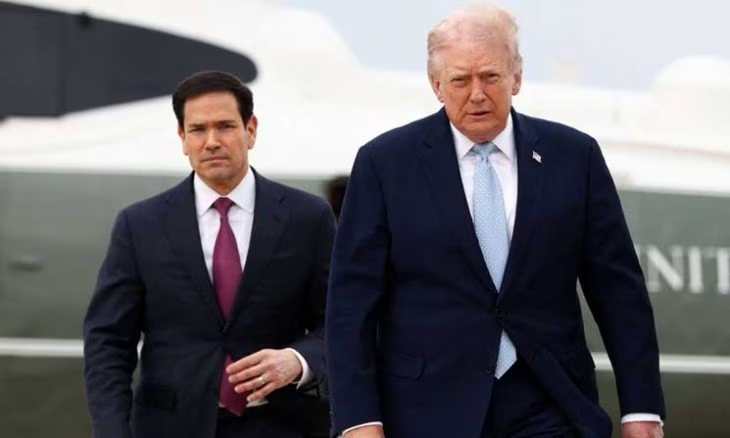







The American administration is experiencing a clear divergence in defining the ultimate goals of the war it is waging in cooperation with Israel against Iran, as observers have noted continuous changes in the political rhetoric of President Donald Trump and his senior officials. Critics believe that this fluctuation reflects the absence of prior planning for the conflict and its potentially serious geopolitical repercussions in the region, especially with the overlap of objectives between weakening regional influence and overthrowing the regime.
The outlines of this trend began on February 28, when Trump addressed the Iranian people directly via social media, urging them to take control of the government and overthrow their rulers. Trump considered the major military operations led by Washington and Tel Aviv to be a historic opportunity for Iranians that might not recur for generations to come, describing the military action as a means to empower internal change.
In parallel with calls for political change, the US administration focused on the military aspect, with Trump pledging to deny Tehran nuclear weapons and completely destroy its arsenal of ballistic missiles. Official sources confirmed that the plan includes leveling the missile industry and eliminating the Iranian naval fleet, under the pretext of protecting allies in Europe and US forces stationed abroad from imminent threats.
Despite Trump's assurances that Iranian missiles could soon reach American soil, intelligence reports and military experts questioned these claims, considering them to lack scientific accuracy. Technical sources indicated that the Iranian missile program still needs years before it poses a direct threat to the American heartland, recalling the pretexts that preceded the invasion of Iraq in 2003.
In early March, the war's timeline began to show significant contradictions, with Trump initially stating that operations might take only four weeks, then later raising expectations to five weeks or more. The US President indicated from inside the White House that forces were ahead of schedule, emphasizing that Washington possessed unlimited ammunition supplies, allowing it to successfully wage long-term wars.
For his part, Secretary of State Marco Rubio presented a different narrative for the outbreak of the conflict, suggesting that Israel's determination to attack Iran unilaterally was what prompted Washington to intervene directly. Diplomatic sources explained that the US administration preferred to launch preemptive strikes in coordination with Tel Aviv to avoid greater losses among US forces if Iran retaliated against a unilateral Israeli attack.
However, Trump contradicted his Secretary of State's statements, claiming that he was the one who pushed the Israeli side to military action, not the other way around, based on information that Tehran was about to initiate an attack. This contradiction in official narratives raised questions about the centrality of decision-making in Washington and the extent of actual coordination between the White House and the State Department in managing the war file.
The Department of Defense entered the fray of statements through Secretary Pete Hegseth, who set purely technical objectives of destroying Iranian security infrastructure and offensive capabilities. Hegseth stressed that the mission focuses on neutralizing the threat of missiles and the naval fleet, without delving into political details related to the nature of the ruling regime in Tehran, which showed a gap in rhetoric between Defense and the White House.
On March 6, Trump raised the bar for political demands to their maximum, announcing via his online platforms that he would not accept any political settlement or agreement with Iran that did not include 'unconditional surrender.' This hardline stance closed the door to any potential international mediation and placed the conflict in a zero-sum framework that does not accept compromises, further complicating the field and diplomatic scene.
Between March 8 and 11, there was extreme confusion regarding the assessment of war outcomes, with the Secretary of Defense describing it as 'just the beginning,' while Trump emerged the next day to say that the war was 'almost over.' When journalists confronted Trump with this contradiction, he replied that the war could be considered to have begun and ended simultaneously, claiming numerous victories but not enough to close the file permanently.
By mid-March, Trump began to soften his rhetoric towards the Iranian interior, admitting in a television interview that his call for Iranians to overthrow their regime faced significant obstacles due to civilians' lack of weapons. This relative retreat reflected a belated realization of the difficulty of achieving internal political change through air strikes and external military operations alone, without an organized armed opposition on the ground.
The US Department of Defense, for its part, tried to reconcile the temporal contradictions through statements by Hegseth, who affirmed that Washington would not commit to a specific timeframe for ending operations. The Secretary clarified that the final decision to stop the war rests solely with President Trump, when he decides that military objectives have been fully achieved, which leaves the door open for continued military attrition for an unknown period.
In the latest developments, Trump hinted via 'Truth Social' at the possibility of ending the great military efforts - as he described them - soon, considering that the objectives are within reach. However, he surprised observers with another statement confirming that he does not wish to sign a ceasefire agreement, indicating Washington's intention to end combat operations unilaterally without making any legal or political commitments.
These ongoing contradictions in the US administration's statements continue to raise concerns among allies and international observers alike, as there is no clear post-war vision. As military operations continue, the question remains whether Washington has a real exit strategy, or if it is drifting behind momentary decisions that change with President Trump's media positions.
There will be no agreement with Iran except on unconditional surrender.

Share your opinion
White House Confusion: Trump's Shifting War Goals in Iran Spark Controversy