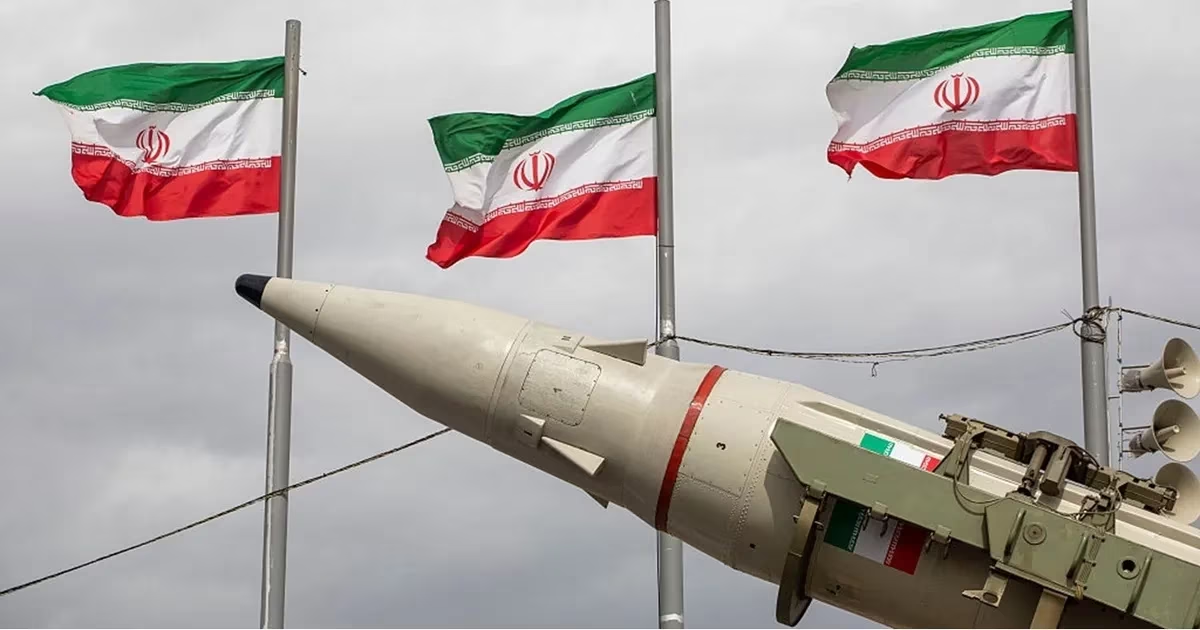







The Middle East region is currently witnessing an intense struggle between three main entities, each seeking to assert its existence by attempting to exclude the other. This conflict, which transcends traditional political boundaries, combines the legacy of ancient Persian civilization, the emergent occupying entity in the region, and the rising political and ideological components that reject Western hegemony.
Iran considers itself the heir to a civilization deeply rooted in history, basing its current stance on an ideological vision that places the liberation of Jerusalem and Palestine at the top of its priorities. Tehran believes that its role in the region extends beyond political empowerment to religious empowerment, especially in light of the division experienced by the official Arab system regarding the Palestinian issue.
In contrast, the Israeli occupation views the growing Iranian power as an existential threat that cannot be coexisted with, which has led it to strengthen its international alliances, particularly with the United States. This entity seeks to exploit American support to undermine Iranian influence before it becomes an uncontrollable force in the near future.
The current Israeli vision is characterized by the dominance of the religious right, which blends politics with biblical prophecies, promoting the idea of a holy war against adversaries. This approach finds wide resonance among evangelical currents in the West, transforming the conflict from a geopolitical competition into a zero-sum confrontation based on the principle of 'us or them'.
The third party in this equation is Hezbollah in Lebanon, which has found itself involved in the heart of this existential confrontation. Despite attempts at deterrence and containment, it has managed to emerge from international and local pressures to redefine its role as an effective military and political force in confronting Israeli ambitions.
Observers believe that Hezbollah fully realizes that the current battle is not only about geographical borders but about its existence as an ideological entity targeted for annihilation. Therefore, its involvement in fighting alongside its allies comes as a preemptive step to protect its political and military gains in the Lebanese and regional arenas.
The complexity of the current scene stems from the intertwining of historical dimensions with religious myths and contemporary strategic interests. With each party insisting on eliminating the other, the Middle East remains an open arena for a major struggle of wills whose outcomes will shape the political map of the region for decades to come.
The occupation knows today that its time has come according to its biblical prophecies, and therefore fights fiercely in a war it considers existential and holy.
Share your opinion
The Struggle for Existence in the Middle East: A Reading of the Intersection of Interests and Confrontation Between the Three Poles