







Washington – Said Arikat – 11/3/2026
News Analysis
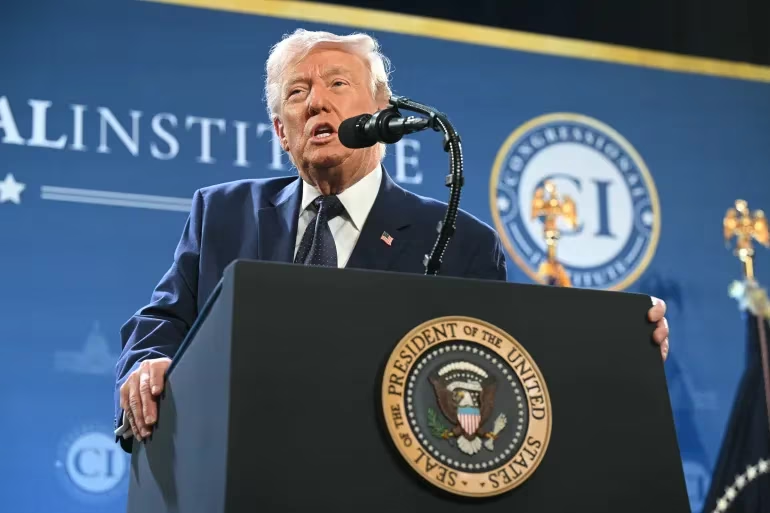
The war launched by the United States and Israel against Iran presents President Donald Trump's administration with a complex strategic dilemma. According to a critical reading of an article published in the "Financial Times," Washington appears to have entered a broad conflict in the Middle East without a clear vision of how to end it or manage its political and economic repercussions. This ambiguity is exacerbated by the clear contradiction in Trump's statements, which have ranged from announcing the imminent end of the war to vowing to continue fighting until the "complete defeat of the enemy."
It is worth noting that in a statement on Monday, Trump described the conflict as "completely over," a phrase that quickly reflected in global markets, as oil prices fell after a sharp rise driven by fears of supply disruption. However, this impression did not last long. Just hours later, the US president returned to a more hawkish rhetoric, emphasizing that the war would not stop before achieving a decisive victory. This fluctuation in political messages reflects, according to many observers, confusion in managing the war rather than a well-thought-out strategy to end it.
Ambiguity of Strategic Objectives
The fundamental problem in this war lies in the absence of a clear definition of its ultimate goals. Trump has spoken at different stages about destroying Iran's nuclear program, crippling its ballistic missile capabilities, bringing about a change in political leadership in Tehran, and even imposing "unconditional surrender." These objectives, while seemingly coherent on the surface, differ radically in their nature and requirements for achievement, raising a fundamental question about whether Washington has actually defined the goal it seeks.
Moreover, the war represents the largest American military deployment in the Middle East since the US invasion of Iraq in 2003, yet Trump described it as a "short mission." This contradiction between the scale of the military operation and the nature of the political rhetoric reinforces the impression that the US administration may have underestimated the complexities of the confrontation with Iran.
War and Attrition Calculations
Despite the severe blows Iran has suffered, including the assassination of Supreme Leader Ali Khamenei in the early days of the war, signs of a rapid collapse of the regime have not materialized. Tehran has shown an ability to reorganize its leadership and continue fighting, and has appointed a new figure at the top of the power hierarchy, the son of the assassinated Supreme Leader, Mojtaba Khamenei, in a move aimed at demonstrating political continuity.
Field data indicate that Iran has chosen a long war of attrition strategy, an approach it had prepared for years. Despite a decline in its ability to launch missiles compared to the early days of the war, it is still capable of carrying out missile and drone attacks against Israel and the positions of Washington's allies in the Gulf. This has disrupted trade and travel in the region, and led to significant disruptions in navigation through the Strait of Hormuz, one of the world's most important energy arteries.
Regional and International Repercussions
The repercussions of the war are clearly visible in the Gulf region, where some countries have been forced to temporarily reduce oil and gas production due to security risks. The leaders of these countries had previously warned that any widespread war with Iran could quickly turn into an uncontrollable regional conflict. Nevertheless, Trump – according to his statements – was surprised by Iran's attacks on countries that were not direct parties to the war, which again reflects a misjudgment of the nature of the regional conflict.
At the same time, the prospects for political change in Iran do not seem imminent. The protest movements that the country witnessed in recent years have almost disappeared with the outbreak of the war, as Iranians have become more concerned with their personal security amidst bombing, sanctions, and economic turmoil. Indeed, the war may give the Iranian regime an opportunity to strengthen its "resistance" rhetoric and mobilize public opinion around it.
End Dilemma
Given this reality, Washington's options appear limited. Continuing the war threatens to exacerbate the global energy crisis and endanger the international economy, and may also cast a shadow over the domestic political situation in the United States, especially with the approaching midterm elections. Ending the war quickly, however, might give Tehran an opportunity to declare "steadfastness" and claim political victory despite military losses.
In both scenarios, the Middle East remains prone to further instability, whether as a result of continued confrontation or due to the vacuum that may result from weakening the Iranian state without a clear political alternative.
The contradiction in Donald Trump's statements reveals a familiar pattern in his management of international crises, based on using strategic ambiguity as a pressure tool. However, this approach, which may sometimes succeed in commercial or political negotiations, becomes more dangerous in the context of wars. Conflicting signals may confuse adversaries, but at the same time, they confuse allies and global markets. In the case of the war with Iran, it seems that ambiguity has not become a deliberate strategy as much as it has become a reflection of the absence of a clear vision for what the end of the conflict should be.
Historical experience shows that overthrowing political leadership in countries with centralized systems does not necessarily lead to the collapse or surrender of the state. The opposite has happened in many cases, where external pressure has strengthened the regime's internal cohesion. In the Iranian case, the assassination of Ali Khamenei did not lead to the collapse of power, but rather prompted it to quickly rearrange the leadership hierarchy. This reflects the ability of Iranian state institutions, especially security and military ones, to maintain continuity even in the face of major political shocks.
The great paradox in this war is that its declared objectives may contradict its potential outcomes. Weakening Iran militarily may achieve tactical gains for Washington and its allies, but it may also open the door to more dangerous scenarios, such as the disintegration of the state or its transformation into an arena for internal and regional conflicts. Such a scenario could create a strategic vacuum in the Gulf and threaten global energy security. Therefore, the real challenge for decision-makers in Washington is not to win the war, but to manage the day after it.

Share your opinion
War Without a Clear End: President Trump's Strategic Dilemma in the War on Iran