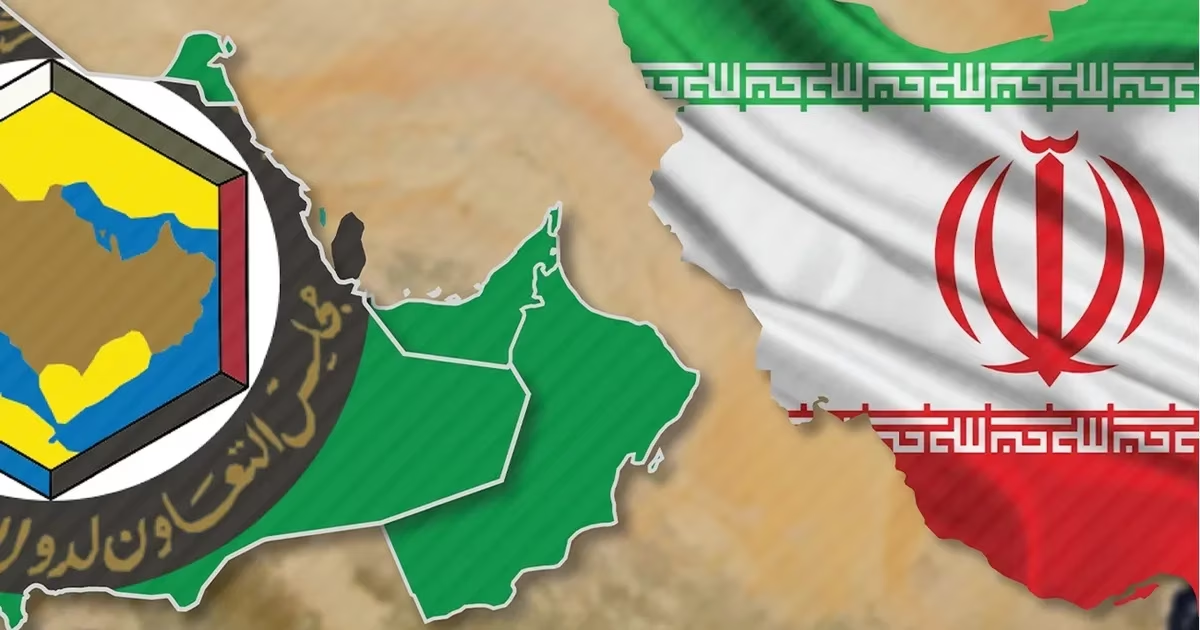







The book 'Iran from Within' by Dr. Nabil Al-Haidari, published by Dar Al-Arabia for Science Publishers, addresses the dimensions of Iran's rise in the region and how it has become a growing source of concern in Arab political discourse. In its concluding parts, the book reviews Tehran's growing influence in several Arab countries, and the historical and political claims it promotes regarding some Arab lands and islands.
The analytical reading of the book indicates that American imperialism linked its failure in Iraq to the growing Iranian hegemony, which prompted it to rally its allied regimes. According to the book, the Arab political map is divided between a majority affiliated with the West and a minority forming the 'axis of resistance' which includes Palestinian, Lebanese, and Syrian factions supported by Tehran.
The official Arab viewpoint adopts serious concerns about Iran transforming into a dominant regional power that exploited American troubles in Iraq and Afghanistan. Tehran has succeeded in building strategic alliances that enabled it to bring about a radical shift in the regional balance of power in favor of its political and sectarian project.
Iran has been able to employ its foreign policy to plant 'advanced centers of influence' in Arab countries to serve as leverage in its conflicts with the United States. This policy began with the Iranian Revolution through the slogan 'exporting the revolution,' then shifted to supporting minorities who share its religious and sectarian authority.
Analysts believe that the Iranian nuclear program has reinforced Arab fears about the imbalance of power and existential threats to national identity. This was evident in public statements by Arab leaders, such as the Jordanian monarch's warning of the 'Shiite crescent' and the former Egyptian president's questioning of the loyalty of Shiite communities to their countries.
The book touched upon the dispute over the three UAE islands (Greater Tunb, Lesser Tunb, and Abu Musa), confirming that their history is linked to the Arab coast for thousands of years. It noted that the occupation of these islands took place in November 1971 with British complicity prior to the declaration of independence of the United Arab Emirates.
Regarding Bahrain, Al-Haidari clarifies that Iranian claims lack historical basis, as the 'Dilmun' civilization predates the existence of the Persian state by more than two thousand years. Sumerian texts and archaeological evidence confirm that the peoples who inhabited this region were Semitic Arabs belonging to the Arabian Peninsula.
The book also addresses the issue of the Arab region of Ahwaz, which fell under Iranian control in 1925 after the Shah allied with the British occupation to abduct Prince Khaz'al al-Kaabi. Since then, Tehran has pursued extensive demographic change policies to erase the Arab roots of the region and change the names of its historical cities.
Ahwaz is considered the economic 'lung of Iran,' as former President Mohammad Khatami stated that it feeds the budget with 80% of oil revenues. Despite this importance, the Arab population suffers from marginalization and deprivation of their cultural and political rights, including the prohibition of wearing traditional Arab attire.
Ancient historians, including the Roman Pliny, confirmed the name 'Arabian Gulf' since the first century AD, noting that Arab tribes surrounded it from all sides. The Persians had no significant role in the trade or habitation of the Gulf; rather, Arab tribes such as Tamim and Bakr dominated its coasts.
In its conclusion, the book calls for the necessity of overcoming the Sunni-Shiite sectarian polarization fueled by external powers to tear apart the region. It believes that the continuation of this conflict serves only imperialist and Zionist interests that seek to weaken all major regional poles in the Middle East.
The critical vision of the book raises the region's need for a new Arab-Islamic regional project based on cooperation between Egypt, Turkey, Iran, and Saudi Arabia. This project aims to build a system of balance and stability that limits the costly arms race and stimulates joint development in the Gulf and the Fertile Crescent.
The analysis emphasizes the importance of building peace treaties and good neighborliness that end proxy wars and civil confrontations in countries like Libya and Yemen. It also calls for resolving border and water disputes, such as the Grand Ethiopian Renaissance Dam crisis, through fair agreements that ensure water and food security for the peoples of the region.
In conclusion, the book highlights that the only way to thwart external hegemonic projects is to formulate strong economic and political cooperation relations. Building a new anti-hegemonic regional system requires political will to overcome the legacy of the past and focus on the common interests of Arab peoples and their neighbors.
Iran has been able to plant advanced centers of influence in several Arab countries to be a strong supporter in any conflict with major powers.


Share your opinion
Iran from Within: Rising Regional Influence and Arab Fears of Hegemonic Projects