







Washington – Said Arikat
10/3/2026
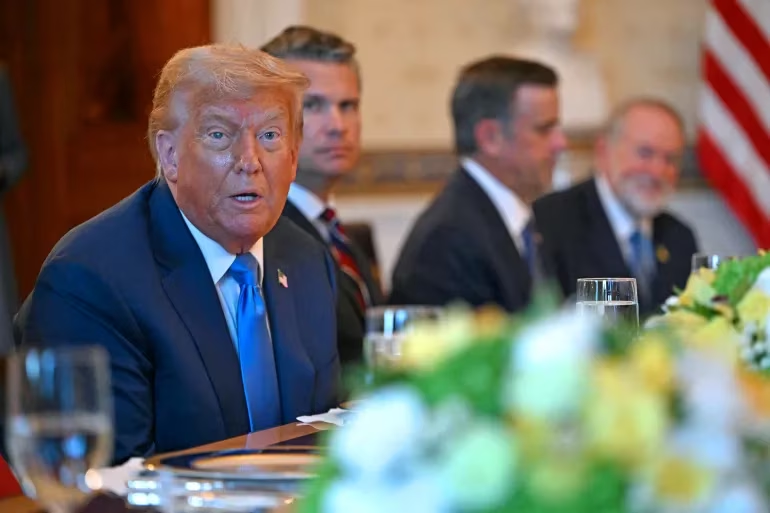
US President Donald Trump said on Monday afternoon that the war with Iran was “largely complete,” asserting that the United States was “far ahead” of the timeline he had initially estimated, which ranged between four and five weeks. Trump’s remarks came in an interview with CBS News.
Trump added that Iranian military capabilities had suffered significant blows, stating: “I believe the war is largely complete. They have no navy, no communications, no air force.”
When asked about navigation in the Strait of Hormuz, he indicated that ships were still crossing the strait, but said he was “considering taking control of it.”
In contrast, statements from Tehran suggest that the Iranian leadership is preparing for a long conflict with the United States, given its adherence to escalation and its refusal to return to the diplomatic path at the current stage. Kamal Kharrazi, foreign policy advisor to the office of the Supreme Leader, affirmed in an interview with CNN that his country is ready for a “long war,” considering that ending the conflict will only be achieved through widespread economic pressure that pushes international parties to intervene to stop what he described as “American and Israeli aggression” against Iran.
Kharrazi explained that Tehran no longer sees room for diplomacy at present, noting that his country had engaged in two rounds of negotiations with Washington, but attacks occurred at the same time those talks were ongoing, which – according to him – led to a complete loss of trust in the possibility of reaching a political settlement.
These statements reflect a clear hardening of the Iranian position after about ten days of the war’s outbreak. The leadership in Tehran is betting that the continuation of the conflict will lead to increased economic pressure on countries in the region and the world, as a result of disrupted energy markets, rising inflation rates, and supply shortages. Iranian officials believe that these pressures may push affected countries, especially in the Gulf, to pressure Washington to end the war.
On the ground, Iran expanded the scope of its attacks to include several countries in the Middle East, asserting that it targets American military interests in the Gulf states. However, multiple reports indicate that civilian facilities, including residential buildings and airports, have been subjected to repeated attacks, which increases regional tension and raises fears of the conflict’s expansion.
Iranian strikes have also affected global energy trade. Tehran exploited the fragility of the oil sector’s infrastructure and maritime transport routes, leading to a sharp decline in navigation through the Strait of Hormuz. At the same time, oil prices exceeded one hundred dollars per barrel, causing disruptions in global financial markets.
According to estimates by the “Rapidan Energy Group,” the conflict has disrupted about 20 percent of global oil supplies, a level far exceeding the impact seen in markets during the Suez Canal crisis in the 1950s. The conflict has also depleted what is known as the oil market’s spare production capacity, which is the ability that producing countries rely on to quickly increase production during crises.
Politically, Iran witnessed a notable development over the weekend with a shift in the power hierarchy, as Mojtaba Khamenei, son of former Supreme Leader Ali Khamenei, was appointed to the highest leadership position in the country. Observers believe this step may indicate the possibility of continued escalation. Kharrazi affirmed that the military and political leadership in Iran is fully united behind this approach.
For his part, Trump expressed his rejection of this appointment, considering it unacceptable, but Kharrazi responded by saying that it was “none of his business.”
Iranian statements indicate a clear shift in Tehran’s strategy for managing the conflict. Instead of relying on direct negotiations, Iran appears to be seeking to expand the economic cost of the war. Recognizing its limited ability to confront the United States militarily in a traditional way, Tehran relies on asymmetric tools, such as disrupting energy supply routes and stirring regional tensions.
This strategy aims to shift pressure from the battlefield to the global economy, which may push international powers, especially in Europe and Asia, to pressure Washington to contain the escalation.
Domestically, Mojtaba Khamenei’s rise to leadership reflects an attempt to maintain the regime’s continuity at a moment of decisive conflict. In wartime, strengthening the cohesion of the political and military leadership becomes a top priority, especially with the expectation of increasing economic and social pressures within Iran itself. However, Iran’s bet on exhausting the global economy may entail significant risks, as it could push the United States and its allies to intensify military strikes and sanctions, which could open the door to a broader regional conflict that would be difficult to contain in the short term.
Share your opinion
Trump: War on Iran Nearing End… Tehran Prepares for Long Conflict with US