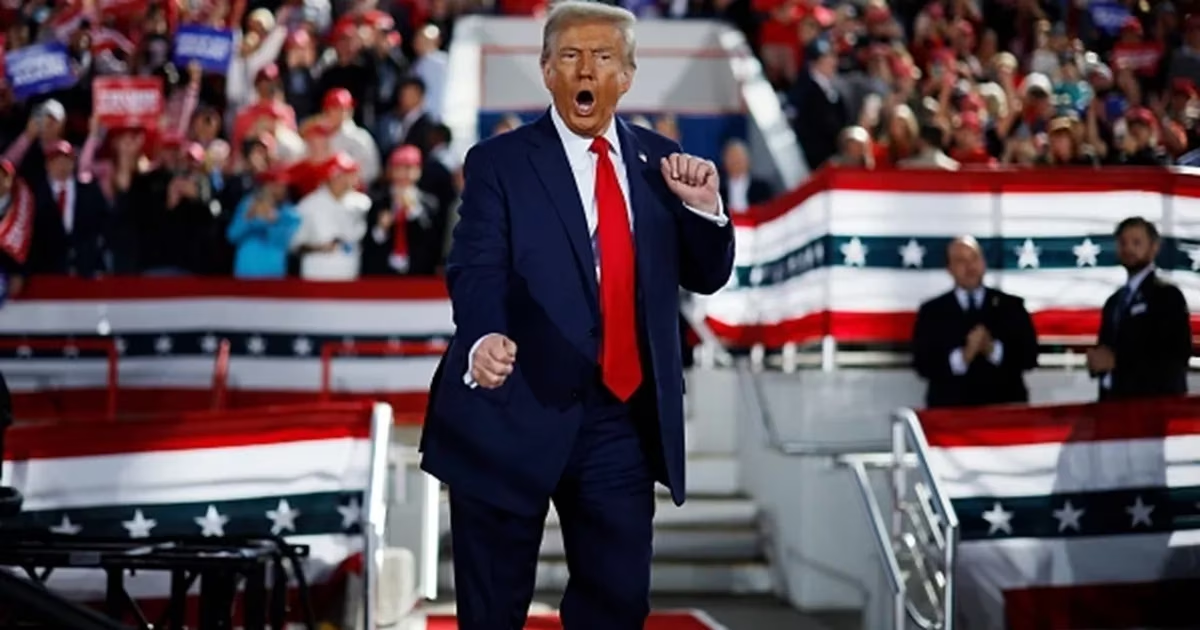







A recent study conducted by the Jerusalem Center for Public Affairs has revealed fundamental and alarming shifts within the Republican Party's electoral base in the United States. Researcher Irwin J. Itzhak Mansdorf confirmed that these changes are particularly evident among younger generations, who have begun to adopt positions contrary to the party's traditional tenets.
The report, published in international media, indicated that the rising influence of conservative media personality Tucker Carlson plays a pivotal role in shaping these new trends. Despite concerns about his stances on Israel, Carlson enjoys strong support that transcends traditional reservations among younger voters.
Mansdorf explained that contemporary democracies are witnessing a paradoxical phenomenon where candidates with extreme positions can rally widespread support. This occurs when these candidates' messages resonate with deep emotions or urgent concerns among the voter base, which explains the rise of some controversial figures.
The survey, on which the study was based, included a sample of 561 Republicans and was designed to be balanced in terms of age and gender to ensure the accuracy of the results. Interviews were conducted in late January, with a statistical margin of error not exceeding 4 percent, giving the results high credibility in interpreting the landscape.
The results showed a sharp generational divide, with over 55 percent of Republicans under the age of 44 considering Tucker Carlson a potential presidential candidate. The percentage went even further, with 58 percent of this group expressing full readiness to vote for him should he decide to run.
In contrast, older age groups appeared more cautious about this populist phenomenon, with only 38 percent of Republicans over the age of 45 believing in his potential candidacy. The willingness to vote for him among this group did not exceed 41 percent, reflecting a gap in political vision between generations.
Although the report noted continued general support for Israel across different groups, there was a relative decline in the intensity of this commitment among young people. 55 percent of younger Republicans considered supporting Israel a very important issue, compared to about 69 percent among the older generation.
The most controversial indicator in the study concerned the perception of Jews as a threat to the American way of life, with 45 percent of young people expressing high concern about this. This percentage is shocking compared to only 23 percent among Republicans over the age of forty-five.
Mansdorf believes that these numbers indicate a growing readiness among young voters to adopt narratives that portray Jews as a societal problem. This shift occurs even if these voters do not explicitly identify themselves as antisemitic, reflecting a change in political and social consciousness.
The researcher attributed this phenomenon to mechanisms of political psychology, where voters tend to focus on the candidate's personal charisma rather than the details of their political positions. Concepts such as the 'halo effect' make controversial stances on sensitive issues less impactful on the final voter decision.
The report warned that the real danger facing Israel and the Jewish community in America is not just a decline in direct support. Rather, the greater challenge is Israel losing its status as a crucial issue in electoral behavior amidst the rise of extremist populist rhetoric that attracts the younger generation.
The study emphasized the need to confront candidates with controversial agendas through strategies that clearly and objectively highlight their negatives. The researcher suggested using what is known as the 'horn effect' to expose inconsistencies in their rhetoric without falling into unproductive media squabbles.
In conclusion, Mansdorf affirmed that traditional Republican support for Israel has not completely collapsed yet, but it faces a real test. The psychological mechanisms that allow for ignoring alarming positions have begun to take root in the minds of young people, which could lead to strategic shifts in American foreign policy in the future.
The biggest challenge for political institutions remains how to deal with this generation, which appears more open to alternative narratives. The continuation of these trends could mean a redefinition of traditional alliances within the United States, requiring careful monitoring of public opinion trends in the coming years.
The real danger is not the direct loss of support, but the decline of Israel's role as a crucial political issue in the face of extremist populist narratives.



Share your opinion
Survey Reveals Deep Shifts: 45% of Young Republicans See Jews as a Threat to the American Way of Life