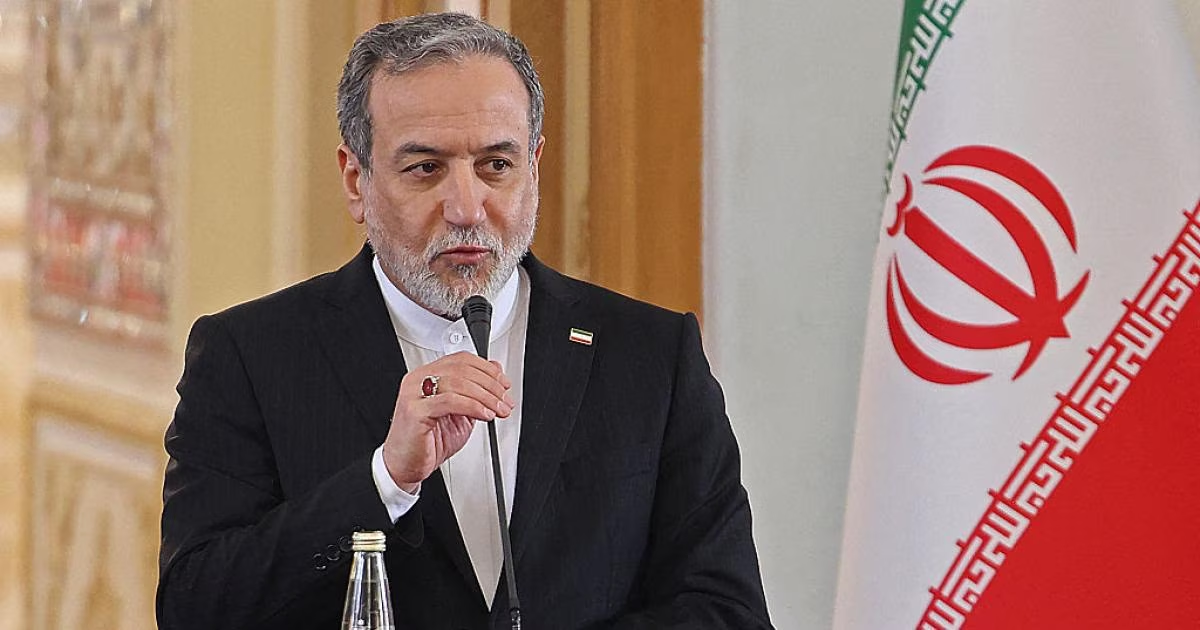







Iranian Foreign Minister Abbas Araghchi stressed that military plans aimed at achieving a swift victory over the Islamic Republic have completely failed. Araghchi explained in media statements that what he described as "Plan A," on which the adversaries relied, did not succeed in achieving its goals, emphasizing that any alternative plans would face a worse fate than their predecessors in light of current Iranian steadfastness.
Regarding strategic shipping lanes, the head of Iranian diplomacy indicated that Tehran currently does not intend to close the Strait of Hormuz, but it is closely monitoring developments. He affirmed that the Iranian armed forces are at the highest levels of combat readiness and are fully prepared to confront any attempt at a ground invasion that American forces might undertake on Iranian territory.
Araghchi strongly criticized the behavior of the American administration, stating that Tehran engaged in negotiations with Washington twice, and in both cases, Iran was subjected to military attacks during the talks. The Iranian minister held the United States fully responsible for the bloodshed and destruction resulting from the ongoing military escalation, describing American and Israeli objectives as illegitimate.
On the ground, sources reported that the Iranian armed forces are operating according to a strategy aimed at turning Iranian territory into a quagmire for any force that chooses to engage in ground warfare. The sources added that the military leadership in Tehran has prepared long-term defensive arrangements to confront the aggression that began last Saturday and targeted prominent facilities and leading figures.
In the context of diplomatic moves, Araghchi revealed that he held a series of intensive contacts with foreign ministers of regional countries, especially in the Arabian Gulf region. These discussions focused on the repercussions of military escalation and the necessity of maintaining regional stability under the current circumstances the region is experiencing due to ongoing attacks.
The Iranian contacts also included coordination with the Republic of Azerbaijan and the presidency of the Kurdistan Region of Iraq, where the activation of joint security agreements was emphasized. The Iranian side stressed the importance of securing borders and preventing any exploitation of neighboring territories in military operations, with a particular focus on border control from the Kurdistan Region.
These statements come at a time when Iran is witnessing a widespread military aggression launched by Israel and the United States, which has resulted in hundreds of casualties. According to field reports, the attacks targeted high-level leadership, while Tehran continues to respond by launching barrages of missiles and drones towards military targets and bases in the region.
For his part, the Secretary of Iran's Supreme National Security Council, Ali Larijani, issued a strong warning to the current US administration led by Donald Trump. Larijani's warning came in response to reports about Washington's intention to deploy thousands of soldiers to participate in ground operations deep inside Iran, describing this step as suicidal.
Larijani vowed that American forces would face fierce resistance from Iranian fighters, emphasizing that they are awaiting any ground movement to inflict heavy losses on the aggressors. He said that history would record thousands of dead and prisoners if Washington committed the folly of entering Iranian territory, stressing that his country would not be an easy place for invaders.
Iranian officials concluded their statements by emphasizing that true victory lies in the ability to resist and thwart the political and military objectives of aggression. They explained that the continuation of attacks on civilian targets and vital facilities would only increase the Iranian people's determination to defend their national sovereignty by all available means.
Plan (A) for a quick and clean military victory has failed, and your alternative plan, Mr. President, will suffer an even greater failure.

Share your opinion
Araghchi: The plan for a quick victory over Iran failed, and we are ready to face a ground invasion