






The international arena is witnessing intense diplomatic activity following military attacks launched by Israeli and American forces against targets in Iran. International reactions have warned of the situation getting out of control, amidst explicit calls for the necessity of returning to the political path and avoiding military options that threaten the stability of the Middle East and the world.
In this context, Omani Foreign Minister Sayyid Badr Albusaidi sent a firm message to the American administration, demanding it not to slide further into this conflict. Albusaidi affirmed that this confrontation does not serve American interests nor does it contribute to achieving global peace, stressing that the ongoing military operations blatantly contradict the principles of international law.
For its part, Turkish diplomacy actively entered the crisis, as official sources in Ankara revealed extensive movements led by Foreign Minister Hakan Fidan. Fidan held a series of contacts that included his counterparts in Iran, Iraq, Saudi Arabia, Qatar, and Syria, with the aim of coordinating positions and searching for practical steps to stop the mutual attacks.
On the European level, Spanish Prime Minister Pedro Sánchez announced his categorical rejection of the unilateral military action carried out by the United States and Israel. In an official statement, Sánchez described this move as contributing to the creation of a more hostile and ambiguous international system, demanding the necessity of immediate de-escalation and adherence to international legitimacy.
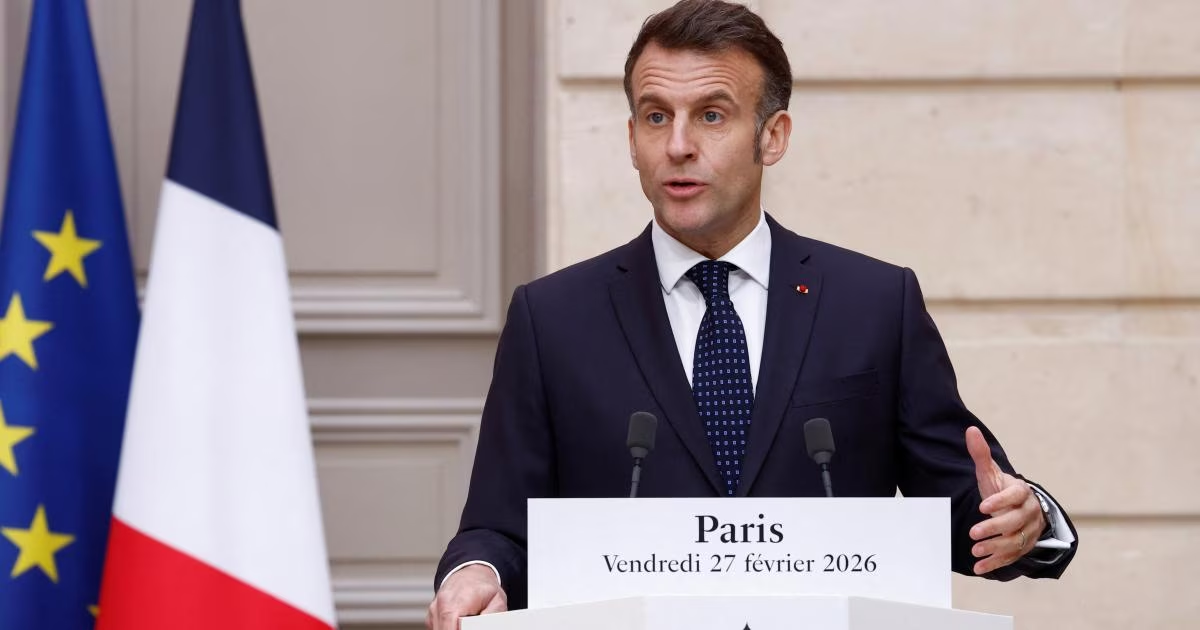
In an escalating diplomatic move, French President Emmanuel Macron called for an emergency meeting of the United Nations Security Council. Macron explained that the outbreak of a direct confrontation between Washington and Tel Aviv on one hand, and Tehran on the other, would lead to dire consequences whose impact on international peace and security cannot be predicted.
The French Presidency office reported that Macron held separate phone calls with the leaders of Saudi Arabia, the UAE, Qatar, and Jordan, in addition to the President of the Kurdistan Region of Iraq. These discussions focused on ways to protect regional stability and prevent the conflict from spreading to neighboring countries, in light of the extreme state of alert in the region.
The French President expressed his country's readiness to harness all necessary resources to protect Paris's closest partners in the region if they request it. However, Macron stressed that the Iranian regime is required to realize the seriousness of the situation and engage in serious negotiations to end its nuclear and missile programs that concern the international community.
In contrast, the Canadian position supported the American approach, as the Canadian Prime Minister affirmed his country's stand with Washington in its efforts to prevent Iran from acquiring nuclear weapons. Ottawa considered current Iranian policies a direct threat to global security, necessitating firm measures to deter Tehran.
Reports from diplomatic sources indicate that the coming hours will be crucial in the corridors of the United Nations, as several countries seek to formulate a resolution calling for a ceasefire. These efforts clash with differing visions among major powers on how to deal with the Iranian file and the repercussions of the recent attack.
Anticipation remains the master of the situation in regional capitals, as observers fear that these attacks could lead to retaliatory reactions that get out of control. Consultations continue behind the scenes to try to find a political solution that spares the region a comprehensive war that could burn everything and destroy global energy supplies.
This is not your war.. American involvement does not serve Washington's interests nor the cause of global peace.
Share your opinion
Widespread international diplomatic activity and France calls for an emergency Security Council session to stop escalation against Iran