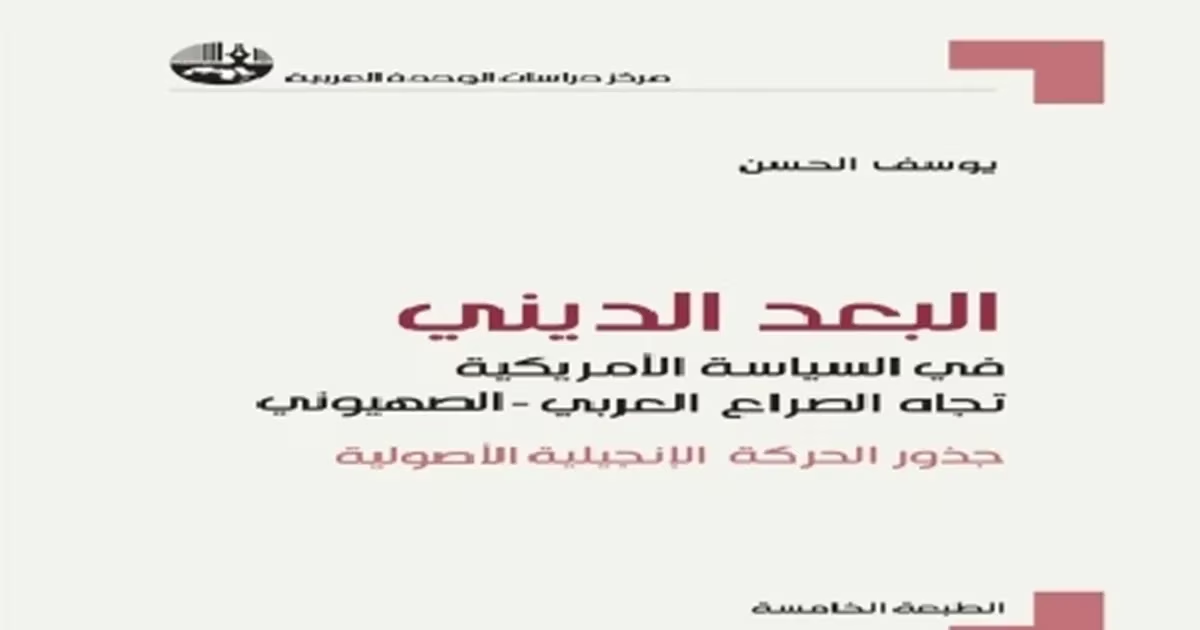







The book 'The Religious Dimension in American Policy Towards the Arab-Zionist Conflict' by researcher and diplomat Youssef Al-Hassan, raises fundamental questions about the nature of American desperation in defending the Zionist entity. The author believes that traditional explanations, which limit this support to strategic interests or the pressures of the Israeli lobby, remain inadequate for understanding the doctrinal depth that drives the ruling elites in Washington.
The book's central hypothesis revolves around the role of the contemporary Christian fundamentalist movement in the United States as a fundamental pillar of the Zionist project. Al-Hassan explains that this movement does not see Israel merely as a political ally, but considers its existence to be the fulfillment of biblical prophecies related to the Second Coming of Christ, making its defense a form of worship.
The book defines Christian fundamentalism as a radical movement that believes in the literal infallibility of the Bible, both Old and New Testaments. These individuals link the establishment of the occupation state in 1948 with the approaching end of time, as their belief stipulates the 'restoration of Israel' as a chosen people to their promised land to pave the way for the appearance of the awaited Savior.
As for Evangelicals, the author describes them as the solid bloc that believes in the necessity of the Second Coming of Christ, and sees supporting Israel as drawing closer to the Creator. These beliefs go so far as to consider any criticism of Israeli policies as a divine 'curse' that afflicts opponents, which explains the political immunity Israel enjoys in Congress.
Al-Hassan highlights 'Christian Zionism' as an ideology transcending Protestant churches, promoting the historical and religious right of Jews to Palestine. He cites the 'Ball Declaration' issued in 1985, in which leaders of global churches called on Jews to immigrate to Palestine, considering that it was God's hand that gathered their diaspora.
The book traces the roots of this thought back to the 16th century in Europe, specifically with the Protestant Reformation movement. King Henry VIII's decision to translate the Torah into English in 1538 made biblical culture an integral part of the popular consciousness, paving the way for the later Balfour Declaration.
These convictions were carried by the early settlers to the 'New World,' where the 'Puritans' considered themselves children of Israel fleeing Pharaoh Britain to the Promised Land. The doctrinal identification reached the extent of naming the United States 'New Canaan' and naming American geographical features after ancient biblical names.
The author reveals how the American founding elites internalized this history, to the extent that President Thomas Jefferson proposed a state symbol embodying the children of Israel led by a cloud and a pillar of fire. This overlap between American identity and Hebrew stories made support for Zionism part of the United States' 'religious nationalism' since its inception.
In the modern era, Christian Zionism has utilized advanced media to spread its ideas through what is called the 'visible church.' Statistics cited in the book confirm that programs by pastors supporting Israel, such as Billy Graham, reach millions of viewers and listeners through thousands of radio and television stations around the world.
Al-Hassan indicates that this continuous media influx has created a broad popular base that believes Israel's borders should extend from the Nile to the Euphrates. This explains why American policy towards the conflict does not change with changing presidents, as religious doctrine remains the constant compass guiding decision-makers in the White House.
The book affirms that American bias is not merely 'slips of the tongue' or fleeting positions by inexperienced diplomats, but rather the implementation of an ancient doctrinal program. The American official who supports settlement expansion often acts from a deeply rooted religious conviction that this expansion is a divine will that cannot be opposed.
Through his diplomatic experience, Youssef Al-Hassan analyzes how these ideas have permeated research centers and decision-making in Washington. He believes that confronting this bias requires a deep understanding of these religious roots, rather than merely betting on changing political or economic interests, which experience has shown to be secondary to doctrine.
The author concludes his study by emphasizing that Christian Zionism has succeeded in transforming the Palestinian issue in the Western imagination from a cause of a people under occupation into a cosmic religious battle. This transformation is what grants Israel moral and legal cover in the eyes of a large segment of the American public, despite its commission of genocide.
The book 'The Religious Dimension in American Policy' represents an important document for understanding the mechanisms of intellectual hegemony exercised by Evangelical fundamentalism. It provides the Arab reader and specialists in international affairs with a comprehensive vision of how religion intertwines with politics in the world's greatest power, and how this reflects on the future of the conflict in the region.
Supporting Israel is not an optional matter based on moral or strategic foundations, but rather a divine decree in the view of American Evangelical fundamentalism.




Share your opinion
The Doctrinal Roots of American Bias: How 'Christian Zionism' Became a Pillar of Foreign Policy?