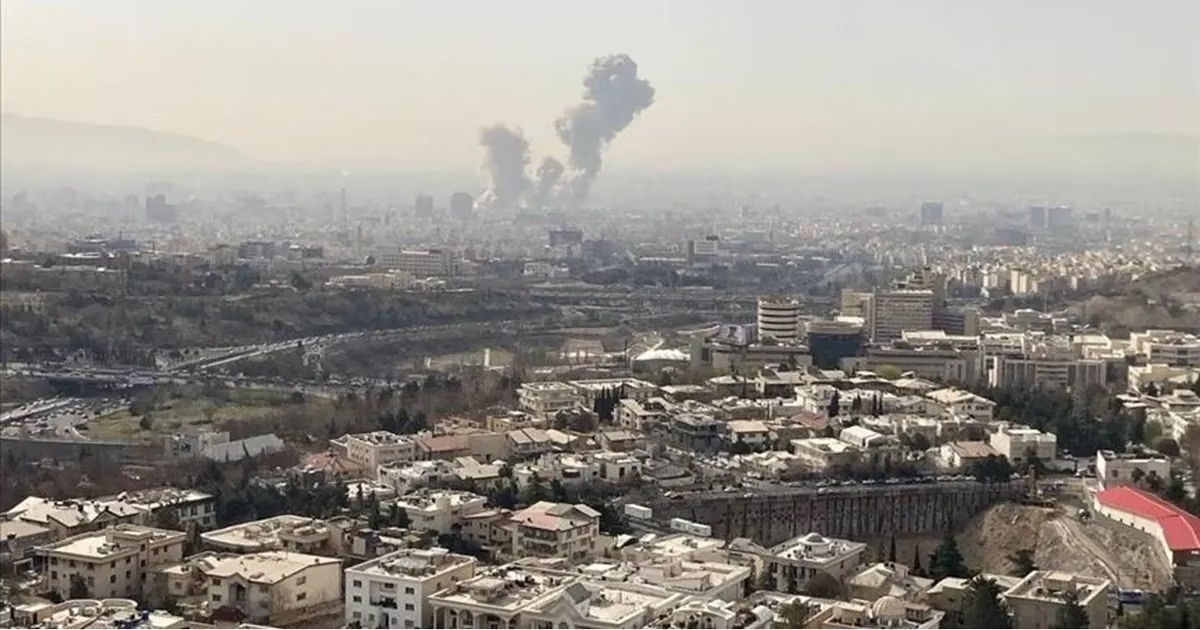







The region is experiencing a state of turmoil following the Israeli-American aggression that targeted sites in the Iranian capital, Tehran, and several other areas on Saturday morning. This field escalation comes in the context of a prolonged conflict that goes beyond direct military details, raising fundamental questions about the future of political balances in the Middle East. The stance on Iran's role requires frankness without equivocation, especially in light of its deep interventions in thorny Arab issues.
Over the past decades, the Iranian regime has played a pivotal role in deepening crises within a number of Arab countries, starting from Iraq after 2003 to Syria, Lebanon, and Yemen. This project was not merely humanitarian solidarity, but was based on strategic, national, and sectarian calculations aimed at entrenching clear Iranian hegemony. It is natural that this expansion would face widespread rejection from peoples who have suffered from the disintegration of their national arenas.
However, criticizing Iranian policies does not mean being drawn into simplistic readings that seek to completely remove Iran from the regional equation. Iran is a country with deep roots in the history and geography of West Asia, and it is a constant component that cannot be ignored or treated as an alien element. Attempts to forcibly exclude regional powers often lead to counterproductive results that increase instability.
Historical readings indicate that the American-Iranian confrontation did not begin with the recent events in Gaza, but rather its roots go back to 1979 and the embassy crisis in Tehran. This tension deepened over decades of conflict over the nuclear file, economic sanctions, and regional influence. Therefore, linking the current confrontation exclusively to the Palestinian issue lacks historical accuracy, as Tehran's decisions have always been governed primarily by its supreme national interests.
Tehran has used the discourse of 'resistance and steadfastness' as a tool for political and media mobilization and to gain popular legitimacy in the Arab street. Despite the presence of this discourse, practical behavior has always been subject to the cost-benefit balance specific to the Iranian state alone. This was clearly demonstrated in managing the limits of confrontation after October 2023, where the pace of interventions was adjusted to protect the security of the Iranian regime.
The issue today goes beyond fears of the nuclear program or ballistic missiles, reaching an attempt to radically rearrange the regional balance of power. There is a clear endeavor to establish unilateral regional superiority by weakening competing powers and depleting their capabilities. The sole beneficiary of this path is the Israeli occupation, which seeks to create strategic vacuums that allow it to impose absolute hegemony over the region.
Field sources reported that the recent attacks prompted neighboring countries to take strict precautionary measures to protect their national security. Iraq announced the complete closure of its airspace, and flights at Erbil International Airport were suspended until further notice. These steps reflect the extent of concern about the region sliding into a comprehensive war that may not differentiate between warring parties and neutral states.
In a related context, Kuwait, Qatar, and the UAE announced similar measures, including suspending flights or modifying their air routes. Syria also closed its southern air corridors for 12 hours, adopting alternative routes to ensure navigation safety. These collective measures confirm that any explosion in the Iranian-Israeli conflict will affect the economic and security consequences of all countries in the region without exception.
Within the occupied territories, the occupation authorities declared a special state of emergency, including closing airspace and suspending studies in several areas. This alert reflects the occupation's fear of potential Iranian reactions that might target Israeli depth. This state of emergency places Israeli society before complex security challenges resulting from its government's escalation policies.
For its part, Iran closed its airspace for six hours after the explosions that rocked Tehran, in a measure aimed at controlling the airspace and securing vital sites. This field development places the region at a dangerous crossroads, where the language of weapons becomes dominant over the language of diplomacy. The consequences of this clash may reproduce new maps of influence at the expense of the stability of Arab societies.
The collapse of the existing balance in the region will not produce lasting stability, but will unleash new waves of chaos and uncertainty. The loss in the event of a widespread explosion will not be limited to one party, but will affect countries that will find themselves facing a reality where equations are imposed from outside. Therefore, protecting the interests of peoples requires an independent vision that rejects subservience to any project seeking subjugation.
What is required today is a conscious and balanced regional stance that balances criticism of expansionist Iranian policies with a rejection of projects aimed at dismantling the region. It is unacceptable to turn the Arab arena into a stage for settling international scores or for entrenching unilateral Israeli hegemony. Awareness of the dangers of the current moment requires moving away from blind alignments and focusing on protecting national sovereignty.
The ongoing battle is not just a technical confrontation over centrifuges or missile ranges, but a struggle over the identity of the coming regional order. Either the region emerges with a vision that guarantees the interests of its peoples, or it remains hostage to the conflicts of major powers and proxies. This pivotal moment will determine the shape of the Middle East for decades to come, and its results will affect the lives of millions.
In conclusion, the biggest challenge remains how to prevent the conflict from turning into a tool for redrawing maps by military force. The stability of the region depends on finding real balances that respect the sovereignty of states and reject hegemony in all its forms. Between the Iranian influence project and the opposing hegemony projects, the need for an independent Arab project emerges to protect what remains of stability in this turbulent region.
The ongoing battle today is not just a technical confrontation over uranium enrichment, but a struggle over the shape of the coming regional order.
Share your opinion
The Struggle for Influence and the Redrawing of Maps: Is the Battle Over Iran or the Future of the Region?