






American intellectual Noam Chomsky believes that the global hegemony of the United States was not accidental, but rather the result of an imperial strategy crafted by economic and social elites since the end of World War II. These elites sought to preserve their interests through military, political, and economic tools, with blatant disregard for human rights despite the democratic slogans they espoused.
Since 1945, Washington has emerged as a key supporter of regimes involved in grave violations and ethnic cleansing, spanning vast geographical areas from El Salvador and Colombia to Israel and South Africa. This approach was not limited to political support but extended to direct military interventions in Vietnam, Yugoslavia, Afghanistan, and Iraq to ensure the flow of resources.
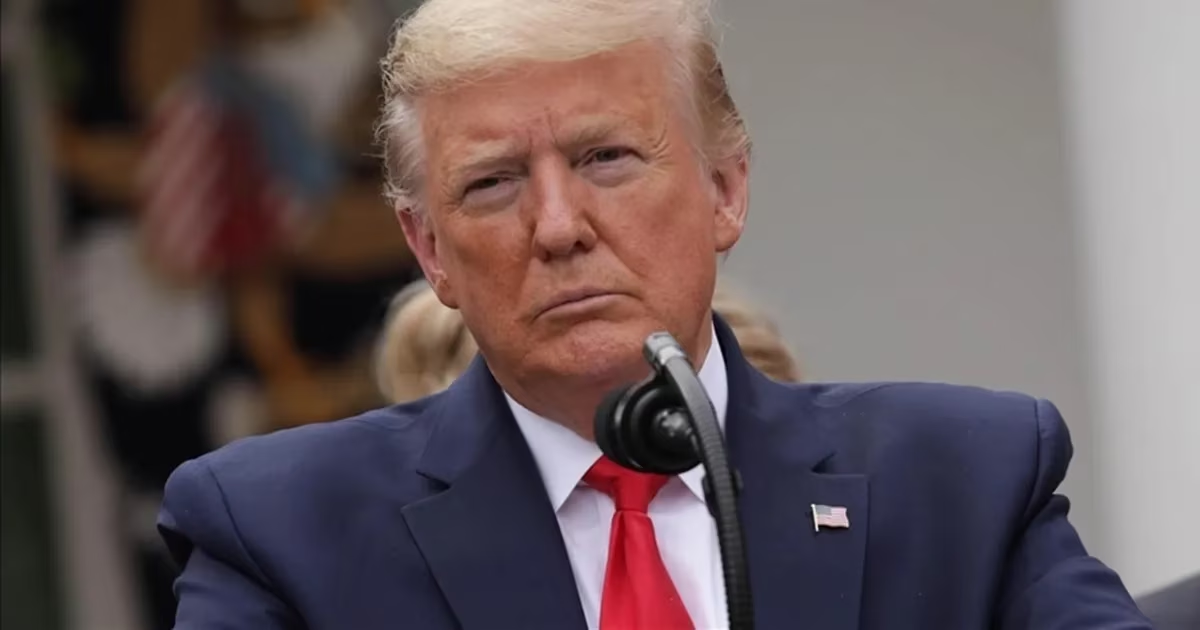
Analyses confirm that American foreign policy, whether under a Democratic or Republican administration, adheres to the same expansionist agenda aimed at strengthening dominance over global markets. However, observers believe that Donald Trump's return to the White House represents a negative turning point where the country has begun to lose its leading position in the global economy.
The United States inherited its influence from the British Empire, transforming many countries into satellite planets orbiting its sphere through loyal regimes or transnational corporations. These corporations, whose predatory nature resembles that of the old East India Company, contributed to a massive accumulation of capital within America, but it remained concentrated in the hands of a limited few.
American society today suffers from a huge economic gap, with wealth concentrated among the 'oligarchy' that controls the levers of the state from behind the scenes. Statistics indicate that 1% of the population controlled about 35% of the country's wealth by 2021, making the average American the most affected by inequality.
In the current Trumpian era, the power of money has merged with populist rhetoric, as billionaires and owners of major technology companies provided unlimited support for Trump's election campaigns. In return, Trump relied on mobilizing popular bases with nationalist slogans such as 'America First,' which analysts considered an official declaration of the end of the era of globalization.
Trump's economic policies, based on imposing exorbitant tariffs, led to counterproductive results that diminished Washington's trade influence instead of strengthening it. This economic isolation pushed historical partners, especially in Europe, towards strengthening their relations with China, the United States' primary strategic rival on the international stage.
The current administration did not stop at trade wars; its threats extended to allies and neighbors, with Trump hinting at occupying parts of Canada or seizing the Panama Canal. These statements, described by diplomatic sources as political ignorance, caused massive disruptions in the collective security system that Washington had led for centuries.
Regarding the Palestinian issue, the current administration adopts an extremist approach aimed at placing the Gaza Strip under American guardianship with international cover, after years of using the veto to prevent a ceasefire. This approach reflects a desire to impose coercive solutions that bypass Palestinian national rights and serve the security interests of the Israeli occupation.
Trump's recent speeches are characterized by an excessive focus on the language of numbers and trillions, moving away from traditional diplomacy, which has caused widespread international concern. Some European politicians, including French parliamentarians, went so far as to question the psychological fitness of the American president after analyzing his latest proposals in February 2026.
American threats have not stopped at its neighbors but have included countries such as Iran and Venezuela, reflecting a state of confusion in managing international files. Researchers see this aggressive behavior as evidence of the erosion of American soft power and its transformation into a power that relies solely on military threats and intimidation.
Analysts believe that Trump, unintentionally, is clipping his country's claws on the international stage by weakening traditional alliances such as NATO. This disintegration of international ties heralds the beginning of the end of the American era and the emergence of new international poles seeking to fill the vacuum left by Washington.
Historically, the American capitalist system had controls that ensured a minimum level of balance, but the current dominance of companies like 'Tesla' and 'Meta' has changed the rules of the political game. Political decisions have become hostage to the interests of a handful of wealthy individuals who prioritize quick gains over the long-term strategic stability of the state.
In conclusion, it seems that the United States faces an existential test under a leadership that adopts controversy and confrontation as a means of governance, which recalls historical sayings about the demise of nations due to the ignorance of their leaders. The current trajectory indicates that 'Trumpism' may be the tool that demolishes the pillars of hegemony built over eight decades.
United States foreign policy follows a consistent agenda to access resources and markets, but Trump's arrival has caused Washington to lose its leading position in the global economy.


Share your opinion
The End of Hegemony: How 'Trumpism' Accelerates the Dismantling of the American Empire?