






What was media-dubbed the 'Deal of the Century' was not merely a fleeting political event or a casual proposal, but rather an intense expression of an entire phase aimed at politically and strategically re-engineering the region. This perception transcends the technical details of the plan to reach the conceptual framework through which the Palestinian cause and its historical essence were redefined.
The use of the term 'deal' in the context of a national issue of Palestine's weight carries dangerous implications for the legal and ethical structure of the conflict. While deals are legally based on equality and mutual benefit, invoking them under an ongoing occupation aims to shift the issue from the realm of permanent rights to areas of political bargaining.
Land, sovereignty, and identity are non-negotiable elements in the Palestinian consciousness, yet the foundational logic of recent projects attempts to make them items on a commercial agenda. From the perspective of international law, the right of peoples to self-determination remains a peremptory norm that cannot be circumvented through economic arrangements or false developmental promises.
Occupation does not acquire legitimacy with the passage of time, nor can an illegitimate reality become legal merely by the recognition of major powers. In this context, the American role in sponsoring these projects was not neutral; rather, it was consistent with a strategic vision that reordered the region's priorities to exclusively serve Israeli interests.
These projects and schemes find fertile ground for expansion in societies suffering from political fragility and identity fragmentation. Nations exhausted by their internal conflicts and divisions become less capable of formulating a unified national stance, making them more susceptible to international pressures and bargains that target their constants.
Recently, a phenomenon of redirecting the compass of animosity has emerged in the consciousness of some regimes, where the centrality of the conflict with the occupation has been replaced by other regional rivalries. This shift aims to create an 'alternative enemy' in public awareness, which objectively leads to the dissipation of energies in side conflicts that serve the continuation of settlement realities on the ground.
The Iraqi model after the 2003 invasion offers a harsh lesson on the danger of managing countries according to the logic of external interests and dismantling national institutions. The imposed restructuring policies led to the opening of deep internal conflicts, proving that the imbalance of national sovereignty inevitably leads to an imbalance of overall stability.
Reading the 'Deal of the Century' in light of current data reveals that it was not a genuine peace initiative, but an attempt to impose a low political ceiling and normalize an illegitimate reality. Peace that is not based on removing the root causes of the conflict, foremost among them the occupation, remains fragile peace lacking justice and permanence.
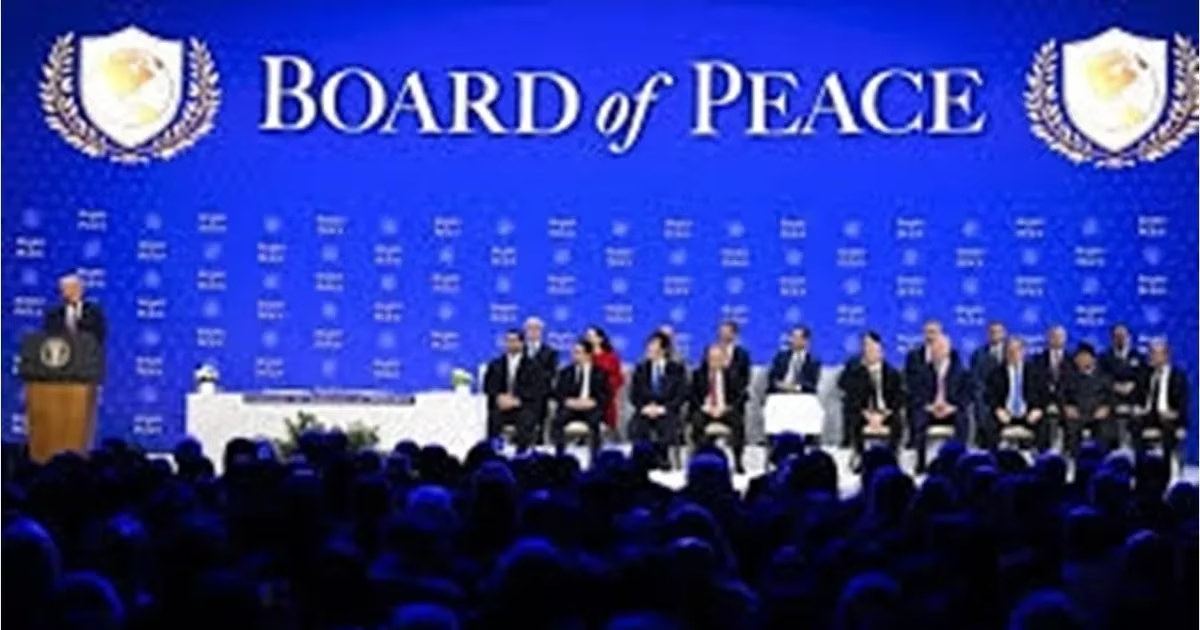
The widespread talk about forming a so-called 'Peace Council' emerges as an advanced institutional step aimed at translating the vision of political deals into permanent organizational structures. This transition from the level of theoretical initiatives to institutional building means an attempt to institutionalize the status quo and make it an integral part of the new regional order.
The establishment of such councils, if they move towards entrenching the imbalance instead of addressing it, will turn into a mechanism for managing the conflict, not for ending it justly. Here, the fundamental question arises as to whether peace is built on the foundations of international justice or on the basis of reorganizing the occupation in less politically costly forms.
The real danger in some political projects lies in the infrastructure and permanent structures they establish, which may make reversing their effects in the future extremely difficult. Therefore, the current battle is not merely a struggle over the texts of initiatives, but a battle of awareness to distinguish between true peace based on dignity and packaged peace.
The logic of rights remains more entrenched in history and has a deeper impact on the collective consciousness than the logic of fleeting deals imposed by temporary power balances. Between these two logics, the future of the Palestinian cause is determined: either a settlement that reproduces injustice, or a path based on law, justice, and human dignity.
The current stage requires political vigilance capable of deconstructing discourses that attempt to wrap concessions in the guise of development and economic prosperity. National sovereignty cannot be compensated by financial grants, and the right of return and self-determination remain the essence of any just and comprehensive solution to the Palestinian issue in the face of liquidation attempts.
In conclusion, the bet remains on the ability of the Palestinian people and their living forces to adhere to constants and refuse to engage in paths that legitimize the occupation. History proves that projects that override the rights of peoples and ignore their legitimate aspirations are doomed to failure, no matter how strong the international parties supporting them.
The mere use of the term 'deal' in the context of an issue of Palestine's magnitude implies a dangerous shift in the legal and ethical structure of the conflict.


Share your opinion
From the Logic of Deals to the Permanence of Rights: Deconstructing Schemes to Reshape the Palestinian Landscape