






Washington – Said Arikat - 28/2/2028
News Analysis
The words of the United Nations High Commissioner for Human Rights, Volker Türk, before the Human Rights Council this week were not merely a routine presentation of a human rights report, but rather seemed to indicate a significant shift in the nature of UN discourse regarding the war in Gaza and Israeli policies in the occupied Palestinian territories.
When Türk spoke of the possibility of Israel seeking to effect a "permanent demographic change" in the Gaza Strip and the West Bank, he used one of the most sensitive terms in international law, a description rarely appearing in UN statements with such political and legal clarity.
The report, covering the period between November 2024 and October 2025, concluded that there was what the UN official described as "total disregard for human rights," pointing to widespread destruction of residential areas, severe restrictions on the population, and the use of humanitarian aid within the context of military conflict.
Türk warned that the accumulation of these measures "appears to be aimed at permanent demographic change," cautioning against growing concerns about ethnic cleansing — a description that carries legal implications that could extend beyond political condemnation to discussions of international accountability.
Gaza: A Truce Without an End to the Crisis
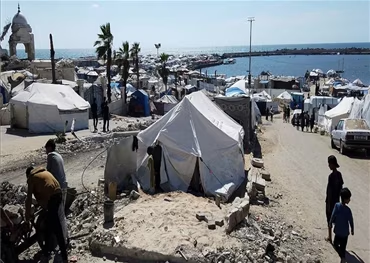
Despite the announcement of a ceasefire in October 2025, the report indicates that the humanitarian reality in Gaza has not seen substantial improvement. More than 600 Palestinians have been killed and over 1600 injured since the truce began, while the UN documented approximately 1700 violations, including restrictions on aid, denial of medical treatment, and repeated attacks.
The United Nations had declared a famine in the Strip in August 2025, while malnutrition continued to spread due to limited humanitarian supply flows.
Türk noted that civilians are still dying from bombing, hunger, cold, and treatable diseases, adding that what is happening "would be considered a major global crisis if it occurred anywhere else."
UN estimates indicate that more than 72,000 Palestinians, mostly civilians, have been killed since Israel launched its brutal war on Gaza in October 2023, in addition to the destruction of over 80% of the infrastructure in the Strip, leading to a near-complete collapse of civil life.
The UN's use of the term "demographic change" marks a turning point in the description of the conflict, as the international institution moves from documenting the humanitarian consequences of the war to analyzing long-term political intentions and patterns. This development reflects growing concern within international legal circles that military operations are no longer understood solely as a security response, but as part of a new reality being reshaped on the ground. However, the central question remains whether the linguistic escalation will translate into actual political pressure or remain within the bounds of customary symbolic condemnation.
West Bank: Administrative Changes with Strategic Dimensions
In the occupied West Bank, the report described the situation as "extremely alarming," pointing to the killing of over a thousand Palestinians during the same period, in parallel with Israeli measures expanding the scope of civil administration in areas that were under military rule.
Türk believes that these steps solidify a reality that is gradually approaching annexation, which international law considers illegal in occupied territories. Observers note that these administrative shifts may have a more significant long-term impact than military operations themselves, as they change the legal and political structure of the land.
The High Commissioner described the overall situation as a "man-made catastrophe," holding Israel responsible for forced displacement and criticizing the absence of international accountability for grave violations.
Türk's statements reveal a deeper dilemma that transcends the Israeli-Palestinian conflict itself: the limited ability of the international system to translate legal reports into executive actions. While evidence and legal descriptions accumulate, accountability mechanisms remain subject to political considerations within the Security Council and international alliances. This gap between law and politics not only affects the course of the conflict but also threatens the credibility of the global human rights system, as the impression grows that state power, not the scale of the violation, is the decisive factor in determining the level of accountability.
Human Rights as a Condition for Stability
In concluding his speech, Türk stressed that any future reconstruction process or political path would not be sustainable without placing human rights at the center of the proposed solutions.
He stated that human rights in the Palestinian territories have been "crushed," emphasizing that achieving lasting stability requires addressing the root causes of the crisis, not just managing its humanitarian consequences.
As the war continues to reshape the political and geographical reality of the region, the High Commissioner's report does not merely describe the tragedy but poses a broader question to the international community: Is what is happening a fleeting humanitarian crisis, or a moment of permanent redefinition?

Share your opinion
UN Accusation Against Israel of Seeking Permanent Demographic Change: Linguistic Escalation Reflects a Shift in International Discourse