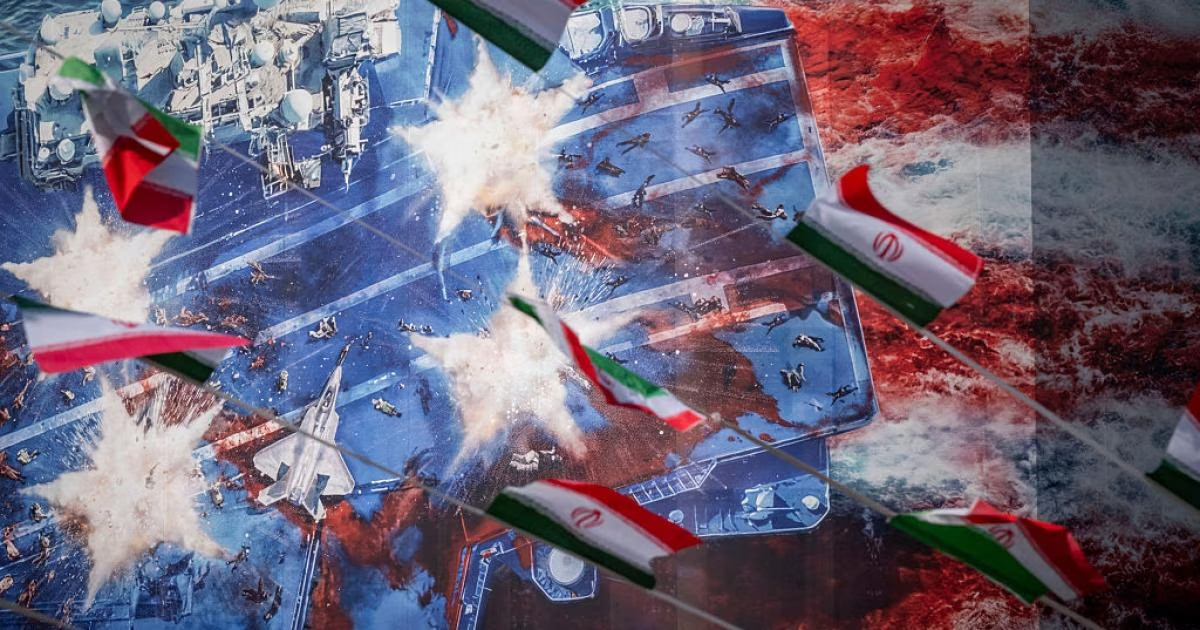







The relationship between Washington and Tehran has entered a highly sensitive phase with the launch of a round of negotiations described as crucial in the Swiss city of Geneva. The American administration preceded this round by imposing a new package of sanctions targeting entities linked to Iran, a step that reflects Washington's desire to exert maximum pressure before sitting down at the dialogue table.
For his part, US President Donald Trump adopted a dual discourse combining direct military threats with an expression of readiness to negotiate. Trump warned that Tehran continues to develop a missile arsenal capable of reaching American and European depths, considering that the current confrontation concerns national security and is not merely a fleeting political option.
In response, Tehran countered with a discourse that completely denied the American accusations, accusing Washington of systematic misinformation against its peaceful program. Iranian President Masoud Pezeshkian affirmed that his country is open to dialogue to find diplomatic solutions, but at the same time stressed his refusal to make any fundamental concessions that affect Iranian sovereignty.
On the ground, media sources revealed intensive American military movements to enhance defensive and offensive capabilities in the region. The US Army intends to deploy 6 additional advanced 'F-22' fighter jets in Israel, raising the total number of this type of aircraft in the region to 18 fighters.
Political circles in Israel view the Geneva negotiations as the last chance before moving to more stringent options. Israeli officials believe that the diplomatic path may not lead to tangible results, emphasizing the need to prepare for all scenarios, including direct military action against nuclear facilities.
In a related context, Steve Witkoff explained that the Trump administration insists that any new nuclear agreement must be comprehensive and not time-bound. Witkoff pointed out that Washington seeks to include the ballistic missile file in any future understandings to ensure long-term stability in the Middle East.
Conflict management experts believe that recent American statements aim to prepare public opinion for the possibility of diplomatic failure. Analysts considered that raising the long-range missile issue at this time reduces the maneuvering space for the Iranian negotiator, who was betting on partial interim agreements.
Analytical readings indicate that the current American equation is based on the principle of 'peace through strength.' This approach frames negotiations as a strategic pressure tool, where military buildup and economic sanctions are used as coercive factors to push Tehran towards making tangible concessions in its nuclear file.
On the other hand, the Israeli position stands out as an additional pressure factor on the Trump administration, as Tel Aviv seeks to convince Washington of the futility of previous agreements. The Israeli narrative is based on the premise that Tehran exploited previous periods of calm to increase uranium enrichment rates and strengthen the influence of its military arms in the region.
Researchers in Israeli affairs believe that there is a near consensus within the security and political establishment in Tel Aviv on the necessity of launching a military strike. They believe that current circumstances represent an unprecedented opportunity to weaken Iranian capabilities, which could give the Israeli leadership a strong political card in facing internal crises.
Despite this escalation, informed sources indicate that Washington is still resisting some pressure to expand the negotiation agenda in a way that could lead to its immediate collapse. The current American approach focuses on dismantling the nuclear program as a top priority, before moving on to discussing regional roles and other thorny security files.
In the absence of clear indications of the success of the Geneva talks, tension remains the master of the situation in the corridors of international diplomacy. Mutual threats and increasing military buildup indicate that the region stands on the brink of a major strategic transformation, either through a historic agreement or an open confrontation.
The director of the 'New Lines' Institute for Strategy confirms that the American administration's discourse reflects a firm determination to prevent Iran from acquiring nuclear weapons. She explained that the absence of explicit and documented Iranian commitments in this regard makes the option of military escalation strongly present on the table of decision-makers in the White House.
In conclusion, the eyes of the world remain fixed on Geneva, awaiting the outcome of the direct and indirect meetings between the parties. The path that the Geneva meeting will take will determine the features of the conflict in the Middle East for the coming years, amidst the intertwining of international interests and increasing field complexities.
Iran is ready to negotiate to find a solution without making fundamental concessions, and it is managing the process as an entry point for a strategic transformation to address concerns.

Share your opinion
Drums of War Beat in Geneva: Washington Tightens the Noose on Tehran and Military Buildup in the Region