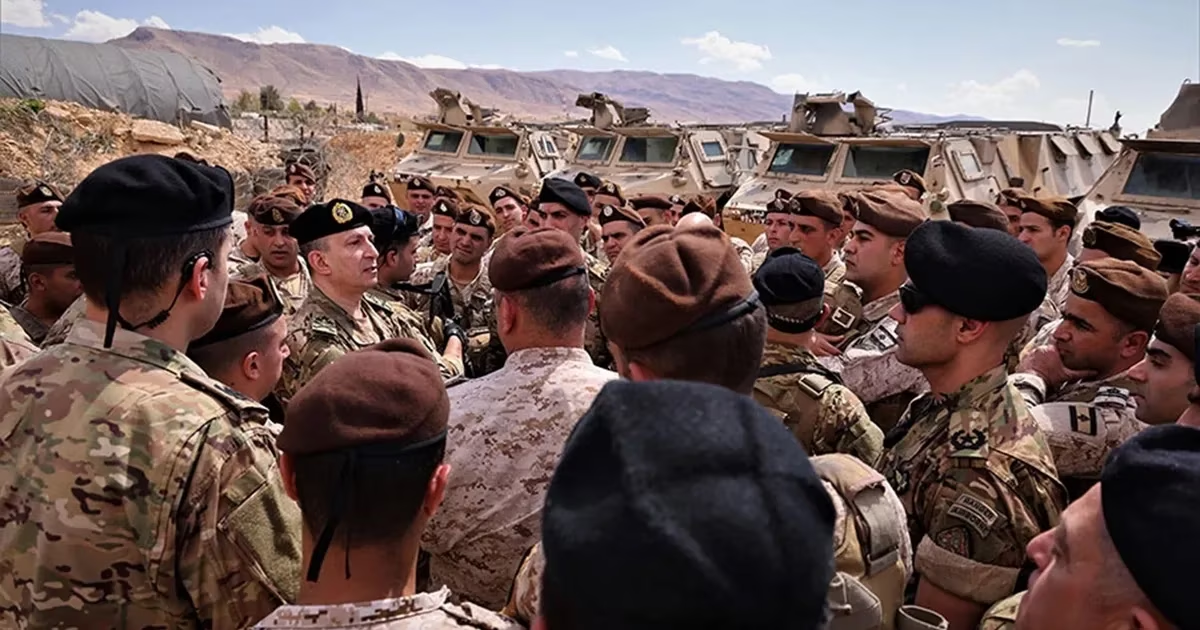







The visit of the Lebanese Army Commander to Washington, the American capital, comes at a highly sensitive time, as political pressures escalate and internal crises deepen in Lebanon. This visit transcended the protocol framework to become a strategic move aimed at re-establishing the military institution's position as a fundamental pillar of stability amidst the erosion of sovereign state institutions.
The discussions held by the Army Commander with American officials included vital files related to the continuation of military support programs, both in terms of qualitative armament and field training. These aids aim to maintain the institution's readiness and the morale of its personnel in light of the economic and financial collapse sweeping the country and affecting all sectors.
The meetings also focused on enhancing the army's capabilities in controlling land and sea borders and combating terrorism, in addition to stabilizing the southern Lebanon region. The Lebanese side affirmed its commitment to relevant international resolutions, emphasizing the necessity of stopping repeated Israeli violations of Lebanese sovereignty.
In contrast, some positions in Washington reflected a traditional approach that raises expectations from the Lebanese state and its military institutions without exerting parallel pressure on Israel. This disparity added a political dimension to the visit, as Lebanon seeks to obtain international guarantees that protect its security and sovereignty in a balanced manner.
The army leadership's stance during the discussions was characterized by balance and clarity, based on the national doctrine that forms the core of the military institution and its constitutional foundation. This doctrine intersects with the content of the presidential oath speech, which rejects the logic of a 'broken sect' and insists on the exclusivity of weapons in the hands of the Lebanese state.
The official Lebanese approach emphasizes the necessity of a complete Israeli withdrawal from the occupied territories and the preservation of national unity as the primary guarantee of stability. From this perspective, the army rejects being turned into a tool in internal or regional conflicts, committing to its constitutional role in protecting the land and the people.
These movements coincide with rapid transformations in the region, where conflict arenas intertwine with stalled negotiation paths in the region. This complex scene makes any internal imbalance in Lebanon susceptible to exaggeration and exploitation by external parties seeking to reshape local balances.
National unity remains an absolute priority that takes precedence over all international considerations, despite increasing pressures to reframe the Lebanese scene according to external approaches. The Lebanese leadership adopts an approach based on strategic patience and avoiding internal confrontation, realizing that any confrontation will only serve fragmentation projects.
This approach intersects with an announced desire from internal parties to avoid sedition, but challenges remain in light of the escalation of financial and economic sanctions policy. These pressures, coinciding with military strikes and near-daily raids, put the containment and de-escalation equation to a very precise and complex test.
In this context, the preparation for the upcoming conference to support the Lebanese Army in Paris next month gains double importance that goes beyond financial support. This conference is seen as an international political framework to re-establish consensus on the necessity of supporting the military institution as the only remaining safety valve.
The effectiveness of international support is linked to the extent of the international community's, especially the United States', willingness to adopt a more balanced approach to the Lebanese file. This requires practical steps that include pressuring Israel to stop its aggressions, and providing a real political umbrella that supports the path of reform and sovereignty in Lebanon.
In the absence of actual American pressure on the Israeli side, the military institution emerges as the only realistic guarantee to prevent the country from sliding into comprehensive chaos. Maintaining the army's cohesion is a national and strategic necessity that transcends narrow political differences in this foggy phase.
The stability of the military institution is the mandatory gateway to protecting the Lebanese state from disintegration and complete collapse under the weight of successive crises. Therefore, the required support for the army is not merely a technical measure, but a political decision aimed at protecting what remains of the state structure.
In conclusion, the Washington visit remains an important stop in the search for a lost balance, as Lebanon seeks to secure international cover that protects its military institution. The bet remains on the ability of this institution to maintain its internal balance amidst regional storms and increasing economic pressures.
The Lebanese military institution represents the realistic guarantee of national unity and civil peace, and the last fortress that prevents the country from sliding into chaos.

Share your opinion
Lebanese Army Commander in Washington: Efforts to Consolidate Military Support Amidst Collapse Challenges and Regional Pressures