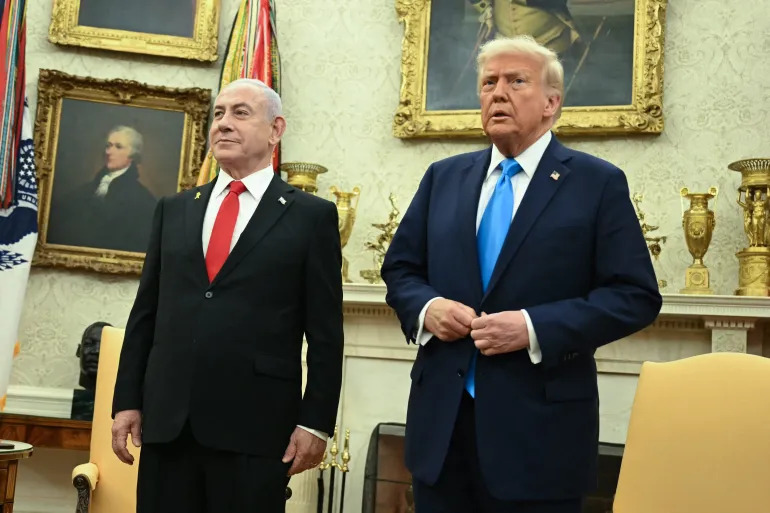







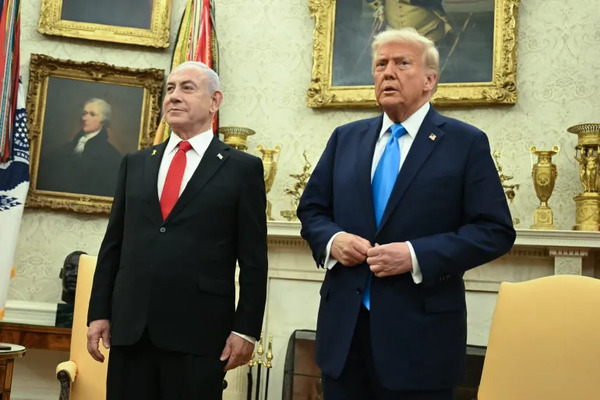
On the eve of receiving Israeli Prime Minister Benjamin Netanyahu in Washington, US President Donald Trump chose to deliver a complex message: political reassurance to the Israeli ally that any understanding with Iran would not be "lenient," and a direct warning to Tehran that the option of force is still present, and perhaps closer than it imagines. According to Axios, Trump said that Netanyahu "also wants a deal... a good deal," stressing that the ongoing nuclear talks with Iran "bode well," and that this time they are "completely different."
Outwardly, Trump's statements appear to be an attempt to reset the relationship between Washington and Tel Aviv on a highly sensitive issue that has long been a source of friction between successive US administrations and Israeli governments. But between the lines, it is clear that Trump is not presenting negotiation as a traditional diplomatic path, but rather as a direct extension of a deterrence balance that was formed by force almost a year ago, when the United States carried out strikes on Iranian nuclear sites in June 2025 at the end of the 12-day Israel-Iran war, which came days after the collapse of the diplomatic track.
According to Axios, Trump recalled that moment to emphasize that he is a president who "does what he says," stating that the Iranians "last time didn't believe I would do it," and that they "overestimated their strength." However, the recall was not just a reminder, but an establishment of a new negotiating equation whose title is: agreement under the pressure of threat, not agreement through mutual concessions.
Here lies the fundamental difference between Trump's language and that of previous administrations: the US president does not speak of "de-escalation" or "building trust," but rather of an "excellent deal" on the one hand, and "very firm action" on the other if talks fail. This makes the negotiations seem more like a test of wills than a technical settlement on enrichment ratios or inspection mechanisms.
In this context, observers believe that what distinguishes Trump's approach is that he does not separate diplomacy and force, but rather integrates them into a single message managed according to the logic of a deal: an "excellent agreement" for a "heavy price." This model may succeed in extracting tactical concessions, but it carries a strategic risk, because Iran may interpret threats as a prelude to a strike, not just a negotiating chip. At that point, Tehran's goal becomes not an agreement, but buying time and expanding its deterrence margin through its proxies in the region.
According to Axios, Trump stressed that any agreement with Iran "obviously" must include its nuclear facilities, adding that he expects the possibility of including its missile program as well. This is a historically sensitive point, because Tehran has always considered its missile program "non-negotiable," and directly links it to the concept of national security after decades of sanctions, threats, and proxy wars.
Netanyahu's visit to Washington, therefore, comes as a double political test: a test of the American administration's ability to control the pace of negotiations without Israel becoming an explosive factor, and a test of Netanyahu's willingness to accept an agreement that does not reach the ceiling of "complete dismantling" of Iran's nuclear infrastructure. Trump tried to dispel the impression that Netanyahu stands against the diplomatic path, stressing that he is not opposed to talks, but wants a "good deal." However, this phrase itself carries a wide margin for interpretation: "good" for Washington may mean verifiable restrictions, while "good" for Tel Aviv may mean permanently depriving Iran of any enrichment capability, a demand that is difficult to impose diplomatically.
In contrast, the military dimension moves as a heavy shadow over the negotiating table. Trump announced, according to Axios, that he is considering sending a second aircraft carrier to the Middle East if negotiations fail, noting that "a fleet is heading there, and another fleet may set off." In recent weeks, the United States has reinforced its naval and air presence in the region, providing a political pressure element and ready firepower for any scenario.
On the ground, signs of limited engagement have begun to appear: US forces shot down a drone they said approached too close to the USS Abraham Lincoln aircraft carrier, and provided assistance to a US-flagged ship that Iranian forces attempted to stop in the Strait of Hormuz, the narrow entrance to the Gulf. Although these incidents appear tactical, they reveal the fragility of the situation, because any miscalculation could turn "pressure" into confrontation.
In this scene, the Sultanate of Oman returned to playing the role of mediator, in the first practical communication after the twelve-day war. Ali Larijani's visit to Muscat, in his capacity as Secretary of the Supreme National Security Council, carried important symbolic signals, especially with the circulation of photos of him alongside Omani Foreign Minister Badr Al Busaidi holding what appeared to be a sealed message. Historically, Iran relies on written messages as a preferred channel for dealing with Washington, because it gives it the ability to control the language, leave room for interpretation, and avoid public embarrassment.
Iranian media spoke of an "important message" that Larijani would carry, but official Iranian television surprised observers by indicating that Al Busaidi "delivered a message" to Larijani, without specifying its source. This ambiguity may be intentional: Tehran does not want to appear to be receiving "American conditions" at a moment of internal and regional tension, and Washington does not want to be accused of negotiating from a position of weakness.
Iran's official news agency said that Larijani also met with Sultan Haitham bin Tariq of Oman for about three hours, while the Omani news agency stated that the two sides discussed "the latest developments" and "ways to reach a balanced and fair agreement," while emphasizing the importance of returning to the dialogue table. It is also noteworthy that Larijani met with Mohammed Abdul Salam, the Houthi spokesman, in a move that suggests that Tehran links negotiations to the issue of regional influence and its proxies, not to the nuclear program alone.
Larijani is likely to head later to Qatar, which hosts the main US Al Udeid Air Base, the base that Iran attacked last June after the bombing of Iranian nuclear sites. This stop adds another dimension: Iran is signaling that it is capable of expanding the scope of retaliation if it feels that Washington is preparing to repeat the bombing scenario.
In this context, Larijani accused Israel of trying to play a "disruptive role" in the talks, warning that Netanyahu might seek to impose a "negotiating framework" on the Americans before his arrival in Washington. Such talk reflects Iran's sensitivity to the Israeli dimension in the nuclear file, but at the same time hints that Tehran does not see an agreement with Washington as separate from its open conflict with Israel.
Analysts believe that Larijani's visit to Muscat does not seem to be just a negotiating stop, but an Iranian repositioning after the 2025 war: Tehran wants to say that it is capable of combining the "diplomatic track" and the "regional influence network" at the same time. Larijani's meetings with the Houthis and his reference to Israel's "disruptive role" suggest that Iran will use regional issues as reciprocal pressure cards, and that any nuclear agreement will not be isolated from the security of navigation in Hormuz, from America's bases in the Gulf, and from the balance of deterrence with Israel.
In conclusion, Trump's statements appear to be an attempt to impose a new negotiating framework based on three pillars: escalating military pressure, traditional Omani mediation, and a political Israeli guarantee through the meeting with Netanyahu. But the success of this framework will depend on one point: does Iran want an agreement because it is convinced of it, or because it wants to temporarily avoid a painful strike? And can Washington control Israel's calculations if Tel Aviv feels that the agreement does not meet its definition of security?
So far, Trump says the talks are "different." But the Middle East has taught everyone that true difference is not measured by statements, but by the ability of the parties to prevent slipping from negotiation to war.

Share your opinion
Trump on the Eve of Meeting Netanyahu: "Good Deal" with Iran... and "Different" Negotiations Under the Shadow of Aircraft Carriers