






Washington – Said Arikat
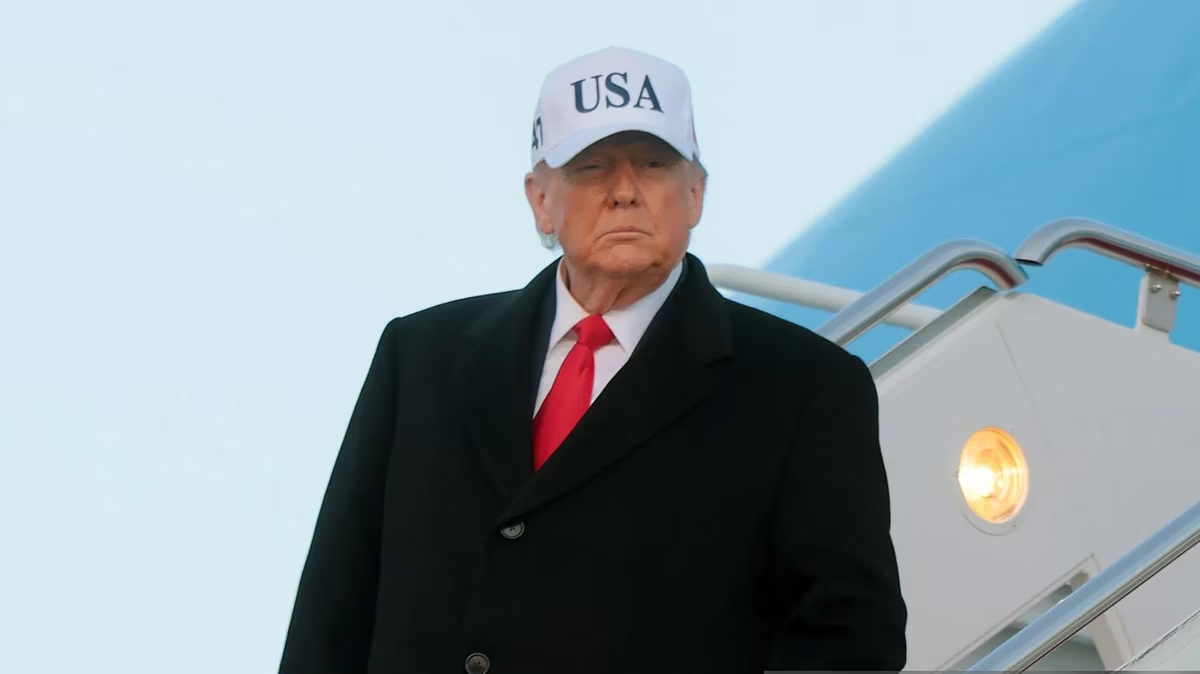
In a calculated escalation of political rhetoric without sliding into direct military confrontation, US President Donald Trump brought the Iran file back to the forefront of international debate, clearly hinting that the option of regime change remains on the table, even if the use of military force has been postponed. Trump said in an interview with Politico on Saturday: "It's time to look for new leadership in Iran," a statement that recalled his administration's approach of combining political pressure and military threats on one hand, and tactical retreat on the other.
These statements came just days after Trump's surprising decision not to launch military strikes against Iran, even though he had seriously considered a limited attack in response to the Iranian authorities' suppression of popular protests. This retreat, according to American sources, was not an expression of de-escalation as much as it was the result of precise calculations regarding the feasibility of strikes and the potential for the region to slide into a wider confrontation.
Trump's remarks coincided with verbal escalation from the Iranian leadership, as Supreme Leader Ali Khamenei's account on the "X" platform published a series of sharply worded posts, holding the US President responsible for what he described as "violence and bloody unrest" inside Iran. Khamenei wrote: "We consider the US President guilty for the losses, damages, and slanders he has inflicted on the Iranian people," a direct accusation reflecting the extent of tension between the two sides.
In another post, Khamenei accused Trump of distorting the image of the Iranian people by describing them as violent groups, considering it a "heinous slander." This escalatory language did not go unnoticed in Washington, as Trump responded by saying that Tehran's rulers govern only through repression and violence. He added: "What he is guilty of, as a leader of a country, is the complete destruction of the country and the use of violence at unprecedented levels," accusing the Iranian leadership of killing thousands to maintain its grip on power, instead of focusing on managing the country's affairs.
Over the past weeks, Trump has intensified his statements that combine encouraging Iranian protesters and threatening the government, emphasizing on more than one occasion that the United States might resort to targeting Iran's nuclear program and missile facilities if it sees Tehran moving in a direction that threatens regional and international security. Despite his temporary abstention from striking, American officials confirm that the military option is still on the table, and a decision in this regard could be made within weeks, according to what the "Axios" website reported from informed sources.
All of this comes at a time when the US military presence in the Middle East is experiencing a noticeable decline compared to its peak during the Israeli-Iranian war last June. Leaks from within the US administration indicate that one of the main reasons for Trump's reversal on launching a strike is doubt about the ability of any limited attack to overthrow the Iranian regime or even decisively weaken it, in addition to fears of widespread retaliatory reactions.
The United States also faces logistical and security challenges, most notably the lack of adequate missile defense systems in the region to protect its forces and bases, as well as to protect Israel from any potential Iranian response. Nevertheless, Washington seeks to carefully strengthen its military presence, as the US aircraft carrier "Abraham Lincoln" is expected to arrive in the region later this week, sending a clear deterrent message without declaring direct offensive intentions.
In parallel, an old debate re-emerges within American circles about the potential alternative to the Iranian regime. Some proponents of regime change call for installing Reza Pahlavi, the son of the former Shah of Iran, as a leader for a transitional phase. However, Trump himself explicitly rejected this proposal, considering that Pahlavi lacks a real popular base inside Iran, and that imposing him from outside would only deepen the crisis.
Trump's rhetoric towards Iran reflects a structural contradiction in US policy: the desire for regime change without bearing the cost of overthrowing it. The constant brandishing of the military option, coupled with repeated retreats, weakens the credibility of deterrence and gives Tehran a wider margin for maneuver. Moreover, relying on an internal uprising, without a clear support strategy or a vision for the post-regime phase, seems closer to political wishes than to realistic planning.
In contrast, Khamenei's sharp responses reveal deep concern within the structure of the Iranian regime, but it is a concern that translates into further isolation rather than reform. Portraying the protests as a product of an "American conspiracy" allows the authorities to justify repression, but it deepens the gap with society. Between Washington's threats and Tehran's rigidity, the Iranian people remain caught in an equation of international conflict over whose paths they have no control.
Share your opinion
Trump: Time to Change Iranian Leadership