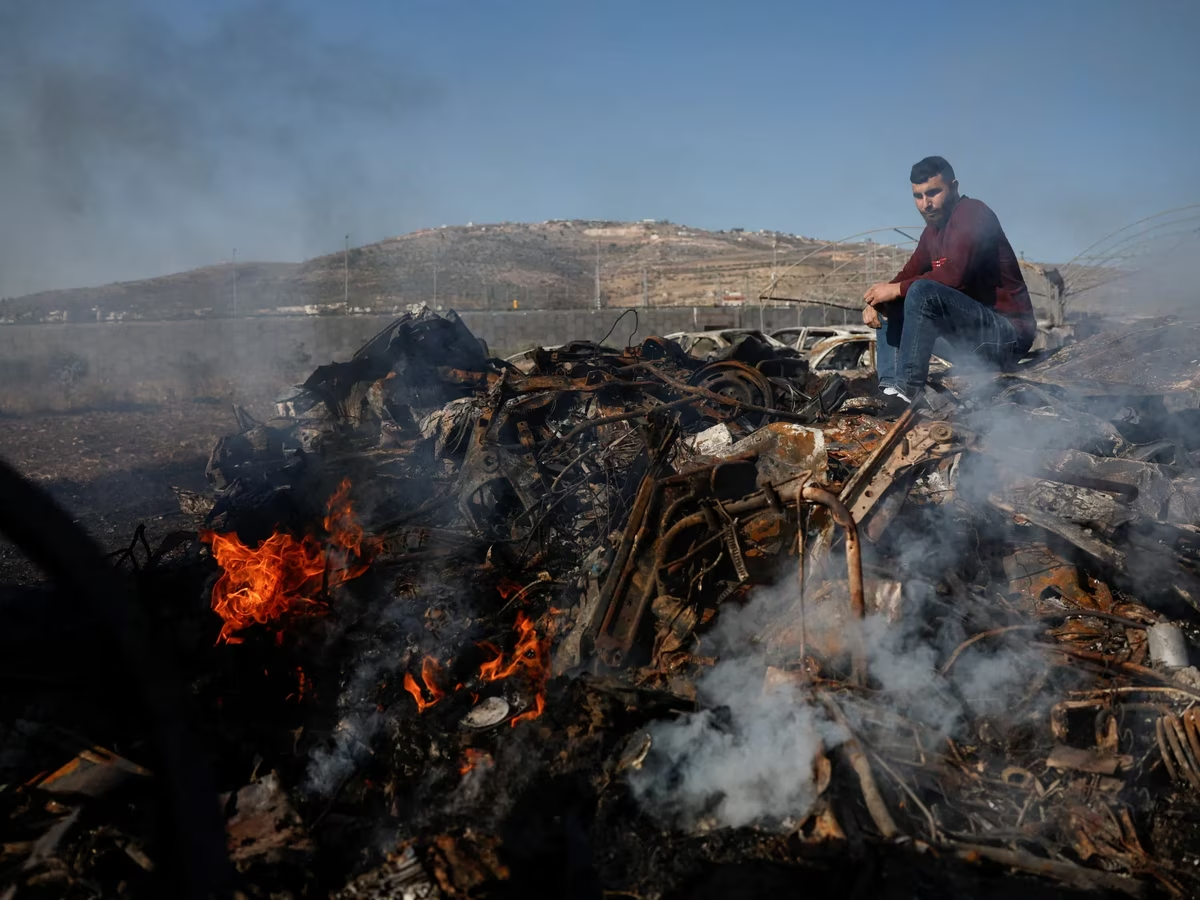







Israel no longer needs to declare the annexation of the occupied West Bank to impose its control over it. Away from official laws and decisions, a new equation is forming on the ground that practically ends the conflict by resolving it militarily, based on the concept of "security sovereignty" as a less costly alternative to direct annexation.
This approach formed the core of the discussion in the "Course of Events" program episode, where it became clear that what is happening in the West Bank is not a temporary escalation, but a strategic path that seeks to fundamentally resolve the conflict by dismantling the conditions for the establishment of a Palestinian state, rather than merely managing the conflict with it.
Since the formation of the far-right government at the end of 2022, field transformations in the West Bank have accelerated, suggesting that Israel is exploiting the regional and international moment to impose facts on the ground that are difficult to reverse, benefiting from the world's preoccupation with the Gaza war and Washington's shifting priorities.
In this context, academic and expert in Israeli affairs Dr. Muhannad Mustafa believes that "resolution" is no longer an ideological slogan, but a multi-stage plan that begins with eliminating any political or geographical basis that would allow for the establishment of an independent Palestinian entity, even before reaching annexation.
According to this perception, security control is no longer merely a precautionary measure, but becomes a complete alternative to "legal sovereignty," where Israel imposes its authority over the land, borders, movement, and resources, without bearing the obligations or international legal consequences of an annexing state.
What distinguishes the current stage, as highlighted in the analysis, is the introduction of a new actor into the control system, represented by armed settler militias operating under the umbrella of the occupation authority, performing a dual function: carrying out the "dirty work" on the ground, and providing deniable cover for the official establishment.
This overlap between the army and settlers, as Mustafa explains, cannot be separated from the concept of security sovereignty, as the militias become part of the tools of governance, not outlaw groups, under systematic political, judicial, and security protection.
Pressuring Paths
In contrast, daily life in the West Bank is read as a direct reflection of this policy, where three pressing paths intersect: violent settlement expansion, escalating economic strangulation, and comprehensive movement restrictions, making the very existence of Palestinians constantly tested.
Dr. Ghassan Al-Khatib, Professor of Political Science at Birzeit University, points out that the goal is not limited to control, but extends to making life "unbearable," gradually pushing Palestinians to consider emigration, in what resembles a slow displacement that does not require official decisions.
However, this path, as Al-Khatib explains, has so far clashed with a remarkable social attachment to the land, especially in rural areas surrounding settlements, where family ties and community solidarity play the role of the last line of defense against settlement encroachment.
But this steadfastness, despite its importance, does not change the fact that Israel acts in the West Bank as a region under its full sovereignty, which makes the discussion about "annexation" closer to a verbal debate, as long as the practices on the ground have surpassed its political meaning.
From this perspective, Al-Khatib believes that judging Israeli behavior is more accurate than merely following statements, as the current pattern of control does not differ much – from what it would be under declared annexation – in essence, but only in form.
Notably, this shift is not happening in isolation from the American stance, where a striking distinction emerges between preventing full annexation through legislation and overlooking gradual annexation practices, which opens the door for Israel to proceed with its strategy without a direct clash with Washington.
The American Stance
Former US State Department official Dr. Thomas Warrick describes this approach as an "absence of a red light" rather than an explicit green light, explaining that the Trump administration focuses on preventing one dramatic step, and ignores the accumulation of small steps.
This approach, as Warrick warns, gives Israel ample space to impose daily realities that do not provoke sharp American reactions, especially given the administration's preoccupation with files such as Gaza, Iran, Syria, and Lebanon, which pushes the West Bank down the list of priorities.
In the Palestinian context, Dr. Bilal Al-Shobaki, head of the Political Science Department at Hebron University, believes that relying solely on the American stance involves a great deal of illusion, especially given a long history of statements not translated into actual pressure.
Al-Shobaki believes that Israel is acting out of a conviction in its ability to resolve the conflict, benefiting from the imbalance of power and American support, which necessitates, for Palestinians, the formulation of a counter-goal that is not based on resolution, but on preventing and thwarting it.
This goal, according to his analysis, cannot be achieved without rebuilding the Palestinian internal position, by ending the division, renewing institutions, and activating the Palestine Liberation Organization, as a representative framework that transcends the limitations of the Palestinian Authority and its administrative function.
In contrast, Israel monitors the Palestinian Authority as an entity capable of being marginalized or terminated, with a preference for maintaining it in a depoliticized form, handling civil affairs without serving as a banner for a competing national project.
This scenario, as Mustafa sees it, is entirely consistent with the logic of "security sovereignty," where the lives of Palestinians are managed without recognizing their right to sovereignty, and the Authority is used as a control tool, not as a political partner.
Security control is no longer merely a precautionary measure, but becomes a complete alternative to "legal sovereignty," where Israel imposes its authority over the land, borders, movement, and resources, without bearing the obligations or international legal consequences of an annexing state.


Share your opinion
Israel Imposes its Security Sovereignty over the West Bank.. A Less Costly Alternative to Direct Annexation